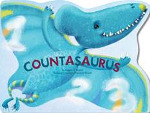
Countasaurus
Grade 1
4 skill lessons
Math
Skill lessons
The mathematics the book carries, taught directly. Printable workbook pages and teacher keys are not available for this book yet.
- 1One Number, One Thing
- 2One More Each Time
- 3Six and Six
- 4Ten Eggs in the Nest
Math + reading
Math through the reading
The same book, entered through a sentence it prints. Change one word in the reading and the numbers change with it.
No math-through-reading lessons for this book yet.
Reading
Reading and language lessons
The same book read as a text. What a word means in its sentence, how a character is shown, how the writing is put together - no mathematics.
- 5Two words that tell how it looks
- 6Words that tell how it moves
Skill lessons
4 lessons on the mathematics the book carries. Printable workbook pages and teacher keys are not available for this book yet.
1. One Number, One Thing
The book hands a counter the two things a count needs and never separates them: a number and the thing being counted. Every line names a body part and says how many of it there are, from one tail up to ten eggs, so a child who builds what the line names has built a set whose size the book already states. Students lay out cubes for the line they hear, touch each one as they say its number word, and stop on the number the book stopped on. That is one-to-one correspondence and the last-number rule: the number you say on the final object is how many there are, and it is the number the text printed.
Full lesson — 20 minutes
1. Build what the line says (6 min)
Listen to the line and lay out one cube for each thing it names: one cube for the tail, two for the wings, three for the horns. Touch each cube as you say its number word, one touch and one word. Stop your count on the last cube and say that number again.
Word preview: count
Doplidocus has one long strong tail.
Pterodactyl swoops and soars on two tough wings.
Triceratops is three huge horns on his head.
2. Carry the count to ten (6 min)
Keep building for the lines that follow, up through the nest at the end. Sweep the cubes back into a pile before each new line so you always start from nothing. Say the last number louder than the rest so your partner hears where you stopped.
There are four fear spikes on a Stegosaurus' tail.
Ichthyosaurus swims through the water with five flippy fins.
If you are quiet and careful, you can count 10 dinosaur eggs in a nest.
3. Say how many without recounting (4 min)
Your partner points at a set you have already built and asks how many. Answer from the number you stopped on, without starting over at one. If you cannot remember it, count it again and this time say the last number twice.
4. Match the pile to the line (4 min)
Your partner builds a set while you look away, then reads you one of the book's lines. Count the pile and say whether it is the pile that line asks for. Say the number you counted and the number the line said.
Segnosaurus stands on eight thick toes.
Short version — 9 minutes
1. Build what the line says (5 min)
Lay out one cube for each thing the line names. Touch each cube as you say its number word, one touch and one word. Stop on the last cube and say that number again.
Word preview: count
Doplidocus has one long strong tail.
Pterodactyl swoops and soars on two tough wings.
2. Say how many without recounting (4 min)
Your partner points at a set you built and asks how many. Answer from the number you stopped on, without starting over at one.
Three levels
- Support
- Stay inside the first five lines, one through five, and keep the cubes in a straight row so no cube is counted twice or skipped. The listening, the touching and the last-number answer are all unchanged; only the size of the sets comes down.
- At Grade
- Build every line from one tail to ten eggs, touching once per number word, and answer how many from the last number said rather than by recounting.
- Extension
- Scatter the cubes instead of rowing them and count the same set twice, starting from a different cube each time. Tell your partner why both counts land on the same number even though you began somewhere else.
English learners
Number words are among the first English a new speaker owns, and the counting act itself needs no English at all: one touch, one word, and a child can be correct from the first cube. The nouns the numbers are attached to are the part a child will not already have, and this book attaches a different one to every number, so preview the body-part words with the picture cards before the count rather than during it. Children may count aloud in their strongest language and say only the final number in English; the touching shows you the one-to-one work whatever language rides on top of it.
Materials
- Counting cubes, twenty per child
- A set of ten picture cards, one per counted line, dinosaur and body part named
- Word cards: count
Standards & curriculum
Choose your curriculum above to see the standards for this lesson.
Standards are held back while this plan is edited. Every standard shown here was matched against the supplied wording of this lesson, quoting its steps, so a changed step is no longer the thing that was checked. Undo your changes to bring the standards back — your edits stay in this browser either way.
2. One More Each Time
The book climbs from one to ten a single number at a time, and each line prints the number it has reached. That gives a class a checked ladder: a child who builds the Pterodactyl's two from the Doplidocus's one has a right answer waiting on the next page. Students build a staircase of cube towers, adding exactly one cube to make each new tower, and read the finished staircase back as the book's own run. The representation is the staircase itself, and what it shows is that the counting numbers are not a list to memorise but a thing you can build, each step one taller than the last.
Full lesson — 20 minutes
1. Start the staircase (5 min)
Build a tower of one for the tail, stand it on the left of your strip, then build the next tower by taking the first and adding exactly one cube. Stand it beside the first. Say the number of the new tower out loud as you stand it up.
Doplidocus has one long strong tail.
Pterodactyl swoops and soars on two tough wings.
2. Climb to ten (6 min)
Keep going the same way, each new tower made by adding one cube to a copy of the tower before it. Do not build any tower from scratch. Stop when your staircase reaches the nest at the end of the book.
If you are quiet and careful, you can count 10 dinosaur eggs in a nest.
3. Read the staircase back (5 min)
Run your finger up the staircase and say every number in order, touching each tower once. Then run it back down and say them backwards. Say which tower you would have to build next and how tall it would be.
4. Find the tower that is wrong (4 min)
Your partner takes one cube off a tower while you look away, or adds one. Find the tower that broke the staircase and say how you knew, using the tower before it and the tower after it. Put it right and say its number.
Short version — 9 minutes
1. Start the staircase (4 min)
Build a tower of one, then make the next by taking the first and adding exactly one cube. Stand it beside the first and say its number aloud.
Doplidocus has one long strong tail.
2. Climb to ten (5 min)
Keep going, each new tower made by adding one cube to a copy of the one before. Build no tower from scratch. Stop at the nest of ten.
If you are quiet and careful, you can count 10 dinosaur eggs in a nest.
Three levels
- Support
- Climb to five and stop there, and keep the towers touching so the one-taller step shows as a single cube sticking up. The adding of exactly one, the standing in order and the reading back are all unchanged; the staircase is just shorter.
- At Grade
- Build the staircase from one to ten by adding exactly one cube each time, read it forwards and backwards touching one tower per number, and say what the next tower would be.
- Extension
- Rebuild your staircase starting from the tower of ten and take one cube away each time instead. Say what stays the same about the staircase and what has changed about the way you built it.
English learners
The phrase one more is the load here, not the numbers. In several languages the same idea is carried by a verb rather than by the words more or add, so a child may follow the action perfectly and still not recognise the English phrase. Fix the phrase to the gesture: say one more every single time a cube goes on, never a synonym, so the words and the hand teach each other. The staircase itself is language-free and a new speaker can be visibly right at every step before saying anything. Children may count the towers in their strongest language and report only the tower they are on in English.
Materials
- Counting cubes, sixty per pair
- A long paper strip, one per pair, laid across the desk
Standards & curriculum
Choose your curriculum above to see the standards for this lesson.
Standards are held back while this plan is edited. Every standard shown here was matched against the supplied wording of this lesson, quoting its steps, so a changed step is no longer the thing that was checked. Undo your changes to bring the standards back — your edits stay in this browser either way.
3. Six and Six
One line in this book names two groups instead of one, and names them the same size: six fingers and six claws on the same animal. It is the only place the text puts two counts together, and it puts them together in a single sentence a child can hear whole. Students build the two groups separately, keep them separate, and then find how many in all by counting on from six rather than starting over. The concept is that two equal groups have a total, that the total is not what either group says, and that a count that carries on from six gets there faster than a count that goes back to one.
Full lesson — 20 minutes
1. Build the two groups (5 min)
Listen to the line and build the two groups it names, six cubes for the fingers and six cubes of another colour for the claws. Keep them apart on the desk, not mixed. Count each group aloud to check that both stopped on six.
Word preview: and
Velociraptor has six skinny fingers and six sharp claws.
2. Count on from six (6 min)
Put your hand flat on the group of six and say six without counting it. Then count the second group on from there, seven, eight, nine, ten, eleven, twelve, touching one cube per word. Say the number you stopped on, and say what it counts.
3. Count them all from one (5 min)
Push the two groups together and count the whole pile from one. Say whether you landed on the same number as before. Tell your partner which of the two counts took longer and why.
4. Say the whole line back (4 min)
Say the line back to your partner with your hands on the cubes, moving from the first group to the second as you reach each six. Then say how many in all. Your partner checks that you touched two groups, not one.
Word preview: and
Velociraptor has six skinny fingers and six sharp claws.
Short version — 9 minutes
1. Build the two groups (4 min)
Build the two groups the line names, six cubes for the fingers and six of another colour for the claws. Keep them apart. Count each aloud to check both stopped on six.
Word preview: and
Velociraptor has six skinny fingers and six sharp claws.
2. Count on from six (5 min)
Hand flat on the first group, say six without counting it, then count the second group on from there to twelve, one touch per word. Say the number you stopped on and what it counts.
Three levels
- Support
- Build both groups but find the total by counting the whole pile from one, and leave the counting on for another day. Both groups, the two colours and the spoken total stay exactly as they are; only the counting-on move comes out.
- At Grade
- Build two groups of six from the line, count on from six to twelve to find how many in all, then check by counting the pushed-together pile from one and say that both counts agree.
- Extension
- Cover the second group with your hand after you have built it and count on without touching, saying the numbers into the air. Then tell your partner how you knew where to stop when you could not see what you were counting.
English learners
The word doing the mathematical work in this line is and, and it is small enough to be swallowed. A child who hears six fingers claws builds one group; a child who hears the and builds two. Say the line slowly with a real pause at and, and let a new speaker build on the pause before any total is asked for. Number and one-to-one matching transfer straight across; the way English strings two counted things into one sentence with a single joining word is what is new, so keep the pause every time the line is read. Children may count on in their strongest language and say the total in English.
Materials
- Counting cubes in two colours, twelve of each per pair
- Word cards: and, count
Standards & curriculum
Choose your curriculum above to see the standards for this lesson.
Standards are held back while this plan is edited. Every standard shown here was matched against the supplied wording of this lesson, quoting its steps, so a changed step is no longer the thing that was checked. Undo your changes to bring the standards back — your edits stay in this browser either way.
4. Ten Eggs in the Nest
The book's run ends on a nest of ten, and it is the only quantity in the text a child of this age is expected to hold as a whole rather than count out one at a time. Students put ten counters in a nest, then split the nest into two smaller nests and say both numbers, hunting for every way ten comes apart. The concept is that ten has parts, that the two parts change while the ten does not, and that saying both parts is what proves you have taken ten apart rather than lost some of it.
Full lesson — 20 minutes
1. Fill the nest (4 min)
Count ten counters into your nest, one at a time, saying each number. Say ten and put your hands round the whole nest so you can feel it as one thing. Your partner counts it back to check you have ten and not nine or eleven.
Word preview: count
If you are quiet and careful, you can count 10 dinosaur eggs in a nest.
2. Split the nest in two (6 min)
Move some of the eggs into the second nest and leave the rest in the first. Count both nests and say both numbers out loud, the first nest and then the second. Say ten last, so the sentence ends where it started.
3. Find another way (6 min)
Sweep the eggs back into one nest and split them a different way. Keep going until you have found a split you have not said before, and say both numbers each time. Your partner writes nothing but listens for a pair already used.
4. Say the pair that is hiding (4 min)
Your partner covers the second nest with a hand. Count the nest you can see, then say how many must be hiding. Uncover it and say whether you were right, and say both numbers together one last time.
Short version — 9 minutes
1. Fill the nest (4 min)
Count ten counters into your nest one at a time, saying each number. Say ten and put your hands round the whole nest. Your partner counts it back to check.
Word preview: count
If you are quiet and careful, you can count 10 dinosaur eggs in a nest.
2. Split the nest in two (5 min)
Move some eggs to the second nest and leave the rest. Count both nests and say both numbers aloud, first nest then second. Say ten last.
Three levels
- Support
- Work with a nest of five instead of ten and split that. The two nests, the saying of both numbers and the hidden-nest guess all stay; only the size of the whole comes down to a number the child can see at a glance.
- At Grade
- Fill a nest with ten, split it into two nests several different ways, say both parts aloud every time, and name the hidden part when one nest is covered.
- Extension
- Split your ten into three nests instead of two and say all three numbers. Then tell your partner whether the ten changed when you used three nests, and how you know.
English learners
This lesson asks for two numbers in one breath, which is a heavier sentence than it looks: many languages order the parts and the whole differently, and a child may say the right numbers in an order that sounds wrong in English and be marked down for arithmetic that is perfectly sound. Fix one spoken frame, this nest and this nest, and ten in all, and keep it identical every round so the shape is learned once. The splitting itself needs no English and a new speaker can be visibly correct before saying a word. Children may work out the hidden part in their strongest language and report the two numbers in English.
Materials
- Counting counters, ten per child
- Two small paper nests or bowls per child
- Word cards: count
Standards & curriculum
Choose your curriculum above to see the standards for this lesson.
Standards are held back while this plan is edited. Every standard shown here was matched against the supplied wording of this lesson, quoting its steps, so a changed step is no longer the thing that was checked. Undo your changes to bring the standards back — your edits stay in this browser either way.
Reading and language lessons
2 lessons on the reading and language the book carries - what a word means in its sentence, how a character is shown, how a text is built. No mathematics: these are matched against the English language arts curricula, which are a different and smaller set than the mathematics ones.
5. Two words that tell how it looks
The book gives every dinosaur the same sentence shape: a number, then one or two describing words, then the thing being described. Students hear that shape in long strong tail, sort tough, skinny and sharp away from wings, fingers and claws onto two cards, replace one describing word with their own, and finish by saying a line of their own built the same way. A describing word sits in front of the naming word and tells how it looks or moves; the numbers stay in the quoted lines and no step asks a child to count them.
Full lesson — 20 minutes
1. Hear the two describing words (5 min)
Listen to the line read aloud twice, then say it back with the teacher. Put a finger up for each describing word you hear in front of the last word: long, then strong. Say the last word, tail, on its own, then say the whole thing again, long strong tail.
Word preview: long, strong
Doplidocus has one long strong tail.
2. Sort the words on two cards (6 min)
Work in pairs with a naming-word card and a describing-word card. Read the line together and lay each word of the last three onto the right card: tough and tough's partner two go on the describing card, wings goes on the naming card. Do the same for the second line, putting skinny and sharp on the describing card and fingers and claws on the naming card. Say aloud where each word went and why.
Word preview: tough, skinny, sharp
Pterodactyl swoops and soars on two tough wings.
Velociraptor has six skinny fingers and six sharp claws.
3. Swap one describing word (5 min)
Read the line with your partner. Keep the naming word fins and take out the describing word flippy, then say the line with a describing word of your own that still tells how the fins look or move. Say both versions out loud, the book's and yours, and tell your partner which one you can picture better and what made the difference.
Word preview: flippy
Ichthyosaurus swims through the water with five flippy fins.
4. Say your own describing line (4 min)
Say one sentence about an animal you choose, built the same way as the line you just read: the animal, then a number, then two describing words, then the naming word. Say it to your partner twice so they can hear both describing words. Your partner names the two describing words back to you.
Word preview: thick
Segnosaurus stands on eight thick toes.
Short version — 9 minutes
1. Hear the two describing words (5 min)
Listen to the line read aloud twice, then say it back. Put a finger up for long and a finger up for strong, then say the naming word tail on its own.
Word preview: long, strong
Doplidocus has one long strong tail.
2. Sort the words on two cards (4 min)
Lay the words from these two lines onto a naming-word card and a describing-word card with your partner. Say aloud which card wings, fingers and claws belong on, and which card tough, skinny and sharp belong on.
Word preview: tough, skinny, sharp
Pterodactyl swoops and soars on two tough wings.
Velociraptor has six skinny fingers and six sharp claws.
Three levels
- Support
- Stay with the first line only and work with one describing word at a time. Say long strong tail after the teacher, then answer just one question: does long tell about the tail or is it the tail? Add strong only once long is secure, and let the child point at each word on the card rather than say it.
- At Grade
- Work both lines in step two, sorting all five words onto the two cards, and say a swap for flippy that keeps the sentence sensible.
- Extension
- After the swap, say what changes in the picture when flippy is replaced, and find the one line in the two you sorted that carries a describing word twice over, once for fingers and once for claws, then say why the poet may have wanted both.
English learners
The pattern of describing word before naming word transfers from English to many languages but not all; in Spanish and Vietnamese the describing word usually follows the noun, so a child may say tail long strong and be following their first language exactly. Do not correct it as a mistake, name it: in English the describing word goes in front. Rehearse the frame aloud, one long strong tail, two tough wings, before step two. Invite the child to say the same describing pair in their strongest language first and then in English, so both orders are heard side by side.
Materials
- Countasaurus, read aloud by the teacher
- Naming-word cards and describing-word cards, one set per pair
- Word cards: long, strong, tough, skinny, sharp, flippy, thick
Standards & curriculum
Choose your curriculum above to see the standards for this lesson.
Standards are held back while this plan is edited. Every standard shown here was matched against the supplied wording of this lesson, quoting its steps, so a changed step is no longer the thing that was checked. Undo your changes to bring the standards back — your edits stay in this browser either way.
6. Words that tell how it moves
Every line in this book carries one word doing the work of movement, and the book chooses a different one each time. Students act swoops and soars apart from each other, mark swims, stands and stomping in three lines, discover that the movement word tells them where the animal is by swapping a water word into a ground line, and finish by supplying a movement word that would suit somebody being quiet and careful. The work is entirely in the verbs; the numbers sit inside the quoted lines and no step asks a child to use them.
Full lesson — 20 minutes
1. Act out the two moving words (5 min)
Listen to the question and the line that answers it. Stand and show swoops with your arm, then show soars, making them look different from each other. Say the two words as you move, then sit and say which one keeps going longer.
Word preview: swoops, soars
Who is flying through the sky?
Pterodactyl swoops and soars on two tough wings.
2. Find the moving word in each line (6 min)
Read each of these three lines with your partner and put one counter on the word that tells how the animal moves: swims in the first, stands in the second, stomping in the third. Say the word aloud, then say whether it is a fast word or a slow word and what in the line made you decide.
Word preview: swims, stands, stomping
Ichthyosaurus swims through the water with five flippy fins.
Segnosaurus stands on eight thick toes.
Look, here comes a herd of nine Maiasaura, stomping through a stream.
3. Match the moving word to the place (5 min)
Look at the two lines together. Say which word tells you the animal is in water and which tells you the animal is on ground you can feel shake. Then swap them out loud, saying the water line with the ground word in it, and tell your partner why it now sounds wrong.
Ichthyosaurus swims through the water with five flippy fins.
Look, here comes a herd of nine Maiasaura, stomping through a stream.
4. Say a quiet moving word (4 min)
Read the last line. Say the two words that tell how you must be, quiet and careful, then say a moving word that would fit somebody being quiet and careful near a nest. Say the whole line again with your moving word added at the end, and say it in a voice that matches the word.
Word preview: quiet, careful
If you are quiet and careful, you can count 10 dinosaur eggs in a nest.
Short version — 9 minutes
1. Act out the two moving words (4 min)
Listen to the question and the line that answers it. Show swoops with your arm, then show soars so the two look different, and say each word as you move.
Word preview: swoops, soars
Who is flying through the sky?
Pterodactyl swoops and soars on two tough wings.
2. Find the moving word in each line (5 min)
Put a counter on the word that tells how the animal moves in each of these three lines, then say each word aloud and say whether it is fast or slow.
Word preview: swims, stands, stomping, quiet, careful
Ichthyosaurus swims through the water with five flippy fins.
Segnosaurus stands on eight thick toes.
Look, here comes a herd of nine Maiasaura, stomping through a stream.
Three levels
- Support
- Take one line at a time from the three and mark only the moving word, without the fast-or-slow question. Say the word while making the movement, so the body carries the meaning before the mouth has to. Two of the three lines is enough.
- At Grade
- Mark the moving word in all three lines and say fast or slow for each, naming what in the line decided it.
- Extension
- After marking all three, say which of the three moving words could be swapped for another without changing where the animal is, and which one could not, using the words in the lines to say why.
English learners
Movement verbs are among the hardest words to carry between languages because the fine distinctions differ: many languages have one word covering both swoops and soars. Let the child show the difference with an arm before naming it, and accept the gesture as the answer. Rehearse the frame it swims, it stands, it stomps before step two. Invite the child to name the movement in their strongest language and then say the English word beside it.
Materials
- Open floor space for two movements
- Two counters per pair to mark words
- Countasaurus, read aloud by the teacher
- Word cards: swoops, soars, swims, stands, stomping, quiet, careful
Standards & curriculum
Choose your curriculum above to see the standards for this lesson.
Standards are held back while this plan is edited. Every standard shown here was matched against the supplied wording of this lesson, quoting its steps, so a changed step is no longer the thing that was checked. Undo your changes to bring the standards back — your edits stay in this browser either way.