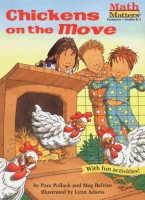
Chickens on the Move
Grade 3
4 skill lessons
Math
Skill lessons
The mathematics the book carries, taught directly. Printable workbook pages and teacher keys are not available for this book yet.
- 1One Side, One Number
- 2Is Gordon Right?
- 3Same Fence, Four Coops
- 4A Coop the Book Never Built
Math + reading
Math through the reading
The same book, entered through a sentence it prints. Change one word in the reading and the numbers change with it.
No math-through-reading lessons for this book yet.
Reading
Reading and language lessons
The same book read as a text. What a word means in its sentence, how a character is shown, how the writing is put together - no mathematics.
No reading and language lessons for this book yet.
Skill lessons
4 lessons on the mathematics the book carries. Printable workbook pages and teacher keys are not available for this book yet.
1. One Side, One Number
The book gives the rule twice at the back. The distance around a figure is called its perimeter, and you add the lengths of its sides to find it. The story then acts the rule out four times with one roll of fence carried around four different coops. What it never shows is the going around. Here the trip is the thing children do: a finger walks a taped coop outline from one corner back to the same corner, each side is touched once and said aloud before any number is written, and then the same trip is walked again on a coop built from a chain of twenty-four paper links. A perimeter is one closed trip with every side touched once, so the figure decides how many numbers get added and the child does not.
Full lesson — 20 minutes
1. Walk the fence around one coop (6 min)
Stand at one corner of the taped coop on the floor and put your finger on the tape. Walk your finger all the way round the outline and stop only when you are back at the corner you started from. Say the length of each side out loud as you pass it, one side one number, while your partner taps the floor once for every side you name. If you get back to the start having said three numbers for a four-sided coop, walk it again.
Word preview: around, perimeter
That's like a yard with a fence around it.
The distance around a figure is called its perimeter.
2. Say the four numbers, then write them down (5 min)
Write the coop's four side lengths on your record strip in the order your finger passed them. Read the strip aloud as an adding sentence the way the book does, nine plus three plus nine plus three, and then say what it equals. Count what you wrote: exactly four numbers, because the coop has exactly four sides.
Word preview: sides, plus
It was 9 feet long and 3 feet wide.
9 plus 3 plus 9 plus 3 equals 24 feet.
3. Lay the same fence a new way and walk it again (5 min)
Lay the chain of twenty-four links on the grid as a coop six squares on every side. Walk your finger round it, say each side aloud as you pass it, and write the numbers in a new row of boxes. Count how many numbers you wrote this time and say what told you it would be four again before you counted.
Word preview: square, each
At the top of the hill, they made a square coop that was six feet on each side.
Six plus six plus six plus six equals 24 feet.
4. Say the rule so someone else could follow it (4 min)
Tell your partner what you did both times, using the words around and every side. Then say the rule as an instruction another pair could carry out with a chain and a grid, with nothing missing from it. Finish by saying which part of your rule is what stops you counting one side twice.
Word preview: figure, lengths
You can add the lengths of the sides of a figure to find its perimeter.
Short version — 9 minutes
1. Walk the fence around one coop (5 min)
Put your finger on one corner of the taped coop and walk it all the way round until you are back at that same corner. Say each side's length out loud as you pass it, one side one number. Your partner taps once for every side you name.
Word preview: around, perimeter
That's like a yard with a fence around it.
The distance around a figure is called its perimeter.
2. Say the four numbers, then write them down (4 min)
Write the four side lengths on your strip in the order you passed them. Read it aloud as an adding sentence, nine plus three plus nine plus three, and say what it equals.
Word preview: sides, plus
It was 9 feet long and 3 feet wide.
9 plus 3 plus 9 plus 3 equals 24 feet.
Three levels
- Support
- Stay with the taped coop on the floor and walk it with the yarn instead of a finger, laying the yarn along each side and pinching it at the corner so one side cannot blur into the next. Say the number as you pinch. Write the four numbers with your partner reading them back off the floor cards. The walking and the saying are what everybody else does; only the grid coop waits.
- At Grade
- Walk both coops, the taped one and the chain one, saying every side aloud on each trip, and write four numbers and a total for each on the strip. Close by saying the rule out loud with the words around and every side in it.
- Extension
- Lay the twenty-four links as a coop with three sides instead of four and walk it. Say how many numbers you will write before you write any, then write them and say what told you the count. Then say what would have to be true of a coop for you to write five numbers, and make one.
English learners
The trip round the figure is visible and will not be the hard part. The English is where the load sits. Around carries a whole phrase on its own here and takes nothing after it, the distance around a figure rather than the distance around of a figure. Each side puts each in front of the noun and means every one of them separately, which a good many languages mark on the verb instead, so a child can have the trip right and the sentence backward. Rehearse one frame aloud with a finger on the tape before any writing: this side is ___ feet, and there are ___ sides. Let children say the side lengths in their strongest language on the first trip and in English on the second. Sides means the edges of a figure throughout this book and never the side of a room or of a person, and it is worth saying so while pointing at one.
Materials
- A coop outline 9 feet by 3 feet taped on the floor, with a numeral card laid at each of the four sides
- A length of yarn per pair, long enough to lay along the longest side
- A record strip per pair, ruled with four boxes and a total box
- A closed chain of twenty-four paper links per pair, each link one grid square long
- A sheet of one-inch grid paper per pair
- Word cards: perimeter, around, sides, plus
Standards & curriculum
These lessons are being matched against curricula now.
Standards are held back while this plan is edited. Every standard shown here was matched against the supplied wording of this lesson, quoting its steps, so a changed step is no longer the thing that was checked. Undo your changes to bring the standards back — your edits stay in this browser either way.
2. Is Gordon Right?
The chart at the back prints six figures as bare rows of side lengths, one claim about all six, that Gordon says each of them has a perimeter of twenty-four feet, and then two questions: is he right, and how do you know. Four of the six are the story's coops, but the chart puts them in a different order and adds two figures the story never builds, so remembering the book answers nothing. Children add each row, write the adding sentence in the book's own words, and give Gordon a yes or a no with the sentence as the reason. The rows run three, four and five numbers long, so the same claim has to be settled with a different count of numbers each time, and every row crosses ten on the way to twenty-four.
Full lesson — 20 minutes
1. Read each row and count its sides first (5 min)
Take the six figure cards. Read the numbers on the first card aloud and say how many sides that figure has before you add anything, then write only that count under the card. Do the same for all six. Two of these figures are never built in the story, so you will not find their answers by remembering it.
Word preview: figure, sides
Number one eight four eight four number two six six six six number three eight eight eight number four nine three nine three number five seven five seven five number six eight two five five four
2. Add every row and write the sentence (6 min)
Add the numbers on each card and write the whole adding sentence on your answer sheet the way the book writes it, with the word plus between the numbers and the word equals before the total. Say each total out loud as you finish it. Do all six rows, the five-number one included.
Word preview: plus, equals
You can add the lengths of the sides of a figure to find its perimeter.
8 plus 4 plus 8 plus 4 equals 24 feet.
3. Answer Gordon (5 min)
Read Gordon's claim off the display. Take the figures one at a time, say yes or no out loud, and then say the adding sentence that settles it while pointing at the total you wrote. If another pair disagrees with you about a figure, add that row again together, one number at a time, before either of you changes an answer.
Word preview: right, perimeter
Gordon says the perimeter of each figure is 24 feet.
Is he right? How do you know?
4. Add the five-number row a second way (4 min)
Go back to the row with five numbers in it, eight, two, five, five and four. Add it in a different order from the one you used first, saying the new order aloud as you go. Say whether the total changed, and say which two numbers you put together to reach ten fastest.
Word preview: order, total
number five seven five seven five number six eight two five five four
Short version — 9 minutes
1. Add every row and write the sentence (5 min)
Add the numbers on each card and write the adding sentence on your sheet with plus between the numbers and equals before the total. Say each total out loud as you finish it.
Word preview: plus, equals
You can add the lengths of the sides of a figure to find its perimeter.
8 plus 4 plus 8 plus 4 equals 24 feet.
2. Answer Gordon (4 min)
Read Gordon's claim. For each figure say yes or no out loud, then say the adding sentence that settles it while pointing at your total.
Word preview: right, perimeter
Gordon says the perimeter of each figure is 24 feet.
Is he right? How do you know?
Three levels
- Support
- Work with three cards instead of six, the four-number rows only, and add with the outline on the card: put a counter on each side, then slide counters together in tens and count on. Say the total aloud and write it in the total box while your partner reads the adding sentence for you. The yes or no you give Gordon is the same answer everybody else gives.
- At Grade
- Add all six rows, write the full adding sentence for each, and answer Gordon figure by figure with the sentence as the reason. Include the five-number row and add it again in a second order.
- Extension
- Make a seventh card. Choose side lengths of your own that add to twenty-four feet, draw the figure on grid squares so its sides really are those lengths, and hand the card to another pair with the total left off. Then say what you had to keep true while you were choosing, and say whether a figure with only two sides could have done it, and why.
English learners
The adding is visible on the cards and the numbers themselves are no obstacle. The English to rehearse is the sentence form the book uses, because this book says its operator instead of printing it: there is no plus sign anywhere in it, and every total arrives as number plus number plus number equals total, with plus between every pair and equals once, at the end. Children who learned the symbols first need to hear that order said aloud before they write it. Two more things worth saying plainly. An English yes or no comes before its reason and not after it, so give the frame and rehearse it: Gordon is right, because eight plus four plus eight plus four equals twenty-four. And right here means correct rather than the direction, one word in English for two in most languages, which is worth clearing up before anybody answers.
Materials
- Six figure cards per pair, one per chart row, each carrying that row's side lengths in order and that figure's outline drawn on grid squares
- An answer sheet per pair, ruled with six lines headed figure, adding sentence and total
- Word cards: figure, perimeter, plus, equals, total
Standards & curriculum
These lessons are being matched against curricula now.
Standards are held back while this plan is edited. Every standard shown here was matched against the supplied wording of this lesson, quoting its steps, so a changed step is no longer the thing that was checked. Undo your changes to bring the standards back — your edits stay in this browser either way.
3. Same Fence, Four Coops
One roll of fence is carried to four places in this book and laid out a different way in each of them, and the book prints the total after every laying: twenty-four feet, four times over. The four adding sentences that reach it hold different numbers, and one of them holds only three. Children build all four coops from a single chain of twenty-four links and then have to say, out loud and with a number in every sentence, what changed and what did not. A total says nothing about a shape. Two coops can spend the same fence and still not be the same coop, and the list of sides is the only thing that tells them apart.
Full lesson — 20 minutes
1. Build the first coop, then the second, with the same chain (5 min)
Lay the chain of twenty-four links on the grid as a coop nine squares by three. Count the links along each side and say the four numbers aloud. Now, without adding or taking away a single link, lay the same chain as a coop eight by four. Say the four numbers again, then say how many links you used both times.
Word preview: wider, links
It was 9 feet long and 3 feet wide.
This time, they made the chicken coop a little wider.
2. Say what changed and what stayed (6 min)
Tell your partner what changed between the two coops and what stayed the same, and put a number in every sentence you say. Say which side got longer and by how much, and which side got shorter and by how much. Then say why the chain never got longer, even though one of its sides did.
Word preview: changed, same
9 plus 3 plus 9 plus 3 equals 24 feet.
8 plus 4 plus 8 plus 4 equals 24 feet.
3. Build the square and the three-sided coop (5 min)
Lay the same chain as a square, six squares on every side. Then lay it as a coop with three sides of eight, which will not follow the grid lines, so count links along each side instead of squares. Write the adding sentence for each in a row of your record sheet, then say out loud how many numbers you added the last time and why it was not four.
Word preview: square, three
Six plus six plus six plus six equals 24 feet.
8 plus 8 plus 8 equals 24 feet.
4. Say what twenty-four feet does not tell Grandpa (4 min)
Grandpa is told the coop is twenty-four feet round and nothing else. Say aloud the two things he still cannot know, then say what you would have to tell him so he could build the right coop. Use the numbers off your record sheet in what you say.
Word preview: shape, total
That's the skinniest chicken coop I've ever seen, said Grandpa.
Short version — 9 minutes
1. Build the first coop, then the second, with the same chain (5 min)
Lay the chain as a coop nine squares by three and say the four numbers. Then lay the same chain, with no links added or taken away, as a coop eight by four and say those four.
Word preview: wider, links
It was 9 feet long and 3 feet wide.
This time, they made the chicken coop a little wider.
2. Build the square and the three-sided coop (4 min)
Lay the same chain as a square six on every side, then as a coop with three sides of eight, counting links rather than squares once the sides leave the grid lines. Say how many numbers you added the last time and why it was not four.
Word preview: square, three
Six plus six plus six plus six equals 24 feet.
8 plus 8 plus 8 equals 24 feet.
Three levels
- Support
- Build only the first two coops, nine by three and eight by four, with the chain already closed into a loop so no link can go missing. Count the links along each side out loud with your partner, then say one sentence about what changed with a number in it. The two coops and the count of twenty-four links are the same as everybody else's.
- At Grade
- Build all four coops from the one chain, write the adding sentence for each, and say what changed and what stayed the same with a number in every sentence. Close by naming what a total of twenty-four feet cannot tell anyone.
- Extension
- Lay the twenty-four links as a coop with three sides that are not all eight. Write its adding sentence, then say why the three sides had to change together and what stopped you choosing the third one freely. Then say whether this chain could make a coop with three sides of six, and what you would have to do to the chain first.
English learners
The building carries the meaning here and needs no English at all. The sentences do. English reports a change with a comparative and puts the amount in front of it, one foot wider and one foot shorter, where a good many languages put the amount after; and it marks the thing that did not change with stayed the same, a three-word phrase children rarely meet as a unit. Rehearse both aloud with the chain in view before any arguing: this side is one foot wider, and the chain stayed the same. Let children say the pair of numbers in their strongest language while pointing at the two sides, then say the sentence in English. Same is doing exact and repeated work in this lesson and belongs on a card: the chain is the same chain, the total is the same number, and the coops are not the same coop.
Materials
- A closed chain of twenty-four paper links per pair, each link one grid square long
- A sheet of one-inch grid paper per pair
- A record sheet per pair, ruled with four rows headed coop, sides and total
- Word cards: same, changed, wider, shape
Standards & curriculum
These lessons are being matched against curricula now.
Standards are held back while this plan is edited. Every standard shown here was matched against the supplied wording of this lesson, quoting its steps, so a changed step is no longer the thing that was checked. Undo your changes to bring the standards back — your edits stay in this browser either way.
4. A Coop the Book Never Built
The chart at the back holds six figures and only four of them are in the story. The fifth is a rectangle seven by five and the sixth has five sides, and neither is drawn, named or built anywhere in the book. Children make both from the rows of numbers alone, the rectangle on grid paper and the five-sided one with a chain of twenty-four links, because a figure with five sides cannot have every side lying along a grid line, and discovering that is part of the job. They label every side and write the adding sentence underneath, then invent a coop of their own worth twenty-four feet and hand it to another pair as a bare row of numbers, the way the chart hands over its six. Going from a row of numbers to a closed outline and back again is the work, and the count of numbers in the row has to match the count of sides every time.
Full lesson — 20 minutes
1. Draw figure five from its row of numbers (4 min)
Read the fifth row of the chart, seven five seven five. Draw that figure on the grid, one square to a foot, and write each side's number along the side itself. Then count the sides you drew and count the numbers in the row, and say both counts aloud.
Word preview: row, label
number five seven five seven five number six eight two five five four
2. Lay out the one with five sides (6 min)
The sixth row has five numbers in it, eight two five five four. Try it on the grid and you will find it will not go, because a figure with five sides cannot have every side lying along a grid line. Lay it with the chain on plain paper instead: count eight links, then two, then five, then five, then four, bending the chain at each corner until the last side lands back where you started. Mark each corner with a dot, trace along the chain, and write each number along its side.
Word preview: closed, corner
Does a coop have to have four sides?" asked Gordon.
Then why don't we make it with three sides, Gordon said?
3. Write the row and the adding sentence under each figure (6 min)
Under each of your two figures write the row of side lengths, then the adding sentence, then check the total is twenty-four. Point at each side of the figure as you read its number off the row, so no side is left out and none gets read twice.
Word preview: adding, total
You can add the lengths of the sides of a figure to find its perimeter.
Gordon says the perimeter of each figure is 24 feet.
4. Make a row for another pair to build (4 min)
Invent a coop of your own that spends all twenty-four feet. Draw it on the grid if its sides will follow the lines and lay it with the chain if they will not, then write only its row of numbers on a card. Swap cards with another pair and make each other's coop from the row alone. Say whether the coop you made is the same shape as theirs, and how you can tell when both rows come to twenty-four.
Word preview: swap, same
Short version — 9 minutes
1. Lay out the one with five sides (5 min)
The sixth row has five numbers, eight two five five four. It will not go on the grid lines, so lay it with the chain on plain paper: count eight links, then two, then five, five and four, bending at each corner until the last side lands back where you started. Trace it and write each number along its side.
Word preview: closed, corner
Does a coop have to have four sides?" asked Gordon.
Then why don't we make it with three sides, Gordon said?
2. Make a row for another pair to build (4 min)
Invent a coop that spends all twenty-four feet, make it on the grid or with the chain, and write only its row of numbers on a card. Swap with another pair and make each other's coop from the row alone.
Word preview: swap, same
Three levels
- Support
- Draw figure five only, seven five seven five, on grid paper that already carries the first two sides and has the corners dotted in. Draw the other two sides, write all four numbers along the sides while pointing at each one, and then complete the adding sentence with the four numbers already printed and only the total left blank.
- At Grade
- Make both of the chart's unbuilt figures from their rows, the rectangle on the grid and the five-sided one with the chain, label every side, write each row and its adding sentence, and check both totals reach twenty-four. Then make a row of your own for another pair to build.
- Extension
- Make two different figures that both spend all twenty-four feet and that share no side length at all, using the grid where the sides will follow it and the chain where they will not. Write both rows and both adding sentences, then say what a row of numbers does tell you about a figure and what it does not, using your two figures as the evidence for both halves.
English learners
Making a figure from a row of numbers is a visual task and children can begin it before they have the English for it. What needs rehearsing are the three words that hold a figure together: side, corner and closed. English says a closed figure, and it says the sides meet at a corner, and both of those are single words here where many languages use a phrase, so hearing them said while a finger traces an outline does more than hearing them defined. Rehearse one frame aloud before building: this figure has ___ sides, and this side is ___ feet. Let children count the grid squares or the links in their strongest language, then read the row in English as they label. Row also wants saying plainly, because it means one line of the chart here and not a line of chairs.
Materials
- A sheet of one-inch grid paper per pair
- A pencil and a straight edge per pair
- A closed chain of twenty-four paper links per pair, each link one grid square long
- A sheet of plain paper per pair
- A record sheet per pair with two blank frames, each headed drawing, row of sides and adding sentence
- A blank card per pair
- Word cards: side, corner, closed figure, row
Standards & curriculum
These lessons are being matched against curricula now.
Standards are held back while this plan is edited. Every standard shown here was matched against the supplied wording of this lesson, quoting its steps, so a changed step is no longer the thing that was checked. Undo your changes to bring the standards back — your edits stay in this browser either way.