Deena's Lucky Penny
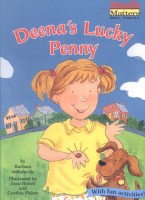
Grade 2
4 skill lessons
Math
Skill lessons
The mathematics the book carries, taught directly. Printable workbook pages and teacher keys are not available for this book yet.
- 1The Trade That Changes Nothing
- 2Count Dina's Money at Every Stop
- 3Two Ways to Make the Same Amount
- 4Smaller Coin, Bigger Value
Math + reading
Math through the reading
The same book, entered through a sentence it prints. Change one word in the reading and the numbers change with it.
No math-through-reading lessons for this book yet.
Reading
Reading and language lessons
The same book read as a text. What a word means in its sentence, how a character is shown, how the writing is put together - no mathematics.
No reading and language lessons for this book yet.
Skill lessons
4 lessons on the mathematics the book carries. Printable workbook pages and teacher keys are not available for this book yet.
1. The Trade That Changes Nothing
The book prints the value of each coin in its own chart and then trades four times, and every trade leaves Dina holding exactly what she held before. Students build each coin out of pennies, run the book's three coin-for-coin trades across a tray, and count both sides before the coins change hands. Knowing a nickel is five cents is not the same as knowing that handing over five pennies for it costs nothing, and this lesson is about the second thing: that a pile can change completely while the amount stays still.
Full lesson — 20 minutes
1. Build each coin out of pennies (5 min)
Lay a row of pennies under each coin card until the row matches the number the chart gives that coin: one penny under the penny, five under the nickel, ten under the dime, twenty-five under the quarter. Count each row aloud as you build it. Leave all four rows out; you will need them.
Word preview: penny, nickel, dime, quarter
Penny. One cent.
Nickel. Five cents.
Dime. Ten cents.
Quarter. Twenty-five cents.
2. Make Dina's first trade (5 min)
One partner takes five pennies, the other takes the nickel. Before anything moves, count the five pennies aloud and count the nickel's row of five. Push them across the tray at the same moment. Then say how many cents each of you is holding now.
Word preview: trade, traded
1 cent plus 1 cent plus 1 cent plus 1 cent plus 1 cent equals 5 cents.
She traded Mrs. Green the five pennies for a nickel.
3. Run Dina's two later trades (6 min)
Trade two nickels for one dime, then trade two dimes and one nickel for one quarter. Each time, count the pennies under both sides first and only push the coins across when the two counts land on the same number. Say the number out loud before you let go.
Word preview: nickel, dime, quarter
5 cents plus 5 cents equals 10 cents said Dina.
They traded coins.
10 cents plus 10 cents plus 5 cents equals 25 cents.
4. Say what the trade did to the money (4 min)
Point at your tray and say the two things that are true: the coins are different now, and the amount is not. Use the words the book gives Dina and put your own number in them.
Word preview: the same as, worth
That's the same as a nickel.
Short version — 9 minutes
1. Build each coin out of pennies (4 min)
Lay a row of pennies under each coin card until the row matches the number the chart gives that coin. Count each row aloud as you build it and leave all four rows out.
Word preview: penny, nickel, dime, quarter
Penny. One cent.
Nickel. Five cents.
Dime. Ten cents.
Quarter. Twenty-five cents.
2. Make Dina's first trade (5 min)
One partner takes five pennies, the other the nickel. Count both sides aloud, push them across the tray together, then say how many cents you hold now.
Word preview: trade, traded
1 cent plus 1 cent plus 1 cent plus 1 cent plus 1 cent equals 5 cents.
She traded Mrs. Green the five pennies for a nickel.
Three levels
- Support
- Stay with pennies and nickels and with the first trade only. Keep the row of five pennies lying beside the nickel the whole time, so the match is in front of you and nothing has to be held in mind. Trade, then trade back, and count five both times.
- At Grade
- Run all three trades in book order with the penny rows built first, and count both sides before each exchange. Say the amount you hold after every trade without rebuilding the rows.
- Extension
- Take the quarter trade and find a second set of coins worth the same twenty-five cents that uses no dime. Prove it against the penny rows, then say what had to stay true of any set you were allowed to build.
English learners
A coin name carries none of its value: a child who counts fluently in Spanish or Arabic still has no word for nickel, and nickel does not sound like five. Write the number on the coin card beside the name so the value travels with the word. The sentence to rehearse while the pennies are still on the tray is "Five pennies is the same as one nickel." Partners who share a language should agree on the coin names in it, count the trade in that language, and then say the English sentence with a hand on each pile.
Materials
- Penny counters, at least forty for each pair
- Coin cards for a nickel, a dime and a quarter
- A shallow tray the two partners push coins across
- Word cards: trade, the same as, worth
Standards & curriculum
These lessons are being matched against curricula now.
Standards are held back while this plan is edited. Every standard shown here was matched against the supplied wording of this lesson, quoting its steps, so a changed step is no longer the thing that was checked. Undo your changes to bring the standards back — your edits stay in this browser either way.
2. Count Dina's Money at Every Stop
Four people hand Dina a coin and the book asks how much she has after each one, printing the answer every time. Students set out the collection at each stop, count it in cents, and check their count against the number the book prints. The counting is the whole task: a pile of two dimes and a nickel has to be counted in tens and then in fives, and a child who starts on the nickel gets a different number than a child who starts on the dimes.
Full lesson — 20 minutes
1. Set out the coins after each gift (5 min)
Build four piles on the strip, one for each stop in the story: one penny and four pennies; then two nickels; then two dimes; then two dimes and a nickel. Do not count yet. Put the largest coins at the left of each pile.
Word preview: pile, gift
I'll give you four more pennies to go with your penny.
I'll give you another nickel to go with that one.
I'd better give you another one.
Here's a nickel to go with your two dimes.
2. Count each pile aloud in cents (6 min)
Count each pile from the largest coin to the smallest, touching one coin per number word: tens for the dimes, then fives for the nickels, then ones for the pennies. Say the last number twice so your partner hears where you stopped. Write that number on a card and lay it under the pile.
Word preview: cents, count on
One, two, three, four, five cents said Dina.
Now I have 10 cents plus 10 cents. That equals 20 cents.
3. Check your count against the book's (5 min)
Listen while the two sentences are read out, and hold up the card that carries the same number. If your card and the book disagree, count that pile again in front of your partner and say which coin you counted twice.
Word preview: how much, check
20 cents plus 5 cents equals 25 cents said Dina, that's the same as a quarter.
Thanks, Grandpa, Dena said, 25 cents plus 25 cents equals 50 cents that's half of a dollar.
4. Count the four quarters to one hundred (4 min)
Lay four quarters in a line and count them by twenty-fives, touching one quarter per number word. Say the last number, then say the other name the book gives that amount.
Word preview: quarter, one hundred
25 cents plus 25 cents plus 25 cents plus 25 cents equals one dollar
Short version — 9 minutes
1. Count each pile aloud in cents (5 min)
Set out two dimes and a nickel, count them from the largest coin down with one touch per number word, and write the number you land on.
Word preview: cents, count on
One, two, three, four, five cents said Dina.
Now I have 10 cents plus 10 cents. That equals 20 cents.
2. Check your count against the book's (4 min)
Hold up your card when the sentence read aloud carries the same number, and count again in front of your partner if it does not.
Word preview: how much, check
20 cents plus 5 cents equals 25 cents said Dina, that's the same as a quarter.
Thanks, Grandpa, Dena said, 25 cents plus 25 cents equals 50 cents that's half of a dollar.
Three levels
- Support
- Count only the two piles built from one kind of coin: the five pennies by ones and the two nickels by fives. Keep the coins in a straight line and touch each one as you say its number. Add the mixed pile only once both single-coin counts land right twice running.
- At Grade
- Count all four piles, largest coin first, and write each amount on a card before the book's sentences are read. Fix any pile the book disagrees with by recounting it aloud.
- Extension
- Take the two dimes and a nickel and count the same pile starting from the nickel instead. Say what number you land on, whether it changed, and why the order of counting is free here when the order of trading was not.
English learners
"How much money do you have?" wants one number, but the English answer runs number then unit, twenty-five cents, and that order is reversed in several children's first languages. It is the commonest place a correct count comes out wrong. Rehearse "I have ___ cents" after the counting is finished, so the child is only dropping a known number into a known slot. Invite the count itself in the child's strongest language and keep only the last sentence in English.
Materials
- Real or plastic coins: pennies, nickels, dimes and quarters
- A paper strip long enough to lay eight coins in a line
- Blank cards for writing an amount in cents
- Word cards: cents, how much money, count on
Standards & curriculum
These lessons are being matched against curricula now.
Standards are held back while this plan is edited. Every standard shown here was matched against the supplied wording of this lesson, quoting its steps, so a changed step is no longer the thing that was checked. Undo your changes to bring the standards back — your edits stay in this browser either way.
3. Two Ways to Make the Same Amount
The book's closing chart gives six amounts and two different coin sets for each, then asks the reader for more. Students build both of the chart's sets side by side, count each to prove they land on the same number, and then build a third set the chart does not give. One amount with two unlike piles under it is the point: the number is a property of the money, not of the coins it happens to be made of.
Full lesson — 20 minutes
1. Read the amount, then build the first way (5 min)
Write the amount on a card and set it at the top of the strip. Build the first set of coins the chart names for it and lay that set under the card. Count it aloud and check you land on the number you wrote.
Word preview: amount, way
Here are two ways to make each amount. Can you think of other ways?
Five cents. One nickel. Five pennies.
2. Build the second way beside it (5 min)
Build the second set of coins for the same amount and lay it in a row directly under the first, so the two rows can be seen at once. Do not clear the first row away. Do this for ten cents and for twenty cents.
Word preview: another way, beside
Ten cents. Two nickels. One nickel. Five pennies.
Twenty cents. Two dimes. One dime. Two nickels.
3. Count both ways and show they match (6 min)
Count the top row aloud, then the bottom row, and say the two numbers one after the other. Point at the card and say the sentence that makes them one amount. Then do twenty-five cents and fifty cents the same way, and say which of the two rows used fewer coins.
Word preview: the same as, match
Twenty-five cents. Two dimes. One nickel. Five nickels.
Fifty cents. Two quarters. Five dimes.
4. Answer the chart's question with a third way (4 min)
Take one hundred cents. Build the two rows the chart gives, then build a third row of your own that also counts to one hundred and uses at least two kinds of coin. Count it in front of your partner and let them stop you if the count misses.
Word preview: one hundred, other ways
One hundred cents. Four quarters. Eight dimes. Four nickels.
Short version — 9 minutes
1. Read the amount, then build the first way (4 min)
Write the amount on a card, build the first set of coins the chart names for it, and count that set aloud to check you land on your number.
Word preview: amount, way
Here are two ways to make each amount. Can you think of other ways?
Five cents. One nickel. Five pennies.
2. Count both ways and show they match (5 min)
Build the chart's second set for the same amount in a row under the first, count the top row aloud and then the bottom row, say both numbers, and say the sentence that makes the two rows one amount.
Word preview: the same as, match
Twenty-five cents. Two dimes. One nickel. Five nickels.
Fifty cents. Two quarters. Five dimes.
Three levels
- Support
- Work with five cents and ten cents only, and build both rows with the coins already sorted into cups by kind. Keep both rows on the strip at once and count them one after the other, out loud, before saying anything about them.
- At Grade
- Build both of the chart's rows for five, ten, twenty, twenty-five and fifty cents, count each row, and say the sentence that makes the pair one amount. Finish with a third row of your own for one hundred cents.
- Extension
- Choose twenty-five cents and find every set that makes it out of quarters, dimes, nickels and pennies with no more than six coins. Lay the sets in order of how many coins each uses, and say what stops the list from going on for ever.
English learners
"Way" is doing unfamiliar work here: it names a set of coins, not a road or a manner, and a child who hears it as route loses the chart entirely. Put two trays down and say "This is one way. This is another way." before any counting starts. The sentence to rehearse is "Two dimes and one nickel is one way to make twenty-five cents." Partners building together may argue about which coins to use in whichever language is quickest; the English sentence comes at the end, with both rows still on the strip.
Materials
- Real or plastic coins: pennies, nickels, dimes and quarters
- A paper strip long enough to lay eight coins in a line
- Blank cards for writing an amount in cents
- Word cards: way, amount, the same as
Standards & curriculum
These lessons are being matched against curricula now.
Standards are held back while this plan is edited. Every standard shown here was matched against the supplied wording of this lesson, quoting its steps, so a changed step is no longer the thing that was checked. Undo your changes to bring the standards back — your edits stay in this browser either way.
4. Smaller Coin, Bigger Value
Dina notices that the dime she just traded for is smaller than the nickel she gave up and worth more all the same, and her brother supplies the multiplier. Students lay the four coins in order of how big they are, lay the same four in order of what they are worth, and find the one place the two lines disagree. The disagreement is the reasoning: a child who sorts money by size gets the nickel and dime the wrong way round every time, and the only way to settle it is to count.
Full lesson — 20 minutes
1. Line the coins up by how big they are (4 min)
Put a penny, a nickel, a dime and a quarter on the strip and slide them into order from smallest across to biggest, going by the coin itself and not by what it buys. Say the order aloud, left to right.
Word preview: smaller, bigger
A dime is much smaller than a nickel, but it's worth more.
2. Line the same coins up by what they are worth (6 min)
Build a row of pennies under each of the four coins to show its value, then slide the coins into order from the shortest row across to the longest. Count each row aloud as you place it. Say this order aloud too.
Word preview: worth, value
Nickel. Five cents.
Dime. Ten cents.
3. Find where the two lines disagree (6 min)
Set your two orders one above the other and look for the coins that swapped places. Point at the pair and say which coin is smaller and which is worth more, in two separate sentences about the same coin. Then say how many times the smaller one's row goes into the larger one's.
Word preview: worth more, twice as much
Twice as much said Sam.
4. Say why Dina's trade was still fair (4 min)
Dina gave two nickels and got one dime. Lay the two nickels' rows end to end, lay the dime's row under them, and say whether she lost anything. Give your partner the number, not just the answer.
Word preview: fair, the same as
Two nickels or one dime.
That's the same as a dime.
Short version — 9 minutes
1. Line the coins up by how big they are (4 min)
Slide a penny, a nickel, a dime and a quarter into order from the smallest coin across to the biggest, going by the coin itself, and say that order aloud.
Word preview: smaller, bigger
A dime is much smaller than a nickel, but it's worth more.
2. Line the same coins up by what they are worth (5 min)
Build a penny row under each coin to show its value, counting aloud, then slide the coins into order from the shortest row to the longest. Say which two coins swapped places between your two orders.
Word preview: worth, value
Nickel. Five cents.
Dime. Ten cents.
Three levels
- Support
- Use the nickel and the dime only. Build the five-penny row and the ten-penny row and leave both out. Hold the nickel and say "bigger", hold the dime and say "worth more", with a finger on the row that proves it each time.
- At Grade
- Order all four coins by size, order them by value, and name the pair that swapped. Say the smaller sentence and the worth-more sentence about the dime, then settle the two-nickel trade with a number.
- Extension
- Find a second pair of coins where the bigger coin is worth less, or say why no other pair in the set does it, using the penny rows as your reason. Then say what a child sorting coins by size would get wrong about a handful of nickels and dimes.
English learners
"Worth" has no one-word partner in many languages and is easily heard as weight or as size, which is the exact mistake this lesson is built on. Keep a hand on the coin whenever the word is said. Rehearse the two sentences "The dime is smaller." and "The dime is worth more." one straight after the other about the same coin, so the contrast is felt rather than explained. A child may sort the coins and give the reason in their strongest language first; the pair of English sentences comes last, coin in hand.
Materials
- Real or plastic coins: pennies, nickels, dimes and quarters
- A paper strip long enough to lay eight coins in a line
- Penny counters, at least forty for each pair
- Word cards: worth, smaller, twice as much
Standards & curriculum
These lessons are being matched against curricula now.
Standards are held back while this plan is edited. Every standard shown here was matched against the supplied wording of this lesson, quoting its steps, so a changed step is no longer the thing that was checked. Undo your changes to bring the standards back — your edits stay in this browser either way.