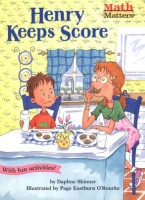
Both exports carry any edits you have made. Edits are
saved in this browser only — nobody else sees them, and they are not sent anywhere.
Skill lessons
5 lessons on the
mathematics the book carries. Each lesson has printable workbook pages and a separate teacher key.
1. How Many More, How Many FewerReasoning · Comparing two groups within five and telling how many more and how many fewer
The book keeps a running score, and every score line sets two numbers side by side: Harriet three, Henry two. Students build both numbers as rows of counters, push the rows into one-to-one pairs, and read the leftover as the answer to two questions at once, how many more Harriet has and how many fewer Henry has. The reasoning is that one arrangement answers both questions, so students must keep a finger on the same leftover counter while they say each sentence. The difference stops being a number they compute and becomes a thing they can point at.
Full lesson — 20 minutes
1. Build both scores(4 min)
Each pair lays one row of red counters for Harriet and one row of yellow for Henry. Put the rows straight across from each other on the score mat. Take the two numbers from the score line the teacher reads. Count each row aloud, one touch per number word. Keep the rows lined up from the same end so nothing has to be moved later.
Word preview: score
Harriet three, Henry two.
2. Match the rows and say the leftover(5 min)
Slide one Harriet counter and one Henry counter together into a pair, then another, until one row runs out. Point at the counters with no partner and say how many are left over. Then say both sentences about that same leftover: Harriet has one more, Henry has one fewer.
Word preview: more, fewer
3. Run four score lines(7 min)
Take the score-line cards one at a time. Build both rows, match them into pairs, and say the leftover out loud before you look at the next card. Two of the cards make rows that match exactly, so say zero left over and keep going.
Harriet five, Henry five.
Harriet four, Henry four.
Harriet 2, Henry 1.
4. Report the flower comparison(4 min)
Set out Henry's four flower cards and Harriet's three, lined up from the same end, and match them into pairs. Tell a partner how many more Henry has and how many fewer Harriet has, touching the unmatched flower on each sentence. Your partner rebuilds your two rows from what you said, without looking at your cards.
Henry has four flowers.
Harriet has one fewer flower than Henry.
Short version — 9 minutes
1. Build both scores(4 min)
Each pair lays a row of red counters for Harriet and a row of yellow for Henry, straight across from each other. Count each row aloud, one touch per number word.
Word preview: score
Harriet three, Henry two.
2. Match the rows and say the leftover(5 min)
Slide the counters together one pair at a time until a row runs out. Point at the leftover and say both sentences about it: Harriet has one more, Henry has one fewer.
Word preview: more, fewer
Three levels
Support
Stay with the one score line from the first step, three and two, and run it three times with different counters instead of moving on to new numbers. Match the rows the same way and say both sentences every round. The rows never go above five, so the leftover is always one counter you can keep a finger on.
At Grade
Run all four score-line cards, matching the rows before saying anything. Say both sentences for every card, including the two cards where nothing is left over, and use the word zero for those.
Extension
Work a leftover backwards. A partner tells you only the sentence, Harriet has one more, and you build two rows that make it true, then a second pair of rows that also make it true. Say why both arrangements are honest answers to the same sentence, and say what the two arrangements have in common.
English learners
Comparison syntax is two-sided: more than and fewer than swap the order of the two names, and many languages mark that with one word where English uses two. Give the sentence aloud and let students run it twice before the partner report, once with one more and once with one fewer, naming both children each time. Invite students to count and match in their family language first, then say the two frames in English while pointing at the leftover counter.
Materials
Two-color counters, ten per pair
Score mats with two labelled rows
Score-line cards, four cards with one score pair each
Flower cards, five per pair
Word cards: fewer, more, score
Workbook
Print these for the class. They carry your edits, and they print in black and white.
Score Mat with Two Labelled Rows full page
Henry Keeps Score — How Many More, How Many Fewer
Score Mat
Put Harriet's counters in the top row.
Put Henry's counters in the bottom row. Start both rows at the same end.
Say Both Sentences
Point at the leftover counter. Say each sentence.
______________ has ________ more.
______________ has ________ fewer.
Flower Cards card set
Henry Keeps Score — How Many More, How Many Fewer
Flower Cards
Cut out the five flower cards.
Line up Henry's flowers and Harriet's flowers from the same end.
Word Cards card set
Henry Keeps Score — How Many More, How Many Fewer
Word Cards
Cut out the word cards.
Teacher key (1 page) — not for the class
Teacher Key: How Many More, How Many Fewer half page
Henry Keeps Score — How Many More, How Many Fewer
Teacher Key
Score mat, the score line read in the first step
"Harriet three, Henry two." Harriet's row holds three counters, Henry's holds two. Two pairs match and one Harriet counter has no partner.
Expected: one left over. Harriet has one more. Henry has one fewer.
Score mat, rows that come out level
Expected: zero left over, said aloud as zero, with both sentences still offered about a difference of zero.
Flower cards
"Henry has four flowers." and "Harriet has one fewer flower than Henry." Henry lays four cards, Harriet three, lined up from the same end.
Expected: Henry has one more. Harriet has one fewer. The partner rebuilds four and three from the two sentences alone.
Read for
A close response keeps a finger on the same unmatched counter or card while both sentences are said, and swaps only the two names. A loose response recounts a whole row, or re-matches the rows between the first sentence and the second, or gives only the sentence about who has more.
One or more pages for this lesson were held back. The lesson names a set larger than it spells out — a deck of cards, a row of strips — and the missing items were not invented to fill it.
Standards & curriculum
Choose your curriculum above to see the standards for this lesson.
Standards are held back while this plan is edited.
Every standard shown here was matched against the supplied wording of this
lesson, quoting its steps, so a changed step is no longer the thing that
was checked. Undo your changes to bring the standards back — your edits stay
in this browser either way.
2. One More Makes It MatchConcept · Finding how many more are needed to make two groups equal, within five
Henry has three pancakes and Harriet has four, and the book fixes it with one word: one more. Students build the two plates, find the empty spot where a pancake is missing, and add exactly enough to make the rows match, never more and never less. The concept is that making two groups equal is a question with one right answer, and that answer is the same number as the leftover when the two rows are matched, seen from the other side: the number you count as extra is the number you add to close it. One of the cards needs nothing added, so zero is a live answer here and not a trick.
Full lesson — 20 minutes
1. Build the two plates(5 min)
Each pair sets out Harriet's plate with four counter pancakes and Henry's with three, in two straight rows one above the other. Count each row aloud, one touch per number word. Check every counter for a partner in the row above, and leave the empty spot where it is.
Word preview: match
She took four.
I only got three.
2. Add just enough(4 min)
Find the spot in Henry's row with no partner above it. Put counters in one at a time, counting each one you add aloud, until every counter has a partner. Say how many you added, then say the two numbers now: four and four.
Word preview: more
Mrs. Hedges gave him one more.
Harriet four, Henry four.
3. Three more matching jobs(7 min)
Take the matching cards one at a time. Build the two rows, then add counters to the shorter row until it matches, saying how many you added each time. One card is already a match, so say zero and move on without touching a counter.
She does three jobs and I do three jobs.
Harriet, three. Henry, three.
4. Say the matching sentence(4 min)
Hold up the counters you added. Tell a partner the whole move in one breath: Henry had three, I added one, now they both have four. Your partner listens for all three numbers and says them back before taking a turn.
If she gets four, I get four,
Short version — 9 minutes
1. Build the two plates(5 min)
Each pair sets out four counter pancakes on Harriet's plate and three on Henry's, in two straight rows one above the other. Count each row aloud and find the spot with no partner.
Word preview: match
She took four.
I only got three.
2. Add just enough(4 min)
Put counters into Henry's row one at a time, counting each one aloud, until every counter has a partner. Say how many you added and say the two numbers now.
Word preview: more
Mrs. Hedges gave him one more.
Three levels
Support
Stay with the pancake plates and the numbers three and four the whole time, rebuilding them from scratch each round instead of taking new cards. Add the missing counter and say all three numbers every round. Never go past five counters in a row, so the missing one is visible in a single look.
At Grade
Run all four matching cards, adding to the shorter row and naming how many you added each time, including the card where the answer is zero.
Extension
Work the move backwards. A partner tells you only how many you would have to add, one, and you build two rows that would need exactly that, then a second pair of rows that also would. Say what stays the same in both. Then say why adding to the shorter row and taking from the longer row do not leave the same two numbers, with counters in front of you.
English learners
Adding counters until two rows match is language-free work, and a child with no English will do it correctly on the first try. The English that carries the load is the three-part report, had and added and now, because it needs a past and a present in the same sentence, and many languages mark that with a different word order or with no change to the verb at all. Practise the sentence twice before the partner turns: what Henry had, what was added, and what they both have now. Students may count and plan in their first language and give the report in English, pointing at each row as they say its number.
Materials
Two paper plates per pair
Round counters, ten per pair
Matching cards, four cards with two numbers each
Word cards: match, more
Workbook
Print these for the class. They carry your edits, and they print in black and white.
Matching Sentence Frames strip set
Henry Keeps Score — One More Makes It Match
Say the Matching Sentence
Cut on the lines. Take one strip each.
Hold up the counters you added. Say all three parts.
Word Cards card set
Henry Keeps Score — One More Makes It Match
Word Cards
Cut out the word cards.
Teacher key (1 page) — not for the class
Teacher Key: One More Makes It Match half page
Henry Keeps Score — One More Makes It Match
Teacher Key
The pancake plates, steps one and two
"She took four." and "I only got three." Harriet's row holds four, Henry's holds three, with one spot in Henry's row that has no partner above it.
Expected: one counter added. "Mrs. Hedges gave him one more." The two numbers now are four and four.
Expected report: Henry had three, I added one, now they both have four.
The jobs pair
"She does three jobs and I do three jobs." Three and three are already a match.
Expected: zero added, said aloud as zero, with no counter touched.
Read for
A close response carries all three numbers in order, what Henry had, what was added, and what both have now, and the middle number is the number of counters actually put in. A loose response gives only the last number, or says one more without ever naming three and four, or adds counters until the row simply looks full.
One or more pages for this lesson were held back. The lesson names a set larger than it spells out — a deck of cards, a row of strips — and the missing items were not invented to fill it.
Standards & curriculum
Choose your curriculum above to see the standards for this lesson.
Standards are held back while this plan is edited.
Every standard shown here was matched against the supplied wording of this
lesson, quoting its steps, so a changed step is no longer the thing that
was checked. Undo your changes to bring the standards back — your edits stay
in this browser either way.
3. Reading the Comparing Chart with CountersRepresentation · Building a set from a comparison sentence: one more, one fewer, as many as, none
A closing chart hands students four sentences and one starting number: Henry has four flowers, and everyone else is described only by how they stand against him. Students hear one sentence at a time and build the set it describes, counter by counter, before the chart says the number. The representation work is turning a relation into an arrangement: one more means the row goes one past Henry's, as many as means it stops exactly level, one fewer means it stops one short, and none means the row stays empty and is still a row with a count. Lining every row up from the same end is what makes the relation readable at a glance.
Full lesson — 20 minutes
1. Build Henry's row(4 min)
Each pair lays four counters in a straight row on the top strip of the mat. Count them aloud, one touch per number word. This row does not move again all lesson. Every other row you build gets lined up underneath it, starting from the same end.
Word preview: row
Henry has four flowers.
Four flowers.
2. One fewer than Henry(5 min)
Listen to the sentence about Harriet and build her row underneath Henry's before anyone says a number. Stop your row one counter short of the end of Henry's. Then count what you built aloud and say the number you got. Check it against the chart only after you have said it.
Word preview: fewer
Harriet has one fewer flower than Henry.
Three flowers.
3. As many as, one more, and none(8 min)
Build the last three rows the same way, one sentence at a time, always lining up from the same end. Owen's row stops exactly level with Henry's, Uncle Ray's goes one counter past, and Judy's stays empty. Count each row aloud after you build it and say its number before the chart is read.
Word preview: none
Owen has as many flowers as Henry.
Uncle Ray has one more flower than Henry.
Judy has no flowers.
Zero flowers.
4. Read the mat back(3 min)
Cover the chart. Point at each row on your mat in turn. Tell a partner the sentence that built it. Henry's row is the one you compare to every time. Your partner checks that the row you point at really is one more, one fewer, level or empty.
Word preview: more
Short version — 9 minutes
1. Build Henry's row(4 min)
Each pair lays four counters in a straight row on the top strip and counts them aloud. This row does not move again; every other row lines up underneath it from the same end.
Word preview: row
Henry has four flowers.
Four flowers.
2. One fewer than Henry(5 min)
Listen to the sentence about Harriet and build her row underneath Henry's before any number is said. Stop one counter short of the end of Henry's row, count aloud, and say the number you got.
Word preview: fewer
Harriet has one fewer flower than Henry.
Three flowers.
Three levels
Support
Build only the two rows that stop level with Henry's or one short of it, Owen's and Harriet's, and build each one twice from the same sentence. Line up from the same end every time and count the row aloud once it is built. The empty row and the row that goes past Henry's wait for another day.
At Grade
Build all five rows from the sentences, counting each aloud and naming its number before the chart is read, then cover the chart and read the mat back to a partner.
Extension
Take Judy's empty row and Uncle Ray's row and make new true sentences about them that the chart never says, Judy against Harriet and Uncle Ray against Owen. Build nothing new; use the rows already on the mat. Then say what has to be true of two rows for one more to be the right words, and say it while pointing at the two rows.
English learners
Building a row of counters from a heard sentence is where the mathematics and the English separate cleanly: the counting carries over and the comparative frame does not. English packs the whole relation into two small words in front of the noun, one more flower and one fewer flower, and puts the person compared to at the very end after than, which is where several languages put it first. Drill two sentences aloud before the third step, one naming who has one more than Henry and one naming who has one fewer. Students may say the number in their home language while pointing at the row and then give the full frame in English.
Materials
Comparison mats with five stacked strips
Round counters, twenty per pair
Word cards: fewer, more, none, row
Workbook
Print these for the class. They carry your edits, and they print in black and white.
Comparison Mat with Five Stacked Strips full page
Henry Keeps Score — Reading the Comparing Chart with Counters
Comparison Mat
Build Henry's row on the top strip. It does not move again.
Line up every other row underneath it, starting from the same end.
Word Cards card set
Henry Keeps Score — Reading the Comparing Chart with Counters
Word Cards
Cut out the word cards.
Teacher key (1 page) — not for the class
Teacher Key: Reading the Comparing Chart with Counters half page
Henry Keeps Score — Reading the Comparing Chart with Counters
Teacher Key
Expected rows, top strip down
Henry. "Henry has four flowers." Four counters. "Four flowers."
Harriet. "Harriet has one fewer flower than Henry." The row stops one counter short of Henry's, so three. "Three flowers."
Owen. "Owen has as many flowers as Henry." The row stops exactly level with Henry's, so four.
Uncle Ray. "Uncle Ray has one more flower than Henry." The row goes one counter past Henry's, so five.
Judy. "Judy has no flowers." The strip stays empty and is still a row with a count. "Zero flowers."
Read for
A close response builds the row from the sentence and says its number before the chart is read, with every row started from the same end as Henry's, and treats Judy's empty strip as a row that counts zero. A loose response waits for the chart number and then lays that many counters, or starts a row from the wrong end so that one more and one fewer cannot be seen at a glance, or leaves Judy's strip out of the reading altogether.
Standards & curriculum
Choose your curriculum above to see the standards for this lesson.
Standards are held back while this plan is edited.
Every standard shown here was matched against the supplied wording of this
lesson, quoting its steps, so a changed step is no longer the thing that
was checked. Undo your changes to bring the standards back — your edits stay
in this browser either way.
4. One More, One Fewer: Fast RoundsFluency · Computational fluency with one more and one fewer for numbers zero to five
Henry's chart moves off four in single steps, one more giving five and one fewer giving three, and the pancake plate runs the same move to close a gap. This lesson is the computational side of it: students answer one more and one fewer for every number from zero to five until the answer arrives without counting. Zero is worked deliberately, because it is the number where one of the two moves has no answer inside the range.
Full lesson — 20 minutes
1. Warm up on the chart numbers(3 min)
Sit with a five-frame and four counters. When the teacher says one more, add a counter and say five. When the teacher says one fewer, take one back and say three. Go back to four between every turn so the number you start from never changes.
Word preview: more, fewer
Uncle Ray has one more flower than Henry.
Harriet has one fewer flower than Henry.
2. Every number, both moves(6 min)
Work down the number strip from five to zero. For each number, say one more and then one fewer without moving a counter. Build it on the frame only if you and your partner disagree. Zero gets one answer only. Say that one more is one. Say out loud that there is no number below zero here to reach for.
Judy has no flowers.
Zero flowers.
3. Fast rounds with a partner(7 min)
Partners take turns dealing a number card from zero to five and saying more or fewer. The other says the answer inside three seconds. A slow answer gets built on the frame and dealt again later in the round. Keep the cards you answered fast in one pile and the rebuilt ones in another.
4. Say the two answers for one number(4 min)
Pick the number from your rebuilt pile that gave you the most trouble. Tell a partner both answers in one sentence: one more than three is four, and one fewer than three is two. Then say which of the two you were sure of first.
Short version — 9 minutes
1. Warm up on the chart numbers(3 min)
Sit with a five-frame and four counters. On one more, add a counter and say five; on one fewer, take one back and say three. Return to four between turns.
Uncle Ray has one more flower than Henry.
2. Every number, both moves(6 min)
Work down the strip from five to zero, saying one more and then one fewer for each number without moving a counter. Build on the frame only where you and your partner disagree, and say aloud that zero has only the one answer.
Word preview: zero
Judy has no flowers.
Zero flowers.
Three levels
Support
Work only the numbers zero to three, both moves, with the five-frame in front of you the whole time. Say the answer first and then build it to check, rather than building it to find it. Take as long as each number needs; the three-second round waits for another day.
At Grade
Work every number zero to five with both moves, building on the frame only where you and your partner disagree, then run the fast rounds and sort your cards into the two piles.
Extension
Take a number you answered fast and chain the moves: one more, then one more again, then one fewer, saying each answer aloud before you make the next move. Then say what two moves in a row have to be for you to land back where you started, and say why that holds for every number on the strip and not only for yours.
English learners
English says one more than three, putting the number you started from at the end after than, when a child may be used to naming it first. Rehearse the two frames aloud before the fast rounds: one more than ___ is ___. One fewer than ___ is ___. Students may say the number words in their strongest language during the fast rounds and give the full frame in English in the last step, and a fast right answer counts as fast in any language.
Materials
Five-frames, one per student
Round counters, six per student
Number strips zero to five, one per pair
Number cards zero to five, one set per pair
Word cards: fewer, more
Workbook
Print these for the class. They carry your edits, and they print in black and white.
Five-Frame and Number Strip full page
Henry Keeps Score — One More, One Fewer: Fast Rounds
Five-Frame
Put your counters in the boxes, one counter to a box.
Number Strip
Work down the number strip from five to zero.
Say It Both Ways
Say each frame out loud before the fast rounds.
One more than ________ is ________.
One fewer than ________ is ________.
Number Cards, Zero to Five card set
Henry Keeps Score — One More, One Fewer: Fast Rounds
Number Cards, Zero to Five
Cut out the number cards. One set for each pair.
Word Cards card set
Henry Keeps Score — One More, One Fewer: Fast Rounds
Word Cards
Cut out the word cards.
Teacher key (1 page) — not for the class
Teacher Key: One More, One Fewer: Fast Rounds half page
Henry Keeps Score — One More, One Fewer: Fast Rounds
Teacher Key
Both moves, five down to zero
Five. One more is six. One fewer is four.
Four. One more is five. One fewer is three.
Three. One more is four. One fewer is two.
Two. One more is three. One fewer is one.
One. One more is two. One fewer is zero.
Zero. One more is one. One fewer has no answer here: there is no number below zero on this strip.
The warm-up numbers
Starting from four, one more gives five and one fewer gives three, with a return to four between every turn.
Read for
A close answer arrives without a recount, inside the three seconds, and zero is answered as one number and a reason rather than as a guess or a silence. A loose answer rebuilds the frame first and reads the total off the counters, or gives one more for both moves because than was not heard, or leaves zero unanswered in both directions.
Standards & curriculum
Choose your curriculum above to see the standards for this lesson.
Standards are held back while this plan is edited.
Every standard shown here was matched against the supplied wording of this
lesson, quoting its steps, so a changed step is no longer the thing that
was checked. Undo your changes to bring the standards back — your edits stay
in this browser either way.
5. Keeping Score at the Pajama PartyApplication · Counting two sets up to five and reporting them as a score pair
Henry's whole method is to count what his sister got, count what he got, and say the two numbers together: Harriet four, Henry four. Students do the counting job the book does, hearing a scene, counting each person's set, and reporting the pair in the book's own form. The application is that the numbers come out of a situation rather than off a card, so students have to decide what counts as one thing before they can count it, four guests or three cookies or three jobs, and then say both numbers in the fixed order with the thing they counted named first.
Full lesson — 20 minutes
1. Count the guest lists(5 min)
Put one counter on the mat for each guest as the teacher reads Henry's party line. Then start a second row and do the same for Harriet's four. Count each row aloud when the reading stops, one touch per number word. Do not start the second row until the first one is finished and counted.
Word preview: score
Owen, Luke, Ted, and Uncle Ray came to Henry's pajama party.
Harriet had four people, said Henry.
2. Say the pair(4 min)
Say the two numbers in the book's order, Harriet's first and Henry's second, pointing at each row as you say its number. Then say whether the two rows match, and say how you can tell without counting either row again.
Word preview: match
Harriet four, Henry four.
3. Score three more scenes(7 min)
Take the scene cards one at a time. Build a row of counters for each child and count both rows. Say the pair before the card is turned over to check. On the shopping card the rows will not match, so say the pair anyway and say which child has fewer.
Word preview: fewer
A glass of milk and three cookies, please, said Harriet.
She does three jobs and I do three jobs.
Harriet three, Henry two.
4. Report a score to a partner(4 min)
Pick one scene. Tell a partner what you counted, what you got, and whether it matched. I counted the guests: Harriet four, Henry four, they match. Your partner rebuilds both rows from what you said and holds up the mat for you to check.
Short version — 9 minutes
1. Count the guest lists(5 min)
Put one counter on the mat for each guest as the teacher reads Henry's party line, then build a second row for Harriet's four. Count each row aloud when the reading stops.
Word preview: score
Owen, Luke, Ted, and Uncle Ray came to Henry's pajama party.
Harriet had four people, said Henry.
2. Say the pair(4 min)
Say the two numbers in the book's order, Harriet's first and Henry's second, pointing at each row. Then say whether the rows match and how you can tell without recounting.
Word preview: match
Harriet four, Henry four.
Three levels
Support
Stay with the two guest rows the whole time and rebuild them from the reading three times instead of taking scene cards. Count both rows aloud and say the pair every round. Keep the counters in a straight line so a row is never miscounted the same way twice.
At Grade
Work all three scene cards after the guest rows, saying each pair before the card is checked and naming the child who has fewer wherever the pair does not match.
Extension
Take the shopping scene, where the pair does not match, and say what would have to change for it to match, either what Henry gets or what Harriet gets. Give both versions with their numbers and say why they are different changes even though both end in a matching pair.
English learners
Counting a set out of a heard scene is the transferable part, and a student can count guests in any language and land on four. The English that carries weight is naming what was counted before naming the numbers, I counted the guests and then Harriet four, Henry four, because the report is useless if the listener does not know what the four is four of. Rehearse the frame aloud twice before the partner report: I counted the ___. ___ ___, ___ ___. They match, or they do not match. Students may count and decide in their strongest language and give the report in English, and pointing at each row while saying its number is enough for a first turn.
Materials
Score mats with two labelled rows
Round counters, twelve per pair
Scene cards, three cards with one situation each
Word cards: fewer, match, score
Workbook
Print these for the class. They carry your edits, and they print in black and white.
Score Mat with Two Labelled Rows full page
Henry Keeps Score — Keeping Score at the Pajama Party
Score Mat
Put one counter on the mat for each guest as the teacher reads.
Finish and count the first row before you start the second one.
Score Report Frames strip set
Henry Keeps Score — Keeping Score at the Pajama Party
Report a Score
Cut on the lines. Take one strip each.
Say what you counted first. Then say both numbers.
Word Cards card set
Henry Keeps Score — Keeping Score at the Pajama Party
Word Cards
Cut out the word cards.
Teacher key (1 page) — not for the class
Teacher Key: Keeping Score at the Pajama Party half page
Henry Keeps Score — Keeping Score at the Pajama Party
Teacher Key
The guest lists, steps one and two
"Owen, Luke, Ted, and Uncle Ray came to Henry's pajama party." Henry's row holds four counters.
"Harriet had four people, said Henry." Harriet's row holds four counters.
Expected pair, in the book's order: "Harriet four, Henry four." The rows match, and a child can tell without recounting because the two rows end level and every counter has a partner across from it.
Read for
A close report names what was counted before it gives any number, gives Harriet's number first and Henry's second, and lets the partner rebuild both rows from the report alone. A loose report gives two bare numbers with no noun, reverses the order so the listener cannot tell whose four is whose, or answers whether the rows match by counting both rows over again instead of reading the pairs.
One or more pages for this lesson were held back. The lesson names a set larger than it spells out — a deck of cards, a row of strips — and the missing items were not invented to fill it.
Standards & curriculum
Choose your curriculum above to see the standards for this lesson.
Standards are held back while this plan is edited.
Every standard shown here was matched against the supplied wording of this
lesson, quoting its steps, so a changed step is no longer the thing that
was checked. Undo your changes to bring the standards back — your edits stay
in this browser either way.
Math through the reading
The mathematics is reached through a sentence the book prints:
change one word in the reading and the numbers change with it. These carry their own
standards, matched against these lessons rather than inherited from the skill ones.
6. The Word That Builds the RowIntegrated · Students build a flower row from a comparing sentence, swap one word in that sentence, build the new row beside the first, and say what the word did to the number.
Students build a flower row from a comparing sentence, swap one word in that sentence, build the new row beside the first, and say what the word did to the number.
Full lesson — 20 minutes
1. Build the chart row by row(5 min)
Each pair sets Henry's four flower cards on the top strip and then builds Harriet's, Owen's, Uncle Ray's and Judy's rows one heard sentence at a time, always lining up from the same end. Say each sentence aloud before touching a card, and count the row aloud once it is built.
2. Swap one word and build again(4 min)
The teacher reads Harriet's sentence with one word changed. Students build the new row underneath the old one without clearing anything, count it aloud, and leave both rows on the mat.
3. Say what the word did(4 min)
Students point at the two rows they built from the two sentences and tell a partner what the one changed word did to the number, naming the word and both numbers. The partner says which sentence goes with which row before taking a turn.
4. Swap the other three sentences(7 min)
Students take the sentences for Owen, Uncle Ray and Judy in turn, swap the relation word for a different one from the chart, and build the row the new sentence asks for. Say the new number aloud before building it, then check it against the row.
Short version — 9 minutes
1. Build the chart row by row(5 min)
Each pair sets Henry's four flower cards on the top strip and then builds Harriet's, Owen's, Uncle Ray's and Judy's rows one heard sentence at a time, always lining up from the same end. Say each sentence aloud before touching a card, and count the row aloud once it is built.
2. Swap one word and build again(4 min)
The teacher reads Harriet's sentence with one word changed. Students build the new row underneath the old one without clearing anything, count it aloud, and leave both rows on the mat.
Three levels
Support
Work only the two sentences that change the row by one, Harriet's and Uncle Ray's, and build each one twice against Henry's unchanged four. Say the relation word aloud as you place or hold back the single card, so the word and the hand move together. The number of sentences is smaller; the building and the saying stay whole.
At grade
Build all four rows from the sentences, take the swap on Harriet's sentence and build both versions side by side, then swap the relation word in the other three sentences and build what each new sentence asks for.
Extension
Make up a sentence the chart never says, a relation between two rows already on the mat such as Judy against Uncle Ray, say it aloud, and have a partner build it from your words alone. Then say what makes your sentence checkable: which row is the anchor, and what has to be true of the other row for your word to be the right one.
English learners
The building is language-independent and a child with no English will put down four cards correctly the moment they see Henry's row. The whole load sits on four small English items, one more and one fewer and as many as and no. Three of them are chunks that cannot be taken apart, and the fourth looks like ordinary negation while doing the work of a numeral. Rehearse the chunks aloud as whole pieces before the swap, each with a hand move: one more places a card past the end, one fewer holds a card back, as many as stops level, no shows an empty hand. Students may name numbers in their strongest language while building and give the full sentence in English when they report.
Materials
Flower cards, six per pair
Comparison mats with five stacked strips
The four chart sentences on separate strips
The swapped sentence on its own strip
Standards & curriculum
Choose your curriculum above to see the standards for this lesson.
Standards are held back while this plan is edited.
Every standard shown here was matched against the supplied wording of this
lesson, quoting its steps, so a changed step is no longer the thing that
was checked. Undo your changes to bring the standards back — your edits stay
in this browser either way.
IB PYP developmental alignment
Phases are not grades. The Primary Years Programme is a
developmental continuum and your school places each student in a phase, so this
names the strand the lesson works in and the phases it could sit across. Confirm
against your own school's placement.
Number · Phases 1–2
Phase 1
Develop meaning for counting, quantity, number relationships, simple operations, and early fractions in meaningful contexts.
Phase 2
Develop place value and whole-number operations, mental strategies, fractions, and mathematical language for practical problem solving.
7. Two and One: Did Henry Break His Rule?Integrated · Students build the book's score pairs, sort them by whether anything is left over, and argue aloud to a partner whether the closing pair of two and one breaks Henry's rule, with both numbers in every argument.
Students build the book's score pairs, sort them by whether anything is left over, and argue aloud to a partner whether the closing pair of two and one breaks Henry's rule, with both numbers in every argument.
Full lesson — 20 minutes
1. Sort the score pairs(5 min)
Each pair takes the score-line cards one at a time and builds each score pair as two rows on a mat, matches the rows one to one, and sorts the mats into two piles, pairs with nothing left over and pairs with a leftover counter. Count the leftover aloud on every mat in the second pile.
2. Take a position out loud(4 min)
Students look at the closing mat, two against one, and tell a partner whether Henry broke his rule, saying both numbers and the leftover in the same sentence as the answer. A position with no numbers in it goes back to be said again.
3. Hear the other side(7 min)
Pairs who agree swap mats with a pair who disagreed and give their reason again to them. Students listen for the number the other pair leans on, say that number back before answering it, and say whether it changes their position. Changing your mind counts as an answer as long as you say which number changed it.
4. Say the two mats apart(4 min)
Students set the clothing-store mat and the closing mat side by side, both with one counter left over, and tell a partner what is the same about them in numbers and what is different in the story, using both pairs of numbers.
Short version — 9 minutes
1. Sort the score pairs(5 min)
Each pair takes the score-line cards one at a time and builds each score pair as two rows on a mat, matches the rows one to one, and sorts the mats into two piles, pairs with nothing left over and pairs with a leftover counter. Count the leftover aloud on every mat in the second pile.
2. Take a position out loud(4 min)
Students look at the closing mat, two against one, and tell a partner whether Henry broke his rule, saying both numbers and the leftover in the same sentence as the answer. A position with no numbers in it goes back to be said again.
Three levels
Support
Work with only the two mats that have a leftover, three against two and two against one, already built and matched for you. Take a position on the closing mat with the counters in front of you, using this frame out loud: I think Henry ___ his rule because Harriet has ___ and Henry has ___ and ___ is left over. The counting job is done for you; the argument is not.
At grade
Build and sort all the score pairs, take a position on the closing mat with both numbers in it, hear the other side, and either answer it or change position and say which number changed it.
Extension
Argue the side you did not choose, using the same two numbers, and make it the strongest version you can. Then say which of the two arguments you would now give and name the sentence or the number that decides it for you. Changing back is allowed if you can say why.
English learners
The counting and matching transfer whole; the argument does not. An argument in this shape needs a because clause carrying two numbers, and English puts that connector in the middle of the sentence where several languages put it at the front or at the end. Rehearse the frame aloud twice before the second segment: I think Henry ___ his rule because Harriet has ___ and Henry has ___. Rehearse the objection frame too: You said ___, but ___. Students may think through the mats in their strongest language and give the position in English, and a student may point at the leftover counter instead of naming it on a first turn.
Materials
Two-color counters, ten per pair
Score mats with two labelled rows
Score-line cards, five cards with one score pair each
Henry's rule on a sentence strip
The two position frames on a chart
Standards & curriculum
Choose your curriculum above to see the standards for this lesson.
Standards are held back while this plan is edited.
Every standard shown here was matched against the supplied wording of this
lesson, quoting its steps, so a changed step is no longer the thing that
was checked. Undo your changes to bring the standards back — your edits stay
in this browser either way.
IB PYP developmental alignment
Phases are not grades. The Primary Years Programme is a
developmental continuum and your school places each student in a phase, so this
names the strand the lesson works in and the phases it could sit across. Confirm
against your own school's placement.
Number · Phases 1–2
Phase 1
Develop meaning for counting, quantity, number relationships, simple operations, and early fractions in meaningful contexts.
Phase 2
Develop place value and whole-number operations, mental strategies, fractions, and mathematical language for practical problem solving.
Data handling · Phases 1–2
Phase 1
Collect and organize simple information, sort objects by attributes, represent data in simple displays, and discuss chance in everyday events.
Phase 2
Collect, organize, represent, and interpret data in multiple graph forms; compare likelihood using appropriate probability language.
8. Say It the Other Way RoundIntegrated · Students build the comparing chart's rows, then say each relation in both directions about one unchanged arrangement, changing the comparison word as the sentence turns around.
Students build the comparing chart's rows, then say each relation in both directions about one unchanged arrangement, changing the comparison word as the sentence turns around.
Full lesson — 20 minutes
1. Build two rows and find the leftover(4 min)
Each pair lays Henry's four flower cards on the top strip and Harriet's three underneath, lined up from the same end, then slides the pairs together and leaves the unmatched card where it is. Count each row aloud and point at the leftover.
2. Say the book's sentence, then turn it round(5 min)
Students say the chart's sentence about Harriet while pointing at the leftover card, then say the same fact starting with Henry, changing the comparison word so that it stays true. Both sentences are said about the cards without moving any of them.
3. Reverse the other rows(7 min)
Students build Uncle Ray's row and Owen's row against Henry's and say each relation both ways. Owen's is the one where the word does not change on reversal; students say why after they have said both sentences.
4. Catch the wrong word(4 min)
A partner says a reversal on purpose with the comparison word left as the book had it. Students point at the cards that make it false and say the sentence correctly, then take a turn being the one who says the wrong one.
Short version — 9 minutes
1. Build two rows and find the leftover(4 min)
Each pair lays Henry's four flower cards on the top strip and Harriet's three underneath, lined up from the same end, then slides the pairs together and leaves the unmatched card where it is. Count each row aloud and point at the leftover.
2. Say the book's sentence, then turn it round(5 min)
Students say the chart's sentence about Harriet while pointing at the leftover card, then say the same fact starting with Henry, changing the comparison word so that it stays true. Both sentences are said about the cards without moving any of them.
Three levels
Support
Work only Harriet's row against Henry's, built once and left on the mat the whole time. Say the two sentences with the frames in front of you and a finger on the unmatched card, then say them again after a partner rebuilds the same two rows somewhere else on the desk, so you hear that the words do not depend on where the cards sit. The other rows wait; the reversal does not.
At grade
Build Harriet's, Uncle Ray's and Owen's rows against Henry's and say each relation in both directions about the unmoved cards, then catch a partner's reversal that keeps the wrong word.
Extension
Take Judy's empty row and say the relation between Judy and Henry in both directions, then say whether one fewer and one more are the right words for a gap of four and what the chart would need instead. Say both sentences about the cards and say which of the two you are less sure of.
English learners
Comparative syntax is what does the damage here, and it is worth naming out loud. English marks the reversal in two places at once, swapping the two names around than and swapping fewer for more, and a language that marks comparison with a single particle or with word order alone gives a child no warning that both must move together. Rehearse both frames aloud as a matched pair before the second segment, never one without the other: ___ has one fewer ___ than ___. ___ has one more ___ than ___. Say them with the same cards in view every time, so the frames are learned against one arrangement rather than as separate sentences. Students may state the relation in their strongest language first and then give both English sentences, and pointing at the unmatched card while speaking is expected rather than a concession.
Materials
Flower cards, six per pair
Comparison mats with five stacked strips
The chart's four relation sentences on separate strips
The two reversal frames on a chart
Standards & curriculum
Choose your curriculum above to see the standards for this lesson.
Standards are held back while this plan is edited.
Every standard shown here was matched against the supplied wording of this
lesson, quoting its steps, so a changed step is no longer the thing that
was checked. Undo your changes to bring the standards back — your edits stay
in this browser either way.
IB PYP developmental alignment
Phases are not grades. The Primary Years Programme is a
developmental continuum and your school places each student in a phase, so this
names the strand the lesson works in and the phases it could sit across. Confirm
against your own school's placement.
Number · Phases 1–2
Phase 1
Develop meaning for counting, quantity, number relationships, simple operations, and early fractions in meaningful contexts.
Phase 2
Develop place value and whole-number operations, mental strategies, fractions, and mathematical language for practical problem solving.
Reading and language lessons
5 lessons on the reading and
language the book carries - what a word means in its sentence, how a character is shown,
how a text is built. No mathematics: these are matched against the English language arts
curricula, which are a different and smaller set than the mathematics ones.
9. Henry's Sentence Comes BackConcept · Hearing a repeated sentence and saying what it does
The book hands first graders one sentence that Henry says over and over: If she gets ___, I get ___. Students hear it three times in three different scenes, clap the word that repeats, and notice that the frame stays put while one word swaps. Then they say a line of their own inside Henry's frame. The work is entirely in the ear and the mouth: recognising a repeated pattern of words, holding it in memory across a story, and reusing it in speech. Nothing is counted or compared as a quantity here; the number words are the words that swap, and that is all students do with them.
Full lesson — 20 minutes
1. Hear Henry's sentence come back(5 min)
Sit knee to knee and read Henry's waking-up words aloud with your partner, one of you reading Henry and one reading the narrator. Say Henry's own sentence a second time and clap once on "five" each time you say it. Tell your partner what Henry wants his mother to do.
Word preview: flew, covers
Henry's eyes flew open. If she gets five minutes, I get five minutes," he said. Henry wiggled down under the covers.
2. Catch the frame a second time(5 min)
Read the pancake passage aloud in your pair. Put your hand up the moment you hear Henry's sentence start the same way it did at bedtime. Say both of Henry's sentences back to back and tell your partner which words stayed the same and which word changed.
Word preview: asked, more
Isn't three enough for you?" asked Mrs. Hedges. If she gets four, I get four," said Henry. Mrs. Hedges gave him one more.
3. Say the frame a third time(5 min)
Read the clothing-store passage aloud. Say Henry's sentence in his own voice, the way a boy says it when he already knows the answer will be no. Then read his mother and father's answer aloud and say how Henry sounds in the last printed sentence.
Word preview: fair, parents
Harriet got three things," said Henry. If she gets three, I get three. Not today, said his parents. Hmm, said Henry, no fair.
4. Build your own line in Henry's frame(5 min)
Look at the three printed passages together and read Henry's three sentences in a row. Say one new sentence out loud that uses Henry's words "If she gets" and then "I get" and finish it about something in your own classroom. Your partner listens for both halves and gives you a thumbs up when both are there.
Word preview: said
Henry's eyes flew open. If she gets five minutes, I get five minutes," he said. Henry wiggled down under the covers.
Isn't three enough for you?" asked Mrs. Hedges. If she gets four, I get four," said Henry. Mrs. Hedges gave him one more.
Harriet got three things," said Henry. If she gets three, I get three. Not today, said his parents. Hmm, said Henry, no fair.
Short version — 9 minutes
1. Hear Henry's sentence come back(5 min)
Read Henry's waking-up words aloud with a partner and clap once on "five" each time you say his sentence. Tell your partner what Henry is asking his mother for.
Word preview: flew, covers
Henry's eyes flew open. If she gets five minutes, I get five minutes," he said. Henry wiggled down under the covers.
2. Catch the frame a second time(4 min)
Read the pancake passage aloud and raise your hand the moment Henry's sentence starts the same way it did upstairs. Say the two sentences back to back and name the one word that changed.
Word preview: asked, more
Isn't three enough for you?" asked Mrs. Hedges. If she gets four, I get four," said Henry. Mrs. Hedges gave him one more.
Three levels
Support
Stay with the first two printed passages only. Echo Henry's sentence one half at a time after the teacher says it: you say "If she gets five minutes," then you say "I get five minutes." Put the two halves together on the third try, and clap on the repeated word rather than saying it.
At Grade
Read all three printed passages with a partner, say Henry's three sentences in a row from the printed page, and name the word that changes each time. Build one new sentence in the frame and check that both halves are there.
Extension
After building your own sentence in Henry's frame, say what the repeated sentence tells a listener about Henry that no single one of the three sentences tells on its own. Point to the printed passage in step 3 where the frame gets a different answer and say what that changes about how Henry sounds.
English learners
The frame If she gets ___, I get ___ transfers well because the two halves are short and identical in shape, and the repetition gives a learner three rehearsals before any production is asked for. The contracted spoken English around it is the obstacle: "Isn't three enough for you?" and "you won't" carry contractions that many learners will hear as one word. Rehearse the frame chorally as two halves before step 4 and let students say it in their strongest language first, then in English. A rehearsable frame: "If she gets ___, I get ___."
Materials
Printed passage: Henry wakes up
Printed passage: Henry at breakfast
Printed passage: Henry at the clothing store
Sentence frame strip: If she gets ___, I get ___
Word cards: flew, covers, asked, more, fair, parents, said
Standards & curriculum
Choose your curriculum above to see the standards for this lesson.
Standards are held back while this plan is edited.
Every standard shown here was matched against the supplied wording of this
lesson, quoting its steps, so a changed step is no longer the thing that
was checked. Undo your changes to bring the standards back — your edits stay
in this browser either way.
10. How Henry SoundsReasoning · Naming how a character feels and the word that shows it
Henry is never described as jealous, grumpy or generous; the book leaves his feelings inside his own words, and first graders have to go and get them. Students lean on only in I only got three, read a grumble that is two words long, and finish at the sentence where Henry thinks about his sister and changes his answer. Each time they point at the word on the page that carried the feeling and say the feeling out loud. The work is inference from word choice and reading aloud with expression; students name feelings and evidence, and no quantity is computed or compared anywhere in the lesson.
Full lesson — 20 minutes
1. Say what Henry notices first(5 min)
Read the pancake passage aloud with your partner in Henry's voice. Put your finger on the word "only" and say the sentence again leaning on it. Tell your partner how Henry feels in this moment and name the word on the page that told you.
Word preview: only, more
Mom said Henry, Harriet got four pancakes. I only got three. Harriet got more than I did.
2. Hear how far Henry pushes it(5 min)
Read the snack passage as a two-part script, one partner as Harriet and one as Henry, using exactly the printed words. Read it a second time and make Henry sound as if he is joking. Tell your partner why this is the funniest thing Henry asks for in the whole book.
Word preview: please, glass
A glass of milk and three cookies, please, said Harriet. A glass of milk and ten cookies, please, said Henry.
3. Read the grumble(4 min)
Read the printed passage where Henry's parents answer him. Say Henry's last two words the way a grumpy first grader says them, then the way a boy who is only pretending to be grumpy says them. Tell your partner which reading fits this book better and why.
Word preview: today
Not today, said his parents. Hmm, said Henry, no fair.
4. Say how Henry ends up(6 min)
Read the last printed passage aloud. Say what Henry decides to do, using the word "because" to join his decision to the thing he thought about. Then look back at the first printed passage in this step and tell your partner one way the Henry at the end is not the same as the Henry at the pancakes.
Word preview: thought, because
Mom said Henry, Harriet got four pancakes. I only got three. Harriet got more than I did.
Henry thought about Harriet and her cavity. Yes, he said she can, and Mrs. Hedges gave Harriet one more kiss.
Short version — 9 minutes
1. Say what Henry notices first(4 min)
Read the pancake passage aloud in Henry's voice, put your finger on "only" and say the sentence again leaning on it. Name how Henry feels and the word that told you.
Word preview: only, more
Mom said Henry, Harriet got four pancakes. I only got three. Harriet got more than I did.
2. Say how Henry ends up(5 min)
Read the closing passage aloud. Say what Henry decides, joining it with "because" to the thing he thought about first. Then say one way this Henry is not the Henry from the pancake passage.
Word preview: thought, because
Mom said Henry, Harriet got four pancakes. I only got three. Harriet got more than I did.
Henry thought about Harriet and her cavity. Yes, he said she can, and Mrs. Hedges gave Harriet one more kiss.
Three levels
Support
Work with the pancake passage alone. The teacher reads the sentence twice, once flat and once leaning on only, and you say which reading sounds like Henry. Then point to only on the page and say one feeling word for Henry. Keep the two-word grumble for a second day.
At Grade
Read all four printed passages with a partner, name a feeling for Henry at each one, and each time put your finger on the word or the two words that told you. Say the closing decision with because.
Extension
Say what Henry would have answered at the end if he had not thought about Harriet's cavity first, and point to the sentence in the printed closing passage that makes you say so. Then say why the book is funnier for leaving Henry's feelings inside his own words instead of telling us what they are.
English learners
Feeling words in a learner's strongest language usually map cleanly onto this book, so invite students to name Henry's feeling in that language first and then in English. Only is the exception: it sits in front of the amount in English and carries disappointment rather than smallness. Rehearse the whole sentence chorally rather than the word alone. A rehearsable frame: "Henry feels ___ because he says ___."
Materials
Printed passage: Henry counts the pancakes
Printed passage: the snack order
Printed passage: not today
Printed passage: Henry at the end
Because sentence strip
Word cards: only, more, please, glass, today, thought, because
Standards & curriculum
Choose your curriculum above to see the standards for this lesson.
Standards are held back while this plan is edited.
Every standard shown here was matched against the supplied wording of this
lesson, quoting its steps, so a changed step is no longer the thing that
was checked. Undo your changes to bring the standards back — your edits stay
in this browser either way.
11. From Wake-Up to Good NightApplication · Retelling a day in order using the text's own time words
This book runs one whole day, and it tells you where you are every time it moves: Five minutes later, After school, When they were finished. First graders read five printed passages, hunt the time phrase at the front of each, and use only those phrases to lay the day out in order. Then they retell it aloud to a partner with first, then, after that and last, while the partner watches the cards for a skipped part. The skill is sequencing and oral retelling from textual signals; students order scenes, never quantities, and nothing in the lesson is counted.
Full lesson — 20 minutes
1. Find the words that tell you when(5 min)
Read the two printed morning passages aloud with your partner. Circle on your strip the words that tell you when each one happens, and read those words out loud on their own. Say which passage happens first and how the page told you.
Word preview: later, yawned
Harriet rolled over in bed and yawned. Five more minutes, Mom," she said.
Five minutes later, Harriet smelled something good. So did Henry. They hurried downstairs.
2. Put the afternoon in its place(5 min)
Read the chores passage and then the snack passage aloud. Point to the words at the front of each one that say when it happens. Tell your partner which of these two comes first and read aloud the exact words that prove it.
Word preview: after, finished
After school, Harriet fed the dog and Henry fed the cat. Harriet cleaned the bird cage, Henry took out the garbage. Harriet picked up all her toys. Henry put all his dirty socks in the hamper.
When they were finished, Mrs. Hedges asked them what they'd like for a snack.
3. Lay the day out in order(5 min)
Spread your five passage cards face up and read each printed passage aloud in your pair. Put them in the order the day happened, using only the time words to decide. Read your order aloud from first to last, saying the time words as you go.
Word preview: order, night
Harriet rolled over in bed and yawned. Five more minutes, Mom," she said.
Five minutes later, Harriet smelled something good. So did Henry. They hurried downstairs.
After school, Harriet fed the dog and Henry fed the cat. Harriet cleaned the bird cage, Henry took out the garbage. Harriet picked up all her toys. Henry put all his dirty socks in the hamper.
When they were finished, Mrs. Hedges asked them what they'd like for a snack.
Mrs. Hedges kissed her good night.
4. Retell the day to a partner(5 min)
With the five printed passages in front of you, retell Harriet and Henry's day from waking up to good night. Start each part with a time word, using "first", "then", "after that" and "last". Your partner follows along on the cards and stops you if you skip a part.
Word preview: first, last
Harriet rolled over in bed and yawned. Five more minutes, Mom," she said.
Five minutes later, Harriet smelled something good. So did Henry. They hurried downstairs.
After school, Harriet fed the dog and Henry fed the cat. Harriet cleaned the bird cage, Henry took out the garbage. Harriet picked up all her toys. Henry put all his dirty socks in the hamper.
When they were finished, Mrs. Hedges asked them what they'd like for a snack.
Mrs. Hedges kissed her good night.
Short version — 9 minutes
1. Find the words that tell you when(4 min)
Read the two printed morning passages aloud. Circle the words that tell you when each happens and read them on their own. Say which one happens first.
Word preview: later, yawned
Harriet rolled over in bed and yawned. Five more minutes, Mom," she said.
Five minutes later, Harriet smelled something good. So did Henry. They hurried downstairs.
2. Retell the day to a partner(5 min)
With the five printed passages in front of you, retell the day from waking up to good night. Begin each part with "first", "then", "after that" or "last". Your partner stops you if a part is skipped.
Word preview: first, last
Harriet rolled over in bed and yawned. Five more minutes, Mom," she said.
Five minutes later, Harriet smelled something good. So did Henry. They hurried downstairs.
After school, Harriet fed the dog and Henry fed the cat. Harriet cleaned the bird cage, Henry took out the garbage. Harriet picked up all her toys. Henry put all his dirty socks in the hamper.
When they were finished, Mrs. Hedges asked them what they'd like for a snack.
Mrs. Hedges kissed her good night.
Three levels
Support
Work with three cards instead of five: morning in bed, after school jobs, and good night. Read each printed passage with the teacher, say its time words aloud, and place the three in order. Retell with just first, then and last.
At Grade
Order all five printed passages using their time words and retell the day to a partner with first, then, after that and last, keeping every part in place.
Extension
Retell the day using only the book's own time phrases from the printed passages instead of first and then, and say why the good-night card has to be last even though its printed sentence carries no time word at all.
English learners
Time phrases at the front of a sentence are a strong transfer point, because most languages mark sequence somewhere and learners can say the order in their strongest language before English. English can also leave a scene unmarked and rely on the reader knowing that a good-night kiss ends a day, which is not something a learner will expect. Give students the retelling strip and rehearse the four connectives chorally before step 4. A rehearsable frame: "First ___, then ___, after that ___, last ___."
Materials
Printed passage: morning in bed
Printed passage: downstairs
Time-word strip
Printed passage: after school jobs
Printed passage: snack time
Printed passage: good night
Passage card set (five cards)
Retelling word strip: first, then, after that, last
Word cards: later, yawned, after, finished, order, night, first, last
Standards & curriculum
Choose your curriculum above to see the standards for this lesson.
Standards are held back while this plan is edited.
Every standard shown here was matched against the supplied wording of this
lesson, quoting its steps, so a changed step is no longer the thing that
was checked. Undo your changes to bring the standards back — your edits stay
in this browser either way.
12. Words That Put Two People Side by SideConcept · Using the words that compare two people in a sentence
This book is full of sentences that hold two people up against each other, and it uses a small set of words to do it: more than, one fewer than, as many as, one more than, the same as. First graders find the joining word than, collect the three comparing phrases from the printed chart lines, notice that the book says sameness two different ways, and then build a comparing sentence of their own about pencils or steps to the door. The whole lesson is vocabulary and sentence structure: which words compare, where they sit, and what follows them. Students say the phrases and reuse them; they do not count the flowers, work out any difference, or check whether a line is true.
Full lesson — 20 minutes
1. Say the word that compares(5 min)
Read Henry's sentence aloud and point to the one word in it that puts Harriet next to Henry. Say the sentence again with your finger on that word. Tell your partner who the sentence is about and who it is comparing them to.
Word preview: than
Harriet got more than I did.
2. Collect the comparing words(6 min)
Read the printed chart lines aloud around the circle, one sentence each. Underline on your card the words that do the comparing: one fewer, as many as, one more. Say each of the three sentences again in your own voice and put the matching word card in the middle.
Word preview: fewer, many
Harriet has one fewer flower than Henry. Three flowers. Owen has as many flowers as Henry. Four flowers. Uncle Ray has one more flower than Henry. Five flowers.
3. Find the words that say the same(5 min)
Read the two printed passages aloud with your partner. Both of them say that two people end up alike, but they use different words to say it. Read those words out loud on their own and tell your partner which one sounds more like something you would say to a friend.
Word preview: same, calls
The same as Harriet.' "'Well, okay,' said Henry.'
I get to make as many calls as she does.
4. Say a comparing sentence about your own pair(4 min)
Look back at the printed chart lines and read one of them aloud. Then use the same words to say a sentence about you and your partner, about pencils or books or steps to the door. Your partner listens for the comparing word and says which one you used.
Word preview: about
Harriet has one fewer flower than Henry. Three flowers. Owen has as many flowers as Henry. Four flowers. Uncle Ray has one more flower than Henry. Five flowers.
Short version — 9 minutes
1. Say the word that compares(4 min)
Read Henry's sentence aloud and point to the one word that puts Harriet next to Henry. Say the sentence again with your finger on that word and name who is being compared to whom.
Word preview: than
Harriet got more than I did.
2. Collect the comparing words(5 min)
Read the printed chart lines aloud, one sentence each around the circle. Underline the comparing words one fewer, as many as and one more, and put the matching word card in the middle as you say each sentence.
Word preview: fewer, many
Harriet has one fewer flower than Henry. Three flowers. Owen has as many flowers as Henry. Four flowers. Uncle Ray has one more flower than Henry. Five flowers.
Three levels
Support
Stay with one printed comparing line and the word than. Read "Harriet got more than I did." with the teacher, point to than, and say who is on each side of it. Use one comparing phrase only, as many as, when you build your own sentence.
At Grade
Read all the printed comparing lines, underline the three comparing phrases, and build one sentence of your own about you and your partner using one of them. Say which phrase you used.
Extension
Say one of the printed chart lines with the two names swapped and tell your partner which comparing phrase you had to change to keep the sentence saying the same thing. Then say why the book needs the word than in some of these sentences and the word as in others.
English learners
Comparative structures exist in every language but the ordering differs sharply, and learners often produce more as many rather than as many as. Rehearse the three phrases as whole chunks with the word that follows them attached, one fewer than, as many as, one more than, rather than teaching more and fewer alone. Let students say the comparison in their strongest language first and name the two people before adding the phrase. A rehearsable frame: "___ has as many ___ as ___."
Materials
Printed passage: more than I did
Printed passage: the comparing lines
Comparing word cards: one fewer, as many as, one more
Printed passage: the same as Harriet
Printed passage: as many calls
Sentence frame strip: ___ has ___ than ___
Word cards: than, fewer, many, same, calls, about
Standards & curriculum
Choose your curriculum above to see the standards for this lesson.
Standards are held back while this plan is edited.
Every standard shown here was matched against the supplied wording of this
lesson, quoting its steps, so a changed step is no longer the thing that
was checked. Undo your changes to bring the standards back — your edits stay
in this browser either way.
13. The Curly Mark at the EndFluency · Reading questions with question intonation and answering in a whole sentence
Grown-ups in this book do most of their work by asking. First graders find the question mark at the end of a printed sentence, read those sentences with the voice going up, and pair each question with the sentence that answers it. They meet a question that is not really asking anything, Henry's You had a cavity?, and a closing question whose answer Henry repeats over and over. The lesson finishes with each child asking a partner a real question and getting a whole-sentence answer back. This is punctuation, intonation and conversational turn-taking; the numbers inside the quoted questions are read aloud as words and are never counted or compared.
Full lesson — 20 minutes
1. Find the mark that asks(5 min)
Read the two printed passages aloud with your partner. Run your finger along each sentence until you reach a curly mark at the end, and stop there. Read those two sentences again with your voice going up at the end, the way a question goes.
Word preview: asked, enough
Who would you like to call?" asked Mrs. Hedges.
Isn't three enough for you?" asked Mrs. Hedges. If she gets four, I get four," said Henry.
2. Match the question to its answer(5 min)
Read the phone-call passages in order in your pair, one of you asking and one of you answering. Say which printed sentence is the question and which one answers it. Do the same with the pancake passage and tell your partner whether Henry actually answered what he was asked.
Word preview: grandma, idea
Who would you like to call?" asked Mrs. Hedges.
Then I'll call grandma," said Henry. That's a good idea," said Mrs. Hedges.
Isn't three enough for you?" asked Mrs. Hedges. If she gets four, I get four," said Henry.
3. Read a question that is really a gulp(4 min)
Read the dentist passage aloud, one partner as Henry and one as Harriet. Say Henry's question the way somebody says it when they already heard the answer and wish they had not. Tell your partner what Henry is really doing when he asks it.
Word preview: gulped, turn
Henry gulped. A cavity, he said. You had a cavity? Yes, said Harriet, your turn.
4. Ask and answer the last question(6 min)
Read the closing printed passage aloud in your pair, one asking and one answering. Say Henry's answer with all its words, letting your voice get firmer on each no. Then ask your partner one question of your own about Henry, ending your voice up like a question, and let them answer it in a whole sentence.
Word preview: just, no
Just like Harriet? No, said Henry. No, no, no.
Short version — 9 minutes
1. Find the mark that asks(4 min)
Read the two printed passages aloud and run your finger to the curly mark that ends a sentence. Read those sentences again with your voice going up at the end.
Word preview: asked, enough
Who would you like to call?" asked Mrs. Hedges.
Isn't three enough for you?" asked Mrs. Hedges. If she gets four, I get four," said Henry.
2. Ask and answer the last question(5 min)
Read the closing printed passage in your pair, one asking and one answering, and say Henry's answer with all its words. Then ask your partner one question of your own about Henry and let them answer in a whole sentence.
Word preview: just, no
Just like Harriet? No, said Henry. No, no, no.
Three levels
Support
Use the phone-call passages only. The teacher reads the question and you read it back with your voice going up, then you read the answer sentence. Do this three times before you ask a question of your own, and use the question frame strip when you do.
At Grade
Read all the printed passages, pair each question with the sentence that answers it, and read the questions with rising intonation. Ask a partner one question of your own and answer theirs in a whole sentence.
Extension
Say which of the printed questions is not really asking for an answer and read the sentence just before it that shows Henry already knew. Then say what Henry's repeated no in the closing passage does that a single no would not.
English learners
Rising intonation on questions is not universal, and learners whose home language marks questions with a particle or with word order may read a question mark flat. Model the rise with a hand going up and let them practise on the printed question before any content is asked of them. Yes-no answering also differs: a learner may answer the negatively-framed "Isn't three enough for you?" in the pattern of their own language. Accept the meaning and recast. A rehearsable frame: "Would you like ___?" answered with "Yes, I would like ___."
Materials
Printed passage: who would you like to call
Printed passage: isn't three enough
Printed passage: then I'll call grandma
Printed passage: at the dentist
Printed passage: just like Harriet
Question frame strip: Would you like ___?
Word cards: asked, enough, grandma, idea, gulped, turn, just, no
Standards & curriculum
Choose your curriculum above to see the standards for this lesson.
Standards are held back while this plan is edited.
Every standard shown here was matched against the supplied wording of this
lesson, quoting its steps, so a changed step is no longer the thing that
was checked. Undo your changes to bring the standards back — your edits stay
in this browser either way.