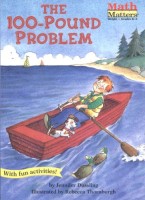
The 100-Pound Problem
Grade 2
4 skill lessons
Math
Skill lessons
The mathematics the book carries, taught directly. Printable workbook pages and teacher keys are not available for this book yet.
- 1Five Pounds Over
- 2How Patch Told Walt a Number
- 3Which Way Did the Plank Go?
- 4Three Columns for One Board
Math + reading
Math through the reading
The same book, entered through a sentence it prints. Change one word in the reading and the numbers change with it.
No math-through-reading lessons for this book yet.
Reading
Reading and language lessons
The same book read as a text. What a word means in its sentence, how a character is shown, how the writing is put together - no mathematics.
No reading and language lessons for this book yet.
Skill lessons
4 lessons on the mathematics the book carries. Printable workbook pages and teacher keys are not available for this book yet.
1. Five Pounds Over
The number that starts this book is written on the bottom of a boat by the cousin who owns it, and the word doing the work in that sentence is only. Students copy the limit onto a load card, then add the weights the book actually states: sixty-five for Walt, twenty for Patch, and twenty for the backpack and the fishing gear together. Eighty-five is the book's own answer to the first of those and students check theirs against it; a hundred and five is the answer to all three and the book never says it. Laid beside the hundred from the boat, a hundred and five is five pounds over, and students reach that five by counting on from one number to the other rather than by taking anything away. Then they deal the same weights into trips that fit, and find that the one card they cannot place is the lunch, because the book never gives it a number.
Full lesson — 20 minutes
1. Read the limit off the boat (5 min)
Find the sentence Walt reads when he turns the boat over, and say the number in it and the unit that number is in. Write that number at the top of your load card and rule a line under it. Then say what the word only is doing to the number, and what the sentence would let you load if that word were missing.
Word preview: only, pounds
There was writing on it.
This boat hold only 100 pounds.
2. Add the weights the book gives you (6 min)
Write 65 for Walt and 20 for Patch on your load card and add them. Check your total against the sentence the book says next, and fix it if the book disagrees with you. Then add the 20 the plank gave Walt for the backpack and the fishing gear together, and write the new total underneath.
Word preview: pounds, together
Walt knew he weighed about 65 pounds.
That was 85 pounds right there.
That means the fishing gear plus the backpack weighed 20 pounds.
3. Hold the total against the line (5 min)
Lay the limit card beside your total and say which of the two is bigger. Then count on from the smaller number to the bigger one and say how many pounds over the boat that load is. Say out loud whether that load can cross in one trip, and point at the two sentences your numbers came out of.
Word preview: more than, over
And I'll be careful not to have more than a hundred pounds in the boat.
I'll take just a few things at a time.
4. Plan trips that fit (4 min)
Deal the weight cards into trips so that no trip goes over the number from the boat, with Walt in every trip because he is the one rowing. Say how many trips you needed and read one of them out as a sentence with its total in it. Then hold up the one card you could not put a number on and say why it is a problem.
Word preview: trip
For his first trip, Walt took his lunch and the fishing gear.
I'll play it safe and make another trip.
Short version — 9 minutes
1. Add the weights the book gives you (5 min)
Write 65 for Walt and 20 for Patch on your load card and add them, then check your total against the sentence the book says next. Add the 20 the plank gave Walt for the backpack and the fishing gear, and write the new total underneath.
Word preview: pounds, together
Walt knew he weighed about 65 pounds.
That was 85 pounds right there.
That means the fishing gear plus the backpack weighed 20 pounds.
2. Hold the total against the line (4 min)
Lay the limit card beside your total and say which is bigger. Count on from the smaller to the bigger and say how many pounds over the boat that load is. Say whether it can cross in one trip.
Word preview: more than, over
And I'll be careful not to have more than a hundred pounds in the boat.
I'll take just a few things at a time.
Three levels
- Support
- Work with the two weights the book adds for you, 65 and 20, and check the total against the book's own sentence rather than producing a third addend. Give the child a hundred-square strip to lay the cards along so the limit is a place on the strip and not just a number. Keep the counting on from the total to the limit, said aloud in pounds.
- At Grade
- All three stated weights added to a hundred and five, the first total checked against the book's eighty-five, the total laid beside the hundred from the boat and the five-pound overshoot reached by counting on, and the weights dealt into trips that each stay under the limit.
- Extension
- Find every way of dealing the four numbered cards into trips that fit, with Walt in each one, and say which arrangement uses the fewest crossings. Then say how heavy the lunch bag would have to get before your best arrangement stopped working, and say which number you compared it against.
English learners
Two very small English words carry this whole decision, over and only. Over is spatial in most children's first uses of it and here it means past a number, which is a jump the word alone does not make. Only in front of a number turns that number into a ceiling, and it is easy to hear as complaining instead. Keep the limit card on the desk and slide each total up against it while the sentence is said, so both words get a picture beside them. Rehearse our trip is ___ pounds and the boat holds ___ pounds before anybody reads a total out, and accept two numbers and a finger on the bigger one while the frame is still arriving. Ask children what their strongest language says for too much and for enough, and write both up beside the limit card.
Materials
- A load card per pair with a line ruled across the top
- The book read aloud
- Weight cards reading 65, 20 and 20
- A red card reading 100 pounds to lay beside every total
- A blank card reading lunch with no number on it
- Four trip mats per pair
- A hundred-square strip for laying the cards along at the Support level
- Word cards: only, over, more than
Standards & curriculum
These lessons are being matched against curricula now.
Standards are held back while this plan is edited. Every standard shown here was matched against the supplied wording of this lesson, quoting its steps, so a changed step is no longer the thing that was checked. Undo your changes to bring the standards back — your edits stay in this browser either way.
2. How Patch Told Walt a Number
Walt's plank cannot count. It says heavier, lighter or level and nothing else, and yet Walt walks away from it knowing that his fishing gear and his backpack come to twenty pounds. The number is Patch's, and the level board is what carries it across. Students do the same trade: one end of the board holds a bag whose weight is already written on it and never moves, and students hunt for two objects that make the free end sit level. When they find them they can say a weight for two objects nobody has counted, and they can say why they are allowed to. Then they split the pair, put one half back on alone, and find that the board has gone quiet again — it will say the single object is lighter than the bag and it will not say by how much. Walt runs into the same wall and says so in his own words about his backpack.
Full lesson — 20 minutes
1. Ask where the twenty came from (5 min)
Listen for the two sentences that give Patch his weight and say who it was that knew it. Then say whether Walt's plank could ever have told him that number, and say what the plank tells him instead. Put the card reading twenty pounds beside the bag on the board.
Word preview: weighed
He knew patch weighed 20 pounds.
That's what the vet had said.
2. Put a known weight on one end (5 min)
One end of your board holds the bag your teacher has already marked with its weight, and nothing else goes on that end for the rest of the lesson. Run one object at a time on the free end. Every object the board calls lighter than the bag goes in a pile you can reach; anything heavier is out of the hunt.
Word preview: less than
He told Patch to sit on the scale again.
That meant the backpack weighed less than Patch.
3. Build a load that sits level (6 min)
Take two objects out of the lighter pile and set both on the free end. If the board tips either way, swap one of the two and go again; if it sits level, stop. Write the weight of those two objects together on a card, and say out loud the reason you are allowed to write it.
Word preview: balanced, the same as
The scale balanced.
That means the fishing gear plus the backpack weighed 20 pounds.
4. Say what you still do not know (4 min)
Split your level pair and put just one of the two back on alone. Say what the board shows now, and say whether you can put a number on that one object. Then say what would have to happen for you to know it.
Word preview: how much
I'm not exactly sure how much the backpack weighs he thought.
The same as you, Patch.
Short version — 9 minutes
1. Put a known weight on one end (4 min)
One end of your board holds the bag with its weight already marked on it, and nothing else goes on that end. Run one object at a time on the free end and keep every object the board calls lighter than the bag in a pile you can reach.
Word preview: less than
He told Patch to sit on the scale again.
That meant the backpack weighed less than Patch.
2. Build a load that sits level (5 min)
Take two objects out of the lighter pile and set both on the free end. Swap one and go again whenever the board tips; stop when it sits level. Write down what the two weigh together and say the reason you can.
Word preview: balanced, the same as
The scale balanced.
That means the fishing gear plus the backpack weighed 20 pounds.
Three levels
- Support
- Hand the child three objects already known to be lighter than the bag, so the hunt is a choice between three pairs rather than a search. A partner steadies the bag end. The child may say the number and point at the two ends before the full reason arrives. Keep the last part where one object goes back on alone, because that is where the child finds out what a level board is actually worth.
- At Grade
- Objects sorted against a marked bag, a pair found that sits the board level, the pair's weight written down with the reason said aloud, and the pair split to show that neither half can be given a number on its own.
- Extension
- Find a second pair that also sits level, then say what you now know about the four objects and what you still do not. Say the closest you can come to a weight for any single one of them, using the words more than and less than, and say which loading told you each half of that answer.
English learners
The reasoning here runs through one small English word, because, and a child can balance the board, know the number and still have no way to say what makes it allowed. Rehearse the frame these two weigh ___ pounds because they balance the ___ bag, and accept the number and a finger on each end while the frame is still arriving. Watch the word same, which is doing two jobs at once: same place on the board and same weight. Split them out loud, because a child who hears only the first will accept any two objects that fit on the end. Invite the pair to say balance and same in their strongest language and hear which of the two jobs that language marks.
Materials
- The book read aloud
- A card reading 20 pounds to stand beside the bag
- A bag marked with its weight, one per group
- A tray for the objects lighter than the bag
- Blank cards for writing the pair's weight
- The pair's weight card, kept where both partners can see it
- Word cards: balanced, the same as, how much
Standards & curriculum
These lessons are being matched against curricula now.
Standards are held back while this plan is edited. Every standard shown here was matched against the supplied wording of this lesson, quoting its steps, so a changed step is no longer the thing that was checked. Undo your changes to bring the standards back — your edits stay in this browser either way.
3. Which Way Did the Plank Go?
Walt has no scale and makes one out of a plank and a rock, and from then on every weight judgement in the book is made by watching which end goes down. Students build the same thing: a board across a block, one end holding a bag they weigh everything against, and one test object at a time on the free end. The board gives exactly three answers and no numbers at all, and the idea students leave with is which sentence each answer earns. Nothing happening means the test object is the lighter one, and that is the result children read backwards most often, because a board that has not moved looks like a board that has said nothing. The reference end going up means the load is heavier. Level means the two sides weigh the same, and level is the only result in the book that ever hands over a number.
Full lesson — 20 minutes
1. Build the plank (5 min)
Lay a board across a block so both ends can drop, the way Walt sets his plank over a rock. Put a matching can on each end and slide the board until it sits level with nobody touching it. Say what level looks like before anything else goes on, and mark where the block sits so you can get back to it.
Word preview: balanced, level
Walt found a plank from an old boat.
He balanced it over a rock.
2. Load one end and read it (6 min)
Put the group's reference bag on one end and hold it while a partner sets one test object on the free end, then let go of both together. Say which of three things the board did: nothing at all, or the bag end lifted, or it settled level. Say what that result tells you about the test object before anybody touches the next one.
Word preview: lighter, heavier
The scale did not move.
That meant the backpack weighed less than Patch.
3. Say the sentence the board earned (5 min)
For each test object, say one sentence out loud with lighter than, heavier than or weighs the same as, and name both sides of it. A partner checks that the board still shows what you just said. If you cannot tell which way it went, take everything off, level the board again and run that object a second time.
Word preview: the same as
Now Walt knew that all three things together were heavier than patch.
The scale balanced.
4. Find a pair that sits level (4 min)
Now put two of your test objects together on the free end against the bag. If the board tips, swap one of the two and try again; if it sits level, stop there. Say which two you finished with, and say what a level board tells you about those two together that it does not tell you about either one on its own.
Word preview: together
Walt said, I'm putting all my stuff on the scale.
What if I take something away, Walt wondered.
Short version — 9 minutes
1. Load one end and read it (5 min)
Put the reference bag on one end and set one test object on the free end, then let go of both together. Say which of three things the board did: nothing, or the bag end lifted, or it settled level. Say what that tells you about the object before the next one goes on.
Word preview: lighter, heavier
The scale did not move.
That meant the backpack weighed less than Patch.
2. Say the sentence the board earned (4 min)
For each object, say one sentence out loud with lighter than, heavier than or weighs the same as, and name both sides. A partner checks the board still shows what you said. Level the board again before the next object.
Word preview: the same as
Now Walt knew that all three things together were heavier than patch.
The scale balanced.
Three levels
- Support
- Run three test objects instead of six, and let a partner level the board and hold the bag end so the child's only job is placing the object and reading the result. The child may point at the end that went down before naming which object is heavier. Keep the spoken sentence, because a board on its own is not evidence that a child read it; the sentence is.
- At Grade
- Six test objects each run once against the reference bag, the board relevelled between objects, and each result said aloud as one sentence that names both sides with lighter than, heavier than or weighs the same as.
- Extension
- Put the six objects in a line from lightest to heaviest using only the board, and count how many separate loadings it took you. Then find two objects the board cannot separate and say exactly what it has told you about those two and what it has not.
English learners
The three results a board can give come out in three different English shapes, and only two of them are comparatives. Lighter than and heavier than hide the comparison inside an ending, so a child whose first language marks it with a separate word can read the board perfectly and still reach for the wrong form. Weighs the same as is easier, because equality is marked plainly in most languages, but the as at the end drops off easily and the sentence then names only one side. Rehearse the pair ___ is lighter than ___ and ___ is heavier than ___ before anybody loads the board, and accept a finger on the end that went down plus the two object names while the frame is still arriving. Ask children for heavy and light in their strongest language and let the class hear whether that language carries the comparison in a word, in an ending, or in the order of the two names.
Materials
- A short board and a block to rest it on, one set per group
- Two matching cans for levelling the board
- A crayon to mark where the block sits
- A reference bag every group weighs against, the same for all groups
- Six unlabelled test objects per group
- Three sentence strips per group reading is lighter than, is heavier than, weighs the same as
- A tray for the objects that have already been tried
- Word cards: lighter than, heavier than, weighs the same as
Standards & curriculum
These lessons are being matched against curricula now.
Standards are held back while this plan is edited. Every standard shown here was matched against the supplied wording of this lesson, quoting its steps, so a changed step is no longer the thing that was checked. Undo your changes to bring the standards back — your edits stay in this browser either way.
4. Three Columns for One Board
The book finishes with a page it calls a weight chart, four rows comparing things to a box nobody opens. Students build the chart the rows belong in: three columns headed lighter, the same and heavier, filled only from results a board actually gave. First they fill one from their own six objects against a reference bag. Then they take the book's four rows and put each one in the column it earns, and read off something no single row said on its own — that the box weighs less than Walt, more than the fishing gear, and about as much as the backpack and gear together. The chart bounds the box without naming it, and the book's own last question asks students to name it anyway. Saying which row would have to change before the chart could settle that is the honest end of this lesson.
Full lesson — 20 minutes
1. Head the three columns (4 min)
Fold a sheet into three columns and head them lighter, the same, heavier. Say what has to have happened on the board before a name can go into each column. Then say which of the three columns is the hardest one to earn, and why.
Word preview: lighter, heavier
Weight chart.
How does each weight compare to the mystery box?
2. Fill it from the board (6 min)
Run six objects one at a time against the reference bag and write each name into the column its result earned. Nothing goes on the chart that has not been on the board. Say each entry out loud as a whole sentence while you write it, naming what it was lighter or heavier than.
Word preview: the same
Look at Walt's balance scale.
The scale balanced.
3. Sort the book's four rows (6 min)
Take the book's four sentences about the mystery box and lay each one in the column it belongs to on a second chart. Then say what the finished chart tells you about the box that no single row said by itself, and say which two rows you used to get there.
Word preview: about the same
Walt is much heavier.
The fishing gear is lighter.
The fish and backpack are heavier.
4. Answer the book's question, or say you cannot (4 min)
Look at your chart of the book's rows and say what the box could weigh and what it could not. Then say whether the chart settles what is inside it. If it does not, name the one row you would need changed, and say what it would have to say instead.
Word preview: mystery
The backpack and gear weigh about the same.
What's in the box?
Short version — 9 minutes
1. Fill it from the board (4 min)
Run six objects one at a time against the reference bag and write each name in the column its result earned. Nothing goes on the chart that has not been on the board. Say each entry aloud as a whole sentence as you write it.
Word preview: the same
Look at Walt's balance scale.
The scale balanced.
2. Sort the book's four rows (5 min)
Lay each of the book's four sentences about the mystery box in the column it belongs to on a second chart. Say what the finished chart tells you about the box that no single row said on its own, and name the two rows you used.
Word preview: about the same
Walt is much heavier.
The fishing gear is lighter.
The fish and backpack are heavier.
Three levels
- Support
- Give the child a chart with the three headings already written and four objects instead of six. A partner runs the board while the child places the name card, and the child may put the card down and then say the sentence rather than the other way round. Keep the book's four rows, cut to two — the one about Walt and the one about the fishing gear — so the box still gets squeezed from both sides.
- At Grade
- A three-column chart headed and filled from six of the pair's own board results with each entry said as a sentence, the book's four rows sorted onto a second chart, and a statement of what the completed chart says about the box that no single row says.
- Extension
- Take one of the book's four rows out of your chart and say what you can no longer claim about the box. Then write a fifth row of your own that would make the box's weight certain, hand it to another pair, and see whether they agree it settles it.
English learners
Column headings are the least forgiving English on this page, because a heading is a fragment with the second half of its comparison missing: lighter than what. Say the missing half out loud every time a name goes down, so the chart is read as three sentences and not three words. About the same is harder again, since about softens a claim rather than changing which claim it is, and a child may take it for a different relation altogether. Rehearse the frame ___ goes in the ___ column because it is ___ than the bag, and accept the column and the object name while the frame is still arriving. Invite children to head a second chart in their strongest language and let the class see where each language puts the two sides of a comparison.
Materials
- A sheet folded into three columns, one per pair
- A thick marker
- The reference bag and the board from the balance work
- Six object name cards per pair
- The book's four back-page sentences on separate strips
- A second three-column sheet for the book's rows
- A blank strip for the pair's answer or for their reason for not having one
- A three-column sheet with the headings already written, for the Support level
- Word cards: lighter, heavier, about the same
Standards & curriculum
These lessons are being matched against curricula now.
Standards are held back while this plan is edited. Every standard shown here was matched against the supplied wording of this lesson, quoting its steps, so a changed step is no longer the thing that was checked. Undo your changes to bring the standards back — your edits stay in this browser either way.