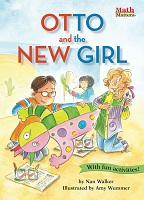
Otto and the New Girl
Grade 3
4 skill lessons · 2 math-through-reading
Math
Skill lessons
The mathematics the book carries, taught directly. Printable workbook pages and teacher keys are not available for this book yet.
- 1Fold It and See If It Matches
- 2None, One, or Several
- 3Which Names Survive the Mirror
- 4Turn It Instead of Folding It
Math + reading
Math through the reading
The same book, entered through a sentence it prints. Change one word in the reading and the numbers change with it.
- 5Match Exactly, or Match Almost
- 6Does Viv Get Into the Club?
Reading
Reading and language lessons
The same book read as a text. What a word means in its sentence, how a character is shown, how the writing is put together - no mathematics.
- 7Who Said That: Finding Speakers with No Marks on the Page
- 8I Bet: When the Person Telling the Story Is Guessing
- 9Everything Is Upside Down: Words That Mean Something Else
- 10From Perfect to Upside Down and Back
- 11I Sigh: Reading a Feeling the Narrator Will Not Name
Skill lessons
4 lessons on the mathematics the book carries. Printable workbook pages and teacher keys are not available for this book yet.
1. Fold It and See If It Matches
The book gives the test in one sentence: fold the figure in half and see whether each half matches the other exactly. Students cut out paper figures, fold each one along a line they choose, and hold the folded pair up to the light to check for overhang. A figure whose halves match everywhere the fold is closed has a line of symmetry; a figure with any part sticking out past the fold does not, no matter how neat the cut was. The test itself is the point, not a vocabulary word: students decide by folding, and the fold is the evidence.
Full lesson — 20 minutes
1. Hear the test and say what a fold has to do (4 min)
Listen for the two sentences that say what symmetry is and what the fold line does. Say back, in your own words, the one thing the two halves have to do after the fold. Hold an uncut paper figure flat on the desk and run a finger along where you think the fold would go, without creasing it yet.
Word preview: symmetry, fold
Symmetry is when a shape can be folded in half so that both sides are perfect mirror reflections of each other.
The line of symmetry is the line where you can fold an image and have each half match exactly.
2. Fold and check for overhang (6 min)
Crease your first figure along the line you chose and press the fold flat with a thumbnail. Hold the folded figure up to the window and look along every edge. Slide a fingertip around the outside: if nothing sticks out past the fold anywhere, the two halves match. Sort the figure into a matched pile or a sticks-out pile and do the same with the rest of your set.
Word preview: match, symmetrical
When a shape is folded in half on the line of symmetry and the two sides line up perfectly, then the shape is symmetrical.
3. Try a second fold line on a figure that failed (5 min)
Take one figure from your sticks-out pile and pick a completely different line to fold along. Crease it, check the edges again, and move it to the matched pile if the halves now line up. A figure only belongs in the sticks-out pile once you have tried more than one line and none of them closed. Say out loud how many different lines you tried on that figure.
Word preview: line of symmetry
Some shapes have no lines of symmetry.
4. Show a partner the fold that decided it (5 min)
Hand a partner one figure from each of your two piles. For each one, refold it in front of them along the line you used and point at what the fold showed: edges closing all the way, or a part sticking out. Your partner refolds the same figure themselves and says whether they get the same result. Settle any figure you disagree about by folding it a third time together.
Word preview: symmetrical
Here are some examples of shapes that are symmetrical.
Short version — 9 minutes
1. Fold and check for overhang (6 min)
Crease your figure along the line you chose and press the fold flat. Hold it up to the window and slide a fingertip around the outside. If nothing sticks out past the fold anywhere, the halves match. Sort each figure into a matched pile or a sticks-out pile.
Word preview: match, symmetrical
When a shape is folded in half on the line of symmetry and the two sides line up perfectly, then the shape is symmetrical.
2. Show a partner the fold that decided it (3 min)
Hand a partner one figure from each pile. Refold each one in front of them and point at what the fold showed: edges closing, or a part sticking out. Your partner refolds it themselves and says whether they agree.
Word preview: symmetrical
Here are some examples of shapes that are symmetrical.
Three levels
- Support
- Your set comes with the fold line already drawn as a faint dashed line on each figure. Crease on the dashed line, check the edges for overhang, and sort into the two piles exactly as everyone else does. Choosing where the line goes is the only part taken out; the folding, the checking and the telling a partner all stay.
- At Grade
- Choose your own fold line on each of the six figures, crease, check every edge for overhang, and sort into a matched pile and a sticks-out pile. Try at least two different lines before you leave a figure in the sticks-out pile, then show a partner the fold that decided one figure from each pile.
- Extension
- Take a figure from your matched pile and find every line that closes it, creasing a fresh copy for each one. Count them, then say what is true about the figure that lets it close more than one way, using two of your creased copies held side by side as the evidence rather than describing it.
English learners
The folding and the overhang check carry no English at all: a child can hold a folded figure to the window and be understood across any language in the room. The load is in two English phrases that sound like everyday speech while doing exact work. Match exactly means every point along the edge, not roughly the same size, and a child who reads it loosely will pass a figure that has a visible overhang. Line of symmetry is a noun phrase built from three words, and its middle word of is easy to lose in fast speech, leaving line symmetry, which is not a thing. Rehearse this frame while holding the folded figure: "I folded here. The edges ___. This shape ___ a line of symmetry." Students may sort their whole set and reason about it in their strongest language first, then say the frame in English while holding up the fold they mean.
Materials
- Paper figures for folding, one set of six per student
- A window or light box to hold folded figures against
- Word cards: fold, match, symmetry, symmetrical, line of symmetry
Standards & curriculum
Choose your curriculum above to see the standards for this lesson.
Standards are held back while this plan is edited. Every standard shown here was matched against the supplied wording of this lesson, quoting its steps, so a changed step is no longer the thing that was checked. Undo your changes to bring the standards back — your edits stay in this browser either way.
2. None, One, or Several
The book sorts figures three ways by a count: no lines, one line, several lines. Students take one figure at a time, fold a fresh copy of it for every line they can find, and keep the creased copies as a record of the count. The count is not read off the figure; it is built out of the folds a student actually made, and a claim of several has to be backed by that many creased copies on the desk. Representing a count as a stack of folded evidence is what keeps this from becoming a guess about how symmetrical something looks.
Full lesson — 20 minutes
1. Hear the three groups and set out three trays (3 min)
Listen for the sentence that names the three groups a figure can fall into. Say the three group names back in order, from fewest lines to most. Label three trays with those names and put them where your whole table can reach them. Take a stack of paper figures and do not fold anything yet.
Word preview: several, line of symmetry
Some shapes have one line of symmetry, and some shapes have several lines of symmetry.
2. Fold a fresh copy for every line you find (7 min)
Pick one figure and take a fresh copy for each line you want to test. Crease each copy along a different line and check the edges for overhang. Keep every copy that closed with no overhang and set the failures aside. Count the copies that closed. That count is how many lines of symmetry you found, and the creased copies are your proof of it.
Word preview: count, line of symmetry
Some shapes have more than one line of symmetry.
3. Put each figure in the tray its count earns (5 min)
Lay your creased copies for one figure in a row and count them aloud, touching each crease as you say a number. Put an uncreased copy of that figure in the tray that matches your count: none if no copy closed, one if exactly one did, several if more than one did. Do the same for the other three figures. Any figure whose tray you are unsure of goes back for another fold.
Word preview: none, several
These shapes have no symmetry.
4. Defend one tray choice with your creases (5 min)
Choose the figure you are most sure about and lay its creased copies in front of a partner. Say the count out loud and say the tray it earned. Your partner picks one of your creased copies at random, refolds it and checks whether it really closes. If any copy fails their check, your count drops by one and the figure may have to move trays. Say what the new count is before you move it.
Word preview: count, asymmetrical
Here are examples of shapes that are not symmetrical or asymmetrical.
Short version — 9 minutes
1. Fold a fresh copy for every line you find (6 min)
Pick one figure and take a fresh copy for each line you want to test. Crease each copy along a different line and check the edges for overhang. Keep every copy that closed and set the failures aside. Count the copies that closed; that count is how many lines of symmetry you found.
Word preview: count, line of symmetry
Some shapes have more than one line of symmetry.
2. Defend one tray choice with your creases (3 min)
Lay your creased copies in front of a partner and say the count and the tray it earned. Your partner refolds one copy at random and checks that it really closes. If it fails, say what your new count is.
Word preview: count, asymmetrical
Here are examples of shapes that are not symmetrical or asymmetrical.
Three levels
- Support
- Work with two figures instead of four, and take exactly three copies of each so the counting stays inside a small number. The folding, the keeping of copies that closed, and the tray choice are all unchanged; only the size of the pile comes down.
- At Grade
- Work through all four figures, folding a fresh copy for each line you test, keeping the copies that closed, and putting each figure in the tray its count earns. Then lay one figure's creases in front of a partner and let them check a copy at random.
- Extension
- Take the figure that earned the several tray and decide whether you have found all of its lines or only some. Fold copies until you can say a number and say why no further line is left, using two creases that cross each other as the reason rather than saying you ran out of ideas.
English learners
Counting creased copies is language-free, and a child who cannot yet say several can still put four creases on the desk and hold up four fingers. The English trouble is that this book's three group names are not a number sequence a learner can lean on: none, one and several run from zero to many, and several is the only one of the three that names no particular number. Learners often map several onto seven by sound, which puts a figure in the wrong tray for a reason that has nothing to do with folding. Rehearse this frame with the creases spread out and touched one at a time: "I found ___ lines. This shape goes in the ___ tray." Students may count and argue in their strongest language first, then say the frame in English over the creases they counted.
Materials
- Paper figures for folding, six copies of each of four figures
- Three labelled sorting trays per table
- Word cards: none, several, count, line of symmetry, asymmetrical
Standards & curriculum
Choose your curriculum above to see the standards for this lesson.
Standards are held back while this plan is edited. Every standard shown here was matched against the supplied wording of this lesson, quoting its steps, so a changed step is no longer the thing that was checked. Undo your changes to bring the standards back — your edits stay in this browser either way.
3. Which Names Survive the Mirror
The story claims two of its names are symmetrical in capital letters, and a third character shortens her name until it is. Students test that claim the only honest way: fold each capital letter card and keep the ones that close, then build a name from letter cards and check whether the whole string still reads the same reflected. Both conditions have to hold, and finding a name where one holds and the other fails is the point of the lesson rather than an accident. This is the fold test from the first module applied to something the book actually asserts.
Full lesson — 20 minutes
1. Fold single capital letters and keep the ones that close (5 min)
Take the deck of capital letter cards and fold each one down the middle from top to bottom. Keep every letter whose two halves close with no overhang and set the rest aside. Sort your keepers into a row. Do not build any names yet; you are finding out which letters can be in one.
Word preview: capital, symmetrical
The name Auto and Ava are symmetrical when they are written in capital letters.
2. Build a name and stand a mirror on the middle (6 min)
Lay letter cards side by side to spell a name in capitals, using only letters from your keepers row. Stand a small mirror upright on the middle of the finished name and look into it. Say whether the name in the mirror spells the same name as the cards on the desk. Write nothing; just say what you see and slide the mirror along to check.
Word preview: mirror
Viv has a mirror name too, just like us.
3. Find the name that fails and say which test it failed (5 min)
Build a name that uses a letter you set aside, and build one whose letters all come from your keepers row but whose order runs differently forwards and backwards. Stand the mirror on each. Say which of the two tests each name failed: a letter that would not close, or an order that came back different. A name has to pass both to be a mirror name.
Word preview: order, mirror
She says we can call her Viv.
4. Check the book's own claim against your cards (4 min)
Build each name the story claims is symmetrical, letter card by letter card, and run both tests on it. Tell a partner which of the claimed names your cards support and which they do not, naming the exact letter or the exact order that decides it. If your cards disagree with the claim, say so and show the card that disagrees rather than changing your answer.
Word preview: capital, symmetrical
Now we split everything right down the middle, sneakers, coloring books, even the flu, and of course sandwiches.
Short version — 9 minutes
1. Fold single capital letters and keep the ones that close (5 min)
Fold each capital letter card down the middle from top to bottom. Keep every letter whose halves close with no overhang and set the rest aside. Sort your keepers into a row.
Word preview: capital, symmetrical
The name Auto and Ava are symmetrical when they are written in capital letters.
2. Build a name and stand a mirror on the middle (4 min)
Spell a name in capitals using only letters from your keepers row. Stand a mirror upright on the middle of the name and say whether the mirror spells the same name as the cards. Slide the mirror along to check.
Word preview: mirror
Viv has a mirror name too, just like us.
Three levels
- Support
- Your keepers row is already sorted for you, so you begin with the letters that close and build straight away. Everything else stays: you stand the mirror, say whether the name comes back the same, and name which test a failing name failed.
- At Grade
- Fold the whole alphabet yourself, keep the letters that close, build names from your keepers, and stand the mirror on each. Say for every failing name which of the two tests it failed, the letter or the order.
- Extension
- Take a name that fails only on order and change the fewest cards you can to make it pass, then say what you had to make true about the arrangement. Show the before and after side by side with the mirror standing on each, rather than describing the change.
English learners
Folding a letter card is language-free, and the mirror does the same work for a child in any language. Two things about English carry real load here. First, this test belongs to the printed capital shapes of one alphabet: a learner whose first writing system is different, or who knows these letters mainly in lower case, may test a shape that is genuinely not the one the story means, and that is worth saying out loud rather than treating as an error. Second, mirror name is a compound the story invents and never defines, so it cannot be looked up; it means the two things students test, a letter that closes and an order that comes back the same. Rehearse this frame with the mirror standing on the cards: "These letters ___. The order ___. So this ___ a mirror name." Students may test and decide in their strongest language first, then say the frame in English over the cards they are pointing at.
Materials
- Capital letter cards, a full alphabet per pair
- Small hand mirrors, one per pair
- Word cards: capital, mirror, order, symmetrical
Standards & curriculum
Choose your curriculum above to see the standards for this lesson.
Standards are held back while this plan is edited. Every standard shown here was matched against the supplied wording of this lesson, quoting its steps, so a changed step is no longer the thing that was checked. Undo your changes to bring the standards back — your edits stay in this browser either way.
4. Turn It Instead of Folding It
The book's closing section says outright that this is a different kind of symmetry and gives its test: the figure looks the same after it has been turned. Students pin a figure at its centre, trace its outline once, then turn it and check whether it drops back inside its own tracing. The reasoning is in keeping the two tests apart: a figure can pass the fold test and fail the turn test, or the other way round, and a student who has only ever folded will report the wrong answer confidently. Students must say which test they ran before they say what they found.
Full lesson — 20 minutes
1. Hear that this is a different test (4 min)
Listen for the two sentences that say this kind of symmetry is not the same as the folding kind, and that say what has to happen to the figure instead. Say back the one action this new test asks for. Put your folded figures out of reach so you are not tempted to fold anything during this lesson.
Word preview: rotated, different
It's different from regular symmetry.
It happens when a shape looks exactly the same after it's been rotated.
2. Pin, trace, and turn (6 min)
Push a split pin through the centre hole of a card figure and into the board so the figure can spin but not slide. Trace all the way around the figure with a pencil, then lift the pencil and turn the figure without lifting it off the pin. Stop turning when the figure looks as if it has settled back into its own outline and check every edge against your tracing.
Word preview: rotate, trace
Rotational symmetry.
3. Sort by which test each figure passes (6 min)
Run the turn test on all four figures and record for each one whether it dropped back into its own tracing. Then say, from the folding work you have already done, which of the four also passed the fold test. Put each figure in one of four places on the desk: passed both, passed only the fold, passed only the turn, passed neither. Do not fold anything now; use what you already found.
Word preview: fold, turn
With three of us, we get it spinning really fast.
4. Name the test before you name the answer (4 min)
Take one figure from a pile that passed only one of the two tests and hand it to a partner. Say which test it passed and which it failed, in that order, and show the evidence for each: the tracing for the turn, the crease for the fold. Your partner spins it on the pin themselves before agreeing. Swap and do the same with one of theirs.
Word preview: rotate, turn
At recess, we all go on the merry-go-round.
Short version — 9 minutes
1. Pin, trace, and turn (5 min)
Push a split pin through the centre hole of a card figure so it can spin but not slide. Trace all the way around it, then turn the figure on the pin. Stop when it looks as if it has settled back into its own outline and check every edge against your tracing.
Word preview: rotate, trace
Rotational symmetry.
2. Name the test before you name the answer (4 min)
Hand a partner a figure that passed one test and failed the other. Say which test it passed and which it failed, in that order, and show the tracing for the turn and the crease for the fold. Your partner spins it themselves before agreeing.
Word preview: rotate, turn
At recess, we all go on the merry-go-round.
Three levels
- Support
- Work with two figures rather than four, and use the tracing your partner has already made rather than making your own. The turning, the checking against the outline and the saying which test you ran all stay exactly as they are.
- At Grade
- Pin, trace and turn all four figures, sort them by which of the two tests each one passes, and hand a partner a figure that passed only one, naming the test before the answer and showing the evidence for both.
- Extension
- Find a figure that drops back into its outline more than once in a single full turn, and say how many times it does so before it comes back to where it started. Show the count with pencil marks around the pin rather than saying a number you did not mark.
English learners
Turning a pinned figure and looking at a tracing needs no English, and a child can point at an edge that has left the outline and be understood by anyone. The vocabulary trap here is that English uses turn, spin and rotate for what is one action in this lesson, and only the last of those is the story's word, so a learner may not connect the instruction to the sentence. Worse, English also uses turn for a page and for a go in a game, and a learner who has met those meanings first will not hear the geometry. The other load is that this test's answer is the same as the folding test's answer for some figures and different for others, so a learner who has memorised one answer per figure will be wrong for a reason that is not about language. Rehearse this frame with a hand on the pin: "I ___ this shape. It ___ back the same. So it ___ this kind of symmetry." Students may run the tests and decide in their strongest language first, then say the frame in English while turning the figure they mean.
Materials
- Card figures with a centre hole, four per pair
- Split pins and a pinboard, one set per pair
- Pencils for tracing
- Word cards: rotate, turn, trace, rotational symmetry
Standards & curriculum
Choose your curriculum above to see the standards for this lesson.
Standards are held back while this plan is edited. Every standard shown here was matched against the supplied wording of this lesson, quoting its steps, so a changed step is no longer the thing that was checked. Undo your changes to bring the standards back — your edits stay in this browser either way.
Math through the reading
The mathematics is reached through a sentence the book prints: change one word in the reading and the numbers change with it. These carry their own standards, matched against these lessons rather than inherited from the skill ones.
5. Match Exactly, or Match Almost
Students sort the same set of paper figures twice, once under the book's own fold rule and once under a rule with one word changed, then hold the two sorts side by side and name the figures the word moved.
Full lesson — 20 minutes
1. Sort the set under the book's rule (6 min)
Students hear the book's rule read aloud twice, then fold each of six paper figures along a line they choose and slide a fingertip around the folded edge. Any figure with paper showing past the crease goes in the no-line pile; the rest go in the has-a-line pile. Students say aloud how many figures landed in each pile.
2. Sort the same set under the changed rule (5 min)
Students hear the same sentence with one word changed, unfold all six figures and sort them again from the start under the new rule. They keep this second sort in its own two piles below the first, without disturbing the first.
3. Name the figures the word moved (5 min)
Students compare the two sorts pile by pile and pull forward every figure that sits in a different pile the second time. They count the movers and, for one of them, refold it and put a finger on the exact overhang that the book's rule rejects and the changed rule allows.
4. Say the word about your own figure (4 min)
Each student picks up one figure that moved, names the word that changed between the two rules, and says a sentence about that figure using the book's word correctly. A partner refolds the same figure and says whether the sentence matches what the fold shows.
Short version — 9 minutes
1. Sort the set under the book's rule (6 min)
Students hear the book's rule read aloud twice, then fold each of six paper figures along a line they choose and slide a fingertip around the folded edge. Any figure with paper showing past the crease goes in the no-line pile; the rest go in the has-a-line pile. Students say aloud how many figures landed in each pile.
2. Name the figures the word moved (5 min)
Students compare the two sorts pile by pile and pull forward every figure that sits in a different pile the second time. They count the movers and, for one of them, refold it and put a finger on the exact overhang that the book's rule rejects and the changed rule allows.
Three levels
- Support
- Your six figures arrive with the fold line already drawn on each one, so you crease where the line is and spend your attention on the edge rather than on choosing the line. Both sorts, the comparison, and saying the sentence about a moved figure all stay exactly as they are.
- At grade
- Choose your own fold line on each of six figures, sort the set under the book's rule, sort it again under the changed rule, pull forward every figure that moved, and say a sentence about one of them using the book's word while a partner checks it against the fold.
- Extension
- Change the sentence's other load-bearing word instead: keep exactly and take out in half, so the rule no longer fixes the number of parts. Fold a figure into three parts under that rule and say what goes wrong when you try to run the matching test, showing the two edges that have no single partner rather than describing the problem.
English learners
The folding and the overhang check transfer completely; a child can hold two figures up and point at a sliver of paper and be understood by anyone at the table. The load sits in a word English speakers hear as emphasis rather than as content. Exactly in ordinary conversation is a way of agreeing, and a learner who has met it that way will not hear it as setting a tolerance to zero. English also offers almost, nearly, about and roughly as near neighbours, none of which are interchangeable with it here, and several is a further trap because it names no particular number while sounding like one. Rehearse this frame while holding a moved figure: "Under this rule this shape ___ a line of symmetry. Under that rule it ___." Students may run both sorts and work out which figures moved in their strongest language first, then say the frame in English while holding up the figure they mean.
Materials
- Paper figures for folding, one set of six per pair
- A window or light box to hold folded figures against
- Two labelled sorting mats per pair, one for each rule
- The book's rule sentence and the changed sentence on two large cards, each read aloud twice as it is shown
Standards & curriculum
Choose your curriculum above to see the standards for this lesson.
Standards are held back while this plan is edited. Every standard shown here was matched against the supplied wording of this lesson, quoting its steps, so a changed step is no longer the thing that was checked. Undo your changes to bring the standards back — your edits stay in this browser either way.
6. Does Viv Get Into the Club?
Students build the story's names from capital letter cards, run the folding test on them, take a position on whether the short name earns the mirror-name title, and defend it with a count of letters a partner can check.
Full lesson — 20 minutes
1. Build the names and fold every letter (6 min)
Each pair spells the story's names in capital letter cards, one name per row. They fold every card down the middle from top to bottom and turn face down any letter whose halves do not close. Students count aloud how many cards are face down in each row.
2. Stand the mirror on the middle of each row (5 min)
Students stand a small mirror upright on the middle of each name and look into it, then say whether the name in the mirror spells the same name as the cards. They compare that answer against the count of face-down cards in the same row and say whether the two checks agree.
3. Take a side and say the count (5 min)
Each child stands at one of two named mats according to whether they think the short name earns the club title, and says their position out loud in a sentence containing the number of letters that failed. Before anyone answers back, each child says the other mat's reason in their own words.
4. Say what would move you (4 min)
Each child names one thing they could find on the cards that would send them to the other mat, then a partner from the other mat hands them a row to check. Children who change their mind move mats and say which card or which reversal did it.
Short version — 9 minutes
1. Build the names and fold every letter (6 min)
Each pair spells the story's names in capital letter cards, one name per row. They fold every card down the middle from top to bottom and turn face down any letter whose halves do not close. Students count aloud how many cards are face down in each row.
2. Take a side and say the count (5 min)
Each child stands at one of two named mats according to whether they think the short name earns the club title, and says their position out loud in a sentence containing the number of letters that failed. Before anyone answers back, each child says the other mat's reason in their own words.
Three levels
- Support
- Take a sentence frame you can lean on and fill from your own cards: "I think the short name ___ get in, because ___ of its letters would not fold and the row reads ___ backwards." The folding, the counting, the mirror and the choosing of a mat all stay exactly as they are; only the shape of the sentence is handed to you.
- At grade
- Build every name in cards, fold each letter, count the failures, stand the mirror on each row, take a mat, say your position with the count in it, restate the other side before answering it, and name what would move you.
- Extension
- Argue the case you did not take. Stand at your own mat, then build the strongest version of the other position from the cards on the desk, including the count that funds it, and say which single piece of evidence you find hardest to answer. Then say whether you are staying where you are.
English learners
The folding, the counting and the mirror carry no English, and a child can hold up four face-down cards and be understood by anybody. Two things need saying plainly. This test belongs to the printed capital shapes of one alphabet, so a child whose first writing system is a different one, or who knows these letters mainly in their small forms, may be testing shapes that are genuinely not the ones the story means, and that is a fact about the test rather than a mistake by the child. And a name is a personal thing: no child should be asked to put their own name on the desk unless they want to, and the story's names are enough for everyone to work with. The argument's syntax is the other load, because a position sentence in English carries its reason in a because clause that comes after the claim, and many languages put the reason first. Rehearse this frame with a hand on the row: "I think ___, because ___ letters ___." Students may run the tests and settle their position in their strongest language first, then say the frame in English over the row they are pointing at.
Materials
- Capital letter cards, a full alphabet per pair
- Small hand mirrors, one per pair
- Two named position mats per table
- The story's two sentences about names on large cards, read aloud twice as they are shown
Standards & curriculum
Choose your curriculum above to see the standards for this lesson.
Standards are held back while this plan is edited. Every standard shown here was matched against the supplied wording of this lesson, quoting its steps, so a changed step is no longer the thing that was checked. Undo your changes to bring the standards back — your edits stay in this browser either way.
Reading and language lessons
5 lessons on the reading and language the book carries - what a word means in its sentence, how a character is shown, how a text is built. No mathematics: these are matched against the English language arts curricula, which are a different and smaller set than the mathematics ones.
7. Who Said That: Finding Speakers with No Marks on the Page
This text prints every spoken line with no quotation marks at all, so a reader has to work out where speech begins and ends from the words themselves. Students slash the boundaries in a cafeteria scene, log the clue that gave each speaker away, punctuate an exchange themselves, and finish by reading a disagreement two different ways and defending one. The work is entirely about how dialogue is signalled and how a reader recovers it when the signals are missing.
Full lesson — 20 minutes
1. Work out who is speaking with no marks to help (6 min)
Read the passage below aloud in a group of three. Nothing in it is inside quotation marks, so you must decide where each speaker starts and stops. Mark the start of each spoken part with a small slash, then read it again with a different voice for each speaker.
Word preview: speaker
But when Eva comes over to our cafeteria table, she is with a girl I've never seen before. This is Vivian, Eva says. The new girl in my class. I'm showing her around. I say hi, then pass Eva half my sandwich.
2. Name the clue that gave the speaker away (5 min)
Read the passage below. Two people speak in it and the tags are tucked in at odd places. On your log write each spoken line, and beside it the word that told you who said it — a name, an I say, or something the speaker alone would know.
Word preview: clue
I wait for Vivian to tell him it was all my fault. Instead she says, oh, it's an evil mutant lizard. I love evil mutant stuff. You do, I ask, Vivian nods. Evil mutant monkey is my absolute favorite power pet. Really, I say? Mine too. She smiles. I hesitate. Then smile back.
3. Punctuate one exchange yourself (5 min)
Copy the passage below onto your log exactly as it is printed. Then add quotation marks where you think each spoken part begins and ends. Read your punctuated version aloud to a partner and see whether they hear the same speakers you did.
Word preview: quotation
When we go out for recess, Eva asks, want to play on the monkey bars? Sure, Vivian says, but we always go on the seesaw, I protest.
4. Read a disagreement aloud and defend your reading (4 min)
Read the passage below with a partner, choosing who says which part. Then swap and read it the other way round. Say aloud which reading you think is right and read the exact words that decided it for you.
Word preview: defend
Viv shakes her head. There are three of us. Let's split everything three ways. And just like that, I have the best lunch ever and two friends to share it with.
Short version — 9 minutes
1. Work out who is speaking with no marks to help (5 min)
Read the passage aloud in a group of three. Mark where each spoken part starts with a small slash, then read it again using a different voice for each speaker.
Word preview: speaker
But when Eva comes over to our cafeteria table, she is with a girl I've never seen before. This is Vivian, Eva says. The new girl in my class. I'm showing her around. I say hi, then pass Eva half my sandwich.
2. Punctuate one exchange yourself (4 min)
Copy the passage below exactly as printed, then add quotation marks where you think each spoken part starts and ends. Read it aloud to a partner.
Word preview: quotation
When we go out for recess, Eva asks, want to play on the monkey bars? Sure, Vivian says, but we always go on the seesaw, I protest.
Three levels
- Support
- Stay with step 1's printed passage and find only the first spoken line. Point to the words This is Vivian and to the two words right after them that name who said it. Then read just that line aloud in Eva's voice.
- At Grade
- Slash the speech boundaries in the printed cafeteria passage, then punctuate the recess exchange and check your reading against a partner's.
- Extension
- Step 3's printed passage puts a speaker tag in the middle of one line and at the end of another. Write three sentences on why a reader can still tell them apart, naming the exact words that do the work each time.
English learners
English marks speech with quotation marks and a said tag, and this text has removed one of the two — so students who learned the rule are meeting a text that breaks it. Read a fully punctuated sentence aloud first, then the same shape from the passage, so the missing marks are heard as absence rather than error. Invite students to say how speech is marked in a book in their strongest language — some use dashes, some use angle marks. Rehearsable frame: I think ___ said it, because ___.
Materials
- Otto and the New Girl, the passage printed in this step
- pencil
- speaker log
- Word cards: speaker, clue, quotation, defend
Standards & curriculum
Choose your curriculum above to see the standards for this lesson.
Standards are held back while this plan is edited. Every standard shown here was matched against the supplied wording of this lesson, quoting its steps, so a changed step is no longer the thing that was checked. Undo your changes to bring the standards back — your edits stay in this browser either way.
8. I Bet: When the Person Telling the Story Is Guessing
Everything in this book arrives through one boy's head, and he guesses far more than he knows. Students separate what the narrator reports from what he only assumes, then find the sentence where a guess is proved wrong and the sentence where he admits it in a single word. They finish by retelling one lunch as another character would see it. The work is understanding that a first-person narrator is a person with a view, not a neutral report.
Full lesson — 20 minutes
1. Read the narrator's guesses out loud (6 min)
Read the two passages below aloud. Both are the narrator telling you what he thinks is happening. On your log write, for each, one thing he KNOWS and one thing he only GUESSES. Then say aloud how you told the two apart.
Word preview: guess
First bananas, now the monkey bars. I feel like curious, George. Only I'm not curious. I'm just confused. Why is Eva acting as if this new girl is her best friend? Does she like Vivian better than me? Everything is upside down.
Our teachers go over the rules about being responsible with paint. Then they tell us to pair up and choose a cardboard prop to paint. I slump. Ava will pair up with Vivian, I bet. And I'll be left alone.
2. Find where a guess turns out wrong (5 min)
Read the passage below. It comes right after the narrator guessed he would be left alone. Copy the sentence that shows the guess was wrong. Then write one line saying what he got wrong and who proved it.
Word preview: wrong
Otto, want to paint the lizard? It's Eva. She wants to work with me.
3. Read the sentence where he says so himself (5 min)
Read the passage below. The narrator names his own mistake in one word. Circle that word on your log and write what it means here. Then write one sentence saying what he thought was true and what was actually true.
Word preview: backward
After lunch, we wait for Viv to bust her tray. Viv is great, I tell Eva. I was worried that I wasn't your best friend anymore, but I had it all backward. We can stay friends and have a new friend too. Of course, Eva says. Bonus.
4. Tell the same day as somebody else would (4 min)
Read the printed passage below. Then tell a partner the same lunch again, but starting I am Vivian. Say what Vivian would notice that the narrator never mentions. Your partner names one thing your telling added.
Word preview: retell
Oh, Vivian says, I love avocado. Eva smiles. Want to trade? Just like that, Vivian has half of my sandwich. Eva has half of Vivian's lasagna. And I have half of Eva's peanut butter and banana wrap. I don't even like bananas.
Short version — 9 minutes
1. Read the narrator's guesses out loud (5 min)
Read both passages aloud. For each, write one thing the narrator knows and one thing he only guesses, then say how you told them apart.
Word preview: guess
First bananas, now the monkey bars. I feel like curious, George. Only I'm not curious. I'm just confused. Why is Eva acting as if this new girl is her best friend? Does she like Vivian better than me? Everything is upside down.
Our teachers go over the rules about being responsible with paint. Then they tell us to pair up and choose a cardboard prop to paint. I slump. Ava will pair up with Vivian, I bet. And I'll be left alone.
2. Read the sentence where he says so himself (4 min)
Read the passage below and circle the one word where the narrator names his own mistake. Write what he thought was true and what actually was.
Word preview: backward
After lunch, we wait for Viv to bust her tray. Viv is great, I tell Eva. I was worried that I wasn't your best friend anymore, but I had it all backward. We can stay friends and have a new friend too. Of course, Eva says. Bonus.
Three levels
- Support
- Use only step 1's second printed passage. Read it aloud. Then answer two questions out loud: what did the teachers actually say, and what does the narrator only think will happen? Copy the words I bet onto the log.
- At Grade
- Sort knows from guesses in both printed passages, then find the word where the narrator names his own mistake.
- Extension
- In step 1's first printed passage the narrator asks himself two questions in a row and answers neither. Write three sentences on what a reader learns from an unanswered question that a plain statement would not give, quoting one of them.
English learners
English marks a guess with I bet, I think and modal verbs like will and would, all short words that are easy to read past — and a reader who misses them takes a guess for a fact. Highlight I bet and I'll before students read. Invite them to say, in their strongest language, a sentence that means I am not sure, and name the word that carries the doubt. Rehearsable frame: He knows ___, but he only thinks ___.
Materials
- Otto and the New Girl, the passage printed in this step
- pencil
- narrator log
- Word cards: guess, wrong, backward, retell
Standards & curriculum
Choose your curriculum above to see the standards for this lesson.
Standards are held back while this plan is edited. Every standard shown here was matched against the supplied wording of this lesson, quoting its steps, so a changed step is no longer the thing that was checked. Undo your changes to bring the standards back — your edits stay in this browser either way.
9. Everything Is Upside Down: Words That Mean Something Else
The same words carry two jobs in this book. A pencil line really does run down the middle of a cardboard lizard; nobody is really in the middle of a friendship. Students underline the phrases nobody means literally, sort the real middles from the figurative ones, explain one phrase to a newcomer, and finish by swapping a phrase for plain words to hear what is lost. The work is telling literal from figurative and saying what the figure buys.
Full lesson — 20 minutes
1. Read four phrases that do not mean what they say (6 min)
Read the three passages below aloud. Each carries a phrase nobody means literally — nothing is really upside down and nobody is really made of iron. Underline one such phrase in each. Then say aloud, in plain words, what each one really means.
Word preview: upside down
First bananas, now the monkey bars. I feel like curious, George. Only I'm not curious. I'm just confused. Why is Eva acting as if this new girl is her best friend? Does she like Vivian better than me? Everything is upside down.
At home, I get out my power pets' action figures. I can have fun all by myself. Iron Penguin is my sidekick. Major Pig snorts angrily. Evil mutant monkey growls. Mine! The fight until Iron Penguin loses a flipper. I guess he isn't made of iron after all.
After lunch, we wait for Viv to bust her tray. Viv is great, I tell Eva. I was worried that I wasn't your best friend anymore, but I had it all backward. We can stay friends and have a new friend too. Of course, Eva says. Bonus.
2. Sort literal from figurative (5 min)
Read the two passages below. Each contains the words down the middle or in the middle. In one of them somebody really is in a middle; in the other the phrase means something about friendship. On your log write REAL beside one and NOT REAL beside the other, and say why.
Word preview: middle
I draw a pencil line straight down the middle. You paint your side, I say, I'll paint mine.
At recess, we all go on the merry-go-round. With three of us, we get it spinning really fast. I feel super happy, and I know it isn't just the ride. I'm glad the three of us can all be friends without anyone in the middle.
3. Explain one phrase to somebody who has never heard it (5 min)
Choose one phrase from your log. Read the passage below for a second example of the same kind of talking. Then write two sentences explaining your chosen phrase to a person who has never met it: what the words say, and what a speaker means by them.
Word preview: explain
Maybe I should have gone with Eva. I'll try to call her, but she's still not home. Who needs a best friend anyways I ask? Then I realize I'm talking to myself. I sigh. Me, that's who.
4. Swap a phrase for plain words and hear what is lost (4 min)
Read the passage below. Rewrite its last sentence using only plain words, with no phrase that means something other than it says. Read both aloud to a partner. Your partner says which one tells them more about how the narrator feels.
Word preview: plain
First bananas, now the monkey bars. I feel like curious, George. Only I'm not curious. I'm just confused. Why is Eva acting as if this new girl is her best friend? Does she like Vivian better than me? Everything is upside down.
Short version — 9 minutes
1. Read four phrases that do not mean what they say (5 min)
Read the three passages aloud and underline one phrase in each that nobody means literally. Say in plain words what each really means.
Word preview: upside down
First bananas, now the monkey bars. I feel like curious, George. Only I'm not curious. I'm just confused. Why is Eva acting as if this new girl is her best friend? Does she like Vivian better than me? Everything is upside down.
At home, I get out my power pets' action figures. I can have fun all by myself. Iron Penguin is my sidekick. Major Pig snorts angrily. Evil mutant monkey growls. Mine! The fight until Iron Penguin loses a flipper. I guess he isn't made of iron after all.
After lunch, we wait for Viv to bust her tray. Viv is great, I tell Eva. I was worried that I wasn't your best friend anymore, but I had it all backward. We can stay friends and have a new friend too. Of course, Eva says. Bonus.
2. Sort literal from figurative (4 min)
Read both passages. Mark REAL beside the one where somebody really is in a middle and NOT REAL beside the other, and say why.
Word preview: middle
I draw a pencil line straight down the middle. You paint your side, I say, I'll paint mine.
At recess, we all go on the merry-go-round. With three of us, we get it spinning really fast. I feel super happy, and I know it isn't just the ride. I'm glad the three of us can all be friends without anyone in the middle.
Three levels
- Support
- Use only the first printed passage in step 1. Read its last sentence aloud. Then answer out loud: is the lunchroom really upside down, yes or no? Say one plain word for how the narrator feels and write it on the log.
- At Grade
- Underline a figurative phrase in each of the three printed passages, then sort the two middle passages into REAL and NOT REAL.
- Extension
- Step 2's two printed passages use nearly the same words for opposite jobs. Write three sentences on how a reader decides which job a phrase is doing, quoting one word from each passage that settled it.
English learners
Upside down, made of iron and had it all backward are English idioms whose images will not carry into another language even when the feeling does. Give the plain meaning first, then read the idiom, so the gap is heard. Invite students to name an idiom in their strongest language for being confused or being wrong, and say what its picture is. Rehearsable frame: It says ___, but it means ___.
Materials
- Otto and the New Girl, the passage printed in this step
- pencil
- figurative language log
- Word cards: upside down, middle, explain, plain
Standards & curriculum
Choose your curriculum above to see the standards for this lesson.
Standards are held back while this plan is edited. Every standard shown here was matched against the supplied wording of this lesson, quoting its steps, so a changed step is no longer the thing that was checked. Undo your changes to bring the standards back — your edits stay in this browser either way.
10. From Perfect to Upside Down and Back
The whole book runs on one boy's wrong idea, and it is trackable sentence by sentence. Students find the moment the trouble starts, chart the two scenes where the narrator makes it worse for himself, then mark the two moments that turn it around and argue about which one mattered more. They finish by retelling the arc in four ordered sentences. Nothing is counted or folded; the work is following a plot problem from its start to its repair.
Full lesson — 20 minutes
1. Find where the misunderstanding starts (5 min)
Read the two passages below in the order printed. On your log write the one sentence where the narrator first decides something is wrong between him and his friend. Then write, in your own words, what he has decided.
Word preview: misunderstanding
Carefully I cut my sandwich down the middle. It's my favorite, tomato and avocado. One side for me, one side for my best friend, Eva. Perfect.
First bananas, now the monkey bars. I feel like curious, George. Only I'm not curious. I'm just confused. Why is Eva acting as if this new girl is her best friend? Does she like Vivian better than me? Everything is upside down.
2. Track how it gets worse (5 min)
Read the two passages below. Both come after the trouble starts. On your log write, in order, one thing the narrator does in each that makes things harder for himself. Then write one sentence saying what he wanted to happen instead.
Word preview: worse
I walk home alone. I can't believe my best friend would abandon me for a cartoon. Even if it is the greatest cartoon ever. I bet they're having a fantastic time.
But I like these seats, I say desperately. Ava looks puzzled. I want her to say, Auto, you're still my best friend. I'll sit with you. Instead, she shrugs and sits down.
3. Mark the two moments that fix it (6 min)
Read the two passages below in the order printed. Each one changes the narrator's mind. Copy one sentence from each onto your log and write beside it what it changed. Then say aloud which of the two mattered more, and why.
Word preview: resolve
I wait for Vivian to tell him it was all my fault. Instead she says, oh, it's an evil mutant lizard. I love evil mutant stuff. You do, I ask, Vivian nods. Evil mutant monkey is my absolute favorite power pet. Really, I say? Mine too. She smiles. I hesitate. Then smile back.
Viv shakes her head. There are three of us. Let's split everything three ways. And just like that, I have the best lunch ever and two friends to share it with.
4. Retell the whole misunderstanding in four sentences (4 min)
Read the passage below, which shows where the book ends up. Then use your story map to tell a partner the whole misunderstanding in four sentences: what he thought, what he did, what changed his mind, and how it ended.
Word preview: retell
At recess, we all go on the merry-go-round. With three of us, we get it spinning really fast. I feel super happy, and I know it isn't just the ride. I'm glad the three of us can all be friends without anyone in the middle.
Short version — 9 minutes
1. Find where the misunderstanding starts (5 min)
Read both passages in the printed order. Write the sentence where the narrator first decides something is wrong, then say in your own words what he has decided.
Word preview: misunderstanding
Carefully I cut my sandwich down the middle. It's my favorite, tomato and avocado. One side for me, one side for my best friend, Eva. Perfect.
First bananas, now the monkey bars. I feel like curious, George. Only I'm not curious. I'm just confused. Why is Eva acting as if this new girl is her best friend? Does she like Vivian better than me? Everything is upside down.
2. Mark the two moments that fix it (4 min)
Read both passages in the printed order. Copy one sentence from each and write what it changed, then say which mattered more.
Word preview: resolve
I wait for Vivian to tell him it was all my fault. Instead she says, oh, it's an evil mutant lizard. I love evil mutant stuff. You do, I ask, Vivian nods. Evil mutant monkey is my absolute favorite power pet. Really, I say? Mine too. She smiles. I hesitate. Then smile back.
Viv shakes her head. There are three of us. Let's split everything three ways. And just like that, I have the best lunch ever and two friends to share it with.
Three levels
- Support
- Use step 1's two printed passages. Read the last word of the first passage and the last sentence of the second. Then answer aloud: does the boy feel better or worse by the second one? Copy the two words Everything is onto the log.
- At Grade
- Find the starting sentence in the printed passages, then mark both turning moments and say what each changed.
- Extension
- The narrator's mind is changed once by Vivian and once by Viv, who are the same person under two names. Write three sentences on what makes the second moment land harder than the first, quoting one sentence from each printed passage.
English learners
Retelling a plot problem depends on English's time-and-cause connectors — first, then, instead, until — which are short and unstressed in speech. Highlight instead and then in the printed passages before students retell. Invite them to retell the misunderstanding in their strongest language first, keeping the same four parts, and then in English. Rehearsable frame: He thought ___. Then ___. So now ___.
Materials
- Otto and the New Girl, the passage printed in this step
- pencil
- story map
- Word cards: misunderstanding, worse, resolve, retell
Standards & curriculum
Choose your curriculum above to see the standards for this lesson.
Standards are held back while this plan is edited. Every standard shown here was matched against the supplied wording of this lesson, quoting its steps, so a changed step is no longer the thing that was checked. Undo your changes to bring the standards back — your edits stay in this browser either way.
11. I Sigh: Reading a Feeling the Narrator Will Not Name
The narrator says he can have fun by himself and then his action figures start fighting until one loses a flipper. He never says he is lonely; he walks home alone, tries to call, sighs, and talks to himself. Students underline the body words across four moments, read the toy fight as evidence, watch a slump turn into super happy, and finish by naming a feeling and giving one word as proof. The work is inference from action.
Full lesson — 20 minutes
1. Read what the narrator does instead of saying how he feels (6 min)
Read the two passages below aloud. Neither one names a feeling in the narrator's own voice. Underline every word that says what his body did — a slump, a sigh, a walk home. Then say aloud one feeling word for each passage and which underlined word made you choose it.
Word preview: sigh
I walk home alone. I can't believe my best friend would abandon me for a cartoon. Even if it is the greatest cartoon ever. I bet they're having a fantastic time.
Maybe I should have gone with Eva. I'll try to call her, but she's still not home. Who needs a best friend anyways I ask? Then I realize I'm talking to myself. I sigh. Me, that's who.
2. Find the feeling hidden in a game (5 min)
Read the passage below. The narrator says he can have fun by himself, and then his toys do something that says otherwise. Copy the sentence about the toys onto your log. Beside it write one line saying what it really tells you about how he feels.
Word preview: fun
At home, I get out my power pets' action figures. I can have fun all by myself. Iron Penguin is my sidekick. Major Pig snorts angrily. Evil mutant monkey growls. Mine! The fight until Iron Penguin loses a flipper. I guess he isn't made of iron after all.
3. Watch a body word turn around (5 min)
Read the two passages below in the order printed. Underline the body words in each. Then write one sentence saying what changed between them, using only the underlined words as your reason — not the story.
Word preview: slump
Our teachers go over the rules about being responsible with paint. Then they tell us to pair up and choose a cardboard prop to paint. I slump. Ava will pair up with Vivian, I bet. And I'll be left alone.
At recess, we all go on the merry-go-round. With three of us, we get it spinning really fast. I feel super happy, and I know it isn't just the ride. I'm glad the three of us can all be friends without anyone in the middle.
4. Name a feeling and give one word as proof (4 min)
Choose one moment from your log. Say in a sentence how the narrator felt, then read aloud the exact words from the passage printed under this step, or from one you logged, that show it. A listener asks: which word? You answer with one word only.
Word preview: evidence
Maybe I should have gone with Eva. I'll try to call her, but she's still not home. Who needs a best friend anyways I ask? Then I realize I'm talking to myself. I sigh. Me, that's who.
At recess, we all go on the merry-go-round. With three of us, we get it spinning really fast. I feel super happy, and I know it isn't just the ride. I'm glad the three of us can all be friends without anyone in the middle.
Short version — 9 minutes
1. Read what the narrator does instead of saying how he feels (5 min)
Read both passages aloud and underline every word that says what his body did. Say a feeling word for each and which underlined word made you choose it.
Word preview: sigh
I walk home alone. I can't believe my best friend would abandon me for a cartoon. Even if it is the greatest cartoon ever. I bet they're having a fantastic time.
Maybe I should have gone with Eva. I'll try to call her, but she's still not home. Who needs a best friend anyways I ask? Then I realize I'm talking to myself. I sigh. Me, that's who.
2. Watch a body word turn around (4 min)
Read both passages in the printed order and underline the body words. Write one sentence on what changed, using only those words as your reason.
Word preview: slump
Our teachers go over the rules about being responsible with paint. Then they tell us to pair up and choose a cardboard prop to paint. I slump. Ava will pair up with Vivian, I bet. And I'll be left alone.
At recess, we all go on the merry-go-round. With three of us, we get it spinning really fast. I feel super happy, and I know it isn't just the ride. I'm glad the three of us can all be friends without anyone in the middle.
Three levels
- Support
- Use only step 1's second printed passage. Act out a sigh yourself. Then answer aloud: is the boy happy or unhappy? Copy the two words I sigh onto the log and add one feeling word beside them.
- At Grade
- Underline body words in both printed passages, name a feeling for each, then compare the slump passage with the merry-go-round passage.
- Extension
- In step 1's second printed passage the narrator asks a question and then answers it himself. Write three sentences on what that answer tells a reader that a plain statement of loneliness would not, quoting the answer.
English learners
This text shows feeling through small physical actions — a sigh, a slump, walking home alone — and leaves the naming to the reader, a move that transfers across languages once it is pointed out. Act out sigh and slump before reading. Invite students to show an action from their own life that means lonely without the word, and let the class name it. Rehearsable frame: He ___, so I think he feels ___.
Materials
- Otto and the New Girl, the passage printed in this step
- pencil
- feelings log
- Word cards: sigh, fun, slump, evidence
Standards & curriculum
Choose your curriculum above to see the standards for this lesson.
Standards are held back while this plan is edited. Every standard shown here was matched against the supplied wording of this lesson, quoting its steps, so a changed step is no longer the thing that was checked. Undo your changes to bring the standards back — your edits stay in this browser either way.