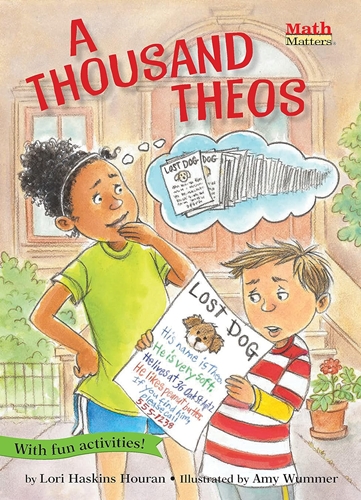
A Thousand Theos
Grade 1
4 skill lessons · 4 math-through-reading
Math
Skill lessons
The mathematics the book carries, taught directly. Printable workbook pages and teacher keys are not available for this book yet.
- 1Two Signs Are Twice One Sign
- 2The Word Each Is Doing All the Work
- 3Count the Names, Check the Number
- 4Ten Steps to Pass a Thousand
Math + reading
Math through the reading
The same book, entered through a sentence it prints. Change one word in the reading and the numbers change with it.
- 5The Word That Turns Adding Two Into Doubling
- 6Put the Signs Back in Order and the Numbers Come Back
- 7Did Jordan Make Them All?
- 8Four More and Half as Many Are the Same Picture
Reading
Reading and language lessons
The same book read as a text. What a word means in its sentence, how a character is shown, how the writing is put together - no mathematics.
- 9Lost Dog: What a Sign Has to Say
- 10A Shaky Voice: How the Book Tells You Benny Is Sad
- 11Kept Spreading, Kept Doubling: Sentences Built the Same Way
- 12I'll Make Another One: The Words People Use to Help
- 13First, Then, At the End: Telling the Whole Book
Skill lessons
4 lessons on the mathematics the book carries. Printable workbook pages and teacher keys are not available for this book yet.
1. Two Signs Are Twice One Sign
Jordan makes one sign, then makes a second, and the book says outright that two signs were twice as good as one. That is the whole idea the rest of the book runs on, and it is small enough to hold in two hands. Students build the first four rungs of the book's own chain with cubes, making a second group that matches the first exactly, then pushing the two together and counting the total. Doubling here means make another one just like it, not multiply, and the second group is built cube by cube against the first so the matching is visible before the total is said.
Full lesson — 20 minutes
1. Make a second group that matches (5 min)
Put one cube on the left row of your doubling mat. That is Jordan's one sign. Now put one cube on the right row, matching it. Push the two rows together and count. Say two out loud. You made a second group that matched the first one exactly.
Word preview: double
I'll make another one, Jordan offered.
Still, two signs were twice as good as one.
2. Double the two (5 min)
Now the left row has two cubes, because Korra and Carl each said they would make a sign. Build a right row that matches it, cube for cube, so neither row is longer. Push them together and count. Say four. Check your partner's mat: did they put the same number in both rows?
Word preview: match
That will double the signs to four.
Two plus two equals four
3. Double the four (5 min)
Slide all four cubes into the left row. Build a right row that matches, one cube at a time, touching the cube you are matching as you go. Do not count the right row until it is finished. Now push and count. Say eight. Say how many cubes you added.
Word preview: equal
That would double the number again to eight.
4 plus 4 equals 8
4. Double the eight and stop (5 min)
Slide all eight into the left row. Match them in the right row. Push and count, and say sixteen. This is where the book stops naming children, so this is where your cubes stop too. Look back along your four totals and say them in order: two, four, eight, sixteen.
Soon there were eight lost dog signs hanging up around town.
8 plus 8 equals 16.
Short version — 9 minutes
1. Make a second group that matches (5 min)
Put one cube on the left row of your mat. Put one cube on the right row, matching it. Push the rows together and count. Say two.
Still, two signs were twice as good as one.
2. Double the two (4 min)
Put two cubes in the left row. Build a right row that matches it cube for cube. Push and count. Say four.
That will double the signs to four.
Two plus two equals four
Three levels
- Support
- Stop the chain at four. Two rungs, one to two and two to four, are enough to meet what doubling is, and both totals stay on the fingers of one hand. Keep the cubes in two straight rows so the child can see a match without counting, and let them say the total by looking rather than by counting on.
- At Grade
- Run all four rungs to sixteen, building the matching row cube by cube each time and saying each total aloud before sliding it left. Say the four totals back in order at the close.
- Extension
- Cover your finished right row with a sheet of paper and tell your partner the total before they lift it. Then take a total your partner names from two, four, eight or sixteen and say what the row before it held, working the chain backwards instead of forwards.
English learners
Double is the load-bearing word and it is a verb here, not an adjective: it names something a child does with their hands, so put the hands first and the word after. Twice as good in the book's sentence is not a quantity comparison at all, it is praise, and a child who reads it as arithmetic will look for a total that is not there; say that sentence with the cubes untouched. The matching itself is language-independent and most children will build the second row correctly before they can name what they did. Children may count both rows in their strongest language and say only the total in English, and the mat records the count either way.
Materials
- Counting cubes, forty per pair, in one colour
- Doubling mat, a paper strip ruled into two rows of boxes
- Word cards: double, match, equal
Standards & curriculum
Choose your curriculum above to see the standards for this lesson.
Standards are held back while this plan is edited. Every standard shown here was matched against the supplied wording of this lesson, quoting its steps, so a changed step is no longer the thing that was checked. Undo your changes to bring the standards back — your edits stay in this browser either way.
2. The Word Each Is Doing All the Work
Jordan's plan works because of one small word. She asks whether each child could get two more friends, and everyone who made a sign asks two more. Delete each from either sentence and the plan collapses into adding two: the signs would go one, three, five instead of one, two, four, eight. Students act out both versions with sign cards on the desk and produce both runs, so the difference between growing by two and doubling is something they built rather than something they were told.
Full lesson — 20 minutes
1. Act out the book's instruction (5 min)
You have one sign card on the desk. The book's rule is that everyone who has a card asks two more. Put two cards next to your one. Now every card on the desk asks two more, so give each of the three cards two of its own. Count what is there. Say your number out loud.
Word preview: each
Everyone who made a sign asked two more kids to make one.
Do you think you could each get two more friends to make signs asked Jordan?
2. Take the word each out (5 min)
Clear the desk back to one card. This time the rule is only two more cards get added, not two more for each. Add two. Then add two again. Then add two again. Count after each round and say the numbers you get. Write nothing down, just say them.
Word preview: only
Just thank one person. And ask them to thank two more.
3. Put the two runs side by side (5 min)
Say your first run of numbers and then your second run. Point at the round where the two runs stop being the same. Tell your partner which single word made the two runs different, and say it in a whole sentence about the cards on your desk.
Then two friends made them. They each asked two friends, and they each asked two friends.
4. Say why the book's way runs away (5 min)
Look at the round where the two runs are furthest apart. Tell your partner why the book's way keeps pulling ahead, using the cards to show it: say how many cards were asking in your round, not just how many were on the desk. Then say the book's own four words about how fast doubling works.
Word preview: everyone
And, well, it turns out doubling works fast.
Jordan is right. Doubling works fast.
Short version — 9 minutes
1. Act out the book's instruction (5 min)
You have one sign card. The rule is that everyone who has a card asks two more. Add two. Now give each of the three cards two of its own. Count and say your number.
Everyone who made a sign asked two more kids to make one.
2. Take the word each out (4 min)
Clear back to one card. This time only two more get added each round, not two for each card. Add two, three times over, counting after each round. Say the numbers.
Just thank one person. And ask them to thank two more.
Three levels
- Support
- Run only two rounds of each version rather than three, and keep the cards in a line so the child can see the two runs without counting them again. The one word is still swapped and the child still produces both runs and says both totals aloud; only the length of the run comes down.
- At Grade
- Run three rounds of both versions, say both runs of numbers aloud, point at the round where they part, and name the word that parted them in a sentence about the child's own cards.
- Extension
- Take a run of numbers your partner produces without being told which rule they used, and say from the numbers alone which sentence they were following. Then find the round at which the book's way first passes twenty, and say whether the other way ever will.
English learners
Each is short, unstressed and easy to lose in connected speech, and this whole lesson turns on hearing it. Say both versions of the instruction back to back with the same rhythm and the same volume, so the cards and not the pronunciation carry the difference. Many languages mark this idea with a word order or a repeated noun rather than a single word, so a child may build the correct run and still have no English word to point at; accept the build first and attach each to it afterwards. A rehearsable frame that carries the quantity is useful here: every card asked two, so we got ___. Children may run the rounds and count in their strongest language and give only the closing sentence in English.
Materials
- Sign cards, small blank squares a child can draw a dog face on, thirty per pair
- Word cards: each, only, everyone
Standards & curriculum
Choose your curriculum above to see the standards for this lesson.
Standards are held back while this plan is edited. Every standard shown here was matched against the supplied wording of this lesson, quoting its steps, so a changed step is no longer the thing that was checked. Undo your changes to bring the standards back — your edits stay in this browser either way.
3. Count the Names, Check the Number
Four times the book stops the story and prints the whole list of children who have made a sign, then prints the number underneath. That is a count and its answer sitting side by side, which is rare and worth using: a child can count the names and find out whether the printed number is right. Students lay out one name card per child in each printed roster, count them, and check their count against the book's own total. The last roster runs to sixteen names, so the count crosses ten and the child must keep track past the fingers they have.
Full lesson — 20 minutes
1. Lay out the first two names (5 min)
Take one blank name card for each child the book names in its first list. Lay them in a row on the desk. Count the cards by touching each one once. Say your number, then listen to the number the book prints under the list. Do they agree?
Word preview: each
Benny, Jordan, one plus one equals two.
2. Add the next two and count again (5 min)
The book's next list has two new names in it. Add one card for each new name to the end of your row. Do not start the row over. Count the whole row from the beginning, touching each card once, and say the total. Check it against the book's number.
Word preview: more
Benny? Jordan? Cora? Carl? Two plus two equals four.
Kora and Carl made their signs right away.
3. Cross ten with the third list (5 min)
The third list is longer than your row. Add a card for every name that is new. Count the whole row again. When you go past ten, keep the counted cards on your left and the uncounted ones on your right so you do not lose your place. Say the total and check it.
Benny, Jordan, Kora, Mack, Abby, Carl, Evan, Lena, 4 plus 4 equals 8.
4. Count the last roster to sixteen (5 min)
The last list names every child so far. Add cards for the new names, then count the whole row one more time. Push each card away as you count it so a card cannot be counted twice. Say sixteen. Now say how many cards you added since the last count.
Word preview: list
Benny Jordan. Korra. Mac. Nick. Andy. Abby. Riley. Sam. Carl. Evan. Tyler. Brett. Lena. Carrie. Fiona. 8 plus 8 equals 16.
Mac asked his neighbors Nick and Andy.
Short version — 9 minutes
1. Lay out the first two names (4 min)
Take one name card for each child in the book's first list. Lay them in a row. Count them by touching each card once and say your number.
Benny, Jordan, one plus one equals two.
2. Add the next two and count again (5 min)
Add one card for each new name in the next list. Count the whole row from the beginning. Say the total and check it against the book's number.
Benny? Jordan? Cora? Carl? Two plus two equals four.
Three levels
- Support
- Stop after the third list, at eight cards. Eight is countable in one pass without a place-keeping trick, so the child practises counting a growing row rather than managing a long one. Lay the cards in two rows of four so the child can check their count by looking at the shape as well as by touching.
- At Grade
- Work all four rosters to sixteen, adding only the new names each time and recounting the whole row, and check every count against the number the book prints.
- Extension
- Before you add the cards for the last list, say how many cards the row will hold when you are done, then add them and find out. Then look at what the book names the same child three different ways in three different lists, and say how you decided whether that was one child or three.
English learners
Each and every are the two words that decide the count here, and both are unstressed in speech, so a child who mishears them counts names rather than children. Touch the card as the number word is said and let the touching, not the hearing, carry the one-to-one rule. The names themselves are a hazard rather than a help: the source prints Korra, Kora and Cora for one child and Mac and Mack for another, so tell the class outright that a spelling change does not mean a new person, and let a child use a drawn face on the card instead of a written name if the spelling is in the way. Children may count in their strongest language throughout and give only the final total in English.
Materials
- Name cards, one blank card per child in the group
- Word cards: each, list, more
Standards & curriculum
Choose your curriculum above to see the standards for this lesson.
Standards are held back while this plan is edited. Every standard shown here was matched against the supplied wording of this lesson, quoting its steps, so a changed step is no longer the thing that was checked. Undo your changes to bring the standards back — your edits stay in this browser either way.
4. Ten Steps to Pass a Thousand
The back of the book prints the chain as a chart and makes a claim about it: keep doubling and you pass one thousand in just ten steps. The numbers in that chart run far past this grade, and no child here computes them. What a child can do, and what this lesson asks, is count the steps. Students number the rungs of the chart one through ten on a step strip, find the rung where the chart's number first goes past a thousand, and check the book's claim about how many steps that took. The mathematics the student performs is a count to ten and a comparison of one number against one thousand, both of them at grade.
Full lesson — 20 minutes
1. Number the rungs (5 min)
Look at the wall chart. Put your finger on the first line of it and lay your step strip beside it. Write 1 in the first box of the strip for that line, then 2 for the next line, and keep going down the chart, one box per line. Say each number as you write it.
Word preview: step
Doubling chart.
Start with the number 1 and double it.
2. Find where the chart passes a thousand (5 min)
The book says the chart passes one thousand. Run your finger down the last number on each line until you reach the first one that is bigger than a thousand. Put a ring round that line on the chart. Do not read the number aloud, just find it.
Word preview: pass
Keep on doubling and you'll pass 1,000 in just 10 steps.
512 plus 512 equals 1,024.
3. Count the steps to the ring (5 min)
Go back to your step strip. Count the boxes from the first one down to the box beside the ringed line, touching each box once. Say your number. That is how many steps the chart took. Say it to your partner before you check anything.
Jordan is right. Doubling works fast.
4. Check the book's claim (5 min)
Now listen to the book's sentence again and say whether your count agrees with it. If it agrees, say the number twice: once as your count and once as the book's. If it does not agree, count your boxes again with your partner watching, and find which box the two of you counted differently.
Word preview: agree
Keep on doubling and you'll pass 1,000 in just 10 steps.
Short version — 9 minutes
1. Number the rungs (4 min)
Lay your step strip beside the wall chart. Write 1 in the first box for the chart's first line, 2 for the next, and keep going down the chart, one box per line.
Doubling chart.
Start with the number 1 and double it.
2. Count the steps to the ring (5 min)
The last line of the chart is the one that passes a thousand. Count the boxes on your strip from the first down to that line, touching each box once. Say your number, then say whether it matches the book's.
Keep on doubling and you'll pass 1,000 in just 10 steps.
Three levels
- Support
- Hand the child a step strip already numbered one to ten and have them match the boxes to the chart's lines by sliding the strip down, one line at a time, saying each number as it lands. The child still finds the ringed line and still counts the boxes to it; only the writing of the numerals comes off.
- At Grade
- Number the strip from the chart, find the first line past one thousand, count the boxes to it, and say whether the count agrees with the book's ten.
- Extension
- Cover the bottom half of the chart. Say how many more steps the chart will need after the last visible line before it passes a thousand, then uncover it and count. Then say what would happen to the number of steps if the chart had started at two instead of one, and check it against the chart you can see.
English learners
This lesson has two kinds of number on the page and only one of them is the child's: the chart's numbers are read and pointed at, the strip's numbers are counted and said. Make that split explicit, because a child who thinks they are being asked to read one thousand and twenty-four aloud will stop working. Step is the word to pre-teach and it is not the everyday one, so show it as a line on the chart before it is ever said in a sentence. Pass is the other load-bearing word and it means goes beyond here, not hands over; the ringed line is the demonstration. Children may count the boxes and check with a partner in their strongest language, and say only the final count in English.
Materials
- Step strip, a paper strip ruled into ten numbered boxes
- The book's doubling chart, copied large onto a wall sheet
- Word cards: step, pass, agree
Standards & curriculum
Choose your curriculum above to see the standards for this lesson.
Standards are held back while this plan is edited. Every standard shown here was matched against the supplied wording of this lesson, quoting its steps, so a changed step is no longer the thing that was checked. Undo your changes to bring the standards back — your edits stay in this browser either way.
Math through the reading
The mathematics is reached through a sentence the book prints: change one word in the reading and the numbers change with it. These carry their own standards, matched against these lessons rather than inherited from the skill ones.
5. The Word That Turns Adding Two Into Doubling
Students act out two versions of the book's rule with sign cards and find that everyone and each, not the two, are what make the signs double.
Full lesson — 20 minutes
1. Hear the rule twice (4 min)
Students hear Jordan's rule read aloud twice and say which single word tells them how many cards to add. They say what they think it orders while their hands are still, and the competing guesses are left standing on the board.
2. Build the book's rule (6 min)
Students lay out four sign cards and act the rule as the book states it: every card on the desk asks two more, so each of the four gets two of its own. They count what arrived, count the whole desk, and say both numbers aloud.
3. Change the one word (6 min)
Students clear back to four cards and hear the rule with someone in place of everyone. They build what that sentence orders, two cards arriving in all, count, and say the new total. Both groups stay on the desk side by side.
4. Say it about your own cards (4 min)
Each student says one sentence to a partner about their own two groups, naming how many cards were asking and how many arrived, and using the word that made the difference. The partner checks the sentence against the cards while it is said.
Short version — 9 minutes
1. Build the book's rule (6 min)
Students lay out four sign cards and act the rule as the book states it: every card on the desk asks two more, so each of the four gets two of its own. They count what arrived, count the whole desk, and say both numbers aloud.
2. Change the one word (6 min)
Students clear back to four cards and hear the rule with someone in place of everyone. They build what that sentence orders, two cards arriving in all, count, and say the new total. Both groups stay on the desk side by side.
Three levels
- Support
- Start the group at two cards rather than four, so the book's reading gives six and the swapped reading gives four, and both totals stay small enough to see without counting twice. The swap is still built both ways and the child still says both totals; only the size of the starting group comes down, so the word stays the thing under test.
- At grade
- Build both readings from a starting group of four, count and say both totals, and say one sentence about the child's own cards that carries the word and both numbers.
- Extension
- Take a finished pair of groups a partner built without being told which rule they used, and say from the cards alone which sentence they were following. Then find a starting group for which the two readings would produce the same total, and say why one is the only one that works.
English learners
The words doing the work here are unstressed and easy to lose: each, everyone and someone all sit in the weak part of the sentence and none of them is the word a child is listening for, which is two. Read both versions back to back at the same speed and the same volume so the cards, not the emphasis, carry the difference. Many languages distribute a quantity by repeating the noun or by changing word order rather than by a single word, so a child may build the correct group and have no English word to point at; take the build first and attach the word to it afterwards. A frame worth rehearsing carries the quantity with it: every card asked two, so ___ came. Children may count and check with a partner in their strongest language and give only the closing sentence in English.
Materials
- Sign cards, small blank squares a child can draw a dog face on, thirty per pair
- The two versions of Jordan's rule, written large on a card, one above the other
- The book's eight-name roster with its total, copied onto a wall sheet
Standards & curriculum
Choose your curriculum above to see the standards for this lesson.
Standards are held back while this plan is edited. Every standard shown here was matched against the supplied wording of this lesson, quoting its steps, so a changed step is no longer the thing that was checked. Undo your changes to bring the standards back — your edits stay in this browser either way.
6. Put the Signs Back in Order and the Numbers Come Back
Students restore the shuffled order of the book's five sign events and build the pile each one leaves, finding that a strip in the wrong place breaks every number after it.
Full lesson — 20 minutes
1. Build the chain in order (7 min)
Students receive the five event strips shuffled and lay them out in the order they think the story went. They then build the cube pile each strip leaves, starting from one cube, doubling by matching the pile they have and pushing the two together, and say each total aloud as it arrives.
2. Check against the captions (5 min)
Students turn over each strip to find the number sentence the book printed under that stage and compare it with the pile they built. Where a pile and a caption disagree, they move the strip, rebuild from that point on, and say which totals changed as a result.
3. Find the strip that will not move (5 min)
Students take the strip where the signs first double to four and try putting it earlier and later in the row, building the pile each time. They say what number comes out in each wrong position and why the book's four cannot arrive from either.
4. Retell it with the numbers in (3 min)
Partners retell the five stages to each other in order, saying the number of signs after each stage. The listener holds the cube pile and grows it as the teller speaks, and stops the teller whenever the pile and the words disagree.
Short version — 9 minutes
1. Build the chain in order (7 min)
Students receive the five event strips shuffled and lay them out in the order they think the story went. They then build the cube pile each strip leaves, starting from one cube, doubling by matching the pile they have and pushing the two together, and say each total aloud as it arrives.
2. Find the strip that will not move (5 min)
Students take the strip where the signs first double to four and try putting it earlier and later in the row, building the pile each time. They say what number comes out in each wrong position and why the book's four cannot arrive from either.
Three levels
- Support
- Work three strips rather than five, from one sign to four, so the piles stay on one hand and the doubling can be seen without recounting. The child still orders the strips, still builds each pile, and still says why one strip comes before another using the numbers; only the length of the chain comes down.
- At grade
- Order all five strips, build the pile at every stage by matching and combining, check each against the book's printed caption, and give a because-sentence naming two numbers for at least one pair of strips.
- Extension
- Take a chain a partner has deliberately mis-ordered by one strip and, without being told which strip moved, find it from the piles alone and say how many of the later totals it spoiled. Then say what the sixth strip's caption would have to read, and why the book stopped naming children at that point.
English learners
The connective words are what this lesson turns on and they are the ones textbooks assume: before, after, then, next, and above all because, which has to carry a number on both sides of it here. Give the frame with the numbers already in it and let children fill the blanks from their own strips rather than composing the whole sentence: this one comes first because there were only ___ signs, so doubling gives ___. Ordering and doubling are both language-independent and most children will have the strips right before they can justify them in English, so accept a correct pointing finger as a first answer and ask for the sentence second. The story's names are transcribed inconsistently, so let children mark strips with a drawing rather than a name. Children may argue the order and count the piles in their strongest language and give only the because-sentence in English.
Materials
- Counting cubes, forty per pair, in one colour
- Event strips, five paper strips carrying one sentence each with the book's number sentence printed on the back
- The five stages listed in book order, kept face down until the checking segment
Standards & curriculum
Choose your curriculum above to see the standards for this lesson.
Standards are held back while this plan is edited. Every standard shown here was matched against the supplied wording of this lesson, quoting its steps, so a changed step is no longer the thing that was checked. Undo your changes to bring the standards back — your edits stay in this browser either way.
7. Did Jordan Make Them All?
Students take a side on the question Benny asks and Jordan half-answers, and defend it out loud to a partner playing Benny, with a number in the sentence.
Full lesson — 20 minutes
1. Lay out the makers (5 min)
Students lay out one card for every child the book's last roster names and count them, reaching sixteen. They mark the card that is Jordan's and say aloud how many of the sixteen she drew herself.
2. Pull the first card (6 min)
Students rebuild the chain from one card up to sixteen, then take Jordan's first card away and try to build it again. They find they cannot start, and say what the totals at each rung become without it.
3. Say it to Benny (6 min)
Each student takes a side and says it to a partner playing Benny, giving a number and saying what the number counts. The partner answers back with the other side, also with a number, and each says whether they are holding their position or changing it.
4. Name what you were counting (3 min)
Partners say in one sentence what the two of them were each counting, hands or signs-that-exist-because, and say whether the two answers can both be right at the same time.
Short version — 9 minutes
1. Lay out the makers (5 min)
Students lay out one card for every child the book's last roster names and count them, reaching sixteen. They mark the card that is Jordan's and say aloud how many of the sixteen she drew herself.
2. Say it to Benny (6 min)
Each student takes a side and says it to a partner playing Benny, giving a number and saying what the number counts. The partner answers back with the other side, also with a number, and each says whether they are holding their position or changing it.
Three levels
- Support
- Work with the eight-name roster rather than the sixteen, so the count stays in one pass and the child's attention can sit on the argument rather than on keeping place. Give the frame with both blanks carrying numbers, I think ___ because Jordan made ___ of them, and let the child fill it from the cards in front of them before saying it to Benny.
- At grade
- Count the sixteen makers, pull the first card and report what each rung becomes without it, take a side, and defend it to a partner with a number and a statement of what that number counts.
- Extension
- Take the side you did not argue and make the strongest case you can for it, then say which of your two arguments you actually believe and why the numbers made you choose. Then say what Benny's mother would have had to count to know whether a hundred or a thousand was right, and whether the book anywhere gives it to her.
English learners
This lesson asks for a because-sentence with a number inside it, which is a demanding shape, so supply it rather than expecting it: I think ___ because Jordan made ___ of them. Only mine, all of them and none of them are the phrases children will reach for, and the difference between them is quantitative rather than emotional, so keep the sixteen cards on the desk while any of them are said. Taking a position and holding it under disagreement is culturally loaded and some children will not contradict a partner directly; let those children answer Benny rather than answer each other, which is what the audience is for. The counting and the card-pulling are language-independent and carry the argument on their own, so a child who can only point at the empty place where Jordan's card was has made the case. Children may argue in their strongest language and give only the sentence to Benny in English.
Materials
- Sign cards, small blank squares a child can draw a dog face on, thirty per pair
- The book's sixteen-name roster, copied onto a wall sheet
- Benny's question and Jordan's answer, written large on two cards
Standards & curriculum
Choose your curriculum above to see the standards for this lesson.
Standards are held back while this plan is edited. Every standard shown here was matched against the supplied wording of this lesson, quoting its steps, so a changed step is no longer the thing that was checked. Undo your changes to bring the standards back — your edits stay in this browser either way.
8. Four More and Half as Many Are the Same Picture
Students build two rungs of the book's chain as matched rows of cubes and say the relation between them both ways round, without the cubes moving.
Full lesson — 20 minutes
1. Build the two rows (6 min)
Students build a row of four cubes for one rung and a row of eight for the next, starting both rows from the same line on the desk. They push the rows together so each cube in the short row faces one in the long row and say how many cubes are left over at the end.
2. Say it the book's way (4 min)
Students say the relation in the direction the book uses, naming the larger number first and using the word the book gave them, and point at the leftover cubes as they say it.
3. Say it the other way round (6 min)
Students say the relation starting from the smaller number instead, and find that the word has to change while the cubes do not. They say both sentences one after the other over the same unmoved rows and say whether the two sentences disagree about anything.
4. Do it again on a different rung (4 min)
Students rebuild with a different pair of rungs from the chain, two against four, and produce both sentences again. They say which of the words they used came from the book and which they had to supply themselves.
Short version — 9 minutes
1. Build the two rows (6 min)
Students build a row of four cubes for one rung and a row of eight for the next, starting both rows from the same line on the desk. They push the rows together so each cube in the short row faces one in the long row and say how many cubes are left over at the end.
2. Say it the other way round (6 min)
Students say the relation starting from the smaller number instead, and find that the word has to change while the cubes do not. They say both sentences one after the other over the same unmoved rows and say whether the two sentences disagree about anything.
Three levels
- Support
- Work the pair one against two, which is the book's own first rung and the pair it actually gives two words for. One cube facing two makes a single leftover cube, so the difference is visible without counting and the child's whole attention can go on the two sentences and the word that changes between them.
- At grade
- Build four against eight as matched rows, say both directions of the relation using the correct comparison word for each, then rebuild on two against four and produce both sentences again.
- Extension
- Say the pair four and eight a third way, using half, and say whether that sentence agrees with the other two or contradicts them. Then find the one rung in the whole chain where the difference between the two rows is the same as the smaller row itself, and say why that is true of every rung rather than special to one.
English learners
Comparative syntax is where this lesson will be hardest and it varies sharply across languages: more than and fewer than put the two quantities in an order that some children's first language reverses, and many languages mark the comparison on the adjective rather than with a separate word, so a child may know the relation perfectly and still assemble the English sentence backwards. Keep both rows on the desk while either sentence is said and let the finger, not the word order, carry which quantity is being talked about. Fewer is the word this lesson has to supply and it is rarer in speech than less, so accept less at first and attach fewer to the countable cubes afterwards. Give both frames written on the same card so the child can see them as one pair rather than two tasks: ___ is ___ more than ___, and ___ is ___ fewer than ___. Children may build, match and check in their strongest language and give the two finished sentences in English.
Materials
- Counting cubes, forty per pair, in two colours
- The two frame sentences with their blanks, written large on one card
- The book's captions for the rungs being compared, copied onto a wall sheet
Standards & curriculum
Choose your curriculum above to see the standards for this lesson.
Standards are held back while this plan is edited. Every standard shown here was matched against the supplied wording of this lesson, quoting its steps, so a changed step is no longer the thing that was checked. Undo your changes to bring the standards back — your edits stay in this browser either way.
Reading and language lessons
5 lessons on the reading and language the book carries - what a word means in its sentence, how a character is shown, how a text is built. No mathematics: these are matched against the English language arts curricula, which are a different and smaller set than the mathematics ones.
9. Lost Dog: What a Sign Has to Say
The book prints a whole lost-dog sign, and it is written nothing like the story around it — short lines, a heading, no characters. Students read the sign aloud, point at the parts that name and locate the puppy, then hold it beside a story passage and hear the difference. They finish by saying what they would add so it worked better. Nothing is counted or doubled; the work is reading a piece of everyday writing and saying what each part is for.
Full lesson — 20 minutes
1. Read a sign out loud (6 min)
The teacher reads the passage below once. Then read the sign part together as a class, one line at a time. Point with your finger to the part that tells Theo's name, then to the part that tells where he lives. Say aloud one thing the sign tells you about Theo.
Word preview: sign
Jordan read the sign Benny's mom was taping to the front door. Lost Dog, his name is Theo. He is very soft. He lives at 36 Oak Street apartment 2. He likes peanut butter.
2. Sort what a sign tells and what a story tells (5 min)
Read the two passages below with the teacher. One is a sign. One is a story. Hold up one finger for the sign and two fingers for the story. Then say aloud one thing the sign tells you that the story does not.
Word preview: story
Jordan read the sign Benny's mom was taping to the front door. Lost Dog, his name is Theo. He is very soft. He lives at 36 Oak Street apartment 2. He likes peanut butter.
Jordan, have you seen my puppy? Jordan looked down at her neighbor Benny. He was usually bouncy and happy, kind of like a puppy himself. But not today.
3. Find the part that helps somebody find Theo (5 min)
Read the passage below again with a partner. Circle with your finger the part that would help a stranger know they had the right dog. Say aloud why that part matters more than the others for finding a lost puppy.
Word preview: find
Jordan read the sign Benny's mom was taping to the front door. Lost Dog, his name is Theo. He is very soft. He lives at 36 Oak Street apartment 2. He likes peanut butter.
4. Say what you would add to the sign (4 min)
Read the passage below, where somebody finally does find Theo. Then tell a partner one thing you would add to a lost-dog sign so it worked even better. Say why, in one sentence.
Word preview: add
Hi there, the ice cream man said. I was going to call, but I decided to stop by since you're right on my route. Is this guy yours? He held up a wiggly brown puppy.
Short version — 9 minutes
1. Read a sign out loud (5 min)
The teacher reads the passage once. Read the sign part together, one line at a time. Point to Theo's name, then to where he lives, then say one thing the sign tells you.
Word preview: sign
Jordan read the sign Benny's mom was taping to the front door. Lost Dog, his name is Theo. He is very soft. He lives at 36 Oak Street apartment 2. He likes peanut butter.
2. Find the part that helps somebody find Theo (4 min)
Read the passage again with a partner. Point to the part that would help a stranger know they had the right dog, and say why that part matters most.
Word preview: find
Jordan read the sign Benny's mom was taping to the front door. Lost Dog, his name is Theo. He is very soft. He lives at 36 Oak Street apartment 2. He likes peanut butter.
Three levels
- Support
- Read only the printed sign in step 1, with the teacher reading first and you echoing. Point to the two words Lost Dog. Then answer aloud: what is the puppy's name? Say it twice.
- At Grade
- Read the printed sign, point at the name and the address, then hold it beside the story passage and say one thing the sign tells that the story does not.
- Extension
- The printed sign says he is very soft and that he likes peanut butter. Say two sentences about which of those two would help a stranger more, and why.
English learners
A sign in English drops the little words a reader expects in a sentence — Lost Dog, not A dog is lost — so it can read as broken rather than as a style. Read the sign line, then the full sentence it stands for, so the missing words are heard. Invite students to describe a sign they have seen in their neighbourhood, in their strongest language, and say what it told people. Rehearsable frame: The sign says ___. That means ___.
Materials
- A Thousand Theos, the passage printed in this step
- pointing finger
- sign and story cards
- Word cards: sign, story, find, add
Standards & curriculum
Choose your curriculum above to see the standards for this lesson.
Standards are held back while this plan is edited. Every standard shown here was matched against the supplied wording of this lesson, quoting its steps, so a changed step is no longer the thing that was checked. Undo your changes to bring the standards back — your edits stay in this browser either way.
10. A Shaky Voice: How the Book Tells You Benny Is Sad
The book almost never names a feeling. It says Benny was usually bouncy but not today, that his voice is shaky, that a smile faded, that he would not look up. Students read the voices aloud and act them, point at the words that carry feeling without naming it, then watch the change when the puppy comes back. They finish by naming a feeling and pointing at one word as proof. The work is inference from what a book shows.
Full lesson — 20 minutes
1. Read two voices and show them (6 min)
The teacher reads the two passages below. Then read Benny's words aloud in the voice the book says he used. Show with your face and shoulders how Benny looks. Say aloud one word for how Benny feels.
Word preview: shaky
Jordan, have you seen my puppy? Jordan looked down at her neighbor Benny. He was usually bouncy and happy, kind of like a puppy himself. But not today.
It's just one little sign said Benny in a shaky voice.
2. Find the words that show feeling without naming it (5 min)
Read the two passages below with a partner. Neither one says the word sad or the word happy. Point to the words that show you how somebody feels anyway — a smile, a grin, a voice. Say each one aloud and add your own feeling word after it.
Word preview: smile
Wow, said Benny, then a smile faded. But the real Theo is still gone. Benny sat down on the steps. His mom and Jordan sat beside him.
Easy said Jordan. She grinned. Just thank one person. And ask them to thank two more.
3. Watch a feeling change (5 min)
Read the two passages below in the order printed. In the first, Benny will not even look up. In the second, something is different. Say aloud what changed, then point to the word in the second passage that shows it.
Word preview: changed
Ding ding ding! Benny didn't even look up at the sound of the ice cream truck. Jordan watched it pull in front of their building.
Theo cried, Benny. The puppy jumped from the man's arms and ran straight to Benny. Benny hugged him tightly.
4. Say a feeling and point at your proof (4 min)
Choose any moment from the passage printed below. Tell a partner in one sentence how that person feels. Then put your finger on the word in the passage that proves it and read that word out loud.
Word preview: proof
Benny picked peanut butter to share with Theo. Jordan chose Cherry Vanilla with sprinkles. The ice cream man pulled away, tooting his horn cheerfully. Thanks again, Benny called after him. Woof! Added Theo.
Short version — 9 minutes
1. Read two voices and show them (5 min)
The teacher reads both passages. Read Benny's words in the voice the book names. Show with your face how Benny looks and say one word for how he feels.
Word preview: shaky
Jordan, have you seen my puppy? Jordan looked down at her neighbor Benny. He was usually bouncy and happy, kind of like a puppy himself. But not today.
It's just one little sign said Benny in a shaky voice.
2. Watch a feeling change (4 min)
Read both passages in the printed order. Say aloud what changed between them and point to the word in the second that shows it.
Word preview: changed
Ding ding ding! Benny didn't even look up at the sound of the ice cream truck. Jordan watched it pull in front of their building.
Theo cried, Benny. The puppy jumped from the man's arms and ran straight to Benny. Benny hugged him tightly.
Three levels
- Support
- Use only the second printed passage in step 1. Say the words in a shaky voice yourself, then in a strong voice. Answer aloud: which one sounds worried? Point to the word shaky.
- At Grade
- Read both printed passages, act each voice, and name a feeling word for each, then compare the two passages in the change step.
- Extension
- In step 1's first printed passage the book says Benny is usually bouncy and happy. Say two sentences about why the word usually matters, and what a reader would miss if it were not there.
English learners
Shaky, bouncy and faded describe a voice or a face and leave the feeling for the reader to supply — an English habit that transfers once students see it happening. Say each word with the matching face and voice before students read. Invite them to show, in their strongest language, how somebody sounds when they are worried, and let the class guess. Rehearsable frame: His voice is ___, so he feels ___.
Materials
- A Thousand Theos, the passage printed in this step
- pointing finger
- feelings cards
- Word cards: shaky, smile, changed, proof
Standards & curriculum
Choose your curriculum above to see the standards for this lesson.
Standards are held back while this plan is edited. Every standard shown here was matched against the supplied wording of this lesson, quoting its steps, so a changed step is no longer the thing that was checked. Undo your changes to bring the standards back — your edits stay in this browser either way.
11. Kept Spreading, Kept Doubling: Sentences Built the Same Way
Two sentences sit side by side built to exactly the same plan, and a longer passage lines up four more that each start with a name and a doing word. Students clap the shared word, point at the sentence openings, then speak the pattern with their own names in it, which is where a grade-one reader turns a pattern into their own sentence. Nothing is doubled or counted; the work is hearing and using a sentence shape.
Full lesson — 20 minutes
1. Hear a sentence shape come back (6 min)
The teacher reads the two passages below. Then read the short one together three times, clapping once on the word kept each time. Say aloud what word comes right after kept both times in that short passage.
Word preview: kept
The word kept spreading. The signs kept doubling.
Kora tacked her's up at the skateboard park where she ran into Mac and Abby. They wanted to make signs too. Carl stapled his sign on the Library bulletin board. He told Evan and Lena very quietly what was going on. They couldn't wait to make signs of their own.
2. Find the sentences that begin the same way (5 min)
Read the two passages below with a partner. Both start with a name and then tell what that person did with a sign. Point to the first word of each sentence in the second passage. Say aloud what all those sentences have in common.
Word preview: pattern
Jordan was putting up her sign when Korra and Carl rode by on their bikes. What's up? asked Korra. Cute dog said Carl.
Kora tacked her's up at the skateboard park where she ran into Mac and Abby. They wanted to make signs too. Carl stapled his sign on the Library bulletin board. He told Evan and Lena very quietly what was going on. They couldn't wait to make signs of their own.
3. Say the pattern with your own name in it (5 min)
Read the passage below one more time for its shape. Then say a sentence out loud using the same shape but your own name and something you did: your name, then what you did, then where. Everybody in the group takes a turn.
Word preview: turn
Kora tacked her's up at the skateboard park where she ran into Mac and Abby. They wanted to make signs too. Carl stapled his sign on the Library bulletin board. He told Evan and Lena very quietly what was going on. They couldn't wait to make signs of their own.
4. Read the two-sentence pattern one last time (4 min)
Read the passage below aloud as a class, then in two halves — one half reads the first sentence, one half reads the second. Say aloud whether the two sentences sound the same or different, and name the word they share.
Word preview: shared
The word kept spreading. The signs kept doubling.
Short version — 9 minutes
1. Hear a sentence shape come back (5 min)
The teacher reads both passages. Read the short one together three times, clapping on kept. Say what word comes right after kept both times.
Word preview: kept
The word kept spreading. The signs kept doubling.
Kora tacked her's up at the skateboard park where she ran into Mac and Abby. They wanted to make signs too. Carl stapled his sign on the Library bulletin board. He told Evan and Lena very quietly what was going on. They couldn't wait to make signs of their own.
2. Say the pattern with your own name in it (4 min)
Read the passage below for its shape. Then say a sentence out loud with your own name, what you did, and where. Everyone takes a turn.
Word preview: turn
Kora tacked her's up at the skateboard park where she ran into Mac and Abby. They wanted to make signs too. Carl stapled his sign on the Library bulletin board. He told Evan and Lena very quietly what was going on. They couldn't wait to make signs of their own.
Three levels
- Support
- Use only the short printed passage in step 1. Echo the teacher one sentence at a time. Clap once on kept. Then answer aloud: did you hear the same word twice? Say kept twice yourself.
- At Grade
- Clap the shared word in the short printed passage, then point at the sentence openings in the longer one and say your own sentence in that shape.
- Extension
- The short printed passage could have been written as one long sentence instead of two short ones. Say two sentences about why two short ones sound better here, and read both aloud to show what you mean.
English learners
The pattern here is kept plus an -ing word, an English shape for something that goes on and on that many languages build a completely different way. Clap the two-beat rhythm before reading so students hold the shape by ear. Invite them to say, in their strongest language, that something keeps happening, and tell the class which word did that job. Rehearsable frame: The ___ kept ___ing.
Materials
- A Thousand Theos, the passage printed in this step
- clapping hands
- sentence pattern strips
- Word cards: kept, pattern, turn, shared
Standards & curriculum
Choose your curriculum above to see the standards for this lesson.
Standards are held back while this plan is edited. Every standard shown here was matched against the supplied wording of this lesson, quoting its steps, so a changed step is no longer the thing that was checked. Undo your changes to bring the standards back — your edits stay in this browser either way.
12. I'll Make Another One: The Words People Use to Help
Almost everything in this book happens because somebody says the right thing to somebody else. Students read three offers of help and name who is offering what, sort an ask from a promise by the question mark and the words around it, read the thank-you exchange in two voices, then make an offer of their own out loud and hear it answered. The work is the everyday language of offering, asking and thanking — spoken, not counted.
Full lesson — 20 minutes
1. Read three people offering to help (6 min)
The teacher reads the three passages below. Then read aloud, one student each, the words where somebody offers to help. Say aloud who is offering in each one and what they are offering to do.
Word preview: offered
I'll make another one, Jordan offered. I can hang it up at the soccer field on my way to practice. That would be great, said Benny's mom.
Jordan told them about Benny's lost puppy. Benny was worried that one sign wasn't enough. So I made a second one, Jordan explained.
Thank you so much, said Benny. You're welcome, said the ice cream man. Would you kids like some ice cream too? Ooh, yes, please!
2. Sort asking words from telling words (5 min)
Read the two passages below with a partner. One person is asking for something and one is promising something. Point to the question mark. Then say aloud which passage is an ask and which is a promise, and name the words that decided it.
Word preview: promise
Can't we look for him now? Benny begged his mom. I'm so sorry, honey. We have to go, she said. But I bet someone will see your sign and find him.
Don't worry, Jordan told him. We'll find Theo.
3. Read the thank-you words (5 min)
Read the passage below aloud with a partner, taking one voice each. Point to the words that say thank you and to the words that answer them. Say aloud what a person says back when somebody thanks them.
Word preview: welcome
Thank you so much, said Benny. You're welcome, said the ice cream man. Would you kids like some ice cream too? Ooh, yes, please!
4. Offer help out loud (4 min)
Read the passage below one more time for the words Jordan uses. Then turn to a partner and offer to help them with something, using a sentence that starts with I'll. Your partner answers the way Benny's mom answers in the passage.
Word preview: offer
I'll make another one, Jordan offered. I can hang it up at the soccer field on my way to practice. That would be great, said Benny's mom.
Short version — 9 minutes
1. Read three people offering to help (5 min)
The teacher reads the three passages. Read aloud the words where somebody offers to help, and say who is offering and what they will do.
Word preview: offered
I'll make another one, Jordan offered. I can hang it up at the soccer field on my way to practice. That would be great, said Benny's mom.
Jordan told them about Benny's lost puppy. Benny was worried that one sign wasn't enough. So I made a second one, Jordan explained.
Thank you so much, said Benny. You're welcome, said the ice cream man. Would you kids like some ice cream too? Ooh, yes, please!
2. Read the thank-you words (4 min)
Read the passage aloud with a partner, one voice each. Point to the thank-you words and to the answer, then say what a person says back when thanked.
Word preview: welcome
Thank you so much, said Benny. You're welcome, said the ice cream man. Would you kids like some ice cream too? Ooh, yes, please!
Three levels
- Support
- Use only the first printed passage in step 1. Echo the teacher on the words I'll make another one. Then answer aloud: is Jordan helping? Say the two words thank you to a partner and hear them answer.
- At Grade
- Read all three printed passages, name who offers what in each, then read the thank-you exchange in two voices.
- Extension
- In step 1's first printed passage Jordan offers before anybody asks her. Say two sentences about why that is different from being asked, and read the sentence that shows nobody asked.
English learners
I'll is a contraction of I will and it carries the whole offer, so a learner who hears it as one short sound may miss that a promise was made. Say I will make another one and then I'll make another one, and let students hear the two as the same. Invite them to make an offer in their strongest language and say which word promised. Rehearsable frame: I'll ___ for you.
Materials
- A Thousand Theos, the passage printed in this step
- pointing finger
- asking and telling cards
- Word cards: offered, promise, welcome, offer
Standards & curriculum
Choose your curriculum above to see the standards for this lesson.
Standards are held back while this plan is edited. Every standard shown here was matched against the supplied wording of this lesson, quoting its steps, so a changed step is no longer the thing that was checked. Undo your changes to bring the standards back — your edits stay in this browser either way.
13. First, Then, At the End: Telling the Whole Book
A puppy is lost, a town fills up with signs, and an ice cream man brings him back — three parts a grade-one reader can hold. Students read the beginning and state the problem, read two middle passages and say what people are doing about it, read the ending and name who solved it and how he knew. They finish by telling the whole book in three sentences using First, Then and At the end. Nothing is added up; the work is retelling in order.
Full lesson — 20 minutes
1. Read the beginning and say the problem (5 min)
The teacher reads the two passages below. Then say aloud, in one sentence, what has gone wrong at the start of this book. Point to the words in the second passage that tell you Benny does not think one sign is enough.
Word preview: beginning
Jordan, have you seen my puppy? Jordan looked down at her neighbor Benny. He was usually bouncy and happy, kind of like a puppy himself. But not today.
It's just one little sign said Benny in a shaky voice.
2. Read the middle and say what people do about it (5 min)
Read the two passages below with the teacher. Both are from the middle of the book. Say aloud one thing people are doing to fix the problem. Then say whether the problem is fixed yet, and point to the words that tell you.
Word preview: middle
Jordan felt much better. Eight signs. That was pretty good. Maybe somebody would see one and find Theo. Benny would be so happy.
Jordan couldn't believe it. Theos' face was everywhere. Someone had to find him now, didn't they?
3. Read the end and say who solved it (6 min)
Read the two passages below in the order printed, taking turns with a partner. Say aloud who finds Theo and how he knew whose dog it was. Then point to the sentence that shows Benny is not sad any more.
Word preview: end
Hi there, the ice cream man said. I was going to call, but I decided to stop by since you're right on my route. Is this guy yours? He held up a wiggly brown puppy.
Theo cried, Benny. The puppy jumped from the man's arms and ran straight to Benny. Benny hugged him tightly.
4. Tell the whole book in three sentences (4 min)
Read the passage below, where the book finishes. Then use your mat to tell a partner the whole book in three sentences: what went wrong, what people did, and how it ended. Start each sentence with First, Then, or At the end.
Word preview: retell
Benny picked peanut butter to share with Theo. Jordan chose Cherry Vanilla with sprinkles. The ice cream man pulled away, tooting his horn cheerfully. Thanks again, Benny called after him. Woof! Added Theo.
Short version — 9 minutes
1. Read the beginning and say the problem (5 min)
The teacher reads both passages. Say in one sentence what has gone wrong, then point to the words telling you Benny does not think one sign is enough.
Word preview: beginning
Jordan, have you seen my puppy? Jordan looked down at her neighbor Benny. He was usually bouncy and happy, kind of like a puppy himself. But not today.
It's just one little sign said Benny in a shaky voice.
2. Read the end and say who solved it (4 min)
Read both passages in the printed order, taking turns. Say who finds Theo and how he knew, then point to the sentence showing Benny is not sad any more.
Word preview: end
Hi there, the ice cream man said. I was going to call, but I decided to stop by since you're right on my route. Is this guy yours? He held up a wiggly brown puppy.
Theo cried, Benny. The puppy jumped from the man's arms and ran straight to Benny. Benny hugged him tightly.
Three levels
- Support
- Use step 1's first printed passage and step 3's second printed passage only. Answer two questions aloud: at the start, is the puppy lost or found? At the end, is he lost or found? Put a beginning card and an end card on the mat in that order.
- At Grade
- Read the beginning, middle and end passages, say the problem and the solution, and place all three cards on the mat in order.
- Extension
- In step 3's first printed passage the ice cream man says he was going to call. Say two sentences about how he knew whose dog it was, using words from that printed passage as your reason.
English learners
Retelling in English depends on First, Then and At the end sitting at the front of the sentence, where a listener meets them before the event. Say the three words with three fingers held up before students retell, so the order is held in the hand as well as the ear. Invite students to retell the book in their strongest language first, keeping three parts, then in English. Rehearsable frame: First ___. Then ___. At the end ___.
Materials
- A Thousand Theos, the passage printed in this step
- pointing finger
- beginning middle end mat
- Word cards: beginning, middle, end, retell
Standards & curriculum
Choose your curriculum above to see the standards for this lesson.
Standards are held back while this plan is edited. Every standard shown here was matched against the supplied wording of this lesson, quoting its steps, so a changed step is no longer the thing that was checked. Undo your changes to bring the standards back — your edits stay in this browser either way.