Tightwad Tod
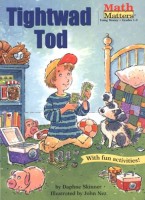
Grade 2
4 skill lessons
Math
Skill lessons
The mathematics the book carries, taught directly. Printable workbook pages and teacher keys are not available for this book yet.
- 1Running Todd's Money Down to Nothing
- 2The Twenty, the Seven, and the Dollars in Between
- 3Enough, or Not Enough?
- 4How Many Coins Are in Todd's Full Jar?
Math + reading
Math through the reading
The same book, entered through a sentence it prints. Change one word in the reading and the numbers change with it.
No math-through-reading lessons for this book yet.
Reading
Reading and language lessons
The same book read as a text. What a word means in its sentence, how a character is shown, how the writing is put together - no mathematics.
No reading and language lessons for this book yet.
Skill lessons
4 lessons on the mathematics the book carries. Printable workbook pages and teacher keys are not available for this book yet.
1. Running Todd's Money Down to Nothing
The book stops three times to say how much money Todd still has, and between the stops it says what went out. Students lay one-dollar bills in a row, take away the dollars each event costs, and count what stays, checking their row against the figure the book prints next. The seven dollars the calculator reports and the four dollars Todd counts a page later are the book's own numbers, and three dollars is exactly the gap between them, so a row that comes out wrong is caught by the book rather than by the teacher. Every amount here is whole dollars, taken away one purchase at a time, and no student adds anything.
Full lesson — 20 minutes
1. Lay out the seven dollars the calculator reported (4 min)
Read the calculator's line aloud with your partner, then count seven one-dollar bills onto the felt strip, one at a time, saying the numbers as you go. Leave a gap at the end of the strip. Say how much money Todd has standing on the escalator.
Word preview: left
It made a chiming noise like a tiny bell and told him that he had $7 left to spend.
2. Pay the photo booth and count what stays (6 min)
Read the booth's price and slide that many dollars off the strip into the GONE tray, counting them as they leave. Now count the bills still on the strip and say the amount aloud before you turn the page. Then read Todd's own line and check whether your strip matches his number.
Word preview: cost
Four pictures for $3, he said.
But I've only got $4 left.
3. Move two dollars out to Ada (5 min)
Ada needs two dollars. Move two bills off the strip into the LENT tray, not the GONE tray, and say out loud which tray they went into and why. Count what is left on the strip and say that amount to your partner.
Word preview: lent
So, he lent me two dollars, she asked.
4. Feed the arcade until the strip is empty (5 min)
The book does not say what a game cost, so your class sets the price at one dollar. Move bills off the strip one game at a time, counting the games, and stop when the strip is bare. Say how much money the arcade took, which the book does settle, and then say how many games that was, which only your class's price settles. Read the book's line and say whether your strip agrees that his money is gone.
Word preview: gone
They played one game and another and another until all Todd's money was gone.
I'm broke, he grinned.
Short version — 9 minutes
1. Pay the photo booth and count what stays (5 min)
Count four one-dollar bills onto the strip, then read the booth's price and slide that many off into the GONE tray. Count what stays and say the amount before you check the book's line.
Word preview: cost
Four pictures for $3, he said.
He took out his new calculator.
2. Feed the arcade until the strip is empty (4 min)
At your class's price of a dollar a game, move the last bills off the strip one game at a time, counting aloud. Say how much the arcade took and whether anything is left.
Word preview: gone
That was fun, said Todd.
Three levels
- Support
- Start the strip at four dollars rather than seven, so the first move is the three-dollar booth and the answer is one bill. Keep the two trays and keep the counting aloud; the child still slides dollars off and counts what stays, with only one take-away to hold at a time.
- At Grade
- Run the strip from seven dollars through the booth, the loan and the arcade, saying each amount aloud before checking it against the book's next figure, and keeping the loaned dollars in a separate tray from the spent ones.
- Extension
- Ernest hands over twenty dollars and the calculator only speaks once the morning is over. Start the strip at twenty, run the two purchases the book prices in whole dollars, and then say what the strip cannot show you and why: the ice cream and the calculator have no whole-dollar price in the book, so the strip stops short of the calculator's seven. Say how far short and how you know.
English learners
Sliding a bill off the strip carries the whole idea without any English, so a child who cannot yet say the sentence can still show it. The word that needs rehearsing is left, because English uses it for what remains and also for a direction and for the past of leave, and children who know one of those meet the other two in this lesson. Keep two frames on the strip all lesson and say them against the bills: I have ___ dollars left, and ___ dollars went out. Students may count and check in their strongest language and then say one frame in English with a hand on the strip.
Materials
- One-dollar play bills, twenty per pair, and a long felt strip to lay them on
- A paper tray labelled GONE and a second labelled LENT
- Word cards: left, lent, gone
Standards & curriculum
These lessons are being matched against curricula now.
Standards are held back while this plan is edited. Every standard shown here was matched against the supplied wording of this lesson, quoting its steps, so a changed step is no longer the thing that was checked. Undo your changes to bring the standards back — your edits stay in this browser either way.
2. The Twenty, the Seven, and the Dollars in Between
Ernest hands Todd one twenty-dollar bill and the calculator later reports seven dollars left. The book never says what has gone. Students build the twenty as twenty ones, lay the calculator's seven along the top of that row, and count the bills the seven does not cover. Thirteen is reached by matching and counting, not by writing a take-away sentence, and the reasoning students have to defend is why those two figures are enough to settle it and Todd's list of purchases is not needed at all.
Full lesson — 20 minutes
1. Build Ernest's twenty in ones (5 min)
Read Ernest's line aloud, then count twenty one-dollar bills into a single long row on the felt strip. Count them again by fives to check, touching a bill on each number word. Say what this row is: every dollar Todd started the day with.
Word preview: twenty
Then here's the 20, said Ernest.
Ernest pulled a $20 bill out of his pocket.
2. Read the calculator's report aloud (3 min)
Read the calculator's line to your partner twice. Say what number the calculator gives and what that number is a number of: money still to spend, not money already spent. Count seven bills out of a second envelope and hold them in your hand without putting them down yet.
Word preview: left
Todd tried his new calculator on the up escalator.
told him that he had $7 left to spend
3. Cover the twenty with the seven and count what shows (7 min)
Lay your seven bills one on top of one, along the start of the row of twenty, so each covered bill disappears. Now count only the bills you can still see, touching each one. Say that number aloud and say what it counts. Do not write a take-away sentence: the row already shows it.
Word preview: cover
Todd counted his money.
4. Say which two numbers came from the book and which one is yours (5 min)
Point at the row and say the sentence three ways to your partner: the book gave me twenty, the book gave me seven, and thirteen is the one I found. Then say whether you needed to know what Todd bought. Put the nylon bone card and the magazine card face down and say the number again to show that it does not change.
Word preview: found
It cost $3.
Three dollars is a lot of money
Short version — 9 minutes
1. Build Ernest's twenty in ones (4 min)
Read Ernest's line aloud and count twenty one-dollar bills into one long row, then check the row by fives.
Word preview: twenty
Deal? Deal. Said Todd.
2. Cover the twenty with the seven and count what shows (5 min)
Lay seven bills one on one along the start of the row so each covered bill disappears, then count only the bills still showing and say what that number counts.
Word preview: cover
He shook Todd's hand.
Three levels
- Support
- Work with ten bills and a report of four left rather than twenty and seven. The move is identical — cover the start of the row and count what shows — and the answer stays inside a row a child can see all at once.
- At Grade
- Build the twenty, cover it with the calculator's seven, count the thirteen that show, and say which two of the three numbers the book supplied.
- Extension
- Do it again at the next checkpoint. The book reports seven left and then four left, so cover a row of seven with four and say what shows. Then say why that answer is already printed in the book while the thirteen is not, and point at the line that prints it.
English learners
The covering move is the argument, so a child can be right in front of the class without a sentence. What English does here is put the small number first — he had seven dollars left out of twenty — while the row runs the other way, and children who follow the words in order start at the seven and lose the twenty. Rehearse the row aloud before covering: Todd started with ___ dollars, and ___ dollars are left. Then the answer frame: ___ dollars are already gone. Counting and checking may happen in a child's strongest language, with the English frame said over the finished row.
Materials
- One-dollar play bills, twenty per pair, and a long felt strip to lay them on
- A second envelope of seven one-dollar play bills per pair
- Two face-down purchase cards per pair, one nylon bone and one magazine
- Word cards: left, gone, started
Standards & curriculum
These lessons are being matched against curricula now.
Standards are held back while this plan is edited. Every standard shown here was matched against the supplied wording of this lesson, quoting its steps, so a changed step is no longer the thing that was checked. Undo your changes to bring the standards back — your edits stay in this browser either way.
3. Enough, or Not Enough?
Todd reads prices the whole way through the mall, and twice the book stops on the question of whether what he holds covers what a thing costs. Students build the amount in one-dollar bills, stand a price card at the end of the row, and let the bills answer: a row that reaches the price buys the thing and a row that falls short does not. Four dollars against a three-dollar price is a row with a bill to spare; the same four dollars against the money counter's price is a row that does not get near, and no arithmetic with cents is needed to see it. Students say the verdict before any bill moves.
Full lesson — 20 minutes
1. Build the four dollars Todd has left (4 min)
Read Todd's line at the money counter aloud, then count four one-dollar bills into a row. Keep them in a row, not a pile, so the row has a length you can look at. Say the amount aloud twice.
Word preview: only
But I've only got $4 left.
Todd! Am I glad to see you?
2. Stand the three-dollar price card at the end of the row (5 min)
Put the photo booth's price card at the end of your row of four. Say out loud, before you touch a bill, whether four dollars is enough for this price. Then slide off the dollars the price asks for and say how many bills are still standing. Say the two amounts in one sentence: I had ___ and it cost ___.
Word preview: enough
Todd spotted a photo booth.
Hmm.
3. Stand the money counter's price against the same four dollars (6 min)
Clear the row back to four bills and stand the money counter's card at the end. Read the price aloud. Count how many one-dollar bills it would take to reach nine dollars, then look at your four. Say whether the row gets there and say your verdict in a full sentence, with both amounts in it. Do not work out the gap in cents; the dollars alone settle it.
Word preview: enough
And it's only $9.95.
I wish I had enough money
4. Sort every price card into can buy and cannot buy (5 min)
Spread the price cards face up beside your row of four dollars. One at a time, put each card on the CAN BUY mat or the CANNOT BUY mat and say the sentence that decided it. When the cards are sorted, say which card was the hardest and why. Then read Ada's line and say what your mats cannot tell you about her.
Word preview: cost
My mom asked me to buy cough drops, but I don't have enough money.
Todd read the prices.
Short version — 9 minutes
1. Stand the three-dollar price card at the end of the row (5 min)
Build four one-dollar bills in a row and stand the photo booth's price card at the end. Say whether four is enough before you touch a bill, then slide off the price and count what stands.
Word preview: enough
Four pictures for $3
2. Sort every price card into can buy and cannot buy (4 min)
Sort the price cards onto the CAN BUY and CANNOT BUY mats beside your row of four dollars, saying the sentence that decided each one.
Word preview: cost
Todd counted his money. "'I can't believe it,' he said.
Three levels
- Support
- Use three cards only, all priced in whole dollars at one, two and three, against a row of two bills. The child still speaks the verdict before moving a bill, and each card is settled by whether the row reaches it.
- At Grade
- Build the four dollars, stand each price card at the end of the row, speak the verdict first, and sort all the cards onto the two mats with the deciding sentence said aloud.
- Extension
- Todd goes back to the mall the next day and comes home with the money counter. Say what must have happened to the row of bills between the two days, and say why the mats from yesterday cannot tell you how much he brought the second time. The book does not say, so say what it would have to have been at least.
English learners
The row of bills against a price card is the whole judgement and it needs no words at all, which is why the verdict is spoken after the row is built rather than before. English hides two different jobs inside enough: not enough money is about amount, and not good enough is about quality, and a child who has met the second hears a judgement about Todd rather than about a number. Hold the frame to the amount and rehearse it against the row: ___ dollars is enough for ___, or ___ dollars is not enough for ___. Sorting and deciding may be argued in a child's strongest language, with the frame said in English over the finished mats.
Materials
- One-dollar play bills, twenty per pair, and a long felt strip to lay them on
- Price cards copied from the book: $3 for four pictures, $3 for the magazine, $9.95 for the money counter
- Two labelled mats per pair, CAN BUY and CANNOT BUY
- Word cards: enough, cost, price
Standards & curriculum
These lessons are being matched against curricula now.
Standards are held back while this plan is edited. Every standard shown here was matched against the supplied wording of this lesson, quoting its steps, so a changed step is no longer the thing that was checked. Undo your changes to bring the standards back — your edits stay in this browser either way.
4. How Many Coins Are in Todd's Full Jar?
Todd keeps four piggy banks, a penny jar, a money clip and a safe, and the book says they are all full. It never says how much is in them. Students count what a full jar actually holds: pennies grouped in tens, quarters stacked in fives, dollar bills folded in fives, reporting how many coins and bills each container holds. The grouping is what makes the count reliable — a loose heap gets counted twice and a row of ten-groups does not — and every number students say is a number of coins, because the book never tells anyone what a coin is worth.
Full lesson — 20 minutes
1. Name the four kinds of money Todd keeps (4 min)
Read the book's list of Todd's hiding places aloud and lay one container on the desk for each. Then find the four kinds of money the story names — a nickel, pennies, quarters and dollar bills — hold each one up and say its name. Say which container each kind is going into.
Word preview: penny, nickel
He had four piggy banks, a penny jar, a money clip, and a safe.
Once he found a nickel on the street
They were all full.
2. Count the penny jar in tens (6 min)
Tip the penny jar out and fill the egg carton cups one penny at a time until a carton of ten is full, then start the next. When the pennies run out, count the full cartons by tens and count the leftover pennies by ones on top. Say how many pennies were in the jar. Count them again a different way and say whether you got the same number.
Word preview: count
One rainy Saturday, Todd was counting his pennies when the phone rang.
3. Stack the quarters in fives and count the stacks (5 min)
Read the book's Sunday line aloud. Build stacks of five quarters and set them in a row, then count the row by fives, touching a stack on each number word. Say how many quarters you rolled. Say what the book does not tell you: how much money that is.
Word preview: quarters
On Sunday, Todd was put in quarters into paper wrappers when the phone rang.
4. Fold the dollar bills in fives and say how many (5 min)
Read the book's Monday line aloud. Fold the bills into bundles of five and clip each bundle, then count the bundles by fives. Say how many bills are in the clip. Now say the three numbers you found today — pennies, quarters, bills — and say which container held the most coins.
Word preview: dollar
On Monday, Todd was folding dollar bills to his money clip when the phone rang.
Todd never spent his money.
Short version — 9 minutes
1. Count the penny jar in tens (5 min)
Fill egg-carton cups of ten from the penny jar, then count the full cartons by tens and the leftovers by ones, and say how many pennies the jar held.
Word preview: count
Whenever he got some, he put it away.
2. Fold the dollar bills in fives and say how many (4 min)
Fold the bills into bundles of five, clip each bundle, count the bundles by fives and say how many bills are in the clip.
Word preview: dollar
He liked getting his allowance.
Three levels
- Support
- Count one container only, with about thirty pennies, and group them in tens. The child fills the cups, counts ten, twenty, thirty and says the number of pennies. The re-count for agreement still happens, because that is the point of the grouping.
- At Grade
- Group and count all three containers, pennies by tens and quarters and bills by fives, and report each count as a number of coins or bills.
- Extension
- Todd has four piggy banks and the book says every one is full. Take the penny count you found for one jar and say how many pennies four full containers of that size would hold, grouping by tens as you go. Then say why that number is your estimate and not the book's: the story never says the banks are the same size.
English learners
Grouping in tens and fives is physical and the count carries in any language, so a child can lead the counting from the first minute. The coin names are the load: English names the coins instead of numbering them, so nickel and quarter say nothing about their size or their worth, and quarter also means a fourth of something, which is a different idea a child may already own. Keep a coin card beside each container and rehearse one frame: this is a ___, and there are ___ of them. Count in a strongest language and say the frame in English with a hand on the container.
Materials
- A jar of pennies, about eighty per pair, a handful of quarters and a bundle of one-dollar play bills
- Four small tubs for piggy banks, a jar, a bulldog clip and a lidded box for the safe
- Ten-cup egg cartons for grouping, three per pair
- Paper strips to wrap each stack of five quarters
- Word cards: penny, nickel, quarters, dollar
Standards & curriculum
These lessons are being matched against curricula now.
Standards are held back while this plan is edited. Every standard shown here was matched against the supplied wording of this lesson, quoting its steps, so a changed step is no longer the thing that was checked. Undo your changes to bring the standards back — your edits stay in this browser either way.