Albert's Pile trade mat with ten-frame full page
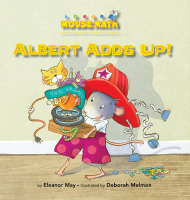
Albert Adds Up! - One More on the Pile
Albert's Pile
Put your counters on the mat. Say the pile out loud.
Grade 1
5 skill lessons · 2 math-through-reading
Math
Skill lessons
The mathematics the book carries, taught directly. Each lesson has printable workbook pages and a separate teacher key.
Math + reading
Math through the reading
The same book, entered through a sentence it prints. Change one word in the reading and the numbers change with it.
Reading
Reading and language lessons
The same book read as a text. What a word means in its sentence, how a character is shown, how the writing is put together - no mathematics.
5 lessons on the mathematics the book carries. Each lesson has printable workbook pages and a separate teacher key.
The book hands over thirteen finished number sentences and a pile that grows one or two things at a time: Robo Rat and Mechano Mall make two, the secret sucker makes three, Ned and Nelly make five, and the count climbs to eleven. Students rebuild that pile with counters and get each new total by counting on from the total already on the mat instead of sweeping the counters back and starting at one.
1. Set out the first three (5 min)
Put one counter on the trade mat for Robo Rat. Add one more for Mechano Mall. Say the pile out loud: one, and one more is two. Add a third counter for the secret sucker. Count on from two: two, three. Do not slide the first counters back to start at one. Partners take turns pushing the counter on and saying the new total.
Word preview: more
1 plus 1 equals 2.
Two plus one equals three.
2. Push both worms on at once (6 min)
Ned and Nelly arrive together. Push two counters on in one move. Count on from three: four, five. The counting hand touches only the two new counters and the mouth starts at three. Each pair runs it twice, clearing back to three in between, and says the total aloud both times.
Word preview: both
But you can have them both.
Three plus two equals five.
3. Climb to seven, then past ten (5 min)
The gum ball lands on the pile: partners count on from five and say six. The tail warmer lands: they count on from six and say seven. Load ten counters into the ten-frame. Set the puzzle counter beside the full frame. Say ten and one more is eleven, without counting the frame again.
Word preview: altogether
5 plus 1 equals 6.
Six plus one equals seven.
10 plus 1 equals 11.
4. Quiz your partner on the pile (4 min)
One partner sets counters on the mat and says how many. Then they push one or two more on under a covering hand. The other partner says the new total before the hand lifts, then lifts it and touches the counters to check. They swap after every three turns and keep every pile at eleven or under.
1. Set out the first three (5 min)
Partners put one counter on the mat for Robo Rat and one more for Mechano Mall and say one and one more is two. They add a third counter for the secret sucker and count on, two then three, without starting again at one.
1 plus 1 equals 2.
Two plus one equals three.
2. Quiz your partner on the pile (4 min)
One partner sets counters on the mat, says the total, then pushes one or two more on under a covering hand. The other says the new total before the hand lifts, then checks by touching. Keep every pile at eleven or under.
The English that reports the change is the hard part: one more is not obviously plus one to a new listener, and English puts the total last, after the change. Model one sentence all lesson and say it the same way every time: what the pile had, how many more came on, and how many it has now. Invite children to count and check in their own language, then say the finished pile in English with the frame.
Put your counters on the mat. Say the pile out loud.
Say it the same way every time.
No single right answer. Any starting pile with one or two more pushed on is correct so long as the pile stays at eleven or under. A strong response names the new total before the covering hand lifts, then checks by touching only the new counters.
A close response starts the count at the total already on the mat and touches only the counters that just arrived. A loose response slides the counters back and counts the whole pile from one, or arrives at the right total only after recounting.
Choose your curriculum above to see the standards for this lesson.
Standards are held back while this plan is edited. Every standard shown here was matched against the supplied wording of this lesson, quoting its steps, so a changed step is no longer the thing that was checked. Undo your changes to bring the standards back — your edits stay in this browser either way.
Once Albert's pile reaches eleven the book runs the whole climb backwards: the puzzle goes home, then the mask, then the two wheels, then the tail warmer and the gum, then the worms, then the last three, and every difference is said aloud down to zero. Students take counters off a mat in those same groups and say what stays after each removal. The idea underneath is that taking away names the part that remains, not the part that leaves, and that a pile can be emptied by taking one, then two, then three.
1. Build eleven and let the puzzle go (5 min)
Partners load ten counters into the ten-frame and set an eleventh beside it for the puzzle. When the puzzle's owner comes looking for it, they slide that one counter off the mat and say what stays: ten. They say the move out loud, eleven, take one, ten, and check that the ten-frame is still full.
Word preview: leaves
10 plus 1 equals 11.
11 minus 1 equals 10.
I guess I only have 10 things to trade.
2. Take one, then take two (4 min)
The mat holds ten. Slide one counter off for the cat mask and say nine. Slide two off together for the wheels and say seven. They never sweep the mat and recount from one: the hand takes only what is refused and the mouth says what stays.
Word preview: away
Not the Cat Mask?
10 minus 1 equals 9.
9 minus 2 equals 7.
3. Two takes in a row (6 min)
Seven counters are on the mat. Take one off for the tail warmer and say six. Take one more off for the gum and say five. Line the two removed counters up at the edge, so both takes stay visible. Then they take two off together for Ned and Nelly and say three. One partner takes, the other says each total, then they swap and run it again.
Word preview: left
7 minus 1 minus 1 equals 5.
No Ned, no Nelly.
Five minus two equals three.
4. Down to nothing (5 min)
Three counters are left. Partners take all three off in one sweep and say what the mat holds now: zero. Put the three back. Take them off one at a time, saying two, one, zero. Then say which way emptied the mat in fewer moves. Each pair finishes by pointing at the bare mat and saying zero aloud.
But that only leaves three things.
And you need to take all three away.
3 minus 3 equals 0.
1. Build eleven and let the puzzle go (5 min)
Partners load ten counters into the ten-frame and set an eleventh beside it for the puzzle. When its owner comes for it they slide that counter off and say what stays: ten. They say the move aloud, eleven, take one, ten.
11 minus 1 equals 10.
I guess I only have 10 things to trade.
2. Take one, then take two (4 min)
The mat holds ten. Partners slide one counter off for the mask and say nine, then two off together for the wheels and say seven. The hand takes only what is refused; the mouth says what stays.
10 minus 1 equals 9.
9 minus 2 equals 7.
English says this one move in at least five ways, and none of them is the operation: take away, minus, are left, leaves and how many now all point at the same act, so a child can own the arithmetic and still lose the sentence. Quantity and the physical taking transfer completely; the verb does not. Walk through one sentence, always in this order: what the pile had, what went away, and what is left. Let children say what stays in their everyday language first and then in English with the frame, and accept a finger on the mat as part of the answer while the English is still arriving.
Build the pile on the mat. Take counters off and say what stays.
Say it in this order every time.
The sweep is one move, taking them one at a time is three. A strong response counts the moves rather than the counters, and notices that both ways finish at the same place, zero.
A close response names what is left on the mat. A loose response names what was just taken off, or sweeps the mat clear and recounts the remaining counters from one instead of holding the total that was already there.
Choose your curriculum above to see the standards for this lesson.
Standards are held back while this plan is edited. Every standard shown here was matched against the supplied wording of this lesson, quoting its steps, so a changed step is no longer the thing that was checked. Undo your changes to bring the standards back — your edits stay in this browser either way.
Albert's pile climbs through two, three, five, six, seven, ten and eleven and then comes back down through ten, nine, seven, five, three and zero, so four totals are reached twice, once by adding and once by taking away. Students sort the book's thirteen number sentences into climbs and drops, match the pairs that land on the same number, and say aloud how the pile arrived at that number from below and from above. The reasoning is the saying: a total does not remember which direction it came from.
1. Find the two sevens (5 min)
Take two strips: Six plus one equals seven, and 9 minus 2 equals 7. Build each one on the mat. Six counters and one more, then nine counters take two. Say what the mat holds after each build. Set the two strips side by side, because both builds ended on seven.
Word preview: same
Six plus one equals seven.
9 minus 2 equals 7.
2. Sort the strips into climbs and drops (5 min)
Spread all thirteen strips face up. Push each one left if the pile got bigger, right if it got smaller. Decide by reading the strip, not by remembering the story. When the table is clear they count each side aloud and check that every strip landed somewhere.
Word preview: bigger
Two plus one equals three.
Five minus two equals three.
3. Make the four matches (6 min)
Four totals are reached twice. Hunt one climb strip and one drop strip that finish on the same number. Set them nose to nose. Three with three, five with five, seven with seven, ten with ten. Any match they are unsure of gets built on the mat with counters before it is left on the table.
Word preview: total
Three plus two equals five.
7 minus 1 minus 1 equals 5.
Seven plus two plus one equals ten.
11 minus 1 equals 10.
4. Say why they land together (4 min)
Each pair picks one match. Tell another pair how the pile reached that number twice. It came up to seven when the tail warmer arrived. It came back down to seven when the wheels went away. The listening pair asks one question, which one was going up, and the telling pair answers by pointing at the strip.
He brought in his electric tail warmer.
Not the wheels?
1. Find the two sevens (5 min)
Partners build Six plus one equals seven and then 9 minus 2 equals 7 on the mat, saying what the mat holds after each build. They set the two strips side by side because both builds ended on seven.
Six plus one equals seven.
9 minus 2 equals 7.
2. Say why they land together (4 min)
Each pair tells another pair out loud how the pile reached seven twice, once when the tail warmer arrived and once when the wheels went away. The listeners ask which one was going up and the tellers answer by pointing at the strip.
He brought in his electric tail warmer.
Not the wheels?
The mathematics of this lesson is a match, and a match can be made and shown without a single English sentence: a child who lays six plus one beside nine minus two and points at two mats holding seven has already reasoned. The telling is where English gets in the way: a past tense that says how the pile got there and the words up and down doing mathematical work. Run one sentence for the telling: how the pile got to that number, and how it got there again the other way. Let pairs settle the match in their family language and tell the other pair in English with the frame, pointing at each strip as they name it.
Build each strip on the mat with counters. Say what the mat holds.
A strip belongs on the climb side if it reads plus and on the drop side if it reads minus. The eight strips supplied here sort four and four.
No single right wording. A strong telling names both journeys to the same number, one arriving from below and one from above, and points at the strip it is naming. For seven: the pile came up to seven when the tail warmer arrived, and it came back down to seven when the wheels went away.
A close response decides by reading the strip. A loose response decides by remembering the order of the story, or answers which one was going up by naming the thing that arrived rather than the strip that says plus.
This strip set carries the eight number sentences the lesson itself reproduces, which is every strip the two sevens, the four matches and the telling need. The other five of the book's thirteen are not reproduced in this lesson and have not been supplied; they must be checked against the book before the sort of all thirteen can be run.
One or more pages for this lesson were held back. The lesson names a set larger than it spells out — a deck of cards, a row of strips — and the missing items were not invented to fill it.
Choose your curriculum above to see the standards for this lesson.
Standards are held back while this plan is edited. Every standard shown here was matched against the supplied wording of this lesson, quoting its steps, so a changed step is no longer the thing that was checked. Undo your changes to bring the standards back — your edits stay in this browser either way.
Every change in Albert's trade is narrated twice, once as a thing that happens and once as a number sentence, from 1 plus 1 equals 2 all the way to 3 minus 3 equals 0. Students build a stage of the pile with counters and then lay the same stage out with number cards and operation cards, so the mat and the card row say one thing in two forms. Nothing is written: students place cards and read the row aloud, pointing from each card to the counters it names.
1. Match a card row to the mat (4 min)
Partners set three counters on the mat for the toys and push two more on for Ned and Nelly. Then they hunt through the tray and lay out the row that says it: 3, plus, 2, equals, 5. The row goes under the mat, left to right, one card for each number and each sign.
Word preview: equals
Plus, all three toys.
Three plus two equals five.
2. Read the row to your partner (5 min)
One partner reads the card row aloud. For each card, they touch the counters it names. The three toys, then the two worms, then a sweep of the whole five. The other partner keeps eyes on the mat and says whether the finger matched the word. They swap and read it again.
Word preview: altogether
That's five things altogether.
3. Build the take-away rows (6 min)
The mat holds ten. Partners slide one counter off, lay the row 10, minus, 1, equals, 9, and read it aloud. Then they slide two more off, lay 9, minus, 2, equals, 7, and read that one. The minus card goes down only when counters have actually left the mat.
Word preview: minus
10 minus 1 equals 9.
9 minus 2 equals 7.
4. The long row (5 min)
Set seven counters on the mat. Push two on for the wheels and one for the mask. Keep the three groups apart. Lay the longest row in the book: 7, plus, 2, plus, 1, equals, 10. Read it while touching each group in turn. Then they slide the groups together and check that the mat holds ten.
Word preview: plus
And here are two wheels that fell off my tricycle.
Plus one scary cat mask.
Seven plus two plus one equals ten.
1. Match a card row to the mat (4 min)
Partners set three counters on the mat for the toys and push two more on for Ned and Nelly, then lay the row that says it: 3, plus, 2, equals, 5. One card for each number and each sign, left to right under the mat.
Three plus two equals five.
2. Read the row to your partner (5 min)
One partner reads the row aloud and touches the counters each card names, the three toys, the two worms, then the whole five. The other watches the mat and says whether finger and word matched. Swap and read it again.
That's five things altogether.
The card row is the friend here: a number card says its number in every language, and a child who cannot yet say seven plus two plus one equals ten in English can still lay it, point at it and be right. The sign names are the snag: plus, minus and equals are English words for marks that look identical everywhere. Rehearse the row aloud as a chant, ___ plus ___ equals ___, and let partners agree on the row in their strongest language before either one reads it in English. A child may read the row with a finger before reading it with a voice.
Build the stage on the mat with counters. Lay the card row under the mat.
No single right wording. A strong reading touches the three toys on the first card, the two worms on the second number card, and sweeps the whole five on the card after equals, in that order.
A close row uses the plus card only where counters arrived and the minus card only where counters left, and the card after equals matches what is actually sitting on the mat. A loose row is arithmetically right but laid before the counters moved, or reads correctly while the finger lands on the wrong group.
Choose your curriculum above to see the standards for this lesson.
Standards are held back while this plan is edited. Every standard shown here was matched against the supplied wording of this lesson, quoting its steps, so a changed step is no longer the thing that was checked. Undo your changes to bring the standards back — your edits stay in this browser either way.
What the pile held before each of Albert's trips and after is stated, but never how many things he carried in: three toys become five things when Ned and Nelly arrive, seven become ten when the wheels and the mask land. Students set the pile at the first total, move counters from a cup one at a time until the mat matches the second total, and count what left the cup. The application is the trip itself, a real question about the story answered by a count and said aloud in a frame.
1. Set the pile at three (4 min)
Partners put three counters on the mat, one for each toy Albert has already offered, and say three out loud. A small cup of loose counters sits beside the mat and holds everything Albert has not brought in yet. Nothing moves out of the cup until the question has been asked.
Word preview: more
So, will you take all three for Captain Slime?
2. Fill the gap to five (6 min)
The pile has to reach five. Move counters out of the cup onto the mat one at a time, counting four, five. Then count how many counters left the cup. Say the whole trip aloud: the pile had three, Albert brought two more, now it has five. Check it against the strip that reads Three plus two equals five.
Word preview: altogether
But you can have them both.
That's five things altogether.
Three plus two equals five.
3. Seven to ten (5 min)
Partners clear the mat, set seven counters on it, and move counters from the cup until the mat holds ten. This time the things arrive in groups: two wheels together, then the mask. Push two on, then one. Say how many counters left the cup altogether. They check the mat against the strip that reads Seven plus two plus one equals ten.
Word preview: group
And here are two wheels that fell off my tricycle.
Seven plus two plus one equals ten.
4. Tell the trip (5 min)
Each partner takes one of the book's one-thing trips. Five to six for the gum ball, six to seven for the tail warmer, ten to eleven for the puzzle. Build it on the mat. Tell your partner the whole trip, using the frame. The pile had this many. Albert brought this many more. Now it has this many. The listener rebuilds the mat from the telling alone and the two mats are set side by side.
5 plus 1 equals 6.
Six plus one equals seven.
10 plus 1 equals 11.
1. Set the pile at three (4 min)
Partners put three counters on the mat, one for each toy Albert has already offered, and say three out loud. A cup of loose counters beside the mat holds everything he has not brought in yet.
So, will you take all three for Captain Slime?
2. Seven to ten (5 min)
Partners clear the mat, set seven counters on it, and move counters from the cup until the mat holds ten, pushing two on for the wheels and then one for the mask. They say how many counters left the cup altogether and check the mat against the strip that reads Seven plus two plus one equals ten.
And here are two wheels that fell off my tricycle.
Seven plus two plus one equals ten.
The counting and the moving carry themselves; the difficulty is that this question is asked in English with the unknown in the middle and the answer at the end, and how many more did he bring is a harder sentence than the arithmetic under it. Number, cup and mat transfer completely. Rehearse the frame until it is automatic, always in this order: The pile had ___. Albert brought ___ more. Now it has ___. Let a child answer first by holding up the counters that left the cup, and let the strongest language carry the thinking while English carries the frame.
Set the pile on the mat. Move counters from the cup until the mat matches.
Say the whole trip out loud.
No single right wording, but all three slots must be filled and in order. For the trip to five: the pile had three, Albert brought two more, now it has five. A strong telling lets the listener rebuild the mat from the words alone, and the two mats end up holding the same number.
A close response answers with what left the cup. A loose response answers with the second total, five instead of two or ten instead of three, which is what the mat holds rather than what Albert carried in. On the seven to ten trip, watch for two, counting only the wheels, instead of three.
One or more pages for this lesson were held back. The lesson names a set larger than it spells out — a deck of cards, a row of strips — and the missing items were not invented to fill it.
Choose your curriculum above to see the standards for this lesson.
Standards are held back while this plan is edited. Every standard shown here was matched against the supplied wording of this lesson, quoting its steps, so a changed step is no longer the thing that was checked. Undo your changes to bring the standards back — your edits stay in this browser either way.
The mathematics is reached through a sentence the book prints: change one word in the reading and the numbers change with it. These carry their own standards, matched against these lessons rather than inherited from the skill ones.
Students build the pile twice from one sentence, once with both and once with one of them, and say aloud which word made which total.
1. Build the pile the sentence describes (5 min)
Pairs set three counters on the left mat for the toys Albert has already offered. They hear the sentence about the worms, push two more counters on, and say the total. Then they check it against the number the book says next, and find that both mat and book say five.
2. Swap the word and build it again (6 min)
Pairs set three counters on the right mat, hear the sentence again with one of them in place of both, and build that. Now two mats stand side by side, one holding five and one holding four. Each child touches the two mats in turn and says the two totals aloud, then says which of the two the book agrees with.
3. Say which word made which pile (3 min)
Each child says one sentence about their own mat with the word in it: this pile has both worms, so it has five, or this pile has one of them, so it has four. Partners listen for the word and the number in the same sentence and say so when one is missing.
4. Do it again with all (6 min)
Pairs clear both mats to three counters. On the left they take all three away and say zero; on the right they take one of the three away and say two. They say which word emptied the mat, and why the other word cannot.
1. Swap the word and build it again (6 min)
Pairs set three counters on the right mat, hear the sentence again with one of them in place of both, and build that. Now two mats stand side by side, one holding five and one holding four. Each child touches the two mats in turn and says the two totals aloud, then says which of the two the book agrees with.
2. Say which word made which pile (3 min)
Each child says one sentence about their own mat with the word in it: this pile has both worms, so it has five, or this pile has one of them, so it has four. Partners listen for the word and the number in the same sentence and say so when one is missing.
The quantity words in this lesson are exactly the words that do not travel. Number transfers completely, and a child who counts in another language will build both mats correctly the moment they know which word is in play. English hides the size of the change inside a small unstressed word at the end of a clause, so them both and one of them sound almost alike to a new ear and differ by one counter. Say the two sentences slowly and back to back before any building, and rehearse the reporting frame: This pile has ___, so it has ___ things. Invite children to say what the word means in their strongest language, then build the mat, then report the pile in English with the frame. Never ask a child to explain the word before they have built it.
Choose your curriculum above to see the standards for this lesson.
Standards are held back while this plan is edited. Every standard shown here was matched against the supplied wording of this lesson, quoting its steps, so a changed step is no longer the thing that was checked. Undo your changes to bring the standards back — your edits stay in this browser either way.
Phases are not grades. The Primary Years Programme is a developmental continuum and your school places each student in a phase, so this names the strand the lesson works in and the phases it could sit across. Confirm against your own school's placement.
Number · Phases 1–2
Students restore Albert's scrambled trade from event cards that name what moved but not the total, building the pile as they go and saying why one card cannot be moved.
1. Deal the cards and read them out (4 min)
Each pair spreads ten event cards face up and reads each one aloud to the other. None of the cards carries a running total; each names a thing and whether it came on or went back. Pairs sort them into two heaps first, things arriving and things leaving, before they try to order anything.
2. Order the arrivals and build as you go (6 min)
Pairs lay the arriving cards in a line and build the pile card by card, saying the new total after each one and writing nothing. When a total disagrees with what the book says at that point, they move a card and run the line again from the start.
3. Place the three cards that go back (7 min)
Pairs take the cards that send the puzzle, the mask and the two wheels back, and try each one in three places in their line. In each place they attempt the subtraction on the mat and see whether the counters are there to take. They leave each card where the mat allows it and say the total that stands after it.
4. Say why one card cannot move (3 min)
Each pair tells another pair, out loud, why the card they placed last cannot sit any earlier, and the reason has to carry a number: the pile only had six then, and none of them were wheels. The listening pair tries to move the card anyway and reports what happened on the mat.
1. Order the arrivals and build as you go (6 min)
Pairs lay the arriving cards in a line and build the pile card by card, saying the new total after each one and writing nothing. When a total disagrees with what the book says at that point, they move a card and run the line again from the start.
2. Say why one card cannot move (3 min)
Each pair tells another pair, out loud, why the card they placed last cannot sit any earlier, and the reason has to carry a number: the pile only had six then, and none of them were wheels. The listening pair tries to move the card anyway and reports what happened on the mat.
Ordering is a doing task before it is a saying task, and a child with little English can lay the cards, build the pile and be entirely right; let that happen first. The language of reason and sequence does not transfer, because before, after, because and could not are the whole content of the last segment and none of them is a number word. Rehearse two frames and keep them visible all lesson: This one comes after ___ because the pile had ___. and It cannot go here because there are no ___ on the mat yet. Let pairs settle the order in their strongest language and give the reason in English with a frame, pointing at the card and then at the mat as they say it.
Choose your curriculum above to see the standards for this lesson.
Standards are held back while this plan is edited. Every standard shown here was matched against the supplied wording of this lesson, quoting its steps, so a changed step is no longer the thing that was checked. Undo your changes to bring the standards back — your edits stay in this browser either way.
Phases are not grades. The Primary Years Programme is a developmental continuum and your school places each student in a phase, so this names the strand the lesson works in and the phases it could sit across. Confirm against your own school's placement.
Number · Phases 1–2
5 lessons on the reading and language the book carries - what a word means in its sentence, how a character is shown, how a text is built. No mathematics: these are matched against the English language arts curricula, which are a different and smaller set than the mathematics ones.
This book shows what Albert wants before he ever asks for it: his paw creeps toward the book. Students read three short spans where Albert acts instead of explaining, act each one out with hand and face, and name the feeling behind it. The work is matching a feeling word to the words on the page that earned it, which is the whole habit this skill asks of a first grader.
1. Read what Albert's paw does (5 min)
Read the passage aloud with a partner, one sentence each. Put your finger on the word crept and act it out with your own hand travelling slowly toward a book on the desk. Say out loud one word for how Albert feels about that book, and say which word on the page made you pick it.
Word preview: crept
Albert's paw crept toward the book. Please let me read it first. He begged. I'll let you play with one of my favorite toys.
2. Show the offer with your hands (5 min)
Read the passage aloud. Hold out one hand as Albert holding out Robo Rat, and shake your head as Wanda. Then tell your partner what Albert wants and what Wanda does about it, using the words on the page.
Word preview: trade
Here, Wanda. Albert said as he came back. I'll trade you Robo Rat for Captain Slime. Deal? Wanda shook her head.
3. Draw the feeling that keeps him going (6 min)
Read both printed passages. Albert is talking to two worms here, and nobody has said yes to him yet. Draw Albert's face on the feelings chart, then finish this sentence out loud: Albert keeps going because ___. Point at the words in the passage that back up your answer.
Word preview: begged
She still hasn't said yes. He told them. I'll get more stuff.
He brought in his electric tail warmer. That's seven things, he said.
4. Say the feeling word to the class (4 min)
Say one feeling word for Albert and then read aloud the sentence from a passage printed in this lesson that shows it. Listeners put a thumb up only when the speaker reads real words off the page after the feeling word.
Albert's paw crept toward the book. Please let me read it first. He begged. I'll let you play with one of my favorite toys.
1. Read what Albert's paw does (5 min)
Read the passage aloud with a partner. Put your finger on crept and travel your own hand slowly toward a book. Say one word for how Albert feels, and say which word on the page made you pick it.
Word preview: crept
Albert's paw crept toward the book. Please let me read it first. He begged. I'll let you play with one of my favorite toys.
2. Draw the feeling that keeps him going (4 min)
Read the printed passage. Nobody has said yes to Albert yet. Draw his face on the feelings chart and finish out loud: Albert keeps going because ___.
Word preview: begged
She still hasn't said yes. He told them. I'll get more stuff.
The word begged carries feeling that plain asking does not, and that difference does not always survive translation word for word. Invite students to say, in their strongest language, how someone asks when they want something very much, then say what changes in the voice. That change in voice is the skill. Rehearsable frame: Albert feels ___ because he ___.
Choose your curriculum above to see the standards for this lesson.
Standards are held back while this plan is edited. Every standard shown here was matched against the supplied wording of this lesson, quoting its steps, so a changed step is no longer the thing that was checked. Undo your changes to bring the standards back — your edits stay in this browser either way.
Albert leaves the room and comes back, over and over, and each return is one event a first grader can hold. Students lay the printed returns in a left-to-right line, read each aloud as they place it, and then retell the whole story touching one strip per sentence. Retelling here means order words carrying real events, not a summary in the abstract.
1. Put the first three trips in order (6 min)
Cut apart the three printed passages on the retelling strip and lay them left to right in the order Albert brought each thing in. Read each strip aloud as you place it, and say first, next, then as you go. Check your order against the printed passages before you glue.
Word preview: first
Here, Wanda. Albert said as he came back. I'll trade you Robo Rat for Captain Slime. Deal?
It's a secret sucker. Albert explained proudly. It's for sucking secrets out of other mice. I made it myself.
I named them Ned and Nelly.
2. Add the next two trips to the line (5 min)
Read these two printed passages aloud. Add them to the end of your retelling strip, still left to right. Now touch each strip in order and say the whole line out loud: first Albert brought ___, next he brought ___, then he brought ___.
Word preview: next
He brought in his electric tail warmer.
And here are two wheels that fell off my tricycle. He dumped them on the pile.
3. Say what happened last (5 min)
Read the printed passage aloud with a partner. This is the end of the story. Add a last strip that says what Albert decides here, then retell the whole story to your partner in five sentences, touching one strip for each sentence and using the word last for this one.
Word preview: last
Albert looked at Captain Slime. You know what, Wanda? He said. I don't want to read it first after all.
4. Retell to a listener who checks (4 min)
Retell the story to a new partner, touching your strips in order. Your listener holds the printed passage from this step and stops you if you say the ending before you have said the beginning. Then swap and listen.
Albert looked at Captain Slime. You know what, Wanda? He said. I don't want to read it first after all.
1. Put the first three trips in order (5 min)
Lay the three printed passages left to right in the order Albert brought each thing in. Read each one aloud as you place it, saying first, next, then.
Word preview: first
Here, Wanda. Albert said as he came back. I'll trade you Robo Rat for Captain Slime. Deal?
It's a secret sucker. Albert explained proudly. It's for sucking secrets out of other mice. I made it myself.
I named them Ned and Nelly.
2. Say what happened last (4 min)
Read the printed passage aloud. This is the end. Retell the story to your partner in four sentences, touching one strip for each and saying last for this one.
Word preview: last
Albert looked at Captain Slime. You know what, Wanda? He said. I don't want to read it first after all.
First, next, then and last are order words, and every language has its own set, though not always in the same position in the sentence. Invite students to retell one trip in their strongest language and say which word did the ordering work, then place that word on the strip beside the English one. Rehearsable frame: First Albert brought ___. Next he brought ___.
Choose your curriculum above to see the standards for this lesson.
Standards are held back while this plan is edited. Every standard shown here was matched against the supplied wording of this lesson, quoting its steps, so a changed step is no longer the thing that was checked. Undo your changes to bring the standards back — your edits stay in this browser either way.
Albert keeps bringing in things nobody has heard of, and the book answers for them right after the question mark. Students take Wanda's question, find the answer sitting beside it, and then break a three-word name into parts they can each draw. The skill is asking a question about an unknown word and taking the answer from words that are actually printed, not from a guess.
1. Ask what it is, then find the answer (5 min)
Read the passage aloud with a partner, one taking Wanda and one taking Albert. Wanda asks a question here that you can ask about any new thing. Underline the question, then underline the sentence that answers it, and say aloud what a secret sucker is meant to do.
Word preview: sucker
Wanda stared at him. What is it? It's a secret sucker. Albert explained proudly. It's for sucking secrets out of other mice. I made it myself.
2. Break a long name into its parts (5 min)
Read the printed passage aloud. The thing Albert brings has a three-word name. Say each word by itself and draw what each one tells you, then say the whole name and tell your partner what it warms. Write the name in your word meaning log.
Word preview: warmer
He brought in his electric tail warmer. That's seven things, he said.
3. Ask your own question about the gum ball (5 min)
Read the printed passage aloud. Ask your partner a question that starts with what, then ask one that starts with why. Your partner must answer using words from the printed passage, and you point at the words as they say them.
Word preview: chew
Well, it isn't exactly a ball anymore. Albert said. But you can chew it as much as you like before you give it back.
4. Say a meaning you can point to (5 min)
Choose secret sucker or tail warmer. Say what it is in one sentence, then read aloud the words from a passage printed in this lesson that told you. Listeners put a thumb up only when they hear real words from the page.
It's for sucking secrets out of other mice.
1. Ask what it is, then find the answer (5 min)
Read the passage aloud with a partner, one as Wanda and one as Albert. Underline Wanda's question and the sentence that answers it, then say what a secret sucker is meant to do.
Word preview: sucker
Wanda stared at him. What is it? It's a secret sucker. Albert explained proudly. It's for sucking secrets out of other mice. I made it myself.
2. Break a long name into its parts (4 min)
Read the printed passage aloud. Say each word of the three-word name by itself, then say the whole name and tell your partner what it warms.
Word preview: warmer
He brought in his electric tail warmer. That's seven things, he said.
English builds names for things by stacking words in front of each other, so tail warmer means a warmer for tails and the last word is the thing itself. Many languages put that thing-word first instead. Invite students to say a two-word name from their strongest language and say which word is the thing, then compare the order with English. Rehearsable frame: A ___ is a thing for ___.
Choose your curriculum above to see the standards for this lesson.
Standards are held back while this plan is edited. Every standard shown here was matched against the supplied wording of this lesson, quoting its steps, so a changed step is no longer the thing that was checked. Undo your changes to bring the standards back — your edits stay in this browser either way.
This book is built out of asking, so question marks are everywhere and every one of them is answered on the next line. Students circle the marks, read each sentence twice to hear the difference a lifted voice makes, and then take the ask side and answer side of a question that reuses the very same words. The skill is seeing an end mark and letting it change the voice.
1. Find the mark that lifts your voice (5 min)
Read both printed passages aloud with a partner. Circle every question mark you find. Read each circled sentence twice, once flat and once with your voice going up at the end, and say which one sounds like a real question.
Word preview: question
Which one is Nelly? I'm not sure, he said. But you can have them both.
Does it work? Wanda asked. Um, not exactly.
2. Read two short questions in a row (5 min)
Read the printed passage aloud. Two of these sentences are questions and one is not. Read only the questions to your partner with your voice going up, and let your partner shake their head as Wanda after each one.
Word preview: ask
Not the Cat Mask? Wanda shook her head. 10 minus 1 equals 9. Not the wheels?
3. Ask and answer the same words (6 min)
Read the printed passage aloud. The same four words appear as a question and then as an answer, with one word added. Take turns: one asks with the voice going up, one answers with the voice going down. Then write the question on your card and put the question mark on yourself.
Word preview: mark
Even the secret sucker? Albert asked. Especially the secret sucker.
4. Read one question to the class (4 min)
Choose one question from the passage printed in this step and read it aloud so the class can hear the mark at the end. Listeners put a thumb up only when the voice goes up.
You still have that gum ball?
1. Find the mark that lifts your voice (5 min)
Read both printed passages aloud with a partner. Circle every question mark. Read each circled sentence once flat and once with your voice going up, and say which sounds like a real question.
Word preview: question
Which one is Nelly? I'm not sure, he said. But you can have them both.
Does it work? Wanda asked. Um, not exactly.
2. Ask and answer the same words (4 min)
Read the printed passage aloud. Take turns: one asks with the voice going up, one answers with the voice going down. Then write the question on your card and add the question mark yourself.
Word preview: mark
Even the secret sucker? Albert asked. Especially the secret sucker.
The rising voice at the end of an English question is not universal: some languages mark a question with a word at the end or with a change in word order, and keep the pitch flat. Invite students to ask does it work in their strongest language and say what did the asking, then compare with the English lift. Rehearsable frame: I hear a question because ___.
Choose your curriculum above to see the standards for this lesson.
Standards are held back while this plan is edited. Every standard shown here was matched against the supplied wording of this lesson, quoting its steps, so a changed step is no longer the thing that was checked. Undo your changes to bring the standards back — your edits stay in this browser either way.
Albert opens wanting the book first and closes wanting it together, and the book prints both wishes plainly. Students write the two wishes on the two sides of one card, hear the sentence Wanda had been trying to say all along, and read the one-word ending aloud. The skill is holding a beginning and an ending side by side and saying what moved between them.
1. Say what Albert wanted at the start (5 min)
Read both printed passages aloud with a partner. These come from the beginning of the story. Say in one sentence what Albert wants, then write it on the left side of your beginning-and-end card.
Word preview: library
I'm back from the library.
Please let me read it first. He begged.
2. Hear what Wanda had been trying to say (5 min)
Read the printed passage aloud, one partner as Wanda. Wanda says she tried to tell Albert something. Say aloud what she was trying to tell him, using her own printed words, and say why Albert did not hear it.
Word preview: listen
But Albert, you don't need anything. Wanda said. I tried to tell you, but you wouldn't listen. I got that book out of the library for you.
3. Read the ending and write it down (6 min)
Read the printed passage aloud with a partner, taking turns line by line. The last word is a whole sentence on its own. Write what Albert chooses at the end on the right side of your card, then read your two sides aloud, start then end.
Word preview: together
You know what, Wanda? He said. I don't want to read it first after all. You don't? Wanda asked. No! Albert said. I'd much rather read it. Together.
4. Tell a partner what changed (4 min)
Read the printed passage aloud once more, then hold up your card and tell a partner: at the start Albert wanted ___, and at the end he wanted ___. Your partner listens for both sides before answering.
You know what, Wanda? He said. I don't want to read it first after all. You don't? Wanda asked. No! Albert said. I'd much rather read it. Together.
1. Say what Albert wanted at the start (4 min)
Read both printed passages aloud with a partner. Say in one sentence what Albert wants, and write it on the left side of your card.
Word preview: library
I'm back from the library.
Please let me read it first. He begged.
2. Read the ending and write it down (5 min)
Read the printed passage aloud with a partner, taking turns line by line. Write what Albert chooses at the end on the right side of your card, then read both sides aloud, start then end.
Word preview: together
You know what, Wanda? He said. I don't want to read it first after all. You don't? Wanda asked. No! Albert said. I'd much rather read it. Together.
Together carries an idea some languages build into the verb rather than a separate word. Invite students to say we will read it together in their strongest language and point at which part carries the togetherness, then compare with the English word standing alone at the end. Rehearsable frame: At the start he wanted ___. At the end he wanted ___.
Choose your curriculum above to see the standards for this lesson.
Standards are held back while this plan is edited. Every standard shown here was matched against the supplied wording of this lesson, quoting its steps, so a changed step is no longer the thing that was checked. Undo your changes to bring the standards back — your edits stay in this browser either way.