Albert Keeps Score
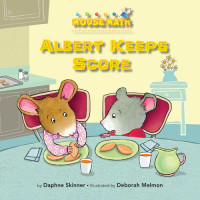
Grade K
5 skill lessons
Math
Skill lessons
The mathematics the book carries, taught directly. Printable workbook pages and teacher keys are not available for this book yet.
- 1Match Wanda's Row to Albert's Row
- 2Count the Guests, Say the Number
- 3The Score That Is Not the Same
- 4Build the Score Line with Number Cards
- 5One More Book
Math + reading
Math through the reading
The same book, entered through a sentence it prints. Change one word in the reading and the numbers change with it.
No math-through-reading lessons for this book yet.
Reading
Reading and language lessons
The same book read as a text. What a word means in its sentence, how a character is shown, how the writing is put together - no mathematics.
No reading and language lessons for this book yet.
Skill lessons
5 lessons on the mathematics the book carries. Printable workbook pages and teacher keys are not available for this book yet.
1. Match Wanda's Row to Albert's Row
The book finishes nearly every page by putting Wanda's number beside Albert's, and it names the things on both sides before it does: three guests at each tea party, four books each at the library, one splinter for Wanda and nothing for Albert. Students put down one counter for each thing the book names, build two rows, and push the rows together a pair at a time. Matching this way lets a child say the same before knowing which number it is, and it is what makes the last page visible on the mat: one counter is left with nothing opposite it.
Full lesson — 20 minutes
1. Lay out both sides (5 min)
Listen for the names the book gives each child and put one counter in that child's row for each name you hear. Lucy, Taffy and Melody go in Wanda's row. Leo, Fred and Grandpa Andy go in Albert's. Do not count yet. One name, one counter.
Word preview: same
Later that day, Wanda had a tea party with Lucy, Taffy, and Melody.
Leo, Fred, and Grandpa Andy came to Albert's party.
2. Push the rows together (6 min)
Slide one counter from Wanda's row against one from Albert's row, and keep going until a row runs out. If both rows run out on the same push, say the same out loud. If one row still has a counter, say whose row it is and hold it up.
Word preview: more
I want the same as Wanda.
3. Do it again with the books (5 min)
Clear the mat. Put one counter in each row for every book that child carried out of the library, four in Wanda's row and four in Albert's. Push them together in pairs again and say the same when the rows run out together.
Wanda got four books, and Albert got four books.
4. Find the pair that will not match (4 min)
Clear the mat one last time. Put one counter in Wanda's row for her splinter. Put in Albert's row exactly what he asked for. Push the rows together and say out loud what happens to Wanda's counter when there is nothing on the other side to push it against.
No, said Albert, not even a little splinter.
Wanda 1, Albert 0.
Short version — 9 minutes
1. Push the rows together (5 min)
Put one counter in Wanda's row for Lucy, Taffy and Melody, and one in Albert's for Leo, Fred and Grandpa Andy. Now slide one counter from Wanda's row against one from Albert's, pair by pair, until a row runs out. Say the same if they run out together, or hold up the counter that is left over.
I want the same as Wanda.
2. Find the pair that will not match (4 min)
Put one counter in Wanda's row for her splinter and put in Albert's row what he asked for. Push and say what is left with nothing opposite it.
Wanda 1, Albert 0.
Three levels
- Support
- Use three counters in a row rather than filling the whole mat, and give Wanda's row one colour and Albert's another so a pair is easy to see. Push one pair, say same or not the same, then push the next, instead of waiting until the rows are finished.
- At Grade
- Build both rows from the names the book gives, push the whole row through in pairs without stopping, and say the same or name the child whose counter is left over. Do the tea party, the library and the splinter with the mat cleared between them.
- Extension
- Rebuild the two rows so one holds exactly one counter more than the other, and say a sentence about your rows that would also be true of the splinter page. Then set out two rows with no counters at all in either and say what the score is.
English learners
Every part of this can be done with hands before a word of English is needed: one name, one counter, then push. Two words carry the lesson and the book supplies both, in I want the same as Wanda and in more seeds than I do. Rehearse one frame aloud and leave it where children can see it: Wanda has ___ and Albert has ___, so they are ___. The word for an empty row is the one the book never gives, so say none and zero yourself each time the empty row appears and let children echo you before they are asked to produce it. Invite children to say what the mat shows in their strongest language first, then in English, and judge the matching of the counters rather than the sentence.
Materials
- A matching mat: one sheet per pair with two long rows drawn on it, one above the other
- Counters, twenty per pair, all one colour
- Word cards: same, more
Standards & curriculum
These lessons are being matched against curricula now.
Standards are held back while this plan is edited. Every standard shown here was matched against the supplied wording of this lesson, quoting its steps, so a changed step is no longer the thing that was checked. Undo your changes to bring the standards back — your edits stay in this browser either way.
2. Count the Guests, Say the Number
This book hands a child small sets already named and already separated: Lucy, Taffy and Melody on one page, Leo, Fred and Grandpa Andy on the same page, four books each at the library, four cheese doodles apiece. Students touch one counter per name or per thing, say one number word per touch, and then answer how many with the last number by itself instead of counting the row again. The sets never run past five, so the whole lesson is one touch, one number word, one answer.
Full lesson — 20 minutes
1. Count Wanda's guests (5 min)
Put one counter down for Lucy, one for Taffy and one for Melody. Now touch each counter once and say one number for each touch. When your partner asks how many, say only the last number you said. Do not start again at one.
Word preview: how many
Later that day, Wanda had a tea party with Lucy, Taffy, and Melody.
2. Count Albert's guests (5 min)
Do the same for Leo, Fred and Grandpa Andy. Touch and count, then say the number on its own. Check the number you said against the number Albert says he should invite.
Leo, Fred, and Grandpa Andy came to Albert's party.
So I should invite three.
3. Count the books (5 min)
Fill a ten-frame with one counter for each of Wanda's library books, then fill a second frame for Albert's. Count each frame out loud, one touch per number, and say each child's number by itself when you finish.
Wanda got four books, and Albert got four books.
4. Count the doodles, then the seeds (5 min)
Set out the cheese doodles Wanda ate and count them, then Albert's, then do the same for the pumpkin seeds. Say each number on its own. Four sets, four numbers, and no counting a row twice.
She ate four and Albert ate four.
Wanda three, Albert three.
Short version — 9 minutes
1. Count Wanda's guests (4 min)
Put one counter down for Lucy, one for Taffy, one for Melody. Touch each once, say one number per touch, and answer how many with the last number alone.
Later that day, Wanda had a tea party with Lucy, Taffy, and Melody.
2. Count the books (5 min)
Fill one ten-frame for Wanda's library books and one for Albert's. Count each frame aloud, one touch per number, and say each child's number by itself.
Wanda got four books, and Albert got four books.
Three levels
- Support
- Stay with the three guests and count only to three, with the counters pushed into a straight line so no counter can be touched twice. Move each counter away as you say its number. The number you say last is how many, so say it once more on its own before going on.
- At Grade
- Count each set to three, four or five with one touch per number, and answer how many with the last number rather than counting the set again from one.
- Extension
- Count one child's set, then say the other child's number without counting it, because the book has already said the two came out the same. Then put one more counter beside Wanda's four books and say the number that makes, counting on rather than starting over.
English learners
The number words one to five are short, they come early in any language, and most children arrive with them already. What is new in English is the question how many and the habit of answering it with a single word, since the book itself answers by naming everyone: Lucy, Taffy, and Melody rather than three. Rehearse the pair aloud and keep it visible: How many? ___. Let a child answer by holding up fingers and saying the number in their strongest language on the first round and in English on the second, and count the touches, not the accent. Names are the one thing here a child may not have heard before, so read Lucy, Taffy, Melody, Leo, Fred and Grandpa Andy slowly the first time and put a counter down as each name lands.
Materials
- Counters, ten per child
- Ten-frame cards, two per pair
- Word cards: three, four, five
Standards & curriculum
These lessons are being matched against curricula now.
Standards are held back while this plan is edited. Every standard shown here was matched against the supplied wording of this lesson, quoting its steps, so a changed step is no longer the thing that was checked. Undo your changes to bring the standards back — your edits stay in this browser either way.
3. The Score That Is Not the Same
Every score in this book comes out even until the last one, and the last one is even a child can feel: Wanda has a splinter and Albert has none, because he was asked whether he wanted one and said no. Students build the two closing scores with counters, put a number on a row that holds nothing, and then say why this score is different from all the ones before it. The reasoning is not about which number is bigger. It is about a count of none being a real count, and about a child choosing not to match.
Full lesson — 20 minutes
1. Build the last two scores (5 min)
Put one counter in Wanda's row for her peanut butter chip and one in Albert's row for his. Push them together and say the same. Now clear the mat and build the splinter score: one for Wanda, and for Albert exactly what he said he wanted.
Then she gave Wanda a whole peanut butter chip for being brave.
Albert didn't ask, but she gave him one too.
2. Show nothing (5 min)
Hold your hand flat over the place in Albert's row where a counter would go, and leave it empty. Say the number for a row with nothing in it out loud, then lay the card for it down and keep it there while you work.
Word preview: none, zero
No, said Albert, not even a little splinter.
3. Say why this one is different (6 min)
Tell your partner why this score did not come out even, using both numbers. Your partner listens for two numbers and holds up a finger for each one they hear. Then swap, and say it the other way round, starting with Albert.
Wanda 1, Albert 0.
I want the same as Wanda.
4. Answer the book's question with a number (4 min)
Mom asks Albert the question herself. Answer it out loud the way Albert does, then say the number that answer gives him and make his row show that number. Check the row against the card you laid down.
Did you want a really big splinter too? The same as Wanda's?
Short version — 9 minutes
1. Show nothing (4 min)
Put one counter in Wanda's row for her splinter and leave Albert's row empty, with your hand flat over it. Say the number for a row that holds nothing, and lay that card down above the row.
No, said Albert, not even a little splinter.
2. Say why this one is different (5 min)
Tell your partner why this score did not come out even, using both numbers. Your partner holds up a finger for each number they hear, then you swap.
Wanda 1, Albert 0.
Three levels
- Support
- Build the chip score at the top of the mat and leave it standing, then build the splinter score underneath it and work only on the second one. Answer in two words rather than a sentence, one for each row: one, none. Point at the row you are naming as you say it.
- At Grade
- Build both closing scores, put the right card above an empty row without being told which card it is, and give a partner a reason that carries both numbers in it.
- Extension
- Say what Albert's row would hold if he had answered Mom the other way, and what the score would then be. Then find the earlier page where Albert also got something he never asked for, and say why that score still came out even.
English learners
The idea of a row with nothing in it is easier to show than to say, so let the empty row do the talking first: a flat hand, then the card, then the word. The book gives no word for it at all, in any sentence, so none and zero both have to come from the teacher and both are worth giving, because a child will meet each of them. Rehearse one frame and keep it visible: Wanda has ___ and Albert has ___, so the score is not the same. Let a child give the reason in their strongest language first and then in English with the frame in front of them, and count whether both numbers arrived rather than whether the sentence was whole.
Materials
- A matching mat: one sheet per pair with two long rows drawn on it, one above the other
- Counters, ten per pair
- Number cards 0 to 5, one set per pair
- Word cards: none, zero
Standards & curriculum
These lessons are being matched against curricula now.
Standards are held back while this plan is edited. Every standard shown here was matched against the supplied wording of this lesson, quoting its steps, so a changed step is no longer the thing that was checked. Undo your changes to bring the standards back — your edits stay in this browser either way.
4. Build the Score Line with Number Cards
The book keeps its running record in a shape a child can copy: the two names, then the two numbers, one page at a time. Students count what the book names on each side, lay the number card that says how many above each row of counters, and read the finished slip aloud. The point is that the card is not a decoration on top of the counters; it stands for exactly the counters underneath it, which is why Albert's empty row still needs a card.
Full lesson — 20 minutes
1. Read a score the book already wrote (4 min)
The book writes one of its scores with numbers you can read: Wanda 1, Albert 0. Put that many counters in each row, one row per child, and lay the number card that matches above each row. Then slide those two cards onto a slip, beside each name. Say out loud what the card over the empty row means.
Word preview: number
Wanda 1, Albert 0.
2. Build the score for the tea party (6 min)
Clear the mat and build the tea party: one counter in Wanda's row for Lucy, Taffy and Melody, and one in Albert's for Leo, Fred and Grandpa Andy. Count each row and find the card that says how many. Lay Wanda's card down first and Albert's second, in the order the book uses. Slide the cards onto the slip beside each name.
Later that day, Wanda had a tea party with Lucy, Taffy, and Melody.
Leo, Fred, and Grandpa Andy came to Albert's party.
3. Build the score for the library (5 min)
Do the same for the library books. Four counters and the card that says four, for each child. Put both cards on a fresh slip and read the slip out loud from left to right.
Wanda got four books, and Albert got four books.
4. Read your score lines back (5 min)
Point at your own cards and say each score the way the book says it, the name and then the number, twice over: Wanda four, Albert four. Do it for every slip you built and say after each one whether the two numbers came out the same.
Wanda four, Albert four.
Wanda three, Albert three.
Short version — 9 minutes
1. Read a score the book already wrote (4 min)
Put out one counter for Wanda and none for Albert, then lay the matching number card above each row. Say what the card above the empty row means.
Wanda 1, Albert 0.
2. Read your score lines back (5 min)
Point at your cards and say the score the way the book says it, name then number, twice over. Say whether the two numbers came out the same.
Wanda four, Albert four.
Three levels
- Support
- Work with the cards 0 to 3 only and build one slip, the splinter score, where the numbers are already printed in the book. Match the card to the counters by putting the card down and touching each counter as you say the number, so the card and the row are checked against each other rather than remembered.
- At Grade
- Count each row, choose the card that says how many, place Wanda's card before Albert's, and read the finished slip aloud without help on the order.
- Extension
- Build a slip for the bedtime chips, a page whose score the book never gives you in numbers, by counting what each child was handed and choosing the cards yourself. Then lay your slips in a line and find the only one whose two cards are different.
English learners
The score line is read left to right, name then number, and that order is the same in the book every time, which makes it a safe thing to rehearse: Wanda ___, Albert ___. The numerals themselves are written the same way in most of the world, so a child who cannot yet say four in English can still place the card correctly and be right. Say the number words as the cards go down and let children echo them. The word zero is not in this book anywhere, and neither is any other word for an empty row, so supply it aloud and pair it with the card 0 every time it appears. Invite children to read a finished slip in their strongest language first.
Materials
- A matching mat: one sheet per pair with two long rows drawn on it, one above the other
- Number cards 0 to 5, two sets per pair
- Counters, ten per pair
- A score slip, one per pair, printed Wanda ____ and Albert ____ with the blanks left empty
Standards & curriculum
These lessons are being matched against curricula now.
Standards are held back while this plan is edited. Every standard shown here was matched against the supplied wording of this lesson, quoting its steps, so a changed step is no longer the thing that was checked. Undo your changes to bring the standards back — your edits stay in this browser either way.
5. One More Book
At the library Wanda has four books and asks for another one, and the book says out loud what that would make: five. Then Dad settles it at four each and the fifth book goes back. Students build four as a cube train, push one cube on and count on rather than starting again, then take that cube off and say the number the train drops back to. The same move happens once more at the end of the book, with a kiss instead of a book, so students meet one more twice on quantities the text states.
Full lesson — 20 minutes
1. Build four (4 min)
Snap four cubes into a train for Wanda's library books and four more into a second train for Albert's. Count each train out loud, one number per cube, and stop at four. Lay the two trains side by side so they look equal.
Wanda got four books, and Albert got four books.
2. Push on another one (6 min)
Wanda asks for another one. Push a single cube onto the end of her train and count on from where the train already was: four, five. Do not go back to one. Say the number the train reaches and check it against the number Albert names.
Word preview: another
Can I get another one?
If she gets five books, I get five books.
3. Dad says no (5 min)
Dad settles it at four each. Pull the extra cube back off Wanda's train, count what is left out loud, and say the number both trains stop at. Hold the loose cube up so everyone can see the one that came off.
Four books each is enough for today, said Dad.
4. One more kiss (5 min)
Wanda has had one kiss and asks for one more. Hold up one finger, then push up one more, and say the number your fingers make. Then say the number Albert would need if he asks for the same as Wanda.
Mom leaned over and gave her a kiss.
Can I have one more?
Short version — 9 minutes
1. Push on another one (5 min)
Snap four cubes into a train for Wanda's library books, then push one more cube onto the end and count on from four rather than starting again. Say the number the train reaches.
If she gets five books, I get five books.
2. One more kiss (4 min)
Hold up one finger for the kiss Wanda has had, push up one more for the one she asks for, and say the number your fingers make.
Can I have one more?
Three levels
- Support
- Work with fingers rather than cubes and start from three instead of four, so the answer stays inside one hand. Say the number you are on, then push up one more finger and say the next number, out loud, before anything is taken away again.
- At Grade
- Build four in cubes, count on to five when the cube goes on, and count back to four when it comes off, saying both numbers without starting the train again from one.
- Extension
- Say the number one more than four before you push the cube on, then check it by pushing. Then do the same for both trains at once: if each child gets one more book, say what each train reaches, and whether the two trains are still equal.
English learners
One more is the whole lesson and it is a phrase, not a word, so it needs saying slowly and often; the book gives it in both of its shapes, another one at the library and one more at bedtime, and a child should hear that these mean the same thing. Rehearse one frame aloud and leave it up: ___ and one more makes ___. Counting on rather than restarting is the habit being built, so let a child say the first number in their strongest language and the count in English if that is what gets the count carried forward. The words another and more can be pointed at on the cube that goes on, which is the clearest definition either of them will get.
Materials
- Linking cubes, ten per child
- Word cards: another, more
Standards & curriculum
These lessons are being matched against curricula now.
Standards are held back while this plan is edited. Every standard shown here was matched against the supplied wording of this lesson, quoting its steps, so a changed step is no longer the thing that was checked. Undo your changes to bring the standards back — your edits stay in this browser either way.