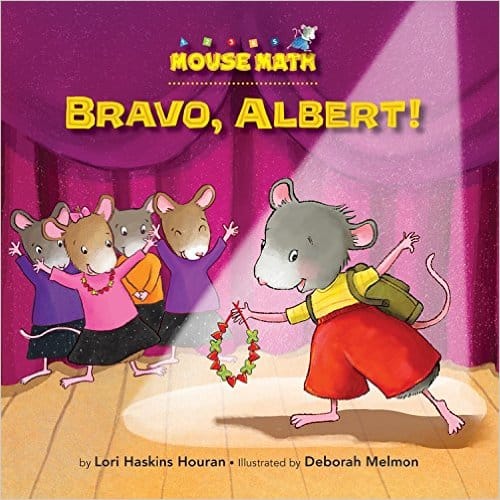
Bravo, Albert!
Grade 1
3 skill lessons · 3 math-through-reading
Math
Skill lessons
The mathematics the book carries, taught directly. Printable workbook pages and teacher keys are not available for this book yet.
- 1Butterfly Heart, Butterfly Heart — and Wanda's Extra Heart
- 2Yellow, Green, Yellow, Green: The Rule Grandma Says Out Loud
- 3Too Many Purple Left Over: When the Rule Has to Change
Math + reading
Math through the reading
The same book, entered through a sentence it prints. Change one word in the reading and the numbers change with it.
- 4The Word That Says Where the Next Bead Goes
- 5Build the Rules in the Order Albert Meets Them
- 6Tell Albert Which Order to Use
Reading
Reading and language lessons
The same book read as a text. What a word means in its sentence, how a character is shown, how the writing is put together - no mathematics.
- 7Super Busy: Two Words That Tell You Why Wanda Says No
- 8Why Do You Do It Like That? How Grandma Answers a Question
- 9Sighed, Wailed, Beaming: The Words That Carry the Feeling
- 10Awning, Hat, Flowers: Retelling What Albert Saw on the Way Home
- 11Pattern: How the Book Hands You One Word and Keeps Using It
Skill lessons
3 lessons on the mathematics the book carries. Printable workbook pages and teacher keys are not available for this book yet.
1. Butterfly Heart, Butterfly Heart — and Wanda's Extra Heart
This is the book's sharpest teaching page and it is entirely in words: two characters string the same two beads and get different necklaces. Children build both, lay them side by side, and fence off the piece that comes back on each. The concept is that a repeating pattern is fixed by its repeating piece and not by which objects are in it, which is exactly what Albert gets wrong when he assumes a pattern is a pattern. Counting appears here only as counting the beads inside a fence, two against three, reached by touching. Nobody adds and nobody subtracts. A teacher watching for understanding wants the child who names Wanda's necklace by the run of two hearts rather than by its colour or its length.
Full lesson — 20 minutes
1. String Albert's necklace (5 min)
Each child takes beads from the two bins and strings Albert's order onto their lace, saying each bead aloud as it slides on. They keep going until the lace is full, then run a finger back along it saying the two beads over and over to check nothing was dropped.
Word preview: pattern
I'll follow a pattern so the necklace looks nice, he decided. Butterfly heart, butterfly heart.
2. String Wanda's necklace beside it (5 min)
On a second lace each child strings Wanda's order instead, sliding the beads on exactly as she does and saying each one aloud. They lay the two finished laces side by side, ends lined up, and say which lace has more hearts on it.
Word preview: different
Wanda slid a butterfly onto her string, then a heart, and another heart.
She made the pattern again. Butterfly heart heart.
3. Fence off the piece that comes back (5 min)
Children put two paper fences around the smallest piece of each lace that keeps repeating, then count aloud the beads inside each fence, touching one bead per number word. They say the two counts out loud and say which necklace repeats in a longer piece.
Word preview: repeat
Oh! Two hearts in a row.
4. Tell the two apart with your eyes shut (5 min)
One partner hides both laces behind their back and hands over just one. The other feels or looks along it, says whose necklace it is, and says the beads that told them, then hands it back. They swap and do it four times, and the guesser must say the run of two hearts or its absence as their reason.
That's pretty Albert, but I'm following a different pattern.
Short version — 9 minutes
1. String Albert's necklace (5 min)
Each child strings Albert's order onto a lace from the two bead bins, saying each bead aloud as it slides on, then runs a finger back along it to check.
Word preview: pattern
I'll follow a pattern so the necklace looks nice, he decided. Butterfly heart, butterfly heart.
2. Fence off the piece that comes back (4 min)
Children fence off the smallest repeating piece on their lace and count the beads inside it aloud, one touch per number word, then say that piece as a chant down the whole lace.
Word preview: repeat
Oh! Two hearts in a row.
Three levels
- Support
- Build only Albert's necklace and then change it into Wanda's by sliding one extra heart in after each butterfly, so the second pattern arrives as a change to the first rather than as a fresh string. Keep the two bins and keep the fencing. Say the beads aloud as each one goes on, and let the finished pair of laces be the whole answer.
- At Grade
- String both necklaces from the two bins, lay them end-lined-up side by side, fence off the repeating piece on each and count the beads inside, then take an unnamed lace and say whose it is with the run of two hearts as the reason.
- Extension
- String a third necklace that uses the same two beads but a repeating piece of four, then say why a run of two hearts alone is no longer enough to name whose necklace it is. Say what a partner would have to look at instead, and say whether every string made of hearts and butterflies has a repeating piece at all.
English learners
Heart and butterfly carry no mathematical load and a child may name them in any language throughout without losing anything; the beads themselves say which is which. What does carry load is the ordinal language for saying what comes after what, and English packs it into small unstressed words that are easy to lose in a noisy room. Give one frame and use only it, after the butterfly comes a heart, spoken with a finger resting on the butterfly bead as it starts. Invite children to say the whole string in their strongest language first, at their own pace, and then to say only the fenced piece in English, which is two words or three rather than a dozen. A pointed finger travelling the lace at the right speed is a complete answer here and should be received as one.
Materials
- Bead trays per pair: fifteen heart beads and fifteen butterfly beads, kept in two separate bins
- A lace or pipe cleaner per child, long enough to hold twelve beads
- The book's page where Albert and Wanda hold up their two strings side by side
- Two paper fence markers per child for closing off the repeating piece
- Word cards: pattern, repeat, different
Standards & curriculum
Choose your curriculum above to see the standards for this lesson.
Standards are held back while this plan is edited. Every standard shown here was matched against the supplied wording of this lesson, quoting its steps, so a changed step is no longer the thing that was checked. Undo your changes to bring the standards back — your edits stay in this browser either way.
2. Yellow, Green, Yellow, Green: The Rule Grandma Says Out Loud
The book hands this lesson a rule already spoken. Grandma corrects Albert mid-task and says the order aloud, then lays a strip with no rule at all so the difference can be seen side by side. Children lay tiles to her spoken rule, then name a hidden tile from its neighbours, then judge a strip that does not repeat and repair it with one move. The child's hand carries the rule: the strip is the only place the order lives, because the book prints no numbers and counts nothing. What a teacher watches for is a child who can keep the alternation going past the four colours the book says, and who can fence off yellow-green as the piece that comes back rather than reciting the whole strip as one long list.
Full lesson — 20 minutes
1. Lay the rule Grandma says (5 min)
Pairs hear Grandma's line and lay tiles onto the quilt strip in the order she names, one tile per square, saying the colour aloud as each tile goes down. They keep going past the four colours she says until the strip is full, and each partner says which colour comes next before the other places it.
Word preview: pattern
See the pattern? Yellow, green, yellow, green.
2. Cover a tile and name it (5 min)
One partner shuts their eyes while the other turns a tile face down somewhere in the middle of the strip. The first partner says which colour is hiding and says which neighbour told them, then turns it over to check. They swap and do it again three more times, hiding a different square each time.
Word preview: next
He passed a yellow square to grandma, then another one. Oops! Grandma said. I need green next.
3. Sort the neat strip from the messy one (5 min)
Children look at the teacher's messy strip beside their own and say which one follows a rule and which does not. They point at the first square where the messy strip stops repeating and say what colour would have to sit there instead to fix it, then move that one tile and check whether the rest of the strip now repeats.
Word preview: repeat
Gram a plop down some squares. A green, a few yellows, more greens, a yellow.
A pattern makes the quilt nice and neat.
4. Say the part that repeats (5 min)
Each child slides two fingers along their own strip to fence off the smallest piece that keeps coming back, then says that piece aloud as a two-word chant while touching its squares. They chant it over and over down the whole strip, one touch per square, and stop when they run out of squares.
Albert passed Grandma the rest of the squares and just the right order. Yellow green, yellow green.
Short version — 9 minutes
1. Lay the rule Grandma says (5 min)
Pairs hear Grandma's line and lay tiles onto the quilt strip in the order she names, one tile per square, saying the colour aloud as each tile goes down. They fill the whole strip, taking turns to say the next colour before it is placed.
Word preview: pattern
See the pattern? Yellow, green, yellow, green.
2. Say the part that repeats (4 min)
Each child fences off with two fingers the smallest piece of their strip that keeps coming back, then chants it down the whole strip, one touch per square.
Albert passed Grandma the rest of the squares and just the right order. Yellow green, yellow green.
Three levels
- Support
- Work on a six-square strip instead of twelve and start it with two tiles already down, so the child extends a rule rather than beginning one. Keep both colours in separate cups so a hand reaching for the next tile has to choose, and keep the hiding step: it is where the rule shows. The chant stays the same two words.
- At Grade
- Fill the twelve-square strip to Grandma's spoken rule, name four hidden tiles from their neighbours, then set the messy strip beside it, point at the first square where the repeating stops, and move one tile to fix it. Finish by fencing off yellow-green with two fingers and chanting it the length of the strip.
- Extension
- Take the teacher's messy strip and find every square that would have to change to make it repeat, not just the first, and say whether starting the fix from the left end or the right end changes how many tiles move. Then lay a strip that repeats using the same two colours but a piece that is three tiles long, and say what makes yours a rule when Grandma's plopped-down squares are not.
English learners
Colour names are the one part of this lesson a child may hold in another language and not in English, and the mathematics does not wait on them. Let a child lay the whole strip naming colours in their strongest language while a partner touches along and says the English word after each one, so the order is built by the hand before it is carried by the vocabulary. The word that does the work here is next, and it is worth rehearsing on its own with the strip under it: I need green next, said while a finger sits on the empty square. Say the chant, yellow green, yellow green, at the speed of the touching and never faster. Many languages put the colour word after the thing it describes rather than before, so a child may say square yellow and be entirely right about the tile; take that and re-say it in the book's order with the tile still in view rather than correcting it.
Materials
- Two-colour tile trays: twenty square paper tiles per pair, ten yellow and ten green
- A blank quilt strip per pair, twelve squares long, laid left to right
- The book's page where Grandma corrects Albert and says the quilt's rule aloud
- A messy strip the teacher has already laid: a green, three yellows, two greens, a yellow
- Word cards: pattern, next, repeat
Standards & curriculum
Choose your curriculum above to see the standards for this lesson.
Standards are held back while this plan is edited. Every standard shown here was matched against the supplied wording of this lesson, quoting its steps, so a changed step is no longer the thing that was checked. Undo your changes to bring the standards back — your edits stay in this browser either way.
3. Too Many Purple Left Over: When the Rule Has to Change
The book ends by failing once and then succeeding, and both attempts are printed. Albert lays a three-colour order, runs out with purple singers still standing, and then borrows the necklace order with its doubled item. Groups run both attempts on a line mat with cards whose colour counts are unequal, so the first order stalls for them exactly as it stalls for Albert. The work is to say why one order emptied the heap and the other did not, in terms of how many purple cards each repeat uses, and to do it with the leftover heap in view. Every number in this lesson comes from touching cards. Nothing is added, nothing is divided, and no child works out in advance how long a line will be.
Full lesson — 20 minutes
1. Line them up Albert's first way (5 min)
Groups lay the singer cards onto the line mat in the three-colour order Albert tries first, saying each colour aloud as it goes down, and stop the moment a colour they need is not in the pile any more. They say which colour is left over in a heap and how many of that colour are still standing, counting the leftovers by touching them.
Word preview: order
There were three colors to use, so it would be tricky, but he was sure he could do it.
Orange Pink Purple, he said, lining up the singers.
2. Say why it ran out (5 min)
Groups look at their stalled line and the leftover heap together and say aloud what went wrong, using the counts they made rather than the word messy. Each child says one sentence naming the colour that ran short and the colour that ran long, and a partner says whether they agree by pointing at the heap.
Then Albert got to the end of the line. There were too many purple niblets left over.
3. Borrow the necklace rule (5 min)
Groups clear the mat and lay the singers again in the order Albert takes from the necklaces, saying each colour aloud. They run the order down the mat as many times as the cards allow and stop where the cards stop, then say how many purple cards sit in each repeat.
Word preview: repeat
Orange purple purple pink. Orange purple purple pink. Orange purple purple and...
4. Check the heap is empty (5 min)
Each group looks for cards still standing outside the mat and says how many of each colour are left, touching them as they count. They say aloud which order used up more of the purple cards and point at the repeated piece that did it, then say the four-colour piece as a chant down the finished line.
Word preview: pattern
And he put two purple niblets in a row.
Short version — 9 minutes
1. Line them up Albert's first way (5 min)
Groups lay the singer cards onto the mat in the three-colour order Albert tries first, saying each colour aloud, and stop when a colour they need has run out. They count the leftover cards by touching them.
Word preview: order
Orange Pink Purple, he said, lining up the singers.
2. Borrow the necklace rule (4 min)
Groups clear the mat and lay the singers again in the order Albert takes from the necklaces, saying each colour aloud, and run it down the mat until the cards stop.
Word preview: repeat
Orange purple purple pink. Orange purple purple pink. Orange purple purple and...
Three levels
- Support
- Work with eight cards rather than twelve, in three colours, and lay the failing order first with the teacher calling each colour aloud so the stall arrives without a reading load. Keep the leftover heap where the child can touch it and count it. The child says only which colour is left over and then lays the second order alongside; naming why can stay in the group talk.
- At Grade
- Lay both orders on the mat with the full twelve cards, count the leftover heap after each, say in one sentence which colour ran short and which ran long, then say how many purple cards each repeat of the second order uses and check that the heap is empty.
- Extension
- Given the same twelve cards, find a different repeating piece that also empties the heap, and say what your piece and Albert's have in common. Then say whether Albert's second order would still have worked if one more pink singer had turned up, and say what you would look at first to decide.
English learners
The colour words carry the whole line here and there are only three of them, so they are worth rehearsing before any card is laid, said slowly with a card of that colour held up. The harder language is the reason sentence, and it is the reason a child may know the answer and say nothing. Give one frame and use only it, we ran out of orange but purple was left over, and let a child fill it by pointing at the two heaps instead of saying the colour names if that is where they are. Invite children to talk the group's plan through in their strongest language before the cards go down and to report only the finished line in English. A child who lays a correct line and can point at the leftover heap has shown the mathematics completely, whatever the sentence sounds like.
Materials
- Twelve singer cards per group in three colours: four orange, five purple and three pink, mixed face up
- A line mat per group, twelve boxes long, laid left to right
- The book's page where Albert's three-colour line runs out with purple singers still standing
- The book's page where Albert uses the necklace order on the line of singers
- Word cards: pattern, repeat, order
Standards & curriculum
Choose your curriculum above to see the standards for this lesson.
Standards are held back while this plan is edited. Every standard shown here was matched against the supplied wording of this lesson, quoting its steps, so a changed step is no longer the thing that was checked. Undo your changes to bring the standards back — your edits stay in this browser either way.
Math through the reading
The mathematics is reached through a sentence the book prints: change one word in the reading and the numbers change with it. These carry their own standards, matched against these lessons rather than inherited from the skill ones.
4. The Word That Says Where the Next Bead Goes
Children string Albert's necklace and then Wanda's from the same two bins, hearing the one sentence that separates them with another swapped out, and say which bead the word put on the lace.
Full lesson — 20 minutes
1. Fill the bins and hear both orders (4 min)
Children set out the two bead bins, one of hearts and one of butterflies, and hear the two sentences read aloud one after the other. They say which beads are named in each and notice aloud that the same two beads are named both times.
2. String the sentence as Wanda says it (6 min)
Each child strings Wanda's order onto a lace, saying each bead aloud as it slides on, and keeps repeating the order until the lace is full. They put paper fences around the smallest piece that comes back and count the beads inside it by touching.
3. Hear it again with one word gone (6 min)
Children hear Wanda's sentence with another taken out of it and string that version onto a second lace. They lay both laces side by side with the ends lined up, say where the two first stop matching, and say which word put the extra heart there.
4. Say it about a bead in your hand (4 min)
Each child holds up a bead and says one true sentence about what comes after it on their own lace, using another where their lace needs it. A partner checks against the lace and says agree or does not agree, pointing at the bead they mean.
Short version — 9 minutes
1. String the sentence as Wanda says it (6 min)
Each child strings Wanda's order onto a lace, saying each bead aloud as it slides on, and keeps repeating the order until the lace is full. They put paper fences around the smallest piece that comes back and count the beads inside it by touching.
2. Hear it again with one word gone (6 min)
Children hear Wanda's sentence with another taken out of it and string that version onto a second lace. They lay both laces side by side with the ends lined up, say where the two first stop matching, and say which word put the extra heart there.
Three levels
- Support
- Work with a six-bead lace instead of twelve so the repeating piece comes back twice and the swap is still visible in one glance. String Wanda's order first with the teacher saying each bead as it goes on, then take the word out and string again. The child slides the bead before saying anything, so the order arrives through the hand and the sentence follows it.
- At grade
- String Wanda's order down a full lace, fence off the repeating piece and count its beads, then string the version with another removed onto a second lace. Lay the two ends-lined-up, say the first place they stop matching, and say which word made the difference. Finish by saying one true sentence with another in it about a bead in your own hand.
- Extension
- Take Albert's sentence instead and put another into it, so his order gains a bead rather than losing one, and string what you get. Say whether your new necklace could be told apart from Wanda's by looking at one bead alone, and say what a partner would have to look at instead. Then say what would have to be true of the bins for the swapped sentence to be impossible to string at all.
English learners
Heart and butterfly carry no load here and a child may name them in any language without losing a thing, because the bead in the hand says which is which. The load sits on another, which English uses both for one more of the same and for a different one, and a child who takes the second reading strings a butterfly where a heart belongs and is being perfectly reasonable about the word. Rehearse it with a bead held up and one already on the lace: another heart, said while the first heart is still under a finger. Give one frame and use only it, after the heart comes another heart. Invite children to say their whole string in their strongest language as they build it and to say only the fenced piece in English. Two laces laid side by side with a finger on the place they part is a complete answer and should be taken as one.
Materials
- Two bead bins per pair, one of heart beads and one of butterfly beads, kept separate
- Two laces or pipe cleaners per child, each long enough for twelve beads
- Two paper fence markers per child for closing off the repeating piece
- The book's page where Wanda strings her own necklace in front of Albert
- The two versions of Wanda's sentence written large, one under the other
Standards & curriculum
Choose your curriculum above to see the standards for this lesson.
Standards are held back while this plan is edited. Every standard shown here was matched against the supplied wording of this lesson, quoting its steps, so a changed step is no longer the thing that was checked. Undo your changes to bring the standards back — your edits stay in this browser either way.
5. Build the Rules in the Order Albert Meets Them
Groups build the book's four repeating pieces down a four-row mat in story order, then one group slides the necklace row to the bottom and finds out by running out of a rule that the order cannot move.
Full lesson — 20 minutes
1. Deal the four episodes out (3 min)
Each group takes four episode strips, one per row of the mat, and lays them in the order the book tells them, saying each aloud. They put the strips beside the rows they name and say which one comes first.
2. Build the rows in the book's order (7 min)
Groups build each row from its own tiles or cards, saying the colours aloud as they go, and fence the smallest piece that comes back on each row. They count the items inside each of the four fences by touching and say the four counts down the mat.
3. Move the necklace row and try again (7 min)
Groups clear the mat, slide the necklace episode to the bottom and build the rows in that new order from the same unequal cards. They lay the last row with whatever rules they now hold, heap what is left over and count it by touching.
4. Say which row could not wait (3 min)
Each child points at the row that had to come before the last one and says what it gave them that no other row did. A partner says whether they agree, pointing at the heap from the second build as they answer.
Short version — 9 minutes
1. Build the rows in the book's order (7 min)
Groups build each row from its own tiles or cards, saying the colours aloud as they go, and fence the smallest piece that comes back on each row. They count the items inside each of the four fences by touching and say the four counts down the mat.
2. Move the necklace row and try again (7 min)
Groups clear the mat, slide the necklace episode to the bottom and build the rows in that new order from the same unequal cards. They lay the last row with whatever rules they now hold, heap what is left over and count it by touching.
Three levels
- Support
- Build only the top row and the bottom row, and hand the group the necklace row already built and fenced so the doubled item is on the table in front of them before the last row is attempted. Keep the counting by touch inside each fence. The child retells by putting a hand on each row in turn and saying its colours, which is a complete retelling here.
- At grade
- Build all four rows in the book's order, fence the repeating piece on each and count its items by touching. Then rebuild with the necklace row slid to the bottom, count the leftover heap, and say out loud which row could not wait and what it gave you. Finish by naming the four fence counts down the mat in order.
- Extension
- Find a different place to move the necklace row to that still lets the bottom row empty the heap, and say why that place works when the bottom does not. Then say what would have to be true of the cards for the plain three-colour order to have worked, and say whether the story would still need Wanda's necklace at all if it were.
English learners
The retelling here can be carried almost entirely by the mat, which is what makes this pairing reachable. A child may retell the whole chain by moving a hand down the four rows in order and saying one colour word per row, and that should be taken as a complete answer. The load sits on the ordering words, and one frame is enough: this row had to come before this one. Rehearse it with two rows already built and a finger on each as the sentence is said. The colour words are the only other vocabulary and they are worth holding up before the cards go down. Invite groups to argue the order through in their strongest language and to give only the final sentence about the necklace row in English. A finger on the leftover heap is a legitimate way to finish that sentence.
Materials
- A four-row mat per group, each row twelve boxes long, laid left to right
- Two-colour tile trays per group for the quilt and street rows
- Bead trays per group: heart beads and butterfly beads kept in two separate bins
- Twelve singer cards per group in three colours: four orange, five purple and three pink
- Four paper fence markers per group for closing off each row's repeating piece
- Four episode strips per group, one naming each of the book's four pattern episodes
- The book's page where Grandma says the quilt's rule aloud
- The book's page where Wanda strings her own necklace in front of Albert
- The book's page where Albert lines the singers up using the necklace order
Standards & curriculum
Choose your curriculum above to see the standards for this lesson.
Standards are held back while this plan is edited. Every standard shown here was matched against the supplied wording of this lesson, quoting its steps, so a changed step is no longer the thing that was checked. Undo your changes to bring the standards back — your edits stay in this browser either way.
6. Tell Albert Which Order to Use
Groups run both of Albert's orders on singer cards whose colours are unequal, then tell Albert which one to use and why, with the leftover heap in front of them as the reason.
Full lesson — 20 minutes
1. Run Albert's first order and count what is left (6 min)
Groups lay the twelve singer cards into the three-colour order Albert tries first, saying each colour aloud, and stop when a colour they need has run out. They heap the leftover cards beside the mat and count them by touching, saying the colour and the count out loud.
2. Run the necklace order and count again (5 min)
Groups clear the mat and lay the same twelve cards into the four-item order Albert borrows from the necklaces, again saying each colour aloud. They heap and count whatever is left over and set the two heaps side by side where both can be seen.
3. Tell Albert which order to use (6 min)
Each child says out loud to Albert, standing at the end of their own line, which order he should use and why, and the reason must have a leftover count in it. A partner listens and then gives their own advice, and each says whether the other's count changed their mind.
4. Argue the other side once (3 min)
Each child says the best thing that can be said for the order they did not advise, pointing at whatever on the mat supports it. They then say whether they are keeping their advice or changing it, and say what on the table decided that.
Short version — 9 minutes
1. Run Albert's first order and count what is left (6 min)
Groups lay the twelve singer cards into the three-colour order Albert tries first, saying each colour aloud, and stop when a colour they need has run out. They heap the leftover cards beside the mat and count them by touching, saying the colour and the count out loud.
2. Tell Albert which order to use (6 min)
Each child says out loud to Albert, standing at the end of their own line, which order he should use and why, and the reason must have a leftover count in it. A partner listens and then gives their own advice, and each says whether the other's count changed their mind.
Three levels
- Support
- Give the group eight cards rather than twelve, still unequal by colour, and lay the first order together with the teacher calling the colours so the stall arrives without a reading load. Keep both heaps on the table and keep the counting by touch, since the heap is the whole argument. The child gives their advice by pointing at the two heaps and saying one colour word and one number, which is a complete position here.
- At grade
- Run both orders with the full twelve cards, count both leftover heaps by touching, then tell Albert which order to use in one sentence with a leftover count inside it. Listen to a partner's advice, say whether it changes yours, and finish by saying the best thing that can be said for the other order.
- Extension
- Take the position you did not choose and make the strongest case you can for it, then say what would have to change about the twelve cards for that case to win outright. Say how many purple cards there would have to be for Albert's first order to have worked with nothing left over, and say how you could check your answer with the cards on the table rather than by working it out.
English learners
An explanation is where a learner is most likely to know the mathematics and say nothing, and this lesson is built so the table carries most of the argument. A child may give their whole position by putting a hand on one mat and pointing at the two heaps, and that is a complete answer. Give one frame and use only it, use the second one, because four purple were left over, with the child touching the heap as the number lands. The three colour words are the only vocabulary the position needs and they are worth rehearsing before the cards go down, held up one at a time. Invite groups to argue it through in their strongest language first and to give only the final advice to Albert in English. Never ask a child to defend a position twice; once, with the heap in view, is the whole of the language work here.
Materials
- Twelve singer cards per group in three colours: four orange, five purple and three pink, mixed face up
- A line mat per group, twelve boxes long, laid left to right
- A heap space marked beside each mat for the leftover cards
- The book's page where Albert's first line runs out with purple singers still standing
- The book's page where Albert lines the singers up using the necklace order
Standards & curriculum
Choose your curriculum above to see the standards for this lesson.
Standards are held back while this plan is edited. Every standard shown here was matched against the supplied wording of this lesson, quoting its steps, so a changed step is no longer the thing that was checked. Undo your changes to bring the standards back — your edits stay in this browser either way.
Reading and language lessons
5 lessons on the reading and language the book carries - what a word means in its sentence, how a character is shown, how a text is built. No mathematics: these are matched against the English language arts curricula, which are a different and smaller set than the mathematics ones.
7. Super Busy: Two Words That Tell You Why Wanda Says No
Wanda answers a question with two words, super busy, and the sentence right after it tells the reader what those two words are covering. Students read the passage, say what Wanda is busy with, and then find the same two words used a second time later in the book. They finish by putting super busy into their own words. Nothing is counted; the work is deciding what a phrase means from the sentences beside it.
Full lesson — 20 minutes
1. Read the two words and find what they cover (6 min)
The teacher reads the passage below once, then reads it again while you follow along. Put your finger on the two words super busy. Then find the part of the passage that tells what Wanda is busy with, and read that part aloud to a partner.
Word preview: busy
Want to play checkers? Asked Albert. Sorry. Wanda said, I'm super busy. Albert Side, Wanda was always super busy since she started her singing group The Nimblets.
2. Say it a different way (5 min)
Read the passage below again with your partner. Then say Wanda's answer again without using the words super busy. Start with Wanda cannot play because ___. Say your sentence aloud so your partner can hear it.
Word preview: super
Want to play checkers? Asked Albert. Sorry. Wanda said, I'm super busy. Albert Side, Wanda was always super busy since she started her singing group The Nimblets.
3. Meet the same two words again (5 min)
Read the short passage below. The book uses the words super busy here for a second time. Say aloud whether Wanda is busy with the same thing as before, and point to the words in the passage that made you decide.
Word preview: again
Back home, Albert found Wanda in their room. She was super busy, of course. I want the nablets to match perfectly." She said, I'm making us matching necklaces.
4. Tell somebody what super busy means (4 min)
Turn to your partner. Say what the words super busy mean in this book, using a whole sentence. Then say one thing you have been super busy with, and let your partner say one thing back.
Word preview: mean
Short version — 9 minutes
1. Read the two words and find what they cover (5 min)
The teacher reads the passage below. Put your finger on the words super busy. Then read aloud the part that tells what Wanda is busy with.
Word preview: busy
Want to play checkers? Asked Albert. Sorry. Wanda said, I'm super busy. Albert Side, Wanda was always super busy since she started her singing group The Nimblets.
2. Say it a different way (4 min)
Read the passage below again. Say Wanda's answer without using the words super busy. Start with Wanda cannot play because ___.
Word preview: super
Want to play checkers? Asked Albert. Sorry. Wanda said, I'm super busy. Albert Side, Wanda was always super busy since she started her singing group The Nimblets.
Three levels
- Support
- In step 1, listen while the teacher reads the printed passage, then point to the two words super busy. Answer aloud: is Wanda saying yes or no? Say the answer twice.
- At Grade
- Read the printed passage in step 1, find the sentence that says what Wanda is busy with, and then say Wanda's answer again in step 2 without using the words super busy.
- Extension
- The printed passage in step 1 says super busy about the singing group. Say two sentences about why the writer used the small word super instead of just busy, and what it adds.
English learners
Super here is not about a superhero; it is a small word English piles in front of another word to turn it up, the way very does. Say busy, then super busy, then very busy, so students hear the three as one family. Invite students to say, in their strongest language, that somebody is extremely busy, and tell the class which word did the turning up. Rehearsable frame: She is super ___, so she cannot ___.
Materials
- Bravo, Albert!, the passage printed in this step
- pointing finger
- sentence frame card
- partner talk cards
- Word cards: busy, super, again, mean
Standards & curriculum
Choose your curriculum above to see the standards for this lesson.
Standards are held back while this plan is edited. Every standard shown here was matched against the supplied wording of this lesson, quoting its steps, so a changed step is no longer the thing that was checked. Undo your changes to bring the standards back — your edits stay in this browser either way.
8. Why Do You Do It Like That? How Grandma Answers a Question
Albert asks Grandma a why question and she answers it in two moves: she says the reason, then she shows what would happen without it. Students read the question and the answer, name the two moves, then read the showing part and say how it backs up the reason. They finish by asking a why question of their own and answering it the same way. Nothing is measured or counted; the work is following how an explanation is built.
Full lesson — 20 minutes
1. Hear the question and the reason (6 min)
The teacher reads the passage below once. Find the sentence that ends with a question mark and read it aloud together. Then find the sentence that gives Grandma's reason and read that aloud too. Say which one is the question and which one is the reason.
Word preview: why
Why do you do it like that? Albert wondered. A pattern makes the quilt nice and neat. Look what happens if I don't use one.
2. Watch Grandma show it instead of saying it (5 min)
Read the passage below with the teacher. Grandma said she would show what happens if she does not use a pattern, and here she does it. Say aloud what she did, then say the one word Albert used to describe the result.
Word preview: show
Gram a plop down some squares. A green, a few yellows, more greens, a yellow. It's kind of messy." Albert said. Exactly. Grandma agreed.
3. Put the reason and the showing side by side (5 min)
Read both passages below. The first one says the reason. The second one shows it. Tell your partner which passage you would use to convince somebody, and why. Use the words because and shows in what you say.
Word preview: reason
Why do you do it like that? Albert wondered. A pattern makes the quilt nice and neat. Look what happens if I don't use one.
Gram a plop down some squares. A green, a few yellows, more greens, a yellow. It's kind of messy." Albert said. Exactly. Grandma agreed.
4. Ask your own why question (4 min)
Ask your partner a why question about something you do at school. Your partner answers with a reason and then says what would happen without it, the way Grandma did. Then swap and take a turn asking.
Word preview: answer
Short version — 9 minutes
1. Hear the question and the reason (5 min)
The teacher reads the passage below. Read the question aloud together, then read Grandma's reason aloud. Say which is which.
Word preview: why
Why do you do it like that? Albert wondered. A pattern makes the quilt nice and neat. Look what happens if I don't use one.
2. Watch Grandma show it instead of saying it (4 min)
Read the passage below. Say aloud what Grandma did, and say the word Albert used to describe how it turned out.
Word preview: show
Gram a plop down some squares. A green, a few yellows, more greens, a yellow. It's kind of messy." Albert said. Exactly. Grandma agreed.
Three levels
- Support
- In step 1, listen to the printed passage, then point to the question mark. Answer aloud: who is asking, Albert or Grandma? Then read Grandma's reason after the teacher.
- At Grade
- Read the printed passage in step 1 and name the question and the reason, then read the passage in step 2 and say how Grandma showed the same idea instead of saying it.
- Extension
- The printed passage in step 2 quotes Albert saying it is kind of messy. Say two sentences about why Grandma wanted Albert to say that himself rather than telling him.
English learners
English why questions put the question word first and turn the sentence order around, and the answer often comes back with because at the front — a pairing worth hearing before it is read. Say Why do you do it like that? and then A pattern makes it neat, and let students hear the question and the answer as a pair. Invite students to ask a why question in their strongest language and say which word was the question word. Rehearsable frame: Why ___? Because ___.
Materials
- Bravo, Albert!, the passage printed in this step
- pointing finger
- two passage strips
- partner talk cards
- Word cards: why, show, reason, answer
Standards & curriculum
Choose your curriculum above to see the standards for this lesson.
Standards are held back while this plan is edited. Every standard shown here was matched against the supplied wording of this lesson, quoting its steps, so a changed step is no longer the thing that was checked. Undo your changes to bring the standards back — your edits stay in this browser either way.
9. Sighed, Wailed, Beaming: The Words That Carry the Feeling
This book almost never names a feeling. Instead it picks a word for how somebody said something or how they looked, and lets the reader work the feeling out. Students read three short passages, match each feeling word to a face they make themselves, and say what the character is feeling and how they know. They finish by choosing which word tells the most. Nothing is counted; the work is reading feeling out of word choice.
Full lesson — 20 minutes
1. Make the face the word tells you to make (6 min)
The teacher reads the passage below once. Find the word sighed. Make the face and the sound of somebody sighing. Then say aloud how Albert is feeling and which word told you.
Word preview: sighed
Albert sighed again. I wonder if Grandma wants company.
2. Find a stronger feeling word (5 min)
Read the passage below with the teacher. Find the word wailed. Say it the way Wanda would say it. Then tell your partner whether wailed is a bigger feeling than sighed, and say why you think so.
Word preview: wailed
It's my fault, Wanda wailed. I kept changing my mind. Now we don't match. We'll look messy on stage.
3. Catch a feeling word that turns around (5 min)
Read the passage below. It has two feeling words close together, beaming and gasped. Point to each one. Say what Wanda felt first and what she felt next, and say which word told you each time.
Word preview: beaming
What a crowd said Wanda, beaming. But when she got backstage, wand a gasped.
4. Pick the word that tells the most (4 min)
Talk with your partner. Of the words you met today, which one told you the most about how somebody felt? Say the word, then say a whole sentence about why you picked it.
Word preview: felt
Short version — 9 minutes
1. Make the face the word tells you to make (5 min)
The teacher reads the passage below. Find the word sighed and make that sound. Say how Albert is feeling and which word told you.
Word preview: sighed
Albert sighed again. I wonder if Grandma wants company.
2. Find a stronger feeling word (4 min)
Read the passage below. Find the word wailed and say it the way Wanda would. Say whether it is a bigger feeling than sighed.
Word preview: wailed
It's my fault, Wanda wailed. I kept changing my mind. Now we don't match. We'll look messy on stage.
Three levels
- Support
- In step 1, listen to the printed passage and point to the word sighed. Make the sound. Answer aloud: is Albert happy or not happy? Say your answer twice.
- At Grade
- Read the printed passages in steps 1 and 2, say what Albert feels and what Wanda feels, and each time name the one word that told you.
- Extension
- The printed passage in step 3 puts beaming and gasped one sentence apart. Say two sentences about what happened in between to turn the feeling around.
English learners
Sighed, wailed and beaming each hide a feeling inside a word for a sound or a face, so a learner who knows only sad and happy will read them as neutral. Say each word with the matching face and breath before students read it. Invite students to show, in their strongest language, how somebody sounds when a plan falls apart, and let the class name the feeling. Rehearsable frame: He ___, so he feels ___.
Materials
- Bravo, Albert!, the passage printed in this step
- feeling face cards
- partner talk cards
- Word cards: sighed, wailed, beaming, felt
Standards & curriculum
Choose your curriculum above to see the standards for this lesson.
Standards are held back while this plan is edited. Every standard shown here was matched against the supplied wording of this lesson, quoting its steps, so a changed step is no longer the thing that was checked. Undo your changes to bring the standards back — your edits stay in this browser either way.
10. Awning, Hat, Flowers: Retelling What Albert Saw on the Way Home
One passage walks Albert past three places and names what he saw at each. Students read it, put the three places in order with First, Then and Last, and retell the walk to a partner without looking. They finish by adding a fourth place from their own walk to school, told in the same order words. Nothing is counted or compared by size; the work is holding a sequence and retelling it in order.
Full lesson — 20 minutes
1. Read the walk and point to each stop (6 min)
The teacher reads the passage below once. Then read it together. Point to the candy shop awning, then to the hat, then to the flowers, in the order the passage puts them. Say each place name aloud as you point.
Word preview: first
When Albert left Grandma's house, he started spotting patterns everywhere. The stripes on the candy shop awning went red-blue, red-blue. The polka dots on Mrs. Gouda's hat went orange brown, orange brown. The flowers in front of the post office were all white, but they made a pattern too. Tulips, daisies, tulips, daisies.
2. Say it with First, Then and Last (5 min)
Read the passage below again. Hold up one finger, then two, then three. Say First Albert saw ___. Then he saw ___. Last he saw ___. Say the whole thing to your partner without stopping.
Word preview: then
When Albert left Grandma's house, he started spotting patterns everywhere. The stripes on the candy shop awning went red-blue, red-blue. The polka dots on Mrs. Gouda's hat went orange brown, orange brown. The flowers in front of the post office were all white, but they made a pattern too. Tulips, daisies, tulips, daisies.
3. Retell it with the book closed (5 min)
Read the passage below one more time. Then turn it face down. Retell the walk to your partner using First, Then and Last. Your partner listens and says whether you kept the three places in the same order the passage used.
Word preview: last
When Albert left Grandma's house, he started spotting patterns everywhere. The stripes on the candy shop awning went red-blue, red-blue. The polka dots on Mrs. Gouda's hat went orange brown, orange brown. The flowers in front of the post office were all white, but they made a pattern too. Tulips, daisies, tulips, daisies.
4. Add a stop from your own walk (4 min)
Tell your partner about your own walk to school. Name three things you pass, and use First, Then and Last to say them in order. Then listen to your partner's three.
Word preview: retell
Short version — 9 minutes
1. Read the walk and point to each stop (5 min)
The teacher reads the passage below. Point to the awning, then the hat, then the flowers, in the order the passage puts them. Say each place aloud.
Word preview: first
When Albert left Grandma's house, he started spotting patterns everywhere. The stripes on the candy shop awning went red-blue, red-blue. The polka dots on Mrs. Gouda's hat went orange brown, orange brown. The flowers in front of the post office were all white, but they made a pattern too. Tulips, daisies, tulips, daisies.
2. Say it with First, Then and Last (4 min)
Read the passage below again. Say First Albert saw ___. Then he saw ___. Last he saw ___. Say the whole thing to a partner.
Word preview: then
When Albert left Grandma's house, he started spotting patterns everywhere. The stripes on the candy shop awning went red-blue, red-blue. The polka dots on Mrs. Gouda's hat went orange brown, orange brown. The flowers in front of the post office were all white, but they made a pattern too. Tulips, daisies, tulips, daisies.
Three levels
- Support
- In step 1, listen to the printed passage and point to just the first place, the candy shop awning. Say that place aloud. Then echo the teacher naming the other two.
- At Grade
- Read the printed passage in step 1, then in step 2 retell the three places in the order the passage put them, using First, Then and Last.
- Extension
- The printed passage in step 1 says the flowers were all white but made a pattern too. Say two sentences about why the writer added the word too in that sentence.
English learners
First, Then and Last sit at the front of the sentence in English, where a listener meets the order word before the event, and many languages mark order at the end instead. Say the three words with three fingers held up before students retell, so the order lives in the hand as well as the ear. Invite students to retell the walk in their strongest language first, keeping three parts. Rehearsable frame: First ___. Then ___. Last ___.
Materials
- Bravo, Albert!, the passage printed in this step
- pointing finger
- three order cards
- partner talk cards
- Word cards: first, then, last, retell
Standards & curriculum
Choose your curriculum above to see the standards for this lesson.
Standards are held back while this plan is edited. Every standard shown here was matched against the supplied wording of this lesson, quoting its steps, so a changed step is no longer the thing that was checked. Undo your changes to bring the standards back — your edits stay in this browser either way.
11. Pattern: How the Book Hands You One Word and Keeps Using It
Grandma says the word pattern, explains it, and from then on the book uses it about quilts, beads and shirts without explaining it again. Students meet the word where it is introduced, then meet it twice more in places it has moved to, and say each time what it is describing. They finish by using the word about something in the classroom. Nothing is sorted or counted; the work is following one word as a book carries it from place to place.
Full lesson — 20 minutes
1. Meet the word where the book first uses it (6 min)
The teacher reads the passage below once. Find the word pattern. Read the sentence it sits in aloud together. Then say what Grandma is talking about when she says it.
Word preview: pattern
He passed a yellow square to grandma, then another one. Oops! Grandma said. I need green next. See the pattern? Yellow, green, yellow, green.
2. Find the word somewhere new (5 min)
Read the passage below. The word pattern turns up again, but Wanda is not talking about a quilt now. Point to the word, then say aloud what it is describing this time.
Word preview: again
Wanda slid a butterfly onto her string, then a heart, and another heart. She made the pattern again. Butterfly heart heart.
3. Watch Albert carry the word to a third place (5 min)
Read the passage below with the teacher. Albert uses the word about the singers now. Say aloud the three things the word pattern has described in this book so far. Then say what all three have in common.
Word preview: carry
Albert remembered what grandma said about her quilt. A pattern makes it nice and neat. Squares could make a pattern. Beads could make a pattern.
4. Use the word yourself (4 min)
Look around the room with your partner. Find something that has a pattern and say a sentence about it using the word. Then listen while your partner finds one and says their sentence.
Word preview: use
Short version — 9 minutes
1. Meet the word where the book first uses it (5 min)
The teacher reads the passage below. Find the word pattern and read its sentence aloud. Say what Grandma is talking about.
Word preview: pattern
He passed a yellow square to grandma, then another one. Oops! Grandma said. I need green next. See the pattern? Yellow, green, yellow, green.
2. Watch Albert carry the word to a third place (4 min)
Read the passage below. Point to the word pattern each time it appears, and say what it is describing there.
Word preview: carry
Albert remembered what grandma said about her quilt. A pattern makes it nice and neat. Squares could make a pattern. Beads could make a pattern.
Three levels
- Support
- In step 1, listen to the printed passage and point to the word pattern. Read it after the teacher. Answer aloud: is Grandma talking about a quilt or a hat?
- At Grade
- Read the printed passages in steps 1 and 2, point to the word pattern in each, and say what it is describing in each place.
- Extension
- In the printed passage in step 3 Albert says a pattern makes it nice and neat about singers, not squares. Say two sentences about how he could be sure the word still fit.
English learners
One English word travelling from quilts to beads to shirts can look like three different words to a learner tracking meaning by topic rather than by word. Read the three sentences one after another, holding up the same word card each time, so the word is seen to stay the same while its subject changes. Invite students to say, in their strongest language, one word that works in many places the same way. Rehearsable frame: The ___ makes a pattern.
Materials
- Bravo, Albert!, the passage printed in this step
- pointing finger
- word card strip
- partner talk cards
- Word cards: pattern, again, carry, use
Standards & curriculum
Choose your curriculum above to see the standards for this lesson.
Standards are held back while this plan is edited. Every standard shown here was matched against the supplied wording of this lesson, quoting its steps, so a changed step is no longer the thing that was checked. Undo your changes to bring the standards back — your edits stay in this browser either way.