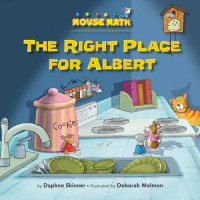
The Right Place for Albert
Grade 1
3 skill lessons · 3 math-through-reading
Math
Skill lessons
The mathematics the book carries, taught directly. Printable workbook pages and teacher keys are not available for this book yet.
- 1One Mouse, One Hiding Place
- 2Six Places, One Left
- 3First, Second, Third, All the Way to Six
Math + reading
Math through the reading
The same book, entered through a sentence it prints. Change one word in the reading and the numbers change with it.
- 4One Word, One Mouse, or All of Them
- 5How Many Mice Got There First?
- 6Was the Roll a Hiding Place?
Reading
Reading and language lessons
The same book read as a text. What a word means in its sentence, how a character is shown, how the writing is put together - no mathematics.
- 7Why Albert Needs a Place: Finding the Reason on the Page
- 8First, Then, Next: Retelling Albert's Search
- 9Say It Again: The Line Everybody Repeats
- 10Thump, Thump: Words That Make a Noise
- 11But He Was Wrong: When the Storyteller Knows More Than Albert
Skill lessons
3 lessons on the mathematics the book carries. Printable workbook pages and teacher keys are not available for this book yet.
1. One Mouse, One Hiding Place
The book states a matching rule four times and never states a number: every mouse gets exactly one hiding place, and no place holds two. Students build that matching with mouse cards and place cards, break it on purpose to see what a doubled-up place and an empty place look like, then join the two rows with yarn so the whole matching is visible all at once. When a card is removed the matching fails, and students say which row has more by seeing what is left over rather than by counting either row.
Full lesson — 20 minutes
1. Lay one mouse on one place (5 min)
Each pair sets six place cards in a row and puts one mouse card on each one, saying the rule out loud as they go: one mouse, one hiding place. Then they check the row by touching each place once and each mouse once, left to right. Every place must have exactly one mouse sitting on it, and no mouse may be left in the hand.
Word preview: each
Each mouse had his own hiding place in the kitchen.
One mouse, one hiding place, said Albert.
2. Break the rule on purpose (5 min)
Partners put two mouse cards on the cookie jar and take the mouse off the spice jars. They touch each place once and say what went wrong: one place has two mice and one place has none. Then they fix it with a single move and say what the move did. Each pair breaks the rule twice more, a different way each time, and the partner names the broken place before the fix.
Word preview: share
Can't we share it?"
One mouse, one hiding place.
3. Give every mouse a place with yarn (6 min)
Partners spread the place cards along the top of the matching mat and the mouse cards along the bottom, then join one mouse to one place with a length of yarn. No yarn may touch a card that already has a yarn on it. When the last yarn is laid, pairs touch each yarn in turn and count the pairs aloud, one to six, then say whether any mouse or any place is left over.
Word preview: every
But now, if there's trouble, every mouse knows just where to hide.
4. Take one place away (4 min)
One partner slides a place card off the mat and keeps it. The other partner tries to lay the yarns again and finds one mouse with nowhere to go. They say aloud how many mice and how many places are on the mat now, and which one there are more of. Swap and take a mouse away instead, so this time a place is left empty.
Word preview: left over
Short version — 9 minutes
1. Lay one mouse on one place (5 min)
Each pair sets six place cards in a row and puts one mouse card on each, saying the rule out loud: one mouse, one hiding place. They check by touching each place once and each mouse once. No mouse stays in the hand.
Each mouse had his own hiding place in the kitchen.
One mouse, one hiding place, said Albert.
2. Take one place away (4 min)
One partner slides a place card off and keeps it. The other lays the mice out again and finds one mouse with nowhere to go. They say how many mice and how many places are on the mat, and which there are more of. Swap and take a mouse away instead.
Three levels
- Support
- Work with four places and four mice instead of six, and lay the cards on the mat only, without yarn. The rule, the saying aloud and the check by touching are unchanged; what comes down is how many pairs are held in one row at once. Break the rule once, not three times, and fix it before the next pair is laid.
- At Grade
- Match all six mice to all six places, break the rule three different ways and fix each with one move, then lay the yarns and count the pairs one to six. When a card is taken away, say how many are in each row and which row has more without recounting the row that did not change.
- Extension
- Take away two places instead of one and say how many mice are left standing before any yarn is moved. Then set out seven mice against six places and say what the rule now forbids, and what the smallest number of new places would be that lets the rule hold again.
English learners
The rule sentence is four words long and it is the whole lesson, so a child can join in saying it on the first repetition even with very little English; let that happen before anything is explained. Left over does not transfer, because it sounds like a leaving rather than a remainder, and neither does the English habit of putting the compared thing last in more mice than places. Keep two frames up all lesson and say them the same way every time: This place has ___ mouse. and There are more ___ than ___. Invite children to say the rule and to name the kitchen spots in their strongest language, then to point along the yarn and say the pair count in English.
Materials
- Mouse cards, six per pair, each with one mouse on it
- Place cards, six per pair, named for the kitchen spots: cookie jar, oven mitt, bookshelf, cuckoo clock, spice jars, under the refrigerator
- Matching mat, a sheet with a row of place cards along the top and a row of mouse cards beneath it
- Yarn lengths, six per pair, for joining one mouse card to one place card
- Word cards: each, every, left over, share
Standards & curriculum
Choose your curriculum above to see the standards for this lesson.
Standards are held back while this plan is edited. Every standard shown here was matched against the supplied wording of this lesson, quoting its steps, so a changed step is no longer the thing that was checked. Undo your changes to bring the standards back — your edits stay in this browser either way.
2. Six Places, One Left
Albert checks six hiding places and the book says taken about five of them, one at a time, without ever giving a count. Students lay out the six places, cover each one as the story rules it out, and say how many are still open after every single removal, counting back six, five, four, three, two, one rather than recounting the row. The last uncovered card is the answer the story arrives at, and students reach one by taking away, not by being told.
Full lesson — 20 minutes
1. Set out the six places (4 min)
Each pair lays six place cards face up in a row in the order the book visits them: cookie jar, oven mitt, bookshelf, cuckoo clock, spice jars, and under the refrigerator. Partners count the row aloud, touching one card per number word, and say six. This is how many places are still open before the search begins.
Word preview: open
There must be a million hiding places in here, said Albert.
2. Lay a taken slip on each place that is gone (6 min)
As each spot is read out, the pair lays a taken slip on it and counts what is still open, touching only the cards with no slip. Cookie jar goes and five are open. Oven mitt goes and four are open. Bookshelf goes and three are open. Each partner says the new open count out loud before the next spot is read, and neither pair recounts the slips.
Word preview: taken
But the cookie jar was taken.
There said Albert, but the oven mitt was taken too.
The bookshelf is mine.
3. Finish the search and say what is left (6 min)
The cuckoo clock and the spice jars go together, two slips laid in one move, and the pair says how many are open now without touching the slips. One card has no slip on it. Pairs say what that one card is and say the number one aloud over it, then say how many of the six ended up taken.
Word preview: left
Inside the cuckoo clock, hi Albert and behind the spice jars.
But every spot was taken.
The place wasn't taken.
4. Run the search again from a different start (4 min)
Partners clear the slips and deal the six place cards in a new order, face down. They turn one at a time and lay a slip if it is taken, saying the open count after every turn. They stop the moment they turn the free place and say how many cards they never had to turn.
Word preview: still
Short version — 9 minutes
1. Set out the six places (4 min)
Each pair lays six place cards in a row in the order the book visits them and counts the row aloud, touching one card per number word, and says six. That is how many are open before the search begins.
There must be a million hiding places in here, said Albert.
2. Lay a taken slip on each place that is gone (5 min)
As each spot is read out, the pair lays a taken slip on it and counts what is still open, touching only the cards with no slip. Five, then four, then three. Each partner says the new open count aloud before the next spot is read.
But the cookie jar was taken.
There said Albert, but the oven mitt was taken too.
Three levels
- Support
- Use four places instead of six and lay one slip at a time, never two together. The counting back, the saying aloud and the touching of only the open cards are all unchanged; what comes down is the length of the count and the pace, because every removal is a single card and the pair says the new number before the next card is read.
- At Grade
- Run all six places, lay the slips as the story rules each spot out, and say the open count aloud after every removal without recounting from six. Take the cuckoo clock and the spice jars off together and say the new count before touching anything.
- Extension
- Before laying any slip, say how many will still be open after the next two removals, then lay them and check. At the end, say how many places were ruled out altogether and how the six splits into the taken ones and the free one, and say whether the answer would change if the free place had been turned over first.
English learners
Counting back is harder to hear than counting on, because English gives the numbers no ending to hold on to and the child must hold the previous number while saying the next. Say the sequence six, five, four, three, two, one slowly and together before any slip is laid, and keep it visible as a strip of numerals the children can touch. The word taken is doing a job here that its everyday meaning hides: it means this one is no longer available to count, not this one was carried away. Rehearse one frame all lesson, ___ is taken, so ___ are open, and let children say the count in their strongest language first and then in English while pointing at the uncovered cards.
Materials
- Place cards, six per pair, named for the kitchen spots: cookie jar, oven mitt, bookshelf, cuckoo clock, spice jars, under the refrigerator
- Taken slips, five per pair, to lay on a place the moment a pair hears it is taken
- Word cards: left, open, still, taken
Standards & curriculum
Choose your curriculum above to see the standards for this lesson.
Standards are held back while this plan is edited. Every standard shown here was matched against the supplied wording of this lesson, quoting its steps, so a changed step is no longer the thing that was checked. Undo your changes to bring the standards back — your edits stay in this browser either way.
3. First, Second, Third, All the Way to Six
The search visits six spots in a fixed order and the book names each one as Albert reaches it, so the row has a real first and a real last that the story, not the teacher, decided. Students rebuild that order, label each place with its number, and answer in both directions, from place to position and from position to place. They then count on inside the row with a cube rather than starting again at one, and find a card from clues that fix only what it comes after and before.
Full lesson — 20 minutes
1. Put the search in order (6 min)
Each pair receives six place cards shuffled and lays them in the order Albert tries them, using the story to decide. They then set a numeral card under each one, one through six, and read the row aloud: first the cookie jar, second the oven mitt, third the bookshelf, fourth the cuckoo clock, fifth the spice jars, sixth under the refrigerator.
Word preview: first
Albert pointed to the cookie jar.
Albert and Wanda looked high and low.
2. Say where each place sits in the line (5 min)
Partners take turns naming a place and the other says which try it was, and then the reverse: one says a number and the other names the place. Each child does three of each. The rule is that the answer must name the position and the place together, not just point.
Word preview: third
Try that thing on the counter, called Wanda as she ran to the bookshelf.
3. Count on from where you are (5 min)
Pairs put a cube on the third card and count on to the sixth, moving the cube one card at a time and saying four, five, six. They say how many cards the cube crossed. Then they start the cube on the first card and count on to the fourth, and say that number too, without going back to the start of the row.
Word preview: after
4. Find the place from two clues (4 min)
One partner gives two clues about a card without naming it: it comes after the oven mitt and before the cuckoo clock. The other partner finds it, names it, and says its number. Each child gives three sets of clues, and a clue that fits two cards has to be made sharper before the turn counts.
Word preview: before
Short version — 9 minutes
1. Put the search in order (5 min)
Each pair takes six shuffled place cards and lays them in the order Albert tries them, using the story to decide. They set a numeral card under each and read the row aloud from first to sixth.
Albert pointed to the cookie jar.
2. Say where each place sits in the line (4 min)
Partners take turns naming a place while the other says which try it was, then the reverse. Each child does two of each, and the answer names the position and the place together.
Try that thing on the counter, called Wanda as she ran to the bookshelf.
Three levels
- Support
- Work with the first four places and stop at fourth. The ordering, the numeral cards and the two-way naming stay exactly as they are; what comes off is the length of the row, so the child answers about a line they can see end to end without moving their head.
- At Grade
- Order all six places, label them one through six, and answer in both directions with the position and the place named together. Move the cube along the row to count on from the third card to the sixth and say how many it crossed without returning to the first card.
- Extension
- Turn the row around so under the refrigerator sits first and say every place's new number. Then say which places kept a number that is the same distance from an end, and give a partner a clue that fixes a card using only its distance from the end of the row.
English learners
Ordinal words in English are irregular exactly where they are used most: first, second and third share nothing with one, two and three, and a child who counts confidently in English may still stall on third. Say the cardinal and the ordinal together as each numeral card goes down, and keep both rows of words visible on the same strip. Before and after are the other hazard, because they are direction words with no number in them and several languages order them the other way round in the sentence. Rehearse the frame The ___ is number ___. and let a pointing finger along the row stand in for the word until it arrives, and invite children to give their clues in their strongest language before saying them in English.
Materials
- Place cards, six per pair, named for the kitchen spots: cookie jar, oven mitt, bookshelf, cuckoo clock, spice jars, under the refrigerator
- Numeral cards one through six, one set per pair
- Connecting cubes, twenty per pair
- Word cards: after, before, first, third
Standards & curriculum
Choose your curriculum above to see the standards for this lesson.
Standards are held back while this plan is edited. Every standard shown here was matched against the supplied wording of this lesson, quoting its steps, so a changed step is no longer the thing that was checked. Undo your changes to bring the standards back — your edits stay in this browser either way.
Math through the reading
The mathematics is reached through a sentence the book prints: change one word in the reading and the numbers change with it. These carry their own standards, matched against these lessons rather than inherited from the skill ones.
4. One Word, One Mouse, or All of Them
Students build the kitchen twice from one sentence, once with each and own in it and once without, and say aloud which words made a kitchen that needs six places and which made one that needs a single place.
Full lesson — 20 minutes
1. Build the kitchen the sentence describes (5 min)
Pairs hear the sentence about each mouse and his own hiding place and build it: six place cards in a row, one mouse card laid on each, saying one mouse, one hiding place as each mouse goes down. They count the places that are still free and find none, then hold up the mouse in their hand that has nowhere to sit.
2. Swap the words and build it again (6 min)
Pairs hear the sentence again with each and own taken out, so it says the mice had a hiding place, and build that on a second mat: one place card, every mouse card piled onto it. They count how many place cards this version needs and say one. Both mats now stand side by side, one needing six places and one needing a single place, and each child touches the two mats in turn and says the two numbers aloud.
3. Say which word made which kitchen (4 min)
Each child says one sentence about their own two mats with the word in it: this mat has each mouse in his own place, so it needs six places, and this mat has the mice together, so it needs one. Partners listen for the word and the number arriving in the same sentence and say so when one of them is missing.
4. Try the word the book refuses (5 min)
Pairs return to the six-place mat and act out Albert's question about sharing the bookshelf: they lay a second mouse on the bookshelf card and count how many places are open now. Then they hear Wanda's answer, the rule said again, take the second mouse off, and count the open places again. They say which count belongs to the book and which does not, and why the story could not end at the bookshelf.
Short version — 9 minutes
1. Swap the words and build it again (6 min)
Pairs hear the sentence again with each and own taken out, so it says the mice had a hiding place, and build that on a second mat: one place card, every mouse card piled onto it. They count how many place cards this version needs and say one. Both mats now stand side by side, one needing six places and one needing a single place, and each child touches the two mats in turn and says the two numbers aloud.
2. Say which word made which kitchen (4 min)
Each child says one sentence about their own two mats with the word in it: this mat has each mouse in his own place, so it needs six places, and this mat has the mice together, so it needs one. Partners listen for the word and the number arriving in the same sentence and say so when one of them is missing.
Three levels
- Support
- Work one mat at a time rather than two at once, and with four mice and four places rather than six. Build the each version, count the places it needs, then clear the mat completely before building the together version and counting that. The matching, the saying aloud and both versions are all still there; what comes off is holding two arrangements in view at the same moment.
- At grade
- Build both versions side by side, count the places each one needs, say which words made each, and say which version the book means. Then run the sharing move on the bookshelf and say the open count before and after the second mouse comes off.
- Extension
- Take taken and every and do the same work with them. Build the row with one spot taken and say the open count, then build it with every spot taken and say that count. Say which of the two words removes one place and which removes all of them, and say how many sentences of the book it took to get from the first to the second.
English learners
The rule is four short words and children join in saying it very fast, so let the chorus happen before anything is asked. English hides the whole force of this sentence in two small unstressed words in the middle of it, each and own, and a new listener hears the mice and the hiding place and quite reasonably takes the sentence to be about a place. Say the two versions slowly and back to back before any card is laid, with a hand on the mat for each one. Rehearse one frame all lesson: This mat needs ___ places, because each mouse has ___. Invite children to say what each and own mean in their strongest language and to name the kitchen spots in it while building, then to report the number of places in English with the frame. Never ask a child to explain the word before they have built the mat.
Materials
- Mouse cards, six per pair
- Place cards, six per pair, named for the kitchen spots
- Two matching mats per pair, one labeled Each Mouse and one labeled The Mice
- The two sentences on one card, the book's sentence above and the swapped sentence below it
- The rule on a strip, kept up all lesson: One mouse, one hiding place.
- The reporting frame: This mat needs ___ places, because each mouse has ___.
Standards & curriculum
Choose your curriculum above to see the standards for this lesson.
Standards are held back while this plan is edited. Every standard shown here was matched against the supplied wording of this lesson, quoting its steps, so a changed step is no longer the thing that was checked. Undo your changes to bring the standards back — your edits stay in this browser either way.
5. How Many Mice Got There First?
Students collect the hiding places the book names, mark the ones it closes, and produce a number the book never says by counting closed places and reading the rule to turn them into mice.
Full lesson — 20 minutes
1. Collect the places the book actually names (5 min)
The story is read and pairs put a place card down every time a new hiding spot is named and only then: cookie jar, oven mitt, bookshelf, cuckoo clock, spice jars, and the space under the refrigerator. Nothing goes down for a spot a child merely thinks a kitchen would have. Pairs count their row and compare it with the pair beside them, and any card neither pair can point to a sentence for comes back off the table.
2. Mark the ones the book says are gone (5 min)
Each sentence that closes a spot is read again and pairs lay a taken slip on that card as they hear it, saying the sentence back before the slip goes down. Five slips go down and one card stays bare. Pairs count the slips and say the number aloud, then count the bare cards and say that number too.
3. Say the number the book never says (6 min)
The question is put to the room: how many mice already had a hiding place before Albert found his? Pairs work it on their cards. Every taken slip means one mouse is behind it, because the rule allows only one, so the slips can be counted as mice. Each pair says a number and then says the two sentences their number rests on, the rule and one of the taken lines, before any answer is confirmed.
4. Point at the line that fixes the number (4 min)
Pairs say the number to another pair and have to give the sentence with it. The listening pair asks the one question that matters, how do you know it is one mouse behind each slip and not two, and the answer has to be the rule said back. A pair that gives the number without a sentence is asked again.
Short version — 9 minutes
1. Mark the ones the book says are gone (5 min)
Each sentence that closes a spot is read again and pairs lay a taken slip on that card as they hear it, saying the sentence back before the slip goes down. Five slips go down and one card stays bare. Pairs count the slips and say the number aloud, then count the bare cards and say that number too.
2. Say the number the book never says (6 min)
The question is put to the room: how many mice already had a hiding place before Albert found his? Pairs work it on their cards. Every taken slip means one mouse is behind it, because the rule allows only one, so the slips can be counted as mice. Each pair says a number and then says the two sentences their number rests on, the rule and one of the taken lines, before any answer is confirmed.
Three levels
- Support
- Work with the three places the story names in clean separate sentences, the cookie jar, the oven mitt and the bookshelf, and hold the answer to three. The collecting, the slip-laying, the counting and the saying of the sentence are all unchanged; what comes down is the length of the row, so the rule has to be held over three cards rather than five while the child says it.
- At grade
- Collect only the places the book names, mark the five it closes, count them, and say how many mice got there first with the rule and one taken sentence said aloud alongside the number. Answer a partner's challenge about why it is one mouse behind each slip and not two.
- Extension
- Say what the number would have to be if the rule allowed two mice to a place, and say why the book's own answer to that question is Wanda refusing to share the bookshelf. Then say why the number of mice in the whole kitchen cannot be worked out at all from this story, and name the sentence that gets in the way.
English learners
The rule is four words, it repeats four times, and it is the load-bearing sentence of the whole lesson, so a child with very little English can be holding the key evidence by the second repetition. Say it as a chorus every time it appears and let the children who are still building English lead it. The move the lesson turns on does not transfer, and English marks it with nothing at all: the jump from five places to five mice happens silently, and the child must say a sentence about places and then a sentence about mice with no word in between to signal the change. Keep two frames up and separate: ___ places are taken. and So ___ mice got there first. Have children point at the slips for the first frame and hold up fingers for the second, so the change of what is being counted has a change of gesture attached to it. Let the challenge question be answered in the strongest language first and then in English with the rule said back.
Materials
- Place cards, six per pair, named only as the book names them
- Taken slips, five per pair
- A strip printed with the rule, one per child, to hold while answering
- The six place cards enlarged, laid up as the story names them
- The two frames on chart paper: ___ places are taken. and So ___ mice got there first.
- The challenge question on a card: How do you know it is one mouse and not two?
Standards & curriculum
Choose your curriculum above to see the standards for this lesson.
Standards are held back while this plan is edited. Every standard shown here was matched against the supplied wording of this lesson, quoting its steps, so a changed step is no longer the thing that was checked. Undo your changes to bring the standards back — your edits stay in this browser either way.
6. Was the Roll a Hiding Place?
Students take a side on whether the paper towel roll counted as an available hiding place and argue it to Wanda with a number of places in the sentence.
Full lesson — 20 minutes
1. Build the row and put the roll in it (5 min)
Pairs lay their place cards and add one for the roll of paper towels. The two sentences about the roll are read again, that Albert hoped it wasn't taken and that it wasn't, and pairs lay no taken slip on it. They count how many places in their row have no slip and find two, the roll and the space under the refrigerator, and say both numbers aloud.
2. Hear the question and take a side (5 min)
The question is put: was the roll of paper towels the right place for Albert? Each child moves their mouse card onto the roll card or onto the refrigerator card to show their side, so the room's two sides are visible before anyone speaks. Pairs count how many mice went to each card.
3. Say it to Wanda with a number in it (6 min)
One child in each pair speaks as Albert and the other answers as Wanda, who made the rule and refused to let it bend at the bookshelf. Albert has to say his side to Wanda with a quantity in it, how many taken slips are on the row, or how many places were still open, or how many mice the rule allows on the roll. Wanda has to answer with a quantity of her own and may not answer that it was scary. They swap parts and run it again.
4. Change your mind out loud if it changed (4 min)
Pairs join another pair and each side says its strongest sentence once more. Any child whose mind changed moves their mouse card to the other card and says the number that moved them, and a child whose mind did not change says which sentence they had to answer to keep their side. Nobody is asked to defend a side they no longer hold.
Short version — 9 minutes
1. Hear the question and take a side (5 min)
The question is put: was the roll of paper towels the right place for Albert? Each child moves their mouse card onto the roll card or onto the refrigerator card to show their side, so the room's two sides are visible before anyone speaks. Pairs count how many mice went to each card.
2. Say it to Wanda with a number in it (6 min)
One child in each pair speaks as Albert and the other answers as Wanda, who made the rule and refused to let it bend at the bookshelf. Albert has to say his side to Wanda with a quantity in it, how many taken slips are on the row, or how many places were still open, or how many mice the rule allows on the roll. Wanda has to answer with a quantity of her own and may not answer that it was scary. They swap parts and run it again.
Three levels
- Support
- Give this child the frame on a strip and let them hold the row while they speak. They still take a side, still count the places without slips, and still say it to Wanda; what comes down is the amount of sentence they build in the moment, because the shape of it is in their hand and the number is the only part they supply. Run the row with four places rather than seven so the count they are defending is short enough to check by touching while they talk.
- At grade
- Take a side, count the available places in the row to fund it, and say it to Wanda in a sentence with the number in it. Answer Wanda's counter-position with a second sentence that also carries a number, and say which of the book's sentences your side rests on.
- Extension
- Argue the side you did not choose, to a partner holding your own, and find the strongest thing that can be said against your first position. Then say what the book would have had to print for the question to be closed, and say whether Albert ending up under the refrigerator settles it or only ends the story.
English learners
The arguing frame is the whole difficulty here and it is nearly all function words: because, still, only, not, all of which carry the argument and none of which carry stress in English. Number and counting transfer completely, so a child can hold a perfectly clear position on the row and be unable to launch the sentence. Keep two frames visible and unchanged all lesson, one for each side: I think the roll was his, because ___ places had no slip on them. and I think the roll was not a place, because only ___ place was really open. Have children point at the cards they are counting as they say the number, so the pointing carries the part of the sentence that has not arrived yet. Let a child settle their side and rehearse the number in their strongest language before saying it to Wanda in English, and let the swap of parts happen only after both children have said their own side once.
Materials
- Place cards, seven per pair, the six the book names plus one for the roll of paper towels
- Taken slips, five per pair
- One mouse card per child, moved onto the card they are arguing for
- The two position frames on chart paper, one above the other
- The two verdict sentences side by side on one card, the roll's and the refrigerator's
- The rule on a strip, kept up all lesson: One mouse, one hiding place.
Standards & curriculum
Choose your curriculum above to see the standards for this lesson.
Standards are held back while this plan is edited. Every standard shown here was matched against the supplied wording of this lesson, quoting its steps, so a changed step is no longer the thing that was checked. Undo your changes to bring the standards back — your edits stay in this browser either way.
Reading and language lessons
5 lessons on the reading and language the book carries - what a word means in its sentence, how a character is shown, how a text is built. No mathematics: these are matched against the English language arts curricula, which are a different and smaller set than the mathematics ones.
7. Why Albert Needs a Place: Finding the Reason on the Page
Albert spends the whole book looking for one thing, and the book prints the reason two pages before he starts looking. Students read the sentence that says the kitchen is dangerous, read the sentence that says every mouse has a place, and put the two together into a because-sentence about what Albert wants. The work is finding a character's reason in printed words instead of guessing it.
Full lesson — 20 minutes
1. Read the sentence that says it is dangerous (6 min)
The teacher reads the passage below once, then everyone reads it again together. Underline the word dangerous. Say aloud the two things the passage tells you are dangerous for a mouse in that kitchen.
Word preview: dangerous
The kitchen was full of wonderful treats, but it was dangerous, too. The people didn't like mice. Neither did the cat.
2. Read the rule and say what it is for (5 min)
Read the passage below with the teacher. Wanda says what happened before the rule. Say aloud, in your own words, what the rule is for. Then put your finger on the words that tell you.
Word preview: reason
You know the rule, said Wanda. One mouse, one hiding place, said Albert. Right, said Wanda, before the rule, we had problems. But now, if there's trouble, every mouse knows just where to hide.
3. Build a because-sentence (5 min)
Read the passage below again. On your reason chart write: Albert wants a hiding place because ___. Finish it using words you can point to in this passage. Read your sentence to a partner.
Word preview: because, wants
The kitchen was full of wonderful treats, but it was dangerous, too. The people didn't like mice. Neither did the cat.
4. Say the want and the reason together (4 min)
Read the passage below one more time. Then tell a partner, in two sentences, what Albert wants and why. Your partner listens for words that really come from this printed passage and gives a thumbs up when they hear them.
The kitchen was full of wonderful treats, but it was dangerous, too. The people didn't like mice. Neither did the cat.
Short version — 9 minutes
1. Read the sentence that says it is dangerous (5 min)
The teacher reads the passage below, then everyone reads it together. Underline the word dangerous and say aloud the two things that are dangerous for a mouse in that kitchen.
Word preview: dangerous
The kitchen was full of wonderful treats, but it was dangerous, too. The people didn't like mice. Neither did the cat.
2. Build a because-sentence (4 min)
Read the passage below again and finish this sentence out loud: Albert wants a hiding place because ___. Use words you can point to in the passage.
Word preview: because
The kitchen was full of wonderful treats, but it was dangerous, too. The people didn't like mice. Neither did the cat.
Three levels
- Support
- Read only the first sentence of the printed passage in step 1 with the teacher, echoing after her. Point to the word dangerous. Then say aloud one thing that is dangerous, using the passage's own words.
- At Grade
- Underline dangerous in the step 1 passage, name both dangers it prints, and finish the because-sentence on the chart using words from that passage.
- Extension
- The step 1 passage says the kitchen was full of wonderful treats and also that it was dangerous. Say two sentences about why a mouse would go into a place that is both, and point to the words that made you think so.
English learners
English puts the reason after because, while several home languages put it first, so students may build the sentence backwards. Say the frame aloud against the printed passage before writing: Albert wants ___ because ___. Invite students to give the reason in their strongest language first, then rebuild it in English with the frame. The word dangerous is long; clap its three parts before reading it.
Materials
- The Right Place for Albert, the passage printed in this step
- pencil
- reason chart (wants / because)
- Word cards: dangerous, reason, because, wants
Standards & curriculum
Choose your curriculum above to see the standards for this lesson.
Standards are held back while this plan is edited. Every standard shown here was matched against the supplied wording of this lesson, quoting its steps, so a changed step is no longer the thing that was checked. Undo your changes to bring the standards back — your edits stay in this browser either way.
8. First, Then, Next: Retelling Albert's Search
Albert tries one spot, then another, then another, and each try ends the same way. Students read three printed tries, put them in the order the book gives them, and retell the search out loud with first, then and next. Nothing is added up; the work is holding several events in order and saying them back so a listener can follow.
Full lesson — 20 minutes
1. Read the first try (5 min)
Read the passage below with the teacher. Albert points at a spot and asks about it. Say aloud what Albert tried first, and say what happened. Write the word taken on your first order card.
Word preview: first, taken
Albert pointed to the cookie jar. How about behind there? Maybe, said Wanda, let's see. But the cookie jar was taken.
2. Read two more spots in one sentence (5 min)
Read the passage below with the teacher. This sentence has a stray label, hi Albert, stuck in the middle of it. Read it exactly as it is printed and do not fix it. Then say aloud the two spots this sentence names, and what the next sentence says about them.
Word preview: then
Inside the cuckoo clock, hi Albert and behind the spice jars. But every spot was taken.
3. Put the tries in order (5 min)
Read both passages below in the order they are printed here, which is the order the book gives them. Lay your order cards down left to right as you read. Then point to your cards and say: first ___, then ___, next ___.
Word preview: next
Albert pointed to the cookie jar. How about behind there? Maybe, said Wanda, let's see. But the cookie jar was taken.
Inside the cuckoo clock, hi Albert and behind the spice jars. But every spot was taken.
4. Retell the search to a partner (5 min)
Read the passage below, which is where the search finally ends. Then retell Albert's whole search to a partner using first, then, next and last. Your partner listens for the order words and holds up a finger each time they hear one.
This place better not be taken. The place wasn't taken. It was his.
Short version — 9 minutes
1. Read the first try (5 min)
Read the passage below with the teacher. Say aloud what Albert tried first and what happened to that spot.
Word preview: first, taken
Albert pointed to the cookie jar. How about behind there? Maybe, said Wanda, let's see. But the cookie jar was taken.
2. Put the tries in order (4 min)
Read both passages below in the order they are printed here. Then say: first ___, then ___, next ___.
Word preview: next
Albert pointed to the cookie jar. How about behind there? Maybe, said Wanda, let's see. But the cookie jar was taken.
Inside the cuckoo clock, hi Albert and behind the spice jars. But every spot was taken.
Three levels
- Support
- Work only with the step 1 passage. Say the spot Albert points to, then say what the last sentence says about it. Two sentences is enough.
- At Grade
- Read both printed passages, lay the order cards out in the book's order, and retell the search with first, then and next.
- Extension
- The step 2 passage carries the words hi Albert in the middle of a sentence about two hiding spots. Say two sentences about why those words are hard to place in the order, and retell the search without them.
English learners
First, then and next are the joints of an English retelling and they are easy to hear but easy to leave out. Rehearse the three words aloud against the step 1 passage before any retelling. Invite students to retell the search in their strongest language first, then again in English with the order words held on cards. Note that the step 2 passage is damaged: hi Albert is not part of either spot, and students should be told so rather than left puzzling.
Materials
- The Right Place for Albert, the passage printed in this step
- pencil
- three order cards
- Word cards: first, then, next, taken
Standards & curriculum
Choose your curriculum above to see the standards for this lesson.
Standards are held back while this plan is edited. Every standard shown here was matched against the supplied wording of this lesson, quoting its steps, so a changed step is no longer the thing that was checked. Undo your changes to bring the standards back — your edits stay in this browser either way.
9. Say It Again: The Line Everybody Repeats
One short line comes back four times in this book, and different characters say it for different reasons. Students hear it inside two printed passages, notice that it is the same words both times, and say what changes about who is saying it and why. The skill is hearing a repeated line and saying what the repeating does to a reader.
Full lesson — 20 minutes
1. Hear the line the first time (5 min)
The teacher reads the passage below. Listen for the short line Albert says back to Wanda. Read that line together as a class. Then say aloud who says it here.
Word preview: rule
You know the rule, said Wanda. One mouse, one hiding place, said Albert. Right, said Wanda, before the rule, we had problems. But now, if there's trouble, every mouse knows just where to hide.
2. Hear the same line again (5 min)
Read the passage below with the teacher. Wanda uses the word repeat. Read the short line again and say aloud whether it is exactly the same words as before. Put a tick on your echo card each time you hear it.
Word preview: repeat, again, same
Repeat after me, Albert said Wanda. One mouse, one hiding place. Okay, okay. He said I get it.
3. Say what is different about who says it (5 min)
Read both passages below. The short line is the same in each. Tell a partner who says it in the first passage and who asks for it in the second, and say aloud one thing that is different about why.
You know the rule, said Wanda. One mouse, one hiding place, said Albert. Right, said Wanda, before the rule, we had problems. But now, if there's trouble, every mouse knows just where to hide.
Repeat after me, Albert said Wanda. One mouse, one hiding place. Okay, okay. He said I get it.
4. Read the line the way each speaker means it (5 min)
Read the passage below aloud twice with a partner. The first time read it the way somebody teaching a rule would say it. The second time read it the way somebody who is tired of hearing it would say it. Say aloud which words in the passage told you the second way was possible.
Repeat after me, Albert said Wanda. One mouse, one hiding place. Okay, okay. He said I get it.
Short version — 9 minutes
1. Hear the line the first time (5 min)
The teacher reads the passage below. Read the short line Albert says back to Wanda together, then say who says it here.
Word preview: rule
You know the rule, said Wanda. One mouse, one hiding place, said Albert. Right, said Wanda, before the rule, we had problems. But now, if there's trouble, every mouse knows just where to hide.
2. Hear the same line again (4 min)
Read the passage below with the teacher. Read the short line again and say whether it is exactly the same words as before.
Word preview: repeat, same
Repeat after me, Albert said Wanda. One mouse, one hiding place. Okay, okay. He said I get it.
Three levels
- Support
- Echo the short line after the teacher from the step 1 passage. Say it three times. Then answer aloud: is it the same words each time?
- At Grade
- Read both printed passages, tick the echo card when you hear the line, and say who is speaking it each time and why.
- Extension
- In the step 2 passage Albert answers Okay, okay. He said I get it. Say two sentences about what that answer tells you about how Albert feels about hearing this line, and point to the words that made you think so.
English learners
A repeated line is a strong hook for students building English, because the same words come back and can be held. Chant the line as a class before reading either passage, then let students hear it arrive inside connected speech. Invite students to name a saying that is repeated in their own family or home language and say what it is for. Rehearsable frame: I hear it again when ___ says it.
Materials
- The Right Place for Albert, the passage printed in this step
- pencil
- echo cards
- Word cards: repeat, again, same, rule
Standards & curriculum
Choose your curriculum above to see the standards for this lesson.
Standards are held back while this plan is edited. Every standard shown here was matched against the supplied wording of this lesson, quoting its steps, so a changed step is no longer the thing that was checked. Undo your changes to bring the standards back — your edits stay in this browser either way.
10. Thump, Thump: Words That Make a Noise
Two printed passages carry words that are noises rather than descriptions, and both arrive at the scariest moment in the book. Students read them aloud, decide which words are the noise itself and which words explain it, then read the same passage two ways and say which reading fits. The skill is hearing what a sound word does in a sentence.
Full lesson — 20 minutes
1. Read the noise out loud (6 min)
The teacher reads the passage below once. Then read it together as a class and say the thumps out loud, one at a time, the way footsteps come. Circle the word that names what the noise turned out to be.
Word preview: thump, loud
Just then he heard a loud, thump, thump, thump, thump. Footsteps. Uh-oh, said Wanda. People are coming. We have to hide.
2. Sort noise words from telling words (5 min)
Read the passage below again. Copy onto your sound word list the words that are the noise itself. Then copy, in a second column, the words that tell you about the noise instead of making it. Say aloud one word from each column.
Word preview: sound, noise
Just then he heard a loud, thump, thump, thump, thump. Footsteps. Uh-oh, said Wanda. People are coming. We have to hide.
3. Read a quiet moment beside a loud one (5 min)
Read the passage below with a partner. There is no noise word here at all. Say aloud how this passage sounds different from the thumping one, and point to the words that made you say so.
I'm safe, thought Albert. But he was wrong.
4. Read it twice and choose (4 min)
Read the passage below aloud twice with a partner. Read it once quietly and once loudly. Say which reading fits the words on the page better, and name the word in the passage that decided it for you.
Just then he heard a loud, thump, thump, thump, thump. Footsteps. Uh-oh, said Wanda. People are coming. We have to hide.
Short version — 9 minutes
1. Read the noise out loud (5 min)
The teacher reads the passage below once. Read it together and say the thumps out loud one at a time. Circle the word that names what the noise turned out to be.
Word preview: thump, loud
Just then he heard a loud, thump, thump, thump, thump. Footsteps. Uh-oh, said Wanda. People are coming. We have to hide.
2. Read it twice and choose (4 min)
Read the passage below aloud twice, once quietly and once loudly. Say which reading fits the words on the page, and name the word that decided it.
Just then he heard a loud, thump, thump, thump, thump. Footsteps. Uh-oh, said Wanda. People are coming. We have to hide.
Three levels
- Support
- Echo the thumps after the teacher from the step 1 passage, one at a time. Then point to the word Footsteps and say it aloud.
- At Grade
- Read the step 1 passage aloud, sort its noise words from its telling words on the list, and read it twice to choose the reading that fits.
- Extension
- The step 1 passage prints the noise before it names what is making it. Say two sentences about why a writer might put the noise first, using words from the passage.
English learners
Sound words often differ sharply between languages, and thump has a consonant cluster many students will find hard at speed. Say it slowly four times before reading the passage, then at footstep speed. Invite students to say the sound a heavy footstep makes in their strongest language and write both spellings on the sound word list side by side.
Materials
- The Right Place for Albert, the passage printed in this step
- pencil
- sound word list
- Word cards: thump, loud, sound, noise
Standards & curriculum
Choose your curriculum above to see the standards for this lesson.
Standards are held back while this plan is edited. Every standard shown here was matched against the supplied wording of this lesson, quoting its steps, so a changed step is no longer the thing that was checked. Undo your changes to bring the standards back — your edits stay in this browser either way.
11. But He Was Wrong: When the Storyteller Knows More Than Albert
Albert thinks he is safe and the very next sentence says he is not. Students read the two-sentence passage, mark whose words each sentence carries, then read on to see what the storyteller was warning about. The work is telling a character's thought from the storyteller's telling, and saying what the storyteller lets a reader know first.
Full lesson — 20 minutes
1. Read two sentences and mark who says them (5 min)
Read the passage below with the teacher. One sentence carries what Albert thinks. The other carries what the storyteller tells you. Underline Albert's thought in one colour and the storyteller's sentence in the other. Say aloud which one you believe.
Word preview: thought, wrong, safe
I'm safe, thought Albert. But he was wrong.
2. Read what happens next (5 min)
Read the passage below with the teacher. This is what the storyteller knew was coming. Say aloud one thing here that shows Albert was wrong, and put your finger on the words.
Word preview: tells
Cat! A paw tried to reach him. It missed. This is not a good hiding place. Albert was bumped and thumped. The cat hit the roll and it went flying. The roll bounced and stopped.
3. Say what the storyteller let you know first (5 min)
Read both passages below in the order printed here. Tell a partner what the storyteller let you know before Albert knew it. Then say aloud whether that made the next part more exciting or less, and why.
I'm safe, thought Albert. But he was wrong.
Cat! A paw tried to reach him. It missed. This is not a good hiding place. Albert was bumped and thumped. The cat hit the roll and it went flying. The roll bounced and stopped.
4. Write a storyteller sentence of your own (5 min)
Read the passage below, where Albert hopes about a new spot. Write one storyteller sentence that could come next, beginning with the word But. Read it aloud and say what your sentence tells a reader that Albert does not know.
Try that thing on the counter, called Wanda as she ran to the bookshelf. What thing, Albert cried? Then he saw it, the roll of paper towels, Albert hurried over, hoping it wasn't taken. It wasn't.
Short version — 9 minutes
1. Read two sentences and mark who says them (5 min)
Read the passage below with the teacher. Underline Albert's thought in one colour and the storyteller's sentence in the other, then say which one you believe.
Word preview: thought, wrong, safe
I'm safe, thought Albert. But he was wrong.
2. Read what happens next (4 min)
Read the passage below with the teacher. Say aloud one thing here that shows Albert was wrong, and point to the words.
Word preview: tells
Cat! A paw tried to reach him. It missed. This is not a good hiding place. Albert was bumped and thumped. The cat hit the roll and it went flying. The roll bounced and stopped.
Three levels
- Support
- Read only the step 1 passage with the teacher. Point to the word safe, then to the word wrong. Answer aloud: was Albert safe?
- At Grade
- Mark both sentences in the step 1 passage by who speaks them, then read the step 2 passage and name one thing that shows Albert was wrong.
- Extension
- The step 1 passage tells you Albert is wrong before it tells you why. Say two sentences about what a reader feels in the gap between those two sentences, and point to the words that made you think so.
English learners
English marks a character's inner speech with thought Albert rather than with any punctuation here, so the difference between what a character thinks and what the storyteller says can be invisible on the page. Read the step 1 passage twice, once in a whispering voice for the thought and once in a plain voice for the storyteller, so the two are heard apart. Rehearsable frame: Albert thinks ___, but the storyteller says ___.
Materials
- The Right Place for Albert, the passage printed in this step
- pencil
- two-colour pencils
- Word cards: thought, wrong, safe, tells
Standards & curriculum
Choose your curriculum above to see the standards for this lesson.
Standards are held back while this plan is edited. Every standard shown here was matched against the supplied wording of this lesson, quoting its steps, so a changed step is no longer the thing that was checked. Undo your changes to bring the standards back — your edits stay in this browser either way.