Both exports carry any edits you have made. Edits are
saved in this browser only — nobody else sees them, and they are not sent anywhere.
Skill lessons
5 lessons on the
mathematics the book carries. Each lesson has printable workbook pages and a separate teacher key.
1. Double the Batch: One Third Plus One ThirdFluency · Adding fractions with like denominators
The book doubles four recipes and writes every doubled amount as a full sentence, so the arithmetic arrives already spelled out in words: one half cup plus one half cup equals one cup. Students take those same amounts, build each part with fraction strips on a cup mat, produce the sum for halves, thirds and quarters, and then write the line the way the book writes it before checking a partner's four lines against their own.
Full lesson — 20 minutes
1. Read the doubling rule(4 min)
Partners read the book's two doubling sentences aloud, one sentence each, then say in their own words what a cook adds. Point at the words one third cup the first time they appear and again the second time, and say how many one third cups are now on the table. Say the amounts; do not work out any answer yet.
Word preview: double, equal
When you double a recipe, that means you add an equal amount of each ingredient.
If a recipe calls for one third cup of something, you add another one third cup for a total of two thirds cup.
2. Build both amounts with strips(6 min)
Each pair lays one half strip on the cup mat, then lays a second half strip beside it and pushes the two together. Say what the pieces cover now, then do the same with two one third strips and with two one quarter strips. One strip goes down for each amount the book names, never two at once.
Buttermilk, one half cup plus one half cup equals one cup.
3. Write the sum for every line(5 min)
Copy each ingredient name onto the recording sheet and write the sum as a sentence: the amount, plus the same amount again, equals your answer. Do the four lines on your sheet before you look at the book's version of any of them. The bottom part of the fraction stays the same on both sides of the plus sign.
Word preview: total
You will need water, 1 third cup, plus 1 third cup, equals 2 third cups.
Trade recording sheets and read your partner's four lines aloud, line by line. Wherever the two of you wrote different answers, rebuild both amounts with the strips and say which sum the strips cover. Mark the line you fixed and tell your partner what changed.
Partners read the two doubling sentences aloud, one each, and say what a cook adds to an amount. Point at one third cup both times it appears and say how many one third cups are on the table.
Word preview: double, equal
When you double a recipe, that means you add an equal amount of each ingredient.
If a recipe calls for one third cup of something, you add another one third cup for a total of two thirds cup.
2. Write the sum for every line(5 min)
Write the sum for two lines as full sentences: the amount, plus the same amount again, equals your answer. Keep the bottom part of the fraction the same on both sides of the plus sign, then read both lines aloud.
Word preview: total
You will need water, 1 third cup, plus 1 third cup, equals 2 third cups.
Stay with halves for the whole lesson. Lay two one half strips on the cup mat, say one half cup plus one half cup equals one cup while touching each strip, and write that one line. Bring in the thirds only after the halves line is written and read aloud.
At Grade
Work all three families — halves, thirds and quarters — building each pair of strips on the mat before writing the line, and finish by reading all four finished lines aloud to your partner.
Extension
Double the peanut paste instead: two thirds cup and another two thirds cup. Your strips will run past the end of the cup mat, so say first how many thirds you are holding, then how many whole cups and how many thirds that makes. Say why the bottom part of the fraction stayed at thirds when the answer grew past one cup.
English learners
English fraction names are the difficulty: the bottom part is said like an order word — third, quarter, eighth — and the top part turns plural at two, so it is two thirds and not two third. Model one sentence until it runs without thinking: one cup of something plus one cup of the same makes two cups. Invite students to count the strips and settle the answer in their own language first, then say the finished line in English at the partner check.
Materials
Sentence strips carrying the book's two doubling rules
Fraction strips in halves, thirds, and quarters
A one cup mat for laying strips
Recording sheet ruled in ingredient lines
Word cards: double, equal, total
Workbook
Print these for the class. They carry your edits, and they print in black and white.
Sentence strips: the two doubling rules, with the lesson's word cards strip set
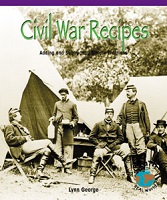
Civil War Recipes — Double the Batch: One Third Plus One Third
Sentence strips: the two doubling rules
When you double a recipe, that means you add an equal amount of each ingredient.
If a recipe calls for one third cup of something, you add another one third cup for a total of two thirds cup.
Word cards
double
equal
total
One cup mat and fraction strips in halves, thirds and quarters strip set
Civil War Recipes — Double the Batch: One Third Plus One Third
One cup mat
Fraction strips: halves
Fraction strips: thirds
Fraction strips: quarters
Doubling sheet full page
Civil War Recipes — Double the Batch: One Third Plus One Third
Doubling sheet
Write the ingredient name on the first line. Then write the sum as a sentence: the amount, plus the same amount again, equals your answer.
If you change a line after you check with your partner, put a check beside it.
Line 1
Ingredient
Sum
Line 2
Ingredient
Sum
Line 3
Ingredient
Sum
Line 4
Ingredient
Sum
Teacher key (1 page) — not for the class
Teacher key: doubling sheet full page
Civil War Recipes — Double the Batch: One Third Plus One Third — Teacher Key
Doubling sheet: expected lines
Four lines. The book's own wording, in the order the lesson meets them:
Buttermilk, one half cup plus one half cup equals one cup.
You will need water, 1 third cup, plus 1 third cup, equals 2 third cups.
Any wording that names the ingredient, states the amount twice and gives the total. A line written without the ingredient name is still correct if the sum is right.
Read for
A close line keeps the bottom part of the fraction the same on both sides of the plus sign and names a total with its unit: two thirds cup, one cup, one tablespoon. A loose line changes the bottom part when the amounts are joined, or gives a bare number with no unit.
The quarter strips are built and said aloud in step 2. The book supplies no quarter line in this lesson, so a sheet with four lines is complete.
Support writes the halves line only. The Extension is argued aloud with the strips and leaves no written line.
Standards & curriculum
Choose your curriculum above to see the standards for this lesson.
Standards are held back while this plan is edited.
Every standard shown here was matched against the supplied wording of this
lesson, quoting its steps, so a changed step is no longer the thing that
was checked. Undo your changes to bring the standards back — your edits stay
in this browser either way.
2. Half the Pot: Taking One Third from Two ThirdsFluency · Subtracting fractions with like denominators
Halving a pot is where this book does its clearest subtraction, and it spells every difference out in words: two thirds cup minus one third cup equals one third cup. Students build the starting amount in thirds, quarters or eighths, slide one piece away, and write the difference as a sentence before checking it against a partner's line and rebuilding whatever the two of them disagree on.
Full lesson — 20 minutes
1. Read the halving rule(5 min)
Partners read the halving rule aloud and then read the soup question that follows it. Say how many people the soup was written for and how many you are cooking for now. Say what a cook takes away from each amount, using the rule's own words.
Word preview: half, minus
When you cut a recipe in half, that means you're subtracting half the amount of each ingredient.
How much of the ingredients would you need if you wanted to prepare the soup for only three people?
2. Take pieces off the strips(6 min)
Lay two one third strips on the desk for the peanut paste, then slide one strip away and push it out of reach. Say what is left while touching it, and say how many thirds you started with and how many you kept. Do it again with quarters and again with eighths.
Peanut butter, two thirds cup minus one third cup equals one third cup.
3. Write the difference for every line(5 min)
Write each line on your sheet as a sentence: the starting amount, minus what you slid away, equals what is left. Do all three lines before you look at the book's version of any of them. The bottom part of the fraction is the same in all three places on the line.
Word preview: third
Two eighth teaspoon minus one eighth teaspoon equals one eighth teaspoon.
Two quarter teaspoons minus one quarter teaspoon equals one quarter teaspoon.
4. Read your line and check it(4 min)
Read your three lines aloud to your partner and listen to theirs. Where two answers differ, rebuild the starting amount and slide the piece away again while your partner watches, and say which line the strips support. Mark the line you changed.
Chicken or vegetable broth, four cups minus two cups equals two cups.
Short version — 9 minutes
1. Read the halving rule(5 min)
Read the halving rule aloud and then the soup question after it. Say how many people the soup was written for, how many you are cooking for, and what a cook takes away from each amount.
Word preview: half, minus
When you cut a recipe in half, that means you're subtracting half the amount of each ingredient.
How much of the ingredients would you need if you wanted to prepare the soup for only three people?
2. Read your line and check it(4 min)
Read your lines aloud to your partner and listen to theirs. Where two answers differ, rebuild the amount and slide the piece away again, then say which line the strips support and mark it.
Chicken or vegetable broth, four cups minus two cups equals two cups.
Three levels
Support
Stay with thirds. Lay two one third strips, slide one away, and say two thirds cup minus one third cup equals one third cup while touching the strip that is left. Write that one line and read it aloud before any other family is opened.
At Grade
Run thirds, quarters and eighths, sliding the piece away before you write each difference, and finish by reading all three lines to your partner.
Extension
Take half of a whole teaspoon of red pepper, the amount this book cuts from one teaspoon down to a half teaspoon. Show with the strips how one whole has to be seen as two halves before anything can be taken from it, and say why the whole had to be broken first.
English learners
The arithmetic travels; the vocabulary of taking away does not. English offers minus, take away and cut in half for moves that are not all the same thing, and in this book half does double duty — it is both the amount removed and the amount left, in the same sentence. That is a real source of error for a child whose subtraction is fine. Walk through a sentence taking one measure away from two of the same and naming what is left. Students may count and slide the strips in their everyday language and say the finished line in English at the partner check.
Materials
Sentence strip of the book's halving rule
Fraction strips in thirds, quarters, and eighths
Recording sheet ruled in ingredient lines
Word cards: half, minus, third
Workbook
Print these for the class. They carry your edits, and they print in black and white.
Sentence strips: the halving rule and the soup question, with the lesson's word cards strip set
Civil War Recipes — Half the Pot: Taking One Third from Two Thirds
Sentence strips: the halving rule and the soup question
When you cut a recipe in half, that means you're subtracting half the amount of each ingredient.
How much of the ingredients would you need if you wanted to prepare the soup for only three people?
Word cards
half
minus
third
Fraction strips in thirds, quarters and eighths strip set
Civil War Recipes — Half the Pot: Taking One Third from Two Thirds
Fraction strips: thirds
Fraction strips: quarters
Fraction strips: eighths
Halving sheet full page
Civil War Recipes — Half the Pot: Taking One Third from Two Thirds
Halving sheet
Write each line as a sentence: the starting amount, minus what you slid away, equals what is left.
If you change a line after you read it to your partner, put a check beside it.
Line 1 — thirds
Line 2 — quarters
Line 3 — eighths
Teacher key (1 page) — not for the class
Teacher key: halving sheet full page
Civil War Recipes — Half the Pot: Taking One Third from Two Thirds — Teacher Key
Halving sheet: expected lines
Three lines, one family each. The book's own wording:
Thirds: Peanut butter, two thirds cup minus one third cup equals one third cup.
Quarters: Two quarter teaspoons minus one quarter teaspoon equals one quarter teaspoon.
Eighths: Two eighth teaspoon minus one eighth teaspoon equals one eighth teaspoon.
Accept
The quarter and the eighth lines carry no ingredient name in the book, so a line written without one is complete. The thirds line may name the peanut butter or not.
Read for
A close line has the same bottom part of the fraction in all three places and leaves one piece behind. A loose line renames the pieces while subtracting - two thirds minus one third written as one half - or reports what was slid away instead of what is left.
The book line read at the partner check is: Chicken or vegetable broth, four cups minus two cups equals two cups. It is read, not written, and is not one of the three lines on the sheet.
Support writes the thirds line only. The Extension is argued aloud with the strips and leaves no written line.
Standards & curriculum
Choose your curriculum above to see the standards for this lesson.
Standards are held back while this plan is edited.
Every standard shown here was matched against the supplied wording of this
lesson, quoting its steps, so a changed step is no longer the thing that
was checked. Undo your changes to bring the standards back — your edits stay
in this browser either way.
3. Two Quarter Pounds Is One Half PoundConcept · Recognizing equivalent fractions in a measured amount
One line in this book carries three names for the same butter: one quarter pound plus one quarter pound equals two quarter pounds equals one half pound. Students build that line with strips, rename two further amounts the book itself renames — a half teaspoon as two quarter teaspoons, a quarter teaspoon as two eighth teaspoons — and then fill the smaller spoon twice into the larger one to see whether anything changed. The concept is exactly this and nothing wider: renaming changes what an amount is called and leaves how much is there alone.
Full lesson — 20 minutes
1. Read the three names on one line(4 min)
Read the butter line aloud from the strip and stop at each equals sign. Say the three names it gives for the butter in order and hold up fingers for how many names there are. Tell your partner which of the three names you would say out loud in a kitchen.
Word preview: quarter
Butter, one quarter pound plus one quarter pound equals two quarter pounds equals one half pound.
2. Cover the half with quarters(6 min)
Lay one half strip on the desk and cover it exactly with quarter strips, adding one at a time until nothing sticks out. Say how many quarters it took and then say both names for the covered length while touching it. Do it again covering a quarter strip with eighth strips.
Ginger, one half teaspoon equals two quarter teaspoons.
3. Rename each amount the second way(5 min)
Write each of the three amounts on your sheet and then write its second name on the line underneath. Build the amount with strips before you write the second name, never after. Read each finished pair aloud as one sentence: one ___ is the same amount as two ___.
Word preview: eighth
Red pepper, one quarter teaspoon equals two eighth teaspoon.
4. Say which name the cook uses(5 min)
Hold the quarter teaspoon and the eighth teaspoon. Fill the eighth spoon twice into the quarter spoon and say whether the amount of red pepper changed. Then tell your partner which name you would use if the recipe asked for a quarter teaspoon and the only spoon left in the drawer were the small one. Say why the amount is the same either way.
Word preview: equal
To add and subtract fractions, you need to know that there are several different but equal ways to write each fraction.
Short version — 9 minutes
1. Read the three names on one line(4 min)
Read the butter line aloud and stop at each equals sign. Say the three names it gives for the same butter and tell your partner which one you would say in a kitchen.
Word preview: quarter
Butter, one quarter pound plus one quarter pound equals two quarter pounds equals one half pound.
2. Rename each amount the second way(5 min)
Write each amount on your sheet and its second name underneath. Build the amount with strips before you write the second name, then read the pair aloud as one sentence.
Word preview: eighth
Red pepper, one quarter teaspoon equals two eighth teaspoon.
Three levels
Support
Work in halves and quarters only and leave the eighth strips in the box. Cover the one half strip with quarter strips, say two quarter pounds and then one half pound while touching the same covered length, and write both names on one line.
At Grade
Rename all three amounts — the butter, the ginger and the red pepper — building each one with strips before writing its second name, and read every finished pair aloud.
Extension
Take the butter line and say why two quarter pounds and one half pound are the same weight when every number in the two names is different. Use the strips to show which pieces each name is counting, and name the one thing that stayed the same while both numbers changed.
English learners
The idea itself is not a language problem: a child who sees that the covered length did not change already holds the concept, whatever words they hold it in. The English is the difficulty. The same amount takes two grammatical shapes, two quarter teaspoons with its plural and one half teaspoon without, and the word equal here means the same amount rather than the same words, which is a genuine trap. Run a sentence naming one measure as the same amount as two of a smaller one. Let students explain the covering in their family language and then say the frame once in English while touching the strips.
Materials
Sentence strip of the book's butter line
Fraction strips in halves, quarters, and eighths
Recording sheet with two naming lines per amount
A quarter teaspoon and an eighth teaspoon measuring spoon
Word cards: eighth, equal, quarter
Workbook
Print these for the class. They carry your edits, and they print in black and white.
Sentence strip: the butter line, with the lesson's word cards strip set
Civil War Recipes — Two Quarter Pounds Is One Half Pound
Sentence strip: the butter line
Butter, one quarter pound plus one quarter pound equals two quarter pounds equals one half pound.
Word cards
eighth
equal
quarter
Fraction strips in halves, quarters and eighths strip set
Civil War Recipes — Two Quarter Pounds Is One Half Pound
Fraction strips: halves
Fraction strips: quarters
Fraction strips: eighths
Naming sheet full page
Civil War Recipes — Two Quarter Pounds Is One Half Pound
Naming sheet
Write each amount on the first line. Build it with strips, then write its second name on the line underneath.
Read each finished pair aloud as one sentence: one ___ is the same amount as two ___.
Amount 1
First name
Second name
Amount 2
First name
Second name
Amount 3
First name
Second name
Teacher key (1 page) — not for the class
Teacher key: naming sheet full page
Civil War Recipes — Two Quarter Pounds Is One Half Pound — Teacher Key
Naming sheet: expected pairs
Three amounts. The second name is the one the book itself gives:
Butter: two quarter pounds, renamed one half pound. The book's line is: Butter, one quarter pound plus one quarter pound equals two quarter pounds equals one half pound.
Ginger: one half teaspoon, renamed two quarter teaspoons. The book's line is: Ginger, one half teaspoon equals two quarter teaspoons.
Red pepper: one quarter teaspoon, renamed two eighth teaspoons. The book's line is: Red pepper, one quarter teaspoon equals two eighth teaspoon.
Accept
Either order within a pair. A pair written the other way round - two quarter teaspoons first, one half teaspoon underneath - is correct, since the point is that the two names hold the same amount.
Read for
A close pair keeps the unit and the amount and changes only the size of the piece being counted: pound stays pound, teaspoon stays teaspoon. A loose pair changes how much is there - two half teaspoons for one half teaspoon - or swaps the unit, which is the error the covering with strips is there to catch.
Support fills the butter and ginger pairs only and leaves the eighths in the box. The Extension is argued aloud from the butter line and leaves no written pair.
Standards & curriculum
Choose your curriculum above to see the standards for this lesson.
Standards are held back while this plan is edited.
Every standard shown here was matched against the supplied wording of this
lesson, quoting its steps, so a changed step is no longer the thing that
was checked. Undo your changes to bring the standards back — your edits stay
in this browser either way.
4. Why the Quarter Teaspoon Became EighthsReasoning · Justifying a rename before subtracting like fractions
For the red pepper the book takes two lines where every other ingredient takes one: first it writes the quarter teaspoon as two eighth teaspoons, and only then does it take one eighth away. Students find that extra line, discover for themselves what stops the subtraction when the eighths are kept in the box, and then write a because sentence that names the pieces they could not slide away and the pieces they could, before doing the whole move again with the ginger. The reasoning is the lesson: the arithmetic is small on purpose so that the argument stays visible.
Full lesson — 20 minutes
1. Find the extra line(4 min)
Read the two red pepper cards in order and put your finger on the line that takes nothing away. Tell your partner what that first line changed about the amount and what it left alone. Say the amount before it and the amount after it in one breath.
Word preview: eighth
Red pepper, one quarter teaspoon equals two eighth teaspoon.
Two eighth teaspoon minus one eighth teaspoon equals one eighth teaspoon.
2. Try the subtraction without the rename(7 min)
Lay one quarter strip on the mat and try to slide half of it away without touching an eighth strip. Say out loud what stops you. Now lay two eighth strips on top of the quarter, slide one away, and say what is left and how you know it is half of what you started with.
3. Write the reason(5 min)
Finish the frame on your sheet: the quarter teaspoon had to be written as two eighth teaspoons because ___. Your reason has to name the pieces you could not slide away and the pieces you could. Read the finished sentence to your partner and let them tell you whether it names pieces or only says the answer again.
Word preview: equal
To add and subtract fractions, you need to know that there are several different but equal ways to write each fraction.
4. Do it again with the ginger(4 min)
Rename the half teaspoon of ginger yourself, then take half of it away, and write both lines on your sheet. Point at the line that does the renaming and at the line that does the taking away. Tell your partner why the renaming could not have come second.
Ginger, one half teaspoon equals two quarter teaspoons.
Two quarter teaspoons minus one quarter teaspoon equals one quarter teaspoon.
Short version — 9 minutes
1. Find the extra line(4 min)
Read the two red pepper cards in order and put your finger on the line that takes nothing away. Say what that line changed and what it left alone.
Word preview: eighth
Red pepper, one quarter teaspoon equals two eighth teaspoon.
Two eighth teaspoon minus one eighth teaspoon equals one eighth teaspoon.
2. Write the reason(5 min)
Finish the frame: the quarter teaspoon had to be written as two eighth teaspoons because ___. Name the pieces you could not slide away and the pieces you could, then read it to your partner.
Word preview: because, equal
To add and subtract fractions, you need to know that there are several different but equal ways to write each fraction.
Three levels
Support
The rename is already written on your sheet for the red pepper — one quarter teaspoon, then two eighth teaspoons. Slide the strips to check that it is true, then do the taking away yourself and write the full because sentence for that one amount.
At Grade
Produce the rename and the subtraction for both amounts, the red pepper and the ginger, and write a because sentence for each that names the pieces rather than repeating the answer.
Extension
Argue why cutting one half teaspoon in half lands on one quarter teaspoon and not on one eighth teaspoon. Lay the quarter strips and the eighth strips against the half strip, say which set the halving actually used, and say what a cook would have put in the pot if the other set had been chosen.
English learners
The reasoning can be built long before the English is ready: a student who slides the strips has already made the argument with their hands, and a teacher can see it. What has to be taught is the causal frame. English puts the result first and the reason after because, which is the reverse of the order several languages use, so a correct argument can arrive sounding backwards. Rehearse 'It had to become ___ because ___.' Invite the reason in the student's strongest language first, then one pass in English with the frame in front of them.
Materials
The book's two red pepper lines on separate cards
Fraction strips in halves, quarters, and eighths
Recording sheet with a because frame
Word cards: eighth, equal
Workbook
Print these for the class. They carry your edits, and they print in black and white.
The book's two red pepper lines, with the lesson's word cards card set
Civil War Recipes — Why the Quarter Teaspoon Became Eighths
The book's two red pepper lines
Card 1
Red pepper, one quarter teaspoon equals two eighth teaspoon.
Card 2
Two eighth teaspoon minus one eighth teaspoon equals one eighth teaspoon.
Word cards
eighth
equal
Because sheet At Gradefull page
Civil War Recipes — Why the Quarter Teaspoon Became Eighths
Because sheet
Finish each sentence. Your reason has to name the pieces you could not slide away and the pieces you could.
Part 1 — Red pepper
The quarter teaspoon had to be written as two eighth teaspoons because
Part 2 — Ginger
Rename the half teaspoon, then take half of it away. Write both lines.
The line that renames
The line that takes away
The half teaspoon had to be written as two quarter teaspoons because
Because sheet, Support: the rename already written Supportfull page
Civil War Recipes — Why the Quarter Teaspoon Became Eighths
Because sheet — Support
The rename is done for you. Slide the strips to check that it is true.
Red pepper, one quarter teaspoon equals two eighth teaspoon.
Now take half away
Write that line.
Write the reason
Name the pieces you could not slide away and the pieces you could.
The quarter teaspoon had to be written as two eighth teaspoons because
Teacher key (1 page) — not for the class
Teacher key: because sheets, At Grade and Support full page
Civil War Recipes — Why the Quarter Teaspoon Became Eighths — Teacher Key
The two written lines for the ginger
The book's own wording, in this order:
Ginger, one half teaspoon equals two quarter teaspoons.
Two quarter teaspoons minus one quarter teaspoon equals one quarter teaspoon.
On the Support sheet the red pepper rename is already printed, and the line the student writes is: Two eighth teaspoon minus one eighth teaspoon equals one eighth teaspoon.
The because sentence has no single right answer
A strong reason names pieces on both sides of the rename: one quarter strip is a single piece and half of it cannot be slid away, and once the same amount is lying as two eighth strips there are two pieces and one of them can be slid away. A strong reason for the ginger says the same thing about one half strip and two quarter strips.
Read for
A close reason talks about pieces and what could be moved. A loose reason restates the answer - because a quarter equals two eighths, or because that is what the book did - which is the exact thing the partner is asked to listen for.
Support writes one because sentence, for the red pepper only. The Extension is argued aloud with the quarter and eighth strips and leaves no written line.
Standards & curriculum
Choose your curriculum above to see the standards for this lesson.
Standards are held back while this plan is edited.
Every standard shown here was matched against the supplied wording of this
lesson, quoting its steps, so a changed step is no longer the thing that
was checked. Undo your changes to bring the standards back — your edits stay
in this browser either way.
5. Cook for Six, Not TwelveApplication · Halving every amount in an ingredient list
The gumbo is written for twelve and the book halves the whole list at once, which is the first place a reader meets amounts that will not split into whole cups. Students copy the five starting amounts, split the two whole cup amounts with counters, break the other three with half strips into a whole number and a half, and then read the book's halved list line by line against their own column, rebuilding whatever disagrees. This is application because nothing is set up for them: the list arrives as a cook would meet it, with the easy lines and the awkward lines mixed together and no signal which is which.
Full lesson — 20 minutes
1. Read the full list(4 min)
Read the five amounts aloud from the chart and copy each one into the full column of your sheet. Say how many people the full pot serves and how many you are cooking for. Circle the amounts you think will not split into whole cups.
Word preview: reduce
You will need 4 cups okra, sliced, 8 cups tomatoes, chopped.
3 pounds chicken, cut into pieces, 5 quarts water, 1 teaspoon red cayenne pepper
Serve 12.
2. Halve the amounts that split evenly(6 min)
Take the okra and the tomatoes first. Lay out counters for four cups and push them into two equal piles, then do the same for eight cups, and write each halved amount in the half column. Say the whole sentence aloud — the starting amount, minus what you pushed away, equals what you kept — before you write it.
Word preview: half
Since 6 is half of 12, you can reduce all of the ingredients by half.
3. Halve the amounts that land on a half(5 min)
Now take the chicken, the water and the red pepper. Break each whole into two halves with the strips, count the halves you are keeping, and write each answer in the half column as a whole number and a half. Say each one aloud that way before you move to the next line.
4. Check the column against the book(5 min)
Read the book's halved list line by line against your own column. Where a line disagrees, rebuild that amount with the counters or the strips and say which column the pieces support. Mark every line you changed and tell your partner what you had counted wrong.
Chicken, 3 pounds, minus 1 and 1 half pound, equals 1 and 1 half pounds.
Water, 5 quarts, minus 2 and 1 half quarts, equals 2 and 1 half quarts.
Red pepper, 1 teaspoon, minus 1 half teaspoon, equals 1 half teaspoon.
Short version — 9 minutes
1. Read the full list(4 min)
Read the five amounts aloud from the chart and copy each into the full column. Say how many the full pot serves and how many you are cooking for, then circle the amounts that will not split into whole cups.
Word preview: reduce
You will need 4 cups okra, sliced, 8 cups tomatoes, chopped.
3 pounds chicken, cut into pieces, 5 quarts water, 1 teaspoon red cayenne pepper
Serve 12.
2. Halve the amounts that land on a half(5 min)
Take the chicken, the water and the red pepper. Break each whole into two halves with the strips, count the halves you keep, and write each answer as a whole number and a half.
Three levels
Support
The okra and the tomato lines are already halved on your sheet. Do the three that land on a half — chicken, water, red pepper — building each whole out of two half strips before you write it, and read your three answers aloud.
At Grade
Halve all five lines yourself, the whole cup amounts first and then the three that land on a half, and check your whole column against the book's halved list.
Extension
Say why the chicken and the water land on a whole and a half while the okra and the tomatoes land on whole numbers. Use the starting counts themselves — three, five, four, eight — and say what is true of every amount that split cleanly.
English learners
Amounts and units carry over with almost no loss; the mixed number does not. English says one and one half pounds, with and doing the joining, and it makes pounds plural even though only a single whole pound is on the table, which reads as an error to a student translating carefully. Rehearse the frame '___ and one half ___.' Let students count the halves and argue the awkward lines in their strongest language, then read the finished half column aloud in English at the check.
Materials
Class chart of the pot's full ingredient list
Recording sheet with a full column and a half column
Counters, sixteen per pair
Fraction strips in halves
Word cards: half, reduce
Workbook
Print these for the class. They carry your edits, and they print in black and white.
Class chart: the pot's full ingredient list, with the lesson's word cards full page
Civil War Recipes — Cook for Six, Not Twelve
Class chart: the full pot
4 cups okra, sliced
8 cups tomatoes, chopped
3 pounds chicken, cut into pieces
5 quarts water
1 teaspoon red cayenne pepper
Serve 12.
Word cards
half
reduce
Full pot and half pot sheet At Gradefull page
Civil War Recipes — Cook for Six, Not Twelve
Full pot and half pot
Copy each amount from the chart onto a full pot line, then write the halved amount on the half pot line underneath.
Circle the amounts you think will not split into whole cups. Put a check beside any line you change at the end.
Line 1
Full pot
Half pot
Line 2
Full pot
Half pot
Line 3
Full pot
Half pot
Line 4
Full pot
Half pot
Line 5
Full pot
Half pot
Full pot and half pot sheet, Support: okra and tomatoes already halved Supportfull page
Civil War Recipes — Cook for Six, Not Twelve
Full pot and half pot — Support
The okra and the tomato lines are already halved. Do the other three.
Build each whole out of two half strips before you write it.
Okra
Full pot: 4 cups okra, sliced
Half pot: 2 cups okra
Tomatoes
Full pot: 8 cups tomatoes, chopped
Half pot: 4 cups tomatoes
Chicken
Full pot: 3 pounds chicken, cut into pieces
Half pot
Water
Full pot: 5 quarts water
Half pot
Red pepper
Full pot: 1 teaspoon red cayenne pepper
Half pot
Teacher key (1 page) — not for the class
Teacher key: full pot and half pot sheets full page
Civil War Recipes — Cook for Six, Not Twelve — Teacher Key
Half column: expected amounts
Okra: 2 cups
Tomatoes: 4 cups
Chicken: 1 and 1 half pounds
Water: 2 and 1 half quarts
Red pepper: 1 half teaspoon
The book's halved lines the lesson supplies
Chicken, 3 pounds, minus 1 and 1 half pound, equals 1 and 1 half pounds.
Water, 5 quarts, minus 2 and 1 half quarts, equals 2 and 1 half quarts.
Red pepper, 1 teaspoon, minus 1 half teaspoon, equals 1 half teaspoon.
The okra and the tomato lines are the two the pairs settle with counters in step 2; the book's halved list is read against the whole column at the check.
The circles in step 1 are a prediction
The three amounts that land on a half are the odd ones: 3 pounds of chicken, 5 quarts of water, 1 teaspoon of red pepper. Accept any circling at that point and let steps 3 and 4 settle it.
Read for
A close half column carries the unit with every amount and writes the awkward three as a whole number and a half. A loose column drops the half and rounds - 1 pound of chicken, 2 quarts of water - or keeps the number of the full pot while changing only the unit.
Support does the three that land on a half. The Extension is argued aloud from the starting counts and leaves no written line.
Standards & curriculum
Choose your curriculum above to see the standards for this lesson.
Standards are held back while this plan is edited.
Every standard shown here was matched against the supplied wording of this
lesson, quoting its steps, so a changed step is no longer the thing that
was checked. Undo your changes to bring the standards back — your edits stay
in this browser either way.
Math through the reading
The mathematics is reached through a sentence the book prints:
change one word in the reading and the numbers change with it. These carry their own
standards, matched against these lessons rather than inherited from the skill ones.
6. Change One Word, Cook a Different PotIntegrated · Students halve a pot of soup the way the book's sentence tells them to, then change one word in that sentence and produce the second, different column of amounts it demands.
Students halve a pot of soup the way the book's sentence tells them to, then change one word in that sentence and produce the second, different column of amounts it demands.
Full lesson — 20 minutes
1. Read the two rules and the pot's question(3 min)
Read the doubling rule and the halving rule aloud from the display, then read the pot's own instruction card. Say how many the pot serves and how many you are cooking for, and circle the word on the card that tells you which rule to use.
2. Run the pot the book's way(6 min)
Fill the first column. Split counters for the two cup amounts, break the chicken, the water and the red pepper with half strips, and write each halved amount under the book's own sentence. Say each line aloud as you write it.
3. Swap the word and run it again(6 min)
Take the second card, where the word has been changed, and read it aloud. Fill the second column from the same starting amounts - the same four cups, eight cups, three pounds, five quarts and one teaspoon - adding an equal amount to each instead. Write every line, including the ones that no longer need a half.
4. Say which sentence made which column(5 min)
Point at your two columns and tell another pair which sentence made each and how you know. Name the word that changed and say what it changed about every line at once. Then find the one line where the two columns are furthest apart and say how far apart they are.
Short version — 9 minutes
1. Read the two rules and the pot's question(3 min)
Read the doubling rule and the halving rule aloud from the display, then read the pot's own instruction card. Say how many the pot serves and how many you are cooking for, and circle the word on the card that tells you which rule to use.
2. Swap the word and run it again(6 min)
Take the second card, where the word has been changed, and read it aloud. Fill the second column from the same starting amounts - the same four cups, eight cups, three pounds, five quarts and one teaspoon - adding an equal amount to each instead. Write every line, including the ones that no longer need a half.
Three levels
Support
Work with the two sentence cards side by side and the changed word circled on the second one. Read the circled word, say which column it belongs to, and then fill both columns exactly as the At Grade does - the amounts are not reduced and neither column is filled in for you.
At grade
Find the deciding word yourself on each card, fill both columns for all five ingredients, and account for the difference between the columns by naming the word.
Extension
Write the sentence that would leave the okra line unchanged while still changing something else on the list, and say whether such a sentence exists. Test whatever you write against your own two columns and say what your test showed.
English learners
The arithmetic here is mostly halving and adding whole amounts, which a student can carry out with counters long before the sentence is readable. Two phrases carry the language here, and both are worth rehearsing directly: reduce by half is a phrase whose meaning is split across three words, and double is a verb, an adjective and a noun in English with different endings for each. Give both cards with the deciding word in a second colour and rehearse 'This word says ___, so the amounts ___.' Let students fill the columns and argue in their strongest language, and ask for the account in English only at the end, with both columns in front of them to point at.
Materials
The pot's ingredient list with its own instruction sentence on one card
The altered instruction sentence on a second card
Counters, sixteen per pair
Fraction strips in halves
A two column recording sheet headed by the two sentences
The book's two rule sentences on separate strips
Standards & curriculum
Choose your curriculum above to see the standards for this lesson.
Standards are held back while this plan is edited.
Every standard shown here was matched against the supplied wording of this
lesson, quoting its steps, so a changed step is no longer the thing that
was checked. Undo your changes to bring the standards back — your edits stay
in this browser either way.
IB PYP developmental alignment
Phases are not grades. The Primary Years Programme is a
developmental continuum and your school places each student in a phase, so this
names the strand the lesson works in and the phases it could sit across. Confirm
against your own school's placement.
Number · Phases 1–2
Phase 1
Develop meaning for counting, quantity, number relationships, simple operations, and early fractions in meaningful contexts.
Phase 2
Develop place value and whole-number operations, mental strategies, fractions, and mathematical language for practical problem solving.
7. Count the Holes the Recipe Never CountsIntegrated · Students find, among a recipe crowded with numbers, the only two sentences that fix how many holes are punched in a batch of crackers, then produce a count the book never states and pair it with the sentence that funds it.
Students find, among a recipe crowded with numbers, the only two sentences that fix how many holes are punched in a batch of crackers, then produce a count the book never states and pair it with the sentence that funds it.
Full lesson — 20 minutes
1. Hunt the numbers in the recipe(4 min)
Read the recipe card with a partner and circle every number in it. Say each circled number aloud together with the thing it measures - three hundred seventy five degrees of heat, forty five minutes of baking, one third of a cup of water - so that the list is spoken and not only marked.
2. Rule out the numbers that cannot help(4 min)
You are counting the holes in the batch. Cross out every circled number that cannot tell you anything about holes and say why as you cross it. Keep only the numbers that count holes or count squares, and read the two sentences they sit in aloud to each other.
3. Punch and count one square(7 min)
Punch four rows of holes into your paper square with four holes in each row, exactly as the recipe describes. Count them by rows, touching each row as you say its number. Then work out how many holes the whole batch holds and say aloud how you got there before you write anything.
4. Write each number beside its sentence(5 min)
Write your count for one square in the number slot and copy the sentence that fixed it into the slot beside it. Do the same for the batch total and the sentence that fixes how many squares there are. Read the pair aloud to another pair and let them say whether the sentence really funds the number.
Short version — 9 minutes
1. Rule out the numbers that cannot help(4 min)
You are counting the holes in the batch. Cross out every circled number that cannot tell you anything about holes and say why as you cross it. Keep only the numbers that count holes or count squares, and read the two sentences they sit in aloud to each other.
2. Write each number beside its sentence(5 min)
Write your count for one square in the number slot and copy the sentence that fixed it into the slot beside it. Do the same for the batch total and the sentence that fixes how many squares there are. Read the pair aloud to another pair and let them say whether the sentence really funds the number.
Three levels
Support
Two sentences are already marked on your recipe card. You still punch the square, count it and work out the batch total yourself; in the last segment your job is to copy the marked sentence beside each number rather than to find it.
At grade
Find the two sentences among the recipe's eleven numbers, punch and count one square, work out the batch total, and pair every number you write with the sentence that funds it.
Extension
Look at the soup recipe instead. It calls for four cups of broth, has the cook stir six tablespoons of it in first, and then says to add the remaining broth. Say what you would have to know to find how much is left, and whether the book tells you anywhere. Decide out loud whether that number is fixed by the text or left open, and say exactly what is missing.
English learners
The mathematics here is an arrangement a student can build with their hands well before the English is secure, and it should be allowed to arrive that way. The reading is the hard part, and one phrase carries almost all of it: four rows of holes with four holes in each row, where the same number appears twice meaning two different things. Rehearse the two questions apart from each other - 'How many rows?' and 'How many in one row?' - and let students answer by pointing at their own square. Ruling a number out is a reading act and should not wait on fluent speech: accept a cross and a gesture, then ask for the reason in English once, using 'This one is ___, not holes.'
Materials
The hard tack recipe printed on one card per pair
A blank paper square for each pair
A pencil for punching the holes
An answer sheet with a slot for the number and a slot for the sentence beside it
The soup recipe's broth lines, for the extension
Standards & curriculum
Choose your curriculum above to see the standards for this lesson.
Standards are held back while this plan is edited.
Every standard shown here was matched against the supplied wording of this
lesson, quoting its steps, so a changed step is no longer the thing that
was checked. Undo your changes to bring the standards back — your edits stay
in this browser either way.
IB PYP developmental alignment
Phases are not grades. The Primary Years Programme is a
developmental continuum and your school places each student in a phase, so this
names the strand the lesson works in and the phases it could sit across. Confirm
against your own school's placement.
Number · Phases 1–4
Phase 1
Develop meaning for counting, quantity, number relationships, simple operations, and early fractions in meaningful contexts.
Phase 2
Develop place value and whole-number operations, mental strategies, fractions, and mathematical language for practical problem solving.
Phase 3
Extend number understanding to larger numbers, fractions, decimals, percentages, and efficient strategies for the four operations.
Phase 4
Apply whole-number, fraction, decimal, percentage, ratio, and proportion concepts with increasingly efficient and flexible computation.
Shape and space · Phases 1–4
Phase 1
Describe and compare 2D and 3D shapes and use everyday spatial language for position, direction, paths, regions, and boundaries.
Phase 2
Classify 2D and 3D shapes by properties; explore symmetry and transformations; interpret and create simple directions.
Phase 3
Analyze regular and irregular polygons, congruence, similarity, symmetry, angles, and coordinates and apply geometry to real situations.
Phase 4
Analyze 2D and 3D forms including polyhedra and circles; use scale, bearings, nets, and geometric reasoning to solve problems.
Reading and language lessons
5 lessons on the reading and
language the book carries - what a word means in its sentence, how a character is shown,
how a text is built. No mathematics: these are matched against the English language arts
curricula, which are a different and smaller set than the mathematics ones.
8. A Recipe Is a Text Type: Reading Hard Tack as a ProcedureConcept · Text Structure in Procedural Writing
The book prints a soldier's hard-tack recipe as two lists that do different jobs: a list of things and a list of ordered actions. Students separate the two lists, underline the command verb in every direction, test which directions can move and which cannot, and write one new direction in the recipe's own voice. The reading work is structural, not culinary: they learn that a procedure is a text type with parts a reader can name.
Full lesson — 20 minutes
1. Sort the two lists(5 min)
Read the printed hard-tack recipe aloud with a partner. On your recipe map, write each thing you would carry to the table under THINGS, and each thing your hands would do under ACTIONS. Stop when you have every line placed and read your two columns back to your partner.
Word preview: ingredients, directions
You will need 1 third cup water, 1 half tablespoon salt, 1 cup flour.
How to do it. Preheat the oven to 375 degrees Fahrenheit. Mix all the ingredients in a bowl to make a stiff batter. Sprinkle some flour on the table. Take the batter out of the bowl and put it on the table. Use your fingers to pat the stiff batter into a square that is about 6 inches on each side and about 1 half inch thick. Cut into 4 3 inch squares. In each square, punch four rows of holes with four holes in each row. Put squares onto a baking sheet. Bake for 45 minutes. Cool the hard tack on wire racks before eating. Makes four squares.
2. Underline the ordering verbs(6 min)
In the printed directions, underline the action word that tells you what to do in each one: Preheat, Mix, Sprinkle, Take, Use, Cut, punch, Put, Bake, Cool. Nine of them open their direction; find the one that does not and say what words come before it. Then write one sentence on your recipe map answering: who is the word 'you' in this recipe?
Word preview: preheat, sprinkle
How to do it. Preheat the oven to 375 degrees Fahrenheit. Mix all the ingredients in a bowl to make a stiff batter. Sprinkle some flour on the table. Take the batter out of the bowl and put it on the table. Use your fingers to pat the stiff batter into a square that is about 6 inches on each side and about 1 half inch thick. Cut into 4 3 inch squares. In each square, punch four rows of holes with four holes in each row. Put squares onto a baking sheet. Bake for 45 minutes. Cool the hard tack on wire racks before eating. Makes four squares.
3. Test whether the order can move(5 min)
Cut your ten direction strips apart and shuffle them. Rebuild the recipe in the printed order, then try moving 'Bake for 45 minutes.' to the front and tell your partner exactly what would go wrong. Write the two directions that could NOT swap places and why on your recipe map.
Word preview: order
How to do it. Preheat the oven to 375 degrees Fahrenheit. Mix all the ingredients in a bowl to make a stiff batter. Sprinkle some flour on the table. Take the batter out of the bowl and put it on the table. Use your fingers to pat the stiff batter into a square that is about 6 inches on each side and about 1 half inch thick. Cut into 4 3 inch squares. In each square, punch four rows of holes with four holes in each row. Put squares onto a baking sheet. Bake for 45 minutes. Cool the hard tack on wire racks before eating. Makes four squares.
4. Write one direction of your own(4 min)
Look again at the printed directions and notice that each one is a command and none of them says 'I' or 'he'. Write one new direction for washing the baking sheet afterward, in that same voice, opening with an action word. Read it to your partner, who checks it sounds like the book's other directions.
How to do it. Preheat the oven to 375 degrees Fahrenheit. Mix all the ingredients in a bowl to make a stiff batter. Sprinkle some flour on the table. Take the batter out of the bowl and put it on the table. Use your fingers to pat the stiff batter into a square that is about 6 inches on each side and about 1 half inch thick. Cut into 4 3 inch squares. In each square, punch four rows of holes with four holes in each row. Put squares onto a baking sheet. Bake for 45 minutes. Cool the hard tack on wire racks before eating. Makes four squares.
Short version — 9 minutes
1. Sort the two lists(4 min)
Read the printed hard-tack recipe with a partner. Write each thing you would carry to the table under THINGS and each thing your hands would do under ACTIONS, then read the two columns back.
Word preview: ingredients, directions
You will need 1 third cup water, 1 half tablespoon salt, 1 cup flour.
How to do it. Preheat the oven to 375 degrees Fahrenheit. Mix all the ingredients in a bowl to make a stiff batter. Sprinkle some flour on the table. Take the batter out of the bowl and put it on the table. Use your fingers to pat the stiff batter into a square that is about 6 inches on each side and about 1 half inch thick. Cut into 4 3 inch squares. In each square, punch four rows of holes with four holes in each row. Put squares onto a baking sheet. Bake for 45 minutes. Cool the hard tack on wire racks before eating. Makes four squares.
2. Underline the ordering verbs(5 min)
In the printed directions, underline the action word in every direction and say each aloud. Write one sentence naming who the word 'you' is in this recipe.
Word preview: preheat, sprinkle
How to do it. Preheat the oven to 375 degrees Fahrenheit. Mix all the ingredients in a bowl to make a stiff batter. Sprinkle some flour on the table. Take the batter out of the bowl and put it on the table. Use your fingers to pat the stiff batter into a square that is about 6 inches on each side and about 1 half inch thick. Cut into 4 3 inch squares. In each square, punch four rows of holes with four holes in each row. Put squares onto a baking sheet. Bake for 45 minutes. Cool the hard tack on wire racks before eating. Makes four squares.
Three levels
Support
Work from the printed directions with the ten direction strips already cut apart. Sort only THINGS and ACTIONS, and underline the action word in five directions your teacher marks rather than all ten.
At Grade
Sort both lists, underline the action word in every direction, name the two directions that cannot swap, and write one new direction in the recipe's voice.
Extension
After rebuilding the order, find the two directions in the printed recipe that name a test rather than an action, and explain in writing why a procedure needs a reader to check something as well as to do something.
English learners
The imperative in English drops the subject: 'Bake for 45 minutes.' means 'you bake'. Many home languages mark the command on the verb itself, so the missing 'you' is the transfer point, not the verb. Rehearse the frame 'First you ___, then you ___' aloud against the printed directions of the first step before writing, and invite students to give the same two directions in their strongest language first, then in English.
Materials
Hard-tack recipe map (two columns: THINGS and ACTIONS)
coloured pencil for underlining
Hard-tack direction strips, one set per pair
Word cards: ingredients, directions, preheat, sprinkle, order
Standards & curriculum
Choose your curriculum above to see the standards for this lesson.
Standards are held back while this plan is edited.
Every standard shown here was matched against the supplied wording of this
lesson, quoting its steps, so a changed step is no longer the thing that
was checked. Undo your changes to bring the standards back — your edits stay
in this browser either way.
9. Tooth Dollars and Sheet Iron Crackers: How a Name Carries a ReasonVocabulary · Word Meaning From Context
One printed passage names four foods and explains where two of the names came from. Students use the 'because' clause the author supplies to see how a name carries its own reason, then unpack the two names the soldiers coined for themselves and say what each comparison tells a reader about the bread. They finish by writing a name and a matching because-sentence of their own. No meaning is looked up; every meaning is built from the printed sentence.
Full lesson — 20 minutes
1. Read the two soldiers' breads(5 min)
Read the printed passage twice with a partner. On your naming chart, write the two breads it names and the side of the war each one belonged to. Underline the sentence that tells you why the northern bread got its name.
Word preview: nickname
Cornbread was an important food for southern soldiers. Sometimes they made a simple cornbread called Saga-Mite. It only had two ingredients, cornmeal and brown sugar, which were mixed together and baked in a pan over a fire. Northern soldiers ate bread that was called hard tack because it was so hard and dry. In fact, soldiers called their squares of hard tack, tooth dollars, or sheet iron crackers. The hard tack was baked in northern factories and often took months to reach the soldiers, who were far away.
2. Find the reason inside the sentence(5 min)
In the printed passage, find the word 'because' and read the whole sentence it sits in. Tell your partner which half of the sentence gives the name and which half gives the reason. Copy the reason half onto your naming chart in your own words.
Word preview: because
Cornbread was an important food for southern soldiers. Sometimes they made a simple cornbread called Saga-Mite. It only had two ingredients, cornmeal and brown sugar, which were mixed together and baked in a pan over a fire. Northern soldiers ate bread that was called hard tack because it was so hard and dry. In fact, soldiers called their squares of hard tack, tooth dollars, or sheet iron crackers. The hard tack was baked in northern factories and often took months to reach the soldiers, who were far away.
3. Explain the two soldier-made names(6 min)
The printed passage gives two names the soldiers themselves invented: tooth dollars and sheet iron crackers. For each one, write on your naming chart what the soldiers were comparing the bread to, and what that comparison tells you about eating it. Say both explanations aloud to your partner before you write.
Word preview: compare
Cornbread was an important food for southern soldiers. Sometimes they made a simple cornbread called Saga-Mite. It only had two ingredients, cornmeal and brown sugar, which were mixed together and baked in a pan over a fire. Northern soldiers ate bread that was called hard tack because it was so hard and dry. In fact, soldiers called their squares of hard tack, tooth dollars, or sheet iron crackers. The hard tack was baked in northern factories and often took months to reach the soldiers, who were far away.
4. Name a food yourself(4 min)
The printed passage shows a name can come from the author or from the people who ate the food. Invent one new name for the hard tack that a soldier might have used, and write one sentence with 'because' that gives your reason, the way the passage does. Read it to your partner, who tells you whether the reason matches the name.
Word preview: invent
Cornbread was an important food for southern soldiers. Sometimes they made a simple cornbread called Saga-Mite. It only had two ingredients, cornmeal and brown sugar, which were mixed together and baked in a pan over a fire. Northern soldiers ate bread that was called hard tack because it was so hard and dry. In fact, soldiers called their squares of hard tack, tooth dollars, or sheet iron crackers. The hard tack was baked in northern factories and often took months to reach the soldiers, who were far away.
Short version — 9 minutes
1. Read the two soldiers' breads(4 min)
Read the printed passage with a partner. Write the two breads and the side of the war each belonged to, and underline the sentence giving the reason for the northern bread's name.
Word preview: nickname
Cornbread was an important food for southern soldiers. Sometimes they made a simple cornbread called Saga-Mite. It only had two ingredients, cornmeal and brown sugar, which were mixed together and baked in a pan over a fire. Northern soldiers ate bread that was called hard tack because it was so hard and dry. In fact, soldiers called their squares of hard tack, tooth dollars, or sheet iron crackers. The hard tack was baked in northern factories and often took months to reach the soldiers, who were far away.
2. Explain the two soldier-made names(5 min)
Using the printed passage, write what the soldiers were comparing the bread to in tooth dollars and in sheet iron crackers, and what each comparison says about eating it.
Word preview: compare
Cornbread was an important food for southern soldiers. Sometimes they made a simple cornbread called Saga-Mite. It only had two ingredients, cornmeal and brown sugar, which were mixed together and baked in a pan over a fire. Northern soldiers ate bread that was called hard tack because it was so hard and dry. In fact, soldiers called their squares of hard tack, tooth dollars, or sheet iron crackers. The hard tack was baked in northern factories and often took months to reach the soldiers, who were far away.
Three levels
Support
Stay with the northern bread only. Point to the word 'because' in the printed sentence, say the name aloud, then say the reason aloud, and write the reason on the naming chart in four words or fewer.
At Grade
Chart both breads with side and reason, explain both soldier-coined names, and write one new name with a because-sentence.
Extension
Explain why the two soldier-coined names are comparisons to things that are not food at all, and write a sentence saying what that choice tells a reader about how the soldiers felt about eating it.
English learners
The connector 'because' places the reason after the claim in English; several home languages place it first, so students may hear the sentence backwards. Rehearse the frame 'They called it ___ because it was ___' aloud against the printed passage in the first step. Invite students to say the reason in their strongest language first, then rebuild it in English with the frame.
Materials
Naming chart (bread, side, name, reason)
Word cards: nickname, because, compare, invent
Standards & curriculum
Choose your curriculum above to see the standards for this lesson.
Standards are held back while this plan is edited.
Every standard shown here was matched against the supplied wording of this
lesson, quoting its steps, so a changed step is no longer the thing that
was checked. Undo your changes to bring the standards back — your edits stay
in this browser either way.
10. Why the South Ran Short: Following an Author's Chain of ReasonsConcept · Cause and Effect in an Explanation
In five sentences the book states a problem and then stacks three reasons behind it, joining them with 'Also' and 'So'. Students separate the effect from its causes, chart the three the author actually gives, retell the chain aloud with reason-frames, and test one cause by removing it. The historical content is handled as the book states it; the skill being taught is reading an explanation and finding its joints.
Full lesson — 20 minutes
1. Mark the effect first(5 min)
Read the printed passage aloud with a partner. Underline the one sentence that names the problem, and write it at the top of your cause chain as THE EFFECT. Read the remaining sentences and decide which of them are reasons for it.
Word preview: civilians, effect
Very soon after the Civil War started, civilians in the South began to have problems getting enough food. Slaves ran away, and there were not enough people to work on the plantations. Also, there were not many trains in the South. So it was hard to move food from the plantations where it was grown to the battlefields where it was needed. In basic foods like flour, sugar, salt, eggs, and butter were hard to get.
2. List the causes the author gives(6 min)
In the printed passage, find the three reasons the author gives for the food problem and write one in each cause box. Circle the two signal words 'Also' and 'So', and tell your partner what each one is doing to the sentences around it.
Word preview: cause, plantations
Very soon after the Civil War started, civilians in the South began to have problems getting enough food. Slaves ran away, and there were not enough people to work on the plantations. Also, there were not many trains in the South. So it was hard to move food from the plantations where it was grown to the battlefields where it was needed. In basic foods like flour, sugar, salt, eggs, and butter were hard to get.
3. Say the chain aloud(5 min)
Using only your cause chain and the printed passage, say the whole explanation to your partner in three sentences beginning 'One reason was', 'Another reason was', and 'So'. Your partner checks that every reason you say is one the printed passage actually gives.
Very soon after the Civil War started, civilians in the South began to have problems getting enough food. Slaves ran away, and there were not enough people to work on the plantations. Also, there were not many trains in the South. So it was hard to move food from the plantations where it was grown to the battlefields where it was needed. In basic foods like flour, sugar, salt, eggs, and butter were hard to get.
4. Test a cause by removing it(4 min)
Choose one cause from your chain and cross it out. Write one sentence saying whether the printed passage's problem would still happen without it, and point to the sentence in the passage that makes you think so.
Very soon after the Civil War started, civilians in the South began to have problems getting enough food. Slaves ran away, and there were not enough people to work on the plantations. Also, there were not many trains in the South. So it was hard to move food from the plantations where it was grown to the battlefields where it was needed. In basic foods like flour, sugar, salt, eggs, and butter were hard to get.
Short version — 9 minutes
1. Mark the effect first(4 min)
Read the printed passage with a partner. Underline the sentence naming the problem and write it in the effect box at the top of the cause chain.
Word preview: civilians, effect
Very soon after the Civil War started, civilians in the South began to have problems getting enough food. Slaves ran away, and there were not enough people to work on the plantations. Also, there were not many trains in the South. So it was hard to move food from the plantations where it was grown to the battlefields where it was needed. In basic foods like flour, sugar, salt, eggs, and butter were hard to get.
2. List the causes the author gives(5 min)
In the printed passage, write the three reasons the author gives into the cause boxes and circle the signal words 'Also' and 'So'.
Word preview: cause, plantations
Very soon after the Civil War started, civilians in the South began to have problems getting enough food. Slaves ran away, and there were not enough people to work on the plantations. Also, there were not many trains in the South. So it was hard to move food from the plantations where it was grown to the battlefields where it was needed. In basic foods like flour, sugar, salt, eggs, and butter were hard to get.
Three levels
Support
Work with the effect box already filled in. Find two of the three causes in the printed passage, and say each aloud with the frame 'One reason was ___' before writing it.
At Grade
Fill the effect box and all three cause boxes from the printed passage, circle both signal words, and retell the chain aloud in three sentences.
Extension
Rank the three causes from the one the author gives most sentences to the one given fewest, and write a sentence saying whether the number of sentences an author spends is good evidence of what mattered most.
English learners
Cause-and-effect in English is often carried by small connectors rather than verb endings, so 'Also' and 'So' do the work that inflection does in many home languages, and students may read straight past them. Rehearse 'One reason was ___' and 'So ___' aloud against the printed passage in the first step. Invite students to lay out the chain in their strongest language first, then rebuild it in English with the two frames.
Materials
Cause chain organiser (one effect box, three cause boxes)
coloured pencil for circling signal words
Word cards: civilians, effect, cause, plantations
Standards & curriculum
Choose your curriculum above to see the standards for this lesson.
Standards are held back while this plan is edited.
Every standard shown here was matched against the supplied wording of this
lesson, quoting its steps, so a changed step is no longer the thing that
was checked. Undo your changes to bring the standards back — your edits stay
in this browser either way.
11. North and South, Side by Side: Reading Two Paragraphs Against Each OtherApplication · Comparing Two Accounts on the Same Topic
The book writes two short paragraphs about the same question and answers it opposite ways, using the same three topics in each: trains, farms and everyday ingredients. Students build a two-column chart in which every row holds one shared topic, then write contrast sentences joined by 'but' or 'while', and close by settling the meaning of 'civilians' from the two sentences that hold it. All comparison is of what the passages say, never of quantities.
Full lesson — 20 minutes
1. Read both sides(5 min)
Read the two printed passages aloud with a partner, South first and then North. On your two-column chart, head one column South and one North, and write one sentence in each column saying whether people there could get enough food.
Word preview: compare, contrast
Very soon after the Civil War started, civilians in the South began to have problems getting enough food. Slaves ran away, and there were not enough people to work on the plantations. Also, there were not many trains in the South. So it was hard to move food from the plantations where it was grown to the battlefields where it was needed. In basic foods like flour, sugar, salt, eggs, and butter were hard to get.
During the Civil War, civilians in the North were usually able to get enough food. Northern farms were still able to raise good crops and trains quickly carried foods from one place to another. Milk, butter, eggs, sugar, and molasses were not hard to get.
2. Line up the matching details(6 min)
The two printed passages talk about the same three things: trains, farms and everyday ingredients. Find each of the three in both passages and write the two halves side by side on your chart, so each row holds one topic. Read one finished row aloud to your partner.
Word preview: trains
Very soon after the Civil War started, civilians in the South began to have problems getting enough food. Slaves ran away, and there were not enough people to work on the plantations. Also, there were not many trains in the South. So it was hard to move food from the plantations where it was grown to the battlefields where it was needed. In basic foods like flour, sugar, salt, eggs, and butter were hard to get.
During the Civil War, civilians in the North were usually able to get enough food. Northern farms were still able to raise good crops and trains quickly carried foods from one place to another. Milk, butter, eggs, sugar, and molasses were not hard to get.
3. Write three contrast sentences(5 min)
Using your chart and the printed passages, write three sentences that each hold both sides, joined by 'but' or 'while'. Every sentence must name something the printed passages actually say. Read all three to your partner.
Word preview: while
Very soon after the Civil War started, civilians in the South began to have problems getting enough food. Slaves ran away, and there were not enough people to work on the plantations. Also, there were not many trains in the South. So it was hard to move food from the plantations where it was grown to the battlefields where it was needed. In basic foods like flour, sugar, salt, eggs, and butter were hard to get.
During the Civil War, civilians in the North were usually able to get enough food. Northern farms were still able to raise good crops and trains quickly carried foods from one place to another. Milk, butter, eggs, sugar, and molasses were not hard to get.
4. Find the shared word(4 min)
Both printed passages use the word 'civilians'. Underline it in each, read both sentences aloud, and write one sentence saying what 'civilians' means here and how you can tell from these two sentences alone.
Word preview: civilians
Very soon after the Civil War started, civilians in the South began to have problems getting enough food. Slaves ran away, and there were not enough people to work on the plantations. Also, there were not many trains in the South. So it was hard to move food from the plantations where it was grown to the battlefields where it was needed. In basic foods like flour, sugar, salt, eggs, and butter were hard to get.
During the Civil War, civilians in the North were usually able to get enough food. Northern farms were still able to raise good crops and trains quickly carried foods from one place to another. Milk, butter, eggs, sugar, and molasses were not hard to get.
Short version — 9 minutes
1. Read both sides(4 min)
Read the two printed passages with a partner, South then North. Write one sentence in each column of the chart saying whether people there could get enough food.
Word preview: compare, contrast
Very soon after the Civil War started, civilians in the South began to have problems getting enough food. Slaves ran away, and there were not enough people to work on the plantations. Also, there were not many trains in the South. So it was hard to move food from the plantations where it was grown to the battlefields where it was needed. In basic foods like flour, sugar, salt, eggs, and butter were hard to get.
During the Civil War, civilians in the North were usually able to get enough food. Northern farms were still able to raise good crops and trains quickly carried foods from one place to another. Milk, butter, eggs, sugar, and molasses were not hard to get.
2. Line up the matching details(5 min)
Find trains, farms and everyday ingredients in both printed passages and write the two halves side by side so each row holds one topic. Read one row aloud.
Word preview: trains
Very soon after the Civil War started, civilians in the South began to have problems getting enough food. Slaves ran away, and there were not enough people to work on the plantations. Also, there were not many trains in the South. So it was hard to move food from the plantations where it was grown to the battlefields where it was needed. In basic foods like flour, sugar, salt, eggs, and butter were hard to get.
During the Civil War, civilians in the North were usually able to get enough food. Northern farms were still able to raise good crops and trains quickly carried foods from one place to another. Milk, butter, eggs, sugar, and molasses were not hard to get.
Three levels
Support
Work one row at a time with the topic word already written in the middle of the chart. Find trains in both printed passages and fill that row only, then read the row aloud as two sentences.
At Grade
Fill all three shared rows from the printed passages, then write three contrast sentences joined by 'but' or 'while'.
Extension
Notice that one printed passage lists more reasons than the other and write a paragraph explaining what an author signals by spending more sentences on one side of a comparison.
English learners
The contrastive connectors 'but' and 'while' both join two whole clauses in English, and 'while' also means 'during', which is the meaning students meet first. Name that double duty explicitly. Rehearse 'In the South ___, but in the North ___' aloud against both printed passages in the first step, and invite students to state the contrast in their strongest language before writing it in English.
Materials
Two-column chart headed South and North
Word cards: compare, contrast, trains, while, civilians
Standards & curriculum
Choose your curriculum above to see the standards for this lesson.
Standards are held back while this plan is edited.
Every standard shown here was matched against the supplied wording of this
lesson, quoting its steps, so a changed step is no longer the thing that
was checked. Undo your changes to bring the standards back — your edits stay
in this browser either way.
12. One Girl, One Scientist: How an Author Opens a Window on a PeriodReasoning · Author's Choices in Informational Writing
The book brackets its history between two named people: a girl whose recipe the author says gives a peek into the past, and a scientist whose peanut work the author credits with helping the South afterward. Students chart both, name what each person lets a reader see about a whole period, and then argue in writing for which passage would make the better opening. The judgement is a reading judgement about the author's choice, supported from the printed text.
Full lesson — 20 minutes
1. Meet the girl the book starts with(5 min)
Read the printed passage about Josephine aloud with a partner. On your people and period chart, write who she was, where she lived, and the year the passage gives. Underline the phrase the author uses to say what her recipe does for a reader.
Word preview: peek
The Gingerbread recipe on page 7 gives us a peek into the past. It came from a girl named Josephine Pepher, who lived in Wisconsin in 1860. Josephine won a blue ribbon for her gingerbread at the 1860 Wisconsin State Fair.
2. Meet the man the book ends with(5 min)
Read the printed passage about George Washington Carver aloud. Add him to your people and period chart with his year and what he did with peanuts. Tell your partner one thing this passage says about the South after the war.
Word preview: economy, nutrients
One of the things that helped to improve the economy of the South was a food introduced by slaves, the peanut. George Washington Carver, who had been born into slavery in 1864, became a famous scientist. He discovered that growing peanuts added nutrients to the soil that made the soil better for growing all kinds of crops. Carver encouraged southern farmers to plant peanuts. He also invented more than 300 ways to use peanuts, including peanut flour, peanut oil for cooking, and everybody's favorite peanut butter.
3. Name what each person lets a reader see(6 min)
Both printed passages use one person to show something about a whole time. On your chart, write one sentence for each person naming what a reader learns about the period from them. Say both sentences aloud to your partner before writing, and use only what the two printed passages state.
Word preview: period
The Gingerbread recipe on page 7 gives us a peek into the past. It came from a girl named Josephine Pepher, who lived in Wisconsin in 1860. Josephine won a blue ribbon for her gingerbread at the 1860 Wisconsin State Fair.
One of the things that helped to improve the economy of the South was a food introduced by slaves, the peanut. George Washington Carver, who had been born into slavery in 1864, became a famous scientist. He discovered that growing peanuts added nutrients to the soil that made the soil better for growing all kinds of crops. Carver encouraged southern farmers to plant peanuts. He also invented more than 300 ways to use peanuts, including peanut flour, peanut oil for cooking, and everybody's favorite peanut butter.
4. Argue for the better opening(4 min)
The book opens with Josephine and closes with Carver. Write one paragraph saying which of the two printed passages would make the better opening for a book about food in this period, and give one reason drawn from the passage itself. Read it to your partner, who names the reason you used.
The Gingerbread recipe on page 7 gives us a peek into the past. It came from a girl named Josephine Pepher, who lived in Wisconsin in 1860. Josephine won a blue ribbon for her gingerbread at the 1860 Wisconsin State Fair.
One of the things that helped to improve the economy of the South was a food introduced by slaves, the peanut. George Washington Carver, who had been born into slavery in 1864, became a famous scientist. He discovered that growing peanuts added nutrients to the soil that made the soil better for growing all kinds of crops. Carver encouraged southern farmers to plant peanuts. He also invented more than 300 ways to use peanuts, including peanut flour, peanut oil for cooking, and everybody's favorite peanut butter.
Short version — 9 minutes
1. Meet the girl the book starts with(4 min)
Read the printed passage about Josephine with a partner. Write who she was, where she lived and the year, and underline the phrase saying what her recipe does for a reader.
Word preview: peek
The Gingerbread recipe on page 7 gives us a peek into the past. It came from a girl named Josephine Pepher, who lived in Wisconsin in 1860. Josephine won a blue ribbon for her gingerbread at the 1860 Wisconsin State Fair.
2. Name what each person lets a reader see(5 min)
Using both printed passages, write one sentence for each person naming what a reader learns about the period from them, using only what the passages state.
Word preview: period, economy, nutrients
The Gingerbread recipe on page 7 gives us a peek into the past. It came from a girl named Josephine Pepher, who lived in Wisconsin in 1860. Josephine won a blue ribbon for her gingerbread at the 1860 Wisconsin State Fair.
One of the things that helped to improve the economy of the South was a food introduced by slaves, the peanut. George Washington Carver, who had been born into slavery in 1864, became a famous scientist. He discovered that growing peanuts added nutrients to the soil that made the soil better for growing all kinds of crops. Carver encouraged southern farmers to plant peanuts. He also invented more than 300 ways to use peanuts, including peanut flour, peanut oil for cooking, and everybody's favorite peanut butter.
Three levels
Support
Stay with Josephine's printed passage. Fill only the person, place and year cells, then say aloud one thing a reader learns about that time from a girl winning a ribbon for gingerbread.
At Grade
Chart both people from the printed passages, write what each lets a reader see about the period, and argue for one as the better opening.
Extension
Explain in writing why an author of a history might choose a person no reader has heard of over a famous one, using the two printed passages as your two cases.
English learners
The phrase 'a peek into the past' is idiomatic and does not translate word for word; treat it as one unit meaning a short look at an earlier time, and check it before the chart is filled. Rehearse 'From ___ a reader learns that ___' aloud against the Josephine passage in the first step, and invite students to say what they learn in their strongest language first, then in English with the frame.
Materials
People and period chart (person, place, year, what the food shows)
Word cards: peek, economy, nutrients, period
Standards & curriculum
Choose your curriculum above to see the standards for this lesson.
Standards are held back while this plan is edited.
Every standard shown here was matched against the supplied wording of this
lesson, quoting its steps, so a changed step is no longer the thing that
was checked. Undo your changes to bring the standards back — your edits stay
in this browser either way.