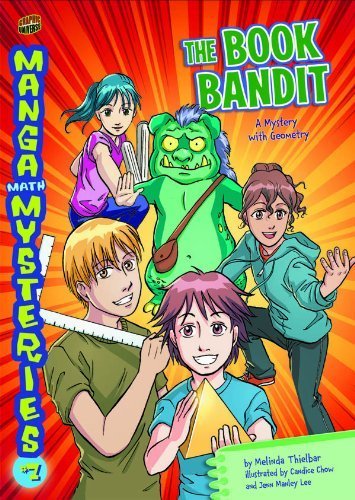
The Book Bandit
Grade 3
5 skill lessons
Math
Skill lessons
The mathematics the book carries, taught directly. Printable workbook pages and teacher keys are not available for this book yet.
- 1Only If All the Sides Match
- 2Symmetrical Along Its Diagonal
- 3Will It Fit Through?
- 4Corner to Corner
- 5Half as Wide
Math + reading
Math through the reading
The same book, entered through a sentence it prints. Change one word in the reading and the numbers change with it.
No math-through-reading lessons for this book yet.
Reading
Reading and language lessons
The same book read as a text. What a word means in its sentence, how a character is shown, how the writing is put together - no mathematics.
No reading and language lessons for this book yet.
Skill lessons
5 lessons on the mathematics the book carries. Printable workbook pages and teacher keys are not available for this book yet.
1. Only If All the Sides Match
A child in the book stops the others from calling something a square and states the rule they have to test it against: all the sides must be exactly the same length. Children measure all four sides of six cardboard rectangles, record the four measures, and file each one as a square or not. The idea under it: a figure's name is the outcome of four measurements, not something settled by how it looks from across the room.
Full lesson — 20 minutes
1. Measure all four sides (6 min)
Take three cardboard figures and measure every side of each one in whole inches, writing each measure on the side you measured. Measure all four sides even when the first two match.
Word preview: side, length
MY TEACHER SAYS IT'S ONLY A SQUARE IF ALL THE SIDES ARE EXACTLY THE SAME LENGTH.
2. File it as a square or not (5 min)
Put each figure on the square mat or the not-a-square mat, and write on the mat why it went there using your four measures. A figure whose sides you have not all measured may not go on either mat.
Word preview: rectangle, opposite
The base is a rectangle.
Only the opposite sides are the same.
3. The near-square that fooled you (5 min)
Find the figure whose sides differ by only one inch. Say which two measures gave it away, and put it beside a real square so your partner can see the difference you measured.
Word preview: right angle
The corners are right angles, but all four sides aren’t the same length.
4. Check the corners too (4 min)
Use the corner tester on all four corners of one figure from each mat. Say what was the same about the corners on both figures, even though one is a square and one is not.
Short version — 9 minutes
1. Measure all four sides (5 min)
Measure every side of two cardboard figures in whole inches, writing each measure on the side it belongs to.
MY TEACHER SAYS IT'S ONLY A SQUARE IF ALL THE SIDES ARE EXACTLY THE SAME LENGTH.
2. File it as a square or not (4 min)
Put each measured figure on the square mat or the not-a-square mat and write the measures that decided it.
The base is a rectangle.
Only the opposite sides are the same.
Three levels
- Support
- Work with three figures whose side lengths differ by three inches or more, so the measuring is what decides and not the reading of the ruler. All four sides are still measured and written.
- At Grade
- Six figures measured all round, both mats filled with the measures that decided each placement, the near-square identified, and the corners tested on one figure from each mat.
- Extension
- Draw a figure that would pass the corner test and fail the side test, and one that would fail both. Label each with the four measures you drew it to.
English learners
Measuring and sorting transfer. The English that does not is the difference between square and rectangle, which in ordinary speech overlap and in this lesson do not — every square passes the rectangle test, and a child who has learned them as rival words will resist that. Say both names about the same figure while pointing at the four equal measures. Rehearsable frame: All four sides measure ____, so it is a ____. Children may compare the measures in their strongest language and then say the frame in English with the figure in hand.
Materials
- Six cardboard four-sided figures per group, two of them squares and two of them near-squares differing by one inch
- A ruler marked in inches, per child
- A pencil
- Two mats per group, one marked square and one marked not a square
- A corner tester per group: a card with one true right angle
- Word cards: side, length, square, rectangle, right angle
Standards & curriculum
These lessons are being matched against curricula now.
Standards are held back while this plan is edited. Every standard shown here was matched against the supplied wording of this lesson, quoting its steps, so a changed step is no longer the thing that was checked. Undo your changes to bring the standards back — your edits stay in this browser either way.
2. Symmetrical Along Its Diagonal
The children declare the monster not symmetrical, and much later one of them takes it back: it is symmetrical along its diagonal. That reversal is the lesson. Children run the fold test on eight figures in three directions — up and down, across, and corner to corner — and find the figures whose only line of symmetry is the diagonal one. The demand is a child withdrawing an earlier answer because a test they had not run says so.
Full lesson — 20 minutes
1. Fold up and down, then across (5 min)
Fold each of the eight figures top to bottom and then left to right, and write no on the figure if neither fold matched. Put the no figures in their own pile.
Word preview: symmetrical
HE'S NOT SYMMETRICAL LIKE A RECTANGLE OR A SQUARE.
2. Now fold corner to corner (6 min)
Take the no pile and fold each figure corner to corner, both ways. Every time the halves match, write yes over your own no and say what test changed your answer.
Word preview: diagonal
THE BOOK MONSTER IS SYMMETRICAL ALONG ITS DIAGONAL.
3. Say which answer was wrong and why (5 min)
For one figure that changed, say a sentence naming the answer you gave first, the fold that changed it, and what you had not done when you answered the first time.
4. Three folds on every figure (4 min)
Go back to the figures you said yes to at the start and fold those corner to corner as well. Write how many of the three folds matched for each one.
The book monster was folded along its diagonal.
Short version — 9 minutes
1. Fold up and down, then across (5 min)
Fold four figures top to bottom and then left to right, writing no on any figure where neither fold matched.
HE'S NOT SYMMETRICAL LIKE A RECTANGLE OR A SQUARE.
2. Now fold corner to corner (4 min)
Fold the no figures corner to corner both ways and write yes over your own no wherever the halves match.
THE BOOK MONSTER IS SYMMETRICAL ALONG ITS DIAGONAL.
Three levels
- Support
- Four figures, two of them symmetrical only along a diagonal, with the two diagonal fold lines faintly dotted. The child still runs all three folds and still records the changed answer.
- At Grade
- Eight figures folded three ways, the changed answers written over the first ones, one change explained aloud, and a count of matching folds for every yes figure.
- Extension
- Make a figure that matches on the diagonal fold and on no other, then make one that matches on all three. Say what you had to keep equal in each case.
English learners
Folding transfers and so does changing an answer. What a learner cannot bring across is the English of the retraction — wasn't really true, I thought it was — which uses tense to mark that a belief has been given up. Model it with the recording strip: point at the first column and say I said, point at the second and say now I say. Rehearsable frame: First I said ____, but when I folded it ____ I found ____. Children may explain the change in their strongest language and then say the frame in English with both answers in front of them.
Materials
- Eight paper figures per pair, three of them symmetrical only along a diagonal
- A pencil
- A recording strip ruled for two answers per figure, per child
- Word cards: symmetrical, diagonal, fold, match
Standards & curriculum
These lessons are being matched against curricula now.
Standards are held back while this plan is edited. Every standard shown here was matched against the supplied wording of this lesson, quoting its steps, so a changed step is no longer the thing that was checked. Undo your changes to bring the standards back — your edits stay in this browser either way.
3. Will It Fit Through?
The whole mystery is one comparison made over and over: is this measure smaller than the window. The book states the test for the round pillar in a single conditional sentence and then applies the same idea to every piece. Children measure five objects, compare each with a paper window, predict, and then try it. The test gets used on a prediction that has to be written down before the object is picked up.
Full lesson — 20 minutes
1. Measure five pieces (5 min)
Measure the widest part of each of the five cardboard pieces in whole inches and write each measure on its piece. Say for each one which part you decided was widest.
Word preview: widest
2. Write the prediction first (5 min)
Measure the paper window. For each piece, write yes or no in the prediction column before anyone touches the window with it, and write the two measures you compared.
Word preview: fit
If the window is wider than the circle, the circle can fit through.
3. Now try it (6 min)
Test every piece at the window, flat first and then turned corner first. Write the result beside your prediction and ring any row where the two disagree.
The pyramid is too tall to fit through the window.
4. Explain a wrong prediction (4 min)
Take a ringed row and say what you compared and what you should have compared. If nothing is ringed, say which piece came closest to fooling you and what its two measures were.
THE MONSTER'S TOO WIDE TO FIT AND TOO TALL.
Short version — 9 minutes
1. Write the prediction first (5 min)
Measure the window, then write yes or no for three pieces before touching the window with them, recording the two measures compared.
If the window is wider than the circle, the circle can fit through.
2. Now try it (4 min)
Test the three pieces at the window, flat and then turned corner first, and ring any row where the result disagrees with the prediction.
The pyramid is too tall to fit through the window.
Three levels
- Support
- Three pieces, one clearly wider than the window and two clearly narrower. The prediction is still written before the test and the two compared measures are still recorded.
- At Grade
- Five pieces measured, five predictions written with their compared measures, five results recorded, disagreements ringed, and one wrong prediction explained.
- Extension
- Find the widest piece that still goes through, then work out the widest piece that could ever go through this window and say which measurement sets that limit.
English learners
Measuring and testing transfer. The English that does not is the conditional: if the window is wider, the circle can fit. A learner can follow both halves and still not hear that the first one governs the second. Put the two measures on cards either side of a card reading wider than, and read left to right before each prediction. Rehearsable frame: The window is ____ and the piece is ____, so it ____ fit. Children may predict in their strongest language and then say the frame in English before the test.
Materials
- Five cardboard pieces per group, of clearly different widths
- A ruler marked in inches, per child
- A pencil
- A paper window per group on squared paper at one inch to the square
- A five-row prediction card per group, ruled for prediction and result
- Word cards: widest, fit, wider than
Standards & curriculum
These lessons are being matched against curricula now.
Standards are held back while this plan is edited. Every standard shown here was matched against the supplied wording of this lesson, quoting its steps, so a changed step is no longer the thing that was checked. Undo your changes to bring the standards back — your edits stay in this browser either way.
4. Corner to Corner
When the base will not fit any way round, one child asks for a different measurement entirely: the distance corner to corner. The book stops to say how that measuring is done, which makes it the one measurement in the book a reader is taught rather than told. Children draw and measure the diagonal on four figures and set each diagonal beside the longest side. What gets built is the drawn diagonal: a line that was not on the figure until a child had a reason to put it there.
Full lesson — 20 minutes
1. Draw the line the book describes (5 min)
On each of four paper figures, rule a line from one corner to the corner furthest from it. Say out loud where your line starts and where it stops before you measure anything.
Word preview: diagonal, corner
Do you mean you want to measure it corner to corner?
Measure like you're drawing a diagonal line across the window.
2. Measure the diagonal (5 min)
Measure each diagonal in whole inches and write the measure on the line itself. Where the measure falls between two inch marks, write the nearer whole inch and put a small arrow to show which way it fell.
3. Which is longer, side or diagonal (6 min)
For each figure, write the longest side in the first column and the diagonal in the second. Then say what was true of all four comparisons, and check it on a fifth figure your partner chooses.
Word preview: longer
4. Turn it to get it through (4 min)
Hold each figure against the paper window and try it flat, then turned corner first. Say which figures got through only when turned, and which measurement explains it.
Word preview: rotate
The person fit the base through the window by rotating it.
Short version — 9 minutes
1. Draw the line the book describes (5 min)
Rule a line from one corner to the furthest corner on two paper figures, saying where the line starts and stops.
Measure like you're drawing a diagonal line across the window.
2. Measure the diagonal (4 min)
Measure each diagonal to the nearer whole inch and write the measure on the line.
Three levels
- Support
- Two figures, with the corners to join already dotted. The child still rules the line, measures it, and compares it with the longest side.
- At Grade
- Four diagonals drawn, measured and recorded beside the longest side, the pattern across all four stated, and the turning test run at the paper window.
- Extension
- Find a four-sided figure whose diagonal is barely longer than its longest side, and one where it is much longer, and say what is different about the two figures' corners.
English learners
Drawing and measuring transfer. Diagonal does not: it is a long word for a simple line, and the book's own paraphrase is the better teacher — corner to corner. Say the paraphrase first and the word second, every time, and trace the line with a finger as you say it. Rehearsable frame: The diagonal goes from ____ to ____, and it measures ____ inches. Children may describe the line in their strongest language and then say the frame in English while tracing it.
Materials
- Four paper four-sided figures per pair
- A ruler marked in inches, per child
- A pencil
- A four-row recording card per pair, headed longest side and diagonal
- A paper window per pair, cut to 23 inches by 33 inches on squared paper at one inch to the square
- Word cards: diagonal, corner, longer, rotate
Standards & curriculum
These lessons are being matched against curricula now.
Standards are held back while this plan is edited. Every standard shown here was matched against the supplied wording of this lesson, quoting its steps, so a changed step is no longer the thing that was checked. Undo your changes to bring the standards back — your edits stay in this browser either way.
5. Half as Wide
The book's solution is a halving: fold the monster on its diagonal and it is half as wide, sixty inches becoming thirty. Children halve eight measured lengths, fold a paper strip for each to check, and find the one halving that does not come out to a whole number of inches. Practised until the halving is quick and the check never changes: fold the strip, measure the fold.
Full lesson — 20 minutes
1. Halve the book's own measure (5 min)
Write the monster's measure across the diagonal, halve it, and check your answer against what the book says the folded height was.
Word preview: half
THE MONSTER IS 60 INCHES ACROSS THE DIAGONAL.
Once the monster is folded, it makes a triangle, and the height of the triangle is 30 inches--half of 60.
2. Halve eight lengths (6 min)
Halve each of the eight lengths on the sheet, writing each half beside its length. Do all eight before you fold anything.
3. Fold a strip to check (5 min)
For three of your lengths, cut a paper strip to that length, fold it end to end, and measure the fold. Write beside your half whether the fold agreed with it.
Word preview: fold
ONCE YOU FOLD THE MONSTER ON ITS DIAGONAL, IT'S HALF AS WIDE.
4. The one that will not halve evenly (4 min)
Find the length on your sheet whose half is not a whole number of inches. Fold its strip anyway and say where the fold landed on the ruler.
Short version — 9 minutes
1. Halve the book's own measure (5 min)
Halve the monster's diagonal measure and check the answer against the folded height the book gives.
THE MONSTER IS 60 INCHES ACROSS THE DIAGONAL.
Once the monster is folded, it makes a triangle, and the height of the triangle is 30 inches--half of 60.
2. Fold a strip to check (4 min)
Cut a strip to one of the lengths, fold it end to end, measure the fold and say whether it agreed with your half.
ONCE YOU FOLD THE MONSTER ON ITS DIAGONAL, IT'S HALF AS WIDE.
Three levels
- Support
- Four even lengths, all under forty inches, and fold a strip for every one so the check is never separated from the arithmetic.
- At Grade
- Eight lengths halved on paper, three checked by folding a strip, and the odd length found and folded.
- Extension
- Fold one strip twice and say what the second fold does to the number, then predict the third fold before you make it.
English learners
Halving and folding transfer. The English that does not is half doing two jobs in one lesson — half as wide describes the whole folded figure, while half of sixty names a number. Keep a strip and a number line side by side and point at whichever one the sentence means. Rehearsable frame: Half of ____ is ____, and my fold landed at ____. Children may halve in their strongest language and then say the frame in English with the folded strip on the ruler.
Materials
- The two sentences about the fold, enlarged
- An eight-row halving sheet per pair
- A pencil
- Strip paper and scissors per pair
- A ruler marked in inches, per child
- Word cards: half, fold, inches
Standards & curriculum
These lessons are being matched against curricula now.
Standards are held back while this plan is edited. Every standard shown here was matched against the supplied wording of this lesson, quoting its steps, so a changed step is no longer the thing that was checked. Undo your changes to bring the standards back — your edits stay in this browser either way.