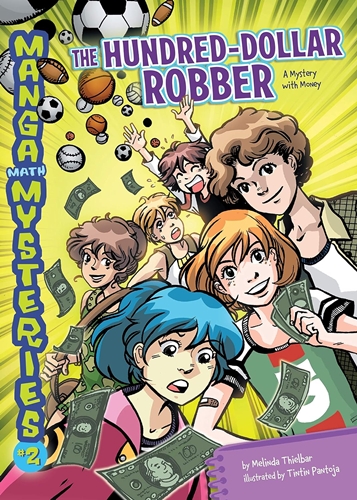
The Hundred-Dollar Robber
Grade 4
4 skill lessons · 4 math-through-reading
Math
Skill lessons
The mathematics the book carries, taught directly. Printable workbook pages and teacher keys are not available for this book yet.
- 1Why did the robbers ask for such strange change?
- 2How much candy does thirty dollars buy?
- 3Do the receipts really come to four hundred dollars?
- 4Where was the four hundred dollars going?
Math + reading
Math through the reading
The same book, entered through a sentence it prints. Change one word in the reading and the numbers change with it.
- 5Each, half, and per: three words that tell you what to do
- 6The order the hundred dollars travelled
- 7The change that could be split, and the change that could not
- 8Was Tom worth suspecting?
Reading
Reading and language lessons
The same book read as a text. What a word means in its sentence, how a character is shown, how the writing is put together - no mathematics.
- 9We're Still Guessing: Where the Characters Stop and Check Themselves
- 10[Caption] and SPEAKER: Reading the Marks a Transcript Puts on the Page
- 11You Have to Be Honest: An Argument the Book Has With Itself
- 12Everybody Knows You Did It: Reading Tom Through Other People's Mouths
- 13Something Else Seemed Strange: Naming What Does Not Fit
Skill lessons
4 lessons on the mathematics the book carries. Printable workbook pages and teacher keys are not available for this book yet.
1. Why did the robbers ask for such strange change?
The book states twice that half means one of two equal groups, and it hands students two sets of bills that are worth the same seventy dollars: the change a shopkeeper would normally give and the change the thieves asked for. Students deal both sets into two piles and discover that one set shares and the other does not, which is the hinge of the whole mystery and the one piece of arithmetic the book never writes down. They find that equal value is not the same as equal shareability, and say which bill is the obstruction. The thirty-five is printed by the book; what students produce is the reason.
Full lesson — 20 minutes
1. Split six pages into two equal groups (4 min)
Take six paper slips standing for the six pages of receipts and deal them into two equal piles, one slip at a time to each pile in turn, until the slips run out. Count one pile. Say aloud what half means using the book's own words, then write the halving as a number sentence.
Word preview: half, equal groups
HOW DO WE FIND HALF OF 6? LET'S DRAW A PICTURE.
SO, IF WE DIVIDE THE 6 PAGES INTO 2 EQUAL GROUPS, EACH GROUP WILL HAVE 3 PAGES.
2. Deal the usual change into two piles (6 min)
Lay out the change a shopkeeper would usually give for seventy dollars: three twenty-dollar bills and one ten. Now try to deal those four bills into two piles worth the same amount, without tearing or trading any bill. Try every way you can and write down what happens each time.
Word preview: change, bill
WHEN YOU GIVE SOMEONE $70 CHANGE, YOU USUALLY GIVE THEM 3 $20 BILLS AND ONE $10 BILL. BUT THEY WANTED 2 $5 BILLS, 2 $10 BILLS, AND 2 $20 BILLS.
3. Deal the change the thieves asked for (6 min)
Now lay out the change that was actually asked for: two fives, two tens and two twenties. Deal these six bills into two piles worth the same amount. Count each pile and write its value. Say aloud what is different about this set of bills that lets it be done.
Word preview: exactly half
WHY, YES, I HAD TO GIVE $70 CHANGE: TWO FIVES, TWO TENS, AND TWO TWENTIES.
THAT WAY YOU COULD EACH TAKE EXACTLY HALF OF THE REMAINING MONEY. THAT GAVE YOU $35 EACH.
4. Write the rule you found (4 min)
Both sets of bills are worth seventy dollars, and half of seventy is thirty-five either way. Write one sentence saying why one set can be shared into two equal piles and the other cannot. Use the words bill and pile, and name the bill that has to be broken.
Word preview: share
$25 FROM KRISTIN PLUS $35 FROM MIKE.
Short version — 9 minutes
1. Deal the usual change into two piles (4 min)
Lay out three twenties and one ten. Try to deal the four bills into two piles worth the same, without tearing or trading. Write down what happens.
Word preview: change, bill
WHEN YOU GIVE SOMEONE $70 CHANGE, YOU USUALLY GIVE THEM 3 $20 BILLS AND ONE $10 BILL. BUT THEY WANTED 2 $5 BILLS, 2 $10 BILLS, AND 2 $20 BILLS.
2. Deal the change the thieves asked for (5 min)
Now lay out two fives, two tens and two twenties and deal them into two piles worth the same. Count each pile, write its value, and say what is different about this set of bills.
Word preview: exactly half
THAT WAY YOU COULD EACH TAKE EXACTLY HALF OF THE REMAINING MONEY. THAT GAVE YOU $35 EACH.
Three levels
- Support
- Stay with the six paper slips and the halving. Deal six slips into two piles and count one, then deal ten slips, then eight, saying each time what half of that number is. Handle the two sets of bills only after the slip halving is easy, and with a partner naming each bill's value aloud as you lay it down.
- At Grade
- Deal both sets of bills into two equal piles, or find that you cannot, and write the sentence that says why. Name the twenty-dollar bill as the one that would have to be broken, and say that both sets are worth seventy dollars all the same.
- Extension
- Find every other set of bills worth seventy dollars, using only fives, tens and twenties, that can be shared into two equal piles. Write them out and look for what the shareable ones have in common. Say what has to be true about the bills, rather than about the seventy, for a fair share to be possible.
English learners
Half and the phrase equal groups both transfer once a learner has shared anything into two, and the dealing is language-free. The new word is change used as a noun for money given back, which is unrelated to change meaning something becoming different; the book uses both senses within a few pages. Rehearse the frame: "Three twenties and a ten are worth seventy dollars, but I cannot make two piles of thirty-five." Invite a student to count each pile aloud in their strongest language and write only the two pile values in English.
Materials
- Six paper slips per pair
- Pencils
- Play money in fives, tens and twenties
- Two paper plates per pair, marked Pile 1 and Pile 2
- A rule card, one per student
- Word cards: change, half, equal groups
Standards & curriculum
Choose your curriculum above to see the standards for this lesson.
Standards are held back while this plan is edited. Every standard shown here was matched against the supplied wording of this lesson, quoting its steps, so a changed step is no longer the thing that was checked. Undo your changes to bring the standards back — your edits stay in this browser either way.
2. How much candy does thirty dollars buy?
This is the book's own two-step calculation and students perform both halves. First they add a price and a tax that the book prints on separate sign lines, producing a per-pound price; then they divide thirty dollars by that price to recover the weight of the purchase. The book shows both results, so students compute and then check rather than discover, and the division is deliberately staged as repeated stacking of play money before it is written as a quotient, because what the six counts is the part children lose. The arithmetic answers a question the story asked first, and the answer is a clue, not an exercise.
Full lesson — 20 minutes
1. Add the price and the tax on one aligned line (5 min)
Write the candy's price per pound on one line and the tax per pound directly under it, decimal points stacked, then add the two. Write the tax as $0.40 with its leading zero even though the book's sign prints it as $.40. Say aloud what your sum means: it is what one pound costs once the tax is on it.
Word preview: per pound, tax
BUT WE KNOW THE PRICE IS $4.60, AND WE KNOW THE TAX IS $0.40. WE CAN ADD THEM TO FIND THE TOTAL.
YOU CAN ADD DECIMALS JUST LIKE WHOLE NUMBERS, BUT YOU HAVE TO MAKE SURE TO LINE UP THE DECIMAL POINTS.
2. Check the sum against a partner's second route (4 min)
One partner adds the two amounts again on paper; the other adds them on a calculator. Compare the two answers out loud. If they agree, write the per-pound price with tax on your card and circle it. If they disagree, both add again before going on, exactly as the book's characters do.
Word preview: check
I'LL ADD THE NUMBERS WITH THE CALCULATOR ON MY CELL PHONE, AND YOU DO IT ON PAPER.
3. Lay out thirty dollars in pound-sized stacks (7 min)
Using the circled per-pound price, lay play money out in stacks of that amount until you have laid out thirty dollars. Count the stacks. That count is the number of pounds of candy the thief bought. Write the division as a sentence in numbers and say what the answer counts, then check it against the number the book prints.
Word preview: divide, pound
NOW WE CAN DIVIDE $30 BY $5.00 TO FIND OUT HOW MUCH CANDY HE BOUGHT.
The person bought 6 pounds of candy.
4. Say what the quotient counts (4 min)
Write two labels beside your answer: one saying six what, and one saying what the thirty and the five each were. Then read the book's line that says a five-pound bag is an armful and say in one sentence why the size of the purchase is what makes it a clue at all.
Word preview: quotient
TO GIVE YOU AN IDEA, THIS IS WHAT A 5-POUND BAG LOOKS
THAT'S STILL AN AWFUL LOT OF CANDY.
Short version — 9 minutes
1. Add the price and the tax on one aligned line (4 min)
Write the price per pound and the tax per pound in a stacked column, decimal points aligned, and add them. Write the tax with its leading zero. Say what the sum means: one pound with the tax on it.
Word preview: per pound, tax
BUT WE KNOW THE PRICE IS $4.60, AND WE KNOW THE TAX IS $0.40. WE CAN ADD THEM TO FIND THE TOTAL.
2. Lay out thirty dollars in pound-sized stacks (5 min)
Lay play money in stacks of your per-pound price until thirty dollars is on the desk, then count the stacks. Write the division in numbers and say what the answer counts.
Word preview: divide, pound
NOW WE CAN DIVIDE $30 BY $5.00 TO FIND OUT HOW MUCH CANDY HE BOUGHT.
Three levels
- Support
- Stay with the addition and the stacking, and use a per-pound price of five dollars given to you on the card rather than one you derived. Lay five-dollar stacks until thirty dollars sits on the desk and count them. Six stacks and six pounds is the whole idea; the two-place addition can wait.
- At Grade
- Derive the per-pound price by adding the price and the tax, check it two ways, then stack thirty dollars into pound-sized piles and write the division with both its labels. Say what the six counts before you say the six.
- Extension
- Work the same two steps for the other candy the book prices, at three dollars fifty a pound with thirty cents tax, and divide thirty dollars by that per-pound price instead. Report what happens: this time the stacks do not come out even, so say how many whole pounds thirty dollars buys and how much money is left over, and say why the book chose the bin it did for its clue.
English learners
Per pound is the phrase to rehearse; a learner may know the relation from a market without the English words for it, and the word per is doing all the work. Tax may or may not appear on a price where the learner shops, so the idea that a sign can show a price and a tax on two lines is worth showing before it is read. Rehearse the frame: "One pound costs four dollars sixty, plus forty cents tax, so one pound costs five dollars." Invite a student to count the stacks aloud in their strongest language and write only the division sentence in English.
Materials
- A two-row price card with a printed decimal guide, one per pair
- Pencils
- A calculator, one per pair
- Play money in ones, fives and tens
- A labelling strip, one per student
- Word cards: per pound, tax, divide
Standards & curriculum
Choose your curriculum above to see the standards for this lesson.
Standards are held back while this plan is edited. Every standard shown here was matched against the supplied wording of this lesson, quoting its steps, so a changed step is no longer the thing that was checked. Undo your changes to bring the standards back — your edits stay in this browser either way.
3. Do the receipts really come to four hundred dollars?
The book hands students six page totals, two subtotals and a grand total, and the whole plot turns on whether that grand total is right. Students do the adding themselves; the book prints its results, so this is a column students compute and then check against the page rather than a sum they read off. They hold six two-place decimal amounts in one aligned column without dropping a row or losing a decimal point, and then reconcile two routes to the same number. The difference between the four hundred collected and the three hundred in the cashbox is reached by comparing the two figures the way the book does, and the book states the hundred outright.
Full lesson — 20 minutes
1. Copy the six page totals into one column (5 min)
Copy the six page totals from the book onto a six-row tally card, one amount per row, with the decimal points stacked so the dollars sit above the dollars and the cents above the cents. Write $35.00 as $35.00 and not as $35, because a column with a missing decimal point is the mistake this book warns about on its first page. Do not add anything yet.
Word preview: total, decimal point
[Caption] Page 4 $55.00 [Caption] Page 5 $45.00 [Caption] Page 6 $204.00 [Caption] $304.00
When we add or subtract money, it is important to line up the decimals.
2. Add the first three rows and the last three rows (6 min)
Add rows one to three and write that subtotal at the foot of the group. Add rows four to six and write that subtotal underneath. Say aloud which page carried the largest amount and read the book's own reason for it, then check both subtotals against the two the book prints.
Word preview: subtotal
SPEAKER: The total for the first three pages is $96.00.
SPEAKER: PAGE 6 HAS AN AWFULLY BIG NUMBER. SPEAKER: THAT'S BECAUSE OF THE GUY WHO GAVE US $200 AT THE END.
3. Add the two subtotals and compare with the cashbox (5 min)
Add your two subtotals together and write the grand total. Read the book's line that names it, and then read the line that names what was actually in the cashbox. Write one sentence saying what the two amounts are and how far apart they are, using the word missing the way the book uses it.
Word preview: cashbox, missing
SPEAKER: SO, WE SHOULD ADD $96 FOR THE FIRST 3 PAGES AND $304 FOR THE SECOND 3 PAGES. SPEAKER: THAT'S $400 EXACTLY. SPEAKER: WE HAD $300 IN THE CASHBOX.
We counted twice, but there was only $300 in the cashbox. We thought we collected $400.
4. Check the column the second way (4 min)
Add all six rows straight down in one pass, without the subtotals, and compare that answer with the one you got by adding the two groups. Say aloud whether the two agree. If they do not, find the row where the two passes part company and add that row again; the book's own rule for disagreeing answers is the rule here.
Word preview: check
IF WE GET THE SAME NUMBER, WE PROBABLY DID EVERYTHING RIGHT. IF WE GET DIFFERENT NUMBERS, ONE OF US MADE A MISTAKE AND WE'LL TRY AGAIN.
Short version — 9 minutes
1. Copy the six page totals into one column (4 min)
Copy the six page totals onto a six-row tally card, one amount per row, decimal points stacked. Write $35.00 with its cents rather than as $35.
Word preview: total, decimal point
[Caption] Page 1 $35.50 [Caption] Page 2 $35.00 [Caption] Page 3 $25.50 [Caption] $96.00 [Caption] Page 4 $55.00
2. Add the two subtotals and compare with the cashbox (5 min)
Add rows one to three, then rows four to six, then add the two subtotals. Read the book's line naming what was in the cashbox and write one sentence saying how far apart the two amounts are.
Word preview: cashbox, missing
SPEAKER: SO, WE SHOULD ADD $96 FOR THE FIRST 3 PAGES AND $304 FOR THE SECOND 3 PAGES. SPEAKER: THAT'S $400 EXACTLY. SPEAKER: WE HAD $300 IN THE CASHBOX.
Three levels
- Support
- Work with the first three rows only, on a three-row card with the decimal points already printed as a faint guide line. Add those three and check against the ninety-six the book prints, then join a partner who has done the last three and add the two subtotals together. The column is shorter but every step of the reconciliation is still yours.
- At Grade
- Add all six rows in two groups of three, then add the two subtotals, then add the whole column straight down as a second route, and reconcile the two answers. Write the grand total and the cashbox amount side by side and say in one sentence how far apart they are.
- Extension
- After reconciling, take the two-hundred-dollar donation out of page six and add the column again. Report the new grand total and say what the cashbox shortfall would look like without that one donor, then explain why removing a single row changes the total by exactly two hundred and not by anything else.
English learners
Dollars-and-cents notation with a decimal point transfers directly for a learner who writes money that way in another currency, and the column addition is the same procedure everywhere. The word cashbox is new, and so is the idiom adds up to, which here means totals rather than makes sense. Rehearse the frame: "The receipts add up to four hundred dollars, but the cashbox holds three hundred dollars." Invite a student to add the column aloud in their strongest language and write only the two totals in English, because the addition is the mathematics and the naming is not.
Materials
- The six-row tally card, one per pair
- Pencils
- A calculator for the checking pass only
- Word cards: cashbox, receipt, total
Standards & curriculum
Choose your curriculum above to see the standards for this lesson.
Standards are held back while this plan is edited. Every standard shown here was matched against the supplied wording of this lesson, quoting its steps, so a changed step is no longer the thing that was checked. Undo your changes to bring the standards back — your edits stay in this browser either way.
4. Where was the four hundred dollars going?
The team's written budget divides its goal into a half and two fourths, and the book computes one of those fourths in a single line. Students build the whole budget as a folded strip so the three shares are visible at once, and produce each dollar amount by dividing four hundred rather than by reading the book's answer, which appears only for the fourth. The strip carries the relation between the half and the two fourths where an equation would not: students see two of the smaller parts lying against the larger one. The lesson closes by matching the missing hundred against a share of the same size, which is the book's own reason for doubting the accusation.
Full lesson — 20 minutes
1. Fold the fund-raiser into four equal parts (5 min)
Fold a paper strip standing for the whole four hundred dollars in half, then in half again, and open it out. Count the parts. Label each part with the amount of money it stands for, dividing four hundred by the number of parts you counted. Do not write anything on the strip until every part is the same width.
Word preview: fourth, divide
Goal: $400
TO FIGURE OUT 1/4, WE HAVE TO DIVIDE BY 4. 1/4 OF $400 IS $100.
2. Colour the budget onto the strip (6 min)
Read the three lines of the team's budget and colour your strip to match: one colour over the groundskeeping share, a second over equipment, a third over travel. Check that every part is covered and none is covered twice. Write the dollar amount inside each coloured region.
Word preview: budget, share
1/2 for groundskeeping
1/4 for equipment
1/4 to help players travel to national soccer tournament
3. Show that the halves and the fourths agree (5 min)
Lay a second, unfolded strip beside your coloured one and fold it once, into halves. Line the two strips up. Say aloud how many fourths lie against one half, and write the dollar amount of the groundskeeping share two ways: once as a half of four hundred and once as two of your hundred-dollar parts.
Word preview: half, fourth
4. Say what the missing money was going to be (4 min)
Point to the travel part of your strip and read its amount. Then read the book's line about the missing bill. Write one sentence saying which share of the budget the missing money is the same size as, and say why that made the team think Tom would not have taken it.
Word preview: missing
STACY, IF I READ YOUR BUDGET RIGHT, YOU WERE GOING TO SPEND 1/4 OF THE CAR WASH MONEY TO HELP SOME PLAYERS TRAVEL TO A SOCCER TOURNAMENT.
BESIDES, I KNOW THERE'S $100 MISSING EVEN WITHOUT COUNTING.
Short version — 9 minutes
1. Fold the fund-raiser into four equal parts (4 min)
Fold a paper strip standing for four hundred dollars in half, then in half again. Open it, count the parts, and label each with the amount it stands for.
Word preview: fourth, divide
TO FIGURE OUT 1/4, WE HAVE TO DIVIDE BY 4. 1/4 OF $400 IS $100.
2. Colour the budget onto the strip (5 min)
Read the three budget lines and colour your strip to match, one colour for each share. Check that every part is covered once and write the dollar amount inside each region.
Word preview: budget, share
1/2 for groundskeeping
1/4 for equipment
Three levels
- Support
- Fold the strip and label the four parts, then colour only the two fourths, leaving the half for a partner to colour. Say the amounts aloud as you write them. One hundred dollars in each of four parts, and four hundred altogether, is the whole of the mathematics at this tier.
- At Grade
- Fold, label and colour the full budget, then lay a halved strip beside it and say how many fourths match one half. Write the groundskeeping share both as a half of four hundred and as two hundred-dollar parts, and finish by naming which share the missing money matches.
- Extension
- The team has to raise the missing hundred again by washing more cars. Work out what fraction of a fresh four-hundred-dollar goal that hundred is, then say what fraction of the original goal is still unspent if the groundskeeping share has already been paid out. Write both answers as fractions and as dollar amounts, and say which of the two questions the book actually answers.
English learners
The written forms 1/2 and 1/4 transfer directly, and a learner who says a quarter rather than a fourth is saying the same thing; accept both and use the book's word alongside. The new words are budget and the idiom in order of importance, which describes the list rather than any amount. Rehearse the frame: "One fourth of four hundred dollars is one hundred dollars." Invite a student to say the three shares aloud in their strongest language while folding, and write only the dollar amounts in English.
Materials
- A paper strip about thirty centimetres long, one per student
- Pencils
- Three coloured pencils per student
- Word cards: budget, fourth, share
Standards & curriculum
Choose your curriculum above to see the standards for this lesson.
Standards are held back while this plan is edited. Every standard shown here was matched against the supplied wording of this lesson, quoting its steps, so a changed step is no longer the thing that was checked. Undo your changes to bring the standards back — your edits stay in this browser either way.
Math through the reading
The mathematics is reached through a sentence the book prints: change one word in the reading and the numbers change with it. These carry their own standards, matched against these lessons rather than inherited from the skill ones.
5. Each, half, and per: three words that tell you what to do
Students find the three words in this book that decide an operation, then watch one of them get swapped and say what the mathematics does differently.
Full lesson — 20 minutes
1. Find the word that gives the order (6 min)
Read three sentences from the book aloud in pairs, and in each one underline the single word that tells you what to do to the numbers. Write the operation beside it. Argue about the third one before you settle it.
2. Run each operation with money on the desk (6 min)
Carry out all three operations with play money: halve seventy dollars into two piles, divide four hundred into four equal parts, and lay out two coffee prices. Write each answer on the card next to its word.
3. Swap the word and run the arithmetic again (5 min)
Hear the coffee sentence read with one word changed and lay out what that sentence describes instead. Say which number moved, by how much, and what happens to the missing ten dollars if the changed sentence were the true one.
4. Write the rule for one word (3 min)
Choose one of the three words and write a sentence a younger reader could use: what the word tells you to do, and what you would get wrong without it.
Short version — 9 minutes
1. Find the word that gives the order (6 min)
Read three sentences from the book aloud in pairs, and in each one underline the single word that tells you what to do to the numbers. Write the operation beside it. Argue about the third one before you settle it.
2. Swap the word and run the arithmetic again (5 min)
Hear the coffee sentence read with one word changed and lay out what that sentence describes instead. Say which number moved, by how much, and what happens to the missing ten dollars if the changed sentence were the true one.
Three levels
- Support
- Work with each only, and with the money in front of you. Lay out one coffee at $4.60, then lay out a second, and count the whole. Then hear the swapped sentence and lay out what it describes: one price, not two. Say which layout has more money on the desk and by how much. The other two words wait for another day.
- At grade
- Take all three words, perform each operation with money and record it, then meet the swap and say what moved. Write the rule for one word in your own sentence, naming both what to do and what goes wrong without it.
- Extension
- Find a fourth operational word in the book yourselves and prove it is one. Test your candidate the way the lesson tested each: write the book's sentence, write it again with your word changed, and show that the two versions produce different numbers. If your candidate produces the same number either way, it is not doing operational work, and say so.
English learners
Each is the hard one and it is the one that matters, because in many languages the per-item sense is carried by a preposition or a case ending rather than by a separate word, and a learner may read each as a plural marker. Per pound has the same shape and is worth teaching beside it. Half is easier and transfers from any language where sharing between two people is spoken about. Rehearse the frame: "Each drink costs four dollars sixty, so two drinks cost nine dollars twenty." Let a learner lay out the money and say the total in their strongest language before writing the operation in English, since the layout is the proof and the sentence is the report.
Materials
- Play money in fives, tens and twenties
- A word-and-operation card, one per pair
- Pencils
- Three sentence strips carrying the book's sentences
- The swapped coffee sentence, written out and kept covered until segment three
- A four-part folded strip standing for the four-hundred-dollar goal
Standards & curriculum
Choose your curriculum above to see the standards for this lesson.
Standards are held back while this plan is edited. Every standard shown here was matched against the supplied wording of this lesson, quoting its steps, so a changed step is no longer the thing that was checked. Undo your changes to bring the standards back — your edits stay in this browser either way.
6. The order the hundred dollars travelled
Students rebuild the money's journey as a chain of five amounts, then find the one event that cannot be moved without breaking the arithmetic.
Full lesson — 20 minutes
1. Collect the five events from the book (5 min)
Find the five moments in the book where the money changes hands or changes shape, and write each on a card. Put the cards in the order you think they happened before you check any amounts.
2. Build the chain with money on the desk (7 min)
Start with a hundred dollars in play money and move it through your cards one at a time, writing the amount before and after each event. Where an amount does not carry over, move the card until it does.
3. Find the card that will not move (5 min)
Try swapping pairs of cards. Find one that cannot be moved anywhere without the amounts failing to meet, and say aloud what runs out and where.
4. Tell the journey to a partner (3 min)
Retell the hundred dollars' journey from cashbox to coffee cup, naming the amount at every handover, without looking at the cards.
Short version — 9 minutes
1. Build the chain with money on the desk (7 min)
Start with a hundred dollars in play money and move it through your cards one at a time, writing the amount before and after each event. Where an amount does not carry over, move the card until it does.
2. Find the card that will not move (5 min)
Try swapping pairs of cards. Find one that cannot be moved anywhere without the amounts failing to meet, and say aloud what runs out and where.
Three levels
- Support
- Work with three cards rather than five: the bill leaves the cashbox, the candy is bought, the change is split. Move real money through those three and say the amount after each. Add the coffee card only once the first three carry over without help.
- At grade
- Build all five cards, carry the money through, find the immovable card and say what runs out when it is moved. Then retell the journey with every amount named.
- Extension
- The book never says how much money Mike spent, only that he still has thirty-five. Add a sixth card standing for what Mike did with his share and try to place it in the chain. Say why it can go almost anywhere without breaking anything, and what that tells you about which events in a chain are load-bearing and which are not.
English learners
The ordering words this retelling needs - first, then, after that, so - transfer directly and most learners have them early. The harder language is the vocabulary of the handovers: change as money given back, split as divided between people, and left over as what remains. Rehearse the frame: "First the bill left the cashbox. Then they bought the candy, so seventy dollars was left." Let a learner move the money and say each amount in their strongest language before retelling in English; the money on the desk carries the meaning while the sentence is being found.
Materials
- Five blank event cards per pair
- Play money in fives, tens, twenties and a hundred
- Pencils
- A blank chain frame with five spaces and an amount slot before and after each
Standards & curriculum
Choose your curriculum above to see the standards for this lesson.
Standards are held back while this plan is edited. Every standard shown here was matched against the supplied wording of this lesson, quoting its steps, so a changed step is no longer the thing that was checked. Undo your changes to bring the standards back — your edits stay in this browser either way.
7. The change that could be split, and the change that could not
Students find out why two thieves asked for six bills instead of four, by trying to share both sets of bills and discovering that only one of them can be done.
Full lesson — 20 minutes
1. Try to split the usual change (6 min)
Lay out three twenties and one ten. Deal them onto two plates every way you can and write down each plate's value. Keep going until you are sure you have tried them all, and write what the closest you got was.
2. Split the change they actually asked for (5 min)
Now lay out two fives, two tens and two twenties. Deal these onto the two plates so both are worth the same. Write each plate's value and check both against the book's figure.
3. Say why the strange change was necessary (6 min)
Both sets are worth seventy dollars. Tell a partner why one could be shared and the other could not, and name the bill that would have had to be broken. Then write it as a sentence a detective could use.
4. Make the usual change work (3 min)
Take the three twenties and the ten and ask the shopkeeper to swap exactly one bill for smaller ones, so the set can then be shared. Say which bill you would swap and what you would ask for instead.
Short version — 9 minutes
1. Try to split the usual change (6 min)
Lay out three twenties and one ten. Deal them onto two plates every way you can and write down each plate's value. Keep going until you are sure you have tried them all, and write what the closest you got was.
2. Say why the strange change was necessary (6 min)
Both sets are worth seventy dollars. Tell a partner why one could be shared and the other could not, and name the bill that would have had to be broken. Then write it as a sentence a detective could use.
Three levels
- Support
- Start with the set that works. Deal two fives, two tens and two twenties onto the two plates and count each pile until both read thirty-five. Only then take out the three twenties and the ten and try the same thing, with a partner writing down each attempt. Finding that it cannot be done is easier once you know what success looked like.
- At grade
- Work both sets, exhaust the deals for the usual change, and write the reason naming the twenty as the bill that would have to be broken. Say plainly that both sets are worth the same seventy dollars.
- Extension
- The thieves could have asked for many things. Find every set of fives, tens and twenties worth seventy dollars that can be dealt into two equal piles, and every set that cannot. Look at your two lists and say what the shareable sets have in common. Test your rule on a seventy-dollar set that includes a fifty.
English learners
Change meaning money handed back is the term to secure first, because it collides with the common verb and a learner may hear the sentence as being about something becoming different. Bill for a note of money is worth showing rather than defining. The mathematical language the explanation needs is comparative - worth the same but broken up differently - and that construction is hard in any language, so give it as a frame: "Both are worth seventy dollars, but only one can be shared." Let a learner deal the bills and count each pile aloud in their strongest language, then say only that one frame in English; the dealing carries the argument.
Materials
- Play money in fives, tens and twenties
- Two paper plates per pair, marked Pile 1 and Pile 2
- A reason card, one per pair
- Pencils
- The two bill sets drawn side by side, both labelled seventy dollars
Standards & curriculum
Choose your curriculum above to see the standards for this lesson.
Standards are held back while this plan is edited. Every standard shown here was matched against the supplied wording of this lesson, quoting its steps, so a changed step is no longer the thing that was checked. Undo your changes to bring the standards back — your edits stay in this browser either way.
8. Was Tom worth suspecting?
Students take a side on whether the team was right to suspect Tom, and have to fund their position with amounts from the book's own budget.
Full lesson — 20 minutes
1. Read what the team knew and when (4 min)
List, in order, the four things the team knew before anyone opened the budget. Mark which of them are about money and which are about how Tom behaved.
2. Work out what Tom stood to lose (6 min)
Fold a strip standing for four hundred dollars into fourths and label each part with its amount. Find the travel share, write it down, and write the missing amount beside it. Say aloud what you notice about the two numbers.
3. Take a side and defend it to Stacy (7 min)
Decide whether suspecting Tom was reasonable and say your case to a partner playing Stacy, who asked for help and still believes him. Your case must contain at least one amount, and your partner must say back which amount you used.
4. Say what would have changed your mind (3 min)
Name one number that, if it had been different, would have moved you to the other position. Say what it would have had to be.
Short version — 9 minutes
1. Work out what Tom stood to lose (6 min)
Fold a strip standing for four hundred dollars into fourths and label each part with its amount. Find the travel share, write it down, and write the missing amount beside it. Say aloud what you notice about the two numbers.
2. Take a side and defend it to Stacy (7 min)
Decide whether suspecting Tom was reasonable and say your case to a partner playing Stacy, who asked for help and still believes him. Your case must contain at least one amount, and your partner must say back which amount you used.
Three levels
- Support
- Fold the strip and find the hundred with a partner, then write the two numbers - the travel share and the missing amount - on one card. Your defence can be one sentence built from that card: Tom was going to get one hundred dollars, and one hundred dollars is what went missing. Say it to Stacy and let her ask you one question.
- At grade
- Compute the fourth, take a side, and defend it to Stacy with an amount inside the argument. Finish by naming the number that would have changed your mind and saying what value it would have needed.
- Extension
- Argue the harder side. Build the strongest case you can that suspecting Tom was reasonable, using only what the team knew before the budget was read, and then say precisely which sentence of the book destroys your case. Say whether a person can be reasonably suspected and completely innocent at the same time, and use both amounts in your answer.
English learners
The reasoning connectives this defence needs - because, so, but, even though - are the load and they transfer directly once a learner has them; give them on a strip and let them be pointed to. The content vocabulary is harder: budget, share, and the idiom charity case, which the book uses as an insult and which a learner will not decode from its parts. Rehearse the frame: "Tom was going to get one hundred dollars, so stealing one hundred dollars makes no sense." Invite a learner to say the whole defence in their strongest language first and then give only that frame in English, since the position is the thinking and the sentence is the report of it.
Materials
- A paper strip about thirty centimetres long, one per student
- Pencils
- A two-number card, one per pair
- A connective strip: because, so, but, even though
- The budget's three lines, written out large
Standards & curriculum
Choose your curriculum above to see the standards for this lesson.
Standards are held back while this plan is edited. Every standard shown here was matched against the supplied wording of this lesson, quoting its steps, so a changed step is no longer the thing that was checked. Undo your changes to bring the standards back — your edits stay in this browser either way.
Reading and language lessons
5 lessons on the reading and language the book carries - what a word means in its sentence, how a character is shown, how a text is built. No mathematics: these are matched against the English language arts curricula, which are a different and smaller set than the mathematics ones.
9. We're Still Guessing: Where the Characters Stop and Check Themselves
Halfway through the investigation one character interrupts the others to point out that their whole line of thinking rests on an assumption nobody has established. Students read the interruption, name the assumption it exposes, then read two passages that reason from evidence and one that reasons from a guess, and sort them. They finish by rewriting a guess as a question. No sums are checked and no totals are verified; the work is telling a supported claim from an unsupported one.
Full lesson — 20 minutes
1. Read the interruption (5 min)
Read the passage below. One speaker stops the group. In your own words, write down the assumption they are pointing at — the thing everybody had been treating as settled without having shown it. Share what you wrote with a partner.
Word preview: assumption
Wait! We're still guessing someone took the money. Maybe it was just lost.
2. Find a claim that rests on something known (5 min)
Read the passage below. Here a character reasons from something they actually know about Tom's situation. Underline the sentence that states what is known, then say aloud what conclusion is drawn from it and whether the conclusion follows.
Word preview: evidence
IS THAT WHY THAT GUY MIKE CALLED TOM A CHARITY CASE? [Caption] PROBABLY. NO ONE WAS SUPPOSED TO KNOW WHO WAS GETTING HELP, BUT I GUESS MIKE FOUND OUT. TOM IS ONE OF THE PLAYERS GETTING MONEY TO TRAVEL.
3. Sort the reasoning (6 min)
Read all three passages below. For each one, decide whether the speaker is reasoning from something they know or from something they are supposing, and write down which words made you decide. Then compare your three answers with a partner and settle any you disagree on.
Word preview: supposing
Wait! We're still guessing someone took the money. Maybe it was just lost.
IS THAT WHY THAT GUY MIKE CALLED TOM A CHARITY CASE? [Caption] PROBABLY. NO ONE WAS SUPPOSED TO KNOW WHO WAS GETTING HELP, BUT I GUESS MIKE FOUND OUT. TOM IS ONE OF THE PLAYERS GETTING MONEY TO TRAVEL.
Tom took your things as a prank. He wouldn't steal from the team.
4. Turn a guess into a question (4 min)
Choose one of the supposing statements you sorted. Rewrite it as a question that could actually be answered by somebody going and finding out. Read your question to your partner and let them say what they would do to answer it.
Word preview: question
Short version — 9 minutes
1. Read the interruption (5 min)
Read the passage below. Write down, in your own words, the assumption the speaker is pointing at.
Word preview: assumption
Wait! We're still guessing someone took the money. Maybe it was just lost.
2. Find a claim that rests on something known (4 min)
Read the passage below. Underline the sentence that states what is known, and say what conclusion is drawn from it.
Word preview: evidence
IS THAT WHY THAT GUY MIKE CALLED TOM A CHARITY CASE? [Caption] PROBABLY. NO ONE WAS SUPPOSED TO KNOW WHO WAS GETTING HELP, BUT I GUESS MIKE FOUND OUT. TOM IS ONE OF THE PLAYERS GETTING MONEY TO TRAVEL.
Three levels
- Support
- In step 1, read the printed passage with a partner and find the one word the speaker uses for what the group is doing. Then say, in one sentence, what the speaker thinks might have happened instead.
- At Grade
- Read the printed passages in steps 1 and 2 and, for each, say whether the speaker is reasoning from something established or something supposed, naming the words that settle it.
- Extension
- The printed passage in step 3 puts a supported claim beside an unsupported one about the same person. Write a short paragraph on why the unsupported one is still reasonable for a friend to say, and why that is not the same as it being shown.
English learners
English hedges a claim with modal verbs — might, would, could — and drops them when the speaker means it flatly, so the difference between a guess and an assertion often rides on one small word that is easy to skim past. Read a hedged sentence and an unhedged one back to back and name the word that changed. Invite students to make a claim and then hedge it in their strongest language, and say what marked the hedge. Rehearsable frame: We know ___, but we are only guessing that ___.
Materials
- The Hundred-Dollar Robber, the passage printed in this step
- notebook
- Word cards: assumption, evidence, supposing, question
Standards & curriculum
Choose your curriculum above to see the standards for this lesson.
Standards are held back while this plan is edited. Every standard shown here was matched against the supplied wording of this lesson, quoting its steps, so a changed step is no longer the thing that was checked. Undo your changes to bring the standards back — your edits stay in this browser either way.
10. [Caption] and SPEAKER: Reading the Marks a Transcript Puts on the Page
This text is not a novel but a transcription of a drawn comic, and it tells the reader up front what its own labels mean. Students read that explanation, then read passages where the labels do their job and a passage where they leave the speaker undecidable, and say what the labelling system can and cannot tell them. They finish by writing what they would add. Nothing is calculated; the work is reading a text feature and testing it against the text.
Full lesson — 20 minutes
1. Read the book's explanation of its own labels (5 min)
Read the passage below. It comes before the story and explains how the rest of the text is marked. Write down what a reader is told to expect from the word Caption and from brackets. Share your notes with a partner.
Word preview: caption
Speech is given as dialogue; narration and document text are marked [Caption]. Brief notes in brackets describe action or setting that is shown only in the pictures.
2. Watch the labels work (5 min)
Read the passage below. Here the labels do exactly what the explanation promised. Point to a place where a name tells you who is speaking, and a place where a bracketed note describes something you would otherwise have to see. Say what each one gave you.
Word preview: label
TOM GOT INTO A FIGHT WITH THIS BOY NAMED MIKE. MIKE: HEY, TOM! I HEAR YOU'RE THE TEAM CHARITY CASE!
3. Find where the labels run out (6 min)
Read the passage below. Every line here is marked, but try to say who speaks each one. Write down which lines you can attribute and which you cannot, and for the ones you cannot, write down what is missing that would have settled it.
Word preview: undecidable
ONE WAS WEARING A T-SHIRT THAT SAID "COLONIAL HEIGHTS," SO I GUESS IT WAS ONE OF THE KIDS FROM THE SOCCER TEAM THAT PLAYS ACROSS THE STREET. [Caption] SHORT OR TALL? [Caption] WHAT COLOR HAIR? [Caption] I DIDN'T PAY MUCH ATTENTION.
4. Say what you would add (4 min)
Write two sentences proposing one change to the labelling system that would fix what you found missing. Then read it to your partner and let them say whether your change would have solved it.
Word preview: system
Short version — 9 minutes
1. Read the book's explanation of its own labels (5 min)
Read the passage below and write down what a reader is told to expect from the word Caption and from brackets.
Word preview: caption
Speech is given as dialogue; narration and document text are marked [Caption]. Brief notes in brackets describe action or setting that is shown only in the pictures.
2. Find where the labels run out (4 min)
Read the passage below. Try to say who speaks each line. Write down which you can attribute and which you cannot.
Word preview: undecidable
ONE WAS WEARING A T-SHIRT THAT SAID "COLONIAL HEIGHTS," SO I GUESS IT WAS ONE OF THE KIDS FROM THE SOCCER TEAM THAT PLAYS ACROSS THE STREET. [Caption] SHORT OR TALL? [Caption] WHAT COLOR HAIR? [Caption] I DIDN'T PAY MUCH ATTENTION.
Three levels
- Support
- In step 1, read the printed passage with a partner and find the word that names what [Caption] marks. Then look at the printed passage in step 2 and point to one [Caption] and one name.
- At Grade
- Read the printed passage in step 1 for what the labels promise, then read step 3 and say which lines the labels actually settle and which they leave open.
- Extension
- The printed passage in step 3 marks every line identically even though the lines come from different speakers. Write a short paragraph on why a transcriber might still choose that system, given what they could and could not see.
English learners
Bracketed editorial marks are a convention of English print, not part of the sentences, and a reader still working on the sentences may try to read them as words in the dialogue. Read one passage aloud twice, once including the marks and once skipping them, so their separateness is heard. Invite students to describe a marking convention from a text in their strongest language. Rehearsable frame: The mark ___ tells the reader that ___.
Materials
- The Hundred-Dollar Robber, the passage printed in this step
- notebook
- Word cards: caption, label, undecidable, system
Standards & curriculum
Choose your curriculum above to see the standards for this lesson.
Standards are held back while this plan is edited. Every standard shown here was matched against the supplied wording of this lesson, quoting its steps, so a changed step is no longer the thing that was checked. Undo your changes to bring the standards back — your edits stay in this browser either way.
11. You Have to Be Honest: An Argument the Book Has With Itself
Standing by the lake, three characters disagree about what an honest person would do with found money, and nobody wins. Students read the three positions, state each one in a sentence, and then read a much later scene where a character acts and say which of the three positions the ending supports. They finish by writing their own position with a reason. Nothing is totalled; the work is tracking one idea across a text and testing an ending against it.
Full lesson — 20 minutes
1. Read the three positions (6 min)
Read the three passages below. They come one after another in the same conversation. Write each speaker's position as a single sentence of your own. Then say aloud which two positions are furthest apart.
Word preview: honest
TURNED IT IN? WHERE? TO THE POLICE? IF I FOUND THAT MUCH MONEY, I'D KEEP IT.
IF I FOUND A HUNDRED-DOLLAR BILL IN FRONT OF A STORE, I'D THINK IT FELL OUT OF SOMEONE'S WALLET. I'D GO INTO THE STORE AND ASK. YOU HAVE TO BE HONEST.
THAT'S A LOT OF MONEY TO BE HONEST WITH. SOMETIMES PEOPLE ARE NICE.
2. Find the hardest thing anybody says (5 min)
Read the passage below again on its own. It is the sharpest objection in the conversation. Write down what it concedes and what it refuses to concede. Then say whether you think it is a fair thing to say.
Word preview: objection
THAT'S A LOT OF MONEY TO BE HONEST WITH. SOMETIMES PEOPLE ARE NICE.
3. Read what somebody actually does (5 min)
Read the passage below, from much later in the book. Nobody here mentions honesty. Write down what the speaker does and says, and then write which of the three positions from step 1 this scene supports, and why.
Word preview: acts
I wanted to say thank you. [Caption] And that I'm sorry about before. I was a real jerk.
4. State your own position (4 min)
Write two or three sentences saying what you think a person should do with money they find, and give one reason. Read it to your partner, and let your partner say which of the book's three positions yours is closest to.
Word preview: position
Short version — 9 minutes
1. Read the three positions (5 min)
Read the three passages below and write each speaker's position as a single sentence of your own.
Word preview: honest
TURNED IT IN? WHERE? TO THE POLICE? IF I FOUND THAT MUCH MONEY, I'D KEEP IT.
IF I FOUND A HUNDRED-DOLLAR BILL IN FRONT OF A STORE, I'D THINK IT FELL OUT OF SOMEONE'S WALLET. I'D GO INTO THE STORE AND ASK. YOU HAVE TO BE HONEST.
THAT'S A LOT OF MONEY TO BE HONEST WITH. SOMETIMES PEOPLE ARE NICE.
2. Read what somebody actually does (4 min)
Read the passage below from much later in the book. Write down what the speaker does, and which of the three positions the scene supports.
Word preview: acts
I wanted to say thank you. [Caption] And that I'm sorry about before. I was a real jerk.
Three levels
- Support
- In step 1, read the three printed passages with a partner and say which one says a person should keep the money. Then say which one says a person should ask inside the store.
- At Grade
- Read the three printed passages in step 1 and state each position in your own words, then read the passage in step 3 and say which position the later scene supports.
- Extension
- The printed passages in step 1 leave the argument unresolved. Write a short paragraph on whether the scene in step 3 settles it or simply changes the subject, quoting from the passages you were given.
English learners
The conditional here — If I found it, I'd keep it — uses a past-tense verb for something that has not happened, which reads as a report of a real event to a learner following tense literally. Say the sentence and then the real version (I have not found any money) so the unreal reading is separated out. Invite students to say what they would do in an imagined situation in their strongest language, and say how the language marked it as imagined. Rehearsable frame: If I found ___, I would ___.
Materials
- The Hundred-Dollar Robber, the passage printed in this step
- notebook
- Word cards: honest, objection, acts, position
Standards & curriculum
Choose your curriculum above to see the standards for this lesson.
Standards are held back while this plan is edited. Every standard shown here was matched against the supplied wording of this lesson, quoting its steps, so a changed step is no longer the thing that was checked. Undo your changes to bring the standards back — your edits stay in this browser either way.
12. Everybody Knows You Did It: Reading Tom Through Other People's Mouths
Tom is talked about for most of this book before he speaks for himself, and every description of him comes from somebody with a stake in it. Students read three of these reports, note who is speaking and what they want, then read Tom's own words and say what changed. They finish by writing what they would still want to ask him. Nothing is computed; the work is reading a character through unreliable report and then against direct evidence.
Full lesson — 20 minutes
1. Read what people say about him (6 min)
Read the two passages below. Neither one has Tom in it. For each, write down who is speaking, what they say about Tom, and what they might want out of saying it. Compare your notes with a partner.
Word preview: report
Why should we help Tom? [Caption] He stole Joy's keys and took our gear. [Caption] Joy could have gotten into a lot of trouble because of him. [Caption] I guess you're right.
Tom took your things as a prank. He wouldn't steal from the team.
2. Read what somebody shouts at him (5 min)
Read the passage below. This is the first thing anybody says directly to Tom in the book. Write down what it accuses him of. Then say aloud whether the speaker offers anything at all to back it up, quoting the words that decide it.
Word preview: accuse
TOM GOT INTO A FIGHT WITH THIS BOY NAMED MIKE. MIKE: HEY, TOM! I HEAR YOU'RE THE TEAM CHARITY CASE!
3. Read Tom's own words (5 min)
Read the passage below. Tom finally speaks for himself here, near the end. Write down what he says about his own earlier behaviour. Then say which of the earlier descriptions his own words support and which they do not.
Word preview: voice
I wanted to say thank you. [Caption] And that I'm sorry about before. I was a real jerk.
4. Write the question you still have (4 min)
Write down one question about Tom that the book never answers. Say why the answer would change how you read him. Read your question to your partner.
Word preview: judge
Short version — 9 minutes
1. Read what people say about him (5 min)
Read the two passages below. For each, write down who is speaking, what they say about Tom, and what they might want out of saying it.
Word preview: report
Why should we help Tom? [Caption] He stole Joy's keys and took our gear. [Caption] Joy could have gotten into a lot of trouble because of him. [Caption] I guess you're right.
Tom took your things as a prank. He wouldn't steal from the team.
2. Read Tom's own words (4 min)
Read the passage below. Write down what Tom says about his own earlier behaviour, and which earlier description it supports.
Word preview: voice
I wanted to say thank you. [Caption] And that I'm sorry about before. I was a real jerk.
Three levels
- Support
- In step 1, read the two printed passages with a partner. Say one bad thing said about Tom in the first, and one good thing said about him in the second. Say who said each.
- At Grade
- Read the printed passages in step 1, note who says what about Tom and why they might say it, then read his own words in step 3 and say what they change.
- Extension
- The printed passage in step 3 is Tom's only extended speech in the book. Write a short paragraph on what the writer gained by keeping him quiet until then, using the passages you were given.
English learners
Reported opinion in English is often given without any marker that it is opinion — He stole Joy's keys reads exactly like a fact — so the speaker's stake has to be recovered from the surrounding scene rather than from the sentence. Read each statement and then ask aloud who said it and why, as a fixed two-step habit. Invite students to report something someone said about a third person in their strongest language, and mark it as their view. Rehearsable frame: ___ says ___, but ___ has a reason to say that.
Materials
- The Hundred-Dollar Robber, the passage printed in this step
- notebook
- Word cards: report, accuse, voice, judge
Standards & curriculum
Choose your curriculum above to see the standards for this lesson.
Standards are held back while this plan is edited. Every standard shown here was matched against the supplied wording of this lesson, quoting its steps, so a changed step is no longer the thing that was checked. Undo your changes to bring the standards back — your edits stay in this browser either way.
13. Something Else Seemed Strange: Naming What Does Not Fit
The break in this case comes when somebody notices that a normal thing was done in an abnormal way, and the book states the normal version and the odd version in a single sentence pair. Students read it, write down the ordinary expectation and the departure from it, then read an earlier passage where the same character had already flagged something unusual, and compare how each is worded. They finish by writing an odd-detail sentence of their own. No change is computed and no amount is checked; the work is the language of noticing.
Full lesson — 20 minutes
1. Read the sentence that names the oddity (6 min)
Read the passage below. It puts what usually happens beside what actually happened. Underline the part that says what is usual and, separately, the part that says what was asked for instead. Write down, in one sentence, what makes the second one strange.
Word preview: ordinary
WHEN YOU GIVE SOMEONE $70 CHANGE, YOU USUALLY GIVE THEM 3 $20 BILLS AND ONE $10 BILL. BUT THEY WANTED 2 $5 BILLS, 2 $10 BILLS, AND 2 $20 BILLS.
2. Find where it was flagged before (5 min)
Read the passage below, from earlier in the book. The same shopkeeper had already mentioned that something unusual happened. Write down what he noticed then, and say aloud how his wording differs from the wording in step 1.
Word preview: flag
SORRY, MISS, BUT DO YOU HAVE SOMETHING SMALLER? [Caption] THANKS! SOMEONE CAME IN YESTERDAY AND USED UP A LOT OF MY CHANGE. I HAVEN’T HAD TIME TO GO TO THE BANK FOR MORE.
3. Compare the two ways of noticing (5 min)
Read both passages below side by side. One notices a consequence and one names an oddity. Write down which one would be more use to somebody investigating, and quote the words that make it more useful.
Word preview: compare
WHEN YOU GIVE SOMEONE $70 CHANGE, YOU USUALLY GIVE THEM 3 $20 BILLS AND ONE $10 BILL. BUT THEY WANTED 2 $5 BILLS, 2 $10 BILLS, AND 2 $20 BILLS.
SORRY, MISS, BUT DO YOU HAVE SOMETHING SMALLER? [Caption] THANKS! SOMEONE CAME IN YESTERDAY AND USED UP A LOT OF MY CHANGE. I HAVEN’T HAD TIME TO GO TO THE BANK FOR MORE.
4. Write an odd detail of your own (4 min)
Write two sentences about something ordinary in this school, using the same shape: one sentence for what usually happens, one for an odd version, joined by But. Read them to your partner and let them say what they would suspect.
Word preview: strange
Short version — 9 minutes
1. Read the sentence that names the oddity (5 min)
Read the passage below. Underline what usually happens and, separately, what was asked for instead. Write one sentence saying what makes it strange.
Word preview: ordinary
WHEN YOU GIVE SOMEONE $70 CHANGE, YOU USUALLY GIVE THEM 3 $20 BILLS AND ONE $10 BILL. BUT THEY WANTED 2 $5 BILLS, 2 $10 BILLS, AND 2 $20 BILLS.
2. Find where it was flagged before (4 min)
Read the passage below from earlier in the book. Write down what the shopkeeper noticed then, and how his wording differs.
Word preview: flag
SORRY, MISS, BUT DO YOU HAVE SOMETHING SMALLER? [Caption] THANKS! SOMEONE CAME IN YESTERDAY AND USED UP A LOT OF MY CHANGE. I HAVEN’T HAD TIME TO GO TO THE BANK FOR MORE.
Three levels
- Support
- In step 1, read the printed passage with a partner and find the word But. Say what comes before it and what comes after it, in your own words.
- At Grade
- Read the printed passage in step 1 and state the ordinary case and the departure, then read step 2 and say what the same person had noticed earlier.
- Extension
- The printed passages in steps 1 and 2 describe the same event, one as a consequence and one as an oddity. Write a short paragraph on why the second telling was the one that broke the case open.
English learners
English marks a departure from the expected with usually in the first clause and but at the front of the second, and both words are easy to skim even though the whole point sits on them. Read the pair with a deliberate pause at But so the turn is heard. Invite students to describe, in their strongest language, something that was done in an unexpected way, and say which word marked the turn. Rehearsable frame: You usually ___, but they ___.
Materials
- The Hundred-Dollar Robber, the passage printed in this step
- notebook
- Word cards: ordinary, flag, compare, strange
Standards & curriculum
Choose your curriculum above to see the standards for this lesson.
Standards are held back while this plan is edited. Every standard shown here was matched against the supplied wording of this lesson, quoting its steps, so a changed step is no longer the thing that was checked. Undo your changes to bring the standards back — your edits stay in this browser either way.