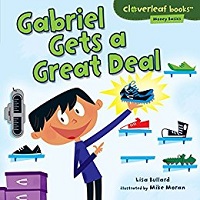
Gabriel Gets a Great Deal
Grade 1
4 skill lessons
Math
Skill lessons
The mathematics the book carries, taught directly. Printable workbook pages and teacher keys are not available for this book yet.
- 1Shipping Adds a Ten
- 2Ten Dollars Off
- 3Inside Thirty Dollars
- 4The Price Line
Math + reading
Math through the reading
The same book, entered through a sentence it prints. Change one word in the reading and the numbers change with it.
No math-through-reading lessons for this book yet.
Reading
Reading and language lessons
The same book read as a text. What a word means in its sentence, how a character is shown, how the writing is put together - no mathematics.
No reading and language lessons for this book yet.
Skill lessons
4 lessons on the mathematics the book carries. Printable workbook pages and teacher keys are not available for this book yet.
1. Shipping Adds a Ten
Chapter 1 puts three amounts in front of a reader inside six sentences and then asks for a fourth it never prints. Mom fixes what they cannot go past, the second website shows a price, and the shipping charge arrives in a question of its own with the word fast in front of it. Students lay three ten-dollar cards for the shoes and one more for the shipping, count the row ten at a time to forty, and write that amount down. Then they set it against the card carrying Mom's thirty and count on from thirty to forty to say how far past it they are. The forty appears nowhere in the book. What appears instead is the sentence directly after, where the family goes back to searching, and that sentence only earns its place once the ten has been added: a child who leaves the shipping out lands on thirty, and thirty is an amount the family could have paid.
Full lesson — 20 minutes
1. Read the three amounts before you touch a card (4 min)
Read the three money sentences aloud in your pair: the one where Mom says what they cannot go past, the one with the price on the screen, and the one with the shipping. Say which of the three is a price for shoes, which is a charge for bringing them to the house, and which is neither. Work nothing out yet.
Word preview: spend, shipping
We can't spend more than $30.
Here are some for $30, I said.
See what it says, $10 for fast shipping?
2. Build the price and the shipping (5 min)
Lay three ten-dollar cards in a row for the shoes on the screen. Put one more ten-dollar card below the row for the shipping. Read the shipping sentence and argue it out: does that fourth card join the row or stand in for one of the three? Move it into the row once you both agree.
Word preview: adds
Shipping adds to the price.
3. Count the four tens to the total (6 min)
Touch the cards one at a time and count ten, twenty, thirty, forty, writing each amount in the box under the card as you say it. Write the last amount on your answer card. Then lift the shipping card back out, count the row again, and say what the answer would have been if nobody had to send the shoes anywhere.
Word preview: cost
4. Put the total beside what Mom said (5 min)
Set your answer card next to the card reading thirty dollars. Say which amount is bigger. Count on from thirty until you reach your total and say how many dollars past Mom's amount the family would be. Then read what the family did next and say whether your answer explains it.
Word preview: much
We checked more websites, but fast kids always cost too much.
Short version — 9 minutes
1. Build the price and the shipping (4 min)
Lay three ten-dollar cards for the shoes on the screen and one more below the row for the shipping. Read the shipping sentence and say whether that fourth card joins the row or stands in for one of the three, then move it in.
Word preview: adds
Shipping adds to the price.
2. Count the four tens to the total (5 min)
Touch the cards one at a time and count ten, twenty, thirty, forty, writing each amount under its card. Write the total on your answer card, then take the shipping card out and say what the answer would have been without it.
Word preview: cost
Three levels
- Support
- Start with the four ten-dollar cards already in a row, so the pair does not have to settle whether the shipping joins the shoes; that argument is made for them. They count the row, one touch to one number word, ten to forty, and write each amount in its box. They still write the total and still put it beside the thirty-dollar card and say which is bigger, because that comparison is the point of the lesson and nobody should be spared it.
- At Grade
- The three money sentences read and sorted into a price, a charge and a limit; three tens laid for the shoes and one for the shipping; the fourth card argued into the row out of the sentence that says shipping adds; the row counted to forty with every amount written down; the total set beside the thirty and the distance counted on from thirty; and the family's next sentence read as the consequence of the answer.
- Extension
- Turn the question round. Shipping is ten dollars and the family may not go past thirty. Lay a ten for the shipping first, then add ten-dollar cards for shoes one at a time until one more would carry you past thirty. Say the most a pair of shoes on that website could cost and still be allowed, and say why twenty works when thirty does not.
English learners
The English doing the work here is adds to, and the direction lives in the small word after the verb rather than in the verb itself. A child can know add perfectly and still not hear that adds to the price means the ten joins the thirty instead of replacing it, because many languages carry that direction in a case ending or in where the words sit rather than in a separate particle. Shipping is the second difficulty: it looks like an action and is being used here as the name of a charge, so the ten dollars is shipping in the same way that a price is a price. Say the ten dollars is for shipping and then shipping adds to the price back to back while the fourth card moves into the row, and let the cards carry the meaning before any explaining does. Rehearse the frame the shoes cost ___ and the shipping adds ___, so we pay ___. Invite children to say how their strongest language says that one amount is being put on top of another, and write that form on the chart beside the English.
Materials
- A strip per pair carrying the book's three money sentences
- Six play ten-dollar cards per pair
- A recording strip per pair, four boxes long
- An answer card per pair
- A card per pair reading thirty dollars, the most Mom will spend
- Word cards: shipping, adds, spend
Standards & curriculum
These lessons are being matched against curricula now.
Standards are held back while this plan is edited. Every standard shown here was matched against the supplied wording of this lesson, quoting its steps, so a changed step is no longer the thing that was checked. Undo your changes to bring the standards back — your edits stay in this browser either way.
2. Ten Dollars Off
The coupon is a rule the book prints in a single line and then uses twice without ever printing either result. Students build the usual price of the fast kids shoes out of three ten-dollar cards and eight one-dollar cards, slide one ten under the coupon, and read off what is left. Then they meet this shop's other shoe price, the twenty the book gives with the coupon already counted in, and decide whether the ten has come off it yet. That decision is the whole lesson. The same three words, with the coupon, sit in a question about a price nobody has worked out and in a statement about a price already worked out, and a child who takes the ten off a second time ends at ten dollars and a shop giving shoes away. The last step looks at what the coupon left alone: eight ones went into the build and eight ones are still there, and only the tens moved, from three to two, which is why a six-year-old can do this in their head once they have watched it happen with cards.
Full lesson — 20 minutes
1. Read the coupon and the usual price (4 min)
Read the coupon line and the price line aloud in your pair. Say how many dollars the coupon takes off and say which shoes it can be used on. Then point to the one word in the price line that tells you the thirty-eight is what the shoes cost before anybody uses a coupon at all.
Word preview: off, usually
It says $10 off all shoes through this weekend.
Fast kids shoes usually cost $38 at shopmour.
2. Take the ten off the usual price (6 min)
Build thirty-eight dollars with three ten-dollar cards and eight one-dollar cards, counting them out loud as you lay them. Slide one ten-dollar card out and put it under the coupon. Count what is left, write the amount on your strip, then read the book's question and say your amount aloud as the answer to it.
Word preview: coupon
How much will they cost with the coupon?
3. Sort the two prices by whether the ten is already off (5 min)
Put this shop's two shoe prices side by side, the fast kids at thirty-eight and the other shoes at twenty, and read the book's sentence under each. Decide which price still has the coupon to come off it and which one has had it off already. Then take the ten off the wrong one on purpose, say the amount you get, and say why the book's own sentence makes it impossible.
Word preview: only
And they cost only $20 with the coupon.
4. Say what the ten did not change (5 min)
Put your thirty-eight build and your answer next to each other. Say how many one-dollar cards you started with and how many are there now, and say which cards moved. Then shut your eyes and take a ten off thirty-eight in your head, and tell your partner the part of the amount you had to think about and the part you did not.
Word preview: price
Short version — 9 minutes
1. Take the ten off the usual price (5 min)
Build thirty-eight dollars with three ten-dollar cards and eight one-dollar cards. Slide one ten out and put it under the coupon, count what is left, and write it. Read the book's question and say your amount as the answer.
Word preview: coupon
How much will they cost with the coupon?
2. Sort the two prices by whether the ten is already off (4 min)
Put the two shoe prices from this shop side by side and read the sentence under each. Say which one still has the coupon to come off and which has had it already, then take the ten off the wrong one and say why it cannot be right.
Word preview: only
And they cost only $20 with the coupon.
Three levels
- Support
- Give the child thirty-eight already built, three tens and eight ones counted out and lined up, so the only move is sliding one ten under the coupon and reading what is left. Say the amount, write it, and stop there for the arithmetic. Keep the sorting whole: two price cards, one with the coupon still to come and one with it already taken, and the child says which is which and points at the words that decide it.
- At Grade
- The coupon read and its amount named, the word usually found and said to mark the price before any coupon, thirty-eight built in tens and ones, one ten slid out and twenty-eight counted and written as the answer to the book's question, the shop's two prices sorted by whether the ten has come off yet with the wrong move tried out loud and refused, and the eight ones named as the part that never moved.
- Extension
- The other shoes cost twenty dollars with the coupon. Work backwards and say what they cost on the shelf before anybody used it, then check yourself by taking the ten off again and landing back on twenty. Say why a shop has two amounts for one pair of shoes, and then go through this chapter and say which of the two the book chose to print for the fast kids and which it chose to print for the other shoes.
English learners
Off is the difficulty and it is not a word children can look up their way out of, because it is doing work here that has nothing to do with places or directions: ten dollars off means ten dollars taken away from the price, and nothing in the phrase says away or takes. Many languages mark a reduction with a verb, so a child who is listening for the verb will hear says and cost and neither of them is it. With is the second trap, because the book uses with the coupon twice, once for a price still to be worked out and once for a price already worked out, and the words are identical both times. Say ten dollars off and the price with the coupon while the ten-dollar card actually leaves the build, then say them again over the twenty, where nothing leaves. Rehearse the frame it costs ___, the coupon takes ___ off, so we pay ___. Invite children to say how a shop announces money coming off a price in their strongest language, and write that phrasing on the chart next to the English.
Materials
- A coupon card per pair reading ten dollars off
- Four play ten-dollar cards and ten play one-dollar cards per pair
- An answer strip per pair
- Two price cards per pair, one reading thirty-eight dollars and one reading twenty dollars
- Word cards: off, usually, coupon
Standards & curriculum
These lessons are being matched against curricula now.
Standards are held back while this plan is edited. Every standard shown here was matched against the supplied wording of this lesson, quoting its steps, so a changed step is no longer the thing that was checked. Undo your changes to bring the standards back — your edits stay in this browser either way.
3. Inside Thirty Dollars
One sentence in Chapter 1 fixes what the family may spend, and the book then never repeats it, never applies it and never once says of any later price whether it is inside or outside. Four prices follow it across three chapters. Students put each price card in one of two boxes and then count the distance from thirty to each card: eight dollars over to the shoe shop's ticket, ten dollars under to the other shoes, twenty dollars under to the pair Gabriel buys. The fourth card is the one worth the argument. The website price is exactly thirty, and Mom's sentence forbids more than thirty rather than thirty, so the card goes in the box for what they can pay, and the shipping in the same chapter is what takes it out again. What a child defends here is not the sort but the reason for it, and the reason is countable: a card is out because you can start at thirty and keep counting before you reach it.
Full lesson — 20 minutes
1. Read Mom's sentence and say what it allows (4 min)
Read the sentence where Mom says what they cannot do. Say the largest amount that sentence still lets the family pay, and say how you know it is not thirty-one. Write that amount between the two boxes on your mat.
Word preview: spend
We can't spend more than $30.
2. Sort the four printed prices (6 min)
Take the four price cards and read the book's sentence on the back of each. Put every card in the box for prices the family can pay or the box for prices they cannot, saying the amount aloud as you place it and saying which box and why. If a card is hard to place, leave it sitting on the line between the boxes and come back to it.
Word preview: price, only
Mom liked them as much as I did, but she didn't like the $38 price tag.
And they cost only $20 with the coupon.
They're only ten dollars
3. Count how far each card is from thirty (5 min)
For a card the family cannot pay, start at thirty and count on until you reach the card, and that is how far over it is. For a card they can pay, start at the card and count on to thirty, and that is how far under. Write the distance in dollars in the box beside every card.
Word preview: much
4. Argue about the card that lands on thirty (5 min)
The website price is exactly thirty. One of you argues the family can pay it, the other argues they cannot, and both of you have to use Mom's own words to do it. Agree on an answer and put the card in a box. Then read the shipping sentence and say what that card has to do next.
Word preview: more
Here are some for $30, I said.
Shipping adds to the price.
Short version — 9 minutes
1. Sort the four printed prices (5 min)
Read the sentence on the back of each price card and put it in the box for prices the family can pay or the box for prices they cannot. Say the amount and the reason aloud. Leave a hard card on the line between the boxes.
Word preview: price, only
Mom liked them as much as I did, but she didn't like the $38 price tag.
And they cost only $20 with the coupon.
They're only ten dollars
2. Count how far each card is from thirty (4 min)
Count from thirty on to any card the family cannot pay to find how far over it is, and from a card they can pay on to thirty to find how far under. Write each distance in dollars beside its card.
Word preview: much
Three levels
- Support
- Sort two cards only, the thirty-eight and the ten, which are the furthest apart of the four, and read the book's sentence for each before it is placed. No distances are counted unless the pair wants them, and if they do, count the ten's distance in tens rather than in single dollars: ten up to twenty is one ten, twenty up to thirty is another, so twenty dollars.
- At Grade
- Mom's sentence read and the largest allowed amount said aloud with a reason, all four cards sorted with the book's sentence read for each, the distance from thirty counted and written for every card, and the exactly-thirty card argued both ways, settled on Mom's wording, and then moved once the shipping is added.
- Extension
- Work out the two amounts the book asks for and never prints: the website price once the ten-dollar shipping sits on it, and the fast kids at the second shop once the coupon comes off. Put both on the mat and count their distances. Then say the thing the book leaves for a reader to notice, that one of those two amounts is inside what the family may spend, and that it is the pair Gabriel wanted, and that the only reason he does not get them is a sign.
English learners
More than is a two-word comparison and English hides the hard part in the second word. Than is unstressed, it carries no meaning a child can picture, and it is what makes the phrase mean above thirty rather than about thirty or up to thirty. The frame also excludes the amount it names, which is a rule about English that has to be said out loud: more than thirty leaves thirty itself allowed. The book also puts a near neighbour in a reader's way, as much as, and there it is about liking rather than money, so a child hunting for comparison words will find one that does not compare amounts. Say more than thirty and exactly thirty over the two boxes with the card moving between them. Rehearse the frame ___ dollars is more than thirty, so they cannot pay it, and its partner ___ dollars is less than thirty, so they can. Invite children to say how their strongest language says one amount is above another, and write it on the chart beside the English.
Materials
- A sorting mat per pair with two boxes, one for prices the family can pay and one for prices they cannot
- Four price cards per pair, each with the book's sentence on the back
- A recording box beside each price card, for the distance in dollars
- Word cards: spend, more, only
Standards & curriculum
These lessons are being matched against curricula now.
Standards are held back while this plan is edited. Every standard shown here was matched against the supplied wording of this lesson, quoting its steps, so a changed step is no longer the thing that was checked. Undo your changes to bring the standards back — your edits stay in this browser either way.
4. The Price Line
The book prices six things and never puts two of them side by side. Each amount arrives in its own chapter in a sentence about a different shop, and a reader is left to carry them all at once, which is quietly what the words a better deal ask for, since better means nothing until there is a set to be better than. Students write a card for every thing the book puts a price on, mark a strip at nought, ten, twenty, thirty and forty, and put each card where it belongs: the football a short way past the start, the shoe shop's ticket nearly at the end, and two cards stacked on one spot because two different shops want the same thirty-eight. Then they touch the cards in the order the story meets them and find the line does not run downhill the way the story feels it does, because the shoe shop is dearer than the website was. The line is exactly what the book leaves out, and once it is on the desk the phrase a better deal has somewhere to point.
Full lesson — 20 minutes
1. Make a card for every price in the book (5 min)
Go through the story chapter by chapter and write a card for each thing the book puts a price on: the price on the website, the price on the ticket in the shoe shop, what the fast kids usually cost at the second shop, what the other shoes cost with the coupon, what the football cost, and what Gabriel pays at the end. Write the amount big and the shop small underneath.
Word preview: cost, price
Here are some for $30, I said.
Mom liked them as much as I did, but she didn't like the $38 price tag.
I got a football there for only two dollars.
2. Build the line in tens (4 min)
Lay the strip in front of you and write nought at the left end, then ten, twenty, thirty and forty at the marks along it, one number for each mark. Touch each mark and say it out loud, going up and then coming back down. Say how many dollars there are from one mark to the next.
3. Put every card where it belongs (6 min)
Place each card on the strip at its own amount. Two of your cards carry the same amount and belong on the same spot, so stack them and say why two different shops can want exactly the same money. Three cards do not land on a mark at all: for each one, say which two marks it sits between and which of the two it is nearer.
Word preview: usually
Fast kids shoes usually cost $38 at shopmour.
They're only ten dollars
4. Read the line the way the story goes (5 min)
Leave the football out of this part, because Gabriel bought it long before the story starts. Touch the other cards in the order the story meets them, from the website to the thrift shop, saying each amount as you touch it. Say whether the amounts always get smaller as the story goes on, and find the one stop where the amount went up instead.
Word preview: better, deal
Keep looking for a better deal.
Finally I found a great deal.
Short version — 9 minutes
1. Put every card where it belongs (5 min)
Place each card on the strip at its own amount. Stack the two cards that carry the same amount and say why two shops can want the same money. For each card that does not land on a mark, say which two marks it sits between and which it is nearer.
Word preview: usually
Fast kids shoes usually cost $38 at shopmour.
They're only ten dollars
2. Read the line the way the story goes (4 min)
Leaving the football out, touch the cards in the order the story meets them and say each amount. Say whether the amounts always get smaller, and find the one stop where the amount went up instead.
Word preview: better, deal
Keep looking for a better deal.
Finally I found a great deal.
Three levels
- Support
- Use three cards only, the ten, the twenty and the thirty, and every one of them lands exactly on a mark, so no card has to be judged between two. Place them, say each amount as it goes down, and read the line from the left to say which is least. Keep the story order with those three cards, because for these three the story order really does go downhill and a child can hear it.
- At Grade
- Six cards written from the chapters with the shop named on each, the strip marked in tens and read up and back down, every card placed, the two thirty-eights stacked with a reason, the three off-mark cards each named as sitting between two marks and nearer one, and the story order touched aloud with the stop where the amount went up found and said.
- Extension
- Add the two amounts the book asks about and never prints, the website price once the shipping is on it and the fast kids once the coupon comes off, and place those cards on the line as well. Then say which of the eight cards is the amount Gabriel actually paid, and count along the strip in tens to say how far it is from the dearest card there.
English learners
This book's comparison words are better, best and great, and only two of the three compare anything. Better and best are the same word bent twice, and English bends it into shapes that share no letters with good, so a child who knows good is given no help at all by the sound of either one. Great is the harder case, because it sits in the same phrase, a great deal, and looks like a third step in the same family when it is not a comparison at all. Say a good deal, a better deal, the best deal with a hand moving down the strip toward the least card, and then say a great deal standing still, so the difference is something a child sees before it is something they are told. Rehearse the frame ___ dollars is a better deal than ___ dollars. Invite children to say which is the better deal in their strongest language, and write that phrasing on the chart beside the English.
Materials
- Six blank cards per pair
- A number strip per pair, marked at nought, ten, twenty, thirty and forty
- Word cards: deal, better, cost
Standards & curriculum
These lessons are being matched against curricula now.
Standards are held back while this plan is edited. Every standard shown here was matched against the supplied wording of this lesson, quoting its steps, so a changed step is no longer the thing that was checked. Undo your changes to bring the standards back — your edits stay in this browser either way.