Let's Make a Circle Graph
Grade 3
3 skill lessons
Math
Skill lessons
The mathematics the book carries, taught directly. Printable workbook pages and teacher keys are not available for this book yet.
- 1One Piece, Ten Children
- 2Reading the Circle Back
- 3Build the Circle from Your Own Class
Math + reading
Math through the reading
The same book, entered through a sentence it prints. Change one word in the reading and the numbers change with it.
No math-through-reading lessons for this book yet.
Reading
Reading and language lessons
The same book read as a text. What a word means in its sentence, how a character is shown, how the writing is put together - no mathematics.
No reading and language lessons for this book yet.
Skill lessons
3 lessons on the mathematics the book carries. Printable workbook pages and teacher keys are not available for this book yet.
1. One Piece, Ten Children
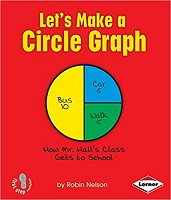
This is the idea that makes a circle graph different from a picture graph: the yellow half does not stand for one child or for ten pieces, it stands for ten children. The book states the class size, the count of bus riders and the fraction in three separate sentences and leaves the reader to put them together. Children find a half and a fourth of several class sizes and check each against a counted set of twenty cubes. The idea under it: a child learns that the size of a piece means nothing until you know how big the whole is.
Full lesson — 20 minutes
1. Count out the whole class (5 min)
Count twenty cubes onto your mat. Read what the circle stands for and put the whole twenty inside the paper circle. Say what one cube stands for.
Word preview: whole, class
Mr. Hall's class has 20 students.
The circle stands for the whole class.
2. Share it into the coloured pieces (6 min)
Move cubes into the yellow half until it holds the bus riders' count, then fill the blue quarter and the green quarter from what is left. Write the count in each piece.
Word preview: half, fourth
10 kids ride the bus.
Five kids come to school in a car.
5 kids walk to school 5 is 1 fourth of 20.
3. Say what one piece stands for (5 min)
Read the two sentences that name the fractions. Then say, for each coloured piece, both things it tells you: what fraction of the circle it is and how many children that is.
10 is one half of the class.
5 is 1 fourth of 20.
4. A different class, the same fractions (4 min)
Your sheet gives three other class sizes. For each one, find one half and one fourth and write both counts. Say which class size makes a quarter that cannot be shared out evenly.
Short version — 9 minutes
1. Share it into the coloured pieces (5 min)
Move cubes into the yellow half for the bus riders, then fill the two quarters from what is left, writing the count in each piece.
10 kids ride the bus.
Five kids come to school in a car.
2. Say what one piece stands for (4 min)
For each coloured piece, say what fraction of the circle it is and how many children that is.
10 is one half of the class.
5 is 1 fourth of 20.
Three levels
- Support
- Work with the yellow half only, and count the ten cubes into it together before the child fills the quarters. Saying both things about a piece stays.
- At Grade
- Twenty cubes counted into the circle, all three pieces filled and labelled with counts, both facts said about each piece, and three further class sizes halved and quartered.
- Extension
- Find a class size where the bus half and one quarter are both whole numbers of children but the other quarter is not, and say why that cannot happen.
English learners
Sharing cubes transfers. The part that has to be taught is that half names a piece of the picture and a number of children at the same time, so one word answers two different questions. Ask the two questions separately, every time, pointing first at the paper and then at the cubes. Rehearsable frame: This piece is ____ of the circle, and that is ____ children. Children may count in their strongest language and then say the frame in English with the cubes in the piece.
Materials
- Twenty cubes and a mat per pair
- A large paper circle per pair, marked into quarters
- A pencil
- Three paper labels per pair: bus, car, walk
- A three-row class-size sheet per pair
- Word cards: whole, half, fourth, class
Standards & curriculum
These lessons are being matched against curricula now.
Standards are held back while this plan is edited. Every standard shown here was matched against the supplied wording of this lesson, quoting its steps, so a changed step is no longer the thing that was checked. Undo your changes to bring the standards back — your edits stay in this browser either way.
2. Reading the Circle Back
The book asks four questions about its own graph and answers none of them. Three want a category and one wants a fraction of the whole, and one of the three has no winner at all because two pieces are equal. Children answer all four from a graph and have to say, for each, whether the answer is a category, a count or a fraction. The work gets applied to reading a finished graph for somebody else's question rather than for one's own.
Full lesson — 20 minutes
1. Answer the three category questions (6 min)
Read the book's first three questions and answer each one from the graph. Write beside each answer how you knew — which pieces you compared.
Word preview: most, more
How do most students get to school?
Do more students ride the bus or ride in a car?
Do more students ride in a car or walk?
2. The question with no winner (5 min)
One of the three questions asks which of two answers more children gave, and on this graph neither did. Find it and write what the honest answer is.
Word preview: equal
3. The question that wants a fraction (5 min)
Read the fourth question and notice that it does not ask how many. Answer it with a fraction of the whole circle, and then say the same answer again as a count of children.
Word preview: how much, how many
How much of the whole circle ride the bus?
4. Sort your four answers (4 min)
Write beside each of your four answers whether it is a category, a count or a fraction. Say which question was the odd one out and why.
Short version — 9 minutes
1. Answer the three category questions (5 min)
Answer the book's first three questions from the graph, writing beside each which pieces you compared.
How do most students get to school?
Do more students ride the bus or ride in a car?
Do more students ride in a car or walk?
2. The question that wants a fraction (4 min)
Answer the fourth question with a fraction of the whole circle, then say the same answer as a count of children.
How much of the whole circle ride the bus?
Three levels
- Support
- Answer the first two questions and the fourth, with the pieces already labelled with their counts. Sorting the answers by kind stays.
- At Grade
- All four questions answered with the compared pieces named, the question with no winner identified, the fraction answer given both ways, and all four answers sorted by kind.
- Extension
- Write a fifth question about this graph whose answer is a fraction and a sixth whose answer is a count, and hand both to another pair.
English learners
Reading the graph transfers. The English that does not is the difference between how much and how many — one asks for a part of a whole and the other for a number of things, and both are answered by looking at the same piece. Put the two questions on cards and hold up the card that matches each answer. Rehearsable frame: How much of the circle is ____; how many children is ____. Children may answer in their strongest language and then say both frames in English with the graph in front of them.
Materials
- A finished circle graph per pair, coloured and labelled
- The four questions, enlarged
- A four-row answer sheet per pair
- A pencil
- Word cards: most, more, equal, how much, how many
Standards & curriculum
These lessons are being matched against curricula now.
Standards are held back while this plan is edited. Every standard shown here was matched against the supplied wording of this lesson, quoting its steps, so a changed step is no longer the thing that was checked. Undo your changes to bring the standards back — your edits stay in this browser either way.
3. Build the Circle from Your Own Class
The book shows the whole procedure in six short sentences: ask a question, collect the answers, count the class, draw a circle, colour the pieces, and put on a title and labels. Children run it on their own class. What gets built is the finished graph, and the two things the book insists on — a title that says what the graph is about and a label on every piece — are what make it readable by somebody who was not in the room.
Full lesson — 20 minutes
1. Ask and record (5 min)
Agree one question with three possible answers and ask every child in the class. Make a tally mark for each answer as it is given, and count the tallies at the end.
Word preview: survey, data
He asks his students how they get to school.
The answers are his data.
2. Check the counts against the class (5 min)
Add your three counts and compare the total with the number of children in the class. If they do not match, find out which answers were missed before you draw anything.
Word preview: total
All pieces of a circle graph equal a whole.
3. Colour the pieces (6 min)
On the quartered circle, colour a piece for each answer, using a half for an answer given by half the class and a quarter for an answer given by a quarter. Where a count does not fit a half or a quarter, say so on the back rather than forcing it.
Each piece is a part of the circle.
4. Title it and label it (4 min)
Read what the book says a title and labels are for. Write a title that says what your graph is about and a label on every coloured piece, then hand it to another pair to read back to you.
Word preview: title, label
Circle graphs should have a title.
The title tells you what the graph is about.
Circle graphs should have labels.
The labels tell you about each part.
Short version — 9 minutes
1. Ask and record (5 min)
Agree a question with three answers, ask every child, tally each answer and count the tallies.
He asks his students how they get to school.
The answers are his data.
2. Title it and label it (4 min)
Write a title that says what the graph is about and a label on every piece, then have another pair read it back.
Circle graphs should have a title.
Circle graphs should have labels.
Three levels
- Support
- Use a question with two answers rather than three, so the circle is a half and a half. The tally, the check against the class and the title and labels stay.
- At Grade
- A three-answer survey tallied and counted, the total checked against the class, the circle coloured piece by piece, and a title and three labels written and read back by another pair.
- Extension
- Ask a question whose answers do not fall into halves and quarters, and say what you would need to draw the pieces honestly.
English learners
Tallying and colouring transfer. The English that does not is the difference between a title and a label — both are short pieces of writing on the same sheet, and the book distinguishes them by what each one is about rather than by where it sits. Keep two cards, one reading the whole graph and one reading this piece, and write under the matching card. Rehearsable frame: The title says ____; this label says ____. Children may draft in their strongest language and then write the English with both cards in view.
Materials
- A tally sheet per pair, ruled for three answers
- A pencil
- A large paper circle marked into quarters, per pair
- Coloured pencils per pair
- Word cards: survey, data, title, label
Standards & curriculum
These lessons are being matched against curricula now.
Standards are held back while this plan is edited. Every standard shown here was matched against the supplied wording of this lesson, quoting its steps, so a changed step is no longer the thing that was checked. Undo your changes to bring the standards back — your edits stay in this browser either way.