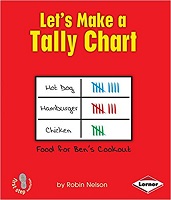
Let's Make a Tally Chart
Grade 1
3 skill lessons · 3 math-through-reading
Math
Skill lessons
The mathematics the book carries, taught directly. Printable workbook pages and teacher keys are not available for this book yet.
- 1One person, one mark: building a tally chart from a class survey
- 2Three more, three fewer: comparing the hamburgers with the chicken
- 3Reading the chart back: five, ten, and then the leftovers
Math + reading
Math through the reading
The same book, entered through a sentence it prints. Change one word in the reading and the numbers change with it.
- 4The word that makes one person one mark
- 5Can we still say hamburgers won?
- 6Three more, three fewer, one row of counters
Reading
Reading and language lessons
The same book read as a text. What a word means in its sentence, how a character is shown, how the writing is put together - no mathematics.
- 7Data Is Information: When the Next Sentence Is the Meaning
- 8Decide, Write, Ask: The Words That Tell You to Do Something
- 9Reading Tally Charts: What a Short Line Announces
- 10Which, What, How: Reading the Question Words
- 11Ben's Job: Reading a Reason Out of Two Sentences
Skill lessons
3 lessons on the mathematics the book carries. Printable workbook pages and teacher keys are not available for this book yet.
1. One person, one mark: building a tally chart from a class survey
The book hands over its own procedure in plain words: ask each person, make a mark after the food they name, and cross every fifth mark over the four before it. Students run that procedure live on classmates instead of reading a finished chart. What representation means here is that the marks are not a picture of the answers, they ARE the answers, one for one, so the sheet can be counted back into the same numbers it was built from. The crossing rule is introduced as a hand movement with a spoken rule attached, not as skip counting; nobody counts groups of five in this lesson.
Full lesson — 20 minutes
1. Ask and mark, one person at a time (6 min)
Take the food list your table wrote and carry it to five classmates. Ask each one, hot dog, hamburger, or chicken, and make one straight mark beside the food that person names before you walk to the next. One person gives you one mark, never two, and you make the mark while they are still standing there.
Word preview: tally, mark
He asks each person what he or she wants to eat.
Ben makes a tally mark after the food each person wants.
2. Cross the fifth mark (5 min)
Keep asking until one food has five marks beside it. Lay the fifth mark slantwise across the four already standing there instead of adding a fifth upright. Say the rule aloud as your hand crosses, every fifth mark goes across the other four, and check a partner's sheet for any run of five uprights that never got crossed.
Word preview: fifth, across
Every 5th tally mark goes across the other 4.
3. Count the marks back (5 min)
Touch every mark beside one food, one touch and one number word, and say the number you land on. Then do the same for the other two foods. Write nothing yet, just say each number and have your partner touch the marks again to see whether they land on the same word.
Word preview: count
4. Name what the sheet is (4 min)
Hold up your finished sheet and tell your partner what it now holds, using the book's two words in one sentence, that the sheet is a tally chart and what it shows is data. Then say what a person who was not in the room could learn from it and what they could not.
Word preview: data, chart
A tally chart shows data.
Data is information.
Short version — 9 minutes
1. Ask and mark, one person at a time (5 min)
Ask three classmates, hot dog, hamburger, or chicken, and make one straight mark beside the food each one names before moving on. One person, one mark.
Word preview: tally, mark
Ben makes a tally mark after the food each person wants.
2. Cross the fifth mark (4 min)
Keep asking until a food has five marks. Lay the fifth mark slantwise across the four before it and say the rule aloud as your hand crosses.
Word preview: fifth, across
Every 5th tally mark goes across the other 4.
Three levels
- Support
- Ask three classmates instead of five and keep to two foods on the list, hot dog and hamburger, so no run reaches five and the crossing rule waits. Everything else stays whole: the student still asks, still marks while the person stands there, and still touches every mark to count it back.
- At Grade
- Ask five classmates across three foods, cross the fifth mark when a run reaches it, and count each food's marks back by touching. Say the sheet is a tally chart and that what it shows is data.
- Extension
- Swap sheets with a partner who surveyed different classmates and find, without asking them, which food each sheet says was named most. Then say what the two sheets together cannot tell you, and why adding the two counts would only be honest if nobody was asked twice.
English learners
The book's word data has no plural and no article in the sentence students will echo, which is unlike the count nouns beside it, and children whose first language marks number on every noun often say a data or datas. Rehearse the frame the sheet shows data, my chart shows data about lunch, and accept it in any language first. The verb ask is the load-bearing word in this lesson and it takes a person as its object here, not a thing; ask each person transfers cleanly from Spanish preguntar a and from Mandarin, while the English mark after the food is an ordering children will need said slowly, because the mark goes beside the name and not on top of it. Invite students to run the survey question itself in their strongest language and record the marks on the same shared sheet, since the marks carry no language at all.
Materials
- A food list of three choices, written by the table
- A pencil for each student
- A partner's marking sheet for the check
- Counters, one per mark, for the recount
- The finished marking sheet
- Word cards: tally, data
Standards & curriculum
Choose your curriculum above to see the standards for this lesson.
Standards are held back while this plan is edited. Every standard shown here was matched against the supplied wording of this lesson, quoting its steps, so a changed step is no longer the thing that was checked. Undo your changes to bring the standards back — your edits stay in this browser either way.
2. Three more, three fewer: comparing the hamburgers with the chicken
This is the only place in the book where two counts are both stated and are not equal, eight against five, and the book prints a question about exactly that pair without answering it. Students build the two rows from the book's own sentences, push them together, and find the three unmatched counters. The difference is reached by matching and is then said in two directions about one unmoved arrangement, so that more and fewer are felt as two descriptions of one fact rather than two facts. No student takes five from eight; the three is seen, not calculated.
Full lesson — 20 minutes
1. Build the two rows (5 min)
Read the book's two sentences aloud and build what they say in counters, one row of eight for hamburgers and one row of five for chicken, both rows starting from the same line on the table. One counter is one person. Do not slide the rows yet.
Word preview: row
8 people want hamburgers Five people want hot dogs.
Five people want chicken.
2. Push the rows together and find who is unmatched (5 min)
Push the short row up against the long one so each chicken counter faces one hamburger counter. Some hamburger counters will have nobody facing them. Touch those and count them aloud. Do not take one number away from the other; the answer is standing there unmatched.
Word preview: unmatched, match
3. Say it both ways (6 min)
Say the sentence forward, eight is three more than five, while your finger rests on the unmatched counters. Then say the same arrangement the other way, five is three fewer than eight, with your finger still on the same counters. Your partner checks that the counters did not move between the two sentences.
Word preview: more, fewer, than
How many more people want hamburgers than chicken?
4. Answer the book's question (4 min)
Read the book's own question aloud and give it your number with the words in it, three more people want hamburgers than chicken. Then say which two of the book's sentences you used to get there, and say why the third one, about hot dogs, was not needed.
Word preview: question
Five people want hot dogs.
Short version — 9 minutes
1. Build the two rows (4 min)
Build the book's two numbers in counters, eight for hamburgers and five for chicken, both rows starting from the same line. One counter is one person.
Word preview: row
Five people want chicken.
2. Say it both ways (5 min)
Push the rows together so each chicken counter faces a hamburger counter, touch the ones left unmatched, and say both sentences about them, eight is three more than five and five is three fewer than eight.
Word preview: more, fewer, than
How many more people want hamburgers than chicken?
Three levels
- Support
- Build the rows in a ten frame so the matching is done by the frame's own columns rather than by pushing, and say the forward sentence only, eight is three more than five, pointing at the unmatched squares. The reversal waits until the forward sentence is steady.
- At Grade
- Build both rows from the book's sentences, push them together, count the unmatched counters, and say the relation forward and reversed about the same unmoved arrangement.
- Extension
- Take the hot dog count, five, which the book also states, and set it against the chicken count, five. Say what the matching shows and why neither more nor fewer will finish the sentence. Then say what word does finish it, and why that pair could not have been used for the book's question.
English learners
The comparative frame more than and fewer than is where the mathematics and the syntax are the same problem. Many languages build comparison with a marker on the verb or with a separate particle rather than with than, and Spanish speakers reliably produce more that for more than, which is a pronunciation of the same structure and should be accepted while the English form is rehearsed. The reversal is the harder half everywhere: children who say eight is three more than five often hear five is three fewer than eight as a new fact about a new arrangement. Keep the counters still and unmoved through both sentences so the eyes contradict that impression. Rehearse both frames aloud with the finger on the unmatched counters, and invite the reversal first in the strongest language, since a child who can reverse it in Somali or Mandarin has the mathematics and needs only the English words.
Materials
- Counters, at least thirteen per pair
- A start line marked on the table or a strip of tape
- The book's three data sentences, displayed
- Word cards: more, fewer
Standards & curriculum
Choose your curriculum above to see the standards for this lesson.
Standards are held back while this plan is edited. Every standard shown here was matched against the supplied wording of this lesson, quoting its steps, so a changed step is no longer the thing that was checked. Undo your changes to bring the standards back — your edits stay in this browser either way.
3. Reading the chart back: five, ten, and then the leftovers
The book states the crossing rule and then prints the numbers its own chart is supposed to give. This lesson is the reading half of that: cards arrive already marked, and students turn marks into a number by reading each crossed group as five and counting the leftovers on by ones. Students keep the hand and the mouth in agreement: one flat finger per group of five, one touch per leftover mark, with no recounting of the marks inside a crossed group. The eight the book states is used as a check against a card students did not build, which is the only place in the lesson where a stated number does any work.
Full lesson — 20 minutes
1. Read a crossed group as five (5 min)
Take a card of finished tally marks and lay a finger flat across each crossed group of five. Say five for the first group, ten for the second, fifteen for the third, moving the finger group to group and never touching a single mark inside them. Stop when the crossed groups run out.
Word preview: group, five
Every 5th tally mark goes across the other 4.
2. Count the leftovers on (5 min)
From the number you stopped on, touch each uncrossed mark left over and count on by ones, one number word per mark. Say the number you finish on, then say it again with the food name in it, so the card reads as a sentence and not just a number.
Word preview: leftover
3. Check the eight (5 min)
Find the card that stands for the hamburgers and read it your way, by crossed groups and then by leftovers. The book says the number this card should give. Read the book's sentence, say your number, and tell your partner whether the card and the sentence agree.
Word preview: agree
8 people want hamburgers Five people want hot dogs.
4. Say what the marks stand for (5 min)
Point at the crossed group on your card and say what those five marks are, five people who each said the same food. Then point at one single mark and say what that one is. Finish by telling your partner why the crossing helps a reader who has to count a long row.
Word preview: stand
Ben makes a tally mark after the food each person wants.
Short version — 9 minutes
1. Read a crossed group as five (5 min)
Lay a finger flat across each crossed group of five on your card and say five, ten, fifteen, moving group to group without touching single marks.
Word preview: group, five
Every 5th tally mark goes across the other 4.
2. Count the leftovers on (4 min)
From the number you stopped on, touch each leftover mark and count on by ones. Say the number you finish on with the food name in it.
Word preview: leftover
Three levels
- Support
- Work with cards that carry one crossed group and at most three leftovers, so the count runs five, six, seven, eight and never past ten. Keep the flat finger for the group and the single touch for the leftovers; the two hand movements are the point and they stay whole.
- At Grade
- Read cards with up to three crossed groups and four leftovers, saying five, ten, fifteen and then counting on by ones to the finish, and check the hamburger card against the number the book states.
- Extension
- Take a card and, without recounting, say how many people it would show if one more person had chosen that food, and whether that new mark would be a leftover or the one that gets crossed. Say which of the two it is before you draw it, and say how you knew.
English learners
Counting on from a number rather than from one is the hard move here and it is a spoken habit, not a written one, so it needs rehearsing aloud before the cards arrive. Children who count fluently in another language often restart at one when they switch to English, which looks like a mathematical error and is a language switch; let them count the leftovers in their strongest language from the number they already reached and only then say the finishing number in English. The frame worth rehearsing is five, ten, and three more is thirteen, with the words and three more said while the finger is still on the leftovers. The word leftover is not the book's and should be given as a classroom word; the book's own word for what the crossed marks do is across, which is a preposition doing a verb's work and is worth pointing at.
Materials
- Cards of finished tally marks, crossed groups and leftovers, one per pair
- The book's data sentence, displayed
- Word cards: group, across
Standards & curriculum
Choose your curriculum above to see the standards for this lesson.
Standards are held back while this plan is edited. Every standard shown here was matched against the supplied wording of this lesson, quoting its steps, so a changed step is no longer the thing that was checked. Undo your changes to bring the standards back — your edits stay in this browser either way.
Math through the reading
The mathematics is reached through a sentence the book prints: change one word in the reading and the numbers change with it. These carry their own standards, matched against these lessons rather than inherited from the skill ones.
4. The word that makes one person one mark
Students act out the book's marking sentence with and without the word each, produce two different counts from the same classmates, and say which word forced which number.
Full lesson — 20 minutes
1. Read the sentence and predict (4 min)
Students hear the book's marking sentence twice, once as written and once with each swapped to the, and say aloud which version will give more marks when eight people are asked. Predictions are recorded on the board as a show of hands, not settled.
2. Run both sentences on the same eight classmates (7 min)
In pairs, students ask eight classmates the same food question. One partner marks by the book's sentence, one mark for each person, and the other marks by the swapped sentence, one mark for the food the person wants. Both work from the same eight answers.
3. Count both rows back (5 min)
Students touch and count the marks in each row, one touch one number word, and say the two numbers aloud. They compare their pair's two numbers with a neighbouring pair's and check that both pairs got the same two.
4. Say which word made which number (4 min)
Each student says one sentence naming the word and the number together, the word each made eight marks because every person got one, and says what the other word would have made instead.
Short version — 9 minutes
1. Run both sentences on the same eight classmates (7 min)
In pairs, students ask eight classmates the same food question. One partner marks by the book's sentence, one mark for each person, and the other marks by the swapped sentence, one mark for the food the person wants. Both work from the same eight answers.
2. Count both rows back (5 min)
Students touch and count the marks in each row, one touch one number word, and say the two numbers aloud. They compare their pair's two numbers with a neighbouring pair's and check that both pairs got the same two.
Three levels
- Support
- Ask four classmates instead of eight, so both rows stay inside a count the student can hold in view, and mark only one food. The two rows then hold four marks and one mark, and the contrast is just as sharp with half the asking. The student still runs both sentences and still says which word made which number.
- At grade
- Ask eight classmates across the three foods the book names, run both versions of the sentence on the same eight answers, count both rows back by touching, and say in one sentence which word produced which count.
- Extension
- Take the book's other rule sentence, the one about crossing every fifth mark, and swap every for the. Predict what a row of thirteen marks will look like under each version, then draw both rows and say which one a reader can count in fives and which one they cannot.
English learners
The word each is a quantifier that attaches to a singular noun in English while meaning something about a whole group, and that mismatch is a real difficulty rather than a vocabulary gap. Many languages express the same idea with a reduplicated noun or a classifier, and children will often produce every person or all person for each person, which is the right mathematics in slightly wrong English and should be accepted while the English form is rehearsed. The frame to rehearse aloud is one person, one mark, said while the hand makes the mark, because the rhythm carries the correspondence better than the sentence does. Invite students to say the deciding word in their strongest language first and then in English, and let the two rows of marks do the arguing, since a row of eight marks beside a row of one mark is an argument in no language at all.
Materials
- A shared marking sheet ruled into two rows
- A pencil
- The food question, agreed by the pair before they start asking
- The book's marking sentence, written out large
- The same sentence with each replaced by the, written directly beneath it
Standards & curriculum
Choose your curriculum above to see the standards for this lesson.
Standards are held back while this plan is edited. Every standard shown here was matched against the supplied wording of this lesson, quoting its steps, so a changed step is no longer the thing that was checked. Undo your changes to bring the standards back — your edits stay in this browser either way.
5. Can we still say hamburgers won?
Students build the book's three counts in cubes, add four unknown guests, and argue aloud to a partner playing Ben about whether the answer to his own question still holds.
Full lesson — 20 minutes
1. Build the book's three counts (5 min)
Students hear the three data sentences and build a cube tower for each food on a labelled card, eight, five and five. They say which food has the most and how many more it has, sliding towers alongside each other rather than counting up.
2. Add the four guests (4 min)
Students hear the three sentences about the late guests and take four loose cubes, one for each of the aunt, the uncle and the two cousins. They are told the book never says which tower these four belong on, and they place them on the table between the towers, not on any of them.
3. Test what four can do (6 min)
In pairs, students move the four loose cubes onto towers to test cases: all four onto chicken, three onto chicken and one elsewhere, one onto each. After each arrangement they read the three counts aloud and say whether hamburgers still leads.
4. Argue it to Ben (5 min)
One partner holds the chart and speaks as Ben, asking his own question, what do the most people want. The other states a position and defends it in a sentence containing a number, then they swap. Each pair reports the one case that would change their mind.
Short version — 9 minutes
1. Test what four can do (6 min)
In pairs, students move the four loose cubes onto towers to test cases: all four onto chicken, three onto chicken and one elsewhere, one onto each. After each arrangement they read the three counts aloud and say whether hamburgers still leads.
2. Argue it to Ben (5 min)
One partner holds the chart and speaks as Ben, asking his own question, what do the most people want. The other states a position and defends it in a sentence containing a number, then they swap. Each pair reports the one case that would change their mind.
Three levels
- Support
- Work with two towers only, hamburgers at eight and chicken at five, and two loose guests instead of four. Students test both guests onto chicken, reaching seven, and say whether hamburgers still leads. The gap of three against two guests has one clean answer, so the student defends a position they can be certain of before facing the harder case.
- At grade
- Build all three towers, place the four guests, test at least three different arrangements of the four, and state a position to the partner playing Ben in a sentence containing a number and a reason.
- Extension
- Find the smallest number of extra guests that could make hamburgers lose, and prove it by building the case just below it as well as the case itself. Then say what would have to be printed in the book for the question to have one certain answer.
English learners
This lesson asks children to argue in English about something uncertain, which needs two frames rather than one. The first is the position frame, I think hamburgers, because eight is more than five, which is available early and transfers from most languages directly. The second is the conditional, if all four picked chicken, then chicken would have nine, and that is genuinely hard: English marks the hypothetical twice, once with if and once with would, where many languages mark it once or not at all. Accept if all four picked chicken, chicken has nine, which is the same reasoning with one marker, and rehearse the fuller form without correcting the shorter one mid-argument. Let students argue to their partner in their strongest language first and then say the sentence with the number in it in English, since the number and the cube arrangement are the parts a listener can check.
Materials
- Labelled cards for hamburgers, hot dogs and chicken
- Linking cubes, at least twenty per pair
- Four loose cubes set apart as the guests
- The book's three data sentences
- The three sentences about the late guests, displayed directly beneath them in the book's own order
Standards & curriculum
Choose your curriculum above to see the standards for this lesson.
Standards are held back while this plan is edited. Every standard shown here was matched against the supplied wording of this lesson, quoting its steps, so a changed step is no longer the thing that was checked. Undo your changes to bring the standards back — your edits stay in this browser either way.
6. Three more, three fewer, one row of counters
Students build the book's eight against its five, find the three unmatched by pushing the rows together, and say the relation both ways about an arrangement that never moves.
Full lesson — 20 minutes
1. Build the two rows (5 min)
Students hear the book's two data sentences and build a row of eight counters for hamburgers and a row of five for chicken, both starting from a common line so the rows are honestly comparable. Nothing is pushed yet and no comparison is spoken.
2. Push and find the unmatched (5 min)
Students push the short row up against the long one so each chicken counter faces one hamburger counter. They touch and count the hamburger counters with nobody facing them, and say the number aloud. Partners check that both rows still start on the line.
3. Say it forward, then say it back (7 min)
With a finger resting on the three unmatched counters, students say eight is three more than five, then, without moving anything, say five is three fewer than eight. Partners watch the counters and confirm they did not move. Each student says both sentences at least twice, and once with the food names in place of the numbers.
4. Answer the book's question (3 min)
Students hear the book's own question read aloud and answer it in a full sentence containing the number and both foods, then say which of their two sentences the question was asking for and which one the book never asks for at all.
Short version — 9 minutes
1. Push and find the unmatched (5 min)
Students push the short row up against the long one so each chicken counter faces one hamburger counter. They touch and count the hamburger counters with nobody facing them, and say the number aloud. Partners check that both rows still start on the line.
2. Say it forward, then say it back (7 min)
With a finger resting on the three unmatched counters, students say eight is three more than five, then, without moving anything, say five is three fewer than eight. Partners watch the counters and confirm they did not move. Each student says both sentences at least twice, and once with the food names in place of the numbers.
Three levels
- Support
- Build the two rows inside a pair of ten frames so the matching is done by the frames' own columns and no pushing is needed. Say the forward sentence only, eight is three more than five, with a finger on the three unmatched squares, and say it until it is steady. The reversal is added only once the forward sentence comes without hesitation.
- At grade
- Build both rows from the book's sentences, push them together, count the unmatched counters, and say the relation forward and reversed about the same unmoved arrangement, then answer the book's printed question in a full sentence.
- Extension
- Set the book's other two counts against each other, the five for hot dogs and the five for chicken, and push those rows together. Say what the matching shows, and say why neither more nor fewer will finish the sentence about them. Then say which word does, and why the book could not have asked its question about that pair.
English learners
Comparative syntax is where this lesson is hard and it is hard differently in different languages. English builds the comparison with a separate word, than, sitting between the two things; Spanish uses que and Spanish-speaking children reliably produce more that for more than, which is the correct structure with an English pronunciation and should be accepted while the target form is rehearsed. Mandarin marks comparison with a particle before the second item, so the English word order can feel reversed. The reversal itself is the universal difficulty and it is not a language problem at all: children in every language treat five is three fewer than eight as new information after saying eight is three more than five. The still counters are the argument against that, so keep them still and point at them during both sentences. Rehearse the two frames as a matched pair, more than and fewer than, and invite the reversal in the strongest language first, since a child who reverses it in Arabic has the mathematics and needs only the English word fewer, which the book never gives them.
Materials
- Counters, at least fifteen per pair
- A start line marked with a strip of tape
- A pair of ten frames for the Support
- The book's data sentences for hamburgers and for chicken
- The book's own comparison question, displayed after the rows are built
Standards & curriculum
Choose your curriculum above to see the standards for this lesson.
Standards are held back while this plan is edited. Every standard shown here was matched against the supplied wording of this lesson, quoting its steps, so a changed step is no longer the thing that was checked. Undo your changes to bring the standards back — your edits stay in this browser either way.
Reading and language lessons
5 lessons on the reading and language the book carries - what a word means in its sentence, how a character is shown, how a text is built. No mathematics: these are matched against the English language arts curricula, which are a different and smaller set than the mathematics ones.
7. Data Is Information: When the Next Sentence Is the Meaning
The book uses a hard word and then explains it in the very next sentence, in three words. Students find the pattern, say the meaning back without looking away from the page, and then hunt for a second place where the book explains itself the same way. Nothing is counted; the skill is taking a word's meaning from a sentence the writer put there on purpose.
Full lesson — 20 minutes
1. Read the word and the sentence that explains it (6 min)
The teacher reads the passage below once, then everyone reads it together. Circle the word data. Underline the sentence that tells you what data means. Say the meaning aloud in your own words.
Word preview: data, information
A tally chart shows data. Data is information.
2. Say the meaning without the word (5 min)
Read the passage below again. Now say the first sentence out loud, but swap the word data for the meaning the second sentence gave you. Say aloud whether the sentence still makes sense.
Word preview: means
A tally chart shows data. Data is information.
3. Find the word again in a longer sentence (5 min)
Read the passage below with a partner. The word data is here again, doing a job in a longer sentence. Underline it. Then say aloud what a person is deciding when they decide what data to keep track of.
Word preview: explain
How to make a tally chart? Decide what data you want to keep track of. Write down the different choices. Ask questions to find out people's choices. Make tally marks after each choice. Add a title.
4. Write the meaning in your log (4 min)
Read the passage below one more time. In your meaning log write: data means ___. Fill it in using words you can point to in this passage. Read your line to a partner.
A tally chart shows data. Data is information.
Short version — 9 minutes
1. Read the word and the sentence that explains it (5 min)
The teacher reads the passage below, then everyone reads it together. Circle data and underline the sentence that tells you what it means. Say the meaning aloud.
Word preview: data, information
A tally chart shows data. Data is information.
2. Write the meaning in your log (4 min)
Read the passage below again. In your meaning log write: data means ___, using words you can point to in the passage.
A tally chart shows data. Data is information.
Three levels
- Support
- Read only the step 1 passage with the teacher, echoing after her. Point to the word data, then point to the word information. Say aloud: data means information.
- At Grade
- Circle data and underline its meaning in the step 1 passage, swap the meaning into the sentence, and write the meaning in your log.
- Extension
- The step 1 passage explains data but never explains tally. Say two sentences about what a reader can and cannot work out from this passage alone, and point to the words that decided it.
English learners
English often defines a word by simply following it with a be-sentence, with no signal word like means at all. Point out that Data is information. is a definition even though it does not say means. Invite students to give the word for information in their strongest language and write it beside data in the meaning log. Rehearsable frame: ___ means ___.
Materials
- Let's Make a Tally Chart, the passage printed in this step
- pencil
- meaning log
- Word cards: data, information, means, explain
Standards & curriculum
Choose your curriculum above to see the standards for this lesson.
Standards are held back while this plan is edited. Every standard shown here was matched against the supplied wording of this lesson, quoting its steps, so a changed step is no longer the thing that was checked. Undo your changes to bring the standards back — your edits stay in this browser either way.
8. Decide, Write, Ask: The Words That Tell You to Do Something
The last passage of this book is a how-to list, and every sentence in it starts with a word that tells the reader to do something. Students find those words, notice they all sit first in the sentence, and hear the difference between a sentence that tells about somebody and a sentence that tells you. The skill is reading instructions and hearing who they are addressed to.
Full lesson — 20 minutes
1. Read the how-to list aloud (6 min)
The teacher reads the passage below once. Then read the sentences after the question together, one at a time. Circle the first word of each of those sentences. Say aloud what all your circled words have in common.
Word preview: decide, write, ask, add
How to make a tally chart? Decide what data you want to keep track of. Write down the different choices. Ask questions to find out people's choices. Make tally marks after each choice. Add a title.
2. Hear who the sentence is talking to (5 min)
Read the two passages below. One passage tells you about what Ben did. The other tells you what to do. Hold up one finger for the passage about Ben and two fingers for the passage that talks to you. Say aloud one word that gave it away.
He asks each person what he or she wants to eat. Ben makes a tally mark after the food each person wants. Every 5th tally mark goes across the other 4.
How to make a tally chart? Decide what data you want to keep track of. Write down the different choices. Ask questions to find out people's choices. Make tally marks after each choice. Add a title.
3. Turn a telling sentence into an instruction (5 min)
Read the passage below again. Choose one sentence about Ben and say it out loud as an instruction for somebody else, starting with a doing word. Write your instruction on the doing-word strip.
He asks each person what he or she wants to eat. Ben makes a tally mark after the food each person wants. Every 5th tally mark goes across the other 4.
4. Read the list in order to a partner (4 min)
Read the passage below to a partner as if you were teaching them. Read one instruction, wait, then read the next. Say aloud why the order of these instructions matters for somebody following them.
How to make a tally chart? Decide what data you want to keep track of. Write down the different choices. Ask questions to find out people's choices. Make tally marks after each choice. Add a title.
Short version — 9 minutes
1. Read the how-to list aloud (5 min)
The teacher reads the passage below once. Read the sentences after the question together and circle the first word of each. Say what those words have in common.
Word preview: decide, write, ask, add
How to make a tally chart? Decide what data you want to keep track of. Write down the different choices. Ask questions to find out people's choices. Make tally marks after each choice. Add a title.
2. Read the list in order to a partner (4 min)
Read the passage below to a partner as if you were teaching them, one instruction at a time. Say why the order matters.
How to make a tally chart? Decide what data you want to keep track of. Write down the different choices. Ask questions to find out people's choices. Make tally marks after each choice. Add a title.
Three levels
- Support
- Read only the last two sentences of the step 1 passage with the teacher. Point to the first word of each. Say those two words aloud, then do what one of them says with your pencil in the air.
- At Grade
- Circle the first word of every instruction in the step 1 passage, then sort the two passages in step 2 by who they are talking to.
- Extension
- The step 1 passage opens with a question and then never asks another one. Say two sentences about what the question is doing there, and what would change if it were a telling sentence instead.
English learners
English instructions drop the subject entirely, so Decide what data you want has no visible you at the front. Students whose home languages mark the addressee on the verb may look for a missing word. Read one instruction, then read it again as You decide ___, so the hidden addressee is heard once. Invite students to give a familiar instruction from home in their strongest language and say whether it names the person or not.
Materials
- Let's Make a Tally Chart, the passage printed in this step
- pencil
- doing-word strip
- Word cards: decide, write, ask, add
Standards & curriculum
Choose your curriculum above to see the standards for this lesson.
Standards are held back while this plan is edited. Every standard shown here was matched against the supplied wording of this lesson, quoting its steps, so a changed step is no longer the thing that was checked. Undo your changes to bring the standards back — your edits stay in this browser either way.
9. Reading Tally Charts: What a Short Line Announces
Two short lines in this book are not really sentences at all; they are labels that tell a reader what the next part will be about. Students read one such line with the sentences under it, say what the line promised, and then check whether the sentences kept the promise. The skill is using a heading to set an expectation before reading.
Full lesson — 20 minutes
1. Read the short line at the start (5 min)
The teacher reads the passage below once. The first three words stand on their own and are not about anybody. Underline them. Say aloud what you think the sentences after them will be about, and write it on a prediction slip.
Word preview: heading, label
Reading tally charts. Ben's aunt, uncle, and two cousins were late to the cookout. Ben asked them what they wanted to eat. He added their answers to his tally chart.
2. Check whether the sentences kept the promise (5 min)
Read the passage below again with a partner. Look at your prediction slip. Say aloud whether the sentences after the short line are about what it announced, and point to the words that decide it.
Word preview: promise
Reading tally charts. Ben's aunt, uncle, and two cousins were late to the cookout. Ben asked them what they wanted to eat. He added their answers to his tally chart.
3. Read a second short line (5 min)
Read the passage below. It also starts with a short line that announces something. Underline it. Say aloud what this one announces, and how it is different from a sentence that tells you a fact.
Word preview: part
How to make a tally chart? Decide what data you want to keep track of. Write down the different choices. Ask questions to find out people's choices. Make tally marks after each choice. Add a title.
4. Write a heading of your own (5 min)
Read the passage below. It has no short line in front of it. Write a heading of three or four words that would fit above it, then read your heading and the passage aloud together and say why they go together.
He asks each person what he or she wants to eat. Ben makes a tally mark after the food each person wants. Every 5th tally mark goes across the other 4.
Short version — 9 minutes
1. Read the short line at the start (5 min)
The teacher reads the passage below. Underline the first three words, which stand on their own. Say what you think the next sentences will be about.
Word preview: heading, label
Reading tally charts. Ben's aunt, uncle, and two cousins were late to the cookout. Ben asked them what they wanted to eat. He added their answers to his tally chart.
2. Write a heading of your own (4 min)
Read the passage below, which has no short line in front of it. Write a heading of three or four words that would fit above it and say why.
He asks each person what he or she wants to eat. Ben makes a tally mark after the food each person wants. Every 5th tally mark goes across the other 4.
Three levels
- Support
- Read only the first three words of the step 1 passage with the teacher. Say them aloud. Then answer with one word: will the next part be about reading, or about running?
- At Grade
- Underline the heading in the step 1 passage, write a prediction, and check it against the sentences that follow.
- Extension
- The step 3 passage uses a question as its heading and the step 1 passage uses a phrase. Say two sentences about which one pulls a reader in harder, using words from both printed passages.
English learners
Headings in English are often not full sentences and have no verb, which can read as an unfinished thought to students used to full-sentence signposting. Read the heading, then say the full sentence it stands for: This part is about reading tally charts. Invite students to say what the heading promises in their strongest language before writing the prediction slip.
Materials
- Let's Make a Tally Chart, the passage printed in this step
- pencil
- prediction slips
- Word cards: heading, label, promise, part
Standards & curriculum
Choose your curriculum above to see the standards for this lesson.
Standards are held back while this plan is edited. Every standard shown here was matched against the supplied wording of this lesson, quoting its steps, so a changed step is no longer the thing that was checked. Undo your changes to bring the standards back — your edits stay in this browser either way.
10. Which, What, How: Reading the Question Words
One printed passage is almost nothing but questions, and each one begins with a different question word. Students read them aloud with a rising voice, sort them by their first word, and say what kind of answer each first word is asking for. No question is answered from a chart; the work is hearing what a question word demands of a reader.
Full lesson — 20 minutes
1. Read the questions aloud (6 min)
The teacher reads the passage below once. Then read the questions together, letting your voice go up at the end of each one. Circle every question mark you find. Say aloud whether every question started with the same word.
Word preview: which, what, how, question
Use Ben's tally chart to answer these questions. Which foods did the new people choose? What do the most people want? How many more people want hamburgers than chicken?
2. Sort the questions by their first word (5 min)
Read the passage below again. Lay a question word card beside each question. Then say aloud what kind of answer each first word is asking you for: a choice from a list, a thing, or an amount.
Use Ben's tally chart to answer these questions. Which foods did the new people choose? What do the most people want? How many more people want hamburgers than chicken?
3. Tell a question from a telling sentence (5 min)
Read the two passages below. One asks. One tells. Say aloud which is which, then read each one in the voice that fits it. Point to the mark at the end of each that gave it away.
How can you keep track?
Five people want chicken.
4. Ask a question of your own (4 min)
Read the passage below again. Write one new question about a cookout that starts with the same first word as any question in this passage. Read it aloud with a rising voice and say what kind of answer it asks for.
Use Ben's tally chart to answer these questions. Which foods did the new people choose? What do the most people want? How many more people want hamburgers than chicken?
Short version — 9 minutes
1. Read the questions aloud (5 min)
The teacher reads the passage below once. Read the questions together with your voice rising at the end, and circle every question mark.
Word preview: which, what, how, question
Use Ben's tally chart to answer these questions. Which foods did the new people choose? What do the most people want? How many more people want hamburgers than chicken?
2. Sort the questions by their first word (4 min)
Read the passage below again and lay a question word card beside each question. Say what kind of answer each first word asks for.
Use Ben's tally chart to answer these questions. Which foods did the new people choose? What do the most people want? How many more people want hamburgers than chicken?
Three levels
- Support
- Read only the second sentence of the step 1 passage with the teacher, echoing after her. Point to the question mark. Say the first word of the sentence aloud.
- At Grade
- Read all the questions in the step 1 passage aloud, circle the marks, and lay a question word card beside each one.
- Extension
- The step 1 passage opens with a sentence that is not a question at all. Say two sentences about what that opening sentence does for the questions that follow it, using its own words.
English learners
English marks a question by word order and by a rising voice, and the question word arrives first, which is not the pattern in every language. Read each question twice, once flat and once rising, so the difference is heard rather than only seen. Invite students to ask one of these questions in their strongest language and say whether the question word came first there too.
Materials
- Let's Make a Tally Chart, the passage printed in this step
- pencil
- question word cards
- Word cards: which, what, how, question
Standards & curriculum
Choose your curriculum above to see the standards for this lesson.
Standards are held back while this plan is edited. Every standard shown here was matched against the supplied wording of this lesson, quoting its steps, so a changed step is no longer the thing that was checked. Undo your changes to bring the standards back — your edits stay in this browser either way.
11. Ben's Job: Reading a Reason Out of Two Sentences
The opening of this book tells a reader what is happening and then, in one sentence, what one person has been given to do. Students read the opening, say what Ben's job is in their own words, and then find the sentences later that show him actually doing it. The skill is holding a stated purpose across a page and matching it to actions.
Full lesson — 20 minutes
1. Read what Ben's job is (6 min)
The teacher reads the passage below once, then everyone reads it together. Underline the sentence that says what Ben's job is. Say his job aloud in your own words, without using the word job.
Word preview: job, find out, everyone
The people in Ben's family are having a cookout. They are making hot dogs, hamburgers, and chicken. Ben's job is to find out what everyone wants to eat.
2. Find him doing it (5 min)
Read the passage below with a partner. Underline the sentence that shows Ben doing his job. Say aloud how you know it is the same job the first passage described.
Word preview: asks
He asks each person what he or she wants to eat. Ben makes a tally mark after the food each person wants. Every 5th tally mark goes across the other 4.
3. Fill in the job chart (5 min)
Read both passages below. In the left column of your job chart write Ben's job, using words from the first passage. In the right column write what he does, using words from the second. Read both columns aloud to a partner.
The people in Ben's family are having a cookout. They are making hot dogs, hamburgers, and chicken. Ben's job is to find out what everyone wants to eat.
He asks each person what he or she wants to eat. Ben makes a tally mark after the food each person wants. Every 5th tally mark goes across the other 4.
4. Say what happened when the job was not finished (4 min)
Read the passage below. Four more people arrive after Ben thought he was done. Say aloud what Ben has to do again because of them, and point to the words in this passage that tell you.
Reading tally charts. Ben's aunt, uncle, and two cousins were late to the cookout. Ben asked them what they wanted to eat. He added their answers to his tally chart.
Short version — 9 minutes
1. Read what Ben's job is (5 min)
The teacher reads the passage below, then everyone reads it together. Underline the sentence that says what Ben's job is and say it aloud in your own words.
Word preview: job, find out
The people in Ben's family are having a cookout. They are making hot dogs, hamburgers, and chicken. Ben's job is to find out what everyone wants to eat.
2. Find him doing it (4 min)
Read the passage below with a partner. Underline the sentence that shows Ben doing his job and say how you know it is the same job.
Word preview: asks
He asks each person what he or she wants to eat. Ben makes a tally mark after the food each person wants. Every 5th tally mark goes across the other 4.
Three levels
- Support
- Read only the last sentence of the step 1 passage with the teacher. Point to the word job. Answer aloud in one sentence: what does Ben have to find out?
- At Grade
- Underline Ben's job in the step 1 passage, find him doing it in the step 2 passage, and fill in both columns of the job chart.
- Extension
- The step 1 passage says find out and the step 2 passage says asks. Say two sentences about why the book uses a different word the second time, and what each word tells you about how Ben does the job.
English learners
Find out is a two-word verb whose meaning is not the sum of find and out, and students may read it literally. Read the step 1 sentence, then say the same idea as discover what everyone wants, so the phrase is heard as one unit. Invite students to say Ben's job in their strongest language first. Rehearsable frame: Ben's job is to ___. He does it by ___.
Materials
- Let's Make a Tally Chart, the passage printed in this step
- pencil
- job chart (job / doing it)
- Word cards: job, find out, asks, everyone
Standards & curriculum
Choose your curriculum above to see the standards for this lesson.
Standards are held back while this plan is edited. Every standard shown here was matched against the supplied wording of this lesson, quoting its steps, so a changed step is no longer the thing that was checked. Undo your changes to bring the standards back — your edits stay in this browser either way.