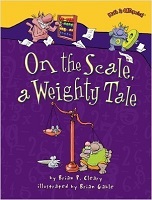
On the Scale, a Weighty Tale
Grade 2
4 skill lessons · 3 math-through-reading
Math
Skill lessons
The mathematics the book carries, taught directly. Printable workbook pages and teacher keys are not available for this book yet.
- 1Which Unit Fits This Thing?
- 2The Weight Ladder
- 3Sixteen Slices in a Pound
- 4Read It, Write It, Say the Unit
Math + reading
Math through the reading
The same book, entered through a sentence it prints. Change one word in the reading and the numbers change with it.
- 5About, Equals, Make
- 6What Does One Pear Weigh?
- 7One Slice Against Sixteen
Reading
Reading and language lessons
The same book read as a text. What a word means in its sentence, how a character is shown, how the writing is put together - no mathematics.
- 8The book stops to say what weight is
- 9Whales and scales in the same breath
- 10A ton of stuff
- 11The list at the back
- 12When the page gets it wrong
Skill lessons
4 lessons on the mathematics the book carries. Printable workbook pages and teacher keys are not available for this book yet.
1. Which Unit Fits This Thing?
The book gives four objects whose weights are each about one unit: a paperclip is about a gram, a slice of bread about an ounce, two pears about a pound, a walrus about a ton. That set is the whole lesson's apparatus. Students hold classroom objects against those reference objects and sort them onto unit cards, then check the two smallest against a real scale. The concept being built is that a unit has a size you can feel and that choosing one is a judgement about the object, not a rule to recall. Nothing is converted and nothing is added; the mathematics is matching an object to a benchmark and reading a scale in whole units.
Full lesson — 20 minutes
1. Sort the tray by the book's four objects (6 min)
Each pair takes a tray of eight classroom objects and four cards reading gram, ounce, pound and ton. On each card sits the book's own example for that size: a paperclip, a slice of bread, two pears, a photo of a walrus. Students hold each tray object, hold the card object beside it, and lay the tray object on the card whose example it feels closest to. Nothing is weighed yet and no number is written.
Word preview: gram, ounce, pound
One paperclip weighs about 1 gram.
One slice of bread weighs about 1 ounce.
Two pairs weigh around 1 pound.
1 female walrus weighs about 1 ton.
2. Check the two easy ones on the scale (5 min)
Students put the paperclip on the gram scale and read the number aloud, then the slice of bread on the ounce scale and read that one. They compare each reading to what the book said the object weighs and say whether the book was close. Only these two objects go on a scale; the pears and the walrus card stay where they are.
Word preview: about
One paperclip weighs about 1 gram.
One slice of bread weighs about 1 ounce.
3. Say why the unit fits (5 min)
Each student picks one object off their tray and says a sentence to their partner naming the unit they chose and the book object that decided it, in the form: I put the eraser on ounce because it feels like the slice of bread. The partner holds both objects and says whether they agree. Every student says one sentence and hears one.
An ounce is just the thing to use for very light amounts.
4. Move the one that was wrong (4 min)
The teacher names one object on each tray that is on the wrong card. Students hold it against the card object, hold it against the neighbouring card's object, and move it to the card it belongs on. They say aloud which card it left and which card it went to.
A scale is the tool we use to weigh things small and large.
Short version — 9 minutes
1. Sort the tray by the book's four objects (5 min)
Each pair takes a tray of eight objects and four cards reading gram, ounce, pound and ton, each card carrying the book's own example: a paperclip, a slice of bread, two pears, a walrus. Students hold each tray object against the card object and lay it on the card it feels closest to. Nothing is weighed and no number is written.
Word preview: gram, ounce, pound
One paperclip weighs about 1 gram.
One slice of bread weighs about 1 ounce.
Two pairs weigh around 1 pound.
1 female walrus weighs about 1 ton.
2. Check the two easy ones on the scale (4 min)
Students put the paperclip on the gram scale and read the number aloud, then the slice of bread on the ounce scale and read that one. They say whether each reading is close to what the book said.
Word preview: about
One paperclip weighs about 1 gram.
One slice of bread weighs about 1 ounce.
Three levels
- Support
- Cut the tray from eight objects to four, and choose them so that no two are close: a paperclip, an eraser, a full water bottle and a brick. Keep both scale readings, keep the sentence, and keep the reference objects in the child's hands the whole time. The load being reduced is the number of judgements, never the judgement itself.
- At Grade
- Sort eight objects onto four unit cards by holding each against the book's reference object, check the paperclip in grams and the bread slice in ounces on a real scale, say one sentence naming the unit and the reference object that decided it, then move the one object the teacher names to its right card.
- Extension
- Find the object on the tray that the book's four examples cannot decide, because it sits between two of them, and say what you would need to settle it. Then choose an object in the room that belongs on the ton card and say what makes you sure, given that nobody can pick it up.
English learners
Unit names travel unevenly. Gram and kilogram are the everyday units in most of the world and many children arrive already knowing them well, so the metric half of this lesson is often the accessible half and the ounce and the pound are the new work, which is the reverse of what an English-only teacher expects. Say so, and let a child who knows grams lead the gram card. The word that causes real trouble is the book's own weigh, which sounds exactly like way and which this transcription actually confuses in four places; write both words on the board and keep them visible. The sentence frame carries the whole language demand, so keep it posted and let children rehearse it with a partner before saying it to the group, in their strongest language first if that helps them find the comparison.
Materials
- Tray of eight classroom objects per pair, ranging from a paperclip to a full water bottle
- Four unit cards reading gram, ounce, pound and ton, each carrying the book's example object
- A paperclip, a slice of bread and two pears per pair, as the reference objects
- Scale reading in whole grams, one per two pairs
- Scale reading in whole ounces, one per two pairs
- Sentence strip showing the frame: I put the ___ on ___ because it feels like the ___
- The four unit cards laid in a row from gram to ton
- Reduced tray of four objects chosen to be far apart in weight
- Word cards: gram, ounce, pound, scale
Standards & curriculum
Choose your curriculum above to see the standards for this lesson.
Standards are held back while this plan is edited. Every standard shown here was matched against the supplied wording of this lesson, quoting its steps, so a changed step is no longer the thing that was checked. Undo your changes to bring the standards back — your edits stay in this browser either way.
2. The Weight Ladder
The book's back matter prints four objects each with a weight: a paperclip about 1 gram, a slice of bread about 1 ounce, two pears around 1 pound, a giraffe about one metric ton. Those four are already in order, and that is what makes them usable. Students build the ladder, verify the two light ends with their own hands and a scale, then slide a fifth unlisted object into it and say what it sits between. The reasoning is ordinal: no student computes how much heavier anything is, because the book's four units are never related to each other by a number a second grader can use. Reading the ladder in both directions is what makes the order a relation rather than a list.
Full lesson — 20 minutes
1. Lay out the four object cards (5 min)
Each group takes four picture cards, one for each of the book's back-matter objects: a paperclip, a slice of bread, two pears, a giraffe. Students read the weight printed on each card aloud, then lay the cards in one line from lightest to heaviest without touching the two they can actually hold. They say the line aloud from one end and then from the other end.
Word preview: lightest, heaviest
One paperclip weighs about 1 gram.
One slice of bread weighs about 1 ounce.
Two pairs weigh around 1 pound.
One female giraffe weighs about one metric ton.
2. Prove the two you can hold (5 min)
Students take the real paperclip and the real slice of bread and hold one in each hand at the same time. They say which hand is pulled down harder, then put each on the correct scale and read both numbers. They check that the heavier hand matches the bigger reading and say so out loud.
One paperclip weighs about 1 gram.
One slice of bread weighs about 1 ounce.
3. Slide a new object into the line (6 min)
The teacher hands each group one object that is not on a card: a pencil, a shoe, a full backpack. Students decide where it goes in the line of four and slide it in. They say one sentence naming what it is heavier than and what it is lighter than, using the two cards it now sits between.
Word preview: heavier, lighter
A heavy backpack filled with books, a teeny paper kite.
4. Read the ladder both ways (4 min)
Groups read their finished line of five aloud from lightest to heaviest, touching one object per name, then read it back the other way from heaviest to lightest. They say which two objects swapped places in their mouths when the direction changed and which one did not move at all.
The very heaviest of things we talk about in tons.
Short version — 9 minutes
1. Lay out the four object cards (5 min)
Each group takes the four object cards carrying the book's weights and reads each aloud. They lay the four in one line from lightest to heaviest, then say the line aloud from one end and then from the other.
Word preview: lightest, heaviest
One paperclip weighs about 1 gram.
One slice of bread weighs about 1 ounce.
Two pairs weigh around 1 pound.
One female giraffe weighs about one metric ton.
2. Prove the two you can hold (4 min)
Students hold the real paperclip in one hand and the real slice of bread in the other, say which hand is pulled down harder, then read both on the scales and check that the heavier hand matched the bigger number.
One paperclip weighs about 1 gram.
One slice of bread weighs about 1 ounce.
Three levels
- Support
- Work with three cards instead of four, dropping the giraffe, so the whole ladder is objects the child could imagine holding. Keep the hand check and keep both scale readings; those are what make the order real rather than remembered. Slide in one new object at the end if there is time, and accept a pointed finger with a spoken heavier than in place of the full two-part sentence.
- At Grade
- Lay the four object cards in order from lightest to heaviest, verify the paperclip against the slice of bread by hand and then on the scales, slide one unlisted object into the line, and say a sentence naming what it is heavier than and what it is lighter than. Finish by reading the whole ladder aloud in both directions.
- Extension
- Take the two pears card and the giraffe card and say what the book gives you that would let you put something between them, and what it does not give you. Then find an object in the room you cannot place on this ladder at all and say exactly which two cards it falls between and why the book leaves it undecided.
English learners
The comparative and superlative are two different structures in English and children often meet only one of them, so a child may say heavier fluently and reach for most heavy where heaviest belongs. Both are correct mathematics and only one is correct English; correct the form lightly and never let the correction interrupt the ordering. Many languages mark comparison with a separate particle rather than an ending, so the -er and -est endings are the specific thing to rehearse, and reading the ladder aloud in both directions is the rehearsal. The two-part sentence in the slide-in step is the hardest structure in the lesson because it holds two comparisons at once; let children say it in two separate sentences first, and in their strongest language first if that gets the relation out, then join them.
Materials
- Four object cards carrying the book's back-matter weights: paperclip, slice of bread, two pears, giraffe
- A real paperclip and a real slice of bread per group
- Scale reading in whole grams, one per two groups
- Scale reading in whole ounces, one per two groups
- One unlisted object per group: a pencil, a shoe or a full backpack
- Sentence strip showing the frame: the ___ is heavier than the ___ and lighter than the ___
- The finished line of five objects and cards left standing on the table
- Reduced set of three object cards, omitting the giraffe
- Word cards: heavier, lighter, heaviest, lightest
Standards & curriculum
Choose your curriculum above to see the standards for this lesson.
Standards are held back while this plan is edited. Every standard shown here was matched against the supplied wording of this lesson, quoting its steps, so a changed step is no longer the thing that was checked. Undo your changes to bring the standards back — your edits stay in this browser either way.
3. Sixteen Slices in a Pound
The book says sixteen ounces make a pound and then does the teaching itself: it tells the reader to picture sixteen slices of bread. Students build that picture with sixteen paper rectangles, count them singly and then in twos, and set the stack beside a real one-pound object on a scale. The fluency is counting to sixteen and halving sixteen twice, both squarely within grade. No student multiplies and no student converts: the sixteen is counted out, not computed, and the pound is read off a scale rather than derived. The paired sentences at the end are the book's own two sentences about the same fact, said in both directions.
Full lesson — 20 minutes
1. Count the sixteen slices out (6 min)
Each pair takes sixteen paper rectangles cut to the size of a bread slice and counts them into a stack one at a time, saying the number aloud on each one. They stop at sixteen and check by counting the stack again in twos. The book's line is read to them once before they start and once when they finish.
Word preview: sixteen
16 ounces make 1 pound.
So, picture 16 slices.
2. Weigh the stack against a pound (5 min)
Pairs put a real one-pound object on one side of the room's scale and their stack of sixteen slices where they can see both readings. They read the pound number and say whether the stack of sixteen is close. They say aloud how many slices they counted and what one pound is, in one sentence with both numbers in it.
Word preview: pound
16 ounces make 1 pound.
1 pound equals 16 ounces.
3. Split the stack in half and say what you have (5 min)
Students split their sixteen slices into two equal piles and count one pile. They say what the pile is: eight slices, and half of one pound. They split one of those piles again and say the same two things about the four that are left in their hand.
Word preview: half
So, picture 16 slices.
4. Say the pair of sentences (4 min)
Each student says two sentences to a partner about the stack: one that starts with the ounces and one that starts with the pound. Both sentences must carry sixteen and one. The partner says whether the two sentences say the same thing or different things.
1 pound equals 16 ounces.
16 ounces make 1 pound.
Short version — 9 minutes
1. Count the sixteen slices out (5 min)
Each pair counts sixteen paper bread-slice rectangles into a stack, saying each number aloud, then checks the stack by counting again in twos. The book's line is read to them before and after.
Word preview: sixteen
16 ounces make 1 pound.
So, picture 16 slices.
2. Weigh the stack against a pound (4 min)
Pairs put a one-pound object on the scale beside their stack of sixteen slices, read the pound number, and say one sentence carrying both numbers: how many slices they counted and what one pound is.
Word preview: pound
16 ounces make 1 pound.
1 pound equals 16 ounces.
Three levels
- Support
- Pre-count the sixteen rectangles into two stacks of eight and let the child count on from eight rather than from one, then check by twos. Keep the scale reading and keep the sentence with both numbers in it. The load reduced is the size of the count, not the sentence, and the child still says sixteen and one in one breath.
- At Grade
- Count sixteen paper slices into a stack singly and then check in twos, set the stack beside a one-pound object on the scale and read the pound number, split the sixteen in half and then in half again saying what each pile is, and finish by saying both of the book's sentences about ounces and pounds.
- Extension
- Split the sixteen into four equal piles and say what one pile is in slices and what it is as a part of the pound. Then say what the book would have had to tell you to let you picture a ton the way it let you picture a pound, and why sixteen rectangles was a fair thing to ask and two thousand would not be.
English learners
Half is the word to watch and it is a genuine trap here, because in this lesson it names both an action and an amount: children split the stack in half and then hold half a pound, and those are two different parts of speech doing two different jobs. Say each aloud with a gesture and keep them apart. Number words to sixteen transfer readily and most children arrive with them secure in at least one language, so counting is where a child new to English can lead rather than follow; invite the count in the strongest language and the sentence in English. The book's own rhyme is heavily garbled in this transcription and rhymes badly even where it is clean, so do not use it for pronunciation practice; use the two flat back-matter sentences instead, which are short, regular and worth memorising.
Materials
- Sixteen paper bread-slice rectangles per pair
- A real slice of bread per pair, to size the rectangles against
- Scale reading in whole ounces and whole pounds, one per two pairs
- A one-pound object per class: a bag of rice or a full drink bottle
- The two sorting mats, one per pile
- Sentence strip showing both frames: 16 ___ make 1 ___ and 1 ___ equals 16 ___
- Pre-counted stacks of eight rectangles
- Word cards: sixteen, pound, ounce, half
Standards & curriculum
Choose your curriculum above to see the standards for this lesson.
Standards are held back while this plan is edited. Every standard shown here was matched against the supplied wording of this lesson, quoting its steps, so a changed step is no longer the thing that was checked. Undo your changes to bring the standards back — your edits stay in this browser either way.
4. Read It, Write It, Say the Unit
The book names the scale as the tool and never shows a reading, so this lesson supplies the part the text asserts and skips. Students weigh three small objects in whole grams, wait for the display to settle, and write each number with its unit beside the object's name. They then weigh one object twice to meet the fact that a scale does not always repeat itself. The representation being built is the three-part record, object and number and unit, and the rule that a number without a unit is not a weight. No arithmetic is performed on the readings: students find the largest by looking down the column, and never subtract one from another.
Full lesson — 20 minutes
1. Read three objects in grams (7 min)
Each group weighs three objects in turn on a scale reading whole grams: the paperclip, a pencil and a glue stick. They wait for the number to settle, read it aloud, and write it on a record sheet next to the object's name with the word grams after it. Nobody writes a number without its unit.
Word preview: grams
One paperclip weighs about 1 gram.
A dollar bill or paperclip?
2. Weigh one thing twice (4 min)
Groups take the glue stick off the scale and put it straight back on. They read the number again and compare it to what they wrote. If it changed they write both numbers; if it did not they write same. They say aloud what they saw.
A scale is the tool we use to weigh things small and large.
3. Find the heaviest on your sheet (5 min)
Students look down their own record sheet and point at the biggest number, then say which object it belongs to and what its unit is. They read the three rows aloud in order from smallest number to biggest, saying the object name and the number and the unit each time.
A scale is the tool we use to weigh things small and large.
4. Add the fourth row yourself (4 min)
Each group chooses one more object from around the room, weighs it, and writes the fourth row themselves with object, number and unit. They say why they chose it and read the row aloud to another group.
Scales can measure a trunk filled with treasure, a crate, or some bait, or a barge.
Short version — 9 minutes
1. Read three objects in grams (5 min)
Each group weighs the paperclip, a pencil and a glue stick on the gram scale, waits for each number to settle, reads it aloud, and writes it on the record sheet with the word grams after it.
Word preview: grams
One paperclip weighs about 1 gram.
A dollar bill or paperclip?
2. Weigh one thing twice (4 min)
Groups take the glue stick off the scale and put it straight back on, read the number again, and write whether it changed or stayed the same.
A scale is the tool we use to weigh things small and large.
Three levels
- Support
- Weigh two objects rather than three and pre-print the unit word grams in every row so the child writes only the object and the number. Keep the repeat weighing, which is the part that teaches what a scale is, and keep the child reading each number aloud before writing it. The load reduced is the writing, not the reading of the scale.
- At Grade
- Weigh three objects in whole grams and record each as object, number and unit, weigh one of them a second time and record whether it changed, read the rows in order from smallest to biggest, then choose a fourth object, weigh it and write its row unaided.
- Extension
- Weigh the same object on two different scales and write both rows, then say which number you would tell somebody and why. Then say what would go wrong if you wrote just the number and left the unit off, using two objects on your own sheet that would become impossible to tell apart.
English learners
The record sheet is the language work and its three parts are the whole point, so keep the column headings visible as words and not only as boxes: object, number, unit. Number reading transfers almost completely and a child new to English can read the scale as accurately as anyone in the room on the first day, which is worth saying to the child. The unit word is the part that does not transfer, and gram is the easier of the two because it is near-identical in many languages while ounce is not; expect ounce to need more rehearsal than its size warrants. Same and changed are the two words the repeat-weighing step turns on, and a gesture for each, hands still and hands apart, carries them further than a definition.
Materials
- Scale reading in whole grams, one per group
- A paperclip, a pencil and a glue stick per group
- Weight record sheet with three rows, each with a space for the object, the number and the unit
- The weight record sheet, second column for the repeat reading
- The completed weight record sheet
- The weight record sheet, fourth row left blank
- Weight record sheet with the unit word pre-printed in each row
- Word cards: scale, grams, unit
Standards & curriculum
Choose your curriculum above to see the standards for this lesson.
Standards are held back while this plan is edited. Every standard shown here was matched against the supplied wording of this lesson, quoting its steps, so a changed step is no longer the thing that was checked. Undo your changes to bring the standards back — your edits stay in this browser either way.
Math through the reading
The mathematics is reached through a sentence the book prints: change one word in the reading and the numbers change with it. These carry their own standards, matched against these lessons rather than inherited from the skill ones.
5. About, Equals, Make
The book uses about on its objects and equals on its tables, and students find out by weighing which of the two words their own scale reading is allowed to disagree with.
Full lesson — 20 minutes
1. Weigh the paperclip and the slice (6 min)
Pairs weigh a paperclip on a gram scale and a slice of bread on an ounce scale, read each number aloud and write it beside the book's sentence for that object. They say out loud whether their number and the book's number are the same.
2. Say which word is in charge (5 min)
Each child takes four sentence cards, two carrying about and two carrying equals, and sorts them into two piles by which word governs. For their own two readings they say a sentence naming the word and saying whether their reading is allowed to differ, with both numbers in the sentence.
3. Build both readings of make (5 min)
Pairs count sixteen paper slices into one stack for the book's sentence, then build what the swapped sentence would demand and try to set it against the one-pound object. They say which of the two stacks matches the pound and which does not.
4. Fix a broken sentence out loud (4 min)
Each child is handed one sentence with the wrong word in it and says the corrected version aloud to a partner, then says what a reader following the broken one would have done wrong with the numbers.
Short version — 9 minutes
1. Weigh the paperclip and the slice (6 min)
Pairs weigh a paperclip on a gram scale and a slice of bread on an ounce scale, read each number aloud and write it beside the book's sentence for that object. They say out loud whether their number and the book's number are the same.
2. Say which word is in charge (5 min)
Each child takes four sentence cards, two carrying about and two carrying equals, and sorts them into two piles by which word governs. For their own two readings they say a sentence naming the word and saying whether their reading is allowed to differ, with both numbers in the sentence.
Three levels
- Support
- Cut to two sentence cards, one about and one equals, and keep both scale readings and both stacks. Give the verdict as a two-way choice said aloud, the book is still right or the book is wrong, rather than as a built sentence, and let the child point at the governing word on the card while saying it. The load reduced is the sentence, never the weighing, because the weighing is where the distinction is found.
- At grade
- Weigh a paperclip in grams and a slice of bread in ounces and write each reading beside the book's sentence, sort four sentence cards by whether about or equals governs them, say for each of your own readings whether it is allowed to differ and why with both numbers in the sentence, build both readings of make and find which stack matches a pound, then correct a broken sentence aloud.
- Extension
- Find the one sentence in the back matter where the book puts about on something it also puts on a table, and say whether the two can both be true. Then write the rule you would give a younger child for deciding, in one sentence, when a number they read is allowed to be a little bit wrong.
English learners
About is a small word doing a large job here and it is the kind of word that survives translation badly, because many languages mark approximation with an ending, a particle or a change of word order rather than with a separate word placed before the number. A child may therefore hear about as filler and read straight past it, which is precisely the error the lesson exists to catch, and it is a listening error and not a mathematical one. Put the two words on cards of different colours and keep the colours consistent all lesson so that the governing word is visible before it is understood. Number reading transfers completely and a child new to English will read the scale as well as anyone, so let that be the part they do first and lead on. Invite children to say why the two words differ in their strongest language and then to give the verdict in English, where only the two words and the two numbers are needed.
Materials
- Scale reading in whole grams, one per pair
- Scale reading in whole ounces, one per pair
- A paperclip and a slice of bread per pair
- Sixteen paper bread-slice rectangles per pair
- Four sentence cards per child, two carrying about and two carrying equals, in two colours
- A one-pound object per class: a bag of rice or a full drink bottle
- The four back-matter object sentences written large, with the word about circled in each
- The two table lines written large, with the word equals circled in each
Standards & curriculum
Choose your curriculum above to see the standards for this lesson.
Standards are held back while this plan is edited. Every standard shown here was matched against the supplied wording of this lesson, quoting its steps, so a changed step is no longer the thing that was checked. Undo your changes to bring the standards back — your edits stay in this browser either way.
6. What Does One Pear Weigh?
The book weighs pears only in pairs, and students find the weight of a single one by splitting the sixteen slices the book told them to picture.
Full lesson — 20 minutes
1. Find the three sentences (6 min)
The teacher reads the back matter aloud twice. Pairs hunt for the sentences that say anything about pears, about pounds and about a slice of bread, and put a finger on each one as it is read the second time. They say aloud what each sentence tells them.
2. Split the sixteen (6 min)
Pairs count sixteen paper slices into a stack, then split it into two equal piles because the book's pears come in twos. They count one pile and say the number aloud with its unit.
3. Say the number and the line together (5 min)
Each child says the weight of one pear and then reads aloud the one sentence that made them split rather than count the whole stack. Their partner says whether that sentence really does the job the child claimed for it.
4. Check it against real pears (3 min)
Two real pears go on the ounce scale together and then one alone. Students compare both readings with the book's pound and with their own eight, and say whether the book's around was fair.
Short version — 9 minutes
1. Find the three sentences (6 min)
The teacher reads the back matter aloud twice. Pairs hunt for the sentences that say anything about pears, about pounds and about a slice of bread, and put a finger on each one as it is read the second time. They say aloud what each sentence tells them.
2. Split the sixteen (6 min)
Pairs count sixteen paper slices into a stack, then split it into two equal piles because the book's pears come in twos. They count one pile and say the number aloud with its unit.
Three levels
- Support
- Read the back matter a third time and narrow the hunt by naming the three sentences as the pear one, the pound one and the bread one before children look, so the search is for three known things rather than for three unknown ones. Keep the splitting exactly as it is and keep the child counting the pile themselves, because that is the answer and it must not be handed over. Accept the sentence pointed at rather than read aloud.
- At grade
- Find the three sentences that bear on a single pear, count sixteen slices and split them into two equal piles because the book weighs pears in twos, count one pile and say eight ounces, then say the number together with the sentence that made you split, and finish by weighing two real pears and one real pear against the book's claim.
- Extension
- Say what would change about your answer if the two pears in the book were not the same size as each other, and find the word in the book's sentence that lets you assume they are near enough. Then work out what one pear weighs in slices of bread rather than in ounces, and say whether that is a different answer or the same one.
English learners
The whole difficulty of this lesson for a child new to English sits in one place: the sentences that fund the answer are scattered and must be recognised while being heard, which is a listening load on top of a reading load. Reduce it by reading the back matter aloud slowly and more than twice, and by letting children put a finger on a sentence before they can say anything about it, because pointing is a complete answer at the first stage. Pair is the word to watch and it carries a real trap in this transcription, where the fruit is rendered as pairs and now looks exactly like the word for two of something; the confusion is the printer's and not the child's, and it is worth naming aloud rather than leaving to be discovered. Number words and halving transfer completely and a child may well know half in their first language before they meet it here, so invite the splitting to be explained in the strongest language and reported in English with only the number and the unit.
Materials
- Sixteen paper bread-slice rectangles per pair
- Two real pears per group
- Scale reading in whole ounces, one per two pairs
- The back-matter sentences printed on one sheet per pair, in the book's own order
- The three funding sentences written large and kept apart on the board until the hunt is over
Standards & curriculum
Choose your curriculum above to see the standards for this lesson.
Standards are held back while this plan is edited. Every standard shown here was matched against the supplied wording of this lesson, quoting its steps, so a changed step is no longer the thing that was checked. Undo your changes to bring the standards back — your edits stay in this browser either way.
7. One Slice Against Sixteen
The book makes a slice of bread weigh an ounce and two pears weigh a pound, and students build the sixteen-to-one relation as a stack and then say it from both ends.
Full lesson — 20 minutes
1. Build the stack beside the slice (6 min)
Pairs read the book's two object sentences aloud, then count sixteen paper slices into a stack and stand one more slice beside it. They weigh two real pears on the ounce scale and say whether the reading is near the pound the book claims.
2. Say it from both ends (6 min)
Each child says one sentence about the pears against the slice using heavier than, and one using lighter than, with both numbers in each. They point at the stack for the first and at the single slice for the second as they speak.
3. Judge your partner's pair (4 min)
Partners say their two sentences to each other. The listener says whether the second sentence says the same thing as the first or something new, and whether both numbers were still there when the sentence turned around.
4. Try it on the paperclip (4 min)
Pairs take the book's paperclip sentence and its apples sentence and try to build the same pair of sentences about those two. They say how far they get and what stops them, and whether a stack would help.
Short version — 9 minutes
1. Build the stack beside the slice (6 min)
Pairs read the book's two object sentences aloud, then count sixteen paper slices into a stack and stand one more slice beside it. They weigh two real pears on the ounce scale and say whether the reading is near the pound the book claims.
2. Say it from both ends (6 min)
Each child says one sentence about the pears against the slice using heavier than, and one using lighter than, with both numbers in each. They point at the stack for the first and at the single slice for the second as they speak.
Three levels
- Support
- Keep both sentence frames visible side by side all lesson, the pears are heavier than the slice and the slice is lighter than the pears, with a box under each blank for a number, and let the child move a name card between the slots rather than rebuilding the sentence from nothing. The child counts all sixteen slices themselves and puts both numbers in both sentences themselves, which is the part that must not be reduced. Drop the paperclip segment before dropping the reversal.
- At grade
- Count sixteen slices into a stack beside one slice and weigh two pears in ounces to check the book's pound, say the relation as a heavier sentence and a lighter sentence each carrying one and sixteen, judge a partner's pair for whether the fact and both numbers survived the turn, then try the same on the paperclip and the apples and say what stops you.
- Extension
- Say the relation a third way, as how many slices you would need before you had the pears, and say whether that sentence is the same fact again or a new one. Then find the one thing in the book's own list you could not build a stack for at all, and say what number would make it impossible.
English learners
Comparative syntax is the specific hazard here and it is where mathematically fluent children most often look weak. English builds a comparison in two pieces at once, an ending on the adjective and a separate word behind it, and a great many languages do it with one piece or with neither, so heavier than is two new things and not one. Keep both frames posted side by side for the whole lesson so that reversing is a matter of moving names between slots rather than recalling a rule, and let the numbers live on cards that physically travel with the names. Build the sentence with the body before the mouth: the child points at the stack for the heavier sentence and at the single slice for the lighter one, and the gesture carries the meaning while the words are still arriving. Accept heavier from or more heavy than and correct lightly, because both are preposition and form slips with the mathematics fully intact. Invite children to say which is heavier in their strongest language first, then give the pair in English where only the two comparison words and the two numbers are needed.
Materials
- Sixteen paper bread-slice rectangles per pair, plus one more to stand beside the stack
- Two real pears per group
- Scale reading in whole ounces, one per two pairs
- Two sentence frames on one strip, one with heavier than and one with lighter than, each with a box under every blank
- Number cards reading 1 and 16, two of each per pair
- The book's slice sentence and pears sentence written large and side by side
- The pound-to-ounce table line written large beneath them
Standards & curriculum
Choose your curriculum above to see the standards for this lesson.
Standards are held back while this plan is edited. Every standard shown here was matched against the supplied wording of this lesson, quoting its steps, so a changed step is no longer the thing that was checked. Undo your changes to bring the standards back — your edits stay in this browser either way.
Reading and language lessons
5 lessons on the reading and language the book carries - what a word means in its sentence, how a character is shown, how a text is built. No mathematics: these are matched against the English language arts curricula, which are a different and smaller set than the mathematics ones.
8. The book stops to say what weight is
This book opens by defining its own subject in a single short sentence and then asks the same question again at the end, giving a reader two places to look. Students find the defining sentence, notice its unusual shape, and compare it with the way the same idea is put in the middle of the book. They finish by saying the definition in their own words. Nothing is weighed or converted; the work is locating and reading a definition.
Full lesson — 20 minutes
1. Find the defining sentence at the very start (5 min)
Read the printed passage. The first sentence tells you what the book's key word means. Underline it. Notice that it has no verb in it at all. Read it aloud, then read it again saying Weight is instead of the comma, and say which version is easier to understand.
Word preview: weight, heaviness, define
Weight, the heaviness of an object. A heavy backpack filled with books, a teeny paper kite. A friend named Kate who just turned eight. These all weigh something, right?
2. Find where the book asks the question again (5 min)
Read the printed passage from near the end of the book. Underline the question it asks. Say aloud whether the book answers this question here, and where in the book you would go to find the answer.
Word preview: weight, define
You've picked up lots of heavy words. And now you know enough. to teach a class because, alas, you've learned a ton of stuff. So what is weight? Do you know?
3. Find a definition built out of what a thing is not (6 min)
Read the printed passage. This one explains a word in a strange way: it starts by saying what the thing is not. Underline the two things it says a gram is not, then underline the sentence that finally says what it is. Say aloud why a writer might explain something this way.
Word preview: define, object
A gram is not a cracker, and it's not your parents' mothers. It's a weight, so get this straight. It's smaller than most others.
4. Give the definition in your own words (4 min)
Close your book. Tell your partner what weight means, in a full sentence of your own that starts Weight is. Your partner says whether your sentence would help somebody who had never heard the word.
Word preview: weight, heaviness, define, object
Short version — 9 minutes
1. Find the defining sentence at the very start (5 min)
Read the printed passage. Underline the first sentence, which tells you what the book's key word means. Read it aloud, then read it again saying Weight is in place of the comma.
Word preview: weight, heaviness
Weight, the heaviness of an object. A heavy backpack filled with books, a teeny paper kite. A friend named Kate who just turned eight. These all weigh something, right?
2. Find a definition built out of what a thing is not (4 min)
Read the printed passage. Underline the two things it says a gram is not, then underline the sentence that says what it is.
Word preview: define, object
A gram is not a cracker, and it's not your parents' mothers. It's a weight, so get this straight. It's smaller than most others.
Three levels
- Support
- Work only the first printed passage. The teacher reads the first sentence twice. You echo it, then answer aloud: weight is the ___ of an object.
- At Grade
- Find the definition in the first printed passage, the repeated question in the second, and the negative definition in the third, and say the meaning in your own words.
- Extension
- The first printed passage defines weight with no verb and the third defines gram by saying what it is not. Write two sentences about which of those two would help a reader more, quoting the printed sentence you prefer.
English learners
The opening sentence has no verb, which is normal in dictionaries and headings but strange in ordinary English, and learners may read it as unfinished. Read it once as printed and once expanded to Weight is the heaviness of an object, and name that the second is what it means. Rehearsable frame: ___ means the ___ of ___.
Materials
- On the Scale, a Weighty Tale, the passage printed in this step
- Pencils
- Sentence frame on the board
- Word cards: weight, heaviness, define, object
Standards & curriculum
Choose your curriculum above to see the standards for this lesson.
Standards are held back while this plan is edited. Every standard shown here was matched against the supplied wording of this lesson, quoting its steps, so a changed step is no longer the thing that was checked. Undo your changes to bring the standards back — your edits stay in this browser either way.
9. Whales and scales in the same breath
This writer does not only rhyme at the ends of lines. Several sentences carry two rhyming words inside a single line, close enough together to hear at once, and it is what gives the book its bounce. Students read printed sentences aloud, mark the rhyming words wherever they fall, and say how a line sounds different when the rhyme is packed inside it. Nothing is weighed; the work is hearing a sound pattern and describing its effect.
Full lesson — 20 minutes
1. Find two rhyming words in one sentence (5 min)
Read the printed passage aloud together, slowly. In the second sentence there are two words that rhyme with each other and they are both in the same line. Circle both of them. Say the sentence aloud again and tap the desk on each circled word.
Word preview: rhyme, inside
A ton is huge. It takes 2,000 pounds to make just one. Cars and whales upon the scales are measured by the ton.
2. Find a sentence packed with them (6 min)
Read the printed passage aloud. Its second sentence has more than one rhyming pair inside it. Circle every word that rhymes with another word in the same sentence and draw a line joining each pair. Say each pair aloud, then read the whole sentence once more leaning on them.
Word preview: pattern, aloud
A scale is the tool we use to weigh things small and large. Scales can measure a trunk filled with treasure, a crate, or some bait, or a barge.
3. Compare it with a line that has no rhyme inside (5 min)
Read the printed passage aloud. Look for two words inside one sentence that rhyme. Are there any? Read this passage and then read one of the earlier ones straight after it, and say aloud which one sounded bouncier and why.
Word preview: rhyme, pattern
An ounce is just the thing to use for very light amounts.
4. Read a line the way the writer meant it (4 min)
Take turns with your partner reading your marked-up sheets aloud. Read once flatly, with no lean on the circled words, and once leaning on them. Say which reading you would rather listen to, and why.
Word preview: rhyme, inside, aloud, pattern
Short version — 9 minutes
1. Find two rhyming words in one sentence (5 min)
Read the printed passage aloud together. In the last sentence, circle the two words that rhyme with each other. Read it again and tap the desk on each circled word.
Word preview: rhyme, inside
A ton is huge. It takes 2,000 pounds to make just one. Cars and whales upon the scales are measured by the ton.
2. Find a sentence packed with them (4 min)
Read the printed passage aloud. Circle every word in the second sentence that rhymes with another word in the same sentence and join the pairs. Say each pair you found aloud.
Word preview: pattern, aloud
A scale is the tool we use to weigh things small and large. Scales can measure a trunk filled with treasure, a crate, or some bait, or a barge.
Three levels
- Support
- Work only the first printed passage. The teacher reads the last sentence and says whales and scales. You echo the pair, then read the sentence aloud once with the teacher.
- At Grade
- Mark the rhyming pairs inside all the printed sentences that have them, and say what the passage with none sounds like beside them.
- Extension
- The second printed passage packs several rhymes into one sentence while the third has none. Write two sentences about what a writer gains and what a writer risks by packing rhymes in this tightly, quoting one printed sentence of each kind.
English learners
Internal rhyme is heard rather than seen, and English spelling hides it, since whales and scales look less alike than they sound while great and bait do not match on paper at all. Read every pair aloud before pointing at it on the page. Invite students to find a rhyme inside a line of a song they know. Rehearsable frame: ___ rhymes with ___, and they are both in the same line.
Materials
- On the Scale, a Weighty Tale, the passage printed in this step
- Coloured pencils
- Pencils
- Marked-up passage sheets
- Word cards: rhyme, inside, aloud, pattern
Standards & curriculum
Choose your curriculum above to see the standards for this lesson.
Standards are held back while this plan is edited. Every standard shown here was matched against the supplied wording of this lesson, quoting its steps, so a changed step is no longer the thing that was checked. Undo your changes to bring the standards back — your edits stay in this browser either way.
10. A ton of stuff
The book ends on a joke that only works if a reader hears two meanings in the same phrase. A ton is a real weight this book has just taught, and a ton of stuff is an everyday way of saying a lot. Students read the printed ending, work out both meanings, and say why the writer chose that phrase to finish on. They then find a second place where a heavy word is used for something that is not heavy at all. Nothing is weighed; the work is reading a phrase two ways.
Full lesson — 20 minutes
1. Read the ending and find the joke (6 min)
Read the printed passage together. Underline the phrase a ton of stuff. Now say aloud two things it could mean: one about weighing, and one about how much you learned. Say which one the writer meant, and say how you can tell.
Word preview: ton, joke
You've picked up lots of heavy words. And now you know enough. to teach a class because, alas, you've learned a ton of stuff.
2. Read the same word doing its plain job (5 min)
Read this printed passage, where the same word is used with only one meaning. Underline the word ton. Say aloud what it means here, and say whether it could also mean a lot in this sentence.
Word preview: ton, meaning
A ton is huge. It takes 2,000 pounds to make just one.
3. Find a second heavy word doing light work (5 min)
Look again at the printed passage below. It calls some words heavy. Underline that phrase. Words cannot be put on a scale, so say aloud what heavy words means here, and say what other word you could use instead.
Word preview: heavy, meaning
You've picked up lots of heavy words. And now you know enough.
4. Make a two-meaning sentence yourself (4 min)
With your partner, say one sentence using a ton of that means a lot, and one sentence using a ton that means the weight. Your partner says which is which and how they could tell.
Word preview: ton, heavy, joke, meaning
Short version — 9 minutes
1. Read the ending and find the joke (5 min)
Read the printed passage together. Underline the phrase a ton of stuff and say two things it could mean. Say which one the writer meant.
Word preview: ton, joke
You've picked up lots of heavy words. And now you know enough. to teach a class because, alas, you've learned a ton of stuff.
2. Read the same word doing its plain job (4 min)
Read this printed passage. Underline the word ton and say what it means here. Say whether it could also mean a lot in this sentence.
Word preview: ton, meaning
A ton is huge. It takes 2,000 pounds to make just one.
Three levels
- Support
- Work only the first printed passage. The teacher reads it and says the phrase a ton of stuff twice. Answer aloud: does it mean a lot, or does it mean heavy? Say the word a lot back.
- At Grade
- Explain both meanings of the phrase in the first printed passage, show the single meaning in the second, and say what heavy words means in the third.
- Extension
- The book teaches ton as a weight and then ends by using it to mean a lot. Write two sentences about why that is a good phrase to finish this particular book with, quoting the printed ending.
English learners
A ton of is a fixed English expression meaning a large amount, and a learner who has just been taught ton as a unit has good reason to be confused here. Say plainly that English reuses the weight word this way and that both readings are correct, which is what makes it a joke. Rehearsable frame: Here a ton of means ___. In the other sentence a ton means ___.
Materials
- On the Scale, a Weighty Tale, the passage printed in this step
- Pencils
- Sentence frame on the board
- Word cards: ton, heavy, joke, meaning
Standards & curriculum
Choose your curriculum above to see the standards for this lesson.
Standards are held back while this plan is edited. Every standard shown here was matched against the supplied wording of this lesson, quoting its steps, so a changed step is no longer the thing that was checked. Undo your changes to bring the standards back — your edits stay in this browser either way.
11. The list at the back
After the verse stops, this book prints a run of short sentences all built to one pattern, and a reader who sees the pattern can find anything in it quickly. Students read the printed list, mark the parts every sentence has, and say what makes it different from the rhyming pages. They also read one sentence in it whose object name has been mistyped, exactly as it stands. Nothing is weighed or converted; the work is reading how a reference list is written.
Full lesson — 20 minutes
1. Mark the parts every sentence has (6 min)
Read the printed passage. Every sentence here is built the same way. In each one, underline the thing being talked about and circle the word about. Say aloud what the word about is doing in every single sentence.
Word preview: list, about, pattern
One female giraffe weighs about one metric ton. Four large apples weigh about one kilogram. One paperclip weighs about 1 gram. One slice of bread weighs about 1 ounce.
2. Read a sentence with a mistyped word (5 min)
Read the printed passage. Its first sentence is built exactly like the ones you just marked, but one word in it has been printed wrongly. Read it aloud exactly as it stands. Do not change it. Say which word looks wrong to you and say what makes the rest of the sentence still readable.
Word preview: list, pattern
Two pairs weigh around 1 pound. English weight measurements.
3. Compare the list with a verse page (5 min)
Read this printed passage from the verse part of the book. Then look back at the list you marked. Write two things the list has that this passage does not, and two things this passage has that the list does not.
Word preview: reference
The very heaviest of things we talk about in tons. like trucks and trains of ducks and cranes or freighters filled with buns.
4. Say when you would use each part (4 min)
Tell your partner which part of the book you would turn to if a friend asked you a quick question, and which part you would read for fun. Use the frame: I would use the ___ part when ___. Your partner gives a reason of their own.
Word preview: list, about, pattern, reference
Short version — 9 minutes
1. Mark the parts every sentence has (5 min)
Read the printed passage. In each sentence, underline the thing being talked about and circle the word about. Say what the word about is doing in every sentence.
Word preview: list, about, pattern
One female giraffe weighs about one metric ton. Four large apples weigh about one kilogram. One paperclip weighs about 1 gram. One slice of bread weighs about 1 ounce.
2. Compare the list with a verse page (4 min)
Read this printed passage from the verse part. Say one thing the list has that this does not, and one thing this has that the list does not.
Word preview: reference
The very heaviest of things we talk about in tons. like trucks and trains of ducks and cranes or freighters filled with buns.
Three levels
- Support
- Work only the first printed passage. The teacher reads the four sentences. Point to the word about in each one as it is read. Then say one sentence from the list back from memory.
- At Grade
- Mark the shared build across the printed list, read the mistyped sentence as it stands, and fill both columns comparing the list with the verse passage.
- Extension
- Every sentence in the printed list uses the word about or around rather than saying an exact figure. Write two sentences about why a reference list would be written that way, quoting two of the printed sentences.
English learners
About before a quantity means roughly, not concerning, and that is a different word sense from the one learners usually meet first. Read one list sentence and then a sentence using about to mean concerning, and name the two uses. Rehearsable frame: A ___ weighs about ___. That means it is close to ___, not exactly ___.
Materials
- On the Scale, a Weighty Tale, the passage printed in this step
- Coloured pencils
- Pencils
- Two-column chart
- Sentence frame on the board
- Word cards: list, about, pattern, reference
Standards & curriculum
Choose your curriculum above to see the standards for this lesson.
Standards are held back while this plan is edited. Every standard shown here was matched against the supplied wording of this lesson, quoting its steps, so a changed step is no longer the thing that was checked. Undo your changes to bring the standards back — your edits stay in this browser either way.
12. When the page gets it wrong
This book reached us through a transcription that dropped and swapped words, and several verse lines carry the damage. That is a real reading situation, so this lesson makes it the work. Students read damaged printed lines exactly as they stand, mark what they can still understand and what they cannot, and use the rhyme and the sentences around each line as evidence. They practise saying I cannot tell rather than guessing. Nothing is weighed; the work is reading carefully when a page cannot be trusted.
Full lesson — 20 minutes
1. Read a line where one word is clearly wrong (6 min)
Read the printed passage aloud exactly as it stands. Do not change any word. One word in the first sentence is not a real word for what it is naming. Underline the word you think is wrong. Then use the rhyme in the same sentence and say aloud what word you think belongs, and say what made you think so.
Word preview: printed, clue
That slice of brand you've just been fanned? It weighs about 1 ounce.
2. Check your guess against a clean sentence (5 min)
Read this printed passage from the back of the book. It names the same thing as the damaged line, and here it is printed correctly. Underline it. Say aloud whether it matches what you worked out in the last step.
Word preview: evidence
One slice of bread weighs about 1 ounce.
3. Meet a line you cannot recover (5 min)
Read the printed passage aloud exactly as it stands. The first sentence here is damaged too, but this time there is no clean sentence elsewhere that tells you what it should say. Underline the part you cannot read. Then say aloud the words I cannot tell what this says, and say what a careful reader should do next.
Word preview: unsure
Bedway around one single pound, no matter what the price is. The very heaviest of things we talk about in tons.
4. Sort your two lines (4 min)
Put your two marked-up sheets in front of you. Tell your partner which damaged line you could work out and which you could not, and say what made the difference. Your partner says whether they sorted them the same way.
Word preview: printed, clue, unsure, evidence
Short version — 9 minutes
1. Read a line where one word is clearly wrong (5 min)
Read the printed passage aloud exactly as it stands, changing nothing. Underline the word that is wrong. Say what word you think belongs and what made you think so.
Word preview: printed, clue
That slice of brand you've just been fanned? It weighs about 1 ounce.
2. Check your guess against a clean sentence (4 min)
Read this printed passage from the back of the book. Underline the thing it names. Say whether it matches what you worked out.
Word preview: evidence
One slice of bread weighs about 1 ounce.
Three levels
- Support
- Work with the first two printed passages only. The teacher reads both aloud. Point to the wrong word in the first, then point to the right word in the second. Say the right word aloud twice.
- At Grade
- Work out the damaged word in the first printed passage, confirm it from the second, and say plainly that the third cannot be recovered.
- Extension
- One damaged printed line could be worked out and one could not. Write two sentences naming exactly what evidence was available for the first and missing for the second, quoting both printed lines.
English learners
Learners reading in a second language often assume an unfamiliar word is one they have not learned yet rather than a misprint, so they may spend effort trying to place brand and bedway. Say at the start that these two words are printing mistakes, not vocabulary, and that a fluent reader also cannot read them. Rehearsable frame: I think this word should be ___, because ___. / I cannot tell what this word should be.
Materials
- On the Scale, a Weighty Tale, the passage printed in this step
- Pencils
- Marked-up passage sheets
- Word cards: printed, clue, unsure, evidence
Standards & curriculum
Choose your curriculum above to see the standards for this lesson.
Standards are held back while this plan is edited. Every standard shown here was matched against the supplied wording of this lesson, quoting its steps, so a changed step is no longer the thing that was checked. Undo your changes to bring the standards back — your edits stay in this browser either way.