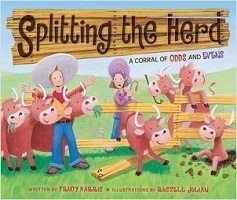
Splitting the Herd
Grade 2
5 skill lessons
Math
Skill lessons
The mathematics the book carries, taught directly. Printable workbook pages and teacher keys are not available for this book yet.
- 1Count Off, Two Mats
- 2Two More Cows Every Time
- 3The Herd That Would Not Split
- 4Two Rows, One Left Over
- 5Yours or Mine
Math + reading
Math through the reading
The same book, entered through a sentence it prints. Change one word in the reading and the numbers change with it.
No math-through-reading lessons for this book yet.
Reading
Reading and language lessons
The same book read as a text. What a word means in its sentence, how a character is shown, how the writing is put together - no mathematics.
No reading and language lessons for this book yet.
Skill lessons
5 lessons on the mathematics the book carries. Printable workbook pages and teacher keys are not available for this book yet.
1. Count Off, Two Mats
The book hands over a whole procedure and then repeats it four times. The cattle are held in a line, every cow takes the next number as it passes, and the number decides which side it joins: evens to Emma, odds to Kirby. Students run that rule on the twenty cows Kirby announces and count what has landed on each mat, ten and ten, then run it again on twelve. Splitting a group in two stops being something done to a number and becomes something done to twenty objects, one cow at a time, with the two counts at the end as the answer.
Full lesson — 20 minutes
1. Hear the rule (4 min)
Listen to Kirby's rule read twice, then say back what happens to each cow as it walks past. Lay twenty counters in one long line on the desk, the way the cattle are kept in the line, and touch each one as the class counts to twenty. One touch, one number word.
Word preview: even, odd, split
Twenty cows are in my pasture, so I'll tell you what to do.
Keep the cattle in the line. Even numbers will be yours. All the odd ones will be mine.
2. Deal the twenty (7 min)
Walk the line with a partner. Say the next number for each cow and move it to Emma's mat if that number is even and to Kirby's mat if it is odd. Every cow takes one number and one mat. When the line is empty, count each mat out loud and say the two numbers.
3. Check Kirby's number (5 min)
Kirby says what each side should get before anybody counts. Read his line, then hold your two mats up beside it. Say whether your mats match his number, and say it as a whole sentence with your own counts in it: twenty cows, ten on this mat and ten on that one.
Ten a piece should work out fine.
4. Do it again with twelve (4 min)
Take twelve counters and run the same rule: count off, evens to Emma, odds to Kirby. Count both mats and say the two numbers, then read Kirby's line for this herd and say whether it matches what you have.
Six a piece should work out fine.
Short version — 9 minutes
1. Hear the rule (3 min)
Hear Kirby's rule read twice, then lay twenty counters in one line and count them with one touch per number word.
Word preview: even, odd, split
Keep the cattle in the line. Even numbers will be yours. All the odd ones will be mine.
2. Deal the twenty (6 min)
Count off the line of twenty, evens to Emma's mat and odds to Kirby's, then count both mats and say the two numbers.
Three levels
- Support
- Deal twelve counters rather than twenty, and slide a number card under each cow as it moves so its number stays readable on the mat. The two mat counts are the whole answer; the words even and odd can arrive once the dealing is reliable.
- At Grade
- Deal the twenty and then the twelve, count both mats each time, and say each result against Kirby's own line for that herd.
- Extension
- Deal the twenty, then predict both mats for sixteen before dealing it and say what told you. Close on a herd of fifteen and report what happens to the last cow.
English learners
The dealing carries itself: a student can take a full turn by moving cows and pointing at the two mats. Even and odd are arbitrary labels in English, so pin them to the mats rather than to a definition, one mat for evens and one for odds, and the label becomes a place. Apiece is the word doing mathematics in Kirby's line, on each mat rather than altogether, and it is worth saying with two hands. The reporting frame is short: twenty cows, blank here and blank there.
Materials
- 20 counters per pair of students
- Printed source passage in this step
- Two mats per pair, one labelled Emma and one labelled Kirby
- Number cards 1 to 20 per pair
- Word cards: even, odd, apiece
Standards & curriculum
These lessons are being matched against curricula now.
Standards are held back while this plan is edited. Every standard shown here was matched against the supplied wording of this lesson, quoting its steps, so a changed step is no longer the thing that was checked. Undo your changes to bring the standards back — your edits stay in this browser either way.
2. Two More Cows Every Time
Four times after the first split, two cows arrive and Kirby announces a new pasture count. Every round is the same two pieces of work: put the new cows in with the share that was already there and count the herd, then run the count-off again. Students work the four rounds in order with counters, twelve, eight, six and five, checking every total and every share against the number the book prints. The last round is the one that will not come out, and students meet it having earned the three rounds before it.
Full lesson — 20 minutes
1. Ten and two make twelve (5 min)
Put ten counters on Kirby's mat, the share he kept. Read the line about the two that roamed and walk two more cows in. Count the herd, then line it up and count off, evens to Emma and odds to Kirby, and say both mat counts. Read Kirby's line for this herd and say whether it matches.
Word preview: herd, share
But next morning, without warning, two of them began to roam.
Twelve cows are in my pasture.
Six a piece should work out fine.
2. Six and two make eight (5 min)
Clear the mats and put six counters on Kirby's mat. Two more cows come through the gate: walk them in and count. This is the one round the book prints as a sum, so read it and check your count against it. Count off the eight and say both mat counts.
as the rooster crowed next morning, two more cows charged through the gate.
They joined the six in Kirby's yard. That added up to eight.
4 apiece should work out fine.
3. Four and two make six (5 min)
Start from four on Kirby's mat, the share from the round before. Two more cows arrive in the night. Count the herd and check your count against the number Kirby announces, then count off and say both mat counts.
Six cows are in my pasture.
Three a piece should work out fine.
4. Three and two make five (5 min)
Start from three. Two more cows wander over. Count the herd, then count off and say what is on each mat before you say anything else. Read Kirby's line for this herd and put your finger on the cow he is talking about.
Word preview: spare
Two willful cows from Emma's ranch began again to wander
Five cows are in my pasture.
With three for me and two for you, there seems to be a spare.
Short version — 9 minutes
1. Six and two make eight (4 min)
Put six counters on Kirby's mat, walk two more cows in and count. Read the book's sum and check yours against it, then line the eight up and count off and say both mat counts.
Word preview: herd, share
They joined the six in Kirby's yard. That added up to eight.
2. Three and two make five (5 min)
Start from three, walk two more cows in and count. Count off the five, say both mat counts, then read Kirby's line and put a finger on the cow he means.
Word preview: spare
With three for me and two for you, there seems to be a spare.
Three levels
- Support
- Work two rounds only, the eight and the five, keeping the arriving cows in the second colour so they stay visible inside the herd. Count the whole herd aloud with one touch per cow before any dealing starts.
- At Grade
- Work all four rounds in order, check each total and each share against the printed number, and say both mat counts every round.
- Extension
- Work the four rounds, then find the herd that would never change: a count where each side gets its share and two more cows walking in lands you back on the same count. Test it with counters and say what makes that count different from twelve.
English learners
Every round is the same two moves with new numbers under them, so the language settles quickly: two more cows, count the herd, count off, say both mats. Teach the round frame once and reuse it for all four, blank and two make blank, and blank on each mat. Roam, wander and charged through the gate are three ways this book says one arrival, and a student can be told they are one event rather than three new words.
Materials
- 20 counters per pair of students in two colours
- Two mats per pair, one labelled Emma and one labelled Kirby
- Printed source passage in this step
- Word cards: herd, share, spare
Standards & curriculum
These lessons are being matched against curricula now.
Standards are held back while this plan is edited. Every standard shown here was matched against the supplied wording of this lesson, quoting its steps, so a changed step is no longer the thing that was checked. Undo your changes to bring the standards back — your edits stay in this browser either way.
3. The Herd That Would Not Split
Four of Kirby's herds come out even and the fifth does not, and the book stops there without saying why. Students deal all five of the counts he announces, twenty, twelve, eight, six and five, and sort them by what the mats show at the end: the same on both, or one cow with nobody opposite. Then they call new counts before dealing them and have to say what told them. The reason has to be spoken with the counters in view, and it comes down to the last number said over the line.
Full lesson — 20 minutes
1. Deal all five herds (5 min)
Take the five herd cards Kirby announces and deal each one: count off, evens to Emma and odds to Kirby. Write both mat counts next to each herd as you finish it. Do not skip the five.
Word preview: even, odd
Eight cows are in my pasture.
Five cows are in my pasture.
2. Sort them by what the mats show (6 min)
Put the five herds into two groups: the ones where both mats came out the same, and the ones where they did not. Only one herd goes in the second group. With all five dealt in front of you, say what is different about that one, and say it about the cows rather than about the number.
Word preview: left over
This time it isn't fair.
With three for me and two for you, there seems to be a spare.
3. Predict, then prove (5 min)
For each new count the teacher calls, fourteen, nine, sixteen and seven, say which group it belongs in before you touch a counter, and say what told you. Then deal it and report both mats. A call without a reason does not count.
4. Say the rule with a number in it (4 min)
Finish with one sentence each, said aloud with your mats still on the desk: name a herd, say whether it splits into two of the same, and say what happens to the last cow. Kirby never gets this sentence out. You do.
He couldn't figure out what was wrong, though something wasn't right.
Short version — 9 minutes
1. Deal all five herds (4 min)
Deal the five counts Kirby announces, twenty, twelve, eight, six and five, and write both mat counts beside each herd.
Word preview: even, odd
Five cows are in my pasture.
2. Sort them by what the mats show (5 min)
Sort the five herds into the ones whose mats came out the same and the one that did not, and say what is different about that one in terms of the cows.
Word preview: left over
With three for me and two for you, there seems to be a spare.
Three levels
- Support
- Deal three herds only, the eight, the six and the five, and lay each mat's cows in a row so the two rows can be pushed together and looked at. The verdict can be given by pointing: rows the same length, or one cow past the end.
- At Grade
- Deal all five herds, sort them, call the four new counts with a reason attached, and say the closing sentence with a herd and a leftover cow in it.
- Extension
- After the five herds, find every count from one to twenty that leaves a cow over, list them in order and say what you notice about the list. Then settle Kirby's real trouble: how many more cows would have to walk in to make five come out even?
English learners
The sorting can be done in silence with the hands and still be right, so let the mats give the answer before any sentence is asked for. Same and left over are the two phrases the whole lesson turns on and both are visible on the desk; even and odd can be attached to them afterwards. The closing frame is fixed and worth rehearsing whole: blank cows split into blank and blank, and blank cow is left over.
Materials
- 20 counters per pair of students
- Two mats per pair, one labelled Emma and one labelled Kirby
- Herd card set: 20, 12, 8, 6, 5
- Record sheet per student
- Pencil per student
- Printed source passage in this step
- Word cards: even, odd, left over
Standards & curriculum
These lessons are being matched against curricula now.
Standards are held back while this plan is edited. Every standard shown here was matched against the supplied wording of this lesson, quoting its steps, so a changed step is no longer the thing that was checked. Undo your changes to bring the standards back — your edits stay in this browser either way.
4. Two Rows, One Left Over
Kirby keeps his cattle in a line and reads a number off each one, and the two mats at the end of the deal are the only picture the book gives. Students turn each pair of mats into two rows laid one directly under the other, cow against cow, so a split can be seen rather than counted, and then write each herd as its two shares. Four of the book's herds make two rows that end together. The fifth makes a row with one cow hanging past the end of the other, and its record is the only one whose two numbers are not the same.
Full lesson — 20 minutes
1. Line, then two rows (5 min)
Deal a herd of twelve the book's way, then lay each mat's cows out as a row, Emma's row directly under Kirby's, cow under cow, both starting at the same end. Say what you see at the far end of the two rows.
Word preview: row, match
Keep the cattle in the line. Even numbers will be yours. All the odd ones will be mine.
2. Build all five (6 min)
Build the two rows for each of Kirby's five herds, twenty, twelve, eight, six and five, and leave them on the desk in order. Do not count the rows yet. Point at the herd whose two rows do not end together.
3. The cow past the end (5 min)
Take the five apart down to the last herd. Match Emma's two cows against Kirby's three, one under one, and put your finger on the cow with nobody under it. Say how many cows are past the end. Then read Kirby's line for this herd and say which word in it means that cow.
Word preview: spare
With three for me and two for you, there seems to be a spare.
4. Write the five records (4 min)
Write one line per herd on your sheet: the herd count, then its two shares. Twenty is ten and ten. Read your five lines aloud and say which one is the odd one out and why.
Short version — 9 minutes
1. Line, then two rows (4 min)
Deal a herd of twelve and lay the two mats out as two rows, cow under cow, then say what you see at the far end.
Word preview: row, match
Keep the cattle in the line. Even numbers will be yours. All the odd ones will be mine.
2. The cow past the end (5 min)
Build the last herd, five, as two rows and match them cow under cow. Say how many cows are past the end, then read Kirby's line and name the word that means that cow.
Word preview: spare
With three for me and two for you, there seems to be a spare.
Three levels
- Support
- Build two rows for the eight and then for the five only, dropping each cow into a squared strip so the rows cannot drift out of line. The verdict is a point rather than a sentence: rows ending together, or one cow sticking out.
- At Grade
- Build all five pairs of rows, find the pair that does not match, and write the five records with both shares for each herd.
- Extension
- Build the rows for a herd of nine and a herd of fourteen and write their records. Then take a herd whose rows ended together, add one cow, and say from the picture alone which row that cow has to join and what it does to the far end. Finish by saying what a record with two of the same numbers in it tells you about the rows.
English learners
The two rows say the whole thing without English: the same length, or one cow past the end. Build the picture before asking for any sentence, and let a student answer by pointing at the far end. Row, match and past the end are the three phrases worth teaching at the desk. The written record needs only the herd number and its two shares, so a student writing three numbers per line is doing the whole task.
Materials
- 20 counters per pair of students
- Two mats per pair, one labelled Emma and one labelled Kirby
- Printed source passage in this step
- Herd card set: 20, 12, 8, 6, 5
- Record sheet per student
- Pencil per student
- Squared paper strip per pair
- Word cards: row, match, spare
Standards & curriculum
These lessons are being matched against curricula now.
Standards are held back while this plan is edited. Every standard shown here was matched against the supplied wording of this lesson, quoting its steps, so a changed step is no longer the thing that was checked. Undo your changes to bring the standards back — your edits stay in this browser either way.
5. Yours or Mine
Kirby's rule turns every number into a side: evens to Emma, odds to Kirby. The book walks that rule out loud over the numbers one to twenty, so the class already has the whole list. Students take numbers at speed and call the side, with counters on the desk as the referee for any call that is argued over. The last rounds separate the two questions this book keeps side by side: which mat one cow goes to, and how a whole herd of that many splits.
Full lesson — 20 minutes
1. Walk the rule to ten (4 min)
Say the numbers one to ten as a class and call the side on each one: Kirby, Emma, Kirby, Emma. Then read Kirby's rule and check that your calls match what he says.
Word preview: even, odd
Keep the cattle in the line. Even numbers will be yours. All the odd ones will be mine.
2. Fast rounds to twenty (7 min)
Cards come up one at a time from one to twenty in any order. Call the side out loud as fast as you can read the card. On every fourth card one pair builds that many counters and pushes them into twos to prove the call, and the class waits for the proof before going on.
3. Two questions that sound the same (5 min)
The teacher says one number twice. First it is one cow's number: call the mat that single cow goes to. Then it is a whole pasture count: deal that many counters the book's way and say what lands on each mat. Do both for seven, then both for twelve, and say which answer is one cow and which is two counts.
4. Run the book's own count (4 min)
Read the book's count for the herd of eight and call the side on every number as you go. Count each mat at the end and say the two numbers. They should be the two numbers Kirby says.
1, 2, 3, 4, 5, 6, 7, 8.
4 apiece should work out fine.
Short version — 9 minutes
1. Walk the rule to ten (3 min)
Call the side on the numbers one to ten as a class, then read Kirby's rule and check the calls against it.
Word preview: even, odd
Keep the cattle in the line. Even numbers will be yours. All the odd ones will be mine.
2. Fast rounds to twenty (6 min)
Call the side on cards from one to twenty at speed, proving every fourth call by pushing that many counters into twos.
Three levels
- Support
- Work the cards one to ten only, with ten counters on the desk, and let the student push the counters into twos before calling any card. Speed is not the point here; the call with a proof behind it is.
- At Grade
- Call the sides to twenty at speed, prove every fourth call by pairing, and answer both of the questions in the last rounds for seven and for twelve.
- Extension
- Call the sides to twenty, then answer without counters: if a cow's number is odd, which mat is the cow behind it on, and why can two cows in a row never land on the same mat? Close by naming the mat the twentieth cow is on and saying how you know without counting.
English learners
Two words carry the whole round and both are arbitrary in English, so hang them on the two mats and let the mats be the answer: a student can point instead of speaking and still be right. The first round can be called in a student's strongest language if that is what gets the speed up, because the mathematics is in the choice rather than in the English word. The proof needs no words at all, only counters pushed into twos.
Materials
- Number cards 1 to 20 per pair
- Printed source passage in this step
- 20 counters per pair of students
- Two mats per pair, one labelled Emma and one labelled Kirby
- Word cards: even, odd
Standards & curriculum
These lessons are being matched against curricula now.
Standards are held back while this plan is edited. Every standard shown here was matched against the supplied wording of this lesson, quoting its steps, so a changed step is no longer the thing that was checked. Undo your changes to bring the standards back — your edits stay in this browser either way.