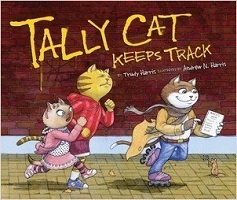
Tally Cat Keeps Track
Grade 1
5 skill lessons · 3 math-through-reading
Math
Skill lessons
The mathematics the book carries, taught directly. Printable workbook pages and teacher keys are not available for this book yet.
- 1Four Marks and a Cross
- 2Five, Ten, Fifteen, Sixteen
- 3Two Names, Two Tallies
- 4Ten Drops and Sixteen
- 5One Can, One Mark
Math + reading
Math through the reading
The same book, entered through a sentence it prints. Change one word in the reading and the numbers change with it.
- 6The Word That Makes One Mark Mean One Thing
- 7More Marks, Shorter Pile
- 8Six Drops Apart
Reading
Reading and language lessons
The same book read as a text. What a word means in its sentence, how a character is shown, how the writing is put together - no mathematics.
- 9Words that end the same
- 10What Tally McNally is like
- 11Stuck in the drain
- 12The story ends, the explaining begins
- 13What it means to keep track
Skill lessons
5 lessons on the mathematics the book carries. Printable workbook pages and teacher keys are not available for this book yet.
1. Four Marks and a Cross
The back of the book teaches the tally itself and teaches it completely: four single marks, then a fifth laid across them, then the same again to ten and to fifteen, and a last group that stops at three because eighteen is where the run ends. Students make the marks themselves, one mark per object counted, and build the crossed groups the book describes rather than being shown a finished picture of one.
Full lesson — 20 minutes
1. One mark for one thing (5 min)
Lay your cubes in a line. Draw one tally mark for each cube. Touch the cube as you make the mark. Stop after four marks. Now count the cubes, then count the marks. Do the two numbers agree?
Word preview: each
Each tally line represents one thing that we are counting.
To tally we count 1, 2, 3, 4, tally cross 5.
2. Lay the fifth mark across (5 min)
Put a fifth cube down. Draw the fifth mark across the other four, not beside them. Cover the group with your finger and say how many. Do not count the marks one by one. Now do cubes six, seven, eight, nine and ten and make a second crossed group.
Word preview: group
To tally we count 1, 2, 3, 4, tally cross 5.
We can continue counting by adding more tally lines or marks. 6, 7, 8, 9, tally cross 10.
3. Carry the run to fifteen (5 min)
Keep going. Build a third crossed group from cubes eleven to fifteen. Say five, ten, fifteen out loud and point at each crossed group as you say its number.
The next group would be 11, 12, 13, 14, tally cross 15.
4. Stop at a part group (5 min)
Put down three more cubes. Make three more marks. Do not cross this group, it has only three marks in it. Say how many cubes you counted in all. Swap strips with your partner and check their marks against their cubes.
Word preview: leftover
The numbers below end with a group of 3, 16, 17, 18.
Short version — 9 minutes
1. One mark for one thing (5 min)
Lay your cubes in a line. Draw one tally mark for each cube. Touch the cube as you make the mark. Stop after four marks. Now count the cubes, then count the marks. Do the two numbers agree?
Each tally line represents one thing that we are counting.
To tally we count 1, 2, 3, 4, tally cross 5.
2. Lay the fifth mark across (4 min)
Put a fifth cube down. Draw the fifth mark across the other four, not beside them. Cover the group with your finger and say how many. Do not count the marks one by one. Now do cubes six, seven, eight, nine and ten and make a second crossed group.
To tally we count 1, 2, 3, 4, tally cross 5.
We can continue counting by adding more tally lines or marks. 6, 7, 8, 9, tally cross 10.
Three levels
- Support
- Stop the run at ten. Two crossed groups is enough to meet what a crossed group is, and the cubes stay in a straight line so a mark can be matched to a cube by sight. The child still makes every mark by hand and still says five and ten over the finished groups.
- At Grade
- Run the whole count to eighteen: three crossed groups and a part group of three left uncrossed. The child says five, ten, fifteen at each close and eighteen at the end, and checks the finished strip against the cubes.
- Extension
- Hand your partner a strip you have already made and have them build the cube line back from it, then say whether the two piles match. Then make a strip for a number your partner names between eleven and eighteen and say, before drawing anything, how many crossed groups it will have and how many marks will be left over.
English learners
The word cross is doing double duty here: it is the mark laid over four others and it is the action of laying it. Show both meanings on the same strip in the same breath and do not ask for the word before the action is fluent. Group is the other load-bearing word and it is not visible in the marks themselves, so point at the boundary between one crossed group and the next every time it is said. Children may count and say the numbers in their strongest language while the marks are being made; the strip records the count either way, and the English number word can be attached to a finished group afterwards.
Materials
- Counting cubes, twenty per child
- Tally strip, a blank paper strip ruled into rows
- Word cards: cross, each, group, leftover
Standards & curriculum
Choose your curriculum above to see the standards for this lesson.
Standards are held back while this plan is edited. Every standard shown here was matched against the supplied wording of this lesson, quoting its steps, so a changed step is no longer the thing that was checked. Undo your changes to bring the standards back — your edits stay in this browser either way.
2. Five, Ten, Fifteen, Sixteen
The book states the counting rule outright: crossed groups are counted by five and whatever is left over is counted by one. It then prints a record that ends on a part group of three, so the rule has to be used rather than admired. Students read finished tally records aloud, switching from fives to ones at the moment the crossed groups run out.
Full lesson — 20 minutes
1. Count the crossed groups by five (5 min)
Take a tally card. Slide your finger from crossed group to crossed group. Say five, ten, fifteen, one number for each whole group. Do not touch the marks one at a time. Say the total when you reach the end of the card.
Word preview: group
When we count groups of tallys, we count by 5.
2. Switch to ones at the leftovers (6 min)
Count the crossed groups by five. When the crossed groups run out, say switch out loud. Then count the leftover marks one at a time, going on from the number you stopped at. Say the total.
Word preview: leftover
For any leftover marks, groups less than 5, we keep counting by 1s.
The numbers below end with a group of 3, 16, 17, 18.
3. Say the total, then prove it (5 min)
One partner reads the card by fives and ones and says the total. The other counts every mark by one and says the total. If the two totals disagree, go back to the group where you stopped agreeing and count that group again.
When we count groups of tallys, we count by 5.
4. Make a card for a number (4 min)
Name a number between eleven and eighteen. Your partner builds the tally that reads as that number. Then read it back by fives and ones without being told what it was. Check with cubes if you disagree.
For any leftover marks, groups less than 5, we keep counting by 1s.
Short version — 9 minutes
1. Count the crossed groups by five (4 min)
Take a tally card. Slide your finger from crossed group to crossed group. Say five, ten, fifteen, one number for each whole group. Do not touch the marks one at a time. Say the total when you reach the end of the card.
When we count groups of tallys, we count by 5.
2. Switch to ones at the leftovers (5 min)
Count the crossed groups by five. When the crossed groups run out, say switch out loud. Then count the leftover marks one at a time, going on from the number you stopped at. Say the total.
For any leftover marks, groups less than 5, we keep counting by 1s.
The numbers below end with a group of 3, 16, 17, 18.
Three levels
- Support
- Use cards whose leftover group holds one or two marks only, so the switch from fives to ones is a single short step and the child hears the change without having to hold a long run of ones. The counting by five over the crossed groups is unchanged.
- At Grade
- Read cards up to eighteen with leftover groups of one to four marks, counting the crossed groups by five and going on by one through the leftovers, and say the total for each card.
- Extension
- Read the card, say the total, then say how the same total would look if it were one mark larger, naming whether a new crossed group closes. Then take a total your partner names and say, before drawing, how many crossed groups and how many leftover marks it will need.
English learners
Counting by five and counting by one are two different rhythms, and English marks the change only by the words themselves, not by anything a listener can hear coming. Say switch out loud at the change point every single time so the seam is audible, and keep the finger moving in a different way for each rhythm, a slide across groups and a tap on marks. Leftover is an idiom, not a number word, and a child who reads it as a quantity will look for a number that is not there; show it as marks with no cross over them rather than defining it. Children may say the counting sequence in their strongest language and give only the finished total in English.
Materials
- Tally cards, a set of ten cards printed with crossed groups and leftover marks
- Counting cubes, twenty per child
- Word cards: group, leftover, total
Standards & curriculum
Choose your curriculum above to see the standards for this lesson.
Standards are held back while this plan is edited. Every standard shown here was matched against the supplied wording of this lesson, quoting its steps, so a changed step is no longer the thing that was checked. Undo your changes to bring the standards back — your edits stay in this browser either way.
3. Two Names, Two Tallies
The book says plainly that a tally can track more than one thing at a time, and then describes exactly how: a mark by one name each time a can went on one pile, a mark by the other name each time a can went on the other. Students run that two-column record live while objects are handed out, and read each column back as its own number.
Full lesson — 20 minutes
1. Rule the sheet into two (4 min)
Rule your sheet into two columns. Write a name at the top of each column, one for each box on the table. Do not count anything yet.
Word preview: track
With tallying, we can keep track of more than one thing at a time.
2. One item, one mark, one column (6 min)
One partner drops cubes into the boxes, one at a time, in any order. The other makes one mark in the matching column as each cube lands. Cross the fifth mark of every group. Do not wait and catch up at the end.
Word preview: each
Each time a can was added to stripes his pile, tally added one mark by stripes his name.
Each time a can was added to tally's pile, he added a mark by his own name.
3. Read each column back (5 min)
Read each column by fives and ones and say its number. Now empty each box and count the cubes. Check each column against its own box. If a column is wrong, work out which cube was missed.
Word preview: total
When we count groups of tallys, we count by 5.
4. Swap jobs and run it faster (5 min)
Swap jobs. Run it again with the cubes going in faster. Check both columns against both boxes. Say which column ended larger.
Word preview: more
With tallying, we can keep track of more than one thing at a time.
Short version — 9 minutes
1. One item, one mark, one column (5 min)
One partner drops cubes into the boxes, one at a time, in any order. The other makes one mark in the matching column as each cube lands. Cross the fifth mark of every group. Do not wait and catch up at the end.
Each time a can was added to stripes his pile, tally added one mark by stripes his name.
Each time a can was added to tally's pile, he added a mark by his own name.
2. Read each column back (4 min)
Read each column by fives and ones and say its number. Now empty each box and count the cubes. Check each column against its own box. If a column is wrong, work out which cube was missed.
When we count groups of tallys, we count by 5.
Three levels
- Support
- Drop the cubes slowly and pause after every one, and keep each column under ten so at most one crossed group is open at a time in either column. The two-column record and the live marking are unchanged; only the pace and the ceiling come down.
- At Grade
- Record two columns live as cubes land in either box in no fixed order, cross every fifth mark, read each column back by fives and ones, and check each column against its own box.
- Extension
- Run a third column with a third box, then say which column is largest and how many more it holds than the smallest by matching, not by recounting. Then, given the finished sheet alone, say how many cubes were dropped altogether.
English learners
The demand here is procedural rather than lexical and that is an advantage: a child who is new to English can do the recording job perfectly from the first cube, because the rule is one cube, one mark, and needs no sentence at all. Put a new speaker on the recording job before the reporting job. The words that do carry weight are the column names and the two totals; keep the column names to a single written word each so the label can be pointed at instead of said. Reporting which column ended larger can be done by holding the sheet up and pointing, and the English sentence attached afterwards.
Materials
- Two-column tally sheet, one per pair
- Two sorting boxes, labeled, one pair of boxes per table
- Counting cubes, twenty per child
- Word cards: each, more, total, track
Standards & curriculum
Choose your curriculum above to see the standards for this lesson.
Standards are held back while this plan is edited. Every standard shown here was matched against the supplied wording of this lesson, quoting its steps, so a changed step is no longer the thing that was checked. Undo your changes to bring the standards back — your edits stay in this browser either way.
4. Ten Drops and Sixteen
The book puts two numbers side by side once and only once, and it does it in the middle of an argument: ten drops on one cat and sixteen on the other. Students build both quantities as rows they can line up, say which is more, and find how many more by matching the rows one to one rather than by taking one number from the other.
Full lesson — 20 minutes
1. Build both rows (5 min)
Build a row of ten counters and a row of sixteen counters. Start both rows at the same line on the mat. Count your partner's rows to check them. Do not say which is bigger yet.
Word preview: more
10 drops for you in 16 for me means I'm the wettest you'll have to agree.
2. Match the rows one to one (6 min)
Push the rows together so every counter in the short row is facing one in the long row. Some counters at the end will face nothing. Pull those clear of the mat and count them. That number is how many more.
10 drops for you in 16 for me means I'm the wettest you'll have to agree.
3. Say it both ways (5 min)
Look at the rows you matched. Say sixteen is six more than ten. Now say ten is six fewer than sixteen. Point at the counters left over both times. It is the same pile and the same six.
Word preview: fewer
10 drops for you in 16 for me means I'm the wettest you'll have to agree.
4. Compare two more pairs (4 min)
Take two more pairs of numbers under twenty. Build each pair, match the rows, and say both sentences. For the pair that comes out even, say what you can say when nothing is left over.
Word preview: equal
Short version — 9 minutes
1. Build both rows (4 min)
Build a row of ten counters and a row of sixteen counters. Start both rows at the same line on the mat. Count your partner's rows to check them. Do not say which is bigger yet.
10 drops for you in 16 for me means I'm the wettest you'll have to agree.
2. Match the rows one to one (5 min)
Push the rows together so every counter in the short row is facing one in the long row. Some counters at the end will face nothing. Pull those clear of the mat and count them. That number is how many more.
10 drops for you in 16 for me means I'm the wettest you'll have to agree.
Three levels
- Support
- Keep the pair at ten and sixteen all lesson and leave the matched rows standing on the mat while the sentences are said, so the six unmatched counters can be touched at the moment the number six is spoken. This scaffolds the language side, not the arithmetic: the matching itself is unchanged.
- At Grade
- Build, match and compare ten and sixteen, then two further pairs within twenty, saying both the more sentence and the fewer sentence for each and finding the difference by matching.
- Extension
- After matching, say the difference before the unmatched counters are pulled clear, then pull them and check. Then take a pair where the smaller number is named and the difference is named, and build the larger row from those two facts alone.
English learners
Comparative syntax is where this lesson is hardest and the arithmetic is not the problem. English says sixteen is six more than ten, putting the difference in the middle and the compared number at the end, and many languages order those parts differently or mark the comparison with a word English does not use. Fewer and more sit either side of the same arrangement and children very often believe the second sentence says something new, so keep both sentences pointing at the same six counters on the mat. Let children say which row is bigger in whatever language comes first, then build the English sentence from the counters with the frame supplied.
Materials
- Two-color counters, twenty per pair
- Comparison mat, a sheet with two rows and a common start line
- Word cards: equal, fewer, more
Standards & curriculum
Choose your curriculum above to see the standards for this lesson.
Standards are held back while this plan is edited. Every standard shown here was matched against the supplied wording of this lesson, quoting its steps, so a changed step is no longer the thing that was checked. Undo your changes to bring the standards back — your edits stay in this browser either way.
5. One Can, One Mark
The book ends by admitting that its own hero cheated: he squashed some cans so he could put more marks beside his name, and the text says outright that the record would only have shown who was taller if the cans had all been the same size. Students build both an honest and a rigged record with cubes, and decide from the marks alone which record can be trusted.
Full lesson — 20 minutes
1. Make an honest record (5 min)
Build two towers, one cube at a time, and make one mark for each cube as you place it. Read both columns. Now compare the two towers side by side. Say whether the marks and the towers tell you the same thing.
Word preview: each
Each time a can was added to tally's pile, he added a mark by his own name.
Each tally line represents one thing that we are counting.
2. Rig one of the towers (6 min)
Rebuild one tower using the short blocks in place of some cubes. Keep making one mark for every block you put on. Stand the towers side by side. Say which tower has more marks. Say which tower is taller. Say what the marks are counting.
Word preview: more
But that sneaky tally scrunched some of his cans.
That way he could add more cans to his tally and make it look like he was taller.
3. Say what the record can and cannot settle (5 min)
Tell your partner what the tally does tell you and what it does not. Use both numbers from your sheet when you say it. Would someone who only saw the sheet know which tower was taller?
Word preview: fair
This would have been a great way to see who was taller, if all the cans had been the same size.
4. Fix the rule so the record works (4 min)
Agree on one rule that would make the marks settle which tower is taller. Rebuild both towers under your rule and read the marks again. Did your rule work?
This would have been a great way to see who was taller, if all the cans had been the same size.
Short version — 9 minutes
1. Make an honest record (4 min)
Build two towers, one cube at a time, and make one mark for each cube as you place it. Read both columns. Now compare the two towers side by side. Say whether the marks and the towers tell you the same thing.
Each time a can was added to tally's pile, he added a mark by his own name.
Each tally line represents one thing that we are counting.
2. Rig one of the towers (5 min)
Rebuild one tower using the short blocks in place of some cubes. Keep making one mark for every block you put on. Stand the towers side by side. Say which tower has more marks. Say which tower is taller. Say what the marks are counting.
But that sneaky tally scrunched some of his cans.
That way he could add more cans to his tally and make it look like he was taller.
Three levels
- Support
- Keep both towers under ten cubes and rig only two of the pieces, so the shorter tower carries just two more marks than the taller one and the mismatch is small enough to hold in view. The child still says which tower has more marks and which tower is taller, which is the reasoning the lesson is for.
- At Grade
- Build an honest two-column record, rig one tower with half-height blocks while still marking every block, and say from the two counts what the record settles and what it does not.
- Extension
- Take the opposite position and argue it: make the case that the rigged tally is the honest one, because it counted every single block that was put on and never missed one. Then say which question each of the two records is the right record for, and revise your first position if the case has changed your mind.
English learners
This lesson asks for a position and a reason, and that is a heavy sentence to build in a new language even when the mathematics is easy. Give the frame and keep it the same all lesson: the marks say one number, the towers say the other, and the frame carries both. The word fair is not a mathematical term and different classrooms and different homes use it differently, so tie it to a fixed observable, one mark for one thing of the same size, rather than leaving it open. Children may settle their position with a partner in their strongest language first and then report only the finished sentence in English, and pointing at the two towers carries most of the argument on its own.
Materials
- Counting cubes, twenty per child
- Two-column tally sheet, one per pair
- Half-height blocks, ten per pair
- Word cards: each, fair, more
Standards & curriculum
Choose your curriculum above to see the standards for this lesson.
Standards are held back while this plan is edited. Every standard shown here was matched against the supplied wording of this lesson, quoting its steps, so a changed step is no longer the thing that was checked. Undo your changes to bring the standards back — your edits stay in this browser either way.
Math through the reading
The mathematics is reached through a sentence the book prints: change one word in the reading and the numbers change with it. These carry their own standards, matched against these lessons rather than inherited from the skill ones.
6. The Word That Makes One Mark Mean One Thing
Students find that the small word each is what makes a tally strip count anything at all, and prove it by building the strip both ways over the same cubes.
Full lesson — 20 minutes
1. Hear the instruction (4 min)
Students listen to the tally instruction read aloud twice and say which single word tells them how many marks to make. They say what they think it orders before any cube is touched, and the competing guesses are left standing.
2. Build it the book's way (6 min)
Students lay out eight cubes and draw one mark for each, crossing the fifth. They count the marks by fives and ones and say eight, then count the cubes and say eight, and say aloud that the two numbers are the same because each cube got its own mark.
3. Change the one word (6 min)
Students hear the instruction again with the in place of each and build what that sentence orders: a single mark beside the same eight cubes. They read the new strip, say one, and say what the strip now fails to tell anyone about the cubes.
4. Say it about your own strip (4 min)
Each student takes a fresh handful of up to eighteen cubes, builds the strip the book's way, and says one sentence to a partner using each, naming how many cubes they had and how many marks they made. The partner checks the strip against the cubes while the sentence is said.
Short version — 9 minutes
1. Build it the book's way (6 min)
Students lay out eight cubes and draw one mark for each, crossing the fifth. They count the marks by fives and ones and say eight, then count the cubes and say eight, and say aloud that the two numbers are the same because each cube got its own mark.
2. Change the one word (6 min)
Students hear the instruction again with the in place of each and build what that sentence orders: a single mark beside the same eight cubes. They read the new strip, say one, and say what the strip now fails to tell anyone about the cubes.
Three levels
- Support
- Keep the collection at five cubes so the strip is one crossed group and the count is a single number the child already holds. The swap is still built both ways and the child still says both totals; only the size of the collection comes down, so the word remains the thing under test.
- At grade
- Build collections up to eighteen both ways, read each strip by fives and ones, and say a sentence using each that names the cube count and the mark count together.
- Extension
- Take a strip a partner built under one of the two readings, without being told which, and say from the strip and the cubes alone which instruction they were following. Then find a collection size for which the two readings would give the same answer, and say why one is the only one.
English learners
The words carrying the load here are small and unstressed, which is exactly what makes them hard to hear: each and the differ by very little in connected speech, and by 5 and by 1s differ by one syllable at the end of a phrase. Say the two versions of the instruction back to back with the same rhythm and let the cubes, not the pronunciation, carry the difference. Quantity and one-to-one matching are language-independent and most children will build the correct strip before they can name the word that ordered it, so accept the build first and attach the word afterwards. Children may count and check in their strongest language and give only the finished sentence in English.
Materials
- Counting cubes, twenty per child
- Tally strip, a blank paper strip ruled into rows
- The two versions of the instruction, written large on a card, one above the other
Standards & curriculum
Choose your curriculum above to see the standards for this lesson.
Standards are held back while this plan is edited. Every standard shown here was matched against the supplied wording of this lesson, quoting its steps, so a changed step is no longer the thing that was checked. Undo your changes to bring the standards back — your edits stay in this browser either way.
7. More Marks, Shorter Pile
Students build a tally that counts every piece honestly and still gives the wrong answer, then argue to a partner what such a record does and does not settle.
Full lesson — 20 minutes
1. Count both towers honestly (5 min)
Partners build two towers from identical cubes, one piece at a time, making one mark per piece in the matching column. They read both columns by fives and ones and check that the taller tower carries the larger count.
2. Rig one tower (6 min)
One partner rebuilds their tower substituting half-height blocks for some cubes, still marking every block. The towers are stood side by side. Students read both columns again and say which column is larger and which tower is taller, which are now different towers.
3. Say what it settles (6 min)
Each student tells their partner what the record does settle and what it does not, naming both column totals in the sentence. The partner must answer the case rather than repeat their own, and either may change position out loud.
4. Write the rule that fixes it (3 min)
Groups agree one spoken rule that would make the marks settle the height question, then test it by rebuilding both towers under it and reading the marks again to see whether the larger count now sits under the taller tower.
Short version — 9 minutes
1. Rig one tower (6 min)
One partner rebuilds their tower substituting half-height blocks for some cubes, still marking every block. The towers are stood side by side. Students read both columns again and say which column is larger and which tower is taller, which are now different towers.
2. Say what it settles (6 min)
Each student tells their partner what the record does settle and what it does not, naming both column totals in the sentence. The partner must answer the case rather than repeat their own, and either may change position out loud.
Three levels
- Support
- Supply the frame and keep it on the table all lesson: my sheet says ___ and ___, and the towers say ___ is taller, so the marks tell me ___. The child fills it from their own sheet and their own towers. This scaffolds the language, not the counting: the towers, the substitution and both counts are unchanged.
- At grade
- Build both records, rig one tower, and state a position to a partner naming both column totals and one reason drawn from how the pieces differed, then answer the partner's opposing case.
- Extension
- Argue the case you did not take: make the strongest defence of the rigged tally as the honest one, on the grounds that it counted every single block and missed none, then say which question each of the two records is the right record for. You may revise your first position, and say what changed it.
English learners
Taking a position in a second language is far harder than the counting that funds it, and a child who can build both records perfectly may still have no sentence to put them in. Give one frame and keep it identical all lesson so the only new material is the numbers, and let the towers do the work the words would otherwise have to: pointing at the shorter tower and then at the larger column is most of the argument already. Fair is not a mathematical word and carries different weight in different homes, so keep the discussion tied to a fixed observable, one mark for one piece of the same size, rather than to whether Tally was naughty. Children may settle their position with a partner in their strongest language and report only the finished sentence in English.
Materials
- Counting cubes, twenty per child
- Half-height blocks, ten per pair
- Two-column tally sheet, one per pair
- The book's closing admission, written large on a card
Standards & curriculum
Choose your curriculum above to see the standards for this lesson.
Standards are held back while this plan is edited. Every standard shown here was matched against the supplied wording of this lesson, quoting its steps, so a changed step is no longer the thing that was checked. Undo your changes to bring the standards back — your edits stay in this browser either way.
8. Six Drops Apart
Students build the story's only two numbers as rows they can match one to one, find the six between them, and say the same fact in both directions over one arrangement.
Full lesson — 20 minutes
1. Build both rows (5 min)
Students hear Tally's claim read aloud and build the two counts as rows of counters from a common start line, ten in one and sixteen in the other, then check a partner's rows by counting them.
2. Match the rows (6 min)
Students push the rows together so each counter in the short row faces one in the long row, pull the counters that face nothing clear of the mat, and count them to find the six.
3. Say it both ways (6 min)
Over the matched rows each student says sixteen is six more than ten, then ten is six fewer than sixteen, pointing at the same unmatched counters both times and saying aloud that it is one pile and one six.
4. The pair that comes out even (3 min)
Students build a pair of equal rows, match them, find nothing left over, and say what can be said when there is no difference to name, then say why neither more nor fewer will do.
Short version — 9 minutes
1. Match the rows (6 min)
Students push the rows together so each counter in the short row faces one in the long row, pull the counters that face nothing clear of the mat, and count them to find the six.
2. Say it both ways (6 min)
Over the matched rows each student says sixteen is six more than ten, then ten is six fewer than sixteen, pointing at the same unmatched counters both times and saying aloud that it is one pile and one six.
Three levels
- Support
- Leave the matched rows standing while both sentences are said and supply the frame with the number already in it: sixteen is six more than ten, ten is six fewer than sixteen. The child says each sentence while touching the six unmatched counters. This scaffolds the language; the building and matching are unchanged.
- At grade
- Build and match ten against sixteen, find the six by matching, and say both directions of the relation over the one arrangement with the correct comparison word in each, then do the same for a pair that comes out even.
- Extension
- Say the difference before pulling the unmatched counters clear, then pull them and check. Then, given only the smaller count and the difference, build the larger row and say both sentences before anyone counts it.
English learners
This is the lesson where comparative syntax carries the whole load and the arithmetic carries almost none. English puts the difference in the middle and the compared quantity at the end, sixteen is six more than ten, and many languages order those parts differently or mark the comparison with a particle English has no equivalent for; a child whose matching is perfect may still assemble the sentence backwards. Fewer and more are the same arrangement seen from either end and children very commonly believe the second sentence reports a new fact, so keep both sentences pointing at the same six counters and say them back to back rather than in separate turns. Let children say which row is bigger in whatever language arrives first, then build the English sentence off the counters with the frame supplied.
Materials
- Two-color counters, twenty per pair
- Comparison mat, a sheet with two rows and a common start line
- Tally's claim, written large on a card with the two numbers underlined
Standards & curriculum
Choose your curriculum above to see the standards for this lesson.
Standards are held back while this plan is edited. Every standard shown here was matched against the supplied wording of this lesson, quoting its steps, so a changed step is no longer the thing that was checked. Undo your changes to bring the standards back — your edits stay in this browser either way.
Reading and language lessons
5 lessons on the reading and language the book carries - what a word means in its sentence, how a character is shown, how a text is built. No mathematics: these are matched against the English language arts curricula, which are a different and smaller set than the mathematics ones.
9. Words that end the same
This story is told in rhyme, and the rhyming words sit at the ends of the lines where a listening ear can find them. Students read printed passages aloud, name the pair of words that end the same, and then say a third word of their own that would rhyme. The lesson stays in the clean stretches of the verse, because parts of this transcription are damaged. Nothing is counted or tallied; the work is hearing the ends of words.
Full lesson — 20 minutes
1. Hear the pair at the ends of the lines (5 min)
The teacher reads the printed passage aloud twice. Listen for the two words that end the same. Say them both aloud, then clap once for each one. Now say another word of your own that ends the same way.
Word preview: rhyme, sound
Then he stood on a box and announced with a grin. I'm Tally McNally and I always win.
2. Find the pair yourself (6 min)
Read the printed passage with a partner. This time nobody tells you the rhyming words. Circle the last word of each sentence, then decide which two of your circled words end the same. Say the pair aloud and then say a third rhyming word.
Word preview: ending, same
Help shouted Tally, I'm stuck in the drain. I don't want to be wetter, I'm sick of the rain.
3. Try a pair that is harder to hear (5 min)
Read the printed passage. The two words that rhyme here are longer than the ones before. Circle the last word of each sentence and say the pair aloud slowly, stretching the ending. Say whether this pair was easier or harder to hear than the last one.
Word preview: rhyme, ending
Boots whispered her plan as they stood in a huddle. Then one by one they are laid by the puddle.
4. Make your own rhyming pair (4 min)
Say a word about a cat out loud to your partner. Your partner says a word that rhymes with it. Then swap over. If your partner cannot find one, both of you say the word slowly and listen to just the end of it.
Word preview: rhyme, same, sound, ending
Short version — 9 minutes
1. Hear the pair at the ends of the lines (5 min)
The teacher reads the printed passage aloud twice. Say the two words that end the same, then clap once for each one. Say another word that rhymes with them.
Word preview: rhyme, sound
Then he stood on a box and announced with a grin. I'm Tally McNally and I always win.
2. Find the pair yourself (4 min)
Read the printed passage with a partner. Circle the last word of each sentence and decide which two end the same. Say the pair aloud.
Word preview: ending, same
Help shouted Tally, I'm stuck in the drain. I don't want to be wetter, I'm sick of the rain.
Three levels
- Support
- Work only the first printed passage. The teacher reads it and says the two rhyming words. You echo them, then clap the pair back three times.
- At Grade
- Find the rhyming pair in all three printed passages and add a third rhyming word of your own to each.
- Extension
- The third printed passage rhymes huddle with puddle, where only the ends of two longer words match. Say two sentences about why that pair is harder to hear than drain and rain, using the printed words themselves.
English learners
Rhyme depends on hearing the vowel and everything after it, and learners whose first language has different vowel contrasts may not hear drain and rain as matching at first. Say each pair slowly with the ending stretched, then say a non-rhyming word so the contrast is available. Invite students to say a rhyming pair from a song in their strongest language. Rehearsable frame: ___ and ___ rhyme. They both end with ___.
Materials
- Tally Cat Keeps Track, the passage printed in this step
- Clapping hands
- Pencils
- Word cards: rhyme, same, sound, ending
Standards & curriculum
Choose your curriculum above to see the standards for this lesson.
Standards are held back while this plan is edited. Every standard shown here was matched against the supplied wording of this lesson, quoting its steps, so a changed step is no longer the thing that was checked. Undo your changes to bring the standards back — your edits stay in this browser either way.
10. What Tally McNally is like
The book tells a reader almost nothing about Tally directly. Instead it shows him boasting, cheating and refusing to lose, and leaves the reader to name what he is like. Students read three printed passages, choose a word for Tally from each, and point at the sentence that made them choose it. The lesson insists on evidence: a word about a character has to be backed by words on the page. Nothing is tallied or compared by number; the work is reading a character from his actions.
Full lesson — 20 minutes
1. Choose a word for Tally and show why (6 min)
Read the printed passage together. Choose one word from the word cards that describes Tally here. Then underline the sentence that made you choose it. Say aloud: I think Tally is ___, because the book says ___.
Word preview: boast, proud
Then he stood on a box and announced with a grin. I'm Tally McNally and I always win.
2. Find him refusing to lose (5 min)
Read the printed passage. Tally has just been beaten, and he says something about it. Underline what he says. Does he agree that he lost? Say aloud what his words show about him.
Word preview: proud, show
Not true replied Tally. The score is now tied. You're the winner out here, but I won inside.
3. Find the sentence the book does tell you (5 min)
Read the printed passage. This time the book uses a describing word about Tally itself. Circle that word. Say aloud whether the word matches what you decided about him in the first two passages.
Word preview: sneaky, show
But that sneaky tally scrunched some of his cans. That way he could add more cans to his tally and make it look like he was taller.
4. Say your describing word and defend it (4 min)
Tell your partner the one word card you would choose for Tally. Your partner asks you how you know. Answer from the sentences you underlined earlier, saying what Tally did that made you choose that word.
Word preview: boast, proud, sneaky, show
Short version — 9 minutes
1. Choose a word for Tally and show why (5 min)
Read the printed passage together. Choose a word card that describes Tally here, then underline the sentence that made you choose it. Say: I think Tally is ___, because the book says ___.
Word preview: boast, proud
Then he stood on a box and announced with a grin. I'm Tally McNally and I always win.
2. Find the sentence the book does tell you (4 min)
Read the printed passage. Circle the describing word the book uses about Tally. Say whether it matches what you decided in the first passage.
Word preview: sneaky, show
But that sneaky tally scrunched some of his cans. That way he could add more cans to his tally and make it look like he was taller.
Three levels
- Support
- Work only the first printed passage. The teacher reads it. Choose one of two word cards, proud or shy, and hold it up. Then point to the sentence Tally says about himself.
- At Grade
- Choose a word for Tally from each of the three printed passages and point at the sentence behind each choice.
- Extension
- Two of the printed passages show what Tally is like and one says it outright with the word sneaky. Write two sentences about which way tells a reader more, using a sentence from each kind as your evidence.
English learners
Trait words in English are abstract and hard to picture, so tie each one to the action in front of it: standing on a box is boasting, scrunching a can is being sneaky. Let students name the trait in their strongest language first and then match it to a word card. Rehearsable frame: Tally is ___. I know because he ___.
Materials
- Tally Cat Keeps Track, the passage printed in this step
- Word cards
- Pencils
- Word cards: boast, proud, sneaky, show
Standards & curriculum
Choose your curriculum above to see the standards for this lesson.
Standards are held back while this plan is edited. Every standard shown here was matched against the supplied wording of this lesson, quoting its steps, so a changed step is no longer the thing that was checked. Undo your changes to bring the standards back — your edits stay in this browser either way.
11. Stuck in the drain
The middle of this book is one clear problem with a plan built to solve it, and the plan is assembled out loud by the characters over several pages. Students read four printed passages, name the problem, list what the cats decide they need, and say how the problem ends. They finish by retelling the rescue as a problem and a solution. Nothing is counted; the work is following a story's trouble to its fix.
Full lesson — 20 minutes
1. Name the problem (5 min)
Read the printed passage together. Say in one sentence what has gone wrong. Underline the words that tell you where Tally is. Write your sentence at the top of your sheet under the heading Problem.
Word preview: problem, help
Help shouted Tally, I'm stuck in the drain. I don't want to be wetter, I'm sick of the rain. But how can we help you? You're so deep below.
2. Find the first try that does not work (5 min)
Read the printed passage. The cats try something here and it fails. Underline the sentence that says it failed. Write on your sheet under Tries: they tried ___, but ___.
Word preview: problem, plan
Stripe stretched and he stretched with all of his might, but Tally McNally remained out of sight. If Stripes cannot get him, none of us can,
3. Find what the plan needs (6 min)
Read the printed passage. The cats work out what kind of helper the plan needs. Underline each thing they say they need. Write them all on your sheet under Plan, in the order the passage says them.
Word preview: plan, solve
We don't just need taller, we also need smaller. Well, Kitty's the one they heard Tally holler. We need smallest and tallest and smartest and yet. We still need another. We'll have to get wet.
4. Find the solution and retell it (4 min)
Read the printed passage. Underline the sentence that shows the problem is over. Then retell the whole rescue to your partner in three sentences, using the words problem, plan and solved.
Word preview: solve
Hurray, they all showed it, we finally got him. And out of the hole together they brought him. After high fives and hugs, they waved to McNally.
Short version — 9 minutes
1. Name the problem (5 min)
Read the printed passage together. Say in one sentence what has gone wrong, and underline the words that tell you where Tally is.
Word preview: problem, help
Help shouted Tally, I'm stuck in the drain. I don't want to be wetter, I'm sick of the rain. But how can we help you? You're so deep below.
2. Find the solution and retell it (4 min)
Read the printed passage. Underline the sentence that shows the problem is over. Retell the rescue to your partner in two sentences, using the words problem and solved.
Word preview: solve
Hurray, they all showed it, we finally got him. And out of the hole together they brought him. After high fives and hugs, they waved to McNally.
Three levels
- Support
- Work with the first and last printed passages only. The teacher reads each one. Say one word for what went wrong, stuck, and one word for how it ended, out. Draw the two moments in two boxes.
- At Grade
- Fill the problem, tries, plan and solution rows of your sheet from the four printed passages, then retell the rescue in three sentences.
- Extension
- The third printed passage says the cats need smallest and tallest and smartest and yet another one. Write two sentences about why the plan needed more than one kind of helper, using only what that printed passage says.
English learners
The word but does the whole job of marking a failed attempt in the second printed passage, and learners often read straight past it. Read that sentence twice, stopping at but, so the turn is heard. Let students describe a time a plan did not work in their strongest language before writing. Rehearsable frame: The problem was ___. They tried ___, but ___. In the end they ___.
Materials
- Tally Cat Keeps Track, the passage printed in this step
- Problem and solution sheet
- Pencils
- Word cards: problem, plan, solve, help
Standards & curriculum
Choose your curriculum above to see the standards for this lesson.
Standards are held back while this plan is edited. Every standard shown here was matched against the supplied wording of this lesson, quoting its steps, so a changed step is no longer the thing that was checked. Undo your changes to bring the standards back — your edits stay in this browser either way.
12. The story ends, the explaining begins
This book changes completely partway through. The front is a rhyming story about cats with names and trouble; the back stops rhyming, drops the characters and explains something straight to the reader. Students read a passage from each part, list what they notice about how the two sound, and say what the writer is doing differently. Nothing is tallied or counted; the work is recognising two kinds of writing inside one book.
Full lesson — 20 minutes
1. Read the story part and say what it has (5 min)
Read the printed passage aloud together. Say aloud two things this passage has: names of characters, and words that rhyme. Underline one character's name and circle the two words that rhyme.
Word preview: story, rhyme
Boots stretched toward Tally, then said with a frown. I can't reach him either, he's much too far down.
2. Read the explaining part and say what it has instead (6 min)
Read the printed passage from the back of the book. Look for a character's name. Is there one? Look for rhyming words at the ends of the sentences. Are there any? Circle the word that means the person reading, and say aloud who this part of the book is talking to.
Word preview: explain, reader
Have you ever used your fingers to help you count? Using fingers is one way to keep track of the number of things we are counting. But sometimes the items we are counting total more than our 10 fingers. Tallying is another way for people to keep track of things they count.
3. Put the two side by side (5 min)
Read this third printed passage, which also comes from the back of the book. Add it to the explaining column of your chart. Then look across your two columns and say one sentence beginning: The story part has ___, but the explaining part has ___.
Word preview: explain
Each tally line represents one thing that we are counting. We can continue counting by adding more tally lines or marks.
4. Say which part you would read first (4 min)
Tell your partner which part of this book you would read first if you already knew the story, and why. Use the frame on the board: I would read the ___ part first, because ___. Your partner says whether they would choose the same.
Word preview: story, explain, rhyme, reader
Short version — 9 minutes
1. Read the story part and say what it has (5 min)
Read the printed passage aloud together. Underline a character's name and circle the two words that rhyme.
Word preview: story, rhyme
Boots stretched toward Tally, then said with a frown. I can't reach him either, he's much too far down.
2. Read the explaining part and say what it has instead (4 min)
Read the printed passage from the back of the book. Say whether it has character names and whether it rhymes. Circle the word that means the person reading.
Word preview: explain, reader
Have you ever used your fingers to help you count? Using fingers is one way to keep track of the number of things we are counting. But sometimes the items we are counting total more than our 10 fingers. Tallying is another way for people to keep track of things they count.
Three levels
- Support
- Work with the first two printed passages only. For each one the teacher asks: are there cats in it? Does it rhyme? Answer yes or no and put the passage in the right column.
- At Grade
- Fill both columns of the chart from all three printed passages and say one sentence comparing the two parts.
- Extension
- The back-of-book passages ask the reader a question and use the word we. Write two sentences about why an explaining part might talk to a reader that way when a story part does not, quoting one printed sentence from each part.
English learners
The explaining part uses we to mean everybody including the reader, which is different from the we the cats use in the story to mean just themselves. Read one of each aloud and ask who is inside the word each time. Rehearsable frame: This part is a ___, because it has ___.
Materials
- Tally Cat Keeps Track, the passage printed in this step
- Pencils
- Coloured pencils
- Two-column chart
- Sentence frame on the board
- Word cards: story, explain, rhyme, reader
Standards & curriculum
Choose your curriculum above to see the standards for this lesson.
Standards are held back while this plan is edited. Every standard shown here was matched against the supplied wording of this lesson, quoting its steps, so a changed step is no longer the thing that was checked. Undo your changes to bring the standards back — your edits stay in this browser either way.
13. What it means to keep track
The phrase keep track is not the two words added together, and this book uses it in both of its halves. The back of the book all but defines it, and the story shows a cat doing it. Students read printed passages, work out what the phrase means from the sentences beside it, and then say it in their own words. They also meet the book's title phrase and decide whether it fits the story they read. Nothing is counted; the work is getting a phrase's meaning from its neighbours.
Full lesson — 20 minutes
1. Meet the phrase where the book nearly defines it (6 min)
Read the printed passage together. Find the two words keep track and underline them both times they appear. Now read the sentences around them. Say aloud what you think keep track means, using your own words and not the book's.
Word preview: track, keep
Using fingers is one way to keep track of the number of things we are counting. But sometimes the items we are counting total more than our 10 fingers. Tallying is another way for people to keep track of things they count.
2. Check your meaning against a second use (5 min)
Read this second printed passage. It uses the phrase again in a new sentence. Try your meaning from the last step in place of the phrase and say the sentence aloud with your words swapped in. Does it still make sense? Say yes or no and why.
Word preview: means
With tallying, we can keep track of more than one thing at a time.
3. See a character doing it in the story (5 min)
Read the printed passage from the story part. Nobody here says the phrase keep track, but Tally is doing it. Underline what he is doing. Say aloud how what he does matches the meaning you worked out.
Word preview: track, count
Each time a can was added to stripes his pile, tally added one mark by stripes his name.
4. Judge the title (4 min)
The book is called Tally Cat Keeps Track. Tell your partner whether that title fits the cat you read about, and say one reason. Your partner says whether they agree and gives a different reason.
Word preview: track, keep, count, means
Short version — 9 minutes
1. Meet the phrase where the book nearly defines it (5 min)
Read the printed passage together. Underline the words keep track both times. Say what the phrase means in your own words.
Word preview: track, keep
Using fingers is one way to keep track of the number of things we are counting. But sometimes the items we are counting total more than our 10 fingers. Tallying is another way for people to keep track of things they count.
2. See a character doing it in the story (4 min)
Read the printed passage from the story part. Underline what Tally does each time a can is added. Say how it matches the meaning you worked out.
Word preview: track, count
Each time a can was added to stripes his pile, tally added one mark by stripes his name.
Three levels
- Support
- Work only the first printed passage. The teacher reads it and points at the words keep track. You point at them too, then finish the sentence aloud: keep track means to ___.
- At Grade
- Work out the phrase's meaning from the first printed passage, test it in the second, and match it to the action in the third.
- Extension
- The phrase keep track does not mean keeping a track the way a train has a track. Write two sentences saying how a reader can tell, using the printed sentences as your evidence.
English learners
Keep track is an idiom: neither keep nor track carries its usual meaning, so a word-by-word translation misleads. Say plainly that these two words work as one, then give the meaning, then read the printed sentence again. Invite students to give the phrase their language uses for the same idea. Rehearsable frame: To keep track of ___ means to ___.
Materials
- Tally Cat Keeps Track, the passage printed in this step
- Pencils
- Sentence frame on the board
- Word cards: track, keep, count, means
Standards & curriculum
Choose your curriculum above to see the standards for this lesson.
Standards are held back while this plan is edited. Every standard shown here was matched against the supplied wording of this lesson, quoting its steps, so a changed step is no longer the thing that was checked. Undo your changes to bring the standards back — your edits stay in this browser either way.