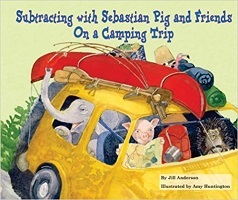
Subtracting with Sebastian Pig and Friends on a Camping Trip
Grade 1
5 skill lessons
Math
Skill lessons
The mathematics the book carries, taught directly. Printable workbook pages and teacher keys are not available for this book yet.
- 1How Many Are Missing
- 2Four Problems From Three Numbers
- 3The Bigger Number Goes First
- 4Two Sentences or Four?
- 5Keeping Track of All of It
Math + reading
Math through the reading
The same book, entered through a sentence it prints. Change one word in the reading and the numbers change with it.
No math-through-reading lessons for this book yet.
Reading
Reading and language lessons
The same book read as a text. What a word means in its sentence, how a character is shown, how the writing is put together - no mathematics.
No reading and language lessons for this book yet.
Skill lessons
5 lessons on the mathematics the book carries. Printable workbook pages and teacher keys are not available for this book yet.
1. How Many Are Missing
Ten times over this book says how many of a thing the camp needs, how many are actually there, and asks for the gap, and ten times it prints the answer underneath. Students put out a red counter for every one the camp needs, cap with a yellow counter every one that is really there, and count the red counters left bare; those are the missing ones. They work the pages in the book's own order, from three paddles to twelve ears of corn, and read the book's own sentence only after their own number is down. The drill is one counter to one thing and one number word to one counter. What earns the period is that the answer is never the pile you can see: the counters still showing stand for things that are not at the camp at all, which is what the word missing is doing in every question the book asks.
Full lesson — 20 minutes
1. Set out three paddles and find the one that is missing (5 min)
Put three red counters in a line, one for each paddle the boat needs. Sebastian can only find two, so cap two of them with a yellow counter. The red counter with nothing on it is the paddle nobody can find. Say it the way Sebastian says it, three take away two, and then say the whole answer out loud: one paddle is missing.
Word preview: missing, take away
There should be three paddles.
But there are only two.
What is three take away two?
He says, aha! One paddle is missing.
2. Do the pegs, the hot dogs and the earplugs the same way (6 min)
Three more pages, three more piles. Four red counters capped with two yellow for the tent pegs. Five red capped with two yellow for the hot dogs. Six red capped with four yellow for the earplugs, and those four are the ones Sebastian's friends already have in their ears. Count the bare red counters each time and write the number on your list before you clear the counters away.
Word preview: only
There should be four pegs, but there are only two.
There were five hot dogs.
Now there are only two.
There were six earplugs.
His friends are using four.
3. Do the worms, the eggs and the markers (5 min)
Seven red counters and one yellow cap for Patty's worms. Eight red and three yellow for Milo's eggs, because eight is what the breakfast needs and three is what is left. Nine red and five yellow for the markers Patty tied along the path. Write each answer on your list, then say which two of these three pages lost more than they kept.
Word preview: just
There were seven worms.
Now there's just one.
Milo needs eight eggs, but there are just three eggs left.
She ties nine orange markers along the way.
She can only find five.
4. Do the ice pops and the corn (4 min)
Ten red counters and one yellow cap for the ice pops in Milo's box. Then twelve red for Patty's ears of corn, laid out as a row of ten and two more so the ten can be seen, and four yellow caps on top. This is the only page in the book whose starting number goes past ten. Write both answers, then read the book's sentence under each and say whether you agree with it.
Word preview: minus
There were ten ice pops in the box, but Milo sees just one.
She had 12 ears of corn.
Now there are only 4 ears.
12 minus 4 equals 8.
Short version — 9 minutes
1. Set out three paddles and find the one that is missing (4 min)
Three red counters are already in a line in front of you, one for each paddle the boat needs. Cap two of them with yellow, because two is all Sebastian can find. Count the bare red counters and say the whole answer out loud, with the word paddle in it.
Word preview: missing
There should be three paddles.
But there are only two.
He says, aha! One paddle is missing.
2. Do the ice pops and the corn (5 min)
Ten red counters for the ice pops, one yellow cap, count the bare ones. Then twelve red for the ears of corn, laid as a row of ten and two more, with four yellow caps on top. Write both numbers and check each against the book's own sentence.
Word preview: minus
There were ten ice pops in the box, but Milo sees just one.
She had 12 ears of corn.
12 minus 4 equals 8.
Three levels
- Support
- Stay on the first three pages, the paddles, the pegs and the hot dogs, where nothing goes past five. Every counter stays on the table where a finger can touch it, and you say the count of the bare ones out loud instead of writing it. The page card carries both numbers, so nothing has to be held in the head from one line to the next.
- At Grade
- Work all ten pages in the book's order. Cap the ones still at the camp, count the bare counters, and write the missing number on your list beside the name of the thing. Read the book's sentence under a page only after your own number is written, never before.
- Extension
- Work the three pages you did last, the markers, the ice pops and the corn, with no counters at all: read the two numbers off the card, say the missing number, and lay counters out afterwards only to check. Then sort all ten pages into the ones where more went missing than stayed and the ones where more stayed than went, and say out loud which pile the tent pegs belong in and why they are awkward.
English learners
The counters carry this step. A child who caps the ones that are there and counts the bare ones has done the subtraction whatever they can say about it in English. Three words are worth rehearsing before any counter moves. Missing here is not a person who has gone away; it is the name of the number you are hunting for, the things that are not on the ground. Should be gives you a number that is not there to be counted, three paddles when only two can be seen, and a child who hears it as are will start from two and have nothing to take away. Only marks the number just said as short of the one before it. Rehearse one frame with counters in hand: there should be ___, there are ___, so ___ are missing. Invite a child to do the capping and counting and to tell the page in their strongest language, and to give the three numbers of the frame in English, which is what this step collects.
Materials
- Twelve red counters and six yellow counters per pair
- Ten page cards per pair, one for each thing that goes missing, each printed with the sentence that gives the number the camp needs and the sentence that gives the number there
- A missing list per pair, ten ruled rows each headed with the name of a thing
- A pencil per child
- Word cards: missing, take away, only
Standards & curriculum
These lessons are being matched against curricula now.
Standards are held back while this plan is edited. Every standard shown here was matched against the supplied wording of this lesson, quoting its steps, so a changed step is no longer the thing that was checked. Undo your changes to bring the standards back — your edits stay in this browser either way.
2. Four Problems From Three Numbers
Sebastian answers a page and then does something else: he asks what other problems the same three numbers make, and writes a list. All ten of the book's pages carry such a list and eight of them run to four sentences, two takeaways and two putting-togethers. Students build the three numbers on a part-part-whole mat, read the mat four ways with a finger, and write what they read. The mat is the point: the same three counters, unmoved, are read as a subtraction when the finger starts at the top and as an addition when it starts at the bottom, so the four sentences are four ways of saying one arrangement rather than four separate things to remember.
Full lesson — 20 minutes
1. Fill the paddle mat and read it four ways (5 min)
Put three counters in the long box at the top, then split them into the boxes below, two in one and one in the other. Now read the mat four ways, moving your finger as you say it: top box take away one small box, top box take away the other small box, then the two small boxes put together, and put together again starting from the other one. Turn over the list card and check your four against Sebastian's.
Word preview: family, equals
What other math problems use? Three, two, and one.
Sebastian makes a list.
Three minus two equals one.
Three minus one equals two.
One plus two equals three.
Two plus one equals three.
2. Build the worm family and write it down (5 min)
Seven counters in the top box, one in a small box and six in the other. Read the mat four ways again and write each sentence on a row of your strip, using minus, plus and equals the way the book does. Four rows, then turn the list card over and see whether your four are the book's four.
Word preview: minus, plus
There were seven worms.
Now there's just one.
Seven minus one equals six.
Seven minus six equals one.
Six plus one equals seven.
One plus six equals seven.
3. Build the corn family, the one that goes past ten (6 min)
Twelve counters in the top box, laid as ten and two more so the ten stays visible. Four in one small box, eight in the other. Read and write the four sentences. This is the only page in the book whose whole is bigger than ten, so say each putting-together sentence slowly and count the top box again afterwards to prove nothing was gained or lost.
Word preview: equals
She had 12 ears of corn.
Now there are only 4 ears.
12 minus 4 equals 8.
12 minus 8 equals 4.
8 plus 4 equals 12.
4 plus 8 equals 12.
4. Test the rule on three numbers with no mat (4 min)
Lay your two written strips side by side with the paddle list card above them and read down the first rows of all three, then the second rows, and say what is the same every time. Now take three number cards you have not used, nine and five and four, with no mat and no counters, and write the four sentences straight from what you noticed. Turn the markers list card over last of all.
Word preview: family
Nine minus five equals four.
Nine minus four equals five.
Four plus five equals nine.
Five plus four equals nine.
Short version — 9 minutes
1. Fill the paddle mat and read it four ways (5 min)
Three counters are in the top box already. Split them below, two and one. Read the mat four ways with your finger, two takeaways from the top and two putting-togethers from the bottom, saying each one out loud. Check against the list card at the end.
Word preview: family
Three minus two equals one.
One plus two equals three.
2. Test the rule on three numbers with no mat (4 min)
Three number cards, nine and five and four, with no mat and no counters. Write the four sentences from what the mat taught you, then turn the markers list card over and check.
Word preview: equals
Nine minus five equals four.
Four plus five equals nine.
Three levels
- Support
- Work the paddle family and the worm family only, with the counters staying in the boxes and the mat in front of you the whole time. Say the four sentences aloud instead of writing them, and turn the list card over after each one rather than at the end, so a wrong reading is caught while the counters are still where you put them.
- At Grade
- Build all three families on the mat, read the paddle four aloud and write the worm four and the corn four on strips, checking a set against the book's list only once your own four are down. Then write the markers family from the three numbers alone, with the mat pushed away.
- Extension
- Take the last page of the book, the bag of marshmallows, whose three numbers are one, one and nought, and write every sentence those three make. The book prints three of them. Find the one it leaves out, and say what makes that sentence different from every other sentence in the book.
English learners
Reading the mat is the mathematics here and it needs no English: a child who moves a finger from the top box down and says a number has done it. Two words get in the way if they are not said first. A family here is not people; it is the set of sentences three numbers make, and the book uses the word ten times without ever explaining it. Equals is the flattest word on the page and the heaviest, and it does not mean the answer comes next; it means the two sides are the same amount, which is why the mat can be read from either end. Rehearse two frames with the mat in front of you: ___ minus ___ equals ___, and ___ plus ___ equals ___. The book prints some pages in number words and others in digits, so show a child both forms of the same sentence before asking for either. Invite the reading aloud in a child's strongest language and collect the two frames in English.
Materials
- A part-part-whole mat per pair, one long box across the top and two boxes beneath it
- Eight red counters and six yellow counters per pair
- Number cards per pair, one to a card, for three, two, one, seven, six, twelve, eight, nine, five and four
- Four list cards per pair, each carrying the sentences the book prints for one family, kept face down until a family is finished
- Three sentence strips per pair, each ruled into four rows
- A pencil per child
- Word cards: family, minus, plus, equals
Standards & curriculum
These lessons are being matched against curricula now.
Standards are held back while this plan is edited. Every standard shown here was matched against the supplied wording of this lesson, quoting its steps, so a changed step is no longer the thing that was checked. Undo your changes to bring the standards back — your edits stay in this browser either way.
3. The Bigger Number Goes First
Before Sebastian works out a single answer he writes down a rule, and it is a rule about order rather than about counting. Students get the two numbers from a page as cards, decide which is bigger, lay them in a notebook row in that order, and only then reach for counters. All ten of the book's pages obey the rule, so the sorting can be checked against the text every time. The work is in the one page that is set up to fail: written the wrong way round, the corn page asks a child to take twelve counters off a pile of four, and running out is the evidence, not a mistake to be avoided. The last page is the other edge, where both numbers are one and the rule has nothing to choose between.
Full lesson — 20 minutes
1. Read Sebastian's rule and try it on the paddles (5 min)
Sebastian writes one thing down before he works anything out. Read the rule card. Now take the paddle page's two number cards, three and two, and write them into the first row of your notebook strip in the order the rule gives you. Say that row out loud with take away in the middle, then build it with counters and finish it.
Word preview: bigger, first
He opens his notebook.
He writes the bigger number first.
What is three take away two?
He says, aha! One paddle is missing.
2. Order the other eight pages before working any of them (6 min)
Eight more pairs of cards, face down, one for every page but the last. Turn a pair over, decide which number is bigger, write the pair into the next row of your strip in that order, and move on. Do all eight before you work out a single answer. Then look back down your eight rows and say whether the number that came first was always the number the camp needed, or sometimes the number that was there.
Word preview: bigger
There should be four pegs, but there are only two.
There were six earplugs.
His friends are using four.
She had 12 ears of corn.
Now there are only 4 ears.
3. Do one page the wrong way round on purpose (5 min)
Take the corn page, twelve and four, and break the rule: write four take away twelve. Now try it. Put out four counters and take twelve of them away. Say out loud what happens and at which counter it happens. Then put the two cards right, do it properly, and say what the rule was protecting you from.
Word preview: first
How many ears of corn are missing?
12 minus 4 equals 8.
4. Find the page where the rule cannot choose (4 min)
The last page has one bag going missing, and one bag was all there ever was. Lay the two cards down and try to say which is bigger. Read what Sebastian writes anyway, and say why the rule still leaves him with something he can do, and what the answer turns out to be.
Word preview: bigger
One bag of marshmallows minus one bag of marshmallows equals zero bags of marshmallows.
One minus one equals zero.
Short version — 9 minutes
1. Read Sebastian's rule and try it on the paddles (5 min)
Read the rule card. Write the paddle page's two cards, three and two, into the first row of your notebook strip in the order the rule gives, say that row out loud with take away in the middle, and finish it with counters.
Word preview: bigger, first
He writes the bigger number first.
What is three take away two?
2. Do one page the wrong way round on purpose (4 min)
The corn page, twelve and four, written backwards for you as four take away twelve. Put out four counters and try to take twelve away. Say where it stops working. Then swap the cards and finish it properly.
Word preview: first
12 minus 4 equals 8.
Three levels
- Support
- Work four pages, the paddles, the pegs, the hot dogs and the worms, where one number is plainly bigger and neither goes past seven. Point to the bigger card and say bigger out loud before you move it, every time, and keep the counters beside you so a doubtful pair can be built rather than argued about.
- At Grade
- Order the nine pairs that can be ordered before working any of them, writing each into a row of your notebook strip with the minus between them. Then do the corn page the wrong way round on purpose and say where it fails, and finish on the tenth pair, where both numbers are one and there is nothing to choose between.
- Extension
- Say whether Sebastian's rule is a rule about which number is bigger or a rule about which number is the whole. Then go through all ten pages hunting for one where those two would send you different ways, and say what you found and what that tells you about the camp.
English learners
Ordering two cards needs no English and a child who puts the bigger one down first has the concept. Two English words do the work and both are easy to mishear. Bigger is a comparing word made from big, and it is never used in this book about size, only about amount, so a child looking for the physically larger thing is looking at the wrong feature; point at two unequal piles and say the bigger number twice before any card is turned. First here means first on the line of writing, left to right, not first in time, and Sebastian does two things in the other order, opening the notebook before writing anything. Rehearse one frame while the cards are being laid down: ___ is bigger than ___, so ___ goes first. Invite a child to argue the ordering in their strongest language and to give the frame in English.
Materials
- A rule card per pair, carrying the two sentences Sebastian writes in his notebook
- Ten pairs of number cards per pair of children, one pair for each page of the book, printed large and kept face down
- A notebook strip per pair, ruled into ten rows, each row a wide box, a printed minus sign and a second wide box
- Twelve counters per pair, all one colour
- A pencil per child
- Word cards: bigger, first
Standards & curriculum
These lessons are being matched against curricula now.
Standards are held back while this plan is edited. Every standard shown here was matched against the supplied wording of this lesson, quoting its steps, so a changed step is no longer the thing that was checked. Undo your changes to bring the standards back — your edits stay in this browser either way.
4. Two Sentences or Four?
Sebastian writes four sentences under the paddles and two under the tent pegs, and the book never says why. That difference is the whole lesson and it is genuinely open on the page: a child can read the short page as one Sebastian rushed, which the story's own hurry makes reasonable, or work out with counters that the two he did not write would have been copies of the two he did. Students write the peg page's sentences from four counters split two and two, stack the ones that repeat, count the piles, and then have to tell Sebastian which it is with both numbers in the telling. The tent pegs are the only page in the book whose two parts are the same number, so the argument cannot be settled by looking at another page.
Full lesson — 20 minutes
1. Count the sentences on two pages (4 min)
Look at the page sheet. Count the number sentences under the paddles, then count the ones under the pegs. Say both counts out loud and say which page is short and by how many.
Word preview: different
Three minus two equals one.
Three minus one equals two.
One plus two equals three.
Two plus one equals three.
Four minus two equals two.
Two plus two equals four.
2. Try to write the two he left out (6 min)
The peg page has three numbers in it: four, two and two. Put four counters in the top box and split them two and two below. Now write every sentence you can read off that mat, one to a blank card, and keep the page sheet turned over while you write. When you have finished, lay your cards out next to Sebastian's two.
Word preview: different
There should be four pegs, but there are only two.
Four minus two equals two.
3. Stack the cards that say the same thing (5 min)
Read your cards out one at a time. Every time a card says exactly what a card already on the table says, word for word, put it on top of that card instead of beside it. Count the piles. Then do the same with the paddle page's four sentences and count those piles.
Word preview: different
Two plus two equals four.
4. Tell Sebastian whether his page is finished (5 min)
Sebastian is the one who keeps the list, so tell him. Say out loud how many different sentences four, two and two make, how many three, two and one make, and why his two pages are not the same length. Your answer has to have both of those numbers in it. Then test yourself on the hot dogs, five, two and three, before you say you are sure.
Word preview: family
Sebastian makes a list.
5 minus 2 equals 3.
2 plus 3 equals 5.
Short version — 9 minutes
1. Try to write the two he left out (5 min)
Four counters, split two and two on the mat. Write every sentence you can read off it, one to a card, with the page sheet turned over. Then lay your cards beside Sebastian's two.
Word preview: different
Four minus two equals two.
Two plus two equals four.
2. Stack the cards that say the same thing (4 min)
Read your cards out one at a time and stack any card that repeats one already down, word for word. Count the piles, and say how many different sentences four, two and two really make.
Word preview: different
There should be four pegs, but there are only two.
Three levels
- Support
- Work the peg page only. Four counters, two and two, and four cards written for you with one word missing from each; fill the missing word and read the card aloud. Then say which of your cards say the same thing as each other, and how many such pairs you find, pointing at the counters as you say it.
- At Grade
- Write the peg page's sentences from the counters with nothing copied, stack the repeats, count the piles, and say how many different sentences four, two and two make and why. Do the same for the paddle page and put the two counts side by side before telling Sebastian.
- Extension
- Go through the whole book and find every page whose two parts are the same number. Say how many there are. Then say what a page's two parts have to be like for the list to run to four sentences. You will find one more short page on the way; say whether it is short for the same reason, and if it is not, say which sentence is missing from it.
English learners
The counters settle this argument, not the English, and a child who stacks two cards on top of each other has made the point whether or not they can word it. Two words need saying first. Different here means not the same words in the same order, which is narrower than a child's everyday use of it: four take away two is two and two plus two is four are different sentences, but four take away two is two written twice is one sentence written twice. Left out is a two-word verb and neither word helps; say missed off the list beside it. The telling at the end is the point of the step, so rehearse the frame before it: four, two and two make ___ different sentences, and three, two and one make ___. A child may argue the case in their strongest language and give the frame in English; both numbers must be in it either way.
Materials
- A page sheet per pair, the paddle page's four sentences printed above the peg page's two, with nothing else on it
- Eight counters per pair, four of one colour and four of another
- A part-part-whole mat per pair, one long box across the top and two boxes beneath it
- Eight blank sentence cards per pair
- A pencil per child
- Word cards: different, family
Standards & curriculum
These lessons are being matched against curricula now.
Standards are held back while this plan is edited. Every standard shown here was matched against the supplied wording of this lesson, quoting its steps, so a changed step is no longer the thing that was checked. Undo your changes to bring the standards back — your edits stay in this browser either way.
5. Keeping Track of All of It
The book's last words hand a job to the reader: keep track of all his missing things. It never does that itself. Every one of the ten shortfalls is printed and finished, and the words altogether, total and in all appear nowhere in the text, so the adding is genuinely left over rather than repeated. Students copy the ten numbers onto a list, put counters out for each row and fill ten-frames, and the numbers cooperate: one and nine make a frame, two and eight make a frame, six and four make a frame, and three, two and five make the fourth, leaving the bag of marshmallows on its own. Four tens and one more is the answer, and saying it with the things named rather than as a bare number is the part the book models at its two ends and drops in between.
Full lesson — 20 minutes
1. Copy the ten missing numbers onto the list (6 min)
Your list has ten rows, one for each thing that went missing, already headed. Go through the pages in order and write the missing number on each row: one paddle, two pegs, three hot dogs, two earplugs, six worms, five eggs, four markers, nine ice pops, eight ears of corn, one bag of marshmallows. Every one of these is printed in the book, so you are copying rather than working anything out, except on the last row: the book prints the bag going rather than the bag missing, and they are the same one bag. Read your ten numbers back before you move on.
Word preview: all
You help Sebastian keep track of all his missing things.
He says, aha! One paddle is missing.
Nine minus five equals four.
Ten minus one equals nine.
2. Make tens out of the list (6 min)
Put counters out for each row of your list, keeping the rows apart. Before you push any of them into a frame, hunt down the list for two rows that would fill a frame between them. The one paddle and the nine ice pops do it. So does one of the twos with the eight ears of corn, and so do the six worms and the four markers. Four rows will be left over: push three of them together and see whether they fill a frame, and see which single row is left with nothing.
Word preview: all
There are all the missing things.
3. Count the full frames and what is left over (4 min)
Count your full frames, then count what is sitting outside them. Say the answer with the tens said first, four tens and one more, and put the paper bag beside the leftover counter so everyone can see which thing it is.
Word preview: all
We are sorry, the mice say.
4. Say the answer with the things in it (4 min)
The book never adds these up and never prints this number, so it is yours. Say it back to Sebastian as a whole sentence with the things named in it, not as a bare number. Then say which single page cost him the most, and how you can tell from the list without counting anything again.
Word preview: missing
There is enough for everyone.
There are the marshmallows.
Short version — 9 minutes
1. Make tens out of the list (5 min)
Your list comes to you with all ten numbers already written. Put counters out row by row, and before you push any into a frame, find two rows that fill one between them: the paddle and the ice pops, one of the twos with the corn, then the worms and the markers. Push the three rows that are left over together and see whether they fill a frame too.
Word preview: all
There are all the missing things.
2. Count the full frames and what is left over (4 min)
Count the full frames, then the counters outside them, and say the answer with the tens first. Put the paper bag beside the leftover counter so everyone can see what it stands for.
Word preview: all
We are sorry, the mice say.
Three levels
- Support
- Work the first five rows only, the paddle, the pegs, the hot dogs, the earplugs and the worms, with the numbers already written in for you. Put the counters out, fill what frames you can, and say how many frames you filled and how many counters are left outside. One frame and four over is the answer to look for.
- At Grade
- Copy all ten numbers onto the list yourself, put counters out for each, pair the rows that make ten before you fill anything, and say the total as tens and ones. Then say the whole sentence with the things named in it.
- Extension
- Do it a second time with no counters at all, running down the written list and crossing off pairs that make ten together. Say which pairs you used, which three rows had to be crossed off as a three, and which single row was left with nothing. Then say whether the bag of marshmallows should count as one thing or as many things, and settle it using the way the book's own sentence counts it rather than by guessing.
English learners
Filling frames and counting them is the mathematics and it survives any amount of missing English. The vocabulary problem here is the opposite of the usual one: the word this step needs is not in the book at all. Altogether, in all and total appear nowhere in the text, so a child cannot borrow the phrasing from the page and the teacher has to supply it. Keep track is the book's own phrase for it and it does not mean following a path; it means writing numbers down so none is forgotten. Rehearse one frame while the frames are being counted: ___ tens and ___ more, so ___ things are missing altogether. Invite a child to run the pairing and to say which rows go together in their strongest language, and to give the frame in English, which is what this step collects.
Materials
- A missing list per pair, ten ruled rows already headed with the name of each thing
- A pencil per child
- Forty counters per pair
- Five ten-frames per pair
- A small paper bag per pair, to stand for the marshmallows
- Word cards: missing, all
Standards & curriculum
These lessons are being matched against curricula now.
Standards are held back while this plan is edited. Every standard shown here was matched against the supplied wording of this lesson, quoting its steps, so a changed step is no longer the thing that was checked. Undo your changes to bring the standards back — your edits stay in this browser either way.