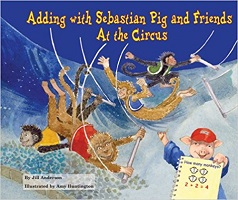
Adding with Sebastian Pig and Friends at the Circus
Grade 1
3 skill lessons · 3 math-through-reading
Math
Skill lessons
The mathematics the book carries, taught directly. Printable workbook pages and teacher keys are not available for this book yet.
- 1Counting on from a number you hold
- 2Two rows that match: doubles to twenty
- 3Either way round: the sums are the same
Math + reading
Math through the reading
The same book, entered through a sentence it prints. Change one word in the reading and the numbers change with it.
- 4The words that tell your hands what to do
- 5What happened first, and what the ring held after
- 6Is twenty-one how many animals?
Reading
Reading and language lessons
The same book read as a text. What a word means in its sentence, how a character is shown, how the writing is put together - no mathematics.
- 7Zip, Zoom, Uh-Oh: The Words That Are Noises
- 8Lots of Big Cats: The Line That Tells You What Is Coming
- 9Zooms, Skates, Enters: Many Words for Coming Into the Ring
- 10Is Called: How a Book Tells You What Something Is Named
- 11Help Sebastian, Look Up: When a Book Talks Straight to You
Skill lessons
3 lessons on the mathematics the book carries. Printable workbook pages and teacher keys are not available for this book yet.
1. Counting on from a number you hold
The book teaches counting on twice and names it both times, first on four clowns and two elephants and again on twelve big cats and four hedgehogs, printing the whole run of counting words each time. Students build both groups with counters, cover the first group so it cannot be recounted, and count on by ones while touching only the second group. They hold a number in the head rather than starting from one, and the second pair of numbers carries that habit across ten, where the book takes it. The sum is spoken last and alone so that the answer is heard as a total rather than as the next word in a count.
Full lesson — 20 minutes
1. Count the whole group by ones (4 min)
Each pair lays out four counters for the clowns while the clown page is read, then two more for the elephants. Touch every counter and count from one to six aloud, one touch per number word. Say the sum last, on its own, so the final number is heard as the answer and not as one more count.
Word preview: clowns, elephants
There are four clowns.
Look, two elephants skate into the ring.
2. Hold the first number and count on (6 min)
Now cover the four clowns with one hand and say four out loud without counting them. Keep that hand still and touch only the two elephants, saying five, six. Do it again the other way round, covering the two elephants first and counting on four, and tell your partner which way took fewer words.
Word preview: counting on
You can add by counting on.
1, 2, 3, 4, 5, 6, 4 plus 2 equals 6.
3. Count on across ten (6 min)
Build twelve counters for the big cats and four more for the hedgehogs. Cover the twelve, say twelve, then touch the four hedgehogs one at a time saying thirteen, fourteen, fifteen, sixteen. The counting words keep going past ten exactly as they do below ten, so say the whole run once more without stopping at ten.
Word preview: sixteen
Sebastian adds the hedgehogs to the big cats.
12 plus 4 equals 16.
4. Say the sum to a partner (4 min)
Take one of the two groups you built and tell your partner the number you held, the number you counted on, and the sum, in that order. Your partner rebuilds it from your words alone and checks that the counters match your sum. Swap and do the other group.
Word preview: sum
The answer is called the sum.
Short version — 9 minutes
1. Hold the first number and count on (5 min)
Lay four counters for the clowns and two for the elephants. Cover the four, say four without counting it, then touch the two elephants saying five, six. Say the sum on its own at the end.
Word preview: counting on
You can add by counting on.
1, 2, 3, 4, 5, 6, 4 plus 2 equals 6.
2. Say the sum to a partner (4 min)
Tell your partner the number you held, the number you counted on, and the sum, in that order. Your partner rebuilds it from your words and checks the counters against your sum.
Word preview: sum
The answer is called the sum.
Three levels
- Support
- Stay with the four clowns and the two elephants and keep the first group visible under a clear cup rather than a hand, so the four can be checked but not recounted. Count on the two elephants with a touch for each, and say only the sum at the end. Add a third group only when the child says four without looking twice.
- At Grade
- Both pairs of numbers, the four and two below ten and the twelve and four across ten, with the first group covered and only the second group touched. The child says the held number, the count-on words, and the sum as three separate pieces of speech.
- Extension
- Cover the SECOND group instead and count on from the smaller number, so a child counting on from two says three, four, five, six and finds it takes four words instead of two. Ask which group is worth holding and have the child say why using both numbers, then test the rule on twelve and four.
English learners
Counting on is a physical routine and the touching carries most of its meaning, so it transfers well once a child has seen it done. Two pieces of English inside it do not. First, the count across ten is irregular in English in a way it is not in many languages, and thirteen, fourteen, fifteen is exactly where a child rehearsing in a second language slows down and loses the one-touch-one-word rule; let the run be said in the child's strongest language while the touching happens, then again in English, so the second run is pronunciation rather than new mathematics. Second, the word sum names a thing and not an action, and a child whose language builds such a word from the verb will hear it as another way of saying add; always say it with a flat hand over the whole pile so the word binds to the whole rather than to the joining. The frame to rehearse is I had ___, I counted on ___, the sum is ___, said twice with counters under the hand before any partner rebuilds a pile from it.
Materials
- Two-colour counters, twenty per pair
- A paper ring mat per pair
- A paper cup or hand-shaped card to cover the first group
- Word cards: sum, counting on
Standards & curriculum
Choose your curriculum above to see the standards for this lesson.
Standards are held back while this plan is edited. Every standard shown here was matched against the supplied wording of this lesson, quoting its steps, so a changed step is no longer the thing that was checked. Undo your changes to bring the standards back — your edits stay in this browser either way.
2. Two rows that match: doubles to twenty
The book supplies two clean doubles and names the strategy on the second, five horses with five riders reaching ten and ten porcupines with ten children reaching twenty. Students build each as two rows laid one under the other so that matching is visible before any counting happens, which is what makes a double different from any other pair of addends. The last step sends students back for the one question the book asks and leaves hanging on its own page, and they answer it by pointing at the two rows of five they already built rather than by recalling a fact. Nothing here is written; the doubles are spoken with the rows under the child's hand.
Full lesson — 20 minutes
1. Build two rows that match (5 min)
Each pair builds five counters in one row for the horses and five in a second row directly underneath for the riders, one rider counter under each horse counter. Run a finger down the two rows together and find that no counter is left over at either end. Say aloud that the rows match before any number is said.
Word preview: same
Five fancy horses with five riders enter the ring.
The number of horses and riders is the same.
2. Name the double and its sum (5 min)
Count one row to five, then count the other row to five, then count both rows straight through to ten touching each counter once. Say five plus five equals ten as one sentence with the rows in front of you. Say the word doubles while pointing at the two matching rows.
Word preview: doubles
Five plus five equals ten.
Add doubles.
3. Build the big double (6 min)
Now build ten counters for the porcupines in one row and ten more for their children underneath, one under each. Check the rows match by running a finger down them before counting anything. Count straight through to twenty, then say ten plus ten equals twenty with the rows still on the table.
Word preview: twenty
10 porcupines are EVERYWHERE. Then their 10 children come in.
4. Find the double the book asks for (4 min)
The book asks which number doubles to make ten and does not answer it on that page. Go back to the horses and riders, put your finger on the two rows of five, and say the answer to your partner with the rows in front of you. Say the number and then say which two rows show it.
Word preview: ten
Do you remember which number doubles to make 10?
Short version — 9 minutes
1. Build two rows that match (5 min)
Build five counters for the horses in one row and five for the riders directly underneath. Run a finger down both rows and find nothing left over at either end. Say the rows match before saying any number.
Word preview: same
The number of horses and riders is the same.
2. Name the double and its sum (4 min)
Count one row to five, then the other to five, then both straight through to ten. Say five plus five equals ten as one sentence with the rows in front of you, and say the word doubles while pointing at them.
Word preview: doubles
Five plus five equals ten.
Add doubles.
Three levels
- Support
- Work only with the horses and riders and keep both rows inside one double ten-frame so the matching is held by the frame rather than by the child's eye. Count one row, count the other, then count straight through, and say the sum. Move to the ten and ten only when the child predicts the rows will match before checking.
- At Grade
- Both doubles, five and five and then ten and ten, each built as two rows one under the other and checked for leftovers by finger before counting. The child names the double, says the sum in a full sentence, and answers the book's ten question from the rows.
- Extension
- Build every double the counters allow from one and one upward and lay the sums in a line, then say what happens to the sum each time one counter is added to each row. Ask whether a double can ever make an odd number of counters and have the child try to build one that does.
English learners
The matching in this lesson is done with a finger and needs no English at all, which makes it a good place for a child new to the language to be visibly right before speaking. What needs care is the word doubles. English uses it here as an imperative naming a kind of addition, and children who meet double as an everyday word for twice as much may expect a comparison rather than a sum of two equal rows; tie the word to the two rows by saying it only while pointing at them. The word same is the other load-bearing item and it is easily confused with equals, which this book also uses; keep same for the two rows and equals for the sentence, and say both while touching what each one describes. The frame is ___ and ___ is the same, so the sum is ___. Invite children to say the matching claim in their strongest language first, since the rows show the meaning and nothing is lost in the translation.
Materials
- Two-colour counters, twenty per pair
- A double ten-frame per pair
- Word cards: doubles, same
Standards & curriculum
Choose your curriculum above to see the standards for this lesson.
Standards are held back while this plan is edited. Every standard shown here was matched against the supplied wording of this lesson, quoting its steps, so a changed step is no longer the thing that was checked. Undo your changes to bring the standards back — your edits stay in this browser either way.
3. Either way round: the sums are the same
This is the one place the book stops and asks a question about the mathematics itself, writing seven plus two and two plus seven side by side and reporting that the sums are the same. Students build the single pile of nine twice, once starting from each group, so the thing that stays the same is a pile they can see rather than a rule they are told. The third step moves the claim to a pair of numbers the book never commutes, four tigers and eight lions, and asks for a prediction before the counting, which is what turns the observation into reasoning. The closing step gives the reasoning an audience the book built, since Sebastian is the one who has to decide what to write down.
Full lesson — 20 minutes
1. Build one group two ways (5 min)
Each pair builds seven counters of one colour for the monkeys and two of another for the hippos, then pushes them together into one pile. Now pull them apart and rebuild the pile with the two hippos placed down first and the seven monkeys after. Look at both piles and say whether anything about the pile itself changed.
Word preview: monkeys, hippos
Sebastian adds monkeys plus hippos.
Or should it be hippos plus monkeys?
2. Say both sentences aloud (5 min)
Say seven plus two equals nine while touching the monkeys first, then say two plus seven equals nine while touching the hippos first. Both sentences are true about the same pile in front of you. Say the two sentences one after the other to your partner and let them point at which group you started from each time.
Word preview: plus
7 plus 2 equals 9.
2 plus 7 equals 9.
3. Test the rule on a new pair (6 min)
Take the four tigers and the eight lions and build them the way the book does, tigers first. Before counting anything, tell your partner what you think the sum will be if you build the lions first instead. Then build it that way and count to check whether your prediction held.
Word preview: tigers, lions
Four tigers, toss balls, and bowling pins.
Then, eight lions come in.
Four plus eight equals 12.
4. Tell Sebastian what to write (4 min)
Sebastian writes the count down for his story and asks which way round to write it. Tell your partner, as if telling Sebastian, whether he needs to write it both ways, and say the sum you got each time as your reason. Use both numbers in your sentence, not just the answer.
Word preview: sums
He writes the problem both ways.
The sums are the same.
Short version — 9 minutes
1. Build one group two ways (5 min)
Build seven counters for the monkeys and two for the hippos and push them into one pile. Pull them apart and rebuild with the two hippos down first. Say whether the pile itself changed.
Word preview: monkeys, hippos
Or should it be hippos plus monkeys?
2. Say both sentences aloud (4 min)
Say seven plus two equals nine touching the monkeys first, then two plus seven equals nine touching the hippos first. Say both to your partner and let them point at which group you started from each time.
Word preview: plus
7 plus 2 equals 9.
2 plus 7 equals 9.
Three levels
- Support
- Stay with the seven monkeys and two hippos and keep the two colours separate inside one long tray, so the pile can be read from either end without being rebuilt. Say the sentence starting from the left end, then turn the tray round and say it starting from the other end. The sum is counted once and used for both sentences.
- At Grade
- The monkeys and hippos built both ways with both sentences spoken, then the prediction on tigers and lions before any counting, then the reason given to a partner with both addends named.
- Extension
- Find a pair in the book where reversing the order would change the story even though the sum holds, such as the bear landing on the ten horses and riders rather than the ten arriving on the bear. Say what stays the same and what does not, and say which of the two the sum cares about.
English learners
The mathematics here survives translation completely, because a pile of nine counters is the same pile whichever group went down first, and that is precisely what makes this lesson a good one for a child working across two languages. The English difficulty is word order. The sentence seven plus two equals nine puts the held group first, and languages differ in whether the order of the two nouns in such a sentence is felt to matter, so a child may reasonably expect the two sentences to say different things. Make that expectation explicit and let the pile settle it, since the whole point of the lesson is that the order changes the sentence and not the sum. Rehearse both directions as one pair, ___ plus ___ equals ___ and then ___ plus ___ equals ___, said back to back with the touching matching each order, so the reversal is felt as a single move. A child may give the prediction on the tigers and lions in their strongest language, since it is a claim about numbers rather than about English.
Materials
- Two-colour counters, twenty per pair
- Word cards: plus, sums
Standards & curriculum
Choose your curriculum above to see the standards for this lesson.
Standards are held back while this plan is edited. Every standard shown here was matched against the supplied wording of this lesson, quoting its steps, so a changed step is no longer the thing that was checked. Undo your changes to bring the standards back — your edits stay in this browser either way.
Math through the reading
The mathematics is reached through a sentence the book prints: change one word in the reading and the numbers change with it. These carry their own standards, matched against these lessons rather than inherited from the skill ones.
4. The words that tell your hands what to do
Students act out the book's adding words with counters and find the one word in a book full of adding that tells them not to add.
Full lesson — 20 minutes
1. Hear the word and make the move (5 min)
Students sit with counters and hear four sentences from the book read one at a time. On 'Then three more.' they push three counters into the pile; on 'Add elephants to clowns.' they slide the two groups together; on 'The answer is called the sum.' they put a hand flat over the whole pile and say the total. Each word gets one physical move and nothing is said about the words yet.
2. Sort the words that make a pile grow (5 min)
Working in pairs, students take word cards for plus, add, more, sum and same, and place each one either on a mat marked with two groups being pushed together or on a mat marked with two groups sitting side by side. They say why each card went where it went, using the counters to show the move the word asked for.
3. Catch the word that does not add (6 min)
The teacher rereads 'The number of horses and riders is the same.' and 'The sums are the same.' Students build the horses and riders and find that 'same' asks them to match two rows rather than to push them together, so nothing grows. They say aloud what 'same' told them to do and what it did not tell them to do.
4. Swap one word and watch the pile change (4 min)
The teacher says the book's sentence and then a changed one, and students act out both with counters. They say which sentence made the pile bigger and which left the two groups apart, naming the word that did it.
Short version — 9 minutes
1. Hear the word and make the move (5 min)
Students sit with counters and hear four sentences from the book read one at a time. On 'Then three more.' they push three counters into the pile; on 'Add elephants to clowns.' they slide the two groups together; on 'The answer is called the sum.' they put a hand flat over the whole pile and say the total. Each word gets one physical move and nothing is said about the words yet.
2. Catch the word that does not add (6 min)
The teacher rereads 'The number of horses and riders is the same.' and 'The sums are the same.' Students build the horses and riders and find that 'same' asks them to match two rows rather than to push them together, so nothing grows. They say aloud what 'same' told them to do and what it did not tell them to do.
Three levels
- Support
- Work with three cards only, plus, add and same, and keep the counters on a two-mat board so the choice is between two visible arrangements rather than five words. The teacher rereads the sentence once while the child's hands are already on the counters, and the child moves first and names the word afterwards. Add the sum card once the child stops pushing groups together on the word same.
- At grade
- All five cards sorted onto the two mats with a spoken reason for each, the horses-and-riders matching built and described in the child's own words, and the swapped sentence acted out with the changed word named aloud.
- Extension
- Students find the book's other matching sentence, 'The sums are the same.', and say why the same word is doing a different job there, since it compares two answers rather than two groups of animals. They then invent one sentence of their own that would make a pile grow and one that would not, and try them on a partner's counters.
English learners
The adding vocabulary transfers readily because most languages have a single common verb for joining quantities, and children will map add and plus onto it quickly. Two things do not transfer. First, 'more' in English carries both an additive sense and a comparative one and this book uses only the additive; a child whose first language marks the two senses with different words, or who has met 'more' in a comparison lesson, will look for a second group to compare against and find none. Second, English marks the held group with 'to' in 'Add elephants to clowns', and languages that order the two nouns differently or mark them with a case ending will not signal it that way. Give every child the frame 'I put ___ with ___ and now there are ___' and let them rehearse it twice with counters before any card is sorted, then invite them to say the same sentence in their strongest language while doing the move, so the class hears that the move is the meaning and the word is what names it.
Materials
- Two-colour counters, twenty per pair
- Word cards: plus, add, more, sum, same
- Two labelled mats per pair, one showing two groups pushed together and one showing two groups side by side
- The book's sentences on sentence strips, read one at a time
- A double ten-frame for the horses-and-riders matching
Standards & curriculum
Choose your curriculum above to see the standards for this lesson.
Standards are held back while this plan is edited. Every standard shown here was matched against the supplied wording of this lesson, quoting its steps, so a changed step is no longer the thing that was checked. Undo your changes to bring the standards back — your edits stay in this browser either way.
5. What happened first, and what the ring held after
Students order the big-cat arrivals, say the running count after each one, and find which card cannot be moved without breaking the number that follows it.
Full lesson — 20 minutes
1. Lay the arrivals out in order (5 min)
Students take four picture cards for the big-cat pages and put them in the order the book read them, tigers first, then lions, then the naming of the dozen, then the hedgehogs. Under each card they build the group with counters and say how many are in the ring at that moment.
2. Say the running count out loud (5 min)
Going along the row of cards, students say the count after each arrival: four, then twelve, then still twelve, then sixteen. They say what changed at each card and what stayed the same, touching the counters as they say each number.
3. Try to move a card (6 min)
Students swap two cards and retell the sequence from the new order. They find that the dozen card cannot move before the lions, because there is no dozen to name until the tigers and lions are together, and that the hedgehog card needs the twelve to exist before it. They say which cards can swap and which cannot, giving the number that blocks the move.
4. Retell it to a partner without the cards (4 min)
With the cards turned face down, each student retells the whole arrival sequence in order to a partner, naming each group, its size, and the count after it joins. The partner turns the cards up one at a time to check the order and the numbers.
Short version — 9 minutes
1. Lay the arrivals out in order (5 min)
Students take four picture cards for the big-cat pages and put them in the order the book read them, tigers first, then lions, then the naming of the dozen, then the hedgehogs. Under each card they build the group with counters and say how many are in the ring at that moment.
2. Try to move a card (6 min)
Students swap two cards and retell the sequence from the new order. They find that the dozen card cannot move before the lions, because there is no dozen to name until the tigers and lions are together, and that the hedgehog card needs the twelve to exist before it. They say which cards can swap and which cannot, giving the number that blocks the move.
Three levels
- Support
- Work with the first three cards only and keep the counters under each one throughout, so the running count can be read off the table rather than held in the head. The teacher rereads each sentence as the card is placed. Ask only whether the dozen card can come first, and let the child answer by trying it and counting what the word would then be naming.
- At grade
- All four cards ordered with counters built under each, the running count spoken along the row, one blocked card identified with the number that blocks it, and a full retelling given from memory with the cards face down.
- Extension
- Students take a fifth card for the porcupine and gorilla pages and decide whether it could be moved to the front of the whole sequence, which it cannot, since the twenty it depends on is itself the result of a double built on that page. They then say which of the book's arrivals could be reordered anywhere in the show without changing a single printed number, and give their reason.
English learners
Sequencing language is where this lesson's difficulty sits, and it is not the same difficulty as the vocabulary. English marks order here with 'first', 'then' and 'but', and the 'but' in 'But the dozen big cats do not stop.' is doing contrastive work rather than sequential work, which is a distinction many children will not hear on a first pass and which some languages mark with a particle rather than a conjunction. The retelling frame to rehearse is 'First ___ came in. Then ___ came in. Now there are ___.' Give it on a strip and have children say it three times with the counters before the cards are turned face down. Invite each child to retell the whole sequence once in their strongest language first, since the order and the numbers survive translation intact and only the connectives change, and a child who has already sequenced it once will hear the English connectives as labels for something they have done rather than as new content.
Materials
- Four picture cards for the big-cat pages
- Two-colour counters, twenty per pair
- A long strip mat for laying the cards in order
- The four sentences on sentence strips
- A sentence frame strip reading First ___ came in. Then ___ came in. Now there are ___.
Standards & curriculum
Choose your curriculum above to see the standards for this lesson.
Standards are held back while this plan is edited. Every standard shown here was matched against the supplied wording of this lesson, quoting its steps, so a changed step is no longer the thing that was checked. Undo your changes to bring the standards back — your edits stay in this browser either way.
6. Is twenty-one how many animals?
Students build every group the book put in the ring, weigh the book's final answer against the piles in front of them, and tell Sebastian what to write with the numbers in their reason.
Full lesson — 20 minutes
1. Build what the ring already holds (6 min)
Groups of four take counters and build one group for each set of animals the book has already brought into the ring, four clowns, two elephants, seven monkeys, two hippos, five horses, five riders, one bear, four tigers, eight lions and four hedgehogs, with the group's card beside each pile. They lay them along a long strip in the order the book brought them, so the whole show is on the table before anything is asked.
2. Hear the book's answer (4 min)
The teacher reads the gorilla page aloud, and students build the twenty porcupines and the one gorilla at the end of the strip and count on to twenty-one. They then hear the book's own sentence answering the question and put a marker on the piles that twenty-one covers.
3. Take a position and say why (6 min)
Each student decides whether twenty-one is the number of animals in the ring, and tells a partner their position with at least two of the book's numbers in the sentence. Partners who disagree each say their reason again while pointing at the piles on the strip.
4. Tell Sebastian what to write (4 min)
Sebastian is writing the count down for his story. Each pair agrees on one sentence to tell him, saying what he should write and which piles they counted to get it. Pairs who cannot agree tell him both sentences and say what the two of them disagree about.
Short version — 9 minutes
1. Hear the book's answer (4 min)
The teacher reads the gorilla page aloud, and students build the twenty porcupines and the one gorilla at the end of the strip and count on to twenty-one. They then hear the book's own sentence answering the question and put a marker on the piles that twenty-one covers.
2. Take a position and say why (6 min)
Each student decides whether twenty-one is the number of animals in the ring, and tells a partner their position with at least two of the book's numbers in the sentence. Partners who disagree each say their reason again while pointing at the piles on the strip.
Three levels
- Support
- Build four piles rather than ten, the eight lions, the four tigers, the twenty porcupines and the one gorilla, and keep them in a single row so the two ends can be seen at once. The teacher rereads the book's question and its answer, and the child says whether twenty-one covers the lions by pointing at them. The frame to use is I think ___ because the book says ___ and I can see ___, and the child needs only one of the book's numbers in it rather than two.
- At grade
- All ten groups built and laid in arrival order, the twenty-one counted on and marked, a position stated to a partner with at least two of the book's numbers in the sentence, and one agreed sentence produced for Sebastian or a clear statement of what the pair disagrees about.
- Extension
- Students take the strongest case against their own position and say it aloud before restating theirs, then decide what single sentence the book would have needed to print for the disagreement to disappear. They may also work out what the count would be under each of the two rulings the book leaves open, counting the clowns and riders in and then out, and say which piles moved between the two answers.
English learners
The mathematics here is counting and matching and travels intact, but the argument language does not. Three things need rehearsing. First, the position frame itself: give 'I think ___ because ___' on a strip and have every child say it twice with counters under their hand before any partner talk, since a child who has to build the syntax and hold the numbers at the same time will drop the numbers. Second, the word 'animal' is the hinge of the whole disagreement and its boundary differs across languages and cultures, with some drawing the line to exclude people and some not; make this explicit and treat a child's different boundary as a contribution to the argument rather than a vocabulary error, because the book leaves the boundary open and the third position is built on exactly that. Third, disagreeing politely is a register, not a skill children have automatically in a new language; supply 'I do not think so, because ___' alongside the agreement frame so a child can hold a different position without needing to find the words for it under pressure. Invite every child to state their position in their strongest language first while pointing at the piles, then give it again in English, since the piles carry the meaning and the second telling is then a translation rather than a fresh act of reasoning.
Materials
- Two-colour counters, one hundred per group of four
- Ten labelled group cards for clowns, elephants, monkeys, hippos, horses, riders, bear, tigers, lions and hedgehogs
- A long strip mat for laying the piles in arrival order
- A marker card to lay over the piles the book's total covers
- The gorilla page read aloud from a sentence strip
- A frame strip reading I think ___ because ___
- A frame strip reading I do not think so, because ___
Standards & curriculum
Choose your curriculum above to see the standards for this lesson.
Standards are held back while this plan is edited. Every standard shown here was matched against the supplied wording of this lesson, quoting its steps, so a changed step is no longer the thing that was checked. Undo your changes to bring the standards back — your edits stay in this browser either way.
Reading and language lessons
5 lessons on the reading and language the book carries - what a word means in its sentence, how a character is shown, how a text is built. No mathematics: these are matched against the English language arts curricula, which are a different and smaller set than the mathematics ones.
7. Zip, Zoom, Uh-Oh: The Words That Are Noises
This book scatters words that are noises rather than names, and it sets them outside the sentences so they can be shouted. Students read them aloud, meet one that carries a feeling as well as a sound, then read a page with every noise taken out to hear what was lost. Nothing is added or counted; the work is what a sound word is and what it does to a page.
Full lesson — 20 minutes
1. Read the words that are noises, not names (6 min)
The teacher reads the passage below out loud, making a real noise for the parts that are noises. Read those parts with the teacher. Point to the words that are sounds rather than the names of things. Say aloud what you think each sound comes from.
Word preview: sound, noise
Zip, zoom, clowns. Hong, hong. A clown zooms into the ring. He goes around and around. Three more clowns drive in. Sebastian writes it all down.
2. Find a sound word that is a feeling too (5 min)
Read the two passages below with a partner. Each has a short noisy word set off by itself. Read each one aloud in the voice it asks for. Say aloud which one is a worried sound and which one is a loud crash, and say what tells you.
Word preview: uh-oh, boom
What is that bear doing? High above the ground, she turns on her toes. Uh-oh, the bear is falling.
Boom! One by one, the porcupines fall. Everyone runs to help. Even Sebastian gets into the act, but he falls into the cannon. Boom! He is part of the show! Sebastian has a great story to tell. His story will be the best one.
3. Say what the page loses without its noises (5 min)
Read the passage below again. Read it a second time, leaving out every sound word and reading only the full sentences. Say aloud what the page lost when you did that, and say why a writer would put noises on a page at all.
Word preview: without, lost
Zip, zoom, clowns. Hong, hong. A clown zooms into the ring. He goes around and around. Three more clowns drive in. Sebastian writes it all down.
4. Make your own sound word for a printed page (4 min)
Read the passage below. It has one repeated shout in it. Say that shout aloud. Then tell a partner one new sound word you would add to this page, and say what is making your noise.
Word preview: shout, add
Fire, fire, four hedgehogs run in with hoses. They put out the fire. But the dozen big cats do not stop.
Short version — 9 minutes
1. Read the words that are noises, not names (5 min)
The teacher reads the passage below, making a real noise for the noisy parts. Point to the sound words and say what each one comes from.
Word preview: sound
Zip, zoom, clowns. Hong, hong. A clown zooms into the ring. He goes around and around. Three more clowns drive in. Sebastian writes it all down.
2. Find a sound word that is a feeling too (4 min)
Read the passage below. Say the short noisy word at the end aloud in the voice it asks for, and say what feeling it carries.
Word preview: uh-oh
What is that bear doing? High above the ground, she turns on her toes. Uh-oh, the bear is falling.
Three levels
- Support
- In the printed passage in step 1, echo Zip, zoom after the teacher and then Hong, hong. Make a real noise for each one.
- At Grade
- Read the printed passage in step 1 aloud, point to every word that is a noise rather than a name, and say what each noise comes from.
- Extension
- The printed passage in step 2 ends on a short noisy word that is also a feeling. Say two sentences about how one small word does both jobs at once.
English learners
Sound words differ sharply between languages, so a student may hear no dog or no engine in these at all. Say each aloud, make the real noise beside it, and invite students to give the sound word their strongest language uses for the same thing. Then read the printed line with the English one. Rehearsable frame: ___ is the sound of ___.
Materials
- Adding with Sebastian Pig and Friends at the Circus, the passage printed in this step
- pointing finger
- partner
- Word cards: sound, noise, uh-oh, boom, shout
Standards & curriculum
Choose your curriculum above to see the standards for this lesson.
Standards are held back while this plan is edited. Every standard shown here was matched against the supplied wording of this lesson, quoting its steps, so a changed step is no longer the thing that was checked. Undo your changes to bring the standards back — your edits stay in this browser either way.
8. Lots of Big Cats: The Line That Tells You What Is Coming
Most pages of this book open with a short line that names the page rather than telling any of its story, and one of them is shouted in capitals. Students read the naming lines, predict from them, check whether the promise was kept, and finally write a heading for the one printed page that has none. The work is what a heading does for a reader making their way through an informational book.
Full lesson — 20 minutes
1. Read the short line that names the page (6 min)
Read the two passages below with the teacher. Each one begins with a short line that is not a full sentence. Read those short lines aloud. Say aloud what each one tells you is coming before you read the rest.
Word preview: heading, names
Monkeys show off. Look up! Three monkeys show off. Four more monkeys come in. They flip and fly.
Lots of big cats. Four tigers, toss balls, and bowling pins. Then, eight lions come in.
2. Check whether the heading kept its promise (5 min)
Read the passage below with a partner. Read its first short line, then stop and say aloud what animals you expect. Then read the rest. Say whether the animals you met were the ones the heading promised.
Word preview: promise, expect
Lots of big cats. Four tigers, toss balls, and bowling pins. Then, eight lions come in.
3. Read the loudest heading in the book (5 min)
Read the passage below. Its heading is printed in big letters. Read it aloud the way the letters ask you to. Say aloud why a writer would make one heading louder than all the others, using what the passage says about where the show is up to.
Word preview: capital letters, loud
PORCUPINES EVERYWHERE. It is the end of the show. It is time for the porcupines. 10 porcupines are EVERYWHERE.
4. Give a heading to a page that has none (4 min)
Read the passage below. It has no naming line at the front. Tell a partner a heading of your own for it, in four words or fewer, and say which words in the passage made you choose it.
Word preview: choose, fits
What is that bear doing? High above the ground, she turns on her toes. Uh-oh, the bear is falling.
Short version — 9 minutes
1. Read the short line that names the page (5 min)
Read the two passages below. Read the short naming line at the front of each and say what it tells you is coming.
Word preview: heading
Monkeys show off. Look up! Three monkeys show off. Four more monkeys come in. They flip and fly.
Lots of big cats. Four tigers, toss balls, and bowling pins. Then, eight lions come in.
2. Give a heading to a page that has none (4 min)
Read the passage below, which has no naming line. Tell a partner a heading of your own for it and say which words made you choose it.
Word preview: choose
What is that bear doing? High above the ground, she turns on her toes. Uh-oh, the bear is falling.
Three levels
- Support
- In the printed passage in step 1, put a finger on the first short line and echo it after the teacher. Say the animal it names.
- At Grade
- Read both printed passages in step 1 and say, for each, what the naming line told you before you read on.
- Extension
- The heading in step 3 is printed in capital letters and repeats inside the passage. Say two sentences about what the capitals do that ordinary letters would not.
English learners
A heading in English is often not a full sentence and can look broken to a reader expecting one. Say the heading, then say the full sentence it stands for, so the missing words are heard. Invite students to name, in their strongest language, what a sign or a title at the top of something is for. Rehearsable frame: The heading says ___. So this page will be about ___.
Materials
- Adding with Sebastian Pig and Friends at the Circus, the passage printed in this step
- pointing finger
- partner
- Word cards: heading, names, promise, capital letters, choose
Standards & curriculum
Choose your curriculum above to see the standards for this lesson.
Standards are held back while this plan is edited. Every standard shown here was matched against the supplied wording of this lesson, quoting its steps, so a changed step is no longer the thing that was checked. Undo your changes to bring the standards back — your edits stay in this browser either way.
9. Zooms, Skates, Enters: Many Words for Coming Into the Ring
Every group of animals in this book does the same thing, arrives in the ring, and the writer almost never uses the same word twice. Students collect the arriving words from printed passages, swap two of them to hear what breaks, find the plainest one in the book, and offer one of their own. The work is word choice: what a lively verb makes a reader picture that a plain one does not.
Full lesson — 20 minutes
1. Collect the different words for coming in (6 min)
Read the two passages below with the teacher. In each one, animals arrive in the ring, but the writer uses a different word for arriving. Point to the arriving word in each passage. Say both words aloud and say how they are not the same.
Word preview: zooms, skate, arrive
Zip, zoom, clowns. Hong, hong. A clown zooms into the ring. He goes around and around. Three more clowns drive in. Sebastian writes it all down.
Look, two elephants skate into the ring. Add elephants to clowns. What you get is crash!
2. Match the arriving word to the animal (5 min)
Read the two passages below with a partner. One says the horses enter and one says the hedgehogs run in. Swap the two words over and read the sentences again. Say aloud which pairing sounds right and why the writer chose as they did.
Word preview: enter, run in, swap
Fancy horses and riders. Five fancy horses with five riders enter the ring. The number of horses and riders is the same.
Fire, fire, four hedgehogs run in with hoses. They put out the fire. But the dozen big cats do not stop.
3. Find the plainest arriving word in the book (5 min)
Read the two passages below. One uses a plain, ordinary word for arriving and the other uses a lively one. Read both aloud. Say which is the plain one, and say what the page would feel like if every arrival used that plain word.
Word preview: plain, lively
Now, two hippos come in.
Monkeys show off. Look up! Three monkeys show off. Four more monkeys come in. They flip and fly.
4. Say a new arriving word of your own (4 min)
Read the passage below one more time. Then tell a partner a different word for how the elephants could arrive, and say what your word makes a reader picture that the book's word does not.
Word preview: picture
Look, two elephants skate into the ring. Add elephants to clowns. What you get is crash!
Short version — 9 minutes
1. Collect the different words for coming in (5 min)
Read the two passages below with the teacher. Point to the arriving word in each and say how the two words are not the same.
Word preview: zooms, skate
Zip, zoom, clowns. Hong, hong. A clown zooms into the ring. He goes around and around. Three more clowns drive in. Sebastian writes it all down.
Look, two elephants skate into the ring. Add elephants to clowns. What you get is crash!
2. Say a new arriving word of your own (4 min)
Read the passage below and tell a partner a different word for how the elephants could arrive, and what your word makes a reader picture.
Word preview: picture
Look, two elephants skate into the ring. Add elephants to clowns. What you get is crash!
Three levels
- Support
- In the printed passages in step 1, find the word zooms and the word skate. Echo each one and act it out with your hand.
- At Grade
- Read both printed passages in step 1, name the arriving word in each, and say how the two are different.
- Extension
- The printed passages in step 3 put a plain arriving word beside a lively one. Say two sentences about what a reader gets from the lively one.
English learners
Several of these verbs are ordinary nouns doing a verb's job, and skate especially may be unfamiliar as an action. Act each verb out as it is read. Invite students to name, in their strongest language, three different ways of coming into a room, then find the closest English word for each. Rehearsable frame: The ___ ___ into the ring. That makes me picture ___.
Materials
- Adding with Sebastian Pig and Friends at the Circus, the passage printed in this step
- pointing finger
- partner
- Word cards: zooms, skate, enter, run in, plain, lively, picture
Standards & curriculum
Choose your curriculum above to see the standards for this lesson.
Standards are held back while this plan is edited. Every standard shown here was matched against the supplied wording of this lesson, quoting its steps, so a changed step is no longer the thing that was checked. Undo your changes to bring the standards back — your edits stay in this browser either way.
10. Is Called: How a Book Tells You What Something Is Named
Three times this book stops describing the circus and hands a name to something, using the phrase is called or a plain is. Students find those sentences, split one into the thing and the name, and then meet a third that carries the same shape while its name has come out wrong in this transcription, quoted here exactly as printed. The work is spotting a naming sentence by its shape, which is a reading skill that survives even when the name itself cannot be trusted.
Full lesson — 20 minutes
1. Find the sentence that stops to name something (6 min)
Read the two passages below with the teacher. Each one contains a sentence that does a different job from the sentences around it: instead of telling what happens, it gives a name to something. Point to that sentence in each passage and read it aloud.
Word preview: is called, name
The answer is called the sum.
A group of 12 is a dozen.
2. Split the naming sentence into its two halves (5 min)
Read the passage below with a partner. Put one finger on the part before is called and one finger on the part after it. Say aloud which half is the thing and which half is the name. Then say the two halves in the other order and say whether the sentence still works.
Word preview: half, order
The answer is called the sum.
3. Read a naming sentence a reader cannot trust (5 min)
Read the passage below. It names something, the way the other naming sentences did. But this book was written down from a recording, and the name in this sentence came out wrong. Read it exactly as it is printed, without fixing it. Say aloud how you can tell a naming sentence is there even when the name itself is not to be trusted.
Word preview: are called, trust
The numbers you add together are called add-ins.
4. Make a naming sentence of your own (4 min)
Read the passage below one more time. Then use its shape to name something in your classroom for a partner: ___ is called ___. Say your sentence, then say which half of it is the thing and which half is the name.
Word preview: is called
The answer is called the sum.
Short version — 9 minutes
1. Find the sentence that stops to name something (5 min)
Read the two passages below. Read each aloud and say which words in it attach a name to a thing.
Word preview: is called
The answer is called the sum.
A group of 12 is a dozen.
2. Make a naming sentence of your own (4 min)
Read the passage below and use its shape to name something in your classroom for a partner. Say which half is the thing and which half is the name.
Word preview: is called
The answer is called the sum.
Three levels
- Support
- In the printed passage in step 1, echo the sentence after the teacher, then say only the last word, which is the name.
- At Grade
- Read both printed passages in step 1 and say, for each, which part is the thing and which part is the name.
- Extension
- The naming sentence in step 3 has the right shape and a name this transcription got wrong. Say two sentences about how a reader can still tell what kind of sentence it is.
English learners
The phrase is called is passive and puts the name last, which reverses the order some languages use for naming. Read the sentence, then say the same fact the other way round, We call the answer the sum, so both orders are heard. Invite students to name something in their strongest language and say the naming word their language uses. Rehearsable frame: ___ is called ___.
Materials
- Adding with Sebastian Pig and Friends at the Circus, the passage printed in this step
- pointing finger
- partner
- Word cards: is called, name, half, order, trust
Standards & curriculum
Choose your curriculum above to see the standards for this lesson.
Standards are held back while this plan is edited. Every standard shown here was matched against the supplied wording of this lesson, quoting its steps, so a changed step is no longer the thing that was checked. Undo your changes to bring the standards back — your edits stay in this browser either way.
11. Help Sebastian, Look Up: When a Book Talks Straight to You
This book keeps breaking off from describing the circus to speak directly to whoever is holding it, and the two kinds of sentence sit side by side on almost every printed page. Students find the sentences aimed at them, sort a whole passage into telling and asking, hear the ringmaster's welcome, and finish on the closing line that tells them what they did. The work is noticing who a sentence is addressed to.
Full lesson — 20 minutes
1. Find the sentences that are talking to you (6 min)
Read the two passages below with the teacher. Some sentences tell you what is happening, and some sentences ask you to do something. Point to a sentence in each passage that is talking straight to you. Say aloud what it asks you to do.
Word preview: you, asks
Lucky Sebastian Pig. Today, he is going to the circus. He has a big job to do. Help Sebastian add. Need help? Look for the answers in Sebastian's notebook.
Monkeys show off. Look up! Three monkeys show off. Four more monkeys come in. They flip and fly.
2. Sort the telling sentences from the asking ones (5 min)
Read the passage below with a partner. Read each sentence in turn. After each one, hold up one finger if it tells you what is happening and two fingers if it is talking to you. Say aloud how you could tell them apart.
Word preview: tells, asks
Lucky Sebastian Pig. Today, he is going to the circus. He has a big job to do. Help Sebastian add. Need help? Look for the answers in Sebastian's notebook.
3. Read the sentence that welcomes the reader in (5 min)
Read the passage below. It is what the ringmaster shouts at the start of the show. Read it aloud in a big voice. Say aloud who the ringmaster is speaking to inside the story, and who is really being spoken to as you read.
Word preview: welcome, audience
The most amazing show in the world! Ladies and Animals, let the circus begin! Everyone is ready!
4. Read the book's last words to you (4 min)
Read the passage below, which is the very end of the book. It says you did something. Say aloud what the book says you did, and say whether you agree with it. Then say who the word you means here.
Word preview: you, agree
Now you know. Good work! You help Sebastian add all of the animals. Use this chart to practice more addition facts.
Short version — 9 minutes
1. Find the sentences that are talking to you (5 min)
Read the two passages below with the teacher. Point to a sentence in each that is talking straight to you, and say what it asks you to do.
Word preview: you, asks
Lucky Sebastian Pig. Today, he is going to the circus. He has a big job to do. Help Sebastian add. Need help? Look for the answers in Sebastian's notebook.
Monkeys show off. Look up! Three monkeys show off. Four more monkeys come in. They flip and fly.
2. Read the book's last words to you (4 min)
Read the passage below, the very end of the book. Say what it says you did and who the word you means here.
Word preview: agree
Now you know. Good work! You help Sebastian add all of the animals. Use this chart to practice more addition facts.
Three levels
- Support
- In the printed passage in step 1, find the word Help and echo the sentence it starts. Then say what that sentence asks you to do.
- At Grade
- Read both printed passages in step 1 and name one sentence in each that is spoken to you rather than about anyone.
- Extension
- The printed passage in step 3 is shouted to an audience inside the story. Say two sentences about how a reader ends up being part of that audience.
English learners
A sentence like Look up! has no visible subject at all, which can read as an unfinished sentence rather than as a request. Say the full form once, You look up, then the printed form, so the hidden you is heard. Invite students to give a classmate a friendly instruction in their strongest language and then in English. Rehearsable frame: This sentence asks me to ___.
Materials
- Adding with Sebastian Pig and Friends at the Circus, the passage printed in this step
- pointing finger
- partner
- Word cards: you, asks, tells, welcome, audience, agree
Standards & curriculum
Choose your curriculum above to see the standards for this lesson.
Standards are held back while this plan is edited. Every standard shown here was matched against the supplied wording of this lesson, quoting its steps, so a changed step is no longer the thing that was checked. Undo your changes to bring the standards back — your edits stay in this browser either way.