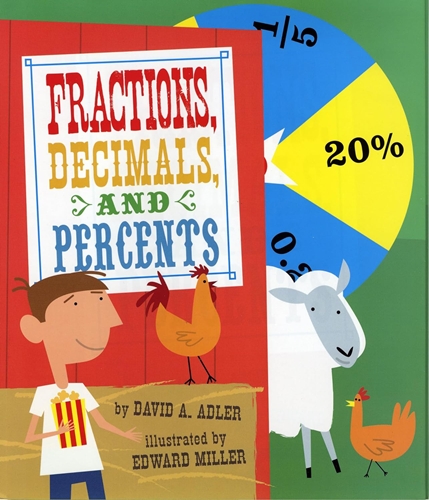
Fractions, Decimals, and Percents
Grade 4
5 skill lessons · 2 math-through-reading
Math
Skill lessons
The mathematics the book carries, taught directly. Printable workbook pages and teacher keys are not available for this book yet.
- 1The Box the Book Never Answers
- 2Three Ways, Fast
- 3Ninety Cents or Nine Cents
- 4Finish the Division the Book Starts
- 5Same Amount, Different Occasion
Math + reading
Math through the reading
The same book, entered through a sentence it prints. Change one word in the reading and the numbers change with it.
- 6Which Number Goes Inside?
- 7The Third Box
Reading
Reading and language lessons
The same book read as a text. What a word means in its sentence, how a character is shown, how the writing is put together - no mathematics.
- 8The Words Between the Commas
- 9Probably, Might, But He Could
- 10What a Person Would Actually Say
- 11Rules, In the Order You Need Them
- 12Everywhere, Said Four Times
Skill lessons
5 lessons on the mathematics the book carries. Printable workbook pages and teacher keys are not available for this book yet.
1. The Box the Book Never Answers
The book counts two boxes of coins for the reader and answers both. It sets out a third box, asks all three questions about it, and then walks away without answering any of them. Students count the third box themselves and write the amount all three ways. The book supplies the machinery to check the work: four sentences later it lists the three box fractions together, and the third one settles what the answer had to be.
Full lesson — 20 minutes
1. How the book writes one amount three ways (5 min)
Read the cotton candy passage aloud. Lay out 89 cents in coins on the desk. Have students write the amount underneath in all three forms the book uses. Ask which of the three a price tag at a fair would actually show.
Word preview: fraction, decimal, percent, cents
Cotton candy might cost 89 cents.
There are 100 cents in $1.
89 over 100, 0.89 and 89% are different ways of writing the same thing.
2. Count the two boxes the book counts (4 min)
Have students build the first coin box and count it, then write the amount three ways before you read the book's answer. Do the same for the second box. Confirm each time that their three forms match the book's three forms.
Did you count 41 cents?
You could write that as 41 over 100 or 0.41 or 41% of a dollar.
Did you count 53 cents?
3. The third box has no answer under it (6 min)
Read the three questions the book asks about the third box, then stop. Point out that the book gives no answer here. Have pairs count the third coin box and write the fraction, the decimal and the percent themselves. Each pair reads its three answers aloud before any checking.
Now count the money in this box.
What fraction of a dollar is in the box?
How would you write that as a decimal?
How would you write that as a percent of a dollar?
4. Find where the book gives it away (5 min)
Tell students the book does answer the third box, just not where they expected. Have them find the sentence that lists the three fractions. Ask which two they already know and where that leaves the third. Students write that sentence beside their own answer as their reason.
Now take a look at these fractions.
41 over 100, 53 over 100, and 17 over 100.
Short version — 9 minutes
1. The third box has no answer under it (5 min)
Read the three questions the book asks about the third box, then stop. Pairs count the coins and write the fraction, the decimal and the percent with nothing printed to copy.
Word preview: fraction, decimal, percent, cents
Now count the money in this box.
What fraction of a dollar is in the box?
2. Find where the book gives it away (4 min)
Have students find the sentence listing the three fractions. Ask which two they already know and where that leaves the third. Students write that sentence beside their answer.
41 over 100, 53 over 100, and 17 over 100.
Three levels
- Support
- The counting load comes down, not the writing: hand the third box already sorted into a dime, a nickel and two pennies so the count to seventeen is short, and leave a dollar mat of a hundred squares on the desk so seventeen squares can be shaded and pointed at. All three forms still get written, and the hunt for the settling sentence still happens.
- At Grade
- Count the third box, write seventeen cents as a fraction of a dollar, as a decimal and as a percent with nothing printed to copy, then find the sentence that lists the three box fractions and write it beside the answer as the reason.
- Extension
- The book never says the third box holds seventeen cents; it only lists three fractions. Write the argument that pins it down anyway, naming which two fractions are already spoken for and why that leaves exactly one home for the third. Then build a fourth box of your own, write its three forms, and hand a partner only the fraction list to see whether the same argument works twice.
English learners
Number and coin counting transfer completely, and a student who counts in Arabic, Haitian Creole or Vietnamese will pin the third box at seventeen with no English at all. English, though, writes one amount three different ways and treats them as the same amount, and the word percent hides its own meaning inside it; no first language prepares a student for either. Anchor all three forms to the same coins on the desk rather than to definitions, and rehearse one fixed frame, seventeen cents is 17 over 100 of a dollar, 0.17, and 17% of a dollar, spoken with a finger moving along the three written forms. Students may argue which two fractions are already taken in their strongest language before saying the frame in English.
Materials
- Coin set with at least 99 cents in mixed coins, one per pair
- Recording strip with three blanks headed fraction, decimal, percent, one per student
- Pencil per student
- Third box coin card, seventeen cents in mixed coins, one per pair
- Printed source passage in this step
- Dollar mat of one hundred squares, one per student
- Word cards: fraction, decimal, percent, cents, dollar
Standards & curriculum
Choose your curriculum above to see the standards for this lesson.
Standards are held back while this plan is edited. Every standard shown here was matched against the supplied wording of this lesson, quoting its steps, so a changed step is no longer the thing that was checked. Undo your changes to bring the standards back — your edits stay in this browser either way.
2. Three Ways, Fast
The book's rule for hundredths is one sentence long: when the bottom number is 100, the fraction, the decimal and the percent are already the same three numerals. Students turn that into speed. Given any one of the three forms they produce the other two, first with coins on the desk as the referee, then from the numerals alone, with the coins still available to settle any disagreement.
Full lesson — 20 minutes
1. Why hundredths are the easy case (4 min)
Read the book's rule for a denominator of one hundred. Test it on the two amounts the book already worked. Have students say in their own words why nothing has to be calculated when the bottom number is already one hundred.
Word preview: denominator, numerator, equivalent
It's easy when the denominator, the bottom number of the fraction is 100.
41 over 100 is the same as 0.41 and 41%.
53 over 100 is the same as 0.53 and 53 percent.
2. Coins first (6 min)
One partner deals an amount in coins under a dollar. The other counts it and writes all three forms, then they swap. Repeat until each student has done four amounts. Settle any disputed answer by counting the coins, not by asserting.
3. Numerals only (6 min)
Set the coins aside. Show one form at a time, sometimes a fraction, sometimes a decimal, sometimes a percent. Students write the missing two. Every fourth card, call on a student to say the full equivalence sentence aloud before showing the next card.
4. Prove one with coins (4 min)
Each student picks one amount they wrote from numerals alone and rebuilds it in coins, proving all three forms describe that one pile. Have them circle the proved row on the record sheet and collect it.
Short version — 9 minutes
1. Coins first (5 min)
Partners deal an amount in coins under a dollar, count it, and write all three forms, swapping after each amount. Settle disputes by counting the coins.
Word preview: denominator, numerator, equivalent
2. Numerals only (4 min)
Set the coins aside. Students write the missing two forms for each card shown, and say the full equivalence sentence aloud every fourth card.
Three levels
- Support
- Keep the coins on the desk for the whole lesson rather than setting them aside, and restrict the deck to amounts of ten, twenty, twenty-five and fifty cents so the count is short and familiar. All three forms are still written for every amount; what comes down is the counting, not the writing.
- At Grade
- Produce both missing forms for eight amounts, four with coins available and four from numerals alone, and prove one of the numeral-only rows by rebuilding it in coins.
- Extension
- Handle the two amounts that catch people out: an amount under a dime, where the decimal needs a zero holding the tenths place, and one whole dollar, where the percent reaches a hundred. Write both, then say what a reader would get wrong if the zero were left out.
English learners
The three forms are read very differently in English even though they name one amount, and the percent sign is spoken as a whole word that appears nowhere in the numeral. Say each form aloud as it is written, and keep the coin pile in view as the thing all three names point at, so the equivalence is seen before it is said. The sentence frame is fixed and worth rehearsing whole: 41 over 100 is the same as 0.41 and 41%. Decimal separators differ across languages, and a student who writes a comma where English writes a point has made a notation difference, not a mathematical error; show the English convention on the record sheet rather than marking it wrong.
Materials
- Printed source passage in this step
- Coin set with at least 99 cents in mixed coins, one per pair
- Three-column record sheet headed fraction, decimal, percent, one per student
- Pencil per student
- Form cards showing single hundredths amounts, one deck per class
- Two catch-out cards, one under a dime and one whole dollar
- Word cards: denominator, numerator, equivalent, hundredths
Standards & curriculum
Choose your curriculum above to see the standards for this lesson.
Standards are held back while this plan is edited. Every standard shown here was matched against the supplied wording of this lesson, quoting its steps, so a changed step is no longer the thing that was checked. Undo your changes to bring the standards back — your edits stay in this browser either way.
3. Ninety Cents or Nine Cents
The book makes a flat assertion and leaves it standing: ninety cents and nine cents are not the same. The two are written with the same digit and differ only by where that digit sits. Students build both amounts in coins, put the two piles side by side, and settle from the piles what the assertion means. Then they defend the harder version, why the same digit written twice in one price can mean two different amounts.
Full lesson — 20 minutes
1. Build the two piles (5 min)
Read the book's assertion aloud. Have students build ninety cents in one pile and nine cents in another. Set the two piles side by side and let everyone look before any discussion.
Word preview: decimal point, place, value
$0.90 and $0.09 are not the same.
2. Say what the piles show (5 min)
Have partners take turns finishing one spoken sentence about the two piles: the nine in this one means blank because it sits blank. The sentence must name the pile and the position. Pointing at the coins while speaking is allowed.
What matters is on which side of the decimal point the digit 9 is written and how close it is to the decimal point.
3. The same digit three times (6 min)
Read the book's claim about the price of a champion lamb. Give each pair three cards, one per nine, and have them lay out what each nine is worth. Order the three from largest to smallest and say what decided the order.
A champion lamb might cost $999.99.
Each of the 9's in $999.99 means something different.
4. Write the case (4 min)
Each student writes one sentence that would convince someone who thinks the two piles are the same amount, using both numbers. Partners check that the sentence names a position and not only a size.
Short version — 9 minutes
1. Build the two piles (4 min)
Read the book's assertion aloud. Students build ninety cents in one pile and nine cents in another, set side by side.
Word preview: decimal point, place, value
$0.90 and $0.09 are not the same.
2. Say what the piles show (5 min)
Partners take turns finishing the spoken sentence about each pile, naming the pile and the position. Pointing at the coins while speaking is allowed.
What matters is on which side of the decimal point the digit 9 is written and how close it is to the decimal point.
Three levels
- Support
- The building and the ordering stay whole; the speaking is what gets carried. Offer the sentence as a printed frame with the two blanks marked, and let a student point at the pile and read the frame rather than composing it. A student may answer by placing the two piles in order and pointing at the position before any sentence is attempted.
- At Grade
- Build both piles, say the position sentence for each, order what the three nines in the lamb price are worth, and write one convincing sentence naming a position.
- Extension
- The book says the two piles are not the same but never says how much they differ. Work out how many of the smaller pile it takes to make the larger one, show it with the coins, and say what it is about the two positions that produces exactly that answer.
English learners
Money is the accessible route here, because the two piles are visibly different sizes before any English is spoken, and a student can order them correctly without a word. The English that carries the mathematics is positional and small: the phrases to the left of, to the right of, and next to the decimal point do the work, and many languages order such phrases differently or mark position with a case ending instead. Rehearse the two frames with a finger on the written price and then on the pile, the nine is right after the point, so it means ninety cents, the nine is one further along, so it means nine cents. Students may reason about the order of the piles in their strongest language first and give the position sentence in English afterwards.
Materials
- Coin set with at least 99 cents in mixed coins, one per pair
- Two labelled pile mats reading $0.90 and $0.09, one pair per pair of students
- Printed source passage in this step
- Place cards for the three nines in the lamb price, one set per pair
- Lined answer strip, one per student
- Pencil per student
- Printed position sentence frame with two blanks, one per student
- Word cards: decimal point, place, value, digit
Standards & curriculum
Choose your curriculum above to see the standards for this lesson.
Standards are held back while this plan is edited. Every standard shown here was matched against the supplied wording of this lesson, quoting its steps, so a changed step is no longer the thing that was checked. Undo your changes to bring the standards back — your edits stay in this browser either way.
4. Finish the Division the Book Starts
The book has an easy case and a hard case. When the bottom number is 100 there is nothing to do. When it is not, the book names three fractions, states the procedure in three short sentences, and stops at the last one without ever carrying it out. Students carry it out. They divide the numerator by the denominator for each of the three fractions the book names, and write the decimal and the percent the book left blank.
Full lesson — 20 minutes
1. The case that is not easy (4 min)
Reread the easy rule for a denominator of one hundred. Then read the three fractions that break it. Ask what stops the easy rule working when the bottom number is 2, 4 or 5. Have students predict each answer before any dividing.
Word preview: divide, quotient, denominator
It's easy when the denominator, the bottom number of the fraction is 100.
But what about 1 over 2, 3 over 4 and 4 over 5?
2. Read the procedure the book gives (4 min)
Read the book's three procedure sentences. Have students number the moves in order on a strip: change the numerator to a decimal, then divide by the denominator. Point out that the book stops there and prints no answers.
To change each of those fractions to a decimal or a percent, you divide.
First you change the numerator into a decimal.
Then you divide the numerator by the denominator.
3. Do the three divisions (8 min)
Have students divide one by two, three by four and four by five, writing each quotient as a decimal and then as a percent. Check each answer against a dollar built in coins beside the written work: half a dollar, three quarters of a dollar, four fifths of a dollar.
4. Say which sentence you finished (4 min)
Each pair reads aloud the book's last procedure sentence and then its own three answers, naming what the book left undone. Collect the working sheet with the three completed rows.
Then you divide the numerator by the denominator.
Short version — 9 minutes
1. Read the procedure the book gives (3 min)
Read the book's procedure sentences. Students number the two moves in order on a strip and note that the book prints no answers.
Word preview: divide, quotient, denominator
To change each of those fractions to a decimal or a percent, you divide.
Then you divide the numerator by the denominator.
2. Do the three divisions (6 min)
Students divide one by two, three by four and four by five, writing each quotient as a decimal and a percent, and check each against a dollar built in coins.
Three levels
- Support
- Do one over two first and finish it completely, coins and all, before the second fraction is introduced, so the procedure is watched working once before it is trusted. Quarters and fifths of a dollar can be laid out in coins first and counted, with the division written afterwards to match a result already on the desk.
- At Grade
- Carry out all three divisions, write each result as a decimal and as a percent, and check each against the matching amount built in coins.
- Extension
- Take a fraction the book does not name, three over eight, and run the same procedure on it. The decimal does not stop where the others did. Say what is different about eight, and decide what you would write on a price tag for that amount and why.
English learners
Division is notated differently around the world and a student may have learned a layout that looks nothing like the one on the board while computing perfectly well; accept any layout that produces the quotient and shows the work. What needs rehearsing is the direction words, because English says divide the numerator by the denominator and the order in that sentence is the whole instruction: name the top number and the bottom number aloud while pointing at each before the first division is written. The coin check is language independent, so a student who is uncertain of the English sentence can still show that the answer is right by laying out the dollar.
Materials
- Printed source passage in this step
- Prediction slip, one per student
- Pencil per student
- Procedure strip with two numbered slots, one per student
- Coin set with at least 99 cents in mixed coins, one per pair
- Three-row working sheet headed fraction, decimal, percent, one per student
- Extra fraction card reading 3 over 8, one per pair
- Word cards: divide, quotient, denominator, numerator
Standards & curriculum
Choose your curriculum above to see the standards for this lesson.
Standards are held back while this plan is edited. Every standard shown here was matched against the supplied wording of this lesson, quoting its steps, so a changed step is no longer the thing that was checked. Undo your changes to bring the standards back — your edits stay in this browser either way.
5. Same Amount, Different Occasion
The book makes a claim about people rather than about numbers: all three forms say the same thing, but a pie eater reaches for a fraction and a ballplayer reaches for a decimal. Students test that claim. They take amounts from the book's own scenes, write each one in all three forms, then decide which form belongs on which occasion and defend the choice to a partner who has to be convinced.
Full lesson — 20 minutes
1. The claim the book makes about people (4 min)
Read the two sentences that set up the claim. Check the easy half first: have students confirm on one amount they already know that all three forms name the same amount. Only then look at the claim about occasions.
Word preview: equivalent, percent, average
Fractions, decimals and percents can each be used to say something is less than one.
But there are times people mostly use fractions, times people mostly use decimals, and times people mostly use percents.
2. Write the book's two scenes three ways (6 min)
Take the pie eater's amount and the ballplayer's amount. Have students write each in all three forms, including the ones the book says nobody would use, so every choice later is between forms they have actually produced.
He would probably say, I ate four and one half pies.
You hit the ball three times out of ten tries.
You would say, I batted .300.
3. Argue one occasion (6 min)
Give each pair one occasion, the pie contest or the batting average. One argues which form belongs there, the other pushes back with a different form. Require both to use the numbers in the argument, not only the sound of the words.
He probably would not say, I ate four point five pies, but he could.
4. A third occasion the book supplies (4 min)
Read the sale passage. Have students write the sale price the book gives, write it in the other two forms as well, and say why a shop window would still show the percent.
40% off the price of a toy means it costs 40% less than 100% of the regular price.
Instead of $1, the toy would cost 60 cents.
Short version — 9 minutes
1. Write the book's two scenes three ways (5 min)
Students write the pie eater's amount and the ballplayer's amount in all three forms, including the ones the book says nobody would use.
Word preview: equivalent, percent, average
He would probably say, I ate four and one half pies.
You would say, I batted .300.
2. Argue one occasion (4 min)
Give each pair one occasion. One argues which form belongs there, the other pushes back with a different form. Both must use the numbers in the argument.
He probably would not say, I ate four point five pies, but he could.
Three levels
- Support
- The writing load comes down, not the deciding: supply the three forms for each scene already written on cards and have students match a card to an occasion and say why. The argument still happens and still has to use the numbers; what is removed is producing all six forms from scratch.
- At Grade
- Write both scenes in all three forms, argue one occasion with the numbers in the argument, and write the sale price in all three forms with a reason for the shop window.
- Extension
- Find the case where the book's own claim is weakest. The ballplayer's three hits out of ten tries is a fraction before it is ever a decimal, so argue the side the book does not take, then say what it is about a batting average that made the decimal win anyway.
English learners
This module's language demand is the heaviest in the set, because the claim is about custom rather than about number, and custom does not transfer: the form a language reaches for in a shop, on a scoreboard or at a table varies, and a student whose home country quotes discounts differently has correct knowledge that disagrees with the book. Treat that disagreement as evidence worth hearing rather than an error, and invite students to say what form would be used where they or their families have shopped. The arguing frame is fixed and worth rehearsing, I would say blank here because blank, and a student may make the case in their strongest language to a partner before giving the frame in English.
Materials
- Printed source passage in this step
- Coin set with at least 99 cents in mixed coins, one per pair
- Two-scene record sheet with three form columns, one per student
- Pencil per student
- Pre-written form cards for both scenes, one set per pair
- Word cards: equivalent, percent, average, occasion
Standards & curriculum
Choose your curriculum above to see the standards for this lesson.
Standards are held back while this plan is edited. Every standard shown here was matched against the supplied wording of this lesson, quoting its steps, so a changed step is no longer the thing that was checked. Undo your changes to bring the standards back — your edits stay in this browser either way.
Math through the reading
The mathematics is reached through a sentence the book prints: change one word in the reading and the numbers change with it. These carry their own standards, matched against these lessons rather than inherited from the skill ones.
6. Which Number Goes Inside?
Students divide both ways around the book's procedure sentence and use the book's own printed answers to decide which reading the sentence must have meant.
Full lesson — 20 minutes
1. Read the sentence and mark the small word (4 min)
Partners read the procedure sentence aloud to each other twice, swapping who reads. Each student then circles the word by on their strip and draws an arrow from it to the noun it attaches to. Before anything is divided, each partner says aloud which of the two numbers they think goes inside the division.
2. Divide it both ways (6 min)
For each of the three fractions the book names, students work the division as the sentence reads and then work it reversed, writing both quotients in two columns. Nothing is judged yet; both columns are completed in full.
3. Let the book's own answers decide (6 min)
Students build half a dollar in coins and read the book's sentence saying the coins in each box were a fraction of a dollar. They put a finger on the pile, then on each column, and say to a partner which column can possibly be an amount of a dollar and which cannot. They mark the ruled-out column.
4. Write what the word decided (4 min)
Each student writes one sentence naming which reading the book's answers rule out, with a number from each column in it, and underlines the word that made the difference. Partners check that the sentence names the word and not only the answer.
Short version — 9 minutes
1. Divide it both ways (6 min)
For each of the three fractions the book names, students work the division as the sentence reads and then work it reversed, writing both quotients in two columns. Nothing is judged yet; both columns are completed in full.
2. Let the book's own answers decide (6 min)
Students build half a dollar in coins and read the book's sentence saying the coins in each box were a fraction of a dollar. They put a finger on the pile, then on each column, and say to a partner which column can possibly be an amount of a dollar and which cannot. They mark the ruled-out column.
Three levels
- Support
- Both divisions still get carried out and both columns still get compared; nothing comes off the mathematics. For the final segment the teacher rereads the two readings aloud and the student points at the column each one produces, then completes the spoken frame, the sentence says divide the top by the bottom, so a half is 0.5, not 2, while a partner holds the coin pile. The sentence is spoken rather than written.
- At grade
- Divide all three fractions both ways, complete both columns, build half a dollar in coins, mark the ruled-out column, and write the sentence naming the reading the book's own answers eliminate.
- Extension
- The word off in the sale passage does the same kind of work. Compute the toy's price with off in the sentence and again with it removed, show that the two prices are 60 cents and 40 cents, and say which sentence a shop would have to print to be honest about what it charges.
English learners
Division itself transfers completely and a student may write the working in a layout learned elsewhere while computing perfectly; accept any layout that shows the quotient. The whole instruction is carried by one English preposition, and that is what a first language does not supply. English marks the divisor with by after the verb, and the two nouns on either side are long, similar-looking words that differ by three letters, so learners routinely take in the operation and lose the order. Rehearse the frame with a finger moving along the written sentence and then along the division, divide the numerator by the denominator, the top number goes inside. Many languages mark this relation with a case ending or with the opposite word order, so a student who reverses it has made a transfer error, not an arithmetic one, and the coin check will show them that themselves. Students may decide which column can be part of a dollar in their strongest language first, then give the frame in English while pointing at the pile.
Materials
- Procedure strip printed with the book's division sentence, one per student
- Two-column division sheet headed as the sentence reads and reversed, one per student
- Coin set with at least 99 cents in mixed coins, one per pair
- Dollar mat of one hundred squares, one per pair
- Pencil per student
- The two readings of the sentence written one above the other where the class can see both
- One enlarged pair of columns showing 0.5 against 2
Standards & curriculum
Choose your curriculum above to see the standards for this lesson.
Standards are held back while this plan is edited. Every standard shown here was matched against the supplied wording of this lesson, quoting its steps, so a changed step is no longer the thing that was checked. Undo your changes to bring the standards back — your edits stay in this browser either way.
7. The Third Box
Students count the coin box the book asks about and never answers, then find the later sentence that proves what the answer had to be.
Full lesson — 20 minutes
1. Watch the book answer the first two boxes (5 min)
Students build and count the first coin box and write its three forms before the book's answer is read aloud, then do the same for the second. Each time they check their three forms against the book's. By the end both partners have produced 41 over 100 and 53 over 100 themselves.
2. Count the box the book leaves open (5 min)
The teacher reads the three questions the book asks about the third box and stops. Students count the third box and write the fraction, the decimal and the percent with nothing printed to copy. Each pair reads its three answers aloud before any checking happens.
3. Find the sentence that settles it (6 min)
Students search the following page for the sentence that lists three fractions, read it aloud, and say to a partner which two are already accounted for and where that leaves the third. They copy the sentence beside their own answer as the reason it is right.
4. Say why the book had to give it away (4 min)
Partners answer one question aloud for the class: why could a reader who skipped the counting not use that sentence? Each student writes one line naming what the counting supplied that the sentence alone does not.
Short version — 9 minutes
1. Count the box the book leaves open (5 min)
The teacher reads the three questions the book asks about the third box and stops. Students count the third box and write the fraction, the decimal and the percent with nothing printed to copy. Each pair reads its three answers aloud before any checking happens.
2. Find the sentence that settles it (6 min)
Students search the following page for the sentence that lists three fractions, read it aloud, and say to a partner which two are already accounted for and where that leaves the third. They copy the sentence beside their own answer as the reason it is right.
Three levels
- Support
- The counting comes down and the citing stays: hand the third box pre-sorted as a dime, a nickel and two pennies, and leave the hundred-square dollar mat out so seventeen squares can be shaded and pointed at. The student still finds the settling sentence, still says which two fractions are taken, and may give the elimination argument by pointing at the two known boxes rather than naming them.
- At grade
- Count the third box, write all three forms with nothing to copy, find the sentence listing the three fractions, and give the elimination argument naming both known boxes.
- Extension
- The book never states that the third box holds seventeen cents; the reader assembles it. Write the argument out as a chain a stranger could follow, then build a fourth box of your own, hand a partner only a fraction list containing it, and see whether the same argument closes a second time or whether something about the book's list was doing more work than you thought.
English learners
Coin counting transfers completely and a student who counts in Somali, Portuguese or Urdu will reach seventeen cents with no English at all, so the mathematics of this lesson is available immediately. The reading demand is where the load sits, and it is specific: the settling sentence gives no signal that it is an answer, and the elimination argument needs the language of ruling out, which is grammatically heavy in English. Anchor it to the objects, putting the two counted boxes physically beside the fraction list so the argument can be made by pointing before it is made in words. Rehearse one frame, this one is 41, this one is 53, so the last one has to be 17. Students may work out which fraction is left in their strongest language and then give the frame in English while touching each box in turn.
Materials
- First and second coin box cards, 41 cents and 53 cents in mixed coins, one set per pair
- Third box coin card, seventeen cents in mixed coins, one per pair
- Dollar mat of one hundred squares, one per pair
- Recording strip with three blanks headed fraction, decimal, percent, one per student
- Printed strip of the sentence listing the three box fractions, one per pair
- Pencil per student
- The three questions the book asks about the third box, written where the class can see them unanswered
- The fraction list displayed only after every pair has written its own answer
Standards & curriculum
Choose your curriculum above to see the standards for this lesson.
Standards are held back while this plan is edited. Every standard shown here was matched against the supplied wording of this lesson, quoting its steps, so a changed step is no longer the thing that was checked. Undo your changes to bring the standards back — your edits stay in this browser either way.
Reading and language lessons
5 lessons on the reading and language the book carries - what a word means in its sentence, how a character is shown, how a text is built. No mathematics: these are matched against the English language arts curricula, which are a different and smaller set than the mathematics ones.
8. The Words Between the Commas
This book teaches its hardest words without ever stopping to teach them: it drops the plain meaning between two commas and carries on. Students find these built-in definitions, say which part is the technical word and which part is the explanation, and then write one of their own for a familiar word. The lesson is about a punctuation move and what it does for a reader; no quantity is computed anywhere.
Full lesson — 20 minutes
1. Find the explaining words (5 min)
Read the passage below with the class. Each sentence has a pair of commas with a word tucked between them. Point to what sits between the commas in each sentence, and say aloud whether it is the everyday phrase or the technical term.
Word preview: comma
The bottom number, the denominator, tells you how many cents there are in one dollar. The top number, the numerator, tells you what part of a dollar, how many cents you have.
2. Try it on a shorter sentence (5 min)
Read the passage below with a partner. It uses the same move in a single short sentence. Say aloud which word is the plain one and which is the one being explained, and say how the commas told you.
Word preview: explain
The period, dot, before the 8 is a decimal point.
3. See what happens without it (6 min)
Read the passage below together. Now read the first sentence again with the words between the commas left out. Say aloud what a reader would lose. Then say whether the sentence still works grammatically without them.
Word preview: remove
The bottom number, the denominator, tells you how many cents there are in one dollar. The top number, the numerator, tells you what part of a dollar, how many cents you have.
4. Write one of your own (4 min)
Read the passage below one more time to hear the shape. Then say a sentence to a partner about something in this classroom that uses the same comma move to explain a word, such as a name for a part of a book or a piece of equipment.
Word preview: own
The period, dot, before the 8 is a decimal point.
Short version — 9 minutes
1. Find the explaining words (5 min)
Read the passage below. Point to what sits between the commas in each sentence, and say whether it is the everyday phrase or the technical term.
Word preview: comma
The bottom number, the denominator, tells you how many cents there are in one dollar. The top number, the numerator, tells you what part of a dollar, how many cents you have.
2. Write one of your own (4 min)
Read the passage below to hear the shape. Then say a sentence of your own that uses the same comma move to explain a word about something in this classroom.
Word preview: own
The period, dot, before the 8 is a decimal point.
Three levels
- Support
- Use only the passage in step 2. Read it with the teacher. Point to the two commas. Say aloud the word that sits between them.
- At Grade
- Read the passage in step 1 and, for each sentence, name the technical term and the everyday words that explain it.
- Extension
- Read the passage in step 3. Say two or three sentences about why a writer would explain a term this way instead of using a glossary or a separate sentence.
English learners
A pair of commas doing the work of a definition is a silent signal, and a student reading word by word will often carry the inserted phrase straight into the main clause and lose the sentence. Read each sentence twice, once skipping what sits between the commas, so the main clause is heard on its own first. Invite students to say how their strongest language marks an aside like this. Rehearsable frame: The ___, the ___, means ___.
Materials
- Fractions, Decimals, and Percents, the passage printed in this step
- comma pair strips
- sentence frame strip
- Word cards: comma, explain, remove, own
Standards & curriculum
Choose your curriculum above to see the standards for this lesson.
Standards are held back while this plan is edited. Every standard shown here was matched against the supplied wording of this lesson, quoting its steps, so a changed step is no longer the thing that was checked. Undo your changes to bring the standards back — your edits stay in this browser either way.
9. Probably, Might, But He Could
This book keeps softening its own claims. It says probably rather than always, might rather than does, and it twice concedes that the other choice would also be allowed. Students find those softening words, say what the sentence would claim without them, and then say why a careful writer wants them there. The reasoning is entirely about how strongly a sentence commits; nothing is worked out numerically.
Full lesson — 20 minutes
1. Find the softening word (5 min)
Read the passage below with the class. One word here keeps the writer from claiming too much. Point to it in each sentence where it appears, and say aloud what the sentence would claim if that word were deleted.
Word preview: probably
If the man at the pie eating contest ate four full pies and half of a fifth pie, he would probably use a fraction. He would probably say, I ate four and one half pies.
2. Find the same move somewhere else (5 min)
Read the passage below with a partner. Find the softening word here. Say aloud whether this passage claims that everyone answers this way, or only that most people would, and point to the word that settles it.
Word preview: careful
Let's play baseball at the arcade. You hit the ball three times out of ten tries. If someone asks, what's your batting average, you would probably answer that question with a decimal. You would say, I batted .300.
3. Read a sentence that gives ground (6 min)
Read the passage below with the teacher, exactly as it is printed. Notice that the last sentence stops in the middle and does not finish. Read what is there and no more. Then say aloud what the phrase but he could does to the claim in the sentence before it.
Word preview: concede
He probably would not say, I ate four point five pies, but he could. He probably would not say, I ate four pies and fifty percent of a fifth pie, but he
4. Say why a writer bothers (4 min)
Read the passage below one more time. Then tell a partner two sentences: without probably, this book would be saying ___; with it, the book is saying ___. Say which version you would trust more, and why.
Word preview: trust
Let's play baseball at the arcade. You hit the ball three times out of ten tries. If someone asks, what's your batting average, you would probably answer that question with a decimal. You would say, I batted .300.
Short version — 9 minutes
1. Find the softening word (5 min)
Read the passage below. Point to the word that keeps the writer from claiming too much, and say what the sentence would claim without it.
Word preview: probably
If the man at the pie eating contest ate four full pies and half of a fifth pie, he would probably use a fraction. He would probably say, I ate four and one half pies.
2. Say why a writer bothers (4 min)
Read the passage below. Then say: without probably, this book would be saying ___; with it, the book is saying ___. Say which you would trust more.
Word preview: trust
Let's play baseball at the arcade. You hit the ball three times out of ten tries. If someone asks, what's your batting average, you would probably answer that question with a decimal. You would say, I batted .300.
Three levels
- Support
- Use only the passage in step 1. Read it with the teacher. Point to the word probably each time it appears. Say aloud whether the book is sure or not sure.
- At Grade
- Read the passages in steps 1 and 2 and say, for each, what the softening word stops the book from claiming.
- Extension
- Read the passage in step 3. The last sentence breaks off unfinished. Say two or three sentences about what the writer had already conceded before the sentence stopped, using only the words that are printed.
English learners
Hedging words carry the whole force of these sentences while looking like filler, and a reader building vocabulary is likely to skip them. Read one sentence with probably and once without, side by side, and ask which sounded more sure. Invite students to name the word their strongest language uses for probably and write the pair on a card. Rehearsable frame: The book says ___, not ___.
Materials
- Fractions, Decimals, and Percents, the passage printed in this step
- strong and careful claim cards
- sentence frame strip
- Word cards: probably, careful, concede, trust
Standards & curriculum
Choose your curriculum above to see the standards for this lesson.
Standards are held back while this plan is edited. Every standard shown here was matched against the supplied wording of this lesson, quoting its steps, so a changed step is no longer the thing that was checked. Undo your changes to bring the standards back — your edits stay in this browser either way.
10. What a Person Would Actually Say
The book argues that people choose their words to fit the situation, and it proves it with two little scenes about a pie eater and a batter. Students read the claim, read both scenes, and explain what makes each speaker's choice sound natural in that setting. They then invent a third setting of their own. The reasoning is about who is speaking to whom; students are never asked to convert or compute anything.
Full lesson — 20 minutes
1. Read the claim the book makes (5 min)
Read the passage below with the class. The second sentence makes a claim about people rather than about numbers. Say aloud what that claim is, in your own words, without using the book's wording.
Word preview: claim
Fractions, decimals and percents can each be used to say something is less than one. But there are times people mostly use fractions, times people mostly use decimals, and times people mostly use percents.
2. Read the first scene (5 min)
Read the passage below with a partner. Say aloud what the man says and where he is. Then say why that way of saying it fits a person talking after a contest rather than a person writing a report.
Word preview: scene
If the man at the pie eating contest ate four full pies and half of a fifth pie, he would probably use a fraction. He would probably say, I ate four and one half pies.
3. Read the second scene (6 min)
Read the passage below with the teacher. Say aloud who asks the question, who answers, and what makes the answer sound like something a real player would say. Point to the sentence that names the setting.
Word preview: setting
Let's play baseball at the arcade. You hit the ball three times out of ten tries. If someone asks, what's your batting average, you would probably answer that question with a decimal. You would say, I batted .300.
4. Invent a third scene (4 min)
Read the two scene passages below again. Then describe to a partner a third everyday situation and say what a person there would most likely say, and why that way of saying it fits the place and the listener.
Word preview: fit
If the man at the pie eating contest ate four full pies and half of a fifth pie, he would probably use a fraction. He would probably say, I ate four and one half pies.
Let's play baseball at the arcade. You hit the ball three times out of ten tries. If someone asks, what's your batting average, you would probably answer that question with a decimal. You would say, I batted .300.
Short version — 9 minutes
1. Read the first scene (4 min)
Read the passage below. Say what the man says and where he is, then why that way of saying it fits a person talking after a contest.
Word preview: scene
If the man at the pie eating contest ate four full pies and half of a fifth pie, he would probably use a fraction. He would probably say, I ate four and one half pies.
2. Invent a third scene (5 min)
Read the two scene passages below again. Then describe a third everyday situation and say what a person there would most likely say, and why it fits.
Word preview: fit
If the man at the pie eating contest ate four full pies and half of a fifth pie, he would probably use a fraction. He would probably say, I ate four and one half pies.
Let's play baseball at the arcade. You hit the ball three times out of ten tries. If someone asks, what's your batting average, you would probably answer that question with a decimal. You would say, I batted .300.
Three levels
- Support
- Use only the passage in step 2. Read it with the teacher. Say aloud where the man is. Then read out the exact words the book says he would say.
- At Grade
- Read both scene passages in step 4 and say, for each, why the speaker's wording fits the place he is in.
- Extension
- Read the passage in step 1 and both scenes in step 4. Say two or three sentences about whether the two scenes are enough to support the claim the book makes.
English learners
The idea that wording changes with setting exists in every language, often more sharply than in English, so this is a place where students may already know more than the lesson assumes. Read both scenes as short dialogues with two voices before discussing them. Invite students to say how a greeting changes between a friend and an elder in their strongest language, and use that as the way in. Rehearsable frame: At the ___, a person would say ___, because ___.
Materials
- Fractions, Decimals, and Percents, the passage printed in this step
- two scenes chart
- sentence frame strip
- Word cards: claim, scene, setting, fit
Standards & curriculum
Choose your curriculum above to see the standards for this lesson.
Standards are held back while this plan is edited. Every standard shown here was matched against the supplied wording of this lesson, quoting its steps, so a changed step is no longer the thing that was checked. Undo your changes to bring the standards back — your edits stay in this browser either way.
11. Rules, In the Order You Need Them
The last pages of this book stop explaining and start instructing: a title, a list of what you need, then setup, play and a stopping rule. Students read three stretches of the rules, name what job each stretch does, and find the single sentence that says when the game is over. They then retell the rules in order to somebody who has not read them. Nothing is scored or totalled; the work is reading procedural writing.
Full lesson — 20 minutes
1. Read the heading and the list (5 min)
Read the passage below with the class. Say aloud what this passage tells you before any rule is given, and why a reader needs to know those things first.
Word preview: rules
Fraction decimal percent memory, a game for two or more players. You'll need 36 index cards, a pen, pencil or marker.
2. Read the setting-up part (5 min)
Read the passage below with a partner. Say aloud whether these sentences tell you how to get ready or how to play. Point to the verb at the start of each instruction.
Word preview: prepare
Now you are ready to play. Mix up the cards, turn them over and place them on a flat surface in rows.
3. Find the rule that ends the game (6 min)
Read the passage below with the teacher. Two sentences here do two different jobs. Say aloud which sentence tells you when to stop, and which one tells you who has won. Say why a set of rules needs both.
Word preview: end
The game ends when all the cards are taken. The player with the most cards is the winner.
4. Retell the rules in order (4 min)
Read the three passages below in the order the book gives them. Then explain the game to a partner who has not read it, in order, starting with what they will need.
Word preview: order
Fraction decimal percent memory, a game for two or more players. You'll need 36 index cards, a pen, pencil or marker.
Now you are ready to play. Mix up the cards, turn them over and place them on a flat surface in rows.
The game ends when all the cards are taken. The player with the most cards is the winner.
Short version — 9 minutes
1. Find the rule that ends the game (5 min)
Read the passage below. Say which sentence tells you when to stop and which tells you who has won, and why a set of rules needs both.
Word preview: end
The game ends when all the cards are taken. The player with the most cards is the winner.
2. Retell the rules in order (4 min)
Read the three passages below in the order the book gives them, then explain the game to a partner who has not read it, starting with what they will need.
Word preview: order
Fraction decimal percent memory, a game for two or more players. You'll need 36 index cards, a pen, pencil or marker.
Now you are ready to play. Mix up the cards, turn them over and place them on a flat surface in rows.
The game ends when all the cards are taken. The player with the most cards is the winner.
Three levels
- Support
- Use only the passage in step 1. Read it with the teacher. Say aloud two things a player needs before starting. Point to each one in the passage.
- At Grade
- Read the three passages in step 4 and name the job each one does: what you need, how to set up, how it ends.
- Extension
- Read the three passages in step 4. Say two or three sentences about what would go wrong for a reader if the book had printed these three parts in a different order.
English learners
Rules are written in the bare command form — Mix up the cards — with no subject, and a run of them can read as a list of fragments rather than as instructions to the reader. Point to a student while reading each command so the missing you is supplied by the gesture. Invite students to give the rules of a game they know in their strongest language and notice whether commands drop the subject there too. Rehearsable frame: First you ___. Then you ___. The game ends when ___.
Materials
- Fractions, Decimals, and Percents, the passage printed in this step
- rule order strips
- Word cards: rules, prepare, end, order
Standards & curriculum
Choose your curriculum above to see the standards for this lesson.
Standards are held back while this plan is edited. Every standard shown here was matched against the supplied wording of this lesson, quoting its steps, so a changed step is no longer the thing that was checked. Undo your changes to bring the standards back — your edits stay in this browser either way.
12. Everywhere, Said Four Times
One three-word phrase runs through this whole book, and near the end it is repeated in several sentences in a row to make a point about where these things turn up. Students find the repeated phrase, notice what changes around it each time, and say what the repetition is for. One of these lines is printed twice in the transcript, and the lesson names that rather than hiding it. Nothing is counted; the work is explaining a writer's use of repetition.
Full lesson — 20 minutes
1. Meet the phrase at the start (5 min)
Read the two passages below with the class. They come from the very beginning of the book. Say aloud the three words that appear in both, and say what job those words are doing here.
Word preview: repeat
Fractions are parts of things. Decimals and percents are parts of things too.
You can find fractions, decimals and percents at a fair.
2. Meet it again near the end (5 min)
Read the passage below with a partner. The same three words are here again, in a different kind of sentence. Say aloud what has changed around them, and what the book is now claiming.
Word preview: again
Look around when you go shopping. You see fractions, decimals, and percent in shopping malls.
3. Read the shortest version (6 min)
Read the passage below with the teacher. This is the same phrase with almost nothing added. Say aloud why the book might save its shortest sentence for this point, and what a reader is meant to feel after all the longer ones.
Word preview: short
Fractions, decimals, and percent are everywhere.
4. Say what the repeating is for (4 min)
Read the three passages below again in order. Then tell a partner two sentences about what the repetition does that saying it once would not, and whether you find it convincing.
Word preview: effect
Fractions are parts of things. Decimals and percents are parts of things too.
Look around when you go shopping. You see fractions, decimals, and percent in shopping malls.
Fractions, decimals, and percent are everywhere.
Short version — 9 minutes
1. Read the shortest version (5 min)
Read the passage below. Say why the book might save its shortest sentence for this point, and what a reader is meant to feel after the longer ones.
Word preview: short
Fractions, decimals, and percent are everywhere.
2. Say what the repeating is for (4 min)
Read the three passages below in order. Then say what the repetition does that saying it once would not, and whether you find it convincing.
Word preview: effect
Fractions are parts of things. Decimals and percents are parts of things too.
Look around when you go shopping. You see fractions, decimals, and percent in shopping malls.
Fractions, decimals, and percent are everywhere.
Three levels
- Support
- Use only the passage in step 3. Read it with the teacher. Say the sentence back from memory. Then say one place you have seen one of these three things.
- At Grade
- Read the three passages in step 4 and say what stays the same in each and what changes around it.
- Extension
- Read the three passages in step 4. Say two or three sentences about whether the repetition strengthens the book's point or wears it out, using the passages as evidence.
English learners
A repeated phrase is a foothold for a student still assembling English: once these three words are secure, three separate sentences open at once. Teach the phrase on its own as a chunk, with a card, before reading any of the passages. Invite students to say where they have seen these three things in their own neighbourhood, in whichever language comes first. Rehearsable frame: The book says ___ again here, because ___.
Materials
- Fractions, Decimals, and Percents, the passage printed in this step
- repeated phrase strips
- sentence frame strip
- Word cards: repeat, again, short, effect
Standards & curriculum
Choose your curriculum above to see the standards for this lesson.
Standards are held back while this plan is edited. Every standard shown here was matched against the supplied wording of this lesson, quoting its steps, so a changed step is no longer the thing that was checked. Undo your changes to bring the standards back — your edits stay in this browser either way.