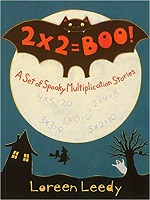
2 X 2 = Boo!
Grade 3
5 skill lessons · 3 math-through-reading
Math
Skill lessons
The mathematics the book carries, taught directly. Printable workbook pages and teacher keys are not available for this book yet.
- 1Three Scarecrows, Same Parts Each
- 2The Spell That Empties Any Crowd
- 3Two Rows in the Spectacles
- 4Boo Stew for Five
- 5Four Feet of Wings, Four Times the Cookies
Math + reading
Math through the reading
The same book, entered through a sentence it prints. Change one word in the reading and the numbers change with it.
- 6The Word That Says What to Do
- 7Should the Big Bird Get Four Times the Cookies?
- 8One Foot of Wings, Four Feet of Wings
Reading
Reading and language lessons
The same book read as a text. What a word means in its sentence, how a character is shown, how the writing is put together - no mathematics.
- 9Three Questions and a Plan
- 10Hi Mom! Hi Mom!
- 11Put On Glasses and Stare
- 12That's Because I'm So Much Bigger
- 13Caw, Caw, Boom, AHHHHH
Skill lessons
5 lessons on the mathematics the book carries. Printable workbook pages and teacher keys are not available for this book yet.
1. Three Scarecrows, Same Parts Each
Chapter three hands over the cleanest equal-groups picture in the book: three scarecrows, and every one of them gets the same parts. Students build the three mats, load each with two eyes and then with three teeth, count the mats by the group size, and write the two equations that say what the mats show. Concept work here is seeing that the word each is what makes the groups equal, and that the two numbers in the equation do different jobs.
Full lesson — 20 minutes
1. Build the three scarecrows (5 min)
Set out three paper mats, one for each scarecrow the sisters decide to build. Put one pumpkin counter on every mat, then count the mats aloud, touching one mat per number word: one, two, three. Tell your partner how many scarecrows you have and how many pumpkins that took.
Word preview: times, each
The garden is so large, we'd better make three scare crows.
One pumpkin times three equals three pumpkins.
2. Put two eyes on every mat (5 min)
The book says each head needs two eyes. Put two counters on every one of your three mats, so no mat has more than another. Count by twos across the mats, one touch per mat: two, four, six. Say how many groups you filled and how many eyes went in each.
Word preview: groups, equal
Each head needs two eyes.
Two eyes times three equals six eyes.
3. Write what your mats say (5 min)
Write 2 × 3 = 6 on your board next to the mats. Ring the 3 and touch the three mats; ring the 2 and touch inside one mat. Say out loud which number counts the scarecrows and which counts the eyes on one of them.
Word preview: equal
4. Do the teeth the same way (5 min)
Clear your mats and build the mouths: three teeth on each of the three mats, none left over. Count by threes to nine, touching a whole mat per number word, then write 3 × 3 = 9 under your first equation. Tell your partner what stayed the same in both builds and what changed.
Word preview: times, groups
Each mouth needs three teeth.
Three teeth times three equals nine teeth.
Short version — 9 minutes
1. Put two eyes on every mat (5 min)
Set out three mats for the three scarecrows, then put two counters on every mat so no mat has more than another. Count by twos across the mats, one touch per mat: two, four, six. Say how many groups you filled and how many went in each.
Word preview: groups, equal
Each head needs two eyes.
Two eyes times three equals six eyes.
2. Write what your mats say (4 min)
Write 2 × 3 = 6 beside your mats. Ring the 3 and touch the three mats; ring the 2 and touch inside one mat. Say which number counts scarecrows and which counts eyes.
Word preview: equal
Three levels
- Support
- Stay with the eyes and leave the teeth out. Build the three mats with your partner and count to six twice: once touching every single counter, and once touching only whole mats. Hearing the same six come out of both counts is the whole point of the lesson, and it is worth the full time.
- At Grade
- Build both rounds, count each by its group size, and write both equations with the two numbers ringed and named aloud. Say each equation first as a sentence about scarecrows, then as numbers.
- Extension
- After both equations are written, build the limbs round as well: four on each of the three mats. Before counting, tell your partner what you expect and why, then count by threes to twelve to check. Say what happens to the total each time the number on a mat goes up by one.
English learners
The arithmetic travels: three mats with two counters each look the same to a child who counted first in Somali or Spanish, and the written equation 2 × 3 = 6 is readable before any English is spoken. What does not travel is the English word each, which is doing the quiet work of making the groups equal, and the phrase order in "two eyes times three", where the thing comes before the number of groups. Rehearse one frame with a hand on the mats until it is automatic: how many mats, how many on each mat, how many altogether. Let students count aloud in their strongest language while they build, then report the frame in English.
Materials
- Round counters, 80 per pair
- Paper group mats, five per pair
- Small whiteboard and marker, one per student
- Word cards: each, equal, groups, times
Standards & curriculum
Choose your curriculum above to see the standards for this lesson.
Standards are held back while this plan is edited. Every standard shown here was matched against the supplied wording of this lesson, quoting its steps, so a changed step is no longer the thing that was checked. Undo your changes to bring the standards back — your edits stay in this browser either way.
2. The Spell That Empties Any Crowd
The first chapter runs five multiplications by zero and the back matter turns them into a claim about every number. Students act each one out on a mat, write the five equations as a column, then test the claim on a number the book never used. The thinking is in noticing that the column of answers never moves, and in deciding whether five cases are enough to believe a rule about all numbers.
Full lesson — 20 minutes
1. Make the vampire vanish (5 min)
Read the vampire line with your partner. Put one counter on the mat, then take away everything the spell leaves behind and say what is left. Say the sentence back in your own words: one vampire, none of them left, zero.
Word preview: zero
I know, one vampire time zero equals zero vampires.
2. Try it on bigger crowds (6 min)
Do the same for the bats, the snakes, the spiders and the ghosts: two, then three, then four, then five counters on the mat, and each time say aloud what is left after the spell. Tell your partner whether the answer ever changes when the crowd gets bigger.
Word preview: zero, times
Two bats times zero equals zero bats.
Four spiders times zero equals zero spiders.
Five ghosts times zero equals zero ghosts.
3. Write the five equations (5 min)
Write the five lines down your board, 1 × 0 = 0 through 5 × 0 = 0, one under the other. Read them aloud in order. Point at the column of answers and say what you notice about it.
Word preview: equal
1 times 0 equals 0.
4. Test the rule the book states (4 min)
The back of the book makes a claim about every number. Pick a number bigger than any in your column, put that many counters on the mat, and run the spell on it. Tell your partner whether the book's claim held, and how your counters showed it.
Word preview: rule
Any number times 0 will equal 0.
Short version — 9 minutes
1. Try it on bigger crowds (5 min)
Run the spell on the bats, the snakes, the spiders and the ghosts: two, three, four, then five counters on the mat, saying aloud what is left each time. Tell your partner whether the answer ever changes when the crowd grows.
Word preview: zero, times
Two bats times zero equals zero bats.
Four spiders times zero equals zero spiders.
Five ghosts times zero equals zero ghosts.
2. Test the rule the book states (4 min)
Read the book's claim about every number. Pick a number bigger than five, put that many counters on the mat, and run the spell. Say whether the claim held and how your counters showed it.
Word preview: rule
Any number times 0 will equal 0.
Three levels
- Support
- Stay with the vampire and the bats and use counters you can sweep off the mat with one hand. Say the same sentence each time, with the number changing and the answer not: so many went in, none came out. Two clean cases said aloud are worth more here than five rushed ones.
- At Grade
- Act out all five crowds, write the column of five equations, and test the book's claim on a number of your own choosing.
- Extension
- After you have tested the claim, write the equation with the numbers the other way round, 0 × 4, and build it on the mat: four mats with nothing on any of them. Tell your partner why both arrangements land on zero when they look nothing alike, and whether one of them explains the rule better than the other.
English learners
The sweeping gesture carries the whole idea without English, and the column of five equations is readable at a glance, so a student can do the mathematics of this lesson before saying a word. The English of the claim itself is the obstacle: any means every one rather than a particular one, and a student may hear "any number" as a permission rather than a rule. Rehearse the frame with a hand on the mats: no matter how many I start with, I end with none. Invite students to state the rule first in their strongest language, then in that English frame.
Materials
- Round counters, 80 per pair
- Paper group mats, five per pair
- Small whiteboard and marker, one per student
- Word cards: equal, rule, times, zero
Standards & curriculum
Choose your curriculum above to see the standards for this lesson.
Standards are held back while this plan is edited. Every standard shown here was matched against the supplied wording of this lesson, quoting its steps, so a changed step is no longer the thing that was checked. Undo your changes to bring the standards back — your edits stay in this browser either way.
3. Two Rows in the Spectacles
Chapter two doubles five different objects and the back matter names doubling as multiplying by two. Students build each item as one row and its double as a matching second row, so the picture of doubling is always two equal rows rather than a memorised answer. The second row is what the word double points at, and the equation is a second way of writing the same two rows.
Full lesson — 20 minutes
1. Double the moose head (5 min)
Read the directions on the spectacles, then put one counter on the mat for the moose head. Add a second counter so the mat holds two, and say what the glasses did in your own words. Write 1 × 2 = 2 underneath.
Word preview: double
Put on glasses and stare at something.
The item will double.
One times two equals two.
2. Double the boots and the hats (5 min)
Do the boots next: two counters, then a matching second row of two, counted to four. Then the hats: three counters and a matching row of three, counted to six. Say each total to your partner before you write its equation.
Word preview: equal, double
Two times two equals four.
Three times two equals six.
3. Fill the doubling column (5 min)
Write the five doubling equations down your board, 1 × 2 = 2 through 5 × 2 = 10. Build the brooms and the books on the mat to check the last two. Read the column of answers aloud, in order.
Word preview: times
4 times 2 equals 8.
5 times 2 equals 10.
4. Say what doubling does (5 min)
Look at your column of answers: two, four, six, eight, ten. Tell your partner how much each answer grows over the one above it, and why that step is two. Then say what the word double means using your own two rows as evidence.
Word preview: double, rule
You can double any number by multiplying it by 2.
Short version — 9 minutes
1. Double the boots and the hats (5 min)
Build the boots: two counters, then a matching second row of two, counted to four. Then the hats: three counters and a matching row of three, counted to six. Say each total before writing its equation.
Word preview: equal, double
Two times two equals four.
Three times two equals six.
2. Say what doubling does (4 min)
Read your column of answers aloud: two, four, six, eight, ten. Tell your partner how much each answer grows over the one above it, and say what double means using your own two rows as evidence.
Word preview: double, rule
You can double any number by multiplying it by 2.
Three levels
- Support
- Work the moose head and the boots only, and lay the second row directly under the first so the match is visible without counting. Say the same sentence both times: this many, and this many again. Keep the two rows on the mat while you write the equation.
- At Grade
- Build all five items as paired rows, write the five equations as a column, and say how much each answer climbs over the one above it.
- Extension
- Zelda doubles herself in a mirror at the end of the chapter. Build that as two rows of one, then tell your partner whether doubling one and doubling five feel like the same move, and what stays the same in the picture when the number changes.
English learners
Two matching rows say double without a word of English, and a student can build all five items and check every total by matching rather than counting. The English word double itself is a noun, a verb and an adjective in this book within three sentences, and several languages carry it with a word closer to twice. Rehearse one frame while the two rows sit on the mat: this many, and this many again, makes this many. Let students name the rows in their strongest language first, then give the English frame.
Materials
- Round counters, 80 per pair
- Paper group mats, five per pair
- Small whiteboard and marker, one per student
- Word cards: double, equal, rule, times
Standards & curriculum
Choose your curriculum above to see the standards for this lesson.
Standards are held back while this plan is edited. Every standard shown here was matched against the supplied wording of this lesson, quoting its steps, so a changed step is no longer the thing that was checked. Undo your changes to bring the standards back — your edits stay in this browser either way.
4. Boo Stew for Five
The stew chapter runs the same multiplier down four ingredients in a row, which is what makes it a fluency lesson rather than a concept one. Students build the first two lines on five mats, write all four equations, and read the column of totals to notice that each new ingredient adds another five. They say and write the five facts with the mats still on the table, so the numbers stay attached to something.
Full lesson — 20 minutes
1. Read the recipe line by line (4 min)
Mr. Bones has a recipe for one serving and five people to feed. Read the four ingredient lines with your partner and write down just the number in each: one eyeball, two knuckles, three ears, four toes. Do not multiply anything yet.
Word preview: each
This recipe is only for one serving, but there will be five of us.
Don't worry, I can multiply each ingredient by five.
2. Build the eyeballs and the knuckles (6 min)
Set out five mats, one per dinner guest. Put one counter on each mat for the eyeball line and count by ones to five. Clear them, then put two counters on each mat for the knuckles and count by twos to ten, one touch per mat. Say the two totals to your partner before you write anything.
Word preview: groups
First it calls for one bouncy eyeball.
Next it says two knobby knuckles.
3. Write all four ingredient equations (6 min)
Write the four equations down your board: 1 × 5 = 5, 2 × 5 = 10, 3 × 5 = 15, 4 × 5 = 20. Build the ears and the toes on the mats to check the last two before you write them. Ring the 5 in every line and say what it counts each time.
Word preview: times, equal
Three pointy ears.
4. Say what happens to the totals (4 min)
Read your four totals down the board: five, ten, fifteen, twenty. Tell your partner how much the total climbs each time the recipe asks for one more of something, and why that jump is five and not one.
Word preview: times
Three times five equals fifteen.
Short version — 9 minutes
1. Build the eyeballs and the knuckles (5 min)
Set out five mats, one per guest. Put one counter on each for the eyeball line and count to five; clear them and put two on each for the knuckles, counting by twos to ten. Say both totals aloud.
Word preview: groups
First it calls for one bouncy eyeball.
Next it says two knobby knuckles.
2. Write all four ingredient equations (4 min)
Write 1 × 5 = 5 and 2 × 5 = 10 on your board. Ring the 5 in both lines and say what it counts. Then write the ears line and check it on the mats.
Word preview: times, equal
Three pointy ears.
Three levels
- Support
- Work only the eyeball and knuckle lines, with the five mats staying out the whole time. Count each build twice, once by single counters and once by whole mats. Write the two equations with your partner and read them aloud together.
- At Grade
- Build the first two lines, write all four equations, and read the column of totals aloud naming what climbs and by how much.
- Extension
- After the four equations, use the book's last line about tails to write the fifth: five scaly tails for five guests. Predict the total before building it, then say why this one is the only ingredient where both numbers in the equation are the same, and what that does to the shape on the mats.
English learners
Counting by fives transfers straight across languages, and so does the column of equations, so a student can build every ingredient and check every total without speaking. Two things do not transfer. The English word ingredient is likely new even to a fluent speaker, and the phrase "multiply each ingredient by five" hides who gets multiplied. Preview ingredient with the four things named on the mats in front of you, then rehearse the frame: this line needs so many for one guest, so it needs so many for five. Students may count in the language they count fastest in and report the totals in English.
Materials
- Small whiteboard and marker, one per student
- Round counters, 80 per pair
- Paper group mats, five per pair
- Word cards: each, equal, groups, times
Standards & curriculum
Choose your curriculum above to see the standards for this lesson.
Standards are held back while this plan is edited. Every standard shown here was matched against the supplied wording of this lesson, quoting its steps, so a changed step is no longer the thing that was checked. Undo your changes to bring the standards back — your edits stay in this browser either way.
5. Four Feet of Wings, Four Times the Cookies
Chapter four is the only place the book attaches its multiplier to a measurement: one foot of wings against four, and a cookie claim built on the difference. Students set the two wingspans side by side, build the matching cookie piles for three starting amounts, write the four-times column, and decide whether the book's own claim about multiplying by four held up on the mats. The multiplier comes out of a situation rather than off a page.
Full lesson — 20 minutes
1. Set the two wingspans side by side (5 min)
Read the two lines about wings. Lay one connecting cube on the mat for the small bird's wings and a strip of four cubes beside it for the big bird's. Tell your partner how many of the small wingspan fit along the big one.
Word preview: times, wide
How wide are your wings?
About one foot.
See, my wings are four feet wide.
2. Test the cookie claim (6 min)
The big bird says the wings decide the cookies. Put one cookie counter on the small bird's mat and build the big bird's share beside it, four counters. Count both, then do it again starting with two cookies and then with three. Say what the big bird's pile does each time the small one grows by one.
Word preview: times, each
So if I get 1 cookie, you get 4 cookies.
2 times 4 equals 8.
3 times 4 equals 12.
3. Write the four-times column (5 min)
Write the five equations down your board, 1 × 4 = 4 through 5 × 4 = 20. Build the last two on the mats to check them. Ring the 4 in every line and say what that number is doing.
Word preview: equal
4 times 4 equals 16.
Five times four equals twenty.
4. Judge whether the claim holds (4 min)
The book's back matter states what multiplying by four does. Read it, then tell your partner whether your piles agreed with it every time, and point at the two piles that show it best.
Word preview: rule, times
If I multiply by 4, I get 4 times as much.
Short version — 9 minutes
1. Test the cookie claim (5 min)
Put one cookie counter on the small bird's mat and build the big bird's share beside it, four counters. Do it again starting with two cookies, then three. Say what the big pile does each time the small one grows by one.
Word preview: times, each
So if I get 1 cookie, you get 4 cookies.
2 times 4 equals 8.
3 times 4 equals 12.
2. Write the four-times column (4 min)
Write 1 × 4 = 4, 2 × 4 = 8 and 3 × 4 = 12 on your board beside the piles. Ring the 4 in every line and say what that number is doing.
Word preview: equal
4 times 4 equals 16.
Five times four equals twenty.
Three levels
- Support
- Work only the first two cookie amounts and keep the four-cube wing strip on the mat as a reminder of where the four came from. Build each pile in a straight row so the four is countable at a glance, and say the total aloud before writing anything.
- At Grade
- Build three cookie amounts, write the five equations, and say whether the book's claim about multiplying by four held on your mats.
- Extension
- The big bird argues the cookies should follow the wings. Build one pile for a bird whose wings are two feet wide, decide what its share would be under the same rule, and tell your partner what in the book lets you decide that and what you had to bring yourself.
English learners
The two wing strips make the comparison visible before English enters, and the paired piles let a student check every claim by matching rather than translating. The English construction "four times as much" is the hard part: times means neither the clock nor an occasion, and as much carries the comparison. Preview it with the cube strips in hand and rehearse a single frame: mine is this wide, yours is four of mine, so yours gets four for every one of mine. Let students reason aloud in their strongest language while they build the piles, then give the frame in English.
Materials
- Round counters, 80 per pair
- Connecting cubes, 40 per pair
- Paper group mats, five per pair
- Small whiteboard and marker, one per student
- Word cards: each, equal, rule, times, wide
Standards & curriculum
Choose your curriculum above to see the standards for this lesson.
Standards are held back while this plan is edited. Every standard shown here was matched against the supplied wording of this lesson, quoting its steps, so a changed step is no longer the thing that was checked. Undo your changes to bring the standards back — your edits stay in this browser either way.
Math through the reading
The mathematics is reached through a sentence the book prints: change one word in the reading and the numbers change with it. These carry their own standards, matched against these lessons rather than inherited from the skill ones.
6. The Word That Says What to Do
Students collect the four words this book uses to order a multiplication, test each one on counters, then swap one word in a book sentence and build what the new sentence demands instead.
Full lesson — 20 minutes
1. Collect the four words (4 min)
Students hunt the four operator words in the chapters they have read and write each on a strip: times, each, double, triple. Beside each word they write nothing yet.
2. Predict, then build, one word at a time (7 min)
For each word strip in turn, students say aloud what that word tells them to do to a pile, then build it on the mats and count. They write the equation only after the counters agree with what they said.
3. Swap one word and rebuild (6 min)
Given a book sentence with one word altered, students build what the new sentence demands beside the original build, count both, and say which word changed and what it did to the total.
4. Report the four words (3 min)
Each pair reports one word and the move it names, using their own build as the evidence, in a sentence a partner could follow without seeing the book.
Short version — 9 minutes
1. Predict, then build, one word at a time (7 min)
For each word strip in turn, students say aloud what that word tells them to do to a pile, then build it on the mats and count. They write the equation only after the counters agree with what they said.
2. Swap one word and rebuild (6 min)
Given a book sentence with one word altered, students build what the new sentence demands beside the original build, count both, and say which word changed and what it did to the total.
Three levels
- Support
- Work two words rather than four, times and double, and keep the built pile in front of the student while they say what the word did. Say the prediction before every build, even when the answer is obvious, because saying it first is the part being learned.
- At grade
- Students work all four words, predict before each build, and complete the swap with both piles side by side.
- Extension
- After the swap, students write a second swap of their own: change one word in a different book sentence so the total changes, hand it to a partner without saying what they altered, and see whether the partner's build lands where they intended.
English learners
The builds carry the meaning with no English at all, so a student can do every piece of the mathematics before speaking. The four words themselves are the difficulty and they are unusually slippery: times is not the clock and not an occasion, each looks like a word for one thing while doing the work of all of them, and double and triple are a noun, a verb and an adjective within a page. Preview each word with the built pile in hand rather than on a list, and rehearse one frame per word, for example this word says make it this many times bigger. Let students predict in their strongest language first and then give the English frame with a hand on the counters.
Materials
- Counters, 60 per pair
- Group mats, five per pair
- Word strips, four per pair
- Small whiteboard and marker
- The four book sentences, enlarged
- One altered sentence for the swap
Standards & curriculum
Choose your curriculum above to see the standards for this lesson.
Standards are held back while this plan is edited. Every standard shown here was matched against the supplied wording of this lesson, quoting its steps, so a changed step is no longer the thing that was checked. Undo your changes to bring the standards back — your edits stay in this browser either way.
7. Should the Big Bird Get Four Times the Cookies?
Students build both birds' shares from the wingspans the book gives, take a side on whether the big bird's rule is fair, and argue it aloud to the small bird with the counts in hand.
Full lesson — 20 minutes
1. Lay the wings side by side (4 min)
Students build a one-cube strip and a four-cube strip for the two wingspans and read the two lines that give them. They say how many of the small span fit along the big one.
2. Build what the rule gives (6 min)
Students build both birds' shares at one, two and three cookies, count each pair, and record the six totals beside the wing strips.
3. Take a side and say why (7 min)
Each student states whether the rule is fair and argues it to a partner playing the small bird, naming a count from the piles. The partner must object once, and the speaker must answer the objection.
4. Hear the third bird (3 min)
Students read the chapter's last line and say in one sentence what it does to the position they just argued.
Short version — 9 minutes
1. Build what the rule gives (6 min)
Students build both birds' shares at one, two and three cookies, count each pair, and record the six totals beside the wing strips.
2. Take a side and say why (7 min)
Each student states whether the rule is fair and argues it to a partner playing the small bird, naming a count from the piles. The partner must object once, and the speaker must answer the objection.
Three levels
- Support
- Work only the one-against-four pair and keep both wing strips on the table while arguing. Give the student the opening sentence to start from, so the effort goes into naming the count rather than into finding a way in.
- At grade
- Students build all three cookie pairs, take a side, and answer one objection from a partner using a count from their own piles.
- Extension
- Students argue the position they did not choose, using the same piles, then say which of the two arguments the book's own numbers support better and whether the last line about the other birds changes that.
English learners
The piles do the persuading before any English arrives, and a student can build every pair and count every difference without speaking. The argumentative English this lesson turns on is what has to be taught: four times as much, where times is neither a clock nor an occasion, and the objection-and-answer shape of a disagreement, which is unfamiliar as a classroom form in many places even to confident speakers. Preview four times as much with the cube strips in hand, and rehearse two frames, one for the claim and one for the answer, for example my wings are this many of yours, so I should get this many for every one of yours. Let students settle their position in their strongest language, then argue it in English with the counts in front of them.
Materials
- Connecting cubes, 20 per pair
- Counters, 40 per pair
- Two mats per pair
- The two wingspan lines, enlarged
- The chapter's closing line
Standards & curriculum
Choose your curriculum above to see the standards for this lesson.
Standards are held back while this plan is edited. Every standard shown here was matched against the supplied wording of this lesson, quoting its steps, so a changed step is no longer the thing that was checked. Undo your changes to bring the standards back — your edits stay in this browser either way.
8. One Foot of Wings, Four Feet of Wings
Students build both wingspans as cube strips, work out how many of the small one fit along the big one, and then say the relation both ways round before checking it against the book's cookie counts.
Full lesson — 20 minutes
1. Build the two spans (5 min)
Students build a one-cube strip and a four-cube strip from the two lines the book gives, and lay them alongside each other so the ends line up.
2. Find how many fit (5 min)
Students step the small strip along the big one, counting how many times it fits. They say the number aloud before writing anything.
3. Say it both ways (7 min)
Students say the book's sentence about the big bird's wings, then say the sentence the book never gives, about the small bird's wings against the big bird's, with the strips in hand. Partners check that both sentences describe the same two strips.
4. Check it on the cookies (3 min)
Students build one counter against four and say whether the cookie pairing matches the number the strips gave them.
Short version — 9 minutes
1. Find how many fit (5 min)
Students step the small strip along the big one, counting how many times it fits. They say the number aloud before writing anything.
2. Say it both ways (7 min)
Students say the book's sentence about the big bird's wings, then say the sentence the book never gives, about the small bird's wings against the big bird's, with the strips in hand. Partners check that both sentences describe the same two strips.
Three levels
- Support
- Keep both strips joined end to end on the desk and step the short one along with a finger, counting aloud. Say the book's direction first and give it as a sentence to copy, so the new work is the second sentence and nothing else.
- At grade
- Students build both strips, find the multiplier by stepping, say the comparison in both directions, and check it against the cookie pair.
- Extension
- Students write the third bird's line into the comparison: if another bird's wings were two feet, where would it sit between the two strips, and what would its cookie share be under the same rule? They say what part of that they got from the book and what they had to supply.
English learners
The two strips make the comparison visible before English enters, and stepping the short strip along the long one is a wordless proof a student can complete alone. The English comparison frame is where the difficulty sits, particularly times as a multiplier and the wide of four feet wide, and the fact that the reversal is a different grammatical shape rather than the same sentence turned around. Rehearse the two frames separately with the strips in hand, for example mine is four of yours, and yours is one of my four. Let students find and state the relation in their strongest language first, then give both English sentences with a hand on each strip.
Materials
- Connecting cubes, 20 per pair
- Counters, 20 per pair
- The two wingspan lines, enlarged
Standards & curriculum
Choose your curriculum above to see the standards for this lesson.
Standards are held back while this plan is edited. Every standard shown here was matched against the supplied wording of this lesson, quoting its steps, so a changed step is no longer the thing that was checked. Undo your changes to bring the standards back — your edits stay in this browser either way.
Reading and language lessons
5 lessons on the reading and language the book carries - what a word means in its sentence, how a character is shown, how a text is built. No mathematics: these are matched against the English language arts curricula, which are a different and smaller set than the mathematics ones.
9. Three Questions and a Plan
Before any story starts, this book does two jobs on one page: it hooks the reader with three odd questions, and then it lays out the order of what is coming. Students read the two stretches, name what each one is doing, and say how the second changes what a reader expects. They finish by describing the book's plan in a sentence of their own. Nothing is calculated; the work is reading front matter as a piece of writing with a purpose.
Full lesson — 20 minutes
1. Read the hook (5 min)
Read the passage below aloud with the class. The first three sentences are all questions and the fourth is not. Say aloud what the fourth sentence does for the three before it, and why a reader might keep going after reading this.
Word preview: hook
How do you make a vampire disappear? How do you turn one bag of candy into five bags? And how do you double a moose head? All you have to do is multiply.
2. Read the plan (5 min)
Read the passage below with a partner. This stretch does something different from the hook. Say aloud what it tells you about the order of the book, and point to the two words that name that order.
Word preview: order
The first chapter is about multiplying with zero. The next chapter is about multiplying with the number one. Keep going and by the time you've read all the stories, you will know the multiplication facts from zero to five. Have fun!
3. Say what each part is for (6 min)
Read the two passages below one after the other. Say aloud which one is trying to make you curious and which one is trying to tell you how the book is built. Give one piece of wording from each passage as your reason.
Word preview: purpose
How do you make a vampire disappear? How do you turn one bag of candy into five bags? And how do you double a moose head? All you have to do is multiply.
The first chapter is about multiplying with zero. The next chapter is about multiplying with the number one. Keep going and by the time you've read all the stories, you will know the multiplication facts from zero to five. Have fun!
4. Describe the book in one sentence (4 min)
Read the passage below one more time. Then tell a partner one sentence describing how this book is arranged, without using the book's own wording. Say it as if you were recommending it to somebody.
Word preview: arranged
The first chapter is about multiplying with zero. The next chapter is about multiplying with the number one. Keep going and by the time you've read all the stories, you will know the multiplication facts from zero to five. Have fun!
Short version — 9 minutes
1. Read the hook (4 min)
Read the passage below aloud. Say what the fourth sentence does for the three questions before it, and why a reader might keep going.
Word preview: hook
How do you make a vampire disappear? How do you turn one bag of candy into five bags? And how do you double a moose head? All you have to do is multiply.
2. Say what each part is for (5 min)
Read the two passages below one after the other. Say which one makes you curious and which tells you how the book is built, giving wording from each as your reason.
Word preview: purpose
How do you make a vampire disappear? How do you turn one bag of candy into five bags? And how do you double a moose head? All you have to do is multiply.
The first chapter is about multiplying with zero. The next chapter is about multiplying with the number one. Keep going and by the time you've read all the stories, you will know the multiplication facts from zero to five. Have fun!
Three levels
- Support
- Read only the passage in step 1 with the teacher. Point to the three question marks. Say aloud which of the three questions you would most like answered.
- At Grade
- Read both passages in step 3 and say what each one is doing for the reader, quoting a few words from each as evidence.
- Extension
- Read the passage in step 2. Say two or three sentences about what a reader gains from being told the order of the chapters before reading any of them.
English learners
The hook depends on rhetorical questions — questions that are not really asking — which several languages signal with a particle English does not have. Read the three questions, then say plainly that the book is not expecting an answer, it is advertising. Invite students to describe how a book or advert grabs attention in their strongest language. Rehearsable frame: This part is there to ___, because it ___.
Materials
- 2 X 2 = Boo!, the passage printed in this step
- front matter chart
- sentence frame strip
- Word cards: hook, order, purpose, arranged
Standards & curriculum
Choose your curriculum above to see the standards for this lesson.
Standards are held back while this plan is edited. Every standard shown here was matched against the supplied wording of this lesson, quoting its steps, so a changed step is no longer the thing that was checked. Undo your changes to bring the standards back — your edits stay in this browser either way.
10. Hi Mom! Hi Mom!
The attic chapter ends on two identical words and no explanation at all. Students read the plan, read the warning the character gives herself, and then read the ending, and explain what has happened using only what is on the page. The point is that the writer left the last step to the reader. Students say what the text does not say; they are not asked to work out any quantity.
Full lesson — 20 minutes
1. Read the plan the character makes (5 min)
Read the passage below with the class. Say aloud what the character has decided to do and what she thinks it will get her. Say whether she sounds worried or pleased.
Word preview: plan
Hey, I have a great idea. I'll use this mirror to double myself.
Zelda, have you finished cleaning up there yet? Not quite mom. Oh no, it's going to take twice as long with all this extra stuff.
2. Read the ending exactly (5 min)
Read the passage below with a partner, exactly as it is printed. Two words are repeated. Say aloud who is speaking each time, and whether one speaker or more than one must be present.
Word preview: repeat
Zelda, what's taking you so long? Hi mom! Hi mom!
3. Explain what the book never says (6 min)
Read the two passages below together. The book never tells you what happened between them. Say aloud what must have happened, and name the sentence in the first passage that let you work it out.
Word preview: explain
Hey, I have a great idea. I'll use this mirror to double myself.
Zelda, what's taking you so long? Hi mom! Hi mom!
4. Say why leaving it out is funnier (4 min)
Read the passage below once more. Then tell a partner one or two sentences about why the ending is funnier left as it is than it would be if the book explained it. Point to the words that do the work.
Word preview: funnier
Zelda, what's taking you so long? Hi mom! Hi mom!
Short version — 9 minutes
1. Read the ending exactly (4 min)
Read the passage below exactly as printed. Two words are repeated. Say who is speaking each time and whether one speaker or more than one must be present.
Word preview: repeat
Zelda, what's taking you so long? Hi mom! Hi mom!
2. Explain what the book never says (5 min)
Read the two passages below together. Say what must have happened between them, and name the sentence that let you work it out.
Word preview: explain
Hey, I have a great idea. I'll use this mirror to double myself.
Zelda, what's taking you so long? Hi mom! Hi mom!
Three levels
- Support
- Use only the passage in step 2. The teacher reads it. Answer aloud: does one person say hello here, or more than one? Point to each greeting as you say it.
- At Grade
- Read both passages in step 3 and explain in two sentences what happened between them, naming your evidence.
- Extension
- Read both passages in step 3. Say two or three sentences about what a writer risks by leaving the last step of a joke to the reader, and why this one still works.
English learners
Humour that lives in an omission is the hardest kind to catch in a new language, because nothing on the page can be looked up. Walk the two passages through as a sequence of pictures — mirror, then two greetings — before asking for any explanation. Invite students to tell a short joke from their own language and say what the listener has to supply. Rehearsable frame: The book does not say ___, but I know it because ___.
Materials
- 2 X 2 = Boo!, the passage printed in this step
- set-up and punchline strips
- sentence frame strip
- Word cards: plan, repeat, explain, funnier
Standards & curriculum
Choose your curriculum above to see the standards for this lesson.
Standards are held back while this plan is edited. Every standard shown here was matched against the supplied wording of this lesson, quoting its steps, so a changed step is no longer the thing that was checked. Undo your changes to bring the standards back — your edits stay in this browser either way.
11. Put On Glasses and Stare
In the middle of a story, this book prints a short set of directions, and it is written nothing like the sentences around it: no characters, no past tense, one instruction to a line. Students read the directions, name the features that mark them as directions, hold them beside a story passage, and then say a set of directions of their own for an ordinary classroom task. No steps are counted or timed; the work is recognising and producing a text type.
Full lesson — 20 minutes
1. Read the directions (5 min)
Read the passage below with the class, one instruction at a time. Say aloud who each sentence is talking to. Then say whether any of these sentences names a character.
Word preview: directions
Directions. Put on glasses and stare at something. Multiply by two. The item will double.
2. Hold them beside the story (6 min)
Read the two passages below one after the other. One is a story and one is a set of directions. Say aloud two things about the wording that tell them apart. Point to a word in each passage as evidence.
Word preview: compare
Directions. Put on glasses and stare at something. Multiply by two. The item will double.
I can't believe that Mom expects me to clean this entire attic. Just look at all this old junk. Whose glasses are these? Dr. Spook's double vision spectacles.
3. Try following them (5 min)
Read the passage below again with a partner. Act out each instruction in order using an imaginary pair of glasses. Say aloud what would go wrong if you did the instructions in a different order.
Word preview: follow
Directions. Put on glasses and stare at something. Multiply by two. The item will double.
4. Write directions of your own (4 min)
Read the passage below one more time to hear the shape. Then say a set of three directions to a partner for sharpening a pencil, in the same wording style, with a heading first.
Word preview: heading
Directions. Put on glasses and stare at something. Multiply by two. The item will double.
Short version — 9 minutes
1. Read the directions (4 min)
Read the passage below one instruction at a time. Say who each sentence is talking to, and whether any of them names a character.
Word preview: directions
Directions. Put on glasses and stare at something. Multiply by two. The item will double.
2. Hold them beside the story (5 min)
Read the two passages below one after the other. Say two things about the wording that tell directions from story, pointing to a word in each as evidence.
Word preview: compare
Directions. Put on glasses and stare at something. Multiply by two. The item will double.
I can't believe that Mom expects me to clean this entire attic. Just look at all this old junk. Whose glasses are these? Dr. Spook's double vision spectacles.
Three levels
- Support
- Use only the passage in step 1. Read it with the teacher. Point to the heading word Directions. Act out the first instruction.
- At Grade
- Read both passages in step 2 and name two features of the wording that tell directions from story writing.
- Extension
- Read both passages in step 2. Say two or three sentences about why a writer would drop a set of directions into the middle of a story instead of just describing what the character did.
English learners
English directions use a bare verb with no subject — Put on glasses, not You put on glasses — which reads as an incomplete sentence to many students. Say the full sentence first, then the direction form, so the missing you is heard as deliberate. Invite students to give one instruction in their strongest language and say whether it drops the subject too. Rehearsable frame: First ___. Then ___.
Materials
- 2 X 2 = Boo!, the passage printed in this step
- directions and story sort cards
- sentence frame strip
- Word cards: directions, compare, follow, heading
Standards & curriculum
Choose your curriculum above to see the standards for this lesson.
Standards are held back while this plan is edited. Every standard shown here was matched against the supplied wording of this lesson, quoting its steps, so a changed step is no longer the thing that was checked. Undo your changes to bring the standards back — your edits stay in this browser either way.
12. That's Because I'm So Much Bigger
One character wants more than his share and builds an actual argument for it, step by step, and the other character agrees far too easily. Students trace the reasoning as it is stated, say where the second character concedes, and then say what makes the ending funny. They judge the argument as a piece of persuasion. They are never asked to check whether the comparison is arithmetically right; the work is following how a case is made in words.
Full lesson — 20 minutes
1. Find what he wants (5 min)
Read the passage below with the class. Say aloud what the first speaker complains about, and what the second speaker wants. State the want in one sentence of your own.
Word preview: want
Hey, you're taking too many cookies. That's because I'm so much bigger. How wide are your wings? About one foot. See, my wings are four feet wide. I'm four times bigger than you, so I should get four times as much.
2. Find the reason he gives (6 min)
Read the passage below again with a partner. He does not only ask, he gives a reason. Point to the sentence where the reason begins, and say aloud what the reason rests on. Use the word because in your answer.
Word preview: reason
Hey, you're taking too many cookies. That's because I'm so much bigger. How wide are your wings? About one foot. See, my wings are four feet wide. I'm four times bigger than you, so I should get four times as much.
3. Find where the other one gives in (5 min)
Read the passage below with the teacher. Say aloud the shortest thing the other speaker says here, and what it means for the argument. Then say whether he seems convinced or worn down.
Word preview: agree
Forget it, I'm leaving. Looks like I'll have to eat these cookies all by myself. What about us?
4. Say why the ending is funny (4 min)
Read the passage below one more time. Somebody who has not spoken before speaks at the very end. Tell a partner one or two sentences about why that turns the whole argument into a joke.
Word preview: ending
Forget it, I'm leaving. Looks like I'll have to eat these cookies all by myself. What about us?
Short version — 9 minutes
1. Find the reason he gives (5 min)
Read the passage below. Point to the sentence where his reason begins, and say what the reason rests on. Use the word because.
Word preview: reason
Hey, you're taking too many cookies. That's because I'm so much bigger. How wide are your wings? About one foot. See, my wings are four feet wide. I'm four times bigger than you, so I should get four times as much.
2. Say why the ending is funny (4 min)
Read the passage below. Somebody who has not spoken before speaks at the end. Say one or two sentences about why that turns the argument into a joke.
Word preview: ending
Forget it, I'm leaving. Looks like I'll have to eat these cookies all by myself. What about us?
Three levels
- Support
- Use only the passage in step 1. Read it with the teacher. Answer aloud: who wants more cookies? Point to the words he uses to say why.
- At Grade
- Read the passage in step 2 and state his reason in one sentence beginning with He should get more because.
- Extension
- Read the passages in steps 2 and 3. Say two or three sentences about whether the other speaker ever answers the reason, or only gives way to it.
English learners
The argument is carried by so much, times as much and four times bigger, which are comparison phrases rather than single words, and they are easy to hear as vague emphasis. Put two objects of different sizes on the table and say each phrase while pointing, then read the passage. Invite students to compare two objects in their strongest language and then reach for the English phrase. Rehearsable frame: He says he should get more because ___.
Materials
- 2 X 2 = Boo!, the passage printed in this step
- reason chain strips
- sentence frame strip
- Word cards: want, reason, agree, ending
Standards & curriculum
Choose your curriculum above to see the standards for this lesson.
Standards are held back while this plan is edited. Every standard shown here was matched against the supplied wording of this lesson, quoting its steps, so a changed step is no longer the thing that was checked. Undo your changes to bring the standards back — your edits stay in this browser either way.
13. Caw, Caw, Boom, AHHHHH
These stories keep printing noises straight onto the page instead of describing them, and each one lands at a moment where something goes wrong. Students find the sound words in three passages, say what is happening at that exact moment, and say what would be lost if the noise were replaced with an ordinary sentence. Nothing is counted; the work is noticing a device a writer uses and explaining its effect.
Full lesson — 20 minutes
1. Find the noises (5 min)
Read the passage below with the class. Point to every word here that is a noise rather than an ordinary word. Say each one aloud the way the scene needs it.
Word preview: sound
Did she say scarecrow? I better warn the others. Let's get them. Let's go outside and scare those crows. Shhh! Caw, caw, caw, caw! Help! A giant crow!
2. Say what is happening when the noise lands (6 min)
Read the passage below with a partner. Find the two noise words in it. Say aloud exactly what is happening at the moment each one is printed, and who is making the sound.
Word preview: moment
Now it has to simmer a while Later Mmm, the stew smells wonderful, let me take a peek BOOM! AHHHHH! It's perfect, Mr. Bones. You're a genius. Why thank you, Mrs. Tavia.
3. Compare two noisy endings (5 min)
Read the passage below with the teacher. It ends with a noise too. Say aloud what the noise tells you about the machine that the sentences before it did not, and whether you needed anybody to explain it.
Word preview: compare
Let's try a big number like 99. Wait, the machine is rumbling. It's going to... Boom! Wow! Thank you, Dr. Albert. You're welcome, Nelson.
4. Say what would be lost (4 min)
Read the passage below one last time. Choose one noise word in it. Tell a partner one or two sentences about what would change if the writer had written a plain sentence describing the sound instead.
Word preview: effect
Did she say scarecrow? I better warn the others. Let's get them. Let's go outside and scare those crows. Shhh! Caw, caw, caw, caw! Help! A giant crow!
Short version — 9 minutes
1. Find the noises (4 min)
Read the passage below. Point to every word that is a noise rather than an ordinary word, and say each one aloud the way the scene needs it.
Word preview: sound
Did she say scarecrow? I better warn the others. Let's get them. Let's go outside and scare those crows. Shhh! Caw, caw, caw, caw! Help! A giant crow!
2. Say what would be lost (5 min)
Read the passage below again. Choose one noise word and say what would change if the writer had described the sound in a plain sentence instead.
Word preview: effect
Did she say scarecrow? I better warn the others. Let's get them. Let's go outside and scare those crows. Shhh! Caw, caw, caw, caw! Help! A giant crow!
Three levels
- Support
- Use only the passage in step 1. Read it with the teacher. Point to the word Shhh and to the caws. Say each one aloud.
- At Grade
- Read the passage in step 2 and say what is happening at the exact moment each noise word is printed.
- Extension
- Read the passages in steps 1 and 3. Say two or three sentences about why a writer prints a noise instead of describing it, using both scenes as evidence.
English learners
Sound words are language-specific: an English crow says caw, and a crow in many other languages says something quite different, so these words cannot be worked out from meaning. Say each one aloud and name the animal or event it belongs to before reading the passage. Invite students to give the sound word for a crow, a bang and a shush in their strongest language, and put the pairs side by side. Rehearsable frame: ___ is the sound of ___.
Materials
- 2 X 2 = Boo!, the passage printed in this step
- sound word cards
- sentence frame strip
- Word cards: sound, moment, compare, effect
Standards & curriculum
Choose your curriculum above to see the standards for this lesson.
Standards are held back while this plan is edited. Every standard shown here was matched against the supplied wording of this lesson, quoting its steps, so a changed step is no longer the thing that was checked. Undo your changes to bring the standards back — your edits stay in this browser either way.