Seeing Symmetry
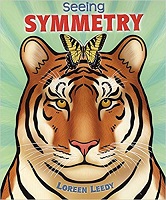
Grade 3
5 skill lessons
Math
Skill lessons
The mathematics the book carries, taught directly. Printable workbook pages and teacher keys are not available for this book yet.
- 1The Fold That Decides
- 2Matches in One Turn
- 3One Kind, or Both?
- 4Which Way Does the Line Run?
- 5When the Halves Do Not Match
Math + reading
Math through the reading
The same book, entered through a sentence it prints. Change one word in the reading and the numbers change with it.
No math-through-reading lessons for this book yet.
Reading
Reading and language lessons
The same book read as a text. What a word means in its sentence, how a character is shown, how the writing is put together - no mathematics.
No reading and language lessons for this book yet.
Skill lessons
5 lessons on the mathematics the book carries. Printable workbook pages and teacher keys are not available for this book yet.
1. The Fold That Decides
The book gives the test in one sentence — fold the shape exactly in half — and then says what a child is looking at once it is folded: two halves that are mirror images. Children fold paper figures, hold the folded pair up to the light to see whether the edges land on each other, and sort a tray of twelve figures into the ones that passed and the ones that did not. The idea under it: the child learns that symmetry is the answer to a test they perform, not something they judge by looking at the front of the shape.
Full lesson — 20 minutes
1. Fold and check (5 min)
Each child takes four paper figures from the tray and folds each one so the two halves land on each other. Hold the folded figure up to the window: if any edge sticks out past the other, the halves did not match. Say which of your four folded exactly in half.
Word preview: fold, half
If you can fold a shape exactly in half, it has symmetry.
2. Sort the tray into two piles (6 min)
Working in pairs, fold every one of the twelve figures and put it on the matched mat or the not-matched mat. A figure only goes on the matched mat if you folded it and the halves covered each other. Count both piles and write the two counts at the top of each mat.
Word preview: mirror image, symmetrical
If each half is a mirror image of the other half, the whole shape is symmetrical.
3. Draw the line you folded on (5 min)
Open each figure from the matched mat and draw along the crease with a ruler. Say what the line you have just drawn does to the figure. Every figure on the matched mat gets exactly one line drawn on it in this step, even if you can find another fold later.
Word preview: line of symmetry
The line in the middle is the line of symmetry.
4. One hand, then two (4 min)
Trace one of your hands, cut it out and try to fold it into matching halves. Then put the traced hand next to a tracing of your other hand and look at the pair. Say in one sentence what is true of the pair that was not true of the single hand.
One hand by itself does not have symmetry, but two hands are mirror images of each other.
Short version — 9 minutes
1. Fold and check (5 min)
Each child folds four paper figures so the halves land on each other, and says which ones folded exactly in half.
If you can fold a shape exactly in half, it has symmetry.
2. Draw the line you folded on (4 min)
Open the figures that matched, draw along the crease with a ruler, and say what that line does to the figure.
The line in the middle is the line of symmetry.
Three levels
- Support
- Work with six figures instead of twelve, and keep the four that fold cleanly together at the front of the tray so the first two folds succeed. The child still folds every figure and still says which matched; nothing about the test is softened.
- At Grade
- Twelve figures, both mats, both counts written, and one line drawn on every figure that passed.
- Extension
- Take three figures from the matched mat and find every fold that works, not just the first. Record how many lines each one has and put the three figures in order by that count.
English learners
The test transfers completely: a child who folds a figure sees whether the halves match whatever language they think in. What will not carry over is that English says this with a noun — symmetry — where the child's experience is a verb, folding. Say the frame the same way every time: I folded it, and the halves matched, so it has a line of symmetry. Children may fold and decide in their strongest language first, then say the English frame while pointing at the crease.
Materials
- A tray of twelve paper figures per group, four of which do not fold into matching halves
- A window or lamp to hold folded figures against
- Two paper mats per pair, one marked matched and one marked not matched
- A pencil
- A ruler per child
- Paper and scissors per child
- Word cards: fold, half, mirror image, line of symmetry
Standards & curriculum
These lessons are being matched against curricula now.
Standards are held back while this plan is edited. Every standard shown here was matched against the supplied wording of this lesson, quoting its steps, so a changed step is no longer the thing that was checked. Undo your changes to bring the standards back — your edits stay in this browser either way.
2. Matches in One Turn
The book turns from folding to spinning and hands over two counted cases: a flower with three matches in a rotation and a pinwheel with four. Children pin a paper figure through its centre, turn it one full way round with a fixed arrow to check against, and count the positions where the figure looks the same as it started. Practised until the count comes out the same every time because the child turns and checks in the same order, not because they remember an answer.
Full lesson — 20 minutes
1. Pin it and turn it (5 min)
Pin the letter Z card through the dot at its centre and turn it slowly all the way round while your partner watches the fixed arrow. Stop every time the Z looks exactly the way it did at the start and say stop out loud.
Word preview: turn, center point
A different kind of symmetry spins around.
Certain shapes rotate around a center point, much like an airplane propeller spins.
2. Count the flower's matches (5 min)
Pin the three-petal flower and turn it one full way round, counting out loud each time a petal lands where the arrow points. Write the count. The book states this one, so check your number against it and turn again if they disagree.
Word preview: matches
This flower has three matches in a rotation.
3. Count the pinwheel's matches (5 min)
Do the same with the four-bladed pinwheel: pin it, turn it one full way round, count the positions where it looks the same, and write the count. Then say which of your two figures made more matches in one turn.
The pinwheel has four matches in a rotation.
4. Name what you counted (5 min)
Write your two counts side by side and read the book's name for what you have been testing. Say one sentence for each figure that uses that name and the number you counted.
Word preview: rotational symmetry
The name for symmetry that spins around is rotational symmetry.
Short version — 9 minutes
1. Count the flower's matches (5 min)
Pin the three-petal flower, turn it one full way round, and count out loud each time a petal lands at the arrow. Check the count against the book.
This flower has three matches in a rotation.
2. Count the pinwheel's matches (4 min)
Turn the four-bladed pinwheel one full way round, count the matches, and say which figure made more.
The pinwheel has four matches in a rotation.
Three levels
- Support
- Turn the pinwheel only, and mark one blade with a sticker so the child has one thing to follow round instead of four. The count and the check against the book stay exactly as they are.
- At Grade
- All three figures pinned and turned, both counts written and checked against the book, and a sentence for each figure using the name and the number.
- Extension
- Cut a figure that makes exactly two matches in one turn, then one that makes six. Say what you had to do to the number of blades to change the count.
English learners
Turning and counting transfer; the phrase in one full turn does not, and it is the phrase the count depends on. A child who keeps turning past the start will count the same match twice, so mark the starting position with a sticker and say the frame at the sticker: back to the start, so stop counting. Rehearsable frame: I turned it one full way round and it matched ____ times. Children may count aloud in their strongest language and then say the frame in English with the figure still pinned in front of them.
Materials
- A letter Z card with a marked centre dot, per pair
- A push pin and a cork board or thick card, per pair
- A fixed paper arrow taped beside the pin
- A three-petal paper flower with a marked centre, per pair
- A four-bladed paper pinwheel with a marked centre, per pair
- A recording strip ruled for two counts, per child
- Word cards: turn, center point, matches, rotational symmetry
Standards & curriculum
These lessons are being matched against curricula now.
Standards are held back while this plan is edited. Every standard shown here was matched against the supplied wording of this lesson, quoting its steps, so a changed step is no longer the thing that was checked. Undo your changes to bring the standards back — your edits stay in this browser either way.
3. One Kind, or Both?
The book is explicit that the two kinds of symmetry come apart: some figures only spin, some do both, and it gives a worked case of each. Children run both tests — the fold and the turn — on the same figure, record the two results, and then have to say which test settled the question. The demand is the child's account of why a hubcap and a snowflake end up in different places when neither was judged by looking.
Full lesson — 20 minutes
1. Run both tests on one figure (6 min)
Take a figure, fold it every way you can and write whether any fold matched. Then pin it and turn it one full way round and write how many matches it made. Do this for four figures before you sort anything.
Word preview: only, both
Some shapes have only rotational symmetry, such as the hubcaps, while some shapes have both line and rotational symmetry, such as the snowflake
2. The one that spins but will not fold (5 min)
Find the figure on your sheet that made matches when you turned it and matched on no fold at all. Fold it three more ways in front of your partner to be sure. Say out loud what is true of it and what is not.
This shape spins around a center point but has no line of symmetry, no mirror image halves.
3. Three lines and a turn (5 min)
Now find the figure that did both. Count its lines of symmetry by folding, count its matches in one turn, and write the two numbers next to each other. Compare your two numbers with the pair beside you.
This shape can spin around a center point and it has three lines of symmetry.
4. Say which test decided it (4 min)
Put your four figures in three groups: folds only, turns only, and does both. For one figure in each group, say a sentence that names the test you ran and what it did, so a partner could put the figure in the same group without touching it.
Short version — 9 minutes
1. Run both tests on one figure (5 min)
Fold a figure every way you can and then pin and turn it, writing both results before sorting anything. Do this for two figures.
Some shapes have only rotational symmetry, such as the hubcaps, while some shapes have both line and rotational symmetry, such as the snowflake
2. Say which test decided it (4 min)
Sort the figures into folds only, turns only and does both, and say for one of them which test put it there.
Three levels
- Support
- Two figures instead of four, chosen so that one does both and one only turns. The child runs both tests on both figures and still has to say which test decided; only the number of figures drops.
- At Grade
- Four figures, both tests recorded for each, the two counts written side by side for the figure that does both, and a spoken sentence for each group.
- Extension
- Find or cut a figure that folds but makes only one match in a full turn, and explain to a partner why a single match does not earn the turning name.
English learners
Running two tests transfers; the English that holds two results in one sentence does not. Only and both are the load-bearing words here and neither is picturable, so build them from the child's own sheet: point at a row with one result and say only, point at a row with two and say both. Rehearsable frame: It ____ and it ____, so it does both. Children may report each test in their strongest language, then say the joined English sentence with the two results in front of them.
Materials
- Four test figures per pair, including a hubcap outline and a six-sided snowflake
- A push pin and board, per pair
- A two-column results sheet headed folded and turned, per pair
- A ruler per child
- Three labelled group cards per pair: folds only, turns only, does both
- Word cards: only, both, folded, turned
Standards & curriculum
These lessons are being matched against curricula now.
Standards are held back while this plan is edited. Every standard shown here was matched against the supplied wording of this lesson, quoting its steps, so a changed step is no longer the thing that was checked. Undo your changes to bring the standards back — your edits stay in this browser either way.
4. Which Way Does the Line Run?
The book states that a line of symmetry may be vertical or horizontal or both, and prints capital letters as its examples. Children run the fold test on letter cards twice — once folding up and down, once folding across — and file each letter in one of three columns by what the two folds did. The representation being built is the letter with its own fold line drawn on it, which is what makes a claim about a letter checkable by somebody else.
Full lesson — 20 minutes
1. Fold each letter two ways (6 min)
Each pair takes eight capital letter cards and folds every card twice: once top to bottom, once left to right. After each fold say whether the halves matched. Keep the card and both answers together.
Word preview: vertical, horizontal
Many letters can have line symmetry. The line of symmetry may be vertical or horizontal or both.
2. File the letters in three columns (5 min)
Put each letter in the column its folds earned: up and down, across, or both. A letter that matched on neither fold goes underneath the chart. Count the letters in each column and write the count in the column head.
3. Check your chart against the book (5 min)
The book prints its own list of the capital letters that have a line of symmetry. Read it and find any letter you filed that the book does not list, and any letter the book lists that you did not file. For each disagreement, fold the card again in front of your partner before you change anything.
Below are the capital letters that have line symmetry either vertical, horizontal, or both.
4. The letter that lost it (4 min)
Look at the same capital letter printed in a plain face and in a curly face. Fold both. Say which one still matched and what the fancy printing did to the fold.
The symmetry in letters can be lost due to the style of lettering used
Short version — 9 minutes
1. Fold each letter two ways (5 min)
Each pair folds six capital letter cards top to bottom and then left to right, saying after each fold whether the halves matched.
Many letters can have line symmetry. The line of symmetry may be vertical or horizontal or both.
2. File the letters in three columns (4 min)
File each letter under up and down, across, or both, and write how many letters landed in each column.
Three levels
- Support
- Use four letter cards chosen so that one lands in each column and one lands in neither. The child still folds both ways and still files by the result; only the number of cards is reduced.
- At Grade
- Eight letters, both folds on every card, three columns with counts, and every disagreement with the book settled by folding again.
- Extension
- Find a letter that belongs in the both column and write it inside a word whose whole spelling then folds across. Test the word by folding, and say which letter would break it if it were swapped.
English learners
The fold and the filing transfer; the two direction words do not. Vertical and horizontal are not picturable on their own and are easily swapped, so tie each to a movement children make: vertical is the fold that brings the top down, horizontal is the fold that brings one side across. Point at the fold while saying the word, every time. Rehearsable frame: This letter matched when I folded it ____, so its line runs ____. Children may name the direction in their strongest language first and then say the frame in English.
Materials
- A set of eight capital letter cards per pair, printed in a plain block face
- A three-column chart per pair headed up and down, across, and both
- A pencil
- The book's printed list of capital letters, enlarged
- Two cards of one capital letter per pair, one plain and one in a decorative face
- Word cards: vertical, horizontal, both, letter
Standards & curriculum
These lessons are being matched against curricula now.
Standards are held back while this plan is edited. Every standard shown here was matched against the supplied wording of this lesson, quoting its steps, so a changed step is no longer the thing that was checked. Undo your changes to bring the standards back — your edits stay in this browser either way.
5. When the Halves Do Not Match
Having taught two tests, the book is careful to say that living things mostly fail them a little, and gives a case that fails outright: the fiddler crab with one oversized claw. Children fold a set of animal cards, count how many passed, and for each failure put a finger on the part that broke the match. The test gets used on things that were not drawn to be symmetrical, where the answer is a judgement the child has to fund.
Full lesson — 20 minutes
1. Fold the animal cards (5 min)
Fold each of the ten animal cards down its middle and look at what happens at the edges. Almost none will match perfectly. Sort them into close and not close, and say what close means for your group before you start.
Word preview: exact
Nature is rarely exact.
2. Find the claw (5 min)
Find the fiddler crab card and fold it. Put your finger on the part that stops the two halves from matching, and say how many of that part the crab has and what is different about them.
The fiddler crab has one front claw that is much larger than its other one.
3. Count what passed (5 min)
Count the cards on each mat and write both counts. Then check that the two counts add to ten, and say which mat holds more.
4. Say what broke it (5 min)
Take three cards from the not-close mat. For each one, name the part that broke the match and say a sentence that would let a partner find the same part without you pointing at it.
Word preview: asymmetrical
Short version — 9 minutes
1. Find the claw (5 min)
Fold the fiddler crab card, put a finger on the part that stops the halves matching, and say what is different about the two claws.
The fiddler crab has one front claw that is much larger than its other one.
2. Say what broke it (4 min)
For two cards that did not match, name the part that broke the match in a sentence a partner could follow.
Three levels
- Support
- Six cards rather than ten, with the crab among them. The child still folds every card, still counts both mats and still names one broken part.
- At Grade
- Ten cards folded and sorted, both counts written and checked against ten, and three broken parts named in sentences a partner can act on.
- Extension
- Find an animal whose two halves match well but whose markings do not, and say which test it passes and which it fails.
English learners
Folding and pointing transfer, and so does the idea of a part that spoils a match. The English that needs teaching is the negative word asymmetrical, built from a prefix a new listener cannot hear as not. Teach it against the child's own two mats: this pile is symmetrical, this pile is asymmetrical, said while pointing. Rehearsable frame: The two halves do not match because of the ____. Children may name the offending part in their strongest language first, then say the frame in English with a finger on the card.
Materials
- Ten animal cards per group, printed from photographs
- Two sorting mats per group, one marked close and one marked not close
- The fiddler crab card, one per group
- A pencil
- A recording strip ruled for three cards, per child
- Word cards: exact, asymmetrical, claw
Standards & curriculum
These lessons are being matched against curricula now.
Standards are held back while this plan is edited. Every standard shown here was matched against the supplied wording of this lesson, quoting its steps, so a changed step is no longer the thing that was checked. Undo your changes to bring the standards back — your edits stay in this browser either way.