Subtraction Action
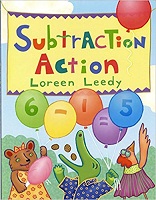
Grade 1
5 skill lessons
Math
Skill lessons
The mathematics the book carries, taught directly. Printable workbook pages and teacher keys are not available for this book yet.
- 1Ten Tickets, Six Used, and the Word for What Is Left
- 2Ten Cookies, Three Takings, Nothing Left
- 3One Equation for Every Child Who Leaves the Line
- 4Two Tables, Two Take-Aways, One Smaller Pile
- 5Every Difference the Book Prints
Math + reading
Math through the reading
The same book, entered through a sentence it prints. Change one word in the reading and the numbers change with it.
No math-through-reading lessons for this book yet.
Reading
Reading and language lessons
The same book read as a text. What a word means in its sentence, how a character is shown, how the writing is put together - no mathematics.
No reading and language lessons for this book yet.
Skill lessons
5 lessons on the mathematics the book carries. Printable workbook pages and teacher keys are not available for this book yet.
1. Ten Tickets, Six Used, and the Word for What Is Left
This book stops its story and teaches its own procedure one sentence at a time: start with the bigger number, make the minus sign, take away the six, make the equal sign, and put four where the answer goes. Students count ten paper tickets, slide six of them out of reach, count what is still there, and only then lay the five cards out in the book's order. The point of the lesson is that the row of cards is a record of something their hands already did, and that the last card has a name: the difference.
Full lesson — 20 minutes
1. Count out ten tickets and hear the question (4 min)
Count ten paper tickets into the middle of the table, one at a time, saying the number as each one lands. Listen to the question Miss Prime puts to her class, then say back which number is the tickets you have, which is the tickets the class uses, and which number nobody knows yet.
Word preview: uses, left over
So if we have ten tickets to the fair and our class uses six of them, how many tickets will be left over?
To find out, we'll write a subtraction equation.
2. Take away six and count what is left over (5 min)
Slide six tickets away from the pile and into your partner's hand, counting them out one at a time as they go. Then count what is still in the middle. Say both numbers out loud: six taken away, and this many left over.
Take away the six.
3. Build the equation in the book's order (7 min)
Lay the equation out with cards in the order the book gives it: the bigger number first, then the minus sign, then the six, then the equal sign, then the number of tickets still in the middle. Read the finished row aloud from left to right, touching each card. Check the last card against the tickets on the table before you call it done.
Word preview: minus, equals
Start with the biggest number, which is ten.
Make the minus sign, which means take away.
Make the equal sign.
The number four goes here, because ten minus six equals four.
4. Say the name for the answer (4 min)
Put a finger on the last card in your row and say what the book calls that number. Then say the whole thing for your partner: ten minus six equals four, and four is the difference. Turn the last card face down and see whether your partner can still say the difference from the row and the tickets.
Word preview: difference
When you subtract, the answer is called the difference.
Short version — 9 minutes
1. Take away six and count what is left over (4 min)
Count ten paper tickets into the middle, then slide six of them into your partner's hand, counting as they go. Count what is still there and say both numbers: six taken away, this many left over.
Take away the six.
2. Build the equation in the book's order (5 min)
Lay the cards out in the book's order: the bigger number, the minus sign, the six, the equal sign, and the number still on the table. Read the row aloud from left to right and check the last card against the tickets.
Word preview: minus, equals
Start with the biggest number, which is ten.
The number four goes here, because ten minus six equals four.
Three levels
- Support
- Hand the pair a strip already ruled into five boxes, one per card, so laying the row out is a matter of filling boxes from the left rather than of remembering the order. Everything else runs whole: ten tickets counted in, six slid away, the leftover counted, and the last number said aloud with its name.
- At Grade
- Count ten tickets, slide six away and count what is left, build the five-card row in the book's order with no template, read it left to right, and say the last number again as the difference.
- Extension
- Clear the table down to just the six tickets the class used and put the other four out of reach. Now try to take ten away from those six and say out loud what runs out and when. Then pick your own ticket count under ten, decide how many the class uses, and build that equation the same way, saying which card had to go first and why.
English learners
Number words and the sliding away itself carry over from any first language; the three names for the parts of the row do not, and neither does take away, a two-word verb whose meaning is in neither half on its own. Bind the words to the hands instead: the minus card goes down as the six tickets leave, the equal card goes down before the last number is spoken. The frame to rehearse is ten minus six equals four, and four is the difference, said once with a finger travelling along the cards. A child who slides six tickets away and points at what is left has answered completely; invite them to count and name the parts in their strongest language first, then bring only the frame into English.
Materials
- Printed source passage in this step
- Ten paper tickets per pair of students
- Number cards 0 to 10, one set per pair
- A minus sign card and an equal sign card per pair
- A strip ruled into five boxes for the support version, one box per card
- Word cards: minus, equals, difference, left over
Standards & curriculum
These lessons are being matched against curricula now.
Standards are held back while this plan is edited. Every standard shown here was matched against the supplied wording of this lesson, quoting its steps, so a changed step is no longer the thing that was checked. Undo your changes to bring the standards back — your edits stay in this browser either way.
2. Ten Cookies, Three Takings, Nothing Left
The cookie delivery is the one scene in the book that prints its own running record three times, each one longer than the last, and it prints every count in between. Students count ten counters into a basket, carry out the three takings in the book's order and say what is in the basket before they check it, then lay the long row of cards that matches. The work is keeping one count alive across three separate removals instead of starting fresh each time.
Full lesson — 20 minutes
1. Count ten cookies into the basket (3 min)
Count ten counters into the basket one at a time, saying the number as each one lands. That is the number the book's own record starts from. Close your hand over the basket and say the count once more without looking in.
2. Give away two, then three, then five (7 min)
Listen for each taking and do it with your hands. Two counters out for the milk, and say what is in the basket before you count it. Three counters out for the wolf, and say what is in the basket before you count it. Then five out for the last mouthful. Keep each group you took out in its own small pile so all three takings can still be seen.
Word preview: minus, left
I'll trade you some milk for two of those cookies.
10 minus 2 equals 8.
That wolf took three cookies.
There are still five left.
3. Build the long equation the book prints (6 min)
Lay the long row out with cards: ten, minus, two, minus, three, minus, five, equals, zero. Touch each of your three piles as you read its number. Then find the shorter record the book prints for the same delivery, read it aloud, and say which card in your long row it stops at. Point at the five in that shorter record and the five in your long row, and say which one is a pile you took out and which one is what was still in the basket.
Word preview: equals, zero
10 minus 2 minus 3 equals 5.
Ten minus two minus three minus five equals zero.
4. Say why the last five was five (4 min)
The book calls the last mouthful the last five. Say why it was five and not ten by walking back through what the basket held after each of the two earlier takings. Then put all ten counters back and take the five first instead, running the basket down again, and say which of the book's sentences about the basket is still true and which one is not.
Word preview: gone
Whoops! I ate the last five!
All the cookies are gone.
Short version — 9 minutes
1. Give away two, then three, then five (5 min)
Count ten counters into the basket. Take two out for the milk and say what is left before you count, then three out for the wolf and say what is left before you count, then five out for the last mouthful. Keep the three groups in three piles.
Word preview: minus, left
10 minus 2 equals 8.
There are still five left.
2. Build the long equation the book prints (4 min)
Lay the cards out: ten, minus, two, minus, three, minus, five, equals, zero. Touch each pile as you read its number, then read the whole row aloud.
Word preview: equals, zero
Ten minus two minus three minus five equals zero.
Three levels
- Support
- Give the pair three small dishes labelled with the three takings, two, three and five, so the counters land somewhere fixed and the running count is read off what is still in the basket rather than held in the head. The three takings, the spoken count after each one and the long row of cards all stay whole.
- At Grade
- Count ten in, carry out the three takings in the book's order saying the count before checking it each time, build the long row of cards, and read the book's shorter record back against it.
- Extension
- Take the same three groups in a different order and run the basket down again, then say which counts along the way changed and which number did not. Say what that tells you about the order of the takings, and find the one taking whose size is the same as what was in the basket at that moment.
English learners
Three takings in one story means three past-tense verbs in three different shapes, traded, took and ate, all meaning the same thing to a pair of hands. Say the number after each one rather than the verb, so the count survives even when the verb does not, and let the three piles on the table stand in for the retelling. The frame to rehearse is there were blank, then blank went, so now there are blank, said three times over. Counting and the taking away transfer whole; invite a child to run the three takings aloud in their strongest language first, then bring only the frame into English.
Materials
- A basket or cup and ten counters per pair of students
- Printed source passage in this step
- Number cards 0 to 10, one set per pair
- Three minus sign cards and an equal sign card per pair
- Three small dishes labelled two, three and five for the support version
- Word cards: minus, equals, zero, gone
Standards & curriculum
These lessons are being matched against curricula now.
Standards are held back while this plan is edited. Every standard shown here was matched against the supplied wording of this lesson, quoting its steps, so a changed step is no longer the thing that was checked. Undo your changes to bring the standards back — your edits stay in this browser either way.
3. One Equation for Every Child Who Leaves the Line
A face-painting line of five gets shorter four times, and the book prints an equation for every one of the four changes. Students stand five counters in a five-space strip, take them off in the book's order, and write the matching row on a recording strip each time, so four changes become four rows. Reading the rows back shows them something the book never says: the answer in one row is the number the next row starts from.
Full lesson — 20 minutes
1. Line up five and watch the first one go (4 min)
Stand five counters in the five spaces, the way the children stand in line for face painting. Take the front one off as the boy with the frog leaves, then say how many are still in line before you count the spaces.
Word preview: in line, only
There are only five kids ahead of us, Ginger.
Look, he got a frog.
Now there are only four in line.
2. Take away and write the equation, four times over (7 min)
Stand the fifth counter back up so the line is five again. Now run the line down in the book's four goes, one leaving, then two, then one, then one, and write the row for each go before the next one happens: the number that was in line, minus, how many just left, equals, how many are still standing. Leave the counters where they are between rows so every row can be checked against the strip.
Word preview: minus, equals
Five minus one equals four.
Oh good, those two girls are leaving.
Four minus two equals two.
2-1 equals 1.
3. Read the four rows back (4 min)
Read your four rows aloud from the top, touching each number. Put one finger on the answer in a row and another on the first number of the row under it, and say what you notice about the pair. Do that for all three pairs.
He's done! One to go!
4. Find where the line reaches zero (5 min)
Put a finger on the row whose answer is zero and say what had to leave for the line to get there. Then set the five counters back up and empty the line again, taking the same four goes in a different order and writing the new rows. Say which of your answers changed, and which one comes out the same however you order the goes.
Word preview: zero
1-1 equals 0.
I'm glad Kiki was subtracted from the line.
Short version — 9 minutes
1. Line up five and watch the first one go (3 min)
Stand five counters in the five spaces for the five children in line. Take the front one off as the boy with the frog leaves, and say how many are still in line before you count.
Word preview: in line, only
There are only five kids ahead of us, Ginger.
Now there are only four in line.
2. Take away and write the equation, four times over (6 min)
Stand the fifth counter back up, then run the line down in the book's four goes, one leaving, then two, then one, then one. Write one row per go: the number in line, minus, how many just left, equals, how many still stand. Leave the counters where they are so each row can be checked.
Word preview: minus, equals
Five minus one equals four.
Four minus two equals two.
Three levels
- Support
- Write the first number and the minus sign into each row before the pair starts, so the writing is the two numbers the child works out rather than the whole row. The counters, the taking off in the book's order and the spoken count after every change all stay whole, and the four rows are still read back at the end.
- At Grade
- Stand five in the strip, take them off in the book's four goes, write a full row for each change, read the four rows back, and say what the answer of one row has to do with the first number of the next.
- Extension
- Empty the same five in only two goes, then in as many goes as you can, writing the rows each time. Say how many rows each way needed and what stayed the same in every version. Then say why no version can have more rows than there were counters.
English learners
Two phrases carry the whole scene and neither of them is about arithmetic on its face: in line and to go, which the book uses for the children still waiting. Teach them against the strip, where in line is the filled spaces and to go is what a finger travels over. The frame to rehearse is blank were in line, blank left, so blank are still in line, said once per row. Number words and the taking off transfer; invite a child to say the running count in their strongest language first and bring only the frame into English.
Materials
- Printed source passage in this step
- A five-space strip and five counters per pair of students, one space per child in the line
- A recording strip ruled into four rows per pair of students
- A pencil per student
- A recording strip with the first number and the minus sign already written in each row, for the support version
- Word cards: minus, equals, to go
Standards & curriculum
These lessons are being matched against curricula now.
Standards are held back while this plan is edited. Every standard shown here was matched against the supplied wording of this lesson, quoting its steps, so a changed step is no longer the thing that was checked. Undo your changes to bring the standards back — your edits stay in this browser either way.
4. Two Tables, Two Take-Aways, One Smaller Pile
Two children sell snacks at the fair and the book prints all four of their numbers: ten bags with six sold, eight apples with three sold. Then it asks who had the least left over and turns the page. Students build both tables in counters, sell what was sold, and commit to an answer out loud before they count, because the guess most first-graders make is the one the counting overturns. The reasoning is in having to say why a bigger starting pile can finish smaller.
Full lesson — 20 minutes
1. Set out both snack tables (5 min)
Build both tables on the strip: ten counters in the first row for Tally's bags of popcorn, eight in the second row for Otto's candy apples. Line the two rows up at the left end. Say which row is longer and by how many, before anything is sold.
Word preview: sold
Tally had 10 bags of popcorn and sold six.
Otto had 8 candy apples and sold three.
2. Sell what each one sold (5 min)
Take six counters out of the popcorn row and three out of the candy apple row, saying each number as it leaves. Do not count what is left yet. Say out loud which row you think has less left over now and what makes you think so, and have your partner say theirs too.
Word preview: left over
Do we get to eat the leftovers?
3. Count both leftovers and match the rows (5 min)
Now count what is left in each row and say the two numbers. Slide the two rows together so they still line up at the left, and put a finger on the counter that has nothing above or below it. Say how many counters stick out and which row they belong to.
4. Answer the book's question and defend it (5 min)
Answer the book's question for your partner with both numbers inside your answer. Then take the other side on purpose: say the best reason someone could give for the other name, and point at what on the strip shows that reason is not enough.
Word preview: least
Who had the least left over?
Short version — 9 minutes
1. Set out both snack tables (5 min)
Build both tables on the strip, ten counters in the first row and eight in the second, lined up at the left. Then sell what each one sold, six out of the first row and three out of the second, saying each number as it leaves. Before counting what is left, say which row you think has less left over and why.
Word preview: sold, left over
Tally had 10 bags of popcorn and sold six.
Otto had 8 candy apples and sold three.
2. Answer the book's question and defend it (4 min)
Count both leftovers, slide the rows together at the left, and answer the book's question with both numbers in your answer. Then say the best reason for the other name and point at what shows it is not enough.
Word preview: least
Who had the least left over?
Three levels
- Support
- Hand the pair a spoken frame with two number slots in it, blank had blank left over, and let them fill it once for each table before they answer which is least. The building, the selling, the counting and the matching all stay whole; only the shape of the sentence is carried.
- At Grade
- Build ten and eight, commit to an answer aloud before counting, sell six and three, count both leftovers, match the rows, and answer the book's question with both numbers in the answer and one reason against it.
- Extension
- Build a third table in the spare row, eight of something with six sold, work its leftover and say where it lands against the other two. Then say how many Otto would have had to sell for the two tables to finish level, and check that number on the strip.
English learners
Least is a superlative and superlatives are built differently across languages, so a child may compute both leftovers correctly and still answer the wrong question. Say the plain comparison first while pointing, this row has less than this row, and only then ask for the book's word. The frame to rehearse is blank had blank left over, so blank had the least. Number and the taking away transfer whole; a child who points at the shorter row and says the two counts has answered completely, and may reason it out in their strongest language first before bringing only the frame into English.
Materials
- Printed source passage in this step
- A three-row strip and about twenty-six counters per pair of students
- A frame card with two number slots for the support version
- Word cards: least, left over, sold
Standards & curriculum
These lessons are being matched against curricula now.
Standards are held back while this plan is edited. Every standard shown here was matched against the supplied wording of this lesson, quoting its steps, so a changed step is no longer the thing that was checked. Undo your changes to bring the standards back — your edits stay in this browser either way.
5. Every Difference the Book Prints
This book prints eight different subtraction facts inside ten, and prints one of them twice. Students read them off the page, build each one on a ten strip and say the difference before counting to check, then answer the one difference question the book asks and does not answer. By the last step the counters come away and the facts are said against a clap, so the strip becomes the way to check rather than the way to find.
Full lesson — 20 minutes
1. Read the book's equations off the page (4 min)
Read each of the book's equations aloud with your partner, then say only the last number again and call it the difference. Do all four from the face-painting line, in the order the book prints them.
Word preview: minus, difference
Five minus one equals four.
Four minus two equals two.
2-1 equals 1.
1-1 equals 0.
2. Show each fact with counters and say the difference (6 min)
Put the first number out in counters on the ten strip, push the second number of them off the strip, and say the difference before you count what is left. Then count to check. Do these two first, ten take two and five take four, then go back and build the four from the first step the same way; those go faster because they start with five or fewer.
Word preview: minus
10 minus 2 equals 8.
5-4 equals 1.
3. Answer the book's difference question (5 min)
The book asks for the difference between ten and five and never prints it. Put ten counters on the strip, push five of them off, and say the difference. Two of the three numbers in this one are fives, so point at the five the book would call the difference and say how you can tell which five it is.
Word preview: difference
What is the difference between ten and five?
When you subtract, the answer is called the difference.
4. Race the fact that ends at nothing (5 min)
Take the counters away. One partner holds up a fact card and the other says the difference before three claps, then you swap. Every round has to include the one fact in this book whose difference is zero, the one the book prints twice. After five rounds each, say which card was quickest for you and which one you still want the strip for.
Word preview: zero
And 1 minus 1 equals 0.
Short version — 9 minutes
1. Show each fact with counters and say the difference (5 min)
Build each of the book's facts on the ten strip: the first number in counters, then push the second number of them off. Say the difference before you count, then count to check.
Word preview: minus, difference
10 minus 2 equals 8.
5-4 equals 1.
2. Answer the book's difference question (4 min)
The book asks for the difference between ten and five and never prints it. Put ten counters out, push five off, and say the difference. Two of the three numbers here are fives, so point at the one the book would call the difference and say how you can tell.
Word preview: difference
What is the difference between ten and five?
Three levels
- Support
- Work only the facts whose first number is five or fewer, five minus one, four minus two, two minus one and one minus one, and keep the counters on the strip for every one of them so the difference is counted rather than recalled. The saying stays whole: the difference is still said aloud before it is checked.
- At Grade
- Read the book's facts aloud, build each one on the strip and say the difference before counting, answer the difference question the book leaves open, then say the facts against a clap with the counters put away.
- Extension
- One scene ends with a riddle the book never answers: someone was twenty and is now eleven less. Build twenty across two ten strips, take eleven away, and say what number is talking. Then say why this one will not fit on a single strip and where the eleven had to be split to come off.
English learners
The whole of this lesson is one noun, difference, and it is a word children already own with a different meaning, so it will be heard as unlikeness rather than as an amount. Teach it against the strip: the difference is the counters still on it, pointed at, before it is a word. Number words and the pushing away transfer whole, and so does the equation once it is on the table. The frame to rehearse is ten minus five equals five, and five is the difference. Invite a child to say the facts in their strongest language first and bring only that frame into English.
Materials
- Printed source passage in this step
- A ten strip and about ten counters per pair of students
- Fact cards carrying the eight subtraction facts the book prints within ten, one fact per card
- Two ten strips and about twenty counters per pair, for the extension
- Word cards: minus, difference, zero
Standards & curriculum
These lessons are being matched against curricula now.
Standards are held back while this plan is edited. Every standard shown here was matched against the supplied wording of this lesson, quoting its steps, so a changed step is no longer the thing that was checked. Undo your changes to bring the standards back — your edits stay in this browser either way.