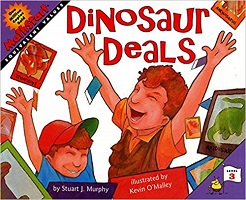
Dinosaur Deals

Dinosaur Deals book cover

Grade 3
5 skill lessons · 2 math-through-reading

Math

Skill lessons

The mathematics the book carries, taught directly. Each lesson has printable workbook pages and a separate teacher key.

  • 1Four for One: What a Trading Rule Really Says
  • 2The Price of Two Triceratops
  • 3Enough or Not Enough: Reading a Price Against Your Hand
  • 4Rows of Four: Drawing What a Trade Costs
  • 5Count the Price: Fours and Threes at Speed

Math + reading

Math through the reading

The same book, entered through a sentence it prints. Change one word in the reading and the numbers change with it.

  • 6Change One Word, Pay a Different Price
  • 7Which Card Is Harder to Buy?

Reading

Reading and language lessons

The same book read as a text. What a word means in its sentence, how a character is shown, how the writing is put together - no mathematics.

  • 8Two Brothers, One Thing in Common
  • 9How a Fossil Is Made, in Order
  • 10Dodged, Stumbled, Pounced: Verbs That Do Work
  • 11Cool Mask, Cool Hat, Cool Sunglasses
  • 12Why Mike Gave the Card Away
Download
PDF

Both exports carry any edits you have made. Edits are saved in this browser only — nobody else sees them, and they are not sent anywhere.

Skill lessons

5 lessons on the mathematics the book carries. Each lesson has printable workbook pages and a separate teacher key.

1. Four for One: What a Trading Rule Really Says Concept · Equal value in a stated exchange rate

The book states two trading rules outright, and states each one as an equality between cards that are plainly not the same thing: four Stegosaurus cards for one Triceratops, three Allosaurus cards for one Tyrannosaurus Rex. Students build each rule on a two-sided mat, break it by being handed three counters where four are owed, repair it, and finish by writing the rule as an offer a partner has to fill in counters.

Full lesson — 20 minutes

  1. 1. Build the rule with counters (5 min)

    Each pair lays one red counter on the right of the mat for the Triceratops card and four blue counters on the left for the Stegosaurus cards. Point at the counters and say the rule aloud while you point: four Stegosaurus cards equals one triceratops card. Then push the four blue counters into a single stack and set it level with the red counter, so both sides of the mat hold one price.

    Word preview: equals

    Four Stegosaurus cards equals one triceratops card.
  2. 2. Test a pile that is not equal (6 min)

    Your partner deals you three blue counters and asks for the red one. Lay the three under the four-counter price, one under one, and say out loud whether the trade can be paid and how many counters are missing. Run it again with five blue counters and say how many are extra. Each round ends with the same sentence: this is not four, so it does not equal one Triceratops.

    Word preview: equal

    He only had three Stegosaurus, and he was running out of time.
  3. 3. Build the second rule beside the first (5 min)

    Now build the book's other rule on a second mat: three green counters on the left, one white counter on the right, and say it aloud as you point. Set the two mats side by side. Tell your partner which rule takes more counters to buy one card, and by how many.

    Word preview: value

    Three Allosaurus cards equals one Tyrannosaurus Rex card.
  4. 4. Write the rule as an offer (4 min)

    On a blank offer strip, write one of the two rules the way a trader at the fair says it out loud: I want ___ for ___. Trade strips and lay out the counters your partner's strip asks for. If the counters do not match the rule the strip meant, fix the strip, not the counters.

    Word preview: for

    I want four Stegosaurus for one triceratops or no deal, he said.

Short version — 9 minutes

  1. 1. Build the rule with counters (5 min)

    Lay one red counter on the right of the mat and four blue counters on the left. Point and say: four Stegosaurus cards equals one triceratops card. Stack the four and set the stack level with the one.

    Word preview: equals

    Four Stegosaurus cards equals one triceratops card.
  2. 2. Write the rule as an offer (4 min)

    Write the rule on an offer strip the way a trader says it: I want ___ for ___. Trade strips and lay out the counters your partner's strip asks for. Fix the strip if the counters come out wrong.

    Word preview: for

    I want four Stegosaurus for one triceratops or no deal, he said.

Three levels

Support
Stay on the Stegosaurus rule for the whole lesson and leave the second mat in the box. Build four against one, break it, rebuild it, and say the same sentence every time until the four and the one come without counting. One rule said forty times beats two rules said twice.
At Grade
Build both rules, test an uneven pile against each of them, and write one offer strip that another pair can fill without asking you a single question.
Extension
A trader offers you eight Stegosaurus cards for two Triceratops cards. Build both sides on the mat and decide whether the book's rule still holds when both sides double. Say what stayed the same and what changed, and show the doubling on the counters rather than telling it.

English learners

Drill one sentence until it is automatic: four of the smaller card equals one of the larger. Students may count and reason in their home language and then say the frame in English. The mat settles who is right, so a student can be corrected on the mathematics without being corrected on the English.

Materials

  • Counters in four colors, at least twenty per pair
  • Trade mat with a left side and a right side
  • Blank offer strips, one per student
  • Word cards: equal, equals, for, value

Workbook

Print these for the class. They carry your edits, and they print in black and white.

Offer strips: I want ___ for ___ strip set

Dinosaur Deals — Four for One: What a Trading Rule Really Says

Offer strips

Write one of the two trading rules the way a trader says it out loud.

Trade strips, then lay out the counters your partner's strip asks for.


Name: ______________________

I want ______________________ for ______________________

If the counters did not match the rule my strip meant, I fix the strip here:

I want ______________________ for ______________________


Name: ______________________

I want ______________________ for ______________________

If the counters did not match the rule my strip meant, I fix the strip here:

I want ______________________ for ______________________


Name: ______________________

I want ______________________ for ______________________

If the counters did not match the rule my strip meant, I fix the strip here:

I want ______________________ for ______________________


Name: ______________________

I want ______________________ for ______________________

If the counters did not match the rule my strip meant, I fix the strip here:

I want ______________________ for ______________________


Trade mat, left side and right side full page

Dinosaur Deals — Four for One: What a Trading Rule Really Says

Trade mat

Lay the counters for the card you are buying on one side of the mat.

Lay the counters that pay for it on the other side. Print a second mat for the second rule.

Word cards: equal, equals, for, value card set

Dinosaur Deals — Four for One: What a Trading Rule Really Says

Word cards

Cut on the lines. One word to a card.

equalequalsforvalue
Teacher key (1 page) — not for the class
Teacher key: Offer strips full page

Dinosaur Deals — Four for One: What a Trading Rule Really Says — Teacher Key

Key: Offer strips

The two rules the lesson puts in front of students:

  • Four Stegosaurus cards equals one triceratops card.
  • Three Allosaurus cards equals one Tyrannosaurus Rex card.

Expected strips

  • I want four Stegosaurus for one triceratops.
  • I want three Allosaurus for one Tyrannosaurus Rex.
  • Either rule written the other way round is also correct, as long as the count stays with the right card: I want one triceratops for four Stegosaurus.

Read for

A close strip names both cards and both numbers, so a partner can lay the counters out without asking a question. A loose strip says only I want four for one, or leaves the card names off one side, and the partner has to guess which pile is which.

The strip is the thing that gets fixed when the counters come out wrong. If a pair changed the counters instead, send the strip back and have them rewrite it.

Standards & curriculum

Choose your curriculum above to see the standards for this lesson.

2. The Price of Two Triceratops Application · Pricing several cards at a stated exchange rate

Two intact prices arrive and neither is ever multiplied out. Students take the four-for-one rule and price the two Triceratops cards Mike says he is holding, then take the three-for-one rule and price a second Tyrannosaurus Rex alongside the first, building each price in rows before saying any total.

Full lesson — 20 minutes

  1. 1. Say the rate before you count anything (4 min)

    Listen to the trading rule, then say it back to your partner with the mat covered: four Stegosaurus cards equals one triceratops card. Uncover the mat, set one counter down for the Triceratops and count its price out beside it. Say the price as a number, not as a handful.

    Word preview: price, equals

    Four Stegosaurus cards equals one triceratops card.
  2. 2. Price the two Triceratops Mike carries (6 min)

    Mike says he has two Triceratops. Build two rows on the mat, four Stegosaurus counters in each row, and keep the rows apart so they can still be counted as rows. Count the rows by fours and say the total. Then say the whole price in one sentence that names the rate and the total together.

    Word preview: rows

    I've got two triceratops
    Four Stegosaurus cards equals one triceratops card.
  3. 3. Price a second Tyrannosaurus Rex (6 min)

    The top card costs three Allosaurus cards. Build that price, then build it again for a second Tyrannosaurus Rex and count both prices together. Say how many Allosaurus cards two of the top card would cost, and show on the counters why it is not four.

    Word preview: total

    Three Allosaurus cards equals one Tyrannosaurus Rex card.
  4. 4. Write the bill (4 min)

    Write each of your two prices on a price-tag card as a number sentence with the rate inside it. Read your tags aloud to another pair while they check them against their own rows. A tag that does not say which card it prices goes back for a rewrite.

    Word preview: price

Short version — 9 minutes

  1. 1. Price the two Triceratops Mike carries (6 min)

    Mike says he has two Triceratops. Build two rows of four Stegosaurus counters, keep the rows apart, count them by fours and say the total in one sentence that names the rate.

    Word preview: rows

    I've got two triceratops
    Four Stegosaurus cards equals one triceratops card.
  2. 2. Write the bill (3 min)

    Write your price on a price-tag card as a number sentence with the rate inside it. Read it to another pair while they check it against their rows.

    Word preview: price

Three levels

Support
Work the Stegosaurus rate only and price the two Triceratops, nothing else. Build the first row of four and count it, then build the second row and count on from four rather than starting again at one. Two rows counted properly is the lesson; the second rate can wait for tomorrow.
At Grade
Price both of Mike's Triceratops and both Tyrannosaurus Rex cards, build every price in rows, and write both as number sentences that name the rate they came from.
Extension
This trader will not break a row: he pays only in whole Triceratops. You are holding eleven Stegosaurus cards. Say how many Triceratops you can buy and how many Stegosaurus you are left holding, and defend the leftover by pointing at the rows rather than by explaining it.

English learners

Model one direction only: 'Two Triceratops cards cost eight Stegosaurus cards.' Students may work the rows and reach the total in their own language, then say the frame in English with a finger on the rows. Accept a correct total said in any language before asking for the sentence.

Materials

  • Counters in four colors, at least twenty per pair
  • Trade mat with a left side and a right side
  • Price-tag cards, four per pair
  • Word cards: equals, price, rows, total

Workbook

Print these for the class. They carry your edits, and they print in black and white.

Price-tag cards card set

Dinosaur Deals — The Price of Two Triceratops

Price tags

Write each price as a number sentence with the rate inside it.

Say which card the tag prices, or the tag comes back for a rewrite.


This tag prices: ______________________

Number sentence: __________________________________

__________________________________


This tag prices: ______________________

Number sentence: __________________________________

__________________________________


This tag prices: ______________________

Number sentence: __________________________________

__________________________________


This tag prices: ______________________

Number sentence: __________________________________

__________________________________


Trade mat, left side and right side full page

Dinosaur Deals — The Price of Two Triceratops

Trade mat

Set the cards you are pricing on one side of the mat.

Build the rows that pay for them on the other side, and keep the rows apart.

Word cards: equals, price, rows, total card set

Dinosaur Deals — The Price of Two Triceratops

Word cards

Cut on the lines. One word to a card.

equalspricerowstotal
Teacher key (1 page) — not for the class
Teacher key: Price tags full page

Dinosaur Deals — The Price of Two Triceratops — Teacher Key

Key: Price tags

The two rates the prices come from

  • Four Stegosaurus cards equals one triceratops card.
  • Three Allosaurus cards equals one Tyrannosaurus Rex card.

Expected tags

  • Mike's two Triceratops: two rows of four is eight, so two Triceratops cards cost eight Stegosaurus cards. Written as a number sentence: 4 + 4 = 8, or 2 rows of 4 = 8.
  • Two Tyrannosaurus Rex cards: two rows of three is six, so two Tyrannosaurus Rex cards cost six Allosaurus cards. Written as a number sentence: 3 + 3 = 6, or 2 rows of 3 = 6.

Read for

A close tag names the card it prices and carries the rate inside the sentence, so a pair reading it can rebuild the rows without asking anything. A loose tag gives the total on its own, eight or six, and leaves the reader guessing which card and which rate.

On Step 3, the point to hear is why two Tyrannosaurus Rex cards do not cost four Allosaurus cards: the second card costs another three, not another one. A strong answer points at the second row of three rather than explaining it.

Extension

Eleven Stegosaurus cards buy two Triceratops, with three Stegosaurus cards left in hand. A strong answer defends the leftover by pointing at the two full rows of four and the three counters that cannot make a third row.

Standards & curriculum

Choose your curriculum above to see the standards for this lesson.

3. Enough or Not Enough: Reading a Price Against Your Hand Reasoning · Deciding whether a hand of cards covers a stated price

Twice in this book a price is named and a hand falls short of it, and both times the book says the shortfall in words rather than in numbers. Students set a stated price and a stated hand side by side, one counter under one counter, decide out loud whether the trade can be paid, and say the number that is missing.

Full lesson — 20 minutes

  1. 1. Set the price, then set the hand (6 min)

    One partner reads the trader's demand aloud: I want four Stegosaurus for one triceratops or no deal. The other partner counts out the three Stegosaurus counters Mike is carrying. Line the hand up under the price, one counter under one counter, and say out loud whether this trade can be paid.

    Word preview: enough

    I want four Stegosaurus for one triceratops or no deal, he said.
    He only had three Stegosaurus, and he was running out of time.
  2. 2. Say how short you are (5 min)

    Point at the empty place at the end of the line and say the number that fills it. Finish the sentence out loud: Mike is short by ___, so he cannot pay. Your partner then feeds counters in one at a time until you say stop, and you both say the number that made the trade payable.

    Word preview: short

  3. 3. Run it again on the biggest price in the book (5 min)

    The Tyrannosaurus Rex costs three Allosaurus cards and Mike is holding one. Line the one up under the three and say how many more he needs. Then say what he would still need after winning a second one, without rebuilding the line.

    Word preview: more

    Three Allosaurus cards equals one Tyrannosaurus Rex card.
    This girl wanted three Allosaurus cards and I only have one
  4. 4. Sort four offers into paid and not paid (4 min)

    Take the four offer cards at your table. For each one, build the price, build the hand, and drop the card into the paid pile or the not paid pile. Every card that lands in the not paid pile gets its missing number said aloud before you touch the next card.

    Word preview: enough

Short version — 9 minutes

  1. 1. Set the price, then set the hand (6 min)

    One partner reads the demand aloud: I want four Stegosaurus for one triceratops or no deal. The other counts out Mike's three Stegosaurus counters. Line the hand under the price, one under one, and say whether the trade can be paid.

    Word preview: enough

    I want four Stegosaurus for one triceratops or no deal, he said.
    He only had three Stegosaurus, and he was running out of time.
  2. 2. Sort four offers into paid and not paid (3 min)

    Take the four offer cards. Build each price, build each hand, and sort the card into paid or not paid. Say the missing number aloud for every card in the not paid pile.

    Word preview: enough

Three levels

Support
Work the Stegosaurus offer only and keep the counters in one straight line under the price, never in a pile. Say short by ___ on every round, and let your partner slide the missing counter in so you hear the number once before you have to produce it. The other three offer cards stay in the box.
At Grade
Work all four offer cards, line each hand under its price, and say the missing number before you sort the card into a pile.
Extension
Two of the offer cards can be paid only if you make a different trade first. Say which of those two you would pay first, and fund your choice with the number of cards each route leaves in your hand. Then say what your partner could tell you that would change your mind.

English learners

The comparison itself is language-independent: a short line is a short line in every language. Two constructions need teaching. Short by puts the number names the gap rather than the amount held, and enough, which is not a count at all but a verdict on one. Walk through the pair of frames together: 'He has ___. He needs ___. He is short by ___.' Students may reason through the comparison in their everyday language and report with the frame, keeping a finger on the empty place in the line while they say it.

Materials

  • Counters in four colors, at least twenty per pair
  • Trade mat with a left side and a right side
  • Offer cards, four per pair, each showing a price and a hand
  • Word cards: enough, more, short

Workbook

Print these for the class. They carry your edits, and they print in black and white.

Offer cards: a price and a hand card set

Dinosaur Deals — Enough or Not Enough: Reading a Price Against Your Hand

Offer cards

Build the price. Build the hand. Line the hand up under the price.

Cut on the lines. One offer to a card.


Price: I want four Stegosaurus for one triceratops or no deal.

Hand: Three Stegosaurus cards.


Price: Four Stegosaurus cards for one Triceratops card.

Hand: Four Stegosaurus cards.


Price: Three Allosaurus cards for one Tyrannosaurus Rex card.

Hand: One Allosaurus card.


Price: Three Allosaurus cards for one Tyrannosaurus Rex card.

Hand: Two Allosaurus cards.


Sentence strips: He is short by ___ strip set

Dinosaur Deals — Enough or Not Enough: Reading a Price Against Your Hand

Saying the gap

Keep a finger on the empty place in the line and say the sentences.


He has ____________

He needs ____________

He is short by ____________

Mike is short by ____________, so he cannot pay.


He has ____________

He needs ____________

He is short by ____________

Mike is short by ____________, so he cannot pay.


He has ____________

He needs ____________

He is short by ____________

Mike is short by ____________, so he cannot pay.


He has ____________

He needs ____________

He is short by ____________

Mike is short by ____________, so he cannot pay.


Word cards: enough, more, short card set

Dinosaur Deals — Enough or Not Enough: Reading a Price Against Your Hand

Word cards

Cut on the lines. One word to a card.

enoughmoreshort
Teacher key (1 page) — not for the class
Teacher key: Offer cards full page

Dinosaur Deals — Enough or Not Enough: Reading a Price Against Your Hand — Teacher Key

Key: Offer cards

Where the four offers come from

  • The first offer is the trader's demand and the hand the lesson counts out against it: He only had three Stegosaurus, and he was running out of time.
  • The second offer is the hand from Step 2, once counters have been fed in one at a time until the trade is payable.
  • The third offer is the price and hand from Step 3: This girl wanted three Allosaurus cards and I only have one.
  • The fourth offer is the same price after winning a second Allosaurus card.

Expected sorts

  • First offer, three Stegosaurus against a price of four: not paid, short by one.
  • Second offer, four Stegosaurus against a price of four: paid, with nothing left over.
  • Third offer, one Allosaurus against a price of three: not paid, short by two.
  • Fourth offer, two Allosaurus against a price of three: not paid, short by one.

Read for

A close response says the missing number before the card is dropped in a pile: short by one, short by two. A loose response says only that there is not enough, or counts the hand again instead of the gap, and it is the gap this lesson is after.

Short by names the empty places at the end of the line, not the cards being held. A student who answers three to the first offer has said what is in the hand, not what is missing, and the line under the price settles it without an argument.

Standards & curriculum

Choose your curriculum above to see the standards for this lesson.

4. Rows of Four: Drawing What a Trade Costs Representation · Representing an exchange rate as equal rows

The price is said in words and never drawn, and the one time many Triceratops sit on a table nobody counts them. Students turn the four-for-one rule into rows on a mat, build up row by row for a herd their own table sizes, then draw the rows on grid paper and hand the drawing to another pair to read back as a sentence.

Full lesson — 20 minutes

  1. 1. Lay the first row (4 min)

    Build the price of one Triceratops as a single straight row of four counters on the mat, with the Triceratops counter alone on the other side. Say the rule while your finger runs along the row. Keep the row straight; a pile cannot be counted twice the same way.

    Word preview: row

    Four Stegosaurus cards equals one triceratops card.
  2. 2. Build the herd, row by row (7 min)

    The book puts a whole herd of Triceratops on one table and never says how many. Your table picks a number from one to five and builds that many rows of four. Add one row at a time, saying the running total after each row goes down. Stop at your number and say the total once more with the rate named inside the sentence.

    Word preview: in all

    Finally, they discovered a table with a whole herd of triceratops.
  3. 3. Draw the rows and label the total (5 min)

    Copy your rows onto grid paper, one square to one counter, keeping the rows the same length. Colour each row a single colour so the fours stay visible. Write the total at the end of the last row and write the number of rows beside the first one.

    Word preview: equal

  4. 4. Read someone else's drawing back (4 min)

    Swap drawings with another pair. Without asking them anything, say aloud how many Triceratops their drawing prices and how many Stegosaurus cards it takes. If you cannot tell the rows apart, hand it back and say which part of the drawing hid the fours.

    Word preview: row

    I want four Stegosaurus for one triceratops or no deal, he said.

Short version — 9 minutes

  1. 1. Draw the rows and label the total (5 min)

    Copy three rows of four onto grid paper, one square to one counter, colouring each row a single colour. Write the total at the end of the last row and the number of rows beside the first.

    Word preview: equal

  2. 2. Read someone else's drawing back (4 min)

    Swap drawings. Say aloud how many Triceratops the drawing prices and how many Stegosaurus cards it takes. Hand back any drawing whose rows you cannot separate, and say which part hid the fours.

    Word preview: row

    I want four Stegosaurus for one triceratops or no deal, he said.

Three levels

Support
Build and draw three rows and stop there, but draw them on paper already ruled into rows of four so the grouping is given and the counting is yours. Say the running total out loud as each row is finished. Keep every row the same colour as its counters so the drawing and the mat can be checked against each other.
At Grade
Build up to your table's number of rows, draw them on plain grid paper with the rows kept straight and separate, and read another pair's drawing back without being told anything about it.
Extension
Redraw your price as one long unbroken line of squares with no rows at all, then hand both drawings to another pair and ask which one shows the rate. Say what the rows were carrying that the line lost, using the total to make your case.

English learners

Grid paper and counters carry the mathematics without any English at all, which makes this the safest lesson in the set for a student new to the language, and the reading-back step is where the demand actually sits. Watch the row-and-total phrasing, especially the way of in a phrase like rows of four. Rehearse one frame: '___ rows of four is ___ in all.' Invite students to count the rows aloud in their strongest language first and then say the frame in English with a finger on the drawing.

Materials

  • Counters in four colors, at least twenty per pair
  • Trade mat with a left side and a right side
  • Grid paper, half sheet per student
  • Colored pencils
  • Word cards: equal, in all, row

Workbook

Print these for the class. They carry your edits, and they print in black and white.

Rows of four, already ruled Support full page

Dinosaur Deals — Rows of Four: Drawing What a Trade Costs

Rows of four

One square is one Stegosaurus counter. Colour each row one colour.

Build and draw three rows, then fill in the two lines.

Number of rows: ____________

Total in all: ____________

Sentence strips: ___ rows of four is ___ in all strip set

Dinosaur Deals — Rows of Four: Drawing What a Trade Costs

Saying the rows

Keep a finger on the drawing and say the sentence.


____________ rows of four is ____________ in all.


____________ rows of four is ____________ in all.


____________ rows of four is ____________ in all.


____________ rows of four is ____________ in all.


Word cards: equal, in all, row card set

Dinosaur Deals — Rows of Four: Drawing What a Trade Costs

Word cards

Cut on the lines. One word to a card.

equalin allrow
Teacher key (1 page) — not for the class
Teacher key: Rows of four full page

Dinosaur Deals — Rows of Four: Drawing What a Trade Costs — Teacher Key

Key: Rows of four

Expected totals

Each table picks its own number of rows from one to five, so there is no single total. The total that matches the number of rows chosen:

  • One row: four in all.
  • Two rows: eight in all.
  • Three rows: twelve in all. This is the total on every Support page, which is ruled to three rows.
  • Four rows: sixteen in all.
  • Five rows: twenty in all.

Read for

A close drawing keeps the rows straight, the same length and separate enough that another pair can see the fours without being told; the total sits at the end of the last row and the number of rows sits beside the first. A loose drawing runs the squares together into one block or one long line, so a reader can find the total but not the rate.

On the reading-back step, a strong response names both counts: how many Triceratops the drawing prices and how many Stegosaurus cards it takes. Naming only the total is the loose version, and it is the one to push on.

Extension

The unbroken line and the rows carry the same total, so a strong answer does not settle it on the total alone. It says that the rows show the four-for-one rate and the line hides it: the line can be read as a count but not as a price.

Standards & curriculum

Choose your curriculum above to see the standards for this lesson.

5. Count the Price: Fours and Threes at Speed Fluency · Skip counting by fours and by threes to price a trade

Exactly two counts arrive with a reason to hurry: four Stegosaurus to a Triceratops, three Allosaurus to a Tyrannosaurus Rex, and a loudspeaker calling ten minutes to closing. Students run each count along a marked track with counters, then run both against the clock and say the total each time.

Full lesson — 20 minutes

  1. 1. Warm both counts with your eyes on the counters (3 min)

    Sit facing your partner with twenty counters between you. Push four across and say four, push four more and say eight, and keep going to twenty. Sweep them back and do the same thing in threes to eighteen. No writing yet, and no starting again at one.

    Word preview: fours

  2. 2. Count by fours along the Stegosaurus track (6 min)

    Lay a counter on every fourth mark of the track and say the number as the counter lands: four, eight, twelve, sixteen, twenty. Take the counters off and do it again with your eyes on your partner instead of the track. Third time through, say only the landing numbers and let your partner check the marks behind you.

    Word preview: fours

    Four Stegosaurus cards equals one triceratops card.
  3. 3. Count by threes along the Allosaurus track (7 min)

    Move to threes on the same track: three, six, nine, twelve, fifteen, eighteen, a counter on every third mark. Then start at three and jump to twelve without saying the numbers between, and tell your partner how many threes that jump was worth. Finish by counting back down the track in threes to zero.

    Word preview: threes

    Three Allosaurus cards equals one Tyrannosaurus Rex card.
  4. 4. Beat the loudspeaker (4 min)

    The fair in the book closes in ten minutes; your round closes in one. Say the fours to twenty and the threes to eighteen, both counts, while your partner watches the timer and the track. Run it twice and keep the better time; a count that skips a landing number does not count, however fast it was.

    Word preview: total

    Fair closes in ten minutes.

Short version — 9 minutes

  1. 1. Count by fours along the Stegosaurus track (6 min)

    Lay a counter on every fourth mark and say the number as it lands: four, eight, twelve, sixteen, twenty. Clear the track and run it again with your eyes off the marks.

    Word preview: fours

    Four Stegosaurus cards equals one triceratops card.
  2. 2. Beat the loudspeaker (3 min)

    Say the fours to twenty and the threes to eighteen while your partner watches the timer. Run it twice, keep the better time, and throw out any run that skipped a landing number.

    Word preview: total

    Fair closes in ten minutes.

Three levels

Support
Run the fours only, and keep the counters on the track for every round instead of taking them off. Say each landing number as the counter touches the mark so the count is never carried in your head alone. The threes come in tomorrow, once the fours arrive without a pause.
At Grade
Run both counts, take the counters off the track by the third round, and finish inside the minute with no landing number dropped.
Extension
Start the fours at eight instead of four and run them to twenty, then start the threes at nine and run them to eighteen. Say how many fours and how many threes each shortened run was worth, and check yourself on the track only after you have answered.

English learners

Let students run the first rounds in their strongest language with the counters landing on the marks, then swap to English on the same track so the rhythm is already built. Rehearse the two landing sequences aloud as chants before timing anything, and never time a student's first English round.

Materials

  • Counters in four colors, at least twenty per pair
  • Number track strip marked to twenty-four
  • Timer or classroom clock
  • Word cards: fours, threes, total

Workbook

Print these for the class. They carry your edits, and they print in black and white.

Number track marked to twenty-four strip set

Dinosaur Deals — Count the Price: Fours and Threes at Speed

Number track to twenty-four

Lay a counter on every fourth mark and say the number as the counter lands.

Clear the track, then do the same thing on every third mark.

123456789101112131415161718192021222324
Word cards: fours, threes, total card set

Dinosaur Deals — Count the Price: Fours and Threes at Speed

Word cards

Cut on the lines. One word to a card.

foursthreestotal
Teacher key (1 page) — not for the class
Teacher key: Landing numbers on the track full page

Dinosaur Deals — Count the Price: Fours and Threes at Speed — Teacher Key

Key: Landing numbers on the track

Expected counts

  • Fours to twenty: four, eight, twelve, sixteen, twenty.
  • Threes to eighteen: three, six, nine, twelve, fifteen, eighteen.
  • The jump from three to twelve is worth three threes.
  • Counting back down in threes: eighteen, fifteen, twelve, nine, six, three, zero.

Expected counts for the Extension

  • Fours started at eight and run to twenty: eight, twelve, sixteen, twenty. The shortened run is worth three fours.
  • Threes started at nine and run to eighteen: nine, twelve, fifteen, eighteen. The shortened run is worth three threes.

Read for

A close run says every landing number in order with nothing dropped and no restart at one; speed is the second thing you judge, not the first. A loose run swallows a landing number, most often twelve, which sits on both counts, or slides back into counting by ones under the breath.

A count that skips a landing number does not count, however fast it was. In the Support round the counters stay on the track, so check the marks rather than the memory.

Standards & curriculum

Choose your curriculum above to see the standards for this lesson.

Math through the reading

The mathematics is reached through a sentence the book prints: change one word in the reading and the numbers change with it. These carry their own standards, matched against these lessons rather than inherited from the skill ones.

6. Change One Word, Pay a Different Price Integrated · Students swap a single word in the book's own trading sentence, build both results in counters, and say each result back in a sentence that uses the word correctly.

Students swap a single word in the book's own trading sentence, build both results in counters, and say each result back in a sentence that uses the word correctly.

Full lesson — 20 minutes

  1. 1. Sort the sentence into words that pay and words that do not (4 min)

    Take the book's trading sentence cut into word cards. Push to one side every word you could change without changing what a trader hands over, and to the other side every word you could not. Defend one card from each side to your partner.

  2. 2. Build both sides of the swap (5 min)

    Build the sentence as the book says it - four counters on the left of the mat, one on the right - and count what a trade costs. Then build the swapped sentence with and in place of equals: all five counters in one heap, no second side. Count both layouts and say the two totals aloud.

  3. 3. Run the swap on the trader's demand (7 min)

    Do it again on the demand sentence, swapping for to and. Build what the trader receives and what he gives back under each reading, then say how many cards your hand ends with in each case. Finish by doubling the priced reading - two Triceratops this time - and counting the price out in rows of four.

  4. 4. Say your result in a sentence that uses the word (4 min)

    Write one sentence beside each of your two layouts, using the swapped word in it, saying what you ended up holding and why. Read both to your partner, who checks each sentence against the counters and hands back any sentence the layout does not support.

Short version — 9 minutes

  1. 1. Build both sides of the swap (5 min)

    Build the sentence as the book says it - four counters on the left of the mat, one on the right - and count what a trade costs. Then build the swapped sentence with and in place of equals: all five counters in one heap, no second side. Count both layouts and say the two totals aloud.

  2. 2. Say your result in a sentence that uses the word (4 min)

    Write one sentence beside each of your two layouts, using the swapped word in it, saying what you ended up holding and why. Read both to your partner, who checks each sentence against the counters and hands back any sentence the layout does not support.

Three levels

Support
Work the equals swap only and leave the demand sentence out. Both layouts stay on the desk at once, never cleared, so the four-against-one and the heap of five can be pointed at while you talk. Say your sentence aloud to your partner and have them write it down for you before you copy it; the counting and the swap are yours, the spelling is not what is being tested today.
At grade
Run both swaps, build all four layouts, count each one, and write a sentence for each that your partner can check against the counters without asking you what you meant.
Extension
Find a fifth word in the book's trading sentences that changes what a trader hands over, and prove it the same way - swap it, build both results, count both. Then find a word that looks difficult and changes nothing, and say how you can tell the two apart without building anything.

English learners

Number and quantity travel here untouched: a student who counts four against one has the mathematics of this lesson in any language. The four words the lesson turns on do not travel. Equals sits between nouns naming different things, which many languages render as a price or an exchange rather than an equality; for marks the direction of a trade and reverses order in several languages; enough is a verdict rather than a count; and left names a remainder that some languages carry in the verb rather than in a separate word. Rehearse two frames until they come without effort: 'Four ___ cards equals one ___ card' and 'I have ___ left.' Invite students to work the swap and reach both totals in their strongest language first and then say the frame in English with a hand on each layout. Because the counters show which reading a sentence describes, a student can be corrected on the mathematics without being corrected on the English in front of the class.

Materials

  • Counters in two colors, at least twenty per pair
  • Trade mat with a left side and a right side
  • The book's trading sentence cut into single word cards, one set per pair
  • Recording sheet with two layout boxes and a sentence line under each
  • The original sentence and the swapped sentence written one above the other on chart paper
  • The trader's demand sentence, written out for the second swap

Standards & curriculum

Choose your curriculum above to see the standards for this lesson.

IB PYP developmental alignment

Phases are not grades. The Primary Years Programme is a developmental continuum and your school places each student in a phase, so this names the strand the lesson works in and the phases it could sit across. Confirm against your own school's placement.

Number · Phases 1–2

Phase 1
Develop meaning for counting, quantity, number relationships, simple operations, and early fractions in meaningful contexts.
Phase 2
Develop place value and whole-number operations, mental strategies, fractions, and mathematical language for practical problem solving.
7. Which Card Is Harder to Buy? Integrated · Students build both prices from the book, take a side on which card is harder to buy, and defend it to the pair who took the other side using the numbers that put them there.

Students build both prices from the book, take a side on which card is harder to buy, and defend it to the pair who took the other side using the numbers that put them there.

Full lesson — 20 minutes

  1. 1. Build both prices side by side (4 min)

    Build the Triceratops price as a row of four counters and the Tyrannosaurus Rex price as a row of three, on the same mat, one above the other. Count both rows aloud and say which row is longer and by how much.

  2. 2. Take a position and fund it with a number (5 min)

    Lay Mike's hand under each price - three counters under the row of four, one under the row of three - and count the empty places in each line. Write the number that decided you on the back of a position card, then place the card face down in the Triceratops pile or the Tyrannosaurus Rex pile. No card goes down without a number on the back of it.

  3. 3. Defend it to a partner, then hear the other side (7 min)

    Turn your card over and say your case to a partner in one sentence with the number in it. Then listen to somebody from the other pile say theirs, and say back what number they were counting before you argue with it. A defence that only repeats the position goes back for a number.

  4. 4. Say what would change your mind (4 min)

    Say one thing that would move you off your position - a card Mike could have been holding, a price that could have been different - and say what the number would have to be for you to switch. Move your card to the other pile if you have been moved, and say the number that moved it.

Short version — 9 minutes

  1. 1. Build both prices side by side (4 min)

    Build the Triceratops price as a row of four counters and the Tyrannosaurus Rex price as a row of three, on the same mat, one above the other. Count both rows aloud and say which row is longer and by how much.

  2. 2. Take a position and fund it with a number (5 min)

    Lay Mike's hand under each price - three counters under the row of four, one under the row of three - and count the empty places in each line. Write the number that decided you on the back of a position card, then place the card face down in the Triceratops pile or the Tyrannosaurus Rex pile. No card goes down without a number on the back of it.

Three levels

Support
Keep both lines of counters on the desk while you talk, and take the frame that carries the quantity for you: 'I think the ___ is harder because it costs ___ and Mike had ___.' Fill it aloud with your finger moving along the counters, and say it twice before you say it to the other pair. The counting is not reduced - both shortfalls are still yours to find.
At grade
Build both prices, compute both shortfalls, place a funded position card, defend it aloud with the number inside the sentence, and say back the other side's number before answering it.
Extension
Argue the strongest case against your own position, using the numbers the other side is counting rather than your own, and then say whether you still hold it. Holding your position after arguing against it is a result; so is switching. Either way, name the number that decided it.

English learners

The comparison itself is language-independent - a short line of counters is short in every language - and a student who finds both shortfalls has done all the mathematics this lesson asks for. What is hard is the English of a defence: the because clause that has to carry a number, and the comparative harder, which several languages build with a separate word rather than an ending and which children often produce as more hard. Rehearse the frame as a whole chunk before any arguing starts: 'I think the ___ is harder because it costs ___ and Mike had ___.' Let students settle their position by pointing at the counters, work out their reasoning in their strongest language, and then deliver the frame in English. Accept a correct case made with a finger and a number before pressing for the full sentence, and never make the first English defence the public one.

Materials

  • Counters in two colors, at least ten per pair
  • Trade mat with two rows marked
  • Position cards, one per student, blank on the back for the funding number
  • Frame strips reading I think the ___ is harder because it costs ___ and Mike had ___, for the Support
  • The two price sentences from the book, written one above the other on chart paper
  • Two labelled piles at the front, Triceratops and Tyrannosaurus Rex, for the position cards

Standards & curriculum

Choose your curriculum above to see the standards for this lesson.

IB PYP developmental alignment

Phases are not grades. The Primary Years Programme is a developmental continuum and your school places each student in a phase, so this names the strand the lesson works in and the phases it could sit across. Confirm against your own school's placement.

Number · Phases 1–2

Phase 1
Develop meaning for counting, quantity, number relationships, simple operations, and early fractions in meaningful contexts.
Phase 2
Develop place value and whole-number operations, mental strategies, fractions, and mathematical language for practical problem solving.

Reading and language lessons

5 lessons on the reading and language the book carries - what a word means in its sentence, how a character is shown, how a text is built. No mathematics: these are matched against the English language arts curricula, which are a different and smaller set than the mathematics ones.

8. Two Brothers, One Thing in Common Concept · Comparing and contrasting two characters using the text's own words

The book opens with two matched lists and then breaks the pattern in a single short sentence, which is exactly the shape a comparison lesson needs. Students sort six named likes into alike and different, then read a second printed passage where Andy is kept home and says he wishes he had as many cards, adding a difference the opening never showed. The talk moves are two sentence frames students must fund with words visible on the printed page, so no comparison rests on a memory of the story.

Full lesson — 20 minutes

  1. 1. Read the two brothers side by side (5 min)

    Read the printed opening aloud with a partner, one of you taking Mike's list and one taking Andy's. Underline the three things Mike likes and circle the three things Andy likes on the brothers chart. Say out loud which single word in the passage tells you the lists are about to stop being different.

    Word preview: both

    Mike liked football and pizza and scary movies. His little brother Andy liked baseball and hamburgers and movies that made him laugh. But there was one thing they both liked. Dinosaurs.
  2. 2. Sort likenesses from differences (5 min)

    Write each of the six things the brothers like into the correct half of the brothers chart, using only what the printed passage says. Put the one thing they share in the middle column and write the sentence from the passage that put it there. Do not add a like the passage does not name.

    Word preview: liked

    Mike liked football and pizza and scary movies. His little brother Andy liked baseball and hamburgers and movies that made him laugh. But there was one thing they both liked. Dinosaurs.
  3. 3. Add what the second passage tells you (5 min)

    Read the second printed passage and find the one line Andy says out loud. Add to your chart what Andy wants that Mike already has, and write beside it the words from the passage that show he is left out. Tell your partner one new difference between the brothers that the opening passage alone did not give you.

    Word preview: young

    Every month, Mike went to the dinosaur card trading fair to find more cards. Andy wanted to go to, but Mom always said he was too young. It's not fair, I'll be 7 tomorrow.
    Wow, I wish I had as many cards as you.
  4. 4. Say the comparison in two sentences (5 min)

    Using your finished chart, say two sentences aloud to your partner: one that begins 'Mike and Andy are alike because' and one that begins 'They are different because'. Each sentence must name words that appear in a passage printed in this lesson. Your partner points to the words on the page before you say the next sentence.

    Word preview: alike, different

    Mike liked football and pizza and scary movies. His little brother Andy liked baseball and hamburgers and movies that made him laugh. But there was one thing they both liked. Dinosaurs.

Short version — 9 minutes

  1. 1. Read the two brothers side by side (5 min)

    Read the printed opening aloud with a partner, one taking Mike's list and one taking Andy's. Underline Mike's three likes and circle Andy's three. Point to the word that tells you the lists stop being different.

    Word preview: both, liked

    Mike liked football and pizza and scary movies. His little brother Andy liked baseball and hamburgers and movies that made him laugh. But there was one thing they both liked. Dinosaurs.
  2. 2. Say the comparison in two sentences (4 min)

    Say two sentences aloud to your partner from the printed passage: one beginning 'Mike and Andy are alike because' and one beginning 'They are different because'. Name words that are actually on the page. Your partner points to each word before you go on.

    Word preview: alike, different

    Mike liked football and pizza and scary movies. His little brother Andy liked baseball and hamburgers and movies that made him laugh. But there was one thing they both liked. Dinosaurs.

Three levels

Support
Support: work only with the opening passage in step 1 and only with the two food words, hamburgers and pizza. Say aloud 'Mike liked pizza. Andy liked hamburgers.' Then find the word both on the page and touch it before saying what they share.
At Grade
At Grade: complete the chart from both printed passages and produce both spoken sentences without a written script, naming a word from the page in each.
Extension
Extension: after the two sentences, write one more that explains why Andy's line about being 7 tomorrow belongs on the difference side and not the alike side, quoting three or fewer words from the printed passage to prove it.

English learners

The frames 'alike because' and 'different because' rehearse cleanly and transfer to any first language that marks contrast. The English comparative pattern where 'both' comes before the verb has to be taught, so drill the whole clause 'they both liked' as one chunk from the printed step 1 passage. Invite students to first say which brother is more like them in their strongest language, then repeat only the two frames in English.

Materials

  • Printed opening passage
  • Brothers chart
  • Pencils
  • Printed fair passage
  • Printed wish sentence
  • Word cards: both, liked, young, alike, different

Standards & curriculum

Choose your curriculum above to see the standards for this lesson.

9. How a Fossil Is Made, in Order Concept · Sequencing and retelling the steps of a printed explanation

The book's back matter explains fossil making in four sentences that run in strict time order and carry their own signal words. Students split the explanation into strips, rebuild another group's shuffled order against the printed page, underline the phrases that carry elapsed time, and retell the whole thing from memory to a partner who checks them against the text. Nothing here asks a student to know geology; the work is holding an order and naming the words that fix it.

Full lesson — 20 minutes

  1. 1. Read the fossil explanation once through (5 min)

    Read the printed fossil passage aloud in your group, one sentence per reader, going around twice. On the second pass, hold up a finger each time a new thing happens to the dinosaur's body. Say how many separate happenings your group counted before you write anything down.

    Word preview: sinks

    A dead dinosaur body sinks into a river and rots away. Sand covers the bones. Over thousands of years, the sand turns to rock. The bones also become rock and are exposed over time.
  2. 2. Cut the steps apart and rebuild the order (5 min)

    Write each happening from the printed passage on its own sequence strip in your own words, one strip per sentence. Shuffle the strips, trade with another group, and rebuild their order using only the printed passage to settle arguments. Read your rebuilt order aloud and check it sentence by sentence against the page.

    Word preview: covers

    A dead dinosaur body sinks into a river and rots away. Sand covers the bones. Over thousands of years, the sand turns to rock. The bones also become rock and are exposed over time.
  3. 3. Find the words that carry the time (5 min)

    Underline every word or phrase in the printed passage that tells when something happens rather than what happens. Write those words at the top of your sequence strips as signposts. Say to your group which one strip could not be moved anywhere else in the order, and point to the words that lock it in place.

    Word preview: thousands

    A dead dinosaur body sinks into a river and rots away. Sand covers the bones. Over thousands of years, the sand turns to rock. The bones also become rock and are exposed over time.
  4. 4. Retell the explanation to a listener (5 min)

    Turn your strips face down and retell the whole fossil explanation to a partner in order, using at least two of the time words you underlined. Your partner turns the strips face up and marks any happening you left out or put in the wrong place. Retell it once more, fixing only what was marked.

    Word preview: retell

    A dead dinosaur body sinks into a river and rots away. Sand covers the bones. Over thousands of years, the sand turns to rock. The bones also become rock and are exposed over time.

Short version — 9 minutes

  1. 1. Read the fossil explanation once through (5 min)

    Read the printed fossil passage aloud in your group, one sentence per reader. Hold up a finger each time a new thing happens to the body. Say how many happenings you counted.

    Word preview: sinks, covers, thousands

    A dead dinosaur body sinks into a river and rots away. Sand covers the bones. Over thousands of years, the sand turns to rock. The bones also become rock and are exposed over time.
  2. 2. Retell the explanation to a listener (4 min)

    Retell the whole fossil explanation to a partner in order, using at least two time words from the printed passage. Your partner checks the page and marks anything out of order. Retell once more, fixing only what was marked.

    Word preview: retell

    A dead dinosaur body sinks into a river and rots away. Sand covers the bones. Over thousands of years, the sand turns to rock. The bones also become rock and are exposed over time.

Three levels

Support
Support: work with two strips instead of four, the first sentence and the last sentence of the printed passage. Lay them left to right and say 'first this, then this' while touching each one. Add the middle two strips only after the two-strip retell is smooth.
At Grade
At Grade: build four strips, rebuild a shuffled set, and retell using two time words without looking at the page.
Extension
Extension: write one sentence explaining why the strip about sand covering the bones cannot come after the strip about the sand turning to rock, using the printed passage to say what would go wrong.

English learners

Sequence words transfer readily; students who mark time with verb endings in their first language may not hear the English phrase doing that job, so rehearse 'Over thousands of years' as a single opening chunk read from the step 1 passage. The frame 'First the body sinks. Then the sand covers the bones.' is rehearsable and reusable. Invite students to retell the order once in their strongest language before the English retell, and to keep the same number of steps in both.

Materials

  • Printed fossil passage
  • Sequence strips
  • Pencils
  • Word cards: sinks, covers, thousands, retell

Standards & curriculum

Choose your curriculum above to see the standards for this lesson.

10. Dodged, Stumbled, Pounced: Verbs That Do Work Concept · Explaining what a precise verb tells a reader that a plain verb does not

Three short printed passages carry five hard-working movement verbs and no general filler. Students collect the verbs off the page, hear the door sentence a second time with went swapped in, rank the verbs by speed and settle every argument by rereading the printed sentence rather than by opinion, then write one sentence of their own using a verb spelled exactly as the book spells it. The swap sentence is teacher-made and labelled as such, so nothing invented is ever attributed to the book.

Full lesson — 20 minutes

  1. 1. Collect the movement verbs (5 min)

    Read the three printed passages aloud and highlight every word that tells how a person or a thing moves. Write each one on the verb ladder without changing its ending. You should finish with at least five words; read your list to a partner and drop anything that is not a movement.

    Word preview: dodged, stumbled, pounced, scooped

    Mike and Andy dodged an apatosaurus, a dilifosaurus, and an anchisosaurus, and stumbled toward the door.
    Just then Mike spotted the T-Rex and pounced. He handed over his three Alasaurus cards to the girl in the T-Rex sunglasses.
    Andy and Mike scooped up the cards on the floor. There was an Apatosaurus, a Maya Sora, and an Over-Raptor. But no T-Rex.
  2. 2. Swap in a plain word and hear what is lost (5 min)

    Take the printed sentence about the door and read it aloud once as the book prints it. Read it a second time saying went instead of dodged and went instead of stumbled. Tell your partner two things a listener no longer knows after the swap, using the printed passage to show what those words were doing.

    Word preview: went

    Mike and Andy dodged an apatosaurus, a dilifosaurus, and an anchisosaurus, and stumbled toward the door.
  3. 3. Rank the verbs by how fast and how sure (5 min)

    Put the words from your verb ladder in order from slowest to fastest, then argue the order with another pair. Settle every disagreement by reading aloud the printed sentence the word came from, not by what the word means to you. Move any word your reading proves is in the wrong place.

    Word preview: spotted

    Just then Mike spotted the T-Rex and pounced. He handed over his three Alasaurus cards to the girl in the T-Rex sunglasses.
    Andy and Mike scooped up the cards on the floor. There was an Apatosaurus, a Maya Sora, and an Over-Raptor. But no T-Rex.
  4. 4. Write one sentence with a chosen verb (5 min)

    Write one new sentence about a crowded room, choosing one word from your verb ladder and spelling it the way the printed passage spells it. Read it to your partner, who must say which printed sentence you borrowed the word from. Then say why that word fits your room better than went.

    Word preview: crowded

    Andy and Mike scooped up the cards on the floor. There was an Apatosaurus, a Maya Sora, and an Over-Raptor. But no T-Rex.

Short version — 9 minutes

  1. 1. Collect the movement verbs (5 min)

    Read the three printed passages aloud and highlight every word telling how someone or something moves. Write each on the verb ladder without changing its ending. Read your list to a partner and drop anything that is not a movement.

    Word preview: dodged, stumbled, pounced, scooped, spotted, crowded

    Mike and Andy dodged an apatosaurus, a dilifosaurus, and an anchisosaurus, and stumbled toward the door.
    Just then Mike spotted the T-Rex and pounced. He handed over his three Alasaurus cards to the girl in the T-Rex sunglasses.
    Andy and Mike scooped up the cards on the floor. There was an Apatosaurus, a Maya Sora, and an Over-Raptor. But no T-Rex.
  2. 2. Swap in a plain word and hear what is lost (4 min)

    Read the printed door sentence aloud as the book prints it, then again saying went in place of dodged and stumbled. Tell your partner two things a listener no longer knows, pointing at the printed words that were doing that work.

    Word preview: went

    Mike and Andy dodged an apatosaurus, a dilifosaurus, and an anchisosaurus, and stumbled toward the door.

Three levels

Support
Support: work with two verbs only, dodged and pounced, from the printed passages in step 1. Act each one out at your seat, then say the sentence the word came from with the action. Skip the ranking and go straight to choosing which of the two fits a crowded hallway.
At Grade
At Grade: collect all five verbs, complete the swap, rank the ladder, and write one original sentence spelled from the page.
Extension
Extension: find the one verb on your ladder that says something about the mover's feeling as well as the movement, and write two sentences arguing for it from the printed passage it appears in.

English learners

The -ed ending on all five verbs is a single pattern worth drilling aloud together, since many languages mark past tense with a separate word instead. Rehearsable frame: 'The book says dodged, not went, because ___.' Say the verb, then the reason. Invite students to name the same five movements in their strongest language first and notice whether their language also needs five different words or reuses one.

Materials

  • Printed movement passages
  • Verb ladder
  • Highlighters
  • Pencils
  • Word cards: dodged, stumbled, pounced, scooped, went, spotted, crowded

Standards & curriculum

Choose your curriculum above to see the standards for this lesson.

11. Cool Mask, Cool Hat, Cool Sunglasses Reasoning · Noticing a repeated phrase and explaining how the repetition makes a joke

This is a humor book and its clearest joke is a two-word compliment printed three times, each time about something a stranger is wearing. Students read the two passages that carry it, copy the three praised objects onto a tracker, then argue whether the third landing is funny because of the repeat or because of the sentence that sits just before it. They finish by writing a fourth compliment that has to obey the printed pattern, which is the only way to prove they saw the pattern rather than the punchline.

Full lesson — 20 minutes

  1. 1. Read the two joke passages back to back (5 min)

    Read the two printed passages aloud in order, the short one first. Circle the one word that appears in all three compliments. Say to your partner what is the same about the three compliments and what is different each time.

    Word preview: cool

    Cool mask. Cool hat.
    Standing next to an Argentinosaurus statue was a tall girl in T-Rex sunglasses. I hope she still wants to trade. Cool sunglasses.
  2. 2. Track what each compliment is about (5 min)

    Fill in the joke tracker: for each of the three compliments write the thing being praised, copied exactly from the printed passage. Notice that all three are things a person is wearing. Tell your partner which one of the three is the funniest and point to the sentence right before it that makes it so.

    Word preview: compliment

    Cool mask. Cool hat.
    Standing next to an Argentinosaurus statue was a tall girl in T-Rex sunglasses. I hope she still wants to trade. Cool sunglasses.
  3. 3. Say why the third one lands hardest (5 min)

    In your group, argue for one of two answers: the third compliment is funny because it repeats, or because of where it sits. Whoever speaks must read aloud the printed sentence they are leaning on before they give their reason. Write your group's answer in one sentence on the joke tracker.

    Word preview: repeats

    Standing next to an Argentinosaurus statue was a tall girl in T-Rex sunglasses. I hope she still wants to trade. Cool sunglasses.
  4. 4. Make a fourth one that fits the pattern (5 min)

    Write a fourth compliment that follows the printed pattern exactly: the word cool and then one thing a person at the fair is wearing. Read it aloud in the place your group thinks it belongs, and say which of the two printed passages it would go beside. Your group says yes or no and gives the pattern reason.

    Word preview: pattern

    Cool mask. Cool hat.

Short version — 9 minutes

  1. 1. Read the two joke passages back to back (5 min)

    Read the two printed passages aloud, the short one first. Circle the one word in all three compliments. Say what is the same each time and what changes.

    Word preview: cool, compliment, repeats

    Cool mask. Cool hat.
    Standing next to an Argentinosaurus statue was a tall girl in T-Rex sunglasses. I hope she still wants to trade. Cool sunglasses.
  2. 2. Make a fourth one that fits the pattern (4 min)

    Write a fourth compliment following the printed pattern: cool plus one thing a person is wearing. Read it aloud beside one of the printed passages and say which one it belongs next to. Your partner says yes or no and gives the pattern reason.

    Word preview: pattern

    Cool mask. Cool hat.

Three levels

Support
Support: read only the two-sentence printed passage in step 1 and say the pattern aloud as one chunk, cool plus a thing. Then say two of your own out loud without writing, about what a classmate is wearing. Join the third-compliment argument only as a listener.
At Grade
At Grade: track all three compliments, take a side in the argument with a printed sentence behind it, and write a fourth that fits.
Extension
Extension: the third compliment sits right after a sentence about hoping to trade. Write two sentences explaining what that placement adds that the first two compliments do not have, quoting the printed sentence you rely on.

English learners

A running joke built on repetition works in most storytelling traditions, so the idea transfers even when the words do not. The English use of cool to mean admirable rather than cold is new; teach it as one fixed expression from the printed page. Rehearsable frame: 'It is funny because it happens ___ times.' Invite students to name a repeated joke from a story in their strongest language and say the number of repeats in English.

Materials

  • Printed joke passages
  • Joke tracker
  • Pencils
  • Word cards: cool, compliment, repeats, pattern

Standards & curriculum

Choose your curriculum above to see the standards for this lesson.

12. Why Mike Gave the Card Away Reasoning · Inferring a character's motive from what he does rather than what he says

The whole story runs on Mike wanting one card, and the last printed scene has him give it away without ever saying why. Students box the moment the card changes hands, gather clues from two earlier printed passages about how hard he chased it, then answer the why question as a claim that must be backed by a sentence on the page. The closing write asks for three sentences where the first two are pointable and the third deliberately is not, which is the line between what the text states and what a reader concludes.

Full lesson — 20 minutes

  1. 1. Read the last scene and mark the surprise (5 min)

    Read the printed ending aloud with a partner, taking one brother each. Draw a box around the sentence where the card changes hands. Say aloud who ends up with the card and who wanted it at the start of the book.

    Word preview: proudly

    Cool, Andy shouted as Mike proudly showed him the card. Did you know that the T-Rect could run as fast as a horse? No, Mike said, but I do know you're one lucky kid. Why is that, Andy, asked? Because now you have one amazing card to add to your collection. Mike handed Andy the card.
  2. 2. Gather the evidence for what Mike wanted (5 min)

    Read the two earlier printed passages and write on the motive chart every clue about what Mike was after all day. Copy each clue exactly, and beside it write which passage it came from. Do not write a clue you cannot point to on a printed page.

    Word preview: evidence

    Mike and Andy ran down one aisle and up the other. But they couldn't find the girl with the T-Rex and nobody else had a T-Rex to trade. I guess we'll just have to wait till next time Andy said when they stopped to catch their breath.
    Just then Mike spotted the T-Rex and pounced. He handed over his three Alasaurus cards to the girl in the T-Rex sunglasses.
  3. 3. Say what the giving tells you (5 min)

    Look at your motive chart and answer out loud: if Mike wanted the card so badly, why does he hand it over? Give your answer as a claim and then read the printed sentence that backs it. Your partner may only disagree by reading a different printed sentence.

    Word preview: motive

    Cool, Andy shouted as Mike proudly showed him the card. Did you know that the T-Rect could run as fast as a horse? No, Mike said, but I do know you're one lucky kid. Why is that, Andy, asked? Because now you have one amazing card to add to your collection. Mike handed Andy the card.
    Every month, Mike went to the dinosaur card trading fair to find more cards. Andy wanted to go to, but Mom always said he was too young. It's not fair, I'll be 7 tomorrow.
  4. 4. Write the inference in three sentences (5 min)

    Write three sentences on the motive chart: what Mike wanted, what he did instead, and what that shows about him. The third sentence must use a word that is not printed anywhere in the passages, because it is your conclusion. Read all three to your partner, who checks that the first two can be pointed to on the page.

    Word preview: conclusion

    Cool, Andy shouted as Mike proudly showed him the card. Did you know that the T-Rect could run as fast as a horse? No, Mike said, but I do know you're one lucky kid. Why is that, Andy, asked? Because now you have one amazing card to add to your collection. Mike handed Andy the card.

Short version — 9 minutes

  1. 1. Read the last scene and mark the surprise (5 min)

    Read the printed ending aloud with a partner, one brother each. Box the sentence where the card changes hands. Say who ends up with it and who wanted it at the start.

    Word preview: proudly, evidence, motive

    Cool, Andy shouted as Mike proudly showed him the card. Did you know that the T-Rect could run as fast as a horse? No, Mike said, but I do know you're one lucky kid. Why is that, Andy, asked? Because now you have one amazing card to add to your collection. Mike handed Andy the card.
  2. 2. Write the inference in three sentences (4 min)

    Write three sentences: what Mike wanted, what he did instead, and what that shows about him. The third uses a word not printed in the passage, because it is your conclusion. Your partner checks the first two against the page.

    Word preview: conclusion

    Cool, Andy shouted as Mike proudly showed him the card. Did you know that the T-Rect could run as fast as a horse? No, Mike said, but I do know you're one lucky kid. Why is that, Andy, asked? Because now you have one amazing card to add to your collection. Mike handed Andy the card.

Three levels

Support
Support: work only with the printed ending passage. Answer two questions aloud, who has the card at the end and who is having a birthday, pointing to the words for each. Then say one sentence beginning 'Mike gave it away because' without writing it down.
At Grade
At Grade: gather clues from all three printed passages, defend a claim with a read-aloud sentence, and write the three-sentence inference.
Extension
Extension: the ending never prints the word birthday, but an earlier printed passage does. Write two sentences explaining how a reader connects them, and mark which of your two sentences the book states and which one you concluded.

English learners

Inference from action rather than statement is a universal reading move, but English sentences here hide the reason inside a because clause that arrives after the claim, which reverses the order some languages prefer. Rehearse the whole frame: 'Mike gave the card away because ___.' Say the claim first, then the reason. Invite students to explain the ending in their strongest language to a partner before writing, and to keep their three English sentences in the same order they used there.

Materials

  • Printed ending passage
  • Motive chart
  • Pencils
  • Printed search passage
  • Printed trade passage
  • Printed fair passage
  • Word cards: proudly, evidence, motive, conclusion

Standards & curriculum

Choose your curriculum above to see the standards for this lesson.

Return to this book in TumbleMath