Give Me Half!
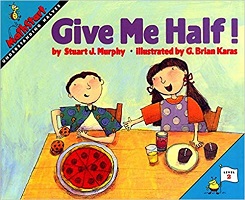
Grade 1
4 skill lessons · 2 math-through-reading
Math
Skill lessons
The mathematics the book carries, taught directly. Printable workbook pages are currently available for 4 of 4 lessons; separate teacher keys are available for 2 of 4.
- 1Split It in Two, Cut It the Same
- 2Half and Half Makes One Whole
- 3One for You, One for Me: Half the Pack
- 4Fair or Not Fair: Prove It by Matching
Math + reading
Math through the reading
The same book, entered through a sentence it prints. Change one word in the reading and the numbers change with it.
- 5Change One Word, Change the Cut
- 6Is One Slice Half?
Reading
Reading and language lessons
The same book read as a text. What a word means in its sentence, how a character is shown, how the writing is put together - no mathematics.
- 7The word at the end of the line says it twice
- 8What the voice wants is right there in the words
- 9First the pizza, last of all the mop
Skill lessons
4 lessons on the mathematics the book carries. Printable workbook pages are currently available for 4 of 4 lessons; separate teacher keys are available for 2 of 4.
1. Split It in Two, Cut It the Same
The story hands a child one whole pizza and then hands the child a rule: it goes into two pieces, and the two pieces have to be cut the same. Students fold and cut a paper pizza into two pieces that match when stacked, then cut a second one carelessly and stack that pair too, so the word half attaches to the matching pair and not to the lopsided one.
Full lesson — 20 minutes
1. Hold the whole and hear the rule (4 min)
Each student holds one uncut paper pizza flat on the desk. Trace its edge all the way around with one finger. Say "one whole" once, as the finger comes back to the start. Listen for the two lines that set the rule for cutting it. Then say back how many pieces the pizza has to go into. Keep the circle uncut until you have said the number out loud.
Word preview: whole
I have one whole pizza, and it's all for me.
It must be split in two.
2. Fold and cut two matching pieces (5 min)
Fold the circle so one edge lands exactly on the other. Press the crease flat with your thumb. Cut along the crease. Lay one piece on top of the other and slide it until the two straight edges line up. If the top piece hides the bottom one with nothing sticking out, your two pieces are the same.
Word preview: same, half
The pieces should be cut the same for each of you.
3. Test a lopsided cut against the rule (7 min)
Take a second paper pizza and cut straight across it without folding first, so one piece comes out bigger than the other. Stack that pair the way you stacked the first pair and put a finger on the part that sticks out. Set both pairs in front of a partner. Tell them which pair follows the rule, and what the stack showed you. Then swap and check your partner's two pairs the same way.
Word preview: same, more
You only get one slice. You'd better give me more than that.
4. Say the half sentence over your own pieces (4 min)
Put the two matching pieces back in front of you. Touch one and say "one half". Touch the other and say "one half". Slide them together and say the story's short sentence about two halves. Say it once on your own and once more while a partner watches your hands.
Word preview: half
Half and half is 1.
Short version — 9 minutes
1. Fold and cut two matching pieces (5 min)
Fold the paper pizza so one edge lands exactly on the other, crease it flat, and cut along the crease. Stack the two pieces and slide the top one until the cut edges line up. Nothing should stick out.
Word preview: same, half
The pieces should be cut the same for each of you.
2. Say the half sentence over your own pieces (4 min)
Touch one piece and say "one half", then touch the other and say "one half". Slide them together and say the story's short sentence about two halves while a partner watches your hands.
Word preview: half
Half and half is 1.
Three levels
- Support
- Stay with the first paper pizza and skip the lopsided cut. Fold it, cut it, stack the pieces, and say "one half" over each one. The folding, the matching test and the saying all stay exactly as they are; only the second pizza comes out.
- At Grade
- Cut both pizzas, run the stacking test on each pair, and say which pair is two halves and which is only two pieces. Then say the story's short sentence about two halves over the matching pair.
- Extension
- Fold the second pizza in half and then in half again, cut on both creases, and stack all four pieces to show they match each other. Say why one of those four pieces still cannot be called one half of the pizza, using what it would take to rebuild the whole as your reason.
English learners
Two words shift meaning here. "Half" names a piece you can pick up, and "the same" here meaning the same size rather than the same shape or the same colour. Walk through this frame while touching the pieces: "This piece is one half. That piece is one half. They are the same." Invite students to run the test and say what they found in their everyday language first, then say the frame in English over the same two pieces.
Materials
- Paper pizza circles, one per student
- Child-safe scissors
- Word cards: half, more, same, whole
Workbook
Paper Pizza Circles (two per student) full page
Give Me Half! — Split It in Two, Cut It the Same
Paper Pizza Circles
Say-It Strips: two halves make one strip set
Give Me Half! — Split It in Two, Cut It the Same
Say-It Strips
Say each line out loud with your two matching pieces in front of you.
Standards & curriculum
Choose your curriculum above to see the standards for this lesson.
Standards are held back while this plan is edited. Every standard shown here was matched against the supplied wording of this lesson, quoting its steps, so a changed step is no longer the thing that was checked. Undo your changes to bring the standards back — your edits stay in this browser either way.
2. Half and Half Makes One Whole
One fact is said three times running, first as a long story sentence, then as a short number sentence, then as an equation, and the set of three is said once for the pizza and again for the juice. Students slide two matching pieces back together until the whole is restored, do it again with a paper juice can, and say each of the three sentences while their hands hold the pieces those sentences are about.
Full lesson — 20 minutes
1. Rebuild the whole from two halves (5 min)
Take the two matching pieces of your paper pizza. Slide them together until the cut edges touch, with no gap and no overlap. Trace the outside edge with one finger and say "one whole" as your finger comes back to where it started. Pull the pieces apart and rebuild the whole twice more.
Word preview: whole
1 half pizza and 1 half pizza make 1 whole pizza.
2. Say the same fact three ways (4 min)
Keep the two pieces joined. Say the story's long sentence about two halves of a pizza. Then the short number sentence. Then the equation sentence. Each one about the pieces under your hands. Pull the pieces apart between sayings so you rebuild the whole each time you say it.
Word preview: half, equals
Half and half is 1. Half plus half equals 1.
3. Do it again with the juice can (6 min)
Fold a paper juice can so the top edge lands on the bottom edge, crease it, and cut on the crease. Stack the two pieces to check they match, then push them back together to remake the can and trace its outside edge. Say the story's juice sentence over the rebuilt can with both hands holding it together.
Word preview: half, whole
1 half can of juice and 1 half can of juice make 1 whole can of juice.
4. Judge a pair that will not rebuild (5 min)
Your teacher hands you an envelope holding two pieces that came from two different pizzas. Try to slide them together and trace the outside edge the way you did before. Tell a partner what goes wrong at the join. Say whether these two pieces can be called two halves of one whole pizza.
Word preview: same
The pieces should be cut the same for each of you.
Short version — 9 minutes
1. Rebuild the whole from two halves (5 min)
Slide your two matching pieces together until the cut edges touch with no gap, and trace the outside edge with one finger, saying "one whole" as you come back around. Pull them apart and rebuild the whole once more.
Word preview: whole
1 half pizza and 1 half pizza make 1 whole pizza.
2. Say the same fact three ways (4 min)
With the pieces joined, say the story's long sentence about two halves, then the short number sentence, then the equation sentence. Pull the pieces apart between sayings so you rebuild the whole each time.
Word preview: half, equals
Half and half is 1. Half plus half equals 1.
Three levels
- Support
- Stay with the pizza pieces and leave the juice can out. Rebuild the whole and say only the short number sentence about two halves, once with the pieces apart and once with them joined. The rebuilding, the tracing and the pulling apart stay exactly as they are.
- At Grade
- Rebuild both the pizza and the juice can, and say all three sentences over each one, pulling the pieces apart between sayings so every saying is about a whole you just remade.
- Extension
- Rebuild your own whole, then take the mismatched envelope and say what would have to be true of two pieces from two different pizzas before they could rebuild one whole. Say what is wrong with the mismatched pair in amounts, not in what the pieces look like.
English learners
Rebuilding is language-free: a child slides two pieces together and traces an edge, and the idea is visible before anything is said. The English that carries load is the three-way saying, because "and", "is", and "plus ... equals" all name the same joining here, and a learner who knows only one of the three can be left thinking three different things happened. Run the ladder with the pieces in hand: "Half and half is one. Half plus half equals one." Let students say what their hands did in their family language first, then climb the same ladder in English over the same rebuilt whole.
Materials
- Paper pizza halves, one matching pair per student
- Paper juice-can rectangles, one per student
- Child-safe scissors
- Envelope of mismatched paper pieces, one per pair
- Word cards: equals, half, same, whole
Workbook
Word Cards: equals, half, same, whole card set
Give Me Half! — Half and Half Makes One Whole
Word Cards
Paper Pizza Halves and Juice Can full page
Give Me Half! — Half and Half Makes One Whole
Paper Pizza Halves and Juice Can
Say-It Strips: the same fact three ways strip set
Give Me Half! — Half and Half Makes One Whole
Say-It Strips
Say the first three lines over your joined pizza pieces. Say the last line over your rebuilt juice can.
Teacher key (1 page) — not for the class
Teacher Prep Sheet: the mismatched envelope full page
Give Me Half! — Half and Half Makes One Whole
Teacher Prep Sheet — Envelope of Mismatched Pieces
Print one sheet per pair of students. Cut out both pieces and seal them in one envelope. The two halves come from circles of different sizes, so they are halves of two different pizzas and will not rebuild one whole.
What the pair should find
- The straight edges can be made to touch, but the curved edges do not carry on into one circle: one runs outside the other all the way round.
- A close answer names the amount — one piece is bigger than the other, so they are not two halves of one whole. A loose answer only says the pieces look wrong or are the wrong shape.
Standards & curriculum
Choose your curriculum above to see the standards for this lesson.
Standards are held back while this plan is edited. Every standard shown here was matched against the supplied wording of this lesson, quoting its steps, so a changed step is no longer the thing that was checked. Undo your changes to bring the standards back — your edits stay in this browser either way.
3. One for You, One for Me: Half the Pack
The cupcakes are the one place the story halves a group instead of an object: a pack of two goes to two children and each one ends up holding a whole cupcake, uncut. Students count the pack of two, deal it onto two plates, and say the story's line that one is half of two, then sort a pizza, a juice can and a pack of cupcakes into things you have to cut in two and things you can deal one and one.
Full lesson — 20 minutes
1. Count the pack (4 min)
Put two paper cupcakes together in front of your pair and count them by touching each one as you say its number. Say how many cupcakes make the pack. Then say the story's sentence about what one cupcake and one cupcake make.
Word preview: pack
One cupcake and one cupcake make a pack of two cupcakes.
2. Deal the pack between two plates (5 min)
Set two paper plates side by side. Deal the pack one cupcake at a time, saying "one for you, one for me", until the pack is gone. Count what is on each plate and check that the two plates hold the same amount. Nothing gets cut in this step.
Word preview: share, half
You both get half the pack
3. Say what half of two is (4 min)
Point at one plate and say how many cupcakes are on it. Then point at both plates and say how many there are altogether. Say the story's sentence that names one as half of two. Say it once pointing at your own plate and once pointing at your partner's plate.
Word preview: half
One and one is two. One plus one equals two. One is half of two.
4. Sort it: cut it or deal it (7 min)
Your pair gets a paper pizza, a paper juice can and a pack of two paper cupcakes. For each one, decide whether to cut it into two pieces or deal it one and one. Then carry out the move you chose onto the two plates. Tell your partner why the cupcakes were the only one you did not have to cut.
Word preview: share
Split the juice in half. Again, you have to share.
Short version — 9 minutes
1. Deal the pack between two plates (5 min)
Set two paper plates side by side and deal the pack of two cupcakes, saying "one for you, one for me". Count each plate and check the two hold the same amount. Nothing gets cut.
Word preview: share, half
You both get half the pack
2. Say what half of two is (4 min)
Point at one plate and say how many cupcakes are on it, then at both plates and say how many there are altogether. Say the story's sentence that names one as half of two.
Word preview: half
One and one is two. One plus one equals two. One is half of two.
Three levels
- Support
- Work only with the pack of two cupcakes and the two plates. Deal one and one, count each plate, and say that one is half of two. Leave the sorting round out; the dealing, the counting and the saying stay whole.
- At Grade
- Deal the pack, say that one is half of two over your own plate, then run the sorting round with all three items and carry out the halving move you chose for each.
- Extension
- After the sorting round, take one cupcake off a plate and say what two children would have to do to that single cupcake to share it. Say how that is different from what you did with the pack of two, using the number of pieces each child ends up holding as your reason.
English learners
Dealing one and one is understood everywhere and needs no English; a child can run the whole share before speaking. The load sits in two phrases that look alike and are not: "half the pack" means one cupcake, a whole object nobody cut, while "half the pizza" means a piece that was cut, and a learner who maps "half" onto "cut" will go looking for scissors that are not needed. Rehearse this frame at the plates: "One is half of two. I get one. You get one." Students may count and reason in their strongest language while they deal, then say the frame in English pointing at the two plates.
Materials
- Paper cupcakes, two per pair
- Two paper plates per pair
- Paper pizza circles, one per pair
- Paper juice-can rectangles, one per pair
- Child-safe scissors
- Word cards: half, pack, share
Workbook
Word Cards: half, pack, share card set
Give Me Half! — One for You, One for Me: Half the Pack
Word Cards
Paper Cupcakes, Pizza and Juice Can (one set per pair) full page
Give Me Half! — One for You, One for Me: Half the Pack
Paper Cupcakes, Pizza and Juice Can
Say-It Strips: one is half of two strip set
Give Me Half! — One for You, One for Me: Half the Pack
Say-It Strips
Say each line out loud with the cupcakes and the two plates in front of you.
Standards & curriculum
Choose your curriculum above to see the standards for this lesson.
Standards are held back while this plan is edited. Every standard shown here was matched against the supplied wording of this lesson, quoting its steps, so a changed step is no longer the thing that was checked. Undo your changes to bring the standards back — your edits stay in this browser either way.
4. Fair or Not Fair: Prove It by Matching
The whole story runs on a complaint: one child says the share is too small, and the rule that answers the complaint is that the pieces have to be cut the same. Students take pairs of pieces they did not cut themselves, stack them to see whether anything sticks out, sort them onto a fair mat and a not fair mat, then give a partner a reason the partner can check by stacking.
Full lesson — 20 minutes
1. Hear the complaint (4 min)
Look at the two pizza pieces your teacher holds up, one big and one small, while the story's argument is read out. Say which of the two pieces the complaining child was handed. Then say, in your own words, what that child wanted instead.
Word preview: more
You only get one slice. You'd better give me more than that.
2. Test three splits by stacking (5 min)
Each pair gets three envelopes, and each envelope holds the two pieces of one cut pizza. Take the pieces out one envelope at a time and stack them. Slide the top piece until its cut edge lines up with the bottom one. Put the envelope on the fair mat if nothing sticks out and on the not fair mat if something does.
Word preview: fair, same
The pieces should be cut the same for each of you.
3. Say your reason with the stack (4 min)
Pick one envelope back off a mat and stack its two pieces again in front of your partner. Say whether that split is fair and say how the stack shows it, naming what lines up or how much sticks out. Your partner has to be able to check your reason by stacking the same two pieces.
Word preview: fair
I have made no more than you, and you have made no less.
4. Pour fair (7 min)
Your pair gets two matching clear cups and one cup of dry beans standing in for the can of juice. Pour beans into the two cups. Set them side by side on the desk. Look straight across at the bean line in each one. Move beans from one cup to the other until the two lines sit level. Tell your partner how you knew you had poured fair.
Word preview: fair
And when you pour it out, make sure that you pour fair.
Short version — 9 minutes
1. Test three splits by stacking (5 min)
Take the two pieces out of each envelope, stack them, and slide the top piece until the cut edges line up. Put the envelope on the fair mat if nothing sticks out and on the not fair mat if something does.
Word preview: fair, same
The pieces should be cut the same for each of you.
2. Say your reason with the stack (4 min)
Pick one envelope off a mat and stack its two pieces again in front of your partner. Say whether the split is fair and how the stack shows it. Your partner has to be able to check by stacking the same two pieces.
Word preview: fair
I have made no more than you, and you have made no less.
Three levels
- Support
- Sort two envelopes instead of three, starting with the one your teacher marks, which is the pair that misses by a lot. Stack, sort and give the reason exactly as everyone else does; only the number of envelopes is smaller.
- At Grade
- Sort all three envelopes by stacking, then give a checkable reason for one of them, naming what lines up or what sticks out rather than saying the verdict again.
- Extension
- Take an envelope your partner sorted and argue the other way: stack the pieces and say the strongest thing that can be said for the sorting you disagree with, then say what finally settles it. Move your own envelope to the other mat if the stack tells you to.
English learners
The judgment itself is language-free: a child stacks two pieces, sees the overhang, and that seeing is the whole reason. English gets in the way in two places. "Fair" here means equal in amount, not kind or polite, and the story's way of saying equal is a double negative, no more and no less, which reads as two comparisons where only one equality is meant. Rehearse this frame with the pieces stacked: "This is fair, because nothing sticks out." or "This is not fair, because this much sticks out." Let students say what the stack showed in their strongest language first, then give the frame in English while a partner watches the same stack.
Materials
- Two paper pizza pieces of different sizes, one pair for the class display
- Three envelopes per pair, each holding the two pieces of one cut paper pizza
- A fair mat and a not fair mat per pair
- Two matching clear cups per pair
- A cup of dry beans per pair
- Word cards: fair, more, same
Workbook
Word Cards: fair, more, same card set
Give Me Half! — Fair or Not Fair: Prove It by Matching
Word Cards
Fair and Not Fair Sorting Mats full page
Give Me Half! — Fair or Not Fair: Prove It by Matching
Sorting Mats
Say-It Strips: give a reason the stack shows strip set
Give Me Half! — Fair or Not Fair: Prove It by Matching
Say-It Strips
Stack the two pieces, then say one line out loud while your partner watches the stack.
Teacher key (3 pages) — not for the class
Teacher Prep Sheet: the class display pair full page
Give Me Half! — Fair or Not Fair: Prove It by Matching
Teacher Prep Sheet — Two Pizza Pieces of Different Sizes
Cut the circle out, then cut along the straight line. One piece comes out big and one comes out small. Hold both up together while the story's argument is read out. One pair is enough for the whole class.
Teacher Prep Sheet: the three envelope pizzas full page
Give Me Half! — Fair or Not Fair: Prove It by Matching
Teacher Prep Sheet — Three Cut Pizzas, One Per Envelope
Print one sheet per pair. Cut out each circle, cut it along its own straight line, and put that circle's two pieces in one envelope. Keep the pieces of different circles apart.
What each circle is cut for
- A is cut through the middle: the two pieces stack with nothing sticking out.
- B is cut a little off the middle: the overhang is there but small, so the pair has to line the cut edges up before they can see it.
- C is cut well off the middle: this is the pair that misses by a lot, so it is the one to mark for a Support pair sorting two envelopes instead of three.
Vary the mix if you want a different balance of splits; three cut pizzas and one that misses by a lot are what the lesson asks for.
Teacher Key: Fair and Not Fair Sorting Mats full page
Give Me Half! — Fair or Not Fair: Prove It by Matching
Teacher Key — Fair / Not Fair Sorting Mats
Whether the three envelopes are cut from the prepared sheet or from your own paper, the correct placement is whatever the stacking test shows for the two pieces in each envelope. Check the sort against the stack, not against a fixed answer.
What a correct sort looks like
- Fair mat: the two pieces stack with their cut edges lined up and nothing sticking out past the other piece.
- Not fair mat: with the cut edges lined up, part of one piece still extends past the other.
- A pair sorted correctly for the wrong reason still needs the stack redone in front of you.
Read for
- A close reason names what the stack showed — what lined up, or how much stuck out — and a partner can check it by stacking the same two pieces.
- A loose reason repeats the verdict, or points to what a piece looks like rather than to the overhang.
- Support: the pair sorts two envelopes instead of three, starting with the one you marked, and gives the reason the same way.
- Extension: listen for the strongest case the student can make for a sorting they disagree with, and for what they say finally settles it.
Standards & curriculum
Choose your curriculum above to see the standards for this lesson.
Standards are held back while this plan is edited. Every standard shown here was matched against the supplied wording of this lesson, quoting its steps, so a changed step is no longer the thing that was checked. Undo your changes to bring the standards back — your edits stay in this browser either way.
Math through the reading
The mathematics is reached through a sentence the book prints: change one word in the reading and the numbers change with it. These carry their own standards, matched against these lessons rather than inherited from the skill ones.
5. Change One Word, Change the Cut
Students carry out the book's cutting rule and a version with one word changed, then hold the two piles of paper side by side to see which sentence made halves.
Full lesson — 20 minutes
1. Do what the book's sentence says (4 min)
Students hear the book's cutting rule read aloud twice, then carry it out on a paper pizza: one fold, one crease, one cut. They stack the two pieces and slide the top one until the cut edges line up, and say how many pieces the sentence made.
2. Do what the changed sentence says (5 min)
Students hear the same sentence with one word changed and carry that one out on a second paper pizza: fold, fold again, cut on both creases. They stack all four pieces to check they match each other and say how many pieces this sentence made.
3. Lay both piles under the whole and say which made halves (6 min)
Each pair takes one piece from the two-piece pile and one from the four-piece pile and lays each against an uncut pizza kept whole for comparing. Students say which single piece would need only one more like it to rebuild the whole, and put the pile that makes halves in front of the sentence that produced it.
4. Say a sentence with the word about your own pile (5 min)
Each student chooses one of the book's amount words, holds up the pile it belongs to, and says a true sentence about that pile using the word. A partner says whether the sentence matches the pile in the speaker's hand.
Short version — 9 minutes
1. Do what the book's sentence says (4 min)
Students hear the book's cutting rule read aloud twice, then carry it out on a paper pizza: one fold, one crease, one cut. They stack the two pieces and slide the top one until the cut edges line up, and say how many pieces the sentence made.
2. Do what the changed sentence says (5 min)
Students hear the same sentence with one word changed and carry that one out on a second paper pizza: fold, fold again, cut on both creases. They stack all four pieces to check they match each other and say how many pieces this sentence made.
Three levels
- Support
- The second pizza comes to you already creased into four, so you cut on lines that are there instead of judging two folds. Everything else stays: you carry out both sentences, lay both pieces against the whole, and say your sentence about your own pile.
- At grade
- Carry out both sentences on your own paper, lay one piece from each pile against the uncut whole, and say which sentence made halves. Then choose an amount word and say a true sentence about your own pile with it.
- Extension
- Change a different word instead. Keep the number of pieces at two and take away the word that makes the pieces the same, then cut a pair that obeys the new sentence. Say which of the two changes does more damage to the word half, and show the damage with pieces rather than describing it.
English learners
The cutting and the comparing transfer without English; a child can hold a piece against a whole and be understood by anyone in the room. The load sits in small function words that English hides inside larger phrases: "in two" carries the count and is easy to lose next to "split", and "each", "both" and "the same" all look like ordinary conversation while doing arithmetic work. English also offers "split", "cut" and "share" as near neighbours that are not interchangeable here. Rehearse this frame while holding a pile: "This sentence made ___ pieces. This piece is ___ of the whole." Students may work out which pile is right in their strongest language first, then say the frame in English while holding the piece they mean.
Materials
- Paper pizza circles, two per student
- Child-safe scissors
- One uncut paper pizza circle per pair, kept whole for comparing
- The book's rule sentence and the changed sentence on two large cards, each read aloud twice as it is shown
Standards & curriculum
Choose your curriculum above to see the standards for this lesson.
Standards are held back while this plan is edited. Every standard shown here was matched against the supplied wording of this lesson, quoting its steps, so a changed step is no longer the thing that was checked. Undo your changes to bring the standards back — your edits stay in this browser either way.
IB PYP developmental alignment
Phases are not grades. The Primary Years Programme is a developmental continuum and your school places each student in a phase, so this names the strand the lesson works in and the phases it could sit across. Confirm against your own school's placement.
Number · Phases 1–2
- Phase 1
- Develop meaning for counting, quantity, number relationships, simple operations, and early fractions in meaningful contexts.
- Phase 2
- Develop place value and whole-number operations, mental strategies, fractions, and mathematical language for practical problem solving.
Shape and space · Phases 1–2
- Phase 1
- Describe and compare 2D and 3D shapes and use everyday spatial language for position, direction, paths, regions, and boundaries.
- Phase 2
- Classify 2D and 3D shapes by properties; explore symmetry and transformations; interpret and create simple directions.
6. Is One Slice Half?
Students cut the two pizzas the story's argument could be about, take a side on whether one slice was a fair share, and defend it with a number and a piece of paper a partner can check.
Full lesson — 20 minutes
1. Cut the two pizzas the argument could be about (5 min)
Each student folds one paper pizza once, cuts it and stacks the two pieces to check they match, then folds a second pizza twice, cuts on both creases and stacks all four. Both cut pizzas stay in front of the student so each reading of the story has an object standing for it.
2. Take a side and say it with a number (4 min)
Students carry their pieces to one of three named mats and say their position to a partner in a sentence that contains a number of pieces, holding up the piece they mean while they say it. A position sentence with no number in it is sent back to be said again.
3. Hear the other side and say what would change your mind (6 min)
Partners from different mats face each other. Each says their position once, then the listener says back what the speaker's reason was before answering it. Each student then says one thing they would need to know about the pizza before they would move mats, and may move.
4. Name the one number the book never gives (5 min)
The class sorts the lines they heard into the ones that give a number and the ones that do not, holding up pieces to show what each numbered line fixes. Students then name the number the book never gives and say what it would have settled.
Short version — 9 minutes
1. Cut the two pizzas the argument could be about (5 min)
Each student folds one paper pizza once, cuts it and stacks the two pieces to check they match, then folds a second pizza twice, cuts on both creases and stacks all four. Both cut pizzas stay in front of the student so each reading of the story has an object standing for it.
2. Take a side and say it with a number (4 min)
Students carry their pieces to one of three named mats and say their position to a partner in a sentence that contains a number of pieces, holding up the piece they mean while they say it. A position sentence with no number in it is sent back to be said again.
Three levels
- Support
- Use this frame with your pieces in your hands: "I think one slice ___ half, because the pizza was cut into ___ pieces and they ___ match." You still cut both pizzas yourself and you still choose your own mat; only the sentence is given to you.
- At grade
- Cut both pizzas, choose a mat, say your position in a sentence that has a number of pieces in it, and say one thing you would need to know about the pizza before you would move.
- Extension
- Go to the mat you did not choose and make the strongest case for it with the pieces in your hands, then say which of the two cases the book supports better and why the book still cannot settle it. You may move mats at the end; changing your mind after hearing a better reason finishes the argument rather than losing it.
English learners
Cutting and counting are language-free, and a child can hold up a piece and a whole and be understood by anyone. The English load is the hinge in every position here: "one slice is half only if the pizza was cut into two" is one claim with a condition inside it, and many learners will produce the two halves of it as two separate statements. "Fair" also means equal in amount in this book, not kind or polite, and the story's own way of saying equal is the double negative in "I have made no more than you, and you have made no less." Rehearse the hinge with the pieces raised: "One slice is half if there are two pieces. One slice is not half if there are four pieces." Students may take their side and reason it out in their strongest language first, then say the frame in English while holding up the piece they mean.
Materials
- Paper pizza circles, two per student
- Child-safe scissors
- One uncut paper pizza circle per pair, kept whole for comparing
- Three floor mats named for the three positions: one slice was half, one slice was not half, and the book does not say
Standards & curriculum
Choose your curriculum above to see the standards for this lesson.
Standards are held back while this plan is edited. Every standard shown here was matched against the supplied wording of this lesson, quoting its steps, so a changed step is no longer the thing that was checked. Undo your changes to bring the standards back — your edits stay in this browser either way.
IB PYP developmental alignment
Phases are not grades. The Primary Years Programme is a developmental continuum and your school places each student in a phase, so this names the strand the lesson works in and the phases it could sit across. Confirm against your own school's placement.
Number · Phases 1–2
- Phase 1
- Develop meaning for counting, quantity, number relationships, simple operations, and early fractions in meaningful contexts.
- Phase 2
- Develop place value and whole-number operations, mental strategies, fractions, and mathematical language for practical problem solving.
Reading and language lessons
3 lessons on the reading and language the book carries - what a word means in its sentence, how a character is shown, how a text is built. No mathematics: these are matched against the English language arts curricula, which are a different and smaller set than the mathematics ones.
7. The word at the end of the line says it twice
This book is written in rhyming couplets, so the last word of one line and the last word of the next end with the same sound. Students hear a pair read aloud, then find pairs themselves across three more printed passages and write them on a rhyme chart, and finally say a new line of their own that ends on one of the book's rhyme words. The skill is hearing and producing the shared ending, not counting anything the lines are about.
Full lesson — 20 minutes
1. Hear the two words that end alike (5 min)
Listen while the teacher reads this passage aloud, then say the last word of each line back: pack, then snack. Hold up two fingers when you hear the second word that ends the same way. Say the pair aloud together - pack, snack - and stretch the ending you hear twice.
Word preview: pack, snack
I know she has some cupcakes. I saw her with a pack. I'm going to hide my cupcakes and save them for a snack.
2. Find the rhyme yourself (6 min)
Read this passage with a partner and underline the last word of each line: some and crumb. Say them aloud and decide with your thumb up or down whether they end alike. Write the pair on your rhyme chart under the heading the teacher displays.
Word preview: some, crumb
Hey, what's that on your chair? You'd better give me some. I'm going to eat them both myself and leave you just a crumb.
3. Collect three more pairs (6 min)
Work through these three passages and add each rhyming pair to your rhyme chart: bite and fight, too and through, share and fair. Read each pair aloud to your partner before you write it. Circle the letters at the end of both words that look the same.
Word preview: bite, fight, through, fair
I have a stack of cookies and you get just one bite. You'd better give me half that stack or else I'll start a fight.
I gave you half of mine, so you must share yours too. I'll give you just a sip, but not until I'm through.
Split the juice in half. Again, you have to share. And when you pour it out, make sure that you pour fair.
4. Make one new rhyming line (3 min)
Pick one pair from your rhyme chart and say a brand-new line that ends with the second word. Say it aloud to your partner - the line is yours, not the book's. Your partner listens for the ending sound and says yes or not yet.
Short version — 9 minutes
1. Hear the two words that end alike (5 min)
Listen while the teacher reads this passage aloud, then say the last word of each line back: pack, then snack. Say the pair aloud together and stretch the ending you hear twice.
Word preview: pack, snack
I know she has some cupcakes. I saw her with a pack. I'm going to hide my cupcakes and save them for a snack.
2. Find the rhyme yourself (4 min)
Read this passage with a partner and underline the last word of each line: some and crumb. Say them aloud and put your thumb up if they end alike. Write the pair on your rhyme chart.
Word preview: some, crumb
Hey, what's that on your chair? You'd better give me some. I'm going to eat them both myself and leave you just a crumb.
Three levels
- Support
- Stay with the pack and snack pair from the first step. Say the two words slowly, one after the other, and clap once on the ending both words share. Add only one more pair, some and crumb, and say it the same way before writing anything.
- At Grade
- Work all five pairs across the printed passages, saying each pair aloud before writing it on the rhyme chart, then produce one new line of your own that ends on a book rhyme word.
- Extension
- After the chart is full, sort the pairs by what the ending looks like on paper - pack and snack share the letters, some and crumb do not. Say aloud what you notice: two words can rhyme in your ear and still be spelled apart.
English learners
Rhyme transfers as a listening skill from almost every home language, so invite the child to say a rhyming pair from their strongest language first and let the class hear it. The English vowel in crumb and some is the hard part, since the two words are spelled apart and sound alike. Rehearse the frame "___ and ___ rhyme" with the pack and snack pair from step 1 before asking for the harder pair in step 2.
Materials
- Printed passage: the cupcake-hiding lines
- Printed passage: the cupcake-grabbing lines
- Rhyme chart
- Printed passage: the cookie-stack lines
- Printed passage: the sip lines
- Printed passage: the pouring lines
- Word cards: pack, snack, some, crumb, bite, fight, through, fair
Standards & curriculum
Choose your curriculum above to see the standards for this lesson.
Standards are held back while this plan is edited. Every standard shown here was matched against the supplied wording of this lesson, quoting its steps, so a changed step is no longer the thing that was checked. Undo your changes to bring the standards back — your edits stay in this browser either way.
8. What the voice wants is right there in the words
Nobody in this book is named and nothing is put in quotation marks, so a reader learns what each voice wants only from the words the line uses. Students read four printed passages, circle the words that carry the wanting - all, hide, crumb, fight, trouble - and build a wants-and-feelings chart, then finish a because sentence that has to name a word printed on the page. The skill is grounding a feeling in the text's own wording.
Full lesson — 20 minutes
1. Read what the first voice wants (5 min)
Read this passage aloud with a partner, each of you taking one line. Then say in your own words what this voice wants - point to the word all when you say it. Tell your partner one word for how this voice sounds: greedy, excited, or teasing.
Word preview: whole, all
I have one whole pizza, and it's all for me. I'm going to get some pizza. Just you wait and see.
2. Find the wanting word (6 min)
Read these two passages and circle the words that show what someone wants to do: hide and save in the first, eat and leave in the second. Write on your wants-and-feelings chart what each voice wants to happen to the cupcakes. Say to your partner which of the two sounds hungrier, and point at the word that told you.
Word preview: hide, crumb
I know she has some cupcakes. I saw her with a pack. I'm going to hide my cupcakes and save them for a snack.
Hey, what's that on your chair? You'd better give me some. I'm going to eat them both myself and leave you just a crumb.
3. Say how the feeling turns (6 min)
Read these two passages one after the other. In the first, someone is angry enough to fight; in the second, both voices are worried about being in trouble. Tell your partner the word in each passage that shows you the feeling, and add both feelings to your wants-and-feelings chart.
Word preview: fight, trouble
I have a stack of cookies and you get just one bite. You'd better give me half that stack or else I'll start a fight.
We're going to be in trouble. We've made a great big mess, but I have made no more than you, and you have made no less.
4. Answer with a because (3 min)
Look at your wants-and-feelings chart, then read this passage once more and finish the sentence aloud for your partner: this voice wants ___ because the book says ___. The word you name must be one you can put your finger on right here. Your partner checks that the word is really there.
Word preview: trouble
We're going to be in trouble. We've made a great big mess, but I have made no more than you, and you have made no less.
Short version — 9 minutes
1. Read what the first voice wants (5 min)
Read this passage aloud with a partner, each taking one line. Say in your own words what this voice wants, and point to the word all when you say it. Name one word for how this voice sounds.
Word preview: whole, all
I have one whole pizza, and it's all for me. I'm going to get some pizza. Just you wait and see.
2. Find the wanting word (4 min)
Read these two passages and circle the words that show what someone wants to do: hide in the first, and the crumb the second one would leave behind. Say to your partner which voice sounds hungrier and point at the word that told you.
Word preview: hide, crumb
I know she has some cupcakes. I saw her with a pack. I'm going to hide my cupcakes and save them for a snack.
Hey, what's that on your chair? You'd better give me some. I'm going to eat them both myself and leave you just a crumb.
Three levels
- Support
- Stay with the opening pizza passage and one word: all. Point to it, say it, and tell your partner what a voice who says all wants. Add the second passage only after the first sentence comes out whole.
- At Grade
- Work all four printed passages, circle one wanting word in each, fill the chart, and finish the because sentence naming a word that is really printed.
- Extension
- Line up the opening pizza passage against the great-big-mess passage and say what changed. The first voice says the pizza is all for me; the last one says we've made a great big mess. Name the word in each that carries the turn from me to we.
English learners
The words for feelings - greedy, hungry, angry, worried - usually have a close match in a child's home language, so invite the feeling word in the strongest language first, then supply the English one. This book gives no speaker tags at all, so the reader has to work out who is talking from the line itself; say aloud with the child "this voice wants ___" using the opening pizza passage in step 1 before asking for it in step 2.
Materials
- Printed passage: the opening pizza lines
- Wants-and-feelings chart
- Printed passage: the cupcake-hiding lines
- Printed passage: the cupcake-grabbing lines
- Printed passage: the cookie-stack lines
- Printed passage: the great-big-mess lines
- Word cards: whole, all, hide, crumb, fight, trouble
Standards & curriculum
Choose your curriculum above to see the standards for this lesson.
Standards are held back while this plan is edited. Every standard shown here was matched against the supplied wording of this lesson, quoting its steps, so a changed step is no longer the thing that was checked. Undo your changes to bring the standards back — your edits stay in this browser either way.
9. First the pizza, last of all the mop
The story runs through four foods and then a mess, and the mess only makes sense after the food it is made of. Students read six printed passages, lay a picture card for each on a story strip in the order the book gives, and retell the whole thing aloud using first, next, then, and last of all while a partner listens for a missing part. The skill is ordering and retelling events, not counting them.
Full lesson — 20 minutes
1. Put the first two things in order (5 min)
Read these two passages and decide which one comes first in the story. Lay your two picture cards down in that order, left to right, on the story strip. Say the order aloud to your partner using the words first and next.
Word preview: first, next
You have to share the pizza. It must be split in two. The pieces should be cut the same for each of you.
What is that behind her back? The last can of juice, I think. If he takes some juice from me, I won't have much to drink.
2. Add the middle of the story (6 min)
Read these two passages and add their cards to the story strip after the first two. Say the whole order aloud so far: first, next, then. If a partner puts a card in the wrong place, read the passage again and show them the words that fix it.
Word preview: then, stack
I know she has some cupcakes. I saw her with a pack. I'm going to hide my cupcakes and save them for a snack.
I have a stack of cookies and you get just one bite. You'd better give me half that stack or else I'll start a fight.
3. Put the ending last (6 min)
Read these two passages and lay their cards at the end of the story strip. Say why the mess has to come after the cookies and not before. Finish your retell aloud with the words last of all.
Word preview: last, mess
Hey, wait! Too late! There are cookies on the floor. There's pizza everywhere. There's juice spilled on the table and sticky stuff under my chair.
We'd better each clean half. There's so much work to do. We'll be done in half the time.
4. Retell the whole thing to a partner (3 min)
Touch each card on your story strip in order and retell the story from start to end, using first, next, then, and last of all. Your partner listens without the strip and holds up a hand if a part is missing. Then swap and listen while your partner retells it.
Short version — 9 minutes
1. Put the first two things in order (5 min)
Read these two passages and decide which one comes first in the story. Lay your two picture cards down in that order on the story strip. Say the order aloud using first and next.
Word preview: first, next
You have to share the pizza. It must be split in two. The pieces should be cut the same for each of you.
What is that behind her back? The last can of juice, I think. If he takes some juice from me, I won't have much to drink.
2. Put the ending last (4 min)
Read these two passages and lay their cards at the end of the story strip. Say why the mess comes after the food and not before, then retell what you have so far using first, next, and last of all.
Word preview: last, mess
Hey, wait! Too late! There are cookies on the floor. There's pizza everywhere. There's juice spilled on the table and sticky stuff under my chair.
We'd better each clean half. There's so much work to do. We'll be done in half the time.
Three levels
- Support
- Work only the two passages from the first step and two cards. Say first for one and next for the other, touching each card as you say the word. Add a third card only when those two come out in the right order twice.
- At Grade
- Build the full six-card strip from the printed passages and retell the story to a partner using first, next, then, and last of all.
- Extension
- After the retell, move one card out of place on purpose and ask your partner to catch it. Then say aloud which cards could swap without breaking the story and which could not - the mess cannot come before the food that made it.
English learners
Order words are among the earliest structures a child controls in any language, so invite the retell in the strongest language first and listen for the sequence rather than the English. The four-word English set first, next, then, last of all has to be learnt as a fixed chain; rehearse it on the two cards in step 1 before the six-card retell, and let the child touch a card for every order word said.
Materials
- Printed passage: the sharing-the-pizza lines
- Printed passage: the juice-behind-her-back lines
- Story strip
- Picture cards
- Printed passage: the cupcake-hiding lines
- Printed passage: the cookie-stack lines
- Printed passage: the everything-spilled lines
- Printed passage: the each-clean-half lines
- Word cards: first, next, then, stack, last, mess
Standards & curriculum
Choose your curriculum above to see the standards for this lesson.
Standards are held back while this plan is edited. Every standard shown here was matched against the supplied wording of this lesson, quoting its steps, so a changed step is no longer the thing that was checked. Undo your changes to bring the standards back — your edits stay in this browser either way.