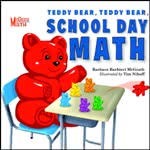
Teddy Bear, Teddy Bear, School Day Math
Grade K
3 skill lessons · 1 math-through-reading
Math
Skill lessons
The mathematics the book carries, taught directly. Printable workbook pages and teacher keys are not available for this book yet.
- 1Eight Bears, Four Pairs
- 2One Bear Plus These Two
- 3Which Row Runs Out First
Math + reading
Math through the reading
The same book, entered through a sentence it prints. Change one word in the reading and the numbers change with it.
- 4The Word Tells Your Hands What To Do
Reading
Reading and language lessons
The same book read as a text. What a word means in its sentence, how a character is shown, how the writing is put together - no mathematics.
- 5Lines that tell your body what to do
- 6The word at the end of the line
Skill lessons
3 lessons on the mathematics the book carries. Printable workbook pages and teacher keys are not available for this book yet.
1. Eight Bears, Four Pairs
The book asks the class to count by twos and asks whether they see eight, and never shows a bear or prints a numeral, so the eight has to be built on the desk before it can be counted. Students set out eight counters, group them into four pairs, and count the pairs two, four, six, eight with one touch per number word. The count has to run off the grouping rather than off a memorised chant: a child who says two, four, six, eight while touching six pairs has not got it yet, and the gap between pairs is what makes that visible to a teacher walking the room.
Full lesson — 20 minutes
1. Set out eight bears (5 min)
Each pair pours out bears and sets exactly eight in a line on the mat. Touch each bear once and say its number, one through eight, one touch to one number word. Push the line back into the tub and rebuild it twice more, so the count starts from an empty mat each time.
Word preview: count
Count the teddies.
2. Snap the eight into pairs (5 min)
Slide the eight bears into four pairs, two bears touching in each pair, with a gap of a finger's width between pairs. Say how many pairs you made. Check a partner's mat and say whether their gaps show four pairs or three.
Word preview: twos
Count by twos.
3. Count the pairs by twos (6 min)
Touch each pair once and count two, four, six, eight, one touch to one number word. Say the last number you land on. Do it again with your eyes on your partner's hand instead of your own, and stop them if a touch and a number word come apart.
Word preview: eight
Do you see eight?
4. Say the two counts side by side (4 min)
Count the same eight bears one at a time, then count them again by twos. Tell your partner both last numbers out loud. Say which count used fewer number words and point at the mat to show why.
Short version — 9 minutes
1. Set out eight bears (4 min)
Each pair sets exactly eight bears in a line and touches each one once, saying one through eight. One touch, one number word.
Word preview: count
Count the teddies.
2. Count the pairs by twos (5 min)
Slide the eight into four pairs with a gap between each. Touch each pair once and count two, four, six, eight. Say the last number you land on.
Word preview: eight
Do you see eight?
Three levels
- Support
- Stay with six bears in three pairs and count two, four, six. Keep the same one-touch rule and the same finger-width gaps. Add one pair at a time and extend the count by one number word per new pair, never past eight.
- At Grade
- Build the eight, group it into four pairs, and count by twos to eight with one touch per pair. Then count the same eight one at a time and say both last numbers.
- Extension
- Set out ten bears and five pairs, count two, four, six, eight, ten, then take one bear away and say what goes wrong with the count by twos. Show your partner on the mat why nine bears cannot be counted by twos and land on nine.
English learners
Number words carry across languages but the counting-by-twos chant does not, so a child who counts fluently at home may still be hearing two, four, six, eight as one long unfamiliar word. Rehearse the frame "I touch one pair and I say one number" before any counting starts, and let children count the pairs aloud in their strongest language first and then in English while touching the same bears. The touching is what proves the count, so a child who is silent in English can still show a correct count with a hand.
Materials
- A tub of two-colour teddy bear counters, at least twenty per pair
- A blank counting mat per pair
- A displayed chart of the number words one to ten
- Word cards: count, twos, eight
Standards & curriculum
Choose your curriculum above to see the standards for this lesson.
Standards are held back while this plan is edited. Every standard shown here was matched against the supplied wording of this lesson, quoting its steps, so a changed step is no longer the thing that was checked. Undo your changes to bring the standards back — your edits stay in this browser either way.
2. One Bear Plus These Two
This is the one place in the book where an operation is named and both of its parts are given: the text asks how many is one bear plus these two, and then turns the page without answering. Students build the one and the two as separate groups, push them together, and count the result, so the word plus is attached to a hand movement rather than to a rule. The joining is the point, not the fact: a child who already knows one and two make three still has to show which two groups were pushed together and say the sentence about their own mat, and the swap in the last step is there so that plus is heard as an instruction rather than as a word that always produces three.
Full lesson — 20 minutes
1. Build one bear and two bears (5 min)
Each pair puts one bear on the left of the mat and two bears on the right, with a wide gap between the groups. Point at the one and say one, point at the two and say two. Say out loud which side has more bears and how you know.
Word preview: plus
How many is one bear plus these two?
2. Push the groups together (5 min)
Slide the one bear across the mat until it touches the two, so the gap closes and the three bears sit in one group. Count the bears in the new group, one touch to one number word. Say the number you land on.
3. Say the whole line about your bears (6 min)
Tell your partner the line the book asks, then answer it about the bears in front of you: one bear plus these two is three. Say it twice, once pointing at the two groups before you push and once pointing at the joined group. Your partner listens for the word plus and says it back.
Word preview: join
Join the fun!
4. Change the second group and say it again (4 min)
Swap the two bears for three bears and rebuild. Push the groups together, count, and say one bear plus these three. Tell your partner what changed in the number you landed on and what stayed the same in the sentence.
Short version — 9 minutes
1. Build one bear and two bears (4 min)
Put one bear on the left of the mat and two on the right with a wide gap. Point at each group and say its number aloud.
Word preview: plus
How many is one bear plus these two?
2. Say the whole line about your bears (5 min)
Slide the one bear across until it touches the two, count the joined group, and say one bear plus these two is three. Your partner listens for the word plus.
Word preview: join
Join the fun!
Three levels
- Support
- Keep the one-and-two build exactly as it is and drop the swap. Say the sentence with the teacher supplying the first half, one bear plus these two, and the child supplying only the number they counted. The bears and the pushing stay whole.
- At Grade
- Build one and two as separate groups, push them together, count the joined group, and say one bear plus these two is three about your own mat. Then rebuild with three on the right and say the new sentence.
- Extension
- Build the three first and then find every way to break it into two groups on the mat, saying a plus sentence for each. Tell your partner why one plus two and two plus one land on the same number when the bears are the same bears.
English learners
Plus is the load-bearing word and it does not survive translation as a gesture, so teach it against the push: the hand movement means plus, and the word rides on it. Number words themselves are largely transferable, so a child new to English can usually count the joined group correctly while being unable to produce the sentence. Give the frame "one bear plus these two is ___" to rehearse aloud with a partner, invite children to say the joining sentence in their strongest language first, and accept a correct count with a pointed finger as evidence while the English sentence is still coming.
Materials
- A tub of two-colour teddy bear counters, at least twenty per pair
- A blank counting mat per pair
- A displayed chart of the number words one to ten
- Word cards: plus, join
Standards & curriculum
Choose your curriculum above to see the standards for this lesson.
Standards are held back while this plan is edited. Every standard shown here was matched against the supplied wording of this lesson, quoting its steps, so a changed step is no longer the thing that was checked. Undo your changes to bring the standards back — your edits stay in this browser either way.
3. Which Row Runs Out First
The book asks twice which colour has fewer and answers neither time, and it never says how many of either colour there are, so the two rows have to be built before the question means anything. Students lay yellow against red in two lined-up rows, match them bear to bear, and read the answer off the leftovers rather than off a subtraction. Representation is the point here: the lined-up rows are what turn fewer from a guess into something a finger can point at, and the last step exists so that fewer is felt to move when the arrangement changes rather than being attached permanently to one colour.
Full lesson — 20 minutes
1. Build two colour groups (5 min)
Each pair builds a row of yellow bears and a row of red bears on the mat, one row above the other, with the bears lined up so the rows start at the same edge. Count each row aloud, one touch to one number word, and say both numbers to your partner.
Word preview: fewer
Are there fewer yellow or red?
2. Match the rows bear to bear (5 min)
Slide the rows until each bear in the shorter row sits directly under a bear in the longer row. Point at the bears left over with nothing under them. Say which colour ran out first.
3. Say the fewer sentence (6 min)
Say the book's question aloud to your partner, then answer it about your own two rows using the word fewer: there are fewer red than yellow. Point at the leftover bears while you say it. Your partner rebuilds the same two rows from your sentence alone, without looking at your mat.
Word preview: fewer
Teddy Bear, Teddy Bear, tie your shoe.
4. Swap the colours and say it again (4 min)
Take bears off the longer row until it is the shorter one. Match the rows again and say the fewer sentence about the new arrangement. Tell your partner which word in your sentence had to change and which colour name moved.
Are there fewer green bears or blue?
Short version — 9 minutes
1. Build two colour groups (4 min)
Build a row of yellow bears and a row of red bears, one above the other, starting at the same edge. Count each row aloud and say both numbers.
Word preview: fewer
Are there fewer yellow or red?
2. Say the fewer sentence (5 min)
Match the rows bear to bear, point at the leftover bears, and answer the book's question about your own mat using the word fewer.
Word preview: fewer
Teddy Bear, Teddy Bear, tie your shoe.
Three levels
- Support
- Keep both rows under six bears and let the difference be one or two, so the leftovers are countable at a glance. Everything else stays: the same matching, the same pointing, the same sentence with the word fewer in it.
- At Grade
- Build two colour rows, match them bear to bear, and say which colour has fewer while pointing at the leftovers. Then change the arrangement so the other colour is fewer and say the sentence again.
- Extension
- Build the two rows so the leftovers number exactly three, without counting either row first. Say the fewer sentence and then say the same fact the other way round using more, and show your partner on the one mat that both sentences describe it.
English learners
Comparative syntax is where this lesson will break for a child whose mathematics is sound: fewer than reverses word order in many languages and some mark the comparison on the noun rather than with a separate word, so a child may match the rows perfectly and still produce the colours the wrong way round. Rehearse the frame "there are fewer ___ than ___" with the two colour names before any matching begins, and let children say which row ran out in their strongest language while pointing, then rebuild the English sentence from the mat. The leftover bears are the evidence, so pointing counts as an answer while the sentence is still being assembled.
Materials
- A tub of two-colour teddy bear counters, at least twenty per pair
- A ten-frame strip per pair
- A displayed chart of the number words one to ten
- Word cards: fewer, count
Standards & curriculum
Choose your curriculum above to see the standards for this lesson.
Standards are held back while this plan is edited. Every standard shown here was matched against the supplied wording of this lesson, quoting its steps, so a changed step is no longer the thing that was checked. Undo your changes to bring the standards back — your edits stay in this browser either way.
Math through the reading
The mathematics is reached through a sentence the book prints: change one word in the reading and the numbers change with it. These carry their own standards, matched against these lessons rather than inherited from the skill ones.
4. The Word Tells Your Hands What To Do
Children act out four of the book's unanswered questions with counters, and discover that swapping one word in the question changes what their hands must do to the same bears.
Full lesson — 20 minutes
1. Act out two questions with bears (6 min)
Each pair hears the book's plus question and its fewer question, one at a time, and builds the answer with counters. For the first they set one bear apart from two bears and push them together, then count. For the second they lay a yellow row against a red row, match them bear to bear, and point at what is left over. They say the number or the colour they arrived at.
2. Name the word that moved your hands (5 min)
Children say which single word in each question told them what to do - plus for the pushing together, fewer for the matching. They say it to a partner while pointing at their own mat, and the partner says whether the word they named matches the movement they watched.
3. Swap the word and move again (6 min)
The teacher says the plus question with fewer in place of plus, and the fewer question with plus in place of fewer. Children rebuild the same bears and do what the new word demands: the one and the two get matched instead of joined, and the two colour rows get pushed together and counted. They say both results out loud - the number and the leftover - and say which word produced which.
4. Say what the word did (3 min)
Each child tells a partner one sentence about their own bears in the form: the word ___ told me to ___, and I got ___. The partner rebuilds the arrangement from the sentence alone without looking, and the speaker says whether the partner's mat is right.
Short version — 9 minutes
1. Act out two questions with bears (6 min)
Each pair hears the book's plus question and its fewer question, one at a time, and builds the answer with counters. For the first they set one bear apart from two bears and push them together, then count. For the second they lay a yellow row against a red row, match them bear to bear, and point at what is left over. They say the number or the colour they arrived at.
2. Swap the word and move again (6 min)
The teacher says the plus question with fewer in place of plus, and the fewer question with plus in place of fewer. Children rebuild the same bears and do what the new word demands: the one and the two get matched instead of joined, and the two colour rows get pushed together and counted. They say both results out loud - the number and the leftover - and say which word produced which.
Three levels
- Support
- Work with one pair of words only, plus against fewer, and keep the bears to one and two against a matched pair of rows under five. The teacher says each question twice and the child does the movement before naming the word rather than after, so the hands lead and the naming follows. The mathematics is untouched; only the number of words in play is reduced.
- At grade
- Act out both questions with counters, name the operative word in each, do both swaps, and say the sentence naming the word, the movement and the result.
- Extension
- Take the book's more than five question and its by twos instruction and decide, before touching a bear, whether the two demands could ever be satisfied by the same arrangement. Build one that satisfies both and one that satisfies neither, and say what each word ruled in or out.
English learners
The mathematics here is almost entirely transferable and the language is almost entirely not, which makes this the lesson where a child strong in number can look weakest. Counting and joining are language-independent; plus and fewer are not, and fewer is the harder of the two because many languages mark it on the noun or reverse the order of the compared things, so a child may match the rows perfectly and name the colours the wrong way round. Rehearse the two frames aloud before any question is asked - "___ told me to push them together" and "___ told me to match them" - and invite children to say what the word made them do in their strongest language first, then in English while pointing at the mat. The hands are the evidence in this lesson, so a child whose English sentence has not arrived can still demonstrate a correct reading of the word, and the teacher should record that as the reading it is.
Materials
- A tub of two-colour teddy bear counters, at least twenty per pair
- A blank counting mat per pair
- The book's four question lines, read aloud one at a time
- A displayed chart of the number words one to ten
Standards & curriculum
Choose your curriculum above to see the standards for this lesson.
Standards are held back while this plan is edited. Every standard shown here was matched against the supplied wording of this lesson, quoting its steps, so a changed step is no longer the thing that was checked. Undo your changes to bring the standards back — your edits stay in this browser either way.
Reading and language lessons
2 lessons on the reading and language the book carries - what a word means in its sentence, how a character is shown, how a text is built. No mathematics: these are matched against the English language arts curricula, which are a different and smaller set than the mathematics ones.
5. Lines that tell your body what to do
Every line in this chant is an instruction with the same four words in front of it, which makes it a clean place for a kindergartner to meet the idea that some sentences tell you to do something. Students perform three commands in a circle, mark the single doing word in three more, meet one line that repeats a doing word three times and one that joins two with a small word, and finish on the line that cancels all of them. The whole lesson is listening and doing; the book's questions about the bears are not asked here and no step gives a child a quantity to handle.
Full lesson — 20 minutes
1. Do what the line says (5 min)
Stand in a circle. As each line is read, do exactly what its last part tells you to do: sit up straight, then touch the floor, then pat your head. Say the doing part back as you do it, so the words and the body go together.
Word preview: sit, touch, pat
Teddy Bear, Teddy Bear, sit up straight.
Teddy Bear, Teddy Bear, touch the floor.
Teddy Bear, Teddy Bear, pat your head.
2. Find the doing word in each line (6 min)
With a partner, read these three lines and put a bear counter on the one word in each that tells your body what to do: turn, tie, moo. Say the word aloud and do the action once. Then say what part of every line is exactly the same, and say that same part together as a class.
Word preview: turn, tie, moo
Teddy Bear, Teddy Bear, turn around.
Teddy Bear, Teddy Bear, tie your shoe.
Teddy Bear, Teddy Bear, moo like a cow.
3. Hear a line that says three at once (5 min)
Read these two lines aloud together. One tells you a doing word three times over and one tells you two different doing words joined by a small word. Say how many actions each line asks for, do each line as it is read, and say the small word that joined the two in the second line.
Word preview: blow, clap, shout
Teddy Bear, Teddy Bear, blow, blow, blow!
Teddy Bear, Teddy Bear, clap and shout.
4. Say the line that stops the game (4 min)
Read this pair of lines. The first offers you a choice of two actions and the second takes all the actions away. Say the word that gives you the choice, then say the word printed in big letters and do what it says. Take turns being the one who reads the stopping line to the circle.
Word preview: jump, hop, stop
Teddy Bear, Teddy Bear, jump or hop. Teddy Bear, Teddy Bear, this means STOP!
Short version — 9 minutes
1. Do what the line says (4 min)
Stand in a circle and do exactly what each line tells you: sit up straight, touch the floor, pat your head. Say the doing part back as you do it.
Word preview: sit, touch, pat
Teddy Bear, Teddy Bear, sit up straight.
Teddy Bear, Teddy Bear, touch the floor.
Teddy Bear, Teddy Bear, pat your head.
2. Find the doing word in each line (5 min)
Put a bear counter on the one word in each line that tells your body what to do, say it aloud, and do the action once. Then say the part every line shares.
Word preview: turn, tie, moo, blow, clap, shout, jump, hop, stop
Teddy Bear, Teddy Bear, turn around.
Teddy Bear, Teddy Bear, tie your shoe.
Teddy Bear, Teddy Bear, moo like a cow.
Three levels
- Support
- Take one line at a time and do the action with the child rather than asking for it, saying the doing word as you both move. Ask for the word only after the body has done it twice. Two of the three lines is plenty.
- At Grade
- Mark the doing word in all three lines, say each aloud, and name the part of the line that never changes.
- Extension
- After marking all three, say which of the three doing words you could not do sitting down, and say what your body would have to do differently for each of the other two.
English learners
Commands are the friendliest sentences in English for a new speaker because the body can answer before the mouth can, and this chant repeats the same four words in front of every one of them. Let the child join by moving for as long as they need to, and count the movement as the answer. Rehearse the frame Teddy Bear, Teddy Bear before step two so the unchanging part is already easy and only the last word is new. Invite the child to give the command in their strongest language for the class to follow, then say the English doing word beside it.
Materials
- Open floor space for a standing circle
- One bear counter per child to mark words
- Word cards: sit, touch, pat, turn, tie, moo, blow, clap, shout, jump, hop, stop
Standards & curriculum
Choose your curriculum above to see the standards for this lesson.
Standards are held back while this plan is edited. Every standard shown here was matched against the supplied wording of this lesson, quoting its steps, so a changed step is no longer the thing that was checked. Undo your changes to bring the standards back — your edits stay in this browser either way.
6. The word at the end of the line
This chant rhymes every couplet, and because the four opening words never change a kindergartner's whole attention can go to the word at the end. Students isolate one pair by ear, collect three more with counters, predict an ending word before hearing it, and close on the pair that ends the chant. Some of the rhyming words happen to be number words, which is what the chant does; students say them as sounds and no step asks a child to count with them or to answer any of the book's questions.
Full lesson — 20 minutes
1. Hear the two words that end alike (5 min)
Listen to this couplet read twice. Say the very last word of the first sentence, straight, and the very last word of the whole thing, eight, and clap once on each. Say whether the two end the same way, then say the ending sound on its own.
Word preview: straight
Teddy Bear, Teddy Bear, sit up straight. Count by twos. Do you see eight?
2. Collect the pairs from three couplets (6 min)
Work with a partner and a bear counter each. Read each couplet aloud, say the last word of its first sentence and the last word of its second, and put a counter down for each pair you can hear: floor and four, head and red, shoe and blue. Say each pair twice.
Word preview: floor, head, shoe
Teddy Bear, Teddy Bear, touch the floor. Which group of bears has just four?
Teddy Bear, Teddy Bear, pat your head. Are there fewer yellow or red?
Teddy Bear, Teddy Bear, tie your shoe. Are there fewer green bears or blue?
3. Guess the ending word before you hear it (5 min)
Listen while the first sentence of this couplet is read and the rest is held back. Say a word that you think could end the couplet because it sounds like cow. Then hear the whole couplet and say whether the poet's word ended the way yours did.
Word preview: cow, now
Teddy Bear, Teddy Bear, moo like a cow. Which color bear should line up now?
4. Find the rhyme that ends the chant (4 min)
Read this last pair of lines aloud together. Say the last word of each line, hop and the one in big letters, and say whether they end alike. Then say the whole pair twice, landing hard on both ending words so everyone can hear the chant close.
Word preview: hop
Teddy Bear, Teddy Bear, jump or hop. Teddy Bear, Teddy Bear, this means STOP!
Short version — 9 minutes
1. Hear the two words that end alike (4 min)
Listen to the couplet twice, say the last word of each of its parts, straight and eight, and clap once on each. Say the ending sound they share.
Word preview: straight
Teddy Bear, Teddy Bear, sit up straight. Count by twos. Do you see eight?
2. Collect the pairs from three couplets (5 min)
Read each couplet, say the last word of each of its parts, and put a counter down for each pair you can hear. Say each pair twice.
Word preview: floor, head, shoe, cow, now, hop
Teddy Bear, Teddy Bear, touch the floor. Which group of bears has just four?
Teddy Bear, Teddy Bear, pat your head. Are there fewer yellow or red?
Teddy Bear, Teddy Bear, tie your shoe. Are there fewer green bears or blue?
Three levels
- Support
- Take one couplet at a time and say only the two end words, floor four, floor four, until the child can say the pair without the couplet in front of them. Leave the shared-sound question out. One pair heard cleanly is the goal.
- At Grade
- Find all three pairs, put down a counter for each, and say each pair twice.
- Extension
- After finding all three pairs, say which pair you could hear the fastest and which took longest, then make up a third word that would fit into any one of the three pairs.
English learners
Which words count as rhyming depends on the vowels a child hears at home, and a pair that is obvious in English may not be audible to a child whose first language keeps those sounds apart. Say the two words slowly, side by side, and let the child answer by pushing two counters together or apart rather than by speaking. Rehearse the frame these two end the same before step two. Invite the child to say a rhyming pair from a song or game in their strongest language first, so the idea is already there when the English pairs arrive.
Materials
- Teddy Bear, Teddy Bear, School Day Math, read aloud by the teacher
- One bear counter per child to mark words
- Word cards: straight, floor, head, shoe, cow, now, hop
Standards & curriculum
Choose your curriculum above to see the standards for this lesson.
Standards are held back while this plan is edited. Every standard shown here was matched against the supplied wording of this lesson, quoting its steps, so a changed step is no longer the thing that was checked. Undo your changes to bring the standards back — your edits stay in this browser either way.