Word Cards card set
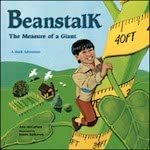
Beanstalk: The Measure of a Giant — How Many Jacks Make a Ray?
Word Cards
Cut along each line. One word to a card.
Grade 4
5 skill lessons · 3 math-through-reading
Math
Skill lessons
The mathematics the book carries, taught directly. Each lesson has printable workbook pages and a separate teacher key.
Math + reading
Math through the reading
The same book, entered through a sentence it prints. Change one word in the reading and the numbers change with it.
Reading
Reading and language lessons
The same book read as a text. What a word means in its sentence, how a character is shown, how the writing is put together - no mathematics.
5 lessons on the mathematics the book carries. Each lesson has printable workbook pages and a separate teacher key.
The book puts two heights side by side and never lets them go: Ray stands 20 feet tall, Jack stands 4 feet tall, and every problem in the story comes out of that pair. Students lay four-foot lengths of paper tape end to end along a twenty-foot length until it is covered, count five lengths, and then write the same fact two ways — as five fours and as a difference of sixteen feet.
1. Mark the two heights (4 min)
Working in fours, students run the tape measure along the floor. Tear one length of paper tape at 4 feet and one at 20 feet. Tape each down with a strip of painter's tape at both ends. Label the short one Jack and the long one Ray. Read the two sentences that give those numbers aloud before labelling.
Word preview: measure
“I’m 4 feet tall and Ray is 20 feet tall.
“Well, I’m 20 feet tall,” Ray said.
2. Lay four-foot lengths end to end (6 min)
Students tear more four-foot lengths and lay them head to tail along the twenty-foot strip until it is exactly covered. Count aloud as each one goes down — four, eight, twelve, sixteen, twenty — one number word per length. Stop when the strip is covered and say how many lengths it took.
3. Write the comparison two ways (6 min)
With the strips still on the floor, each student writes two sentences and the equation under each. Ray is 5 times as tall as Jack, 5 × 4 = 20. And Ray is 16 feet taller than Jack, 20 − 4 = 16. Then circle the sentence whose words match the words the book uses, and read that sentence to a partner.
Word preview: times as tall as, taller than
“That’s five times bigger, so I’ll make Ray’s checkerboard 5 times the size of mine.”
4. Compare the two hoops (4 min)
Students take the two hoop heights from the story, 60 feet and 12 feet, and answer one question on the same paper: how many of Jack's hoops stack up to Ray's hoop? Write the equation that shows it. Say aloud what you notice about the number you got.
Word preview: equation
“It’s 60 feet high,” Ray answered.
Then he bent a branch 12 feet from the ground into a circle.
1. Lay four-foot lengths end to end (6 min)
On the two strips already taped down, students lay four-foot lengths along the twenty-foot strip, counting four, eight, twelve, sixteen, twenty as each one goes down, and stop when it is covered.
Word preview: four, eight, twelve, sixteen, twenty
2. Write the comparison two ways (3 min)
Each student writes one sentence and its equation — Ray is 5 times as tall as Jack, 5 × 4 = 20 — and reads it to a partner with a hand on the five lengths.
Word preview: times as tall as, taller than
“That’s five times bigger, so I’ll make Ray’s checkerboard 5 times the size of mine.”
Numerals and the multiplication itself travel with a student from any language: someone who can find five fours in twenty already holds the mathematics of this lesson. What does not travel is the English comparison frame. In times as tall as, the taller thing is named first and the shorter thing last, and swapping them makes the sentence false rather than merely odd — a trap for students whose first language marks comparison with a different word order or a case ending. Walk through the sentence aloud with the strips in view before any pencil moves, naming the taller thing first, then how many times as tall it is, then the shorter thing. Three turns each, pointing at the two strips as the blanks are filled. A student who counts faster in another language should count the lengths in that language and report only the finished English sentence.
Cut along each line. One word to a card.
Write each sentence, then its equation underneath.
Equation
Equation
Circle the sentence whose words match the words the book uses. Read that sentence to a partner.
Write the two hoop heights from the story.
Ray's hoop ____________ feet Jack's hoop ____________ feet
How many of Jack's hoops stack up to Ray's hoop?
Equation
Count the four-foot lengths, touching each one. Then fill in the sentence.
____________ is ____________ times as tall as ____________.
Equation
Read the sentence to a partner with a hand on the lengths.
A close sentence names the taller thing first, then how many times as tall, then the shorter thing: Ray is 5 times as tall as Jack. A loose sentence reverses the two names, or says five feet where it means five times.
On the hoops, a close answer notices that the same five that worked on the heights works on the hoops. A loose answer computes 60 ÷ 12 and says nothing about the five already on the floor.
Filled frame: Ray is 5 times as tall as Jack. Equation: 5 × 4 = 20.
The order of the two names is the whole point of the frame. A student who writes Jack is 5 times as tall as Ray has the arithmetic and not the sentence; send them back to the strips and have them put a hand on the long one before they say the first blank.
Choose your curriculum above to see the standards for this lesson.
Standards are held back while this plan is edited. Every standard shown here was matched against the supplied wording of this lesson, quoting its steps, so a changed step is no longer the thing that was checked. Undo your changes to bring the standards back — your edits stay in this browser either way.
Ray gives two numbers about himself — he is 20 feet tall and his hoop is 60 feet high — and Jack reads a rule out of them. Students do the same work in the room: pull the two numbers off the page, find the three that carries 20 to 60, apply it to Jack's 4 feet, and then actually mark 12 feet up a wall with a tape and a strip of tape. The application is the marking. A student who computes 3 × 4 = 12 and never measures 12 feet has done arithmetic; a student whose tape is on the wall at the right height has built the thing the number describes.
1. Read Ray's two numbers (5 min)
Students find the two sentences where Ray gives a number about himself and read them aloud, then write the pair on a card: height 20 feet, hoop 60 feet. Say which number is the person and which is the hoop before anything is computed.
Word preview: height
“Well, I’m 20 feet tall,” Ray said.
“It’s 60 feet high,” Ray answered.
2. Check the three (6 min)
Students test whether three is really the number that carries 20 to 60. Skip count 20, 40, 60 aloud, marking each on a number line drawn on chart paper, then write 3 × 20 = 60 underneath. Say in one sentence what the three counts.
Word preview: three times, skip count
“Your hoop is three times your height,” Jack said.
3. Make Jack's hoop (5 min)
Each pair computes 3 × 4 and writes the equation, then runs the tape measure up the wall from the floor and sticks a strip of painter's tape at that height. One partner holds the tape at the floor, the other marks. Stand next to the mark and say how many times your own height it is.
Word preview: measure
“That’s 4 feet.” Ray said.
Then he bent a branch 12 feet from the ground into a circle.
4. Say the rule for a new player (4 min)
Each pair picks a whole number of feet between 3 and 8 for a new player. Work out that player's hoop height. Say the finished sentence to another pair: this player is ___ feet tall, so the hoop has to be ___ feet high. The other pair checks the arithmetic out loud.
1. Check the three (6 min)
Students skip count 20, 40, 60 aloud on the number line and write 3 × 20 = 60 underneath, then say what the three counts.
Word preview: three times, skip count
“Your hoop is three times your height,” Jack said.
2. Make Jack's hoop (3 min)
Each pair computes 3 × 4, runs the tape up the wall, and sticks a strip of tape at 12 feet.
Word preview: twelve, measure, mark
“That’s 4 feet.” Ray said.
Then he bent a branch 12 feet from the ground into a circle.
English packs this rule into a single clause — three times your height — with no verb doing the multiplying, which is exactly why it reads as a phrase to skip rather than an instruction to follow. Say the sentence before writing it, and say it slowly enough that both numbers land: how tall the player is, and how high the hoop has to be. Pair it with a hand at the floor and a hand at the mark, so the words and the height are learned together. Students who prefer to reason in another language should work the number out in that language and bring only the finished English sentence to the checking partner.
Cut along each line. One word to a card.
Work with your partner. Write the equation, then mark the wall.
Jack is 4 feet tall. Write the equation for the height of his hoop.
We put the tape on the wall at ____________ feet.
Pick a whole number of feet between 3 and 8. Work out that player's hoop height.
Work it out
Say the finished sentence to another pair.
This player is ____________ feet tall, so the hoop has to be ____________ feet high.
Any whole number of feet from 3 to 8, tripled:
A close response names the player's height first and the hoop height second, and the hoop height is three times the height the pair chose. A loose response gives a hoop height with no stated player height, or triples the wrong number, or gives 12 feet again because that is the number on the wall.
The mark on the wall is the check that matters: a pair whose paper says 12 and whose tape is at a height nothing like three of themselves has computed without measuring.
Choose your curriculum above to see the standards for this lesson.
Standards are held back while this plan is edited. Every standard shown here was matched against the supplied wording of this lesson, quoting its steps, so a changed step is no longer the thing that was checked. Undo your changes to bring the standards back — your edits stay in this browser either way.
Jack measures two shadows — Ray's at 2 feet, the beanstalk's at 41 feet — and then shouts a height for the beanstalk that the book never works out on the page. Students find the missing factor that carries 2 to Ray's known 20, run that same ten on 41, and decide whether Jack's 410 holds up. The reasoning is the checking: students are not being handed an answer to compute but a claim to test, and they finish by saying what would have changed if the shadow had measured one foot less.
1. Find the two shadow numbers (4 min)
Students hunt down the two shadow measurements in the story and write them on a card: Ray's shadow, the beanstalk's shadow. Read both sentences aloud. Say which one belongs to something whose height the book already told us.
It was just about noon, so Ray’s shadow was only 2 feet long.
He measured its shadow. It was 41 feet long.
2. Test the ten on Ray (6 min)
Students write 2 × ___ = 20 and find the missing factor, then check it against Ray's stated height. Say aloud what the missing number counts. Write the finished equation, 2 × 10 = 20, and keep the card where everyone can see it.
Word preview: missing factor, ten times
“Well, I’m 20 feet tall,” Ray said.
3. Run the same ten on the beanstalk (6 min)
Students multiply 41 by 10, showing it as 40 × 10 plus 1 × 10, and write the answer before reading Jack's line. Then read what Jack yelled and mark the paper agree or disagree. Say to a partner what your own arithmetic gave.
Jack yelled up to Ray, “The beanstalk is 410 feet tall!”
4. Say what would change (4 min)
Each student answers one question in writing. If the beanstalk's shadow had measured 40 feet instead of 41, what height would the same ten give? How far off would that be from Jack's number? Show both the product and the difference, then read the sentence to a partner.
Word preview: difference
1. Find the two shadow numbers (3 min)
Students write the two shadow measurements on a card and read both sentences aloud.
Word preview: shadow, measured, feet
It was just about noon, so Ray’s shadow was only 2 feet long.
He measured its shadow. It was 41 feet long.
2. Run the same ten on the beanstalk (6 min)
Students multiply 41 by 10, showing it as 40 × 10 plus 1 × 10, write the answer before reading Jack's line, and mark agree or disagree.
Word preview: forty-one, ten, four hundred ten
Jack yelled up to Ray, “The beanstalk is 410 feet tall!”
Multiplying by ten is language-independent and often already fluent, so a student new to English may be the fastest in the room here; take the count in whichever language is strongest and only the reported result in English. What blocks these students is not the ten but the shape of the question: the task is to judge somebody else's number, and English carries that judgement in small words — agree, disagree, off by — that are easy to miss and hard to produce under pressure. Give both sentences on a card and run them aloud before the writing, one agreeing with Jack and naming the product, one disagreeing and naming what the product really is. Point at the two shadow numbers while saying it.
Cut along each line. One word to a card.
Find the missing factor, then check it against Ray's height in the story.
2 × ____________ = 20
What does the missing number count?
Multiply 41 by 10. Write your answer before you read Jack's line.
40 × 10 = ____________
1 × 10 = ____________
41 × 10 = ____________
Now read Jack's line. Circle one. agree disagree
If the beanstalk's shadow had measured 40 feet instead of 41, what height would the same ten give?
Product ____________
How far off would that be from Jack's number?
Difference ____________
Write the sentence, then read it to a partner.
Cut on the lines. Say both sentences aloud before you write.
I agree with Jack. 41 × 10 = ____________ feet, and Jack said ____________ feet.
I disagree with Jack. 41 × 10 = ____________ feet, but Jack said ____________ feet.
A close response marks agree because its own product came out at 410, not because Jack said so. Ask any student who wrote 410 after reading the line whether the number was on the paper first; the whole point of the step is that the answer is written before the line is read.
On the last question, a close response gives both numbers, 400 and 10, and says which is the height and which is the gap. A loose response gives 400 alone, or subtracts 41 from 410.
Both frames are filled with 410. The agreeing frame is the one the arithmetic supports; the disagreeing frame is there so the student has practised the words for the case where a checked number does not hold.
Choose your curriculum above to see the standards for this lesson.
Standards are held back while this plan is edited. Every standard shown here was matched against the supplied wording of this lesson, quoting its steps, so a changed step is no longer the thing that was checked. Undo your changes to bring the standards back — your edits stay in this browser either way.
One small piece of arithmetic goes by almost unremarked: Jack says he is 48 inches tall and Ray answers that this is 4 feet. Students build the fluency that makes that exchange automatic — counting by twelves, knowing 4 × 12 = 48 without stopping to reconstruct it, and running the same twelve up to Ray's 20 feet.
1. Count the twelves (4 min)
Students lay four foot-rulers end to end along a desk and count the inch marks in blocks: twelve, twenty-four, thirty-six, forty-eight, sliding a finger to the end of each ruler on each number word. Do it twice, the second time with eyes on the rulers and no finger.
Word preview: inches, count
“So my hoop has to be three times my height, and I’m 48 inches tall.”
2. Match Jack's two numbers (5 min)
Students show why 48 inches and 4 feet name one height. Write 4 × 12 = 48 under the four rulers, then write 48 ÷ 12 = 4 beside it and say which ruler each twelve is. Read Ray's answer aloud and say whether the rulers agree with him.
Word preview: inches, equals
“That’s 4 feet.” Ray said.
3. Build the conversion table (6 min)
Each student rules a two-column table, feet on the left and inches on the right, and fills it for 1 through 6 feet, then adds a row for 10 feet. Fill it by counting on by twelve down the column, not by starting over each time. Trade papers and check one row of a partner's table out loud.
Word preview: table, inches
4. Convert Ray (5 min)
Students take Ray's height from the book and write it in inches, showing the work as 20 × 12 broken into 20 × 10 and 20 × 2. Compare answers around the table; everyone should reach the same number. Say the finished sentence: Ray is 20 feet tall, which is 240 inches.
Word preview: inches
“Well, I’m 20 feet tall,” Ray said.
1. Count the twelves (4 min)
Students count twelve, twenty-four, thirty-six, forty-eight along four foot-rulers laid end to end, sliding a finger to the end of each ruler on each number word.
Word preview: twelve, inches, count
“So my hoop has to be three times my height, and I’m 48 inches tall.”
2. Match Jack's two numbers (5 min)
Students write 4 × 12 = 48 under the rulers and 48 ÷ 12 = 4 beside it, then say whether the rulers agree with Ray's answer.
Word preview: feet, inches, equals
“That’s 4 feet.” Ray said.
Counting by twelve is the same act in every language, and a student who knows the twelve times table in another language already has this lesson's mathematics; let them say the counts in that language while their finger moves along the rulers. English gives no clue which unit is the bigger one — inches and feet give no clue, unlike languages that build the smaller unit out of the larger. Anchor them to objects: one ruler is one foot, twelve marks on it are twelve inches. Rehearse the frame both directions before the table is ruled: ___ feet is the same height as ___ inches, and ___ inches is the same height as ___ feet.
Cut along each line. One word to a card.
Show why 48 inches and 4 feet name one height. Write both equations.
Which ruler is each twelve? Say it aloud, then read Ray's answer and say whether the rulers agree with him.
Write Ray's height in inches. Show the work broken into two parts.
20 × 10 = ____________
20 × 2 = ____________
20 × 12 = ____________
Ray is ____________ feet tall, which is ____________ inches.
Keep the four rulers on the desk. Count the twelves off them and fill in the inches.
Trade papers and check one line of a partner's table out loud.
A close table is filled by counting on by twelve down the column, so the 10-foot row arrives as a jump and not as a fresh start. A loose table restarts the multiplication at every row, and usually stalls or slips at 5 and 6 feet.
On Ray, a close response keeps the two parts visible and adds them; a loose response writes 240 with no split shown, or adds 200 and 40 to something other than 240.
Choose your curriculum above to see the standards for this lesson.
Standards are held back while this plan is edited. Every standard shown here was matched against the supplied wording of this lesson, quoting its steps, so a changed step is no longer the thing that was checked. Undo your changes to bring the standards back — your edits stay in this browser either way.
Jack draws seven lines one way and seven lines the other way and paints the squares, and the book never says how many squares that makes. Students draw the same two sets of lines, discover that seven lines cut a sheet into eight bands rather than seven, count eight rows of eight, and write 8 × 8 = 64. The representation is the point: the drawn grid, the labelled rows and columns, and the equation are three views of one arrangement, and a student who can move between them can read an array anywhere.
1. Draw the lines the book names (4 min)
Each student takes a sheet of grid paper and draws seven straight lines across it, evenly spaced, then seven more running the other way, square to the first set. Use the ruler for every line. Read the two sentences that name the lines before starting, and check a partner's sheet has seven lines each way.
Word preview: parallel, perpendicular
On a big sheet of paper, he drew seven parallel lines.
Then, to make squares, he drew seven perpendicular lines.
2. Count the rows and the columns (5 min)
Students number the bands of the sheet down the left edge and across the top, then say aloud how many rows and how many columns the seven-and-seven lines made. Anyone who wrote seven counts again with a finger in each band. Write the two counts at the top of the sheet.
Word preview: rows, columns
3. Write the equation and shade (6 min)
Students write 8 × 8 = 64 under the grid, then shade the squares red and black in an alternating pattern. Check the equation by counting the shaded squares in eights — eight, sixteen, twenty-four, and on to sixty-four — one row per number word.
He painted the squares red and black.
4. Predict for six lines (5 min)
Before drawing anything, each student writes down how many squares six lines each way would make and why. Then draw it on a fresh corner of the sheet and count. Say to a partner whether the prediction held and what the count of lines has to do with the count of bands.
1. Draw the lines the book names (3 min)
Students draw seven straight lines across a sheet of grid paper with a ruler, then seven more square to the first set.
Word preview: parallel, perpendicular, seven
On a big sheet of paper, he drew seven parallel lines.
Then, to make squares, he drew seven perpendicular lines.
2. Write the equation and shade (6 min)
Students number the bands, write 8 × 8 = 64 under the grid, shade the squares red and black, and count the rows in eights to sixty-four.
Word preview: array, equation, sixty-four
He painted the squares red and black.
Nothing in the counting or the multiplication depends on English, and a student who says eight eights are sixty-four in another language has done this lesson's mathematics; invite that count in the strongest language and the reporting in English. The vocabulary is where the trouble sits: row and column are easy to swap, and in English row runs across while column stands up, which is the opposite of the intuition some students bring from vertical writing. Tie each word to a gesture — flat hand sweeping across for row, upright hand for column — and use the gesture every time the word is said. Rehearse the frame while pointing at the grid: ___ rows of ___ makes ___.
Cut along each line. One word to a card.
Seven lines run across this sheet. Draw seven more the other way, square to these.
Use your ruler for every line.
Before you draw anything, write how many squares six lines each way would make, and why.
How many squares ____________
Why
Now draw it on a fresh corner of your sheet and count.
Count after drawing ____________
A close reason says the bands come out one more than the lines, and applies it to both directions before multiplying: six lines, seven bands, seven rows of seven. A loose reason gives 36 from six times six, or gives 49 with no account of where the seven came from.
A prediction of 36 that is then corrected to 49 by counting is worth as much as a correct prediction, as long as the student can say afterwards what the count of lines has to do with the count of bands.
Choose your curriculum above to see the standards for this lesson.
Standards are held back while this plan is edited. Every standard shown here was matched against the supplied wording of this lesson, quoting its steps, so a changed step is no longer the thing that was checked. Undo your changes to bring the standards back — your edits stay in this browser either way.
The mathematics is reached through a sentence the book prints: change one word in the reading and the numbers change with it. These carry their own standards, matched against these lessons rather than inherited from the skill ones.
Students infer how many squares Jack's giant checkerboard has from the two sentences that describe how he drew it, and give the number together with the line that proves it.
1. Read the two line sentences and say what they promise (6 min)
Students read the two sentences describing how Jack drew the board, then say to a partner what the second set of lines is for, in the book's own words. Copy both sentences onto the bottom of a fresh sheet before drawing anything.
2. Draw seven lines each way and count the bands (5 min)
Each student rules seven evenly spaced lines across the sheet, then seven more square to them, and counts how many bands the sheet is now cut into in each direction, numbering them along the two edges.
3. Multiply and state the number (4 min)
Students write the multiplication for the rows and columns they numbered and work out the product, then say the number aloud to a partner. Any pair whose numbers disagree recounts the bands together before going on.
4. Say the number with the sentence that proves it (5 min)
Each student reads aloud the copied sentence they leaned on and then gives their number, in that order, to a partner who has to say whether the sentence really settles it. Written on the sheet, the two sit together: the line, then the count.
1. Multiply and state the number (4 min)
Students write the multiplication for the rows and columns they numbered and work out the product, then say the number aloud to a partner. Any pair whose numbers disagree recounts the bands together before going on.
2. Say the number with the sentence that proves it (5 min)
Each student reads aloud the copied sentence they leaned on and then gives their number, in that order, to a partner who has to say whether the sentence really settles it. Written on the sheet, the two sit together: the line, then the count.
The counting and the multiplication carry over from any language and are not the barrier here. The barrier is the purpose clause: to make squares tells an English reader what the second set of lines is for, and that little to is the single most skippable word in the sentence and the one the whole answer rests on. Read the sentence twice with the class, the second time stressing that phrase, and ask what the lines are for before asking how many there are. Rehearse the pairing frame aloud before it is written: the book says ___, so there must be ___. Students who prefer another language should count the bands in it and give only the finished English pairing to their partner.
Choose your curriculum above to see the standards for this lesson.
Standards are held back while this plan is edited. Every standard shown here was matched against the supplied wording of this lesson, quoting its steps, so a changed step is no longer the thing that was checked. Undo your changes to bring the standards back — your edits stay in this browser either way.
Phases are not grades. The Primary Years Programme is a developmental continuum and your school places each student in a phase, so this names the strand the lesson works in and the phases it could sit across. Confirm against your own school's placement.
Number · Phases 1–3
Shape and space · Phases 1–3
Students compute two different comparisons of the boys' hoops, take a position on whether the game is fair, and write an argument that carries its numbers inside it.
1. Collect the four numbers (5 min)
Students find the four measurements the argument needs — each boy's height and each boy's hoop — reading each line aloud as it is found and entering it in a four-row table. No comparing yet; just get all four on the paper with their labels.
2. Run both comparisons (6 min)
Each student works both comparisons for both boys and writes all four equations: how many times his own height each hoop is, and how many feet above his own head each boy must send the ball. Circle the two numbers that come out different.
3. Take a position and rehearse it aloud (4 min)
Students decide which comparison fairness means here and say their position to a partner who has been asked to take the other one, using at least one of their circled numbers. Each partner says back what the other's number was before replying.
4. Write the argument with its numbers in it (5 min)
Each student writes two or three sentences to the partner who disagreed, naming the position and putting at least two computed numbers inside the sentences. Trade papers; a paper with no number in it comes back to be rewritten.
1. Take a position and rehearse it aloud (4 min)
Students decide which comparison fairness means here and say their position to a partner who has been asked to take the other one, using at least one of their circled numbers. Each partner says back what the other's number was before replying.
2. Write the argument with its numbers in it (5 min)
Each student writes two or three sentences to the partner who disagreed, naming the position and putting at least two computed numbers inside the sentences. Trade papers; a paper with no number in it comes back to be rewritten.
The comparisons themselves are language-independent and a student new to English will often run all four faster than the room. The load is entirely in the argument: English marks disagreement with because, but, and even though, and those connectives are exactly what carries a reason from one clause to the next, so a student without them ends up restating the answer instead of defending it. Put two frames on a card and rehearse both aloud before anything is written: I think the game is ___ because ___, and I know ___ said ___, but ___. Let students argue the position in their strongest language with a partner who shares it before writing in English, and let the writing be short. Nobody is asked to say anything about their own size or their own family.
Choose your curriculum above to see the standards for this lesson.
Standards are held back while this plan is edited. Every standard shown here was matched against the supplied wording of this lesson, quoting its steps, so a changed step is no longer the thing that was checked. Undo your changes to bring the standards back — your edits stay in this browser either way.
Phases are not grades. The Primary Years Programme is a developmental continuum and your school places each student in a phase, so this names the strand the lesson works in and the phases it could sit across. Confirm against your own school's placement.
Number · Phases 1–3
Measurement · Phases 1–3
Students lay two of the book's measured heights against each other and produce the relation as a true sentence in each direction, then do it again where the reversal forces a different comparison word.
1. Lay the two heights side by side (5 min)
Pairs tear a 4-foot strip and a 20-foot strip of paper tape, tape them down parallel on the floor, then lay more 4-foot strips along the long one until it is covered, counting aloud as each goes down.
2. Say the relation forward (4 min)
With a hand on each strip, students say the sentence the book's own words point at — Ray is 5 times as tall as Jack — and write it with 5 × 4 = 20 underneath. Partners check the hands are on the right strips as the sentence is said.
3. Turn the sentence around (5 min)
Students say and then write the same fact from the other end, keeping it true: five of Jack's heights make one of Ray's. Say both sentences one after the other while pointing at the one arrangement of strips that makes both of them true.
4. Do it again with the two hoops (6 min)
Pairs take the two hoop heights, 60 feet and 12 feet, compute the difference, and write the relation both ways. Here the reversal forces the word to change: higher than in one direction, lower than in the other. Read both sentences to another pair, who say whether each is still true.
1. Say the relation forward (4 min)
With a hand on each strip, students say the sentence the book's own words point at — Ray is 5 times as tall as Jack — and write it with 5 × 4 = 20 underneath. Partners check the hands are on the right strips as the sentence is said.
2. Turn the sentence around (5 min)
Students say and then write the same fact from the other end, keeping it true: five of Jack's heights make one of Ray's. Say both sentences one after the other while pointing at the one arrangement of strips that makes both of them true.
A strong mathematician can look weak here. Comparative syntax differs sharply across languages: English fixes the order — the bigger thing first in times as tall as, the smaller thing first in as tall as — and it changes the adjective on reversal, higher to lower, taller to shorter, while many languages keep one adjective and move a marker instead. A student who produces five times shorter has made a syntactic error, not a mathematical one, and should be corrected as such. Put all four comparison words on cards, rehearse both frames aloud with hands on the strips before any writing — ___ is ___ times as tall as ___, and ___ of ___ make one ___ — and let students say the relation in their strongest language first and then in English.
Choose your curriculum above to see the standards for this lesson.
Standards are held back while this plan is edited. Every standard shown here was matched against the supplied wording of this lesson, quoting its steps, so a changed step is no longer the thing that was checked. Undo your changes to bring the standards back — your edits stay in this browser either way.
Phases are not grades. The Primary Years Programme is a developmental continuum and your school places each student in a phase, so this names the strand the lesson works in and the phases it could sit across. Confirm against your own school's placement.
Measurement · Phases 1–3
Number · Phases 1–3
5 lessons on the reading and language the book carries - what a word means in its sentence, how a character is shown, how a text is built. No mathematics: these are matched against the English language arts curricula, which are a different and smaller set than the mathematics ones.
The book's own last sentence admits that some people tell a different story, which invites students to set this retelling beside the traditional Jack and the Beanstalk they already carry. Students read three printed passages, mark the chant this version borrows from the old tale and the friendship it invents instead, and write one comparison sentence naming what is kept and what is changed. The language work is comparing two versions of the same story and stating the comparison in writing.
1. Read the ending and name the other story (5 min)
Read the printed closing sentence aloud twice. With your pencil, underline the words inside the parentheses. Then tell a partner which older story you already know about a boy named Jack and a beanstalk, and say one thing that happens in the version you know.
Word preview: parentheses, version
From that day on Jack and Ray were best friends (though some people tell a different story) and the relationship between two numbers is still called a “Ray show,” but today we spell it ratio.
2. Mark what this retelling does differently (6 min)
Read the two printed passages. In the first, circle every word the boy giant uses that you have heard in the older tale. In the second, underline what this giant actually wants. On your difference chart, write one sentence naming a difference between this giant and the giant in the tale you know.
Word preview: retelling, giant
He looked up, but instead of rain clouds he saw a huge boy crying. The boy wiped his eyes and sniffed, “Fee fi foe foy, I smell the scent of a human boy.”
Jack stepped out into the open and said, “Hi. I’m Jack. What’s the matter?” “I don’t have any friends,” the giant boy said. “Aren’t there any kids around here your age and umm . . . size?” asked Jack. The giant boy shook his head from side to side.
3. Compare how the two Jacks treat the giant (5 min)
Read the printed passage. Highlight the sentence in which Jack decides what the giant is really like. With a partner, say aloud what the Jack in the older tale does when he meets a giant, and then say what this Jack does instead. Write the two actions side by side on your difference chart.
Word preview: compare
Jack ducked behind a leaf and watched the giant boy. After a minute, Jack said right out loud, “He may be big, but he seems like any other kid.” The giant stopped crying. “Who’s there?” he asked.
4. State the comparison in one sentence (4 min)
Reread the printed closing sentence. On lined paper, write one sentence that begins with the frame on the sentence-frame display and names one thing this retelling keeps from the older tale and one thing it changes. Read your sentence to your partner and listen for whether they named the same change.
From that day on Jack and Ray were best friends (though some people tell a different story) and the relationship between two numbers is still called a “Ray show,” but today we spell it ratio.
1. Read the ending and name the other story (3 min)
Read the printed closing sentence aloud. With your pencil, underline the words inside the parentheses and tell a partner which older Jack story you already know.
Word preview: parentheses, version
From that day on Jack and Ray were best friends (though some people tell a different story) and the relationship between two numbers is still called a “Ray show,” but today we spell it ratio.
2. Mark what this retelling does differently (6 min)
Read the two printed passages. Circle the chant words that come from the older tale, then underline what this giant actually wants. On your difference chart, write one sentence naming a difference between the two giants.
Word preview: retelling, giant
He looked up, but instead of rain clouds he saw a huge boy crying. The boy wiped his eyes and sniffed, “Fee fi foe foy, I smell the scent of a human boy.”
Jack stepped out into the open and said, “Hi. I’m Jack. What’s the matter?” “I don’t have any friends,” the giant boy said. “Aren’t there any kids around here your age and umm . . . size?” asked Jack. The giant boy shook his head from side to side.
Students who know a Jack-and-the-Beanstalk story in another language already hold the comparison text; invite them to tell that version in their strongest language first, then name the difference in English. The chant transfers as sound, not as meaning, so preview that the giant is sniffing for a human. Rehearsable frame: "In my story the giant ___, but in this book the giant ___."
Choose your curriculum above to see the standards for this lesson.
Standards are held back while this plan is edited. Every standard shown here was matched against the supplied wording of this lesson, quoting its steps, so a changed step is no longer the thing that was checked. Undo your changes to bring the standards back — your edits stay in this browser either way.
This story places four strong verbs beside clues a reader can use: a beanstalk that towers over a house, a shadow that stretches toward the horizon, a boy who moves as quick as a mouse, and a mother whose amusement is carried by one verb. Students underline each word in its printed sentence, box the nearby clue, test one meaning by swapping a substitute in, and finish a word-meaning log that records the exact book words behind each definition. The skill is inferring meaning from context and citing the clue.
1. Meet the word in its own sentence (5 min)
Read the printed passage aloud. Underline the word towered. Say aloud what the beanstalk is doing to the house in that sentence, then write your best guess at what towered means without using the word tall.
Word preview: towered
Jack rushed outside. An enormous beanstalk towered over the house. “Did this grow from those beans I got?” asked Jack. “Must have!” his mother replied. “With these big beans, we won’t go hungry.”
2. Use the clue words around the unknown word (6 min)
Read both printed passages. In the first, underline elongated and box the words stretched toward the horizon that appear nearby. In the second, underline scurried and box the words as quick as a mouse. Write in your log what each boxed clue tells you about the underlined word.
Word preview: elongated, scurried
The sun sank lower in the sky as the boys told each other about their homes. Then Ray said, “Let’s play shadows.” “I look as big as you!” Jack said, looking at his elongated shadow. “But I’m still bigger,” Ray said as his shadow stretched toward the horizon. They made shadow shapes until it was time for Jack to go home.
Jack scurried down the beanstalk as quick as a mouse. He measured its shadow.
3. Test a meaning by swapping it in (5 min)
Read the printed passage and underline chuckled. Choose one of the three words on the swap-word display and read the sentence again with your choice swapped in for chuckled. Tell a partner whether the sentence still sounds like a mother who thinks the idea is funny, and record the word you kept.
Word preview: chuckled
“You’ll never guess what I did today!” Jack said when he got home. He told his mother all about Ray. “Tomorrow, I want to show him how to play checkers.” “You and the giant playing checkers?” his mother chuckled. “To him, a checker would be no bigger than a bean.”
4. Write the four meanings from evidence (4 min)
Reread the printed passage. Finish your word-meaning log by writing a short meaning for towered, elongated, scurried and chuckled, and next to each one copy the exact words from the book that helped you decide.
Jack rushed outside. An enormous beanstalk towered over the house. “Did this grow from those beans I got?” asked Jack. “Must have!” his mother replied. “With these big beans, we won’t go hungry.”
1. Meet the word in its own sentence (3 min)
Read the printed passage aloud and underline towered. Write your best guess at what towered means without using the word tall.
Word preview: towered
Jack rushed outside. An enormous beanstalk towered over the house. “Did this grow from those beans I got?” asked Jack. “Must have!” his mother replied. “With these big beans, we won’t go hungry.”
2. Use the clue words around the unknown word (6 min)
Read both printed passages. Underline elongated and box stretched toward the horizon; underline scurried and box as quick as a mouse. Write what each clue tells you about the underlined word.
Word preview: elongated, scurried
The sun sank lower in the sky as the boys told each other about their homes. Then Ray said, “Let’s play shadows.” “I look as big as you!” Jack said, looking at his elongated shadow. “But I’m still bigger,” Ray said as his shadow stretched toward the horizon. They made shadow shapes until it was time for Jack to go home.
Jack scurried down the beanstalk as quick as a mouse. He measured its shadow.
Elongated shares a root with cognates such as largo and long, so name that transfer aloud; scurried and chuckled have no such support and need a gesture and a sound. The comparison frames as quick as a mouse and as big as a dinner plate transfer well once one example is modeled. Rehearsable frame: "___ must mean ___ because the book says ___."
Choose your curriculum above to see the standards for this lesson.
Standards are held back while this plan is edited. Every standard shown here was matched against the supplied wording of this lesson, quoting its steps, so a changed step is no longer the thing that was checked. Undo your changes to bring the standards back — your edits stay in this browser either way.
The giant boy is drawn almost entirely from actions and short lines of dialogue: he cries, he wipes his eyes, he shakes his head instead of answering, and he smiles and sits down when a friend is offered. Students build a character evidence chart across four printed passages, then write a two-sentence claim in which the second sentence quotes the book exactly. The skill is describing a character in depth from what the text says and shows, and supporting the description with evidence.
1. Find what the character does before he speaks (5 min)
Read the printed passage. Underline every action the boy giant's body performs before he says anything. Tell a partner what those actions alone tell you about how he feels, and write that feeling word on your character evidence chart.
Word preview: motive, trait
He looked up, but instead of rain clouds he saw a huge boy crying. The boy wiped his eyes and sniffed, “Fee fi foe foy, I smell the scent of a human boy.”
2. Add what the character says about himself (6 min)
Read the two printed passages. In the first, underline the sentence in which the giant boy names his own problem, and circle the answer he gives with his head instead of his voice. In the second, underline what Jack offers and what the giant does with his body right afterward. Add two rows to your character evidence chart: one line of evidence and one feeling word for each.
Word preview: evidence
Jack stepped out into the open and said, “Hi. I’m Jack. What’s the matter?” “I don’t have any friends,” the giant boy said. “Aren’t there any kids around here your age and umm . . . size?” asked Jack. The giant boy shook his head from side to side.
“I’ll be your friend,” Jack offered. “Okay,” the giant boy smiled and sat down so he was closer to Jack’s size. “My name’s Ray,” he said.
3. Track what changes by the end (5 min)
Read the printed passage. Underline the words Ray uses to explain why he and Jack get along. Compare that line with the first feeling word on your character evidence chart and tell a partner what changed for Ray between the two passages.
Word preview: change
“That’s because we have a lot in common,” Ray said. “We figured out how to do things together even though I’m so much taller.”
4. Write the character claim with its evidence (4 min)
Reread the printed passage. On lined paper, write two sentences about Ray: the first names a trait or feeling, and the second begins I know this because and copies exact words from a printed passage. Read both sentences to your partner, who checks that the second sentence quotes the book.
“I’ll be your friend,” Jack offered. “Okay,” the giant boy smiled and sat down so he was closer to Jack’s size. “My name’s Ray,” he said.
1. Find what the character does before he speaks (3 min)
Read the printed passage and underline every action the boy giant's body performs. Write one feeling word on your character evidence chart.
Word preview: motive, trait
He looked up, but instead of rain clouds he saw a huge boy crying. The boy wiped his eyes and sniffed, “Fee fi foe foy, I smell the scent of a human boy.”
2. Add what the character says about himself (6 min)
Read both printed passages. Underline where the giant names his problem and where Jack makes his offer. Add one line of evidence and one feeling word for each to your character evidence chart.
Word preview: evidence
Jack stepped out into the open and said, “Hi. I’m Jack. What’s the matter?” “I don’t have any friends,” the giant boy said. “Aren’t there any kids around here your age and umm . . . size?” asked Jack. The giant boy shook his head from side to side.
“I’ll be your friend,” Jack offered. “Okay,” the giant boy smiled and sat down so he was closer to Jack’s size. “My name’s Ray,” he said.
Feeling words are the load here, not the plot; the actions in the printed passages are visible enough to be acted out before any English is required. Pre-teach lonely against alone, which many languages do not separate. Rehearsable frame: "Ray feels ___. I know this because the book says ___."
Choose your curriculum above to see the standards for this lesson.
Standards are held back while this plan is edited. Every standard shown here was matched against the supplied wording of this lesson, quoting its steps, so a changed step is no longer the thing that was checked. Undo your changes to bring the standards back — your edits stay in this browser either way.
Almost all of this book's story is carried in two-boy dialogue, which prints quotation marks, speaker tags and the comma inside the closing mark often enough for students to see the pattern rather than be told it. Students mark turns of talk in three printed passages, sort speaker-tag verbs into plain said and tags that tell more, locate the punctuation before each closing mark, and then write and punctuate two turns of their own. The skill is conventions of dialogue in reading and in writing.
1. Mark who is talking (5 min)
Read the printed passage aloud with a partner, one of you as Jack and one as Ray. Using your two highlighters, highlight every pair of quotation marks in one colour and underline the speaker tag that names who said it on your dialogue marking sheet. Count how many separate turns of talk the passage holds.
Word preview: quotation marks, speaker tag
“So, what games do you like to play?” asked Jack. “I like hoopball,” Ray said. “Hoopball is the best!” Jack agreed. “Let’s play.” Ray got his ball. It was almost as big as Jack. “I think we have a problem,” Jack said.
2. Find the tag that does more than say (6 min)
Read the two printed passages. Circle every speaker tag verb. Sort the circled verbs on your dialogue marking sheet into a said column and a tells-you-more column, and write beside each verb in the second column what extra thing it tells you about the speaker.
Word preview: dialogue, verb
The next day, Jack climbed the beanstalk and knocked on Ray’s door. The giant who opened it looked down and smiled. “Hello,” she said. “I have a present for Ray!” He gave her the game. “How nice,” she replied. “I’m Ray’s mother. I’ll take you to his room.” Jack ran to keep up with her. “I feel like I’ve shrunk,” he said as he took a shortcut under a table.
“You’ll never guess what I did today!” Jack said when he got home. He told his mother all about Ray. “Tomorrow, I want to show him how to play checkers.” “You and the giant playing checkers?” his mother chuckled. “To him, a checker would be no bigger than a bean.”
3. Notice where the comma goes (5 min)
Read the printed passage. Draw a box around the punctuation mark that sits just before each closing quotation mark. On your dialogue marking sheet, note which mark appears when the tag follows the words and which appears when the sentence is a question, pointing at the printed line each time.
Word preview: comma
“I invited Ray for lunch,” Jack said to his mother. “I hope it’s okay.” “Sure,” his mother said. Then looking at Ray’s size, she added, “It’s such a nice day, why don’t we eat outside?”
4. Write two turns of your own (4 min)
On lined paper, write two turns of talk between Jack and Ray about what to play next. Punctuate each turn the way the printed passage does: quotation marks around the spoken words, a comma or question mark inside them, and a speaker tag that names who is talking. Trade with a partner and check each other's marks against the printed passage.
“So, what games do you like to play?” asked Jack. “I like hoopball,” Ray said. “Hoopball is the best!” Jack agreed. “Let’s play.” Ray got his ball. It was almost as big as Jack. “I think we have a problem,” Jack said.
1. Mark who is talking (4 min)
Read the printed passage aloud in parts. Using your two highlighters, highlight every pair of quotation marks on your dialogue marking sheet and underline the speaker tag that names who said it.
Word preview: quotation marks, speaker tag
“So, what games do you like to play?” asked Jack. “I like hoopball,” Ray said. “Hoopball is the best!” Jack agreed. “Let’s play.” Ray got his ball. It was almost as big as Jack. “I think we have a problem,” Jack said.
2. Find the tag that does more than say (5 min)
Read both printed passages and circle every speaker tag verb. Sort them into a said column and a tells-you-more column on your dialogue marking sheet.
Word preview: dialogue, verb
The next day, Jack climbed the beanstalk and knocked on Ray’s door. The giant who opened it looked down and smiled. “Hello,” she said. “I have a present for Ray!” He gave her the game. “How nice,” she replied. “I’m Ray’s mother. I’ll take you to his room.” Jack ran to keep up with her. “I feel like I’ve shrunk,” he said as he took a shortcut under a table.
“You’ll never guess what I did today!” Jack said when he got home. He told his mother all about Ray. “Tomorrow, I want to show him how to play checkers.” “You and the giant playing checkers?” his mother chuckled. “To him, a checker would be no bigger than a bean.”
Quotation marks differ by writing system, so show this book's marks beside the marks students use at home before any sorting begins; the comma inside the closing mark is the piece that most often transfers wrongly. Reading in parts gives the pattern through the ear first. Rehearsable frame: "___ said it, so the tag says ___."
Choose your curriculum above to see the standards for this lesson.
Standards are held back while this plan is edited. Every standard shown here was matched against the supplied wording of this lesson, quoting its steps, so a changed step is no longer the thing that was checked. Undo your changes to bring the standards back — your edits stay in this browser either way.
Near the end, a character says a word is needed for something the story has been describing, the boys invent one out of a friend's name, and the book prints the invented spelling beside the ordinary one. Students locate the moment the word is missing, trace the new name to the person it honours, compare the two spellings by ear and by eye, and then coin and explain a name of their own. The skill is understanding and explaining word origins and coined names, not calculating any relationship.
1. Find the moment a word is missing (5 min)
Read the printed passage aloud. Underline the sentence in which Jack's mother says a word is needed, and underline the sentence that describes what the missing word would have to mean. Tell a partner, in your own words, what kind of word the family is looking for.
Word preview: coin, name
“There should be a word for that,” Jack’s mother said. “A word for the relationship between the size of two things.”
2. Find where the new name comes from (6 min)
Read the printed passage. Circle the two words the characters join together to build their new name, and underline the sentence that says who the name honours. Write on your log who the word is named after and why the characters chose that person.
Word preview: origin
From that day on Jack and Ray were best friends (though some people tell a different story) and the relationship between two numbers is still called a “Ray show,” but today we spell it ratio.
3. Compare the invented name with the real word (5 min)
Reread the printed passage and box the two spellings the sentence gives for the same idea. Say both aloud and tell a partner what stays the same when you hear them and what changes when you see them. Write one sentence on your log explaining why the book keeps both.
Word preview: spelling
From that day on Jack and Ray were best friends (though some people tell a different story) and the relationship between two numbers is still called a “Ray show,” but today we spell it ratio.
4. Name something and explain the name (4 min)
Choose something in your classroom that has no good name and invent one built from a person's name or a word you already know. Write two sentences on your log: one giving the new name and one explaining where it came from, using the frame on the sentence-frame display. Read both sentences to your partner, who checks the explanation names a real source.
“There should be a word for that,” Jack’s mother said. “A word for the relationship between the size of two things.”
1. Find the moment a word is missing (3 min)
Read the printed passage aloud and underline the sentence in which Jack's mother says a word is needed. Tell a partner what kind of word the family is looking for.
Word preview: coin, name
“There should be a word for that,” Jack’s mother said. “A word for the relationship between the size of two things.”
2. Find where the new name comes from (6 min)
Read the printed passage. Circle the two words joined to build the new name and underline who the name honours. Write on your log who the word is named after and why.
Word preview: origin
From that day on Jack and Ray were best friends (though some people tell a different story) and the relationship between two numbers is still called a “Ray show,” but today we spell it ratio.
Naming after a person is a pattern most languages carry, so invite students to name a coined or borrowed word from their strongest language before working in English. The heard-and-seen split matters here: the two spellings sound close and look different, which is the point of the comparison step. Rehearsable frame: "The word ___ comes from ___."
Choose your curriculum above to see the standards for this lesson.
Standards are held back while this plan is edited. Every standard shown here was matched against the supplied wording of this lesson, quoting its steps, so a changed step is no longer the thing that was checked. Undo your changes to bring the standards back — your edits stay in this browser either way.