What's Your Angle, Pythagoras? A Math Adventure

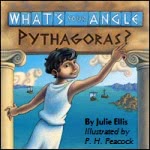
What's Your Angle, Pythagoras? A Math Adventure book cover

Grade 3
5 skill lessons · 3 math-through-reading

Math

Skill lessons

The mathematics the book carries, taught directly. Each lesson has printable workbook pages and a separate teacher key.

  • 1Rows That Make a Square
  • 2Knots for Measuring
  • 3Side Times Side
  • 4Do the Two Numbers Agree?
  • 5Is That Corner Square?

Math + reading

Math through the reading

The same book, entered through a sentence it prints. Change one word in the reading and the numbers change with it.

  • 6Times Itself, Plus Itself
  • 7Was Saltos's Ladder Long Enough?
  • 8Say It Both Ways

Reading

Reading and language lessons

The same book read as a text. What a word means in its sentence, how a character is shown, how the writing is put together - no mathematics.

  • 9Ancient Greece on the Page: Reading a Setting
  • 10Stuck-Out Chests and Sighs: What Characters Do
  • 11One Word, Two Meanings: Reading 'Right'
  • 12First, Next, Then, Finally: Retelling the Search
  • 13The Note After the Story: Reading Back Matter
Download
PDF

Both exports carry any edits you have made. Edits are saved in this browser only — nobody else sees them, and they are not sent anywhere.

Skill lessons

5 lessons on the mathematics the book carries. Each lesson has printable workbook pages and a separate teacher key.

1. Rows That Make a Square Representation · Building squares from rows of unit tiles

The book gives the exact tile counts Pythagoras ends up with in Nef's courtyard: a square with 3 tiles on each side holds 9, one with 4 on each side holds 16, one with 5 on each side holds 25. Students build all three from loose square tiles, laying one row and then adding rows of the same length until the shape is square, and count each one by rows rather than one tile at a time.

Full lesson — 20 minutes

  1. 1. Build the three-square (4 min)

    Lay a row of three square tiles along the marked edge of your mat, the way Pythagoras laid his first row along the statue base. Add one row under it, then one more, until the shape is as tall as it is wide. Count by rows, touching each row as you say three, six, nine.

    Word preview: row

    He made a row of three red tiles along one side of the statue base.
    He added two more rows of red tiles, making a square.
  2. 2. Build the four-square and the five-square (6 min)

    Build a square with 4 tiles on each side in your second color, then a square with 5 tiles on each side using both colors. Keep every row exactly the same length; a row that runs one tile long is the fastest way to lose the square. Count each one by rows and say the total out loud before you start the next.

    Word preview: square

    The square with 3 tiles on each side had 9 tiles, the one with 4 on each side had 16 tiles, and the one with 5 on each side had 25 tiles.
  3. 3. Count each square by rows (5 min)

    Go back to each of your three squares and count it twice: once by the rows going across, once by the rows going down. Say both counts out loud to your partner. When the two counts disagree, find the row that is the wrong length and fix it before you count again.

  4. 4. Record each square three ways (5 min)

    On your record sheet, write each square three ways. The number of tiles on one side. The number of rows and how many tiles are in each row. And the total. Fill all three lines. Then read the four-square line aloud to your partner without pointing at the tiles.

    Word preview: total

Short version — 9 minutes

  1. 1. Build the three-square (4 min)

    Lay a row of three square tiles along the marked edge of your mat, then add rows under it until the shape is as tall as it is wide. Count by rows, touching each row as you say three, six, nine.

    Word preview: row

    He made a row of three red tiles along one side of the statue base.
    He added two more rows of red tiles, making a square.
  2. 2. Record each square three ways (5 min)

    Write your square three ways on the record sheet: 3 tiles on each side, 3 rows of 3, and 9 in all. Then read the line aloud to your partner without pointing at the tiles.

    Word preview: total

Three levels

Support
Build the three-square and the four-square only, and leave the five-square out. Nothing else changes: lay one row, add rows of the same length until the shape is square, count by rows, and fill all three columns for both squares.
At Grade
Build all three squares, count each one by the rows going across and again by the rows going down, and fill all three columns of the record sheet. When two counts of the same square disagree, find the row that is the wrong length before you record anything.
Extension
Once the three squares are recorded, take the four-square apart into its four rows and rebuild the same 16 tiles as a rectangle that is not square, 2 rows of 8. Count it by rows and tell your partner what stayed the same and what changed, using the words rows and in each row.

English learners

Counting and the arrangement itself carry across languages: a student counting rows in Somali or in Spanish is doing this mathematics exactly. What does not carry is the phrase on each side, where each quietly means every one of the four, and the difference between three rows and three tiles, which sounds like a small change and is not. Model one frame all lesson: Three rows of three is nine in all. Let students count and check in their own language first, then say the frame in English while touching each row.

Materials

  • Square tiles in two colors, 60 per pair
  • A build mat with one marked corner
  • A record sheet with three lines and three columns
  • Word cards: row, square, total

Workbook

Print these for the class. They carry your edits, and they print in black and white.

Build Mat full page

What's Your Angle, Pythagoras? A Math Adventure — Rows That Make a Square

Build Mat

Lay your first row of tiles along the marked edge, starting in the marked corner.

Add rows of the same length under it until the shape is as tall as it is wide.

The mat holds a square with 5 tiles on each side, for tiles up to 1 inch (2.5 cm) on a side.

Square Record Sheet full page

What's Your Angle, Pythagoras? A Math Adventure — Rows That Make a Square

Square Record Sheet

Write each square three ways. Fill all three lines.

Square with 3 tiles on each side

Tiles on one side: __________

Rows: __________   Tiles in each row: __________

Total: __________

Square with 4 tiles on each side

Tiles on one side: __________

Rows: __________   Tiles in each row: __________

Total: __________

Square with 5 tiles on each side

Tiles on one side: __________

Rows: __________   Tiles in each row: __________

Total: __________

Word Cards card set

What's Your Angle, Pythagoras? A Math Adventure — Rows That Make a Square

Word Cards

Cut on the lines. One word to a card.


row


square


total


Teacher key (1 page) — not for the class
Teacher Key - Square Record Sheet half page

What's Your Angle, Pythagoras? A Math Adventure — Rows That Make a Square

Teacher Key — Square Record Sheet

Expected entries, one square to a block:

  • Square with 3 tiles on each side: 3 on one side; 3 rows of 3; total 9.
  • Square with 4 tiles on each side: 4 on one side; 4 rows of 4; total 16.
  • Square with 5 tiles on each side: 5 on one side; 5 rows of 5; total 25.

Read for: a close response fills all three lines of a block and the three agree with each other, so the rows line and the total line tell the same story. A loose response records only the total, or writes the same number on the rows line and the tiles-in-each-row line without having counted either.

Support: the five-square block is left blank, since that tier builds the three-square and the four-square only.

Standards & curriculum

Choose your curriculum above to see the standards for this lesson.

2. Knots for Measuring Application · Measuring side lengths with a unit students make

Nef will not say how long to make each side, so Pythagoras makes his own measuring tool: he finds an old piece of rope and ties knots in it, and the triangle that finally works has 3 lengths on one side, 4 lengths on another side, and 5 lengths on the longest side. Students knot a paper strip into equal lengths and use it the way he did, as a ruler with no numbers printed on it, laying it along the sides of two shapes and counting whole lengths. The application is that the unit is theirs: the count means nothing unless every length between knots is the same.

Full lesson — 20 minutes

  1. 1. Knot the strip into equal lengths (4 min)

    Fold your paper strip in half, in half again, and in half once more, then open it flat and draw a knot mark on every fold. You now have eight equal lengths. Check two of them by folding one onto the next; if they do not match, your marks are off and the strip is no good for measuring.

    Word preview: length

    As his father and Nef talked, Pythagoras found an old piece of rope and tied knots in it.
  2. 2. Measure each side of the triangle in lengths (5 min)

    Lay your knotted strip along each side of the large paper triangle, starting with a knot mark exactly at the corner. Count the lengths from one corner to the next. Measure every side twice, and when the two counts disagree, look first at where you started the strip.

    He pulled the rope into different triangles.
  3. 3. Record the three side lengths (5 min)

    Write your three counts on the record card in the order you measured them, then circle the largest. Read your three numbers to another pair and listen to theirs. Every pair should have the same three numbers if every strip was knotted the same way.

    Word preview: longest

    It had 3 lengths on one side, 4 lengths on another side, and 5 lengths on the longest side.
  4. 4. Measure a second shape with the same strip (6 min)

    Measure the sides of the paper rectangle with the same strip, counting whole lengths, and record the counts. When a side ends between two knots, say so out loud and write between 2 and 3 rather than rounding it quietly to the nearer knot.

Short version — 9 minutes

  1. 1. Knot the strip into equal lengths (4 min)

    Fold your paper strip in half three times, open it flat, and draw a knot mark on every fold. Check two lengths against each other by folding one onto the next; if they do not match, the strip is no good for measuring.

    Word preview: length

    As his father and Nef talked, Pythagoras found an old piece of rope and tied knots in it.
  2. 2. Measure each side of the triangle in lengths (5 min)

    Lay the strip along each side of the large paper triangle with a knot mark exactly at the corner, and count the lengths from corner to corner. Measure every side twice, and when two counts disagree, look at where you started.

    He pulled the rope into different triangles.

Three levels

Support
Measure the triangle only and leave the rectangle aside. Everything else holds: knot your own strip, check two lengths against each other, start a knot mark exactly at each corner, count each side twice, and record all three counts.
At Grade
Knot the strip, measure all three sides of the triangle twice each, record and circle the largest, then measure the rectangle and record what you find, including any side that ends between two knots.
Extension
Fold one length of your strip in half to make a half-length, then measure again the rectangle side that ended between two knots and report it as whole lengths and a half. Tell your partner why the count went up when the unit got shorter.

English learners

The English in the way is lengths used as a unit, as in this side is 4 lengths, where nothing follows the noun, and the superlative longest, which many languages build with a separate word rather than an ending. Walk through two frames: This side is 4 lengths. and The longest side is 5 lengths. Students may count in their everyday language and report the number in English while pointing along the side they measured.

Materials

  • A paper strip about 60 cm long per pair
  • A marker
  • A large paper triangle per table with sides of 3, 4, and 5 strip-lengths
  • A record card with three blanks
  • A paper rectangle per table, 2 strip-lengths by 6 strip-lengths
  • Word cards: length, longest

Workbook

Print these for the class. They carry your edits, and they print in black and white.

Measuring Record Card half page

What's Your Angle, Pythagoras? A Math Adventure — Knots for Measuring

Measuring Record Card

Write your counts in lengths, in the order you measured them.

Triangle

Side 1: ______________

Side 2: ______________

Side 3: ______________

Circle the largest count.

Rectangle

Side 1: ______________

Side 2: ______________

Side 3: ______________

Side 4: ______________

Word Cards card set

What's Your Angle, Pythagoras? A Math Adventure — Knots for Measuring

Word Cards

Cut on the lines. One word to a card.


length


longest


Teacher key (1 page) — not for the class
Teacher Key - Measuring Record Card half page

What's Your Angle, Pythagoras? A Math Adventure — Knots for Measuring

Teacher Key — Measuring Record Card

Triangle: the three counts are 3 lengths, 4 lengths and 5 lengths, written in whatever order the pair measured the sides, with 5 circled as the largest. The triangle is cut to those three counts, so a pair whose strip is knotted into equal lengths gets them whichever side they start from.

Rectangle: the four counts are 2 lengths, 6 lengths, 2 lengths and 6 lengths, again in the order measured.

Read for: a close response records what the strip showed, keeps the order it measured in, and writes a count such as between 2 and 3 when a side ends between two knots rather than moving it quietly to the nearer knot. A loose response reports whole numbers only, or reports counts that do not repeat on the rectangle's opposite sides, which points back to a strip whose lengths are not equal rather than to the shape.

Support: that tier measures the triangle only, so the rectangle blanks stay empty.

Standards & curriculum

Choose your curriculum above to see the standards for this lesson.

3. Side Times Side Fluency · Multiplying a one-digit number by itself

On the voyage home Pythagoras states his rule in his own words: the length of a side, times itself, is the number of tiles in the whole square. Students anchor that rule in two arrays they build and count, then work for speed on the products of the one-digit numbers with themselves, from 1 times 1 to 9 times 9, every product inside 100. A student who has to rebuild the array every time is not fluent yet, and the last step sends exactly the missed cards back to the tiles.

Full lesson — 20 minutes

  1. 1. Build the three-square and the four-square (5 min)

    Build a square with 3 tiles on each side and a square with 4 tiles on each side. Count each one by rows and say its total. Leave both squares standing on your mat where you can see them for the rest of the lesson.

    Word preview: squared

    So, in a square, the length of a side, times itself, is the number of tiles in the whole square.
  2. 2. Say the square product for each array (4 min)

    Point at your three-square and say three times three is nine. Point at your four-square and say four times four is sixteen. Say both again with your eyes shut, then open them and check yourself against the tiles.

    Word preview: times

    Three times three is three squared.
  3. 3. Sprint the square products on cards (6 min)

    Your partner shows the cards one at a time in mixed order, from 1 times 1 through 9 times 9. Say each product as fast as you can say it correctly. Any card you miss or slow down on goes in a separate pile. Then swap jobs and run the deck again.

  4. 4. Rebuild the ones you missed (5 min)

    Take the cards out of your miss pile and build each one as a square of tiles. Count it by rows, say the product out loud, and put the card back in the deck. Run just those cards one more time with your partner.

Short version — 9 minutes

  1. 1. Build the three-square and the four-square (5 min)

    Build a square with 3 tiles on each side and a square with 4 tiles on each side. Count each by rows and say its total. Leave both standing where you can see them.

    Word preview: squared

    So, in a square, the length of a side, times itself, is the number of tiles in the whole square.
  2. 2. Say the square product for each array (4 min)

    Point at your three-square and say three times three is nine. Point at your four-square and say four times four is sixteen. Say both again with your eyes shut, then check against the tiles.

    Word preview: times

    Three times three is three squared.

Three levels

Support
Run the cards from 1 times 1 to 5 times 5 only, with the three-square and the four-square left standing in front of you. Everything else holds: say each product out loud, keep a miss pile, and rebuild every miss as a square of tiles before running those cards again.
At Grade
Run the whole deck, 1 times 1 through 9 times 9 in mixed order, rebuild every missed card as a square of tiles, and run the miss pile a second time before the sprint ends.
Extension
Once the deck runs clean, build the six-square and the seven-square side by side. Tell your partner how many more tiles the seven-square holds and show exactly where those extra tiles sit, naming the row and the column they fill.

English learners

The products themselves are language-independent; a student who learned this fact as tres por tres already has it and needs only the English words. Two words do double duty. Squared names the shape and the operation with one word, and times itself, where itself is standing in for the second number. Run one frame: Four times four is sixteen. Invite students to say the fact in their family language first and then in English while touching the array.

Materials

  • Square tiles, 60 per pair
  • A build mat with one marked corner
  • A deck of nine square-product cards per pair, 1 times 1 through 9 times 9
  • Word cards: squared, times

Workbook

Print these for the class. They carry your edits, and they print in black and white.

Build Mat full page

What's Your Angle, Pythagoras? A Math Adventure — Side Times Side

Build Mat

Build your squares here, starting in the marked corner.

Leave both squares standing where you can see them for the rest of the lesson.

The mat holds a square with 5 tiles on each side, for tiles up to 1 inch (2.5 cm) on a side.

Square-Product Cards card set

What's Your Angle, Pythagoras? A Math Adventure — Side Times Side

Square-Product Cards

Cut on the lines. Show one card at a time in mixed order.


1 times 1


2 times 2


3 times 3


4 times 4


5 times 5


6 times 6


7 times 7


8 times 8


9 times 9


Word Cards card set

What's Your Angle, Pythagoras? A Math Adventure — Side Times Side

Word Cards

Cut on the lines. One word to a card.


squared


times


Teacher key (1 page) — not for the class
Teacher Key - Square-Product Cards half page

What's Your Angle, Pythagoras? A Math Adventure — Side Times Side

Teacher Key — Square-Product Cards

The product on each card:

  • 1 times 1: 1
  • 2 times 2: 4
  • 3 times 3: 9
  • 4 times 4: 16
  • 5 times 5: 25
  • 6 times 6: 36
  • 7 times 7: 49
  • 8 times 8: 64
  • 9 times 9: 81

Read for: a close response is said at once, in one breath, with no glance at the tiles. A loose response arrives correct but late, after a rebuild or a count up, and belongs in the miss pile so that it goes back to the tiles in the last step.

Support: that tier runs 1 times 1 through 5 times 5 only, so the last four cards stay out of the deck.

Standards & curriculum

Choose your curriculum above to see the standards for this lesson.

4. Do the Two Numbers Agree? Reasoning · Checking a sum against a separate count

In the courtyard Pythagoras counts three arrangements and says what he found: the 9 tiles in the red square plus the 16 tiles in the blue square equal 25 tiles, and there are exactly 25 tiles in the big square. Students rebuild those same three squares, count each one, add the two smaller counts without looking at the third, then count the big square again and decide whether the two numbers agree. The reasoning is the check itself: a number reached two ways is worth more than a number reached once, and a student who says they agree without naming 9, 16 and 25 has not made the check. The claim stays with the three squares on the mat.

Full lesson — 20 minutes

  1. 1. Count all three squares (5 min)

    Build a square with 3 tiles on each side in red. Build a square with 4 on each side in blue. Then build a big square with 5 on each side, using both colors. Count each one by rows and write its total on your card before you build the next one.

    Pythagoras made a square of blue tiles and a big square of red and blue tiles.
    He counted the tiles.
  2. 2. Add the two smaller counts (5 min)

    Write the two smaller totals as an addition on your card and solve it. Show how you added, whether you made a ten first, counted on, or simply knew it. Keep your hand over the third total while you work so you are not adding toward an answer you have already seen.

    Word preview: total

    The 9 tiles in the red square plus the 16 tiles in the blue square equal 25 tiles.
  3. 3. Recount the big square by rows (6 min)

    Go back to the big square and count it again from the beginning, by rows, out loud with your partner. Write this second count next to the first one. If your two counts of the big square disagree with each other, find the row that is the wrong length and count once more.

    There are exactly 25 tiles in the big red and blue square!
  4. 4. Say whether the two numbers agree, and why (4 min)

    Tell your partner whether your sum and your count of the big square agree, saying all three numbers as you do it. If they do not agree, name which of the three counts you trust least and go and recount that one. Finish by writing one sentence on your card that names all three numbers.

    Word preview: agree

Short version — 9 minutes

  1. 1. Count all three squares (5 min)

    Build a square with 3 tiles on each side in red, one with 4 on each side in blue, and a big square with 5 on each side using both colors. Count each by rows and write its total on your card before building the next.

    Pythagoras made a square of blue tiles and a big square of red and blue tiles.
    He counted the tiles.
  2. 2. Say whether the two numbers agree, and why (4 min)

    Add your two smaller totals out loud, then say whether that sum and your count of the big square agree, naming all three numbers. If they do not agree, name the count you trust least and recount it.

    Word preview: agree

Three levels

Support
Take the tiles already counted into rows: the red square handed to you as three rows of three, the blue as four rows of four, the big one as five rows of five. Everything after that is unchanged. Write all three totals, add the two smaller ones with your hand over the third, recount the big square by rows, and name all three numbers when you tell your partner whether they agree.
At Grade
Build all three squares yourself, count each by rows, add the two smaller totals without looking at the third, recount the big square from the beginning, and name all three numbers when you say whether they agree.
Extension
Before you recount the big square, tell your partner what number you expect it to come to and what makes you expect it, using the two totals you added. Then recount and say whether the recount changed how sure you were. The claim you are defending is about these three squares on your mat and nothing else.

English learners

The English load here is the verb agree used about two numbers rather than about two people, and the difference between makes and is equal to when a sum is read aloud. Rehearse one frame: Nine and sixteen make twenty-five, and I counted twenty-five, so they agree. Students may count, add and check in their strongest language and then say the frame in English while pointing at the three totals on the card.

Materials

  • Square tiles in red and blue, 60 per pair
  • A build mat with one marked corner
  • A record card with three blanks
  • A pencil
  • Word cards: agree, total

Workbook

Print these for the class. They carry your edits, and they print in black and white.

Build Mat full page

What's Your Angle, Pythagoras? A Math Adventure — Do the Two Numbers Agree?

Build Mat

Build each square here, starting in the marked corner.

Count each one by rows.

The mat holds a square with 5 tiles on each side, for tiles up to 1 inch (2.5 cm) on a side.

Counting Record Card full page

What's Your Angle, Pythagoras? A Math Adventure — Do the Two Numbers Agree?

Counting Record Card

Write each total as soon as you have counted that square.

Square with 3 tiles on each side — total: __________

Square with 4 tiles on each side — total: __________

Big square with 5 tiles on each side — total: __________   counted again: __________

Add the two smaller totals

__________ + __________ = __________

Show how you added:

____________________________________________________________

____________________________________________________________
____________________________________________________________

Do the two numbers agree?

Write one sentence that names all three numbers.

____________________________________________________________

____________________________________________________________

Word Cards card set

What's Your Angle, Pythagoras? A Math Adventure — Do the Two Numbers Agree?

Word Cards

Cut on the lines. One word to a card.


agree


total


Teacher key (1 page) — not for the class
Teacher Key - Counting Record Card half page

What's Your Angle, Pythagoras? A Math Adventure — Do the Two Numbers Agree?

Teacher Key — Counting Record Card

Expected entries:

  • Square with 3 tiles on each side: 9.
  • Square with 4 tiles on each side: 16.
  • Big square with 5 tiles on each side: 25, and 25 again on the recount.
  • The addition: 9 + 16 = 25.
  • How they added: any honest account of the method, such as making a ten out of the 9 and one of the 16, counting on from 16, or knowing it outright.

The sentence has no single wording. A strong sentence says all three numbers and what they did, along the lines of nine and sixteen make twenty-five and the big square counted twenty-five, so they agree. A weak one says only that they agree, or names the sum without the count it was checked against.

Read for: the check itself. A close response has the sum written before the recount and both numbers on the card, so the two arrivals at 25 are visibly independent. A loose response has one number filled in after the other was known, or reports agreement with a blank where the recount belongs.

When the two numbers do not agree, the card should show which count the pair went back to; a recount is the expected repair, not a wrong answer.

Standards & curriculum

Choose your curriculum above to see the standards for this lesson.

5. Is That Corner Square? Concept · Deciding whether a corner is a square corner

The temple in the book fails for one reason: four columns stand on crooked bases, some leaning left and some tilting right, and Pythagoras tells the builders to use a right angle to make the bases straight. Students fold their own square-corner tester, use it to decide square or not square on corners around the room, then test four paper column bases and sort them by whether every corner passed. The concept is the decision: a corner is square or it is not, and the tester settles it, not the eye.

Full lesson — 20 minutes

  1. 1. Fold a corner tester (4 min)

    Fold a half sheet of paper roughly in half, then fold it again so the first fold lies exactly along itself. The corner where the two folds meet is your tester, and it is square however crooked the paper started. Run your thumb along both folded edges to sharpen them.

    Word preview: corner

  2. 2. Test the corners around the room (5 min)

    Hold your tester into ten corners you can reach: a book, a floor tile, a door frame, a table leg, a torn scrap. Push it all the way into each corner. Say square out loud when both edges touch with no gap, and not square when you can see light between them.

    Word preview: square corner

    I call it the ‘right triangle’ because it helps me make a nice, square corner that’s exactly the right angle for cutting stone.
  3. 3. Sort four column bases (6 min)

    Your group gets four paper column bases, one for each of the columns in the story. Test all four corners of every base and sort the bases into two piles: bases where every corner is square, and bases with at least one corner that is not. Write on each base how many of its four corners passed.

    Four columns stood on crooked bases. Some columns leaned to the left. Others tilted to the right.
  4. 4. Say what makes a corner square (5 min)

    Carry one base from each pile to another group. Tell them which corners passed and which failed, and how your tester showed it. Do not use the words good or bad. Then say what a base has to have on all four corners before a column will stand straight on it.

    Word preview: right angle

    Use my rope to make right angles.
    If you use a right angle to make the bases straight, the columns will stand straight.

Short version — 9 minutes

  1. 1. Fold a corner tester (4 min)

    Fold a half sheet of paper roughly in half, then fold it again so the first fold lies exactly along itself. The corner where the two folds meet is your tester, and it is square however crooked the paper started.

    Word preview: corner

  2. 2. Test the corners around the room (5 min)

    Hold your tester into ten corners you can reach and push it all the way in each time. Say square out loud when both edges touch with no gap, and not square when you can see light between them.

    Word preview: square corner

    I call it the ‘right triangle’ because it helps me make a nice, square corner that’s exactly the right angle for cutting stone.

Three levels

Support
Test the four corners of one column base instead of all four bases. The routine stays whole: push the tester all the way in, say square or not square out loud for each corner, and write on the base how many of its corners passed.
At Grade
Test corners around the room, then test all four corners of all four bases, sort the bases into two piles, write the passing count on each, and report one base from each pile to another group.
Extension
Take a base with a crooked corner and find the smallest change that would fix it. Mark with your pencil where the edge would have to move for your tester to sit flush, then tell your partner which of the other three corners that change would disturb.

English learners

The English that gets in the way is square used for a shape and for a kind of corner in the same lesson, and the pair square corner and right angle, which name one thing with two phrases. Rehearse two frames: This corner is square. and This corner is not square, I can see light. Students may argue the sorting in their strongest language and give the group report in English while holding the tester against the corner they mean.

Materials

  • A half sheet of paper per student
  • Four paper column bases per group, cut with a mix of square and crooked corners
  • A pencil
  • Word cards: corner, right angle, square corner

Workbook

Print these for the class. They carry your edits, and they print in black and white.

Four Column Bases full page

What's Your Angle, Pythagoras? A Math Adventure — Is That Corner Square?

Four Column Bases

Push your tester all the way into all four corners of every base.

Write on the line inside each base how many of its four corners passed.

A B C D
Word Cards card set

What's Your Angle, Pythagoras? A Math Adventure — Is That Corner Square?

Word Cards

Cut on the lines. One word to a card.


corner


right angle


square corner


Teacher key (1 page) — not for the class
Teacher Key - Four Column Bases full page

What's Your Angle, Pythagoras? A Math Adventure — Is That Corner Square?

Teacher Key — Four Column Bases

Cut the four bases apart along their outlines before the lesson. One set of four to a group.

How many of the four corners are square on each base:

  • Base A, the rectangle: 4 of 4. The tester sits flush in every corner.
  • Base B, the leaning base with two pairs of parallel edges: 0 of 4. Two corners open about 25 degrees wide and two close about 25 degrees; every corner shows light.
  • Base C, the base with one slanted edge: 2 of 4. The two corners at the ends of the upright edge opposite the slant are square. The two at the ends of the slanted edge are about 70 and about 110 degrees.
  • Base D, the base with no two edges parallel: 1 of 4. One corner is square; the other three are about 70, about 120 and about 80 degrees.

Expected sort: only Base A goes in the pile where every corner is square. Bases B, C and D go in the other pile.

Read for: a close response names the corner it means by holding the tester in it and says square or not square about that corner, and its written count matches what the tester showed. A loose response judges the base by how it looks, calls a whole base crooked without testing each corner, or writes a count of 3, which no four-cornered base can have: fixing the fourth corner of a base whose other three are square leaves nothing left to fix.

Extension: students marking where an edge would have to move should find that the change disturbs at least one other corner. That is the honest outcome, not an error in their marking.

Standards & curriculum

Choose your curriculum above to see the standards for this lesson.

Math through the reading

The mathematics is reached through a sentence the book prints: change one word in the reading and the numbers change with it. These carry their own standards, matched against these lessons rather than inherited from the skill ones.

6. Times Itself, Plus Itself Integrated · Students build the square that Pythagoras's rule sentence describes, swap one word in that sentence, build what the new sentence says beside it, and count both.

Students build the square that Pythagoras's rule sentence describes, swap one word in that sentence, build what the new sentence says beside it, and count both.

Full lesson — 20 minutes

  1. 1. Read the rule sentence and mark the word that does the work (3 min)

    Students read the rule sentence and underline the one word that tells a builder what to do with the side length. Pairs test their choice by covering the word and asking whether the sentence still says anything definite.

  2. 2. Build the four-square the sentence describes (5 min)

    Each pair builds what the sentence says for a side of 4: four rows of four tiles. They count by rows, say sixteen, and leave the square standing on the left of the mat.

  3. 3. Swap the word and build both results side by side (6 min)

    Pairs read the sentence aloud with plus in place of times, then build on the right of the mat exactly what that version says for a side of 4: four tiles and four more. They count it, say eight, and leave both arrangements standing so the sixteen and the eight can be seen at once.

  4. 4. Say and write one true sentence about each arrangement (6 min)

    Each pair says aloud which sentence made which pile, then writes one sentence under each arrangement using the word that built it and the count that resulted. They read both sentences to another pair, who must point to the matching arrangement without being told.

Short version — 9 minutes

  1. 1. Read the rule sentence and mark the word that does the work (3 min)

    Students read the rule sentence and underline the one word that tells a builder what to do with the side length. Pairs test their choice by covering the word and asking whether the sentence still says anything definite.

  2. 2. Swap the word and build both results side by side (6 min)

    Pairs read the sentence aloud with plus in place of times, then build on the right of the mat exactly what that version says for a side of 4: four tiles and four more. They count it, say eight, and leave both arrangements standing so the sixteen and the eight can be seen at once.

Three levels

Support
Work with a side of 3 rather than 4, so the two piles are nine tiles and six. The whole routine stays: mark the word, build the book's version, build the swapped version beside it, count both, and write a sentence under each with its number in it.
At grade
Mark the word, build both versions for a side of 4, count both, and write one sentence under each arrangement that names the word and the count.
Extension
Find the side length for which the two sentences would give the same count, build it to prove it, and tell your partner why that one number behaves differently from every other. Then say what would happen for a side of 5 without building it, and check.

English learners

Multiplication and addition are the same operations in every language and the arrays make both visible, so a student new to English can build and count with no disadvantage. The English that does the damage here is times used as an operation word rather than as a count of occasions, and itself standing in for a whole second number, which is not how many languages express a square. Rehearse two frames: Four times four is sixteen. and Four plus four is eight. Students may reason about the swap in their strongest language and read the two versions of the sentence aloud in English while pointing at the pile each one built.

Materials

  • Square tiles, 40 per pair
  • A build mat divided into a left side and a right side
  • A printed copy of the rule sentence per pair
  • A pencil and two sentence strips
  • The rule sentence enlarged, with room to write a second version beneath it
  • The book's line giving the counts for sides of 3, 4 and 5

Standards & curriculum

Choose your curriculum above to see the standards for this lesson.

IB PYP developmental alignment

Phases are not grades. The Primary Years Programme is a developmental continuum and your school places each student in a phase, so this names the strand the lesson works in and the phases it could sit across. Confirm against your own school's placement.

Number · Phases 1–3

Phase 1
Develop meaning for counting, quantity, number relationships, simple operations, and early fractions in meaningful contexts.
Phase 2
Develop place value and whole-number operations, mental strategies, fractions, and mathematical language for practical problem solving.
Phase 3
Extend number understanding to larger numbers, fractions, decimals, percentages, and efficient strategies for the four operations.

Shape and space · Phases 1–3

Phase 1
Describe and compare 2D and 3D shapes and use everyday spatial language for position, direction, paths, regions, and boundaries.
Phase 2
Classify 2D and 3D shapes by properties; explore symmetry and transformations; interpret and create simple directions.
Phase 3
Analyze regular and irregular polygons, congruence, similarity, symmetry, angles, and coordinates and apply geometry to real situations.
7. Was Saltos's Ladder Long Enough? Integrated · Students take a side in the workmen's argument before they measure, build the wall and the ladder in cubes, measure what the leaning ladder reaches, then defend or change their position out loud with the number in it.

Students take a side in the workmen's argument before they measure, build the wall and the ladder in cubes, measure what the leaning ladder reaches, then defend or change their position out loud with the number in it.

Full lesson — 20 minutes

  1. 1. Take a side before you measure (5 min)

    Students hear the two workmen's lines, then each one says out loud which workman they think is right and gives a reason using the two numbers in the argument. Positions are recorded against each name so nobody can quietly change sides later without saying so.

  2. 2. Set the ladder two ways and measure each (5 min)

    Pairs stack a wall of 12 cubes and make a ladder train of 12. They stand the train flat against the wall and read how high it reaches, then set its foot 5 cubes out from the wall and read again to the nearest whole cube, writing nothing but keeping both readings in mind.

  3. 3. Defend your position with the number you measured (4 min)

    Each student tells their partner whether they are holding or changing their position, and why, in a sentence that names the height they read when the ladder leaned and how many cubes short of the top that is. A partner who hears no number asks for it before agreeing.

  4. 4. Argue the strongest case against yourself (6 min)

    Each student now argues the other position as well as they can, using the same two readings. Pairs finish by saying together what the two workmen would each have to accept, and what would have to be true about the foot of the ladder for Saltos to be right after all.

Short version — 9 minutes

  1. 1. Set the ladder two ways and measure each (5 min)

    Pairs stack a wall of 12 cubes and make a ladder train of 12. They stand the train flat against the wall and read how high it reaches, then set its foot 5 cubes out from the wall and read again to the nearest whole cube, writing nothing but keeping both readings in mind.

  2. 2. Defend your position with the number you measured (4 min)

    Each student tells their partner whether they are holding or changing their position, and why, in a sentence that names the height they read when the ladder leaned and how many cubes short of the top that is. A partner who hears no number asks for it before agreeing.

Three levels

Support
Take your position using the sentence frame given on the card, filling both blanks with numbers: I think ___ is right, because the ladder reached ___ cubes. Use it again when you defend and again when you argue the other side. The measuring and the arguing stay exactly as they are.
At grade
Take a position with a reason before measuring, take both readings to the nearest whole cube, then defend or revise your position in a sentence carrying the leaning height and the number of cubes short, and finish by arguing the other side.
Extension
Find the furthest out you can set the foot of the 12-cube ladder and still have it reach within one cube of the top, and say what your reading was at that distance. Then argue the case for Saltos as strongly as it can be argued, using your own numbers, and say exactly which of your readings a person would have to disbelieve to keep it.

English learners

The measuring is physical and transfers whole; a student can read a height against a stack of cubes with no English at all. The load is in the argument, so the frame carries it: I think ___ is right, because the ladder reached ___ cubes. Comparative syntax is the sticking point, since falls two cubes short and is two cubes shorter reverse in different ways across languages, and the conditional in Pepros's line, only when it is flat, is a hard structure to hear once. Reread that line more than once. Students may work out and rehearse their position in their strongest language and then give it in English with the numbers, and no one is asked to say anything about themselves.

Materials

  • Snap cubes, 40 per pair
  • A position card with the frame and two blanks
  • A strip of paper for marking the reach against the wall
  • The three quoted lines of the workmen's argument, enlarged and kept up all lesson
  • A single tally of how many students took each position at the start

Standards & curriculum

Choose your curriculum above to see the standards for this lesson.

IB PYP developmental alignment

Phases are not grades. The Primary Years Programme is a developmental continuum and your school places each student in a phase, so this names the strand the lesson works in and the phases it could sit across. Confirm against your own school's placement.

Measurement · Phases 1–2

Phase 1
Compare and describe measurable attributes of objects and sequence familiar events using direct experience and non-standard units.
Phase 2
Use standard units, estimation, measuring tools, calendars, money, temperature, and time to describe and solve practical problems.

Number · Phases 1–2

Phase 1
Develop meaning for counting, quantity, number relationships, simple operations, and early fractions in meaningful contexts.
Phase 2
Develop place value and whole-number operations, mental strategies, fractions, and mathematical language for practical problem solving.
8. Say It Both Ways Integrated · Students knot strips to the three side lengths the book gives, line two of them up, find the difference, and produce both directions of the comparison about the same pair.

Students knot strips to the three side lengths the book gives, line two of them up, find the difference, and produce both directions of the comparison about the same pair.

Full lesson — 20 minutes

  1. 1. Knot three strips to the book's lengths (3 min)

    Pairs mark three paper strips using the same unit, one at 3 lengths, one at 4 and one at 5, taking the counts from the sentence that gives the sides of the triangle. They trim each strip at its last knot.

  2. 2. Line the strips up and find each difference (5 min)

    Pairs lay the 3-strip under the 5-strip with the left ends together and count the lengths sticking out past the end of the short one. They do the same for the 4-strip and the 5-strip, and say each difference out loud.

  3. 3. Say the relation both ways while you point (6 min)

    For the 3 and the 5, each pair says the comparison starting with the long strip and then again starting with the short strip, pointing at the strip they name each time, and writes both sentences on one card so they sit under each other. A partner checks that the number is the same in both and the word is not.

  4. 4. Do a pair where the word has to change (6 min)

    Pairs take the 4-strip and the 5-strip and produce both directions again, then read one of their four sentences to another pair with the comparison word left out. The listeners have to supply the missing word and say which strip the sentence is about.

Short version — 9 minutes

  1. 1. Knot three strips to the book's lengths (3 min)

    Pairs mark three paper strips using the same unit, one at 3 lengths, one at 4 and one at 5, taking the counts from the sentence that gives the sides of the triangle. They trim each strip at its last knot.

  2. 2. Say the relation both ways while you point (6 min)

    For the 3 and the 5, each pair says the comparison starting with the long strip and then again starting with the short strip, pointing at the strip they name each time, and writes both sentences on one card so they sit under each other. A partner checks that the number is the same in both and the word is not.

Three levels

Support
Work with the 3-strip and the 5-strip only, and say both sentences aloud with the strips in front of you instead of writing them. Everything else holds: line the strips up at the left end, count the overhang, name both strips, and produce the comparison from each side.
At grade
Knot all three strips, find both differences, produce both directions for each pair, write the four sentences on one card, and check that the number stays and the word changes.
Extension
Line all three strips up at once and produce a sentence that is true of the 4-strip in both directions at the same time, comparing it up to the 5 and down to the 3. Then say why the 4-strip needs two different comparison words in one sentence while the 3-strip and the 5-strip each need only one.

English learners

The subtraction transfers immediately; a child who lines the strips up sees the 2 whatever language they think in. Comparative syntax does not transfer, and that costs most here. English marks the comparison twice, with an ending on the adjective and a separate than, and the two nouns swap places when the sentence is reversed while the fact does not change. Some languages mark it once, some with a separate word, some without changing the adjective at all. Rehearse the pair together, never one alone: The 5-strip is 2 lengths longer than the 3-strip. The 3-strip is 2 lengths shorter than the 5-strip. Students may find the difference and rehearse in their strongest language, then say both English sentences while pointing at each strip in turn.

Materials

  • Three paper strips per pair
  • A marker
  • A shared unit strip for marking the lengths
  • A sentence card ruled for four lines
  • The sentence giving the three side counts, enlarged, with the word longest circled
  • One pair of strips lined up at the left end, held where the class can see the overhang

Standards & curriculum

Choose your curriculum above to see the standards for this lesson.

IB PYP developmental alignment

Phases are not grades. The Primary Years Programme is a developmental continuum and your school places each student in a phase, so this names the strand the lesson works in and the phases it could sit across. Confirm against your own school's placement.

Number · Phases 1–2

Phase 1
Develop meaning for counting, quantity, number relationships, simple operations, and early fractions in meaningful contexts.
Phase 2
Develop place value and whole-number operations, mental strategies, fractions, and mathematical language for practical problem solving.

Reading and language lessons

5 lessons on the reading and language the book carries - what a word means in its sentence, how a character is shown, how a text is built. No mathematics: these are matched against the English language arts curricula, which are a different and smaller set than the mathematics ones.

9. Ancient Greece on the Page: Reading a Setting Reading · Setting: Where and When a Story Happens

The book plants its time and place in ordinary nouns rather than in a date line: an olive tree, a harbor, a temple two workmen are still building, a port called Alexandria, bread and olives at dinner. Students collect those nouns from four printed passages, sort them into a Place column and a Time column, test one against their own town, and write a two-sentence setting statement that a stranger to the book could use. No student is asked to name the century; the work is finding the words the author used to signal distance.

Full lesson — 20 minutes

  1. 1. Mark the words that place the story (5 min)

    Read the opening aloud with a partner and underline every word or phrase that tells you WHERE and WHEN this story happens. Circle “ancient Greece” and “olive tree” and “harbor.” Say to your partner one thing you now know about this place that you did not know from the title alone.

    Word preview: ancient, harbor

    Long ago in ancient Greece, there lived a curious boy named Pythagoras. Pythagoras just couldn’t help poking his nose into places. Sometimes, his curiosity got him in trouble, but sometimes it paid off.
    One day, Pythagoras sat in the shade of an old olive tree. He could see the harbor and the sparkling blue sea around the island where he lived. Nearby, two workmen were building a temple. They began to argue.
  2. 2. Sort the setting clues into place and time (6 min)

    Read the two new passages and add every setting clue to a two-column chart headed Place and Time. “the port of Alexandria, the capital city of Egypt” goes under Place; “At dawn the next morning” goes under Time. Each partner adds at least two clues to each column and reads the column aloud when it is full.

    Word preview: port, marveled

    At dawn the next morning, Pythagoras and his father set sail. As they sailed along the coast, Pythagoras said, “I can’t wait to see Alexandria! I hear they have great buildings there. I might want to be a builder someday.”
    Soon they were sailing into the port of Alexandria, the capital city of Egypt. Pythagoras marveled at the great lighthouse that stood proudly against the sky. “Saltos and Pepros should see this!” he exclaimed.
  3. 3. Test one clue against today (5 min)

    Read the dinner passage and find the detail that could not happen in your town today. Tell your partner what a person eats here, how the father travels, and what he is worried about. Finish this sentence out loud: “This is long ago because ____.”

    Word preview: Crete

    Through a mouthful of bread and olives, Pythagoras asked, “Father, you always sail to Rhodes first and then to Crete. Why don’t you just sail straight from here to Crete? It would be a lot faster.”
  4. 4. Write the setting in two sentences (4 min)

    Using your chart, write two sentences that tell a reader who has never opened this book where and when it happens. Each sentence must use at least one word you copied from the book. Read your two sentences to your partner and let them check that both words came from the chart.

Short version — 9 minutes

  1. 1. Mark the words that place the story (5 min)

    Read the opening aloud with a partner and underline every word that tells WHERE and WHEN. Circle “ancient Greece” and “olive tree.” Tell your partner one thing you now know about this place.

    Word preview: ancient, harbor

    Long ago in ancient Greece, there lived a curious boy named Pythagoras. Pythagoras just couldn’t help poking his nose into places. Sometimes, his curiosity got him in trouble, but sometimes it paid off.
    One day, Pythagoras sat in the shade of an old olive tree. He could see the harbor and the sparkling blue sea around the island where he lived. Nearby, two workmen were building a temple. They began to argue.
  2. 2. Sort the setting clues into place and time (4 min)

    Read the two new passages and add setting clues to the Place and Time chart. Put “the port of Alexandria, the capital city of Egypt” under Place and “At dawn the next morning” under Time. Read your columns aloud.

    Word preview: port, marveled

    At dawn the next morning, Pythagoras and his father set sail. As they sailed along the coast, Pythagoras said, “I can’t wait to see Alexandria! I hear they have great buildings there. I might want to be a builder someday.”
    Soon they were sailing into the port of Alexandria, the capital city of Egypt. Pythagoras marveled at the great lighthouse that stood proudly against the sky. “Saltos and Pepros should see this!” he exclaimed.

Three levels

Support
Stay with the first step's two passages only. Work from a chart that already has “ancient Greece” written under Place and “Long ago” written under Time, and add two more clues from the same printed passage. Say each clue aloud before writing it.
At Grade
Collect clues from all four printed passages, sort them without a started chart, and write the two setting sentences using two book words.
Extension
Using the same four printed passages, sort a third column headed Clues that could still be true today — a harbor, a sea, a dinner — and say in writing which column tells a reader that this story is set long ago and why the other one cannot.

English learners

Setting vocabulary in this book is concrete and picturable, so “harbor,” “port,” and “olive tree” transfer with a picture or a gesture. The word “ancient” is not a place word in any language and is easily heard as a name. Say it beside “long ago” from the printed first sentence and let students point to both. Rehearsable frame: “This story happens in ____. I know because the book says ____.” Invite students to name the clue in their strongest language first, then read the book's own word aloud from the page.

Materials

  • Printed passage: the opening and the olive tree
  • Colored pencils
  • Printed passage: setting sail and arriving at Alexandria
  • Two-column Place and Time chart
  • Printed passage: the dinner question
  • Setting sentence strip
  • Word cards: ancient, harbor, port, marveled, Crete

Standards & curriculum

Choose your curriculum above to see the standards for this lesson.

10. Stuck-Out Chests and Sighs: What Characters Do Reading · Character Traits from Actions

This story never tells a reader that Nef is boastful or that Pythagoras is helpful; it shows both in verbs. Nef stuck out his chest, chuckled, took back his rope, and sighed about a thumb just before someone else had to carry a crate. Pythagoras crept around a building, looked at leaning columns, and offered his rope. Students underline actions, name a trait from a word bank, test the trait against a third printed action, and then defend the trait to a partner by reading the sentence that proves it — which is where a guess and a claim come apart.

Full lesson — 20 minutes

  1. 1. Read Nef's boast and name the trait (5 min)

    Read the two Nef passages aloud in pairs, one partner as Nef and one as Pythagoras. Underline what Nef DOES — he “stuck out his chest,” he takes back the rope, he says he hurt his thumb. Tell your partner one word for the kind of person these actions show, and point at the action that made you pick it.

    Word preview: chuckled, secret

    Nef smiled and stuck out his chest. “The secret is this special rope that’s been used by my family for ages.” “You use a knotted rope to cut stone?” Pythagoras asked. Nef laughed. “My dear boy, this rope does not cut stone! I use the rope to make a special triangle.
    Nef let Pythagoras hold the rope. Pythagoras made some triangles, but none had the right angle. “How long do you make each side?” he asked. “Oh, I’ve shown you too much already,” chuckled Nef, as he took back his rope. “Why don’t you run along now?”
  2. 2. Add the third action and check your word (5 min)

    Read the crate passage. Ask yourself whether this action fits the word you chose or changes it. If it fits, say why out loud. If it changes it, cross your word out and pick a new one from the word bank, and tell your partner what made you switch.

    Word preview: sighed

    “I would carry them,” Nef sighed, “but I’ve hurt my thumb so I can’t. You’ll have to make two trips.”
  3. 3. Do the same work for Pythagoras (6 min)

    Read the two Pythagoras passages. Underline three things he DOES, not three things he feels. Write one trait word for him beside your underlining, and name the exact action that proves it to your partner.

    Word preview: crooked, offered

    As the workmen argued, Pythagoras crept around to the other side of the building. Four columns stood on crooked bases. Some columns leaned to the left. Others tilted to the right. “These columns will never hold up a roof,” Pythagoras said to himself. “I wish there were something I could do to help.”
    “Maybe I can help,” Pythagoras offered. “Use my rope to make right angles. If you use a right angle to make the bases straight, the columns will stand straight.”
  4. 4. Say the trait and the proof together (4 min)

    Take your Trait-and-proof card to a new partner. Say your trait word for one character, then read the exact sentence you underlined as your proof. Your partner's job is to say whether the sentence really shows that trait or only sounds like it.

Short version — 9 minutes

  1. 1. Read Nef's boast and name the trait (5 min)

    Read the two Nef passages aloud in pairs. Underline what Nef DOES — he “stuck out his chest,” he takes back the rope. Say one word for the kind of person those actions show, and point at the action that made you pick it.

    Word preview: chuckled, secret

    Nef smiled and stuck out his chest. “The secret is this special rope that’s been used by my family for ages.” “You use a knotted rope to cut stone?” Pythagoras asked. Nef laughed. “My dear boy, this rope does not cut stone! I use the rope to make a special triangle.
    Nef let Pythagoras hold the rope. Pythagoras made some triangles, but none had the right angle. “How long do you make each side?” he asked. “Oh, I’ve shown you too much already,” chuckled Nef, as he took back his rope. “Why don’t you run along now?”
  2. 2. Do the same work for Pythagoras (4 min)

    Read the two Pythagoras passages. Underline three things he DOES. Write one trait word for him and name the exact action that proves it to your partner.

    Word preview: crooked, offered

    As the workmen argued, Pythagoras crept around to the other side of the building. Four columns stood on crooked bases. Some columns leaned to the left. Others tilted to the right. “These columns will never hold up a roof,” Pythagoras said to himself. “I wish there were something I could do to help.”
    “Maybe I can help,” Pythagoras offered. “Use my rope to make right angles. If you use a right angle to make the bases straight, the columns will stand straight.”

Three levels

Support
Work with Nef only, from the first step's two printed passages. Choose between two trait words the teacher writes on the card — proud and shy — and read aloud the one underlined action that decides it.
At Grade
Name a trait for both characters from the word bank, test each against a third printed action, and defend both with an exact underlined sentence.
Extension
Using the same printed passages, find a place where Nef's words and Nef's actions do not agree, and write two sentences saying which one a reader should believe and why.

English learners

Trait words are abstract and often have no single-word match, so lead with the verbs, which are picturable: stuck out his chest, chuckled, sighed, crept, offered. Act each one out before naming any trait. The English habit of an adjective standing in for a whole behavior is what has to be taught. Rehearsable frame: “____ is ____ because he ____.” Students may name the trait in their strongest language, and then read the book's proof sentence in English so the evidence stays exact.

Materials

  • Printed passage: Nef and the knotted rope
  • Character trait word bank
  • Printed passage: Nef and the crate of tiles
  • Printed passage: the crooked columns and the offer of help
  • Trait-and-proof card
  • Word cards: chuckled, secret, sighed, crooked, offered

Standards & curriculum

Choose your curriculum above to see the standards for this lesson.

11. One Word, Two Meanings: Reading 'Right' Language · Multiple-Meaning Words in Context

The word right does two jobs in this book and the author plays them against each other. Nef uses it for a square corner; the father uses it for correct; and the last line of the story sets both meanings inside one sentence. Students circle every right in the printed passages, sort the sentences into a correct pile and a square-corner pile, argue about the closing line where the two meanings collide, and then write one sentence of their own for each meaning. Students are not asked to construct or measure any angle — the work is deciding a word's meaning from the sentence around it.

Full lesson — 20 minutes

  1. 1. Collect every 'right' in the printed passages (5 min)

    Read the three printed passages with a partner and circle every time the word right appears. Say each circled sentence aloud. Count your circles and compare the number with your partner's before going on.

    Word preview: angle, triangle

    Nef laughed. “My dear boy, this rope does not cut stone! I use the rope to make a special triangle. I call it the ‘right triangle’ because it helps me make a nice, square corner that’s exactly the right angle for cutting stone.”
    He put an arm around Pythagoras’s shoulders, “You just have to look at it from the right angle.”
    “Pythagoras, you were right! I made it to Crete in record time,” his father said, hugging him.
  2. 2. Sort the meanings into two piles (6 min)

    Put each circled sentence into one of two piles: right meaning correct, or right meaning a square corner. Read the printed sentence about the ship reaching Crete and say which pile it belongs in and what in the sentence told you. Do the same for the printed sentence about cutting stone.

    “Pythagoras, you were right! I made it to Crete in record time,” his father said, hugging him.
    Nef laughed. “My dear boy, this rope does not cut stone! I use the rope to make a special triangle. I call it the ‘right triangle’ because it helps me make a nice, square corner that’s exactly the right angle for cutting stone.”
  3. 3. Test the last line, where both meanings meet (5 min)

    Read the closing passage. Decide with your partner which pile this right belongs in — and be ready for a disagreement, because the father used the same words earlier to mean something else. Say out loud which meaning you chose and read the words in the sentence that decided it for you.

    Pythagoras looked up at his father and said, “You were right, too. I just had to learn how to look at things from the right angle.”
  4. 4. Write a sentence for each meaning (4 min)

    Write two sentences of your own, one using right to mean correct and one using right to mean a square corner. Trade papers and let your partner say which meaning each of your sentences carries, without you telling them.

Short version — 9 minutes

  1. 1. Collect every 'right' in the printed passages (5 min)

    Read the three printed passages with a partner and circle every time the word right appears. Say each circled sentence aloud and compare your count with your partner's.

    Word preview: angle, triangle

    Nef laughed. “My dear boy, this rope does not cut stone! I use the rope to make a special triangle. I call it the ‘right triangle’ because it helps me make a nice, square corner that’s exactly the right angle for cutting stone.”
    He put an arm around Pythagoras’s shoulders, “You just have to look at it from the right angle.”
    “Pythagoras, you were right! I made it to Crete in record time,” his father said, hugging him.
  2. 2. Test the last line, where both meanings meet (4 min)

    Read the closing passage. Decide which meaning of right this is — correct, or a square corner. Read aloud the words in the sentence that decided it for you.

    Pythagoras looked up at his father and said, “You were right, too. I just had to learn how to look at things from the right angle.”

Three levels

Support
Sort only the first two printed sentences, with the two piles already labeled correct and square corner and one sentence already placed as a model. Read each sentence aloud before placing it.
At Grade
Sort all three printed sentences, settle the closing line, and write one original sentence for each meaning.
Extension
Using the same printed passages, explain in writing why the author chose to end the story on this word, and say what a reader would lose if the last line said accurate instead of right.

English learners

Many languages use two different words where English uses right for both correct and a square corner, so the double meaning is a genuine English fact and not a student error — name it as such out loud. Direction is a third English meaning students may already carry from classroom commands; keep it visible so it does not get confused with these two. Rehearsable frame: “Here right means ____ because the sentence says ____.” Invite students to say what the word would be in their strongest language for each pile, which usually makes the split obvious.

Materials

  • Printed passage: three sentences that use the word right
  • Colored pencils
  • Two-pile meaning sort mat
  • Printed passage: the last line of the story
  • Meaning sentence strip
  • Word cards: angle, triangle

Standards & curriculum

Choose your curriculum above to see the standards for this lesson.

12. First, Next, Then, Finally: Retelling the Search Reading · Recounting a Story in Order

Pythagoras's search runs as a chain: he sees leaning columns and wishes he could help, he meets a builder at a dock, he knots a spare rope while the adults talk, and he lays tiles around a statue base in a courtyard. Students read those four printed moments in order, label them with first, next, then and finally, prove the chain is not shufflable by trying to move the courtyard to the front, and finish by retelling all four to a listener with the cards face down. The retelling is oral and the evidence is the printed sentence — no student computes anything.

Full lesson — 20 minutes

  1. 1. Read the four moments in order (6 min)

    Read the four printed passages aloud in pairs, taking turns, in the order they are printed. After each one, say in a single sentence what Pythagoras wants at that moment. Do not read ahead.

    Word preview: crept, courtyard

    As the workmen argued, Pythagoras crept around to the other side of the building. Four columns stood on crooked bases. Some columns leaned to the left. Others tilted to the right. “These columns will never hold up a roof,” Pythagoras said to himself. “I wish there were something I could do to help.”
    At the dock, a man greeted them. “I am the builder Neferheperhersekeper, but people call me Nef. I’m here for the tiles.” Pythagoras was excited to meet a real builder. “Have you built anything around here?” he asked.
    As his father and Nef talked, Pythagoras found an old piece of rope and tied knots in it. He pulled the rope into different triangles. Finally, he made a triangle that seemed right.
    Pythagoras looked around the sunny courtyard. In the middle stood a statue base made of stone. He took some tiles out of the crate just to see how they would look around the base. “I can put them back quickly,” he thought.
  2. 2. Put first, next, then, finally on the cards (5 min)

    Write one of the four order words — first, next, then, finally — at the top of each card, matching the order the passages are printed in. Retell the four moments to your partner using your order words and nothing else on the desk. Your partner listens for all four words.

  3. 3. Show that the order cannot be swapped (5 min)

    Read the courtyard passage again with your partner. Try telling the story with this moment placed FIRST, before Pythagoras has met a builder or knotted any rope. Say out loud the one thing in your retelling that stops making sense, and point to the printed sentence that proves the moment has to come later.

    Pythagoras looked around the sunny courtyard. In the middle stood a statue base made of stone. He took some tiles out of the crate just to see how they would look around the base. “I can put them back quickly,” he thought.
  4. 4. Retell the whole search to a new partner (4 min)

    Turn your cards face down and retell all four moments to a partner who was not in your pair, in order, using first, next, then and finally. Your listener holds the order word list and checks off each word as they hear it.

Short version — 9 minutes

  1. 1. Read the four moments in order (5 min)

    Read the four printed passages aloud in pairs, taking turns, in the order they are printed. After each one, say in one sentence what Pythagoras wants at that moment.

    Word preview: crept, courtyard

    As the workmen argued, Pythagoras crept around to the other side of the building. Four columns stood on crooked bases. Some columns leaned to the left. Others tilted to the right. “These columns will never hold up a roof,” Pythagoras said to himself. “I wish there were something I could do to help.”
    At the dock, a man greeted them. “I am the builder Neferheperhersekeper, but people call me Nef. I’m here for the tiles.” Pythagoras was excited to meet a real builder. “Have you built anything around here?” he asked.
    As his father and Nef talked, Pythagoras found an old piece of rope and tied knots in it. He pulled the rope into different triangles. Finally, he made a triangle that seemed right.
    Pythagoras looked around the sunny courtyard. In the middle stood a statue base made of stone. He took some tiles out of the crate just to see how they would look around the base. “I can put them back quickly,” he thought.
  2. 2. Show that the order cannot be swapped (4 min)

    Read the courtyard passage again. Try telling the story with this moment placed first, before Pythagoras has met a builder or knotted any rope. Say what stops making sense, and point to the printed sentence that proves it.

    Pythagoras looked around the sunny courtyard. In the middle stood a statue base made of stone. He took some tiles out of the crate just to see how they would look around the base. “I can put them back quickly,” he thought.

Three levels

Support
Retell two moments instead of four — the columns and the courtyard — using only first and finally, with both order words already printed on the cards and the passages in front of you.
At Grade
Label and retell all four moments with all four order words, cards face down for the final retelling.
Extension
Using the same four printed passages, write the one sentence a reader would need if the courtyard moment really did come first, and explain why the author did not write the story that way.

English learners

Order words are among the earliest transfers, and most students arrive with equivalents for first and last already fluent; next and then are the pair that blur, since many languages cover both with one word. Rehearse them as a fixed four-word chain rather than as separate items. Rehearsable frame: “First ____. Next ____. Then ____. Finally ____.” A student may retell the whole chain in their strongest language first and then say it again in English with the printed passages in view; the second telling is the one the listener checks.

Materials

  • Printed passage: four moments in Pythagoras's search
  • Four-card retelling strip
  • Order word list: first, next, then, finally
  • Word cards: crept, courtyard

Standards & curriculum

Choose your curriculum above to see the standards for this lesson.

13. The Note After the Story: Reading Back Matter Reading · Text Features: Back Matter and Notes

This book ends twice. The story ends with a hug at the harbor; then a Historical Note begins, in a flatter voice, and tells a reader that the actual events of Pythagoras's childhood are unknown. A starred footnote goes further and says the lighthouse scene could not have happened, because Alexandria was founded long after. Students read the note, sort story sentences from note sentences, trace the footnote's star back to the scene it corrects, and write one sentence naming what the note does for a reader that the story cannot.

Full lesson — 20 minutes

  1. 1. Read the Historical Note and say what it is for (5 min)

    Read the printed Historical Note aloud with a partner. It sits after the story ends, and its job is different from the story's. Tell your partner two facts it gives you that the story itself never told you, and say why a reader might want them.

    Word preview: philosopher, astronomer

    Historical Note Pythagoras (pie-THAG -uh-rus) was born on the Greek island of Samos around 569 BCE . The actual events of his childhood are unknown.* He founded a school in southern Italy after traveling in Egypt and the Middle East. He was a philosopher, musician, and astronomer, but he is most remembered as a mathematician.
  2. 2. Sort story sentences from note sentences (6 min)

    Put each printed passage in the right column of your chart: Story or Note. Read “Long ago in ancient Greece, there lived a curious boy named Pythagoras” and then “The actual events of his childhood are unknown.” Say out loud what tells you they belong in different columns, and name the one that is telling you a true thing about a real person.

    Long ago in ancient Greece, there lived a curious boy named Pythagoras. Pythagoras just couldn’t help poking his nose into places. Sometimes, his curiosity got him in trouble, but sometimes it paid off.
  3. 3. Read the footnote and find what it corrects (5 min)

    Read the passage that begins with the star. Then read the Alexandria passage from the story. The star note is answering the story — find the sentence in it that says the story could not have happened that way, and read it aloud to your partner.

    Word preview: founded

    * It is known that Pythagoras traveled and studied in Egypt. He may even have learned the knotted-rope trick from the Egyptians and visited the future site of Alexandria. However, he could not have traveled to Alexandria itself or seen its famous lighthouse, as the city was founded by Alexander the Great around 331 BCE .
    Soon they were sailing into the port of Alexandria, the capital city of Egypt. Pythagoras marveled at the great lighthouse that stood proudly against the sky. “Saltos and Pepros should see this!” he exclaimed.
  4. 4. Write what the note does for a reader (4 min)

    Write one sentence finishing this frame: “The Historical Note is here so a reader will know ____.” Read it to your partner. Your partner's job is to say whether your sentence names something only the note tells you, or something the story already told you.

Short version — 9 minutes

  1. 1. Read the Historical Note and say what it is for (5 min)

    Read the printed Historical Note aloud with a partner. It sits after the story ends. Tell your partner two facts it gives you that the story never told you, and say why a reader might want them.

    Word preview: philosopher, astronomer

    Historical Note Pythagoras (pie-THAG -uh-rus) was born on the Greek island of Samos around 569 BCE . The actual events of his childhood are unknown.* He founded a school in southern Italy after traveling in Egypt and the Middle East. He was a philosopher, musician, and astronomer, but he is most remembered as a mathematician.
  2. 2. Read the footnote and find what it corrects (4 min)

    Read the passage that begins with the star, then the Alexandria passage from the story. Find the sentence in the star note that says the story could not have happened that way, and read it aloud.

    Word preview: founded

    * It is known that Pythagoras traveled and studied in Egypt. He may even have learned the knotted-rope trick from the Egyptians and visited the future site of Alexandria. However, he could not have traveled to Alexandria itself or seen its famous lighthouse, as the city was founded by Alexander the Great around 331 BCE .
    Soon they were sailing into the port of Alexandria, the capital city of Egypt. Pythagoras marveled at the great lighthouse that stood proudly against the sky. “Saltos and Pepros should see this!” he exclaimed.

Three levels

Support
Sort just two printed sentences, one from the story's opening and one from the note, into a chart whose columns are already labeled Story and Note. Read both aloud, then say which one is telling you about a real person.
At Grade
Sort all the printed passages, trace the footnote back to the Alexandria scene, and write the sentence naming what the note is for.
Extension
Using the printed footnote and the printed Alexandria passage, write what an author gains by keeping a scene that the note admits could not have happened, and what the note has to do to keep the book honest.

English learners

Back matter is a book-design convention, not a language one, so a student who has read informational books in any language often recognizes it instantly — ask before teaching. The star as a pointer does not carry over; the symbol means different things in different school traditions, so show the star in the note and the star in the story sentence side by side and trace between them with a finger. Rehearsable frame: “The story says ____, but the note says ____.” Students may state the contrast in their strongest language before reading both sentences aloud in English.

Materials

  • Printed passage: the Historical Note
  • Story column and note column chart
  • Printed passage: the opening and the olive tree
  • Printed passage: the footnote after the Historical Note
  • Printed passage: setting sail and arriving at Alexandria
  • Note purpose sentence strip
  • Word cards: philosopher, astronomer, founded

Standards & curriculum

Choose your curriculum above to see the standards for this lesson.

Return to this book in TumbleMath