Teddy Bear Math
Grade 3
5 skill lessons
Math
Skill lessons
The mathematics the book carries, taught directly. Printable workbook pages and teacher keys are not available for this book yet.
- 1Build the Six-Row Bear Graph
- 2Guess First, Then Add the Six Rows
- 3Four Tens and Eight Fives Hold the Same Forty
- 4Turn It Around: Ten Twos, Two Tens, and the Fives in Twenty
- 5Six Bears, Six Places, One Each
Math + reading
Math through the reading
The same book, entered through a sentence it prints. Change one word in the reading and the numbers change with it.
No math-through-reading lessons for this book yet.
Reading
Reading and language lessons
The same book read as a text. What a word means in its sentence, how a character is shown, how the writing is put together - no mathematics.
No reading and language lessons for this book yet.
Skill lessons
5 lessons on the mathematics the book carries. Printable workbook pages and teacher keys are not available for this book yet.
1. Build the Six-Row Bear Graph
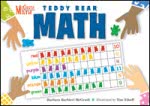
The book hands over a graph and then hands over its answer key. It says to sort a pile of coloured bears, lay one bear in each box of a labelled row, and write the number at the end of every row - and then it prints all six numbers: ten red, eight yellow, four purple, eleven blue, five orange, nine green. Students build the graph from their own tubs first and read it before they ever meet those six numbers, so the reading is theirs. What a child comes away with is that a row is long because it holds many bears and not for any other reason, which is the sentence the book itself supplies: the more bears you add, the longer each grows. The last step turns the longest row and the shortest row into a number, by laying them alongside each other box for box, which the book asks about and never does.
Full lesson — 20 minutes
1. Sort the four handfuls into colour sets (4 min)
Grab four big handfuls out of the tub between your group and pile them in the middle. Before you touch them, say out loud how many different colours you think are in there. Now push the bears into colour sets, one set for each colour, and count the sets. Leave every set where it lands - they are going straight onto the graph and nothing moves twice.
Word preview: sort, sets
Grab four big handfuls, then follow the rules.
Sort the teddies by colors.
How many sets did you get?
We'll use them in groups, so don't move them just yet.
2. Fill one bear to a box, row by row (6 min)
Find the row labelled red and put one red bear in each box, starting at the left edge and leaving no gaps. Do not stack and do not skip a box. Do yellow, purple and blue the same way, then orange and green. When a set runs out, stop - the empty boxes at the end of that row are part of the answer. Every row starts at the same left edge, or the rows cannot be read against each other later.
Word preview: row, box
In the row that reads red, place the reds from your pile.
Put a red bear in each box.
Now do the same with yellow purple and blue.
Don't forget orange and green teddies too.
3. Write the number at the end of every row (5 min)
Count the bears along each row, touching one bear per number, and write that number in the box at the end of the row. Six rows, six numbers. Then read the book's line and put its six numbers under yours. If a number of yours is out by one, count that row again with a partner watching your finger - a row is easy to count twice at a join.
Word preview: total
Write down the total you see in each row.
Ten, red, eight yellow, four purple, eleven blue, five orange, nine green.
4. Say which row is longest, which is shortest, and how many more (5 min)
Point to the row that runs furthest across the page and say its colour and its number. Do the same for the shortest row. Now lay a card along the shortest row, mark where it ends against the longest row, and count the boxes of the longest row that stick out past the mark. Say the whole sentence: blue has the most, purple has the least, and blue has that many more bears than purple.
Word preview: most, least
Examine the bears when your hard work has ceased, which row has the most, which row has the least.
The more bears you add, the longer each grows.
Compare the six rows.
Short version — 9 minutes
1. Write the number at the end of every row (5 min)
Count the bears along each row, touching one bear per number, and write that number in the box at the end of the row. Six rows, six numbers. Turn over the book's card and put its six numbers under yours.
Word preview: total
Write down the total you see in each row.
Ten, red, eight yellow, four purple, eleven blue, five orange, nine green.
2. Say which row is longest, which is shortest, and how many more (4 min)
Point to the longest row and the shortest row and say each colour with its number. Lay a card along the shortest row against the longest one and count the boxes that stick out past the end of the card.
Word preview: most, least
Examine the bears when your hard work has ceased, which row has the most, which row has the least.
The more bears you add, the longer each grows.
Compare the six rows.
Three levels
- Support
- Work with three rows rather than six - red, purple and blue - and keep the other three sets in the tub. Everything else stays: one bear to a box, no gaps, a number written at the end of each row, and the longest and shortest of the three named and laid alongside each other. Three rows still hold the most, the least and the gap between them, and ten against four is the same comparison as eleven against four with one less row to keep track of.
- At Grade
- All six rows, built and numbered by the group, then read three ways: longest, shortest, and how many boxes of the longest stick out past the shortest. Children say the comparison as one whole sentence with both colours and both numbers in it, and check their six numbers against the book's six before they compare anything.
- Extension
- Put the six numbers in order from least to most without moving a single bear, using only the written numbers, and then check the order against the graph by eye. Then answer a question the book never asks: which two rows, put end to end, would just reach the length of the blue row? Eight and four make twelve and that is one too many, ten and four make fourteen, so the only pair that hits eleven exactly is the purple four with a seven the graph does not hold. Children have to say that no two rows do it, and say how they know.
English learners
Bear, red, yellow, purple, blue, orange and green are the six words this lesson runs on, and a child who knows the colours in another language can point at the bear and say both. Row, box and set are the words to rehearse before building starts, because all three name something a child can hold or touch: the row is the line across, the box is the one square a bear sits in, the set is the colour pile before it goes on the graph. The comparison sentence is worth rehearsing whole, because English puts the two things far apart in it: "The ___ row has more bears than the ___ row." Say it three times with different colours before the last step. In English 'most' and 'least' are single words doing the work that several languages do with a phrase, so a child may reach for 'the more' and 'the less' first; both say the right thing and the single word can follow. Invite children to count their rows aloud in their strongest language and write the numeral, since the numeral is the same mark either way.
Materials
- A tub of coloured bear counters per group of four, holding red, yellow, purple, blue, orange and green
- A sorting mat per group, a plain sheet of paper large enough to keep six sets apart
- A six-row grid per group, rows labelled red, yellow, purple, blue, orange and green, with square boxes the width of one bear and at least fifteen boxes to a row
- A pencil per child
- A card per group carrying the book's line of six row numbers, printed face down
- A strip of card per group, long enough to lay along a whole row
- Word cards: row, most, least
Standards & curriculum
These lessons are being matched against curricula now.
Standards are held back while this plan is edited. Every standard shown here was matched against the supplied wording of this lesson, quoting its steps, so a changed step is no longer the thing that was checked. Undo your changes to bring the standards back — your edits stay in this browser either way.
2. Guess First, Then Add the Six Rows
The book opens by telling a child not to count: take a quick glance and keep a guess in your head. Nine hundred characters later it comes back for it. In between it prints the six row numbers and says to add them together, and it does not print the answer until the review page at the very end, where the same six numerals reappear as ten plus eight plus four plus eleven plus five plus nine and the total is given as forty-seven. So the sum is a number students produce, and the book holds the check. Adding these six in the order the book says them crosses a ten four times, at eighteen, at twenty-two, at thirty-three and at forty-seven, which is what makes six small addends worth practising rather than trivial. The last step is the book's own rule for the gap between a guess and a count: take the small from the large.
Full lesson — 20 minutes
1. Take the quick glance and write your guess (4 min)
Look at the pile of bears in the middle of your table for as long as it takes to say the alphabet to F, then look away. Do not count. Write your guess on the top line of your sheet and circle it, and do not change it later for any reason. Say your guess to your partner so it is on the record before any bear moves.
Word preview: guess
Take a quick glance.
You don't need to count.
Keep a guess in your head of the total amount.
2. Add the six row numbers in the order the book says them (6 min)
Write the six row numbers down the sheet in the book's order: ten, eight, four, eleven, five, nine. Add them one at a time and write the running number beside each, so there are six numbers down the page and not just an answer at the bottom. Say each new total aloud as you reach it. Three of your six steps go past a ten, and those are the ones to say slowly.
Word preview: sum
Ten, red, eight yellow, four purple, eleven blue, five orange, nine green.
Now, add them together.
The sum will be grand.
3. Check the sum a second way by counting every bear (5 min)
The book gives two ways and picks neither, so do the other one now. Slide the bears back into one pile and count every bear by hand into groups of ten as you go, then count the tens and the leftovers. Write that number under your sum. If the two numbers are not the same, one of the six row numbers is wrong, and the row to check is the one you found hardest to count.
Word preview: count
You can add all the numbers or count each bear by hand.
4. Take the small from the large and say how far off your guess was (5 min)
Put your circled guess and your sum side by side and say which is the small one and which is the large one. Take the small from the large and write the answer on the last line. Say the whole sentence out loud: my guess was ___, the real number is ___, and I was ___ away. Compare your difference with your partner's and say whose guess was closer, and by how many bears.
Word preview: difference
Was the number you reached more or less than you thought?
Take the small from the large.
That's the difference you've got.
Short version — 9 minutes
1. Add the six row numbers in the order the book says them (5 min)
Write the six row numbers down the sheet in the book's order and add them one at a time, writing the running number beside each and saying it aloud. Ring the three places where your running number goes past a ten.
Word preview: sum
Ten, red, eight yellow, four purple, eleven blue, five orange, nine green.
Now, add them together.
The sum will be grand.
2. Take the small from the large and say how far off your guess was (4 min)
Put your circled guess beside your sum, say which is small and which is large, take the small from the large and write it down. Say the sentence: my guess was ___, the real number is ___, and I was ___ away.
Word preview: difference
Was the number you reached more or less than you thought?
Take the small from the large.
That's the difference you've got.
Three levels
- Support
- Add the same six numbers in the same order, but build each running total on a bead string or a hundred square instead of holding it in your head: slide ten, then eight more, then four more, and read the number you have landed on each time. Every number stays the book's, every step stays in the book's order, and the difference from the guess is still taken at the end. What comes off is the mental carrying, not any part of the sum.
- At Grade
- Six addends added in the book's order with a running total written at every step, then checked a second way by counting the bears into tens, then the difference between the guess and the sum taken small from large and said in a full sentence. A child who reaches forty-seven both ways has checked their own work before the book is opened to the review page.
- Extension
- Add the six numbers in an order of your own choosing and say why you chose it - most children pair the ten and the eleven, or hunt for pairs that make ten, and both are worth saying out loud. Then answer whether the total can change when the order does, and give a reason that is not just 'I got the same answer'. Finally, ask what the guess would have to have been for the difference to come out at seven, and find both numbers that work rather than one.
English learners
Guess, sum and difference are three words this lesson cannot do without, and only one of them is an everyday word. Guess is worth teaching first with the bears in sight, because the book means a careful look and not a wild answer - 'about how many' is the sense, and a child whose language has one word for both may need that said. Sum names the answer to an addition and nothing else here; difference names the answer to a subtraction, which is a surprise in English, because 'difference' in ordinary talk means how two things are unlike. Say plainly that in this book a difference is a number of bears. The frame to rehearse is "My guess was ___. The real number is ___. I was ___ away." Children may count and add in their strongest language throughout - the running numbers on the page are the same marks - and only the final sentence needs to be said in English.
Materials
- A recording sheet per child with a line for the guess at the top, six lines for the row numbers, a line for the sum and a line for the difference
- A pencil per child
- A card per group carrying the book's line of six row numbers
- A paper plate or small hoop per group to hold each group of ten while counting
- A hundred square per pair, to count back on where the difference is hard to see
- Word cards: guess, sum, difference
Standards & curriculum
These lessons are being matched against curricula now.
Standards are held back while this plan is edited. Every standard shown here was matched against the supplied wording of this lesson, quoting its steps, so a changed step is no longer the thing that was checked. Undo your changes to bring the standards back — your edits stay in this browser either way.
3. Four Tens and Eight Fives Hold the Same Forty
This is the one stretch of the book where every number is printed and every one of them checks out. Forty bears are pulled off the pile into four groups of ten; the book says four times ten is forty. The same forty are then broken into eight groups with five in each, and the book says to count by five up to forty. Nothing is added and nothing is taken away between those two arrangements - the bears are the same bears, and the only thing that changes is how many piles they sit in and how many sit in a pile. Students do the rearranging with their hands and say the two multiplications that describe it, and the point to reach is that four bigger groups and eight smaller groups can hold exactly the same number, so a total does not tell you how it was grouped.
Full lesson — 20 minutes
1. Count forty bears off the pile into four groups of ten (6 min)
Take the whole pile and count forty bears off it into four hoops, ten to a hoop, counting one bear at a time and stopping at ten before starting the next hoop. Push every bear that is left over to the far side of the table - those ones are out of this lesson. Count the hoops and count one hoop, and say what you have: four groups, ten bears in each.
Word preview: groups
Split the two bunches so the teddies can make. Four groups of 10 bears.
All the rest take a break.
2. Say the multiplication the four groups make (4 min)
Point at the hoops one at a time and count in tens: ten, twenty, thirty, forty. Now say the sentence the book says: four times ten is forty. Write it on the whiteboard as 4 x 10 = 40 and draw four rings with ten dots in each underneath it, so the four and the ten on the page each point at something on the table.
Word preview: times
Multiply the bears.
Four times ten is forty, as you can now see.
3. Break the four groups into eight and count the bears in each (5 min)
Do not add a bear and do not take one away. Split each hoop of ten into two, so that four hoops become eight, and count what has landed in each new group. Say the number before you count the hoops: how many bears are in one group now, and how many groups are there? Lay the eight groups out in a line so they can all be seen at once.
Word preview: group
It's time to arrange the four groups into eight.
Five bears in each group means you're doing just great.
4. Skip count the eight fives and say why forty did not move (5 min)
Touch each of the eight groups in turn and count by fives: five, ten, fifteen, twenty, twenty-five, thirty, thirty-five, forty. Say how many number words you said - that number is how many groups you have. Write 8 x 5 = 40 under the 4 x 10 = 40 you already have. Then answer the question out loud: the two answers are the same, and no bear was added or taken away, so say what did change.
Word preview: forty
Count by 5 up to 40.
What's 8 times 5 bears?
The answer's right here.
Short version — 9 minutes
1. Break the four groups into eight and count the bears in each (5 min)
Without adding or removing a bear, split each hoop of ten into two so four hoops become eight, and count what has landed in each. Say how many bears are in one group and how many groups there are.
Word preview: group
It's time to arrange the four groups into eight.
Five bears in each group means you're doing just great.
2. Skip count the eight fives and say why forty did not move (4 min)
Touch each of the eight groups and count by fives to forty. Write 8 x 5 = 40 under 4 x 10 = 40, and say what changed between them when no bear was added or taken away.
Word preview: forty
Count by 5 up to 40.
What's 8 times 5 bears?
The answer's right here.
Three levels
- Support
- Work with twenty bears instead of forty: two groups of ten, then four groups of five. The act is unchanged - split each ten in two, add nothing, take nothing away, count what lands in each new group, then skip count the fives to twenty. Two times ten is twenty and four times five is twenty, and the same thing has happened for half as many bears. Children who finish this can go on and do it once more with the full forty.
- At Grade
- Forty bears counted off by hand into four tens, both multiplications written and matched to what is on the table, the four hoops split into eight without a bear moving in or out, and the eight fives skip counted to forty. Children have to say out loud what changed and what did not, and 'the number of groups went up and the size of each group went down' is the answer to listen for.
- Extension
- Find every other way to break the same forty into equal groups with nothing left over, and lay each one out to prove it: two twenties, twenty twos, ten fours, five eights, forty ones. Then say which numbers do not work and why - seven groups is the one to push on, because forty bears into seven hoops leaves five over and that leftover is the same idea the book calls a remainder earlier on. Nobody writes a division sentence; the proof is the bears.
English learners
Group, times and forty carry this lesson. Group is the trap, because it is doing two different jobs at once in every sentence here: how many groups there are, and how many bears are in a group. Rehearse the two questions apart before any counting - 'how many groups?' with a hand sweeping across the table, 'how many in each group?' with a hand around one hoop - and keep the gestures for the whole lesson. Times in English sits between the two numbers and the first number is the number of groups, which is not the order every language uses, so a child may say ten times four for four groups of ten and be describing the same table correctly. Accept it and write both. The frame to rehearse is "___ groups of ___ is ___." Skip counting aloud in a first language is welcome, and the fives and tens are worth hearing in both.
Materials
- A pile of at least forty-seven bear counters per group of four
- Four hoops or paper plates per group
- A small whiteboard and pen per group
- Four more hoops or paper plates per group, making eight in all
- A number line to forty per group, marked at every five
- Word cards: group, times, forty
Standards & curriculum
These lessons are being matched against curricula now.
Standards are held back while this plan is edited. Every standard shown here was matched against the supplied wording of this lesson, quoting its steps, so a changed step is no longer the thing that was checked. Undo your changes to bring the standards back — your edits stay in this browser either way.
4. Turn It Around: Ten Twos, Two Tens, and the Fives in Twenty
The book asks a child to find ten teddies times two, then asks whether turning it around gives twenty again, and answers its own question: that is the product of two bears times ten. The review page prints the same fact a second time. Then it asks one thing it never answers - how many fives make up twenty - and moves straight on to five groups of four. That unanswered question is the work here. Students build ten twos, turn them into two tens, and watch the product stay put; then they break the same twenty into fives, count the groups, and get four from the bears rather than from the page. The last step turns that around too, into five groups of four, which is the arrangement the book does print. Two turns, one collection of twenty bears, and a product that refuses to move.
Full lesson — 20 minutes
1. Build ten twos and count them (5 min)
Take twenty bears and set them out as ten pairs in a line, two bears in each pair, with a gap between the pairs so they can be counted. Count the pairs to check there are ten, then count the bears by twos to twenty. Write it on the whiteboard as 10 x 2 = 20 and point at the ten pairs when you say the ten and at one pair when you say the two.
Word preview: pairs
Multiplying numbers is a fun thing to do.
Next, use the bears to find 10 teddies times 2.
2. Turn it around into two tens and check the product did not change (5 min)
Now do what the book says and turn it around: push the same twenty bears into two groups with ten in each, adding none and taking none away. Count them, ten and ten. Write 2 x 10 = 20 under 10 x 2 = 20. Say what is different between the two lines and what is the same, and say it about the bears on the table, not about the numbers on the board.
Word preview: product
If you turn it around, will you see 20 again?
Yes, that's the product of 2 bears times 10.
3. Break the same twenty into fives and count the groups (5 min)
The book asks this one and never tells you. Take the same twenty bears and push them into groups of five, counting five into each group before starting the next. Do not stop until no bear is left out. Now count the groups and write the number down. Say the answer as a whole sentence with both numbers in it, and then check it a second way by counting five, ten, fifteen, twenty on your fingers and seeing how many number words you said.
Word preview: fives
But do you know how many fives make up 20?
On the subject of 20, bears can do more.
4. Turn the fives around into five fours (5 min)
Turn this one around as well: keep the same twenty bears and build five groups with four in each. Count the groups, count one group, and count the bears. Put the two arrangements side by side on the table if you have room - four groups of five and five groups of four - and say which numbers swapped places. Then say what happened to twenty when they swapped.
Word preview: groups
You'll get the same number with 5 groups of 4.
Short version — 9 minutes
1. Break the same twenty into fives and count the groups (5 min)
The book asks this one and never tells you. Push the same twenty bears into groups of five, five to a group, until no bear is left out. Count the groups and say the answer as a full sentence with both numbers in it.
Word preview: fives
But do you know how many fives make up 20?
On the subject of 20, bears can do more.
2. Turn the fives around into five fours (4 min)
Now turn it around: build five groups with four in each out of the same twenty bears. Say which two numbers swapped places and what happened to the twenty when they did.
Word preview: groups
You'll get the same number with 5 groups of 4.
Three levels
- Support
- Do the same two turns with twelve bears instead of twenty: six twos turned into two sixes, then three fours turned into four threes. Every part of the act stays - build it, count it, turn it, count it again, say what stayed the same - and the numbers are small enough to see the whole collection at once. The bears do the arguing either way, and a child who is sure about twelve can be handed the twenty afterwards.
- At Grade
- Twenty bears built four ways in one lesson - ten twos, two tens, four fives, five fours - with the product written each time and the turn named out loud. The part to insist on is that no bear enters or leaves at any turn, because that is the whole of the reason the product does not move, and a child who says 'because you get the same answer' has not said it yet.
- Extension
- Ask whether every multiplication can be turned around, and make the class prove it with a case that is awkward rather than a case that is easy: three groups of seven turned into seven groups of three. Then push on the one turn that behaves differently. Twenty bears go into four fives and into five fours; twenty bears go into two tens and into ten twos. Ask which of the book's earlier arrangements, four groups of ten, can be turned around and what it turns into, and check the answer of ten groups of four against the forty on the table.
English learners
Product is the word to teach directly, because it is not a word a child meets anywhere else and because English uses it for the answer to a multiplication only. Say it beside sum, which they already have: a sum is what adding gives you, a product is what multiplying gives you. Turn it around is an idiom and will not carry over word for word - the plain version is 'swap the two numbers' and the gesture is two hands crossing over, which is worth doing every time the phrase is said. Ten twos and two tens sound almost identical in English and mean two different arrangements on the table, so point at the bears whenever either is said. The frame to rehearse is "___ groups of ___ is ___, and ___ groups of ___ is ___ too." Children counting by twos and fives in their strongest language should be encouraged to, and asked to say only the final product in English.
Materials
- Twenty bear counters per pair of children
- A small whiteboard and pen per pair
- Two hoops or paper plates per pair
- Four more hoops or paper plates per pair
- A sheet of paper per pair, folded into two halves to keep the two arrangements apart
- Word cards: product, times, swap
Standards & curriculum
These lessons are being matched against curricula now.
Standards are held back while this plan is edited. Every standard shown here was matched against the supplied wording of this lesson, quoting its steps, so a changed step is no longer the thing that was checked. Undo your changes to bring the standards back — your edits stay in this browser either way.
5. Six Bears, Six Places, One Each
The book ends by taking one bear of each colour, standing six of them in a line, and then moving all six at once. Each instruction carries two ordinals doing two different jobs - the fourth bear goes first names a bear by where it is standing now and a place by where it is going. Students number the six places on a mat, act out the three moves the book states cleanly, and then work the last three out, checking as they go that no place gets two bears and no bear is left holding nothing. The check settles something the transcription leaves open: the closing line prints goes forth where the ordinal fourth belongs and the six where the sixth belongs, and only one reading of it puts one bear in every place. That reading is the fourth bear, the fifth, the third, the second, the sixth, the first, and children reach it by elimination rather than by being told.
Full lesson — 20 minutes
1. Line up one bear of each colour and number the places (4 min)
Take one bear of each colour out of the tub - six bears, no two the same. Stand them in a line on the mat, starting with your favourite in the first place, and put the other five wherever you like. Write the numbers one to six under the six places on the mat, not on the bears. Say the line out loud from the left: first is the red one, second is the green one, and so on to the sixth.
Word preview: line
Take one bear of each color, put them all in a line.
Start with your favorite.
Six bears look just fine.
2. Send the rest away and count what is left (4 min)
Everything not in the line goes back in the tub - the book says goodbye to the rest, and the rest is every bear except the six standing up. Count the six once more, touching each one, and say which colour is standing in each of the six places. Both partners have to be able to say the line without looking, because in a moment every bear is going to move at once.
Word preview: sixth
It's time now to say goodbye to the rest.
For the six that are left, slowly follow each word.
3. Move the first three bears the book names (6 min)
Read the line one instruction at a time and do exactly what it says, no faster. Each instruction names two things: which bear to pick up, counted from the old line, and which place to put it in, counted along the new one. The fourth bear goes first - pick up the bear standing in place four and put it down in the new place one. The fifth second. The third third, which means that bear does not move at all. Tick off places one, two and three on your recording strip as they fill.
Word preview: fourth, fifth
The fourth bear goes first, the fifth second, the third third.
4. Work out the last three and check every place has exactly one bear (6 min)
Read the last line. Two of its words are printed in a way that makes you work: it says the second goes forth, and it says the six will be fifth. Look at your recording strip before you argue about the words. Places one, two and three are full and places four, five and six are empty; bears two, six and one are the only ones still standing in the old line. Put each of those three where the line says, and then check the two rules out loud: every place has exactly one bear, and every bear has exactly one place. Read the six ordinal words off the book's own list as you point along the finished line.
Word preview: last
The second goes forth, he trots away fast, the six will be fifth and the first will be last.
First, second, third, fourth, fifth, sixth.
Short version — 9 minutes
1. Move the first three bears the book names (5 min)
Read the line one instruction at a time. Each names a bear by where it is standing now and a place by where it is going. The fourth bear goes first, the fifth second, the third third - and that last one moves nowhere. Tick off places one, two and three as they fill.
Word preview: fourth, fifth
The fourth bear goes first, the fifth second, the third third.
2. Work out the last three and check every place has exactly one bear (4 min)
Read the last line and fill the three empty places with the three bears still standing. Then check aloud: every place has exactly one bear, and every bear has exactly one place.
Word preview: last
The second goes forth, he trots away fast, the six will be fifth and the first will be last.
First, second, third, fourth, fifth, sixth.
Three levels
- Support
- Work with four bears and four places rather than six, using only the part of the line the book states plainly: the fourth bear goes first, the third third, and the second and the first take what is left. Every other part of the task stays whole - two mats, an old line and a new one, a tick on the recording strip as each place fills, and the same two checks said out loud at the end. Four bears is still a reordering and still has to come out one to a place.
- At Grade
- Six bears, two mats and six instructions, with the last three worked out from what is still empty and still standing rather than read off. The pair has to say both checks at the close - one bear in every place, one place for every bear - and be able to point at the bear that never moved and say why the book gave it an instruction at all.
- Extension
- Ask whether the book's line could be run backwards: if the new line is what you start with, what would the instructions have to say to put the bears back where they began? Children write six new instructions of the same shape and test them on the bears. The one that catches people is the third, which stays in place both ways, and the pair of bears that swap straight over. Then ask whether every reordering of six bears can be undone this way, and make them say how they know.
English learners
This lesson lives or dies on six words that sound like six other words. First, second and third look nothing like one, two and three, so they have to be learned as their own set rather than guessed from the counting words, and fourth, fifth and sixth are the counting word with a quiet ending stuck on. Say them beside the counting numbers on a chart and keep the chart up. Two other things are worth naming plainly. English uses the same word for the bear and for the place - the fourth bear and the fourth place - and it is the rest of the sentence that says which is meant, so the two mats are doing language work as much as counting work. And fourth and forth sound identical in English, which is exactly the confusion printed in the book's own last line. The frame to rehearse is "The ___ bear goes ___." Children who have ordinal words in another language should say the finished line in both, pointing along the mat.
Materials
- A tub of coloured bear counters per pair, holding all six colours
- A strip mat per pair with six marked places in a row, wide enough for one bear each
- A pencil per pair
- A blank recording strip per pair with six boxes, for writing where each bear ends up
- A second strip mat per pair, laid below the first, with six marked places for the new line
- An ordinal word card set per pair: first, second, third, fourth, fifth, sixth
- Word cards: fourth, fifth, sixth
Standards & curriculum
These lessons are being matched against curricula now.
Standards are held back while this plan is edited. Every standard shown here was matched against the supplied wording of this lesson, quoting its steps, so a changed step is no longer the thing that was checked. Undo your changes to bring the standards back — your edits stay in this browser either way.