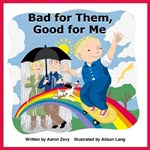
Noah has learned that opposites come in pairs, and he uses that to decide every accident in the book lands on the good side for him — until the last one, where the sentence he has been repeating stops working.
Where you can see it:
- The flooded basement — The roof leaks, the basement floods, and Noah puts on a bathing suit and goes swimming. His parents are not laughing. He closes with the sentence for the first time: bad for them, but good for me.
- The card game — The frog signals so Noah can win. Same closing sentence, but the loss is now something he arranged rather than something that happened.
- The missed dentist appointment — A flat tire, a tow, a new tire his mother has to pay for, and an appointment he did not want. Same sentence again, and this time the cost to her is money.
- The cancelled holiday — A snowstorm stops his parents flying to Aruba. He did not want them to go. Same sentence — but this is the one where what he wanted and what went wrong line up exactly.
- The last page — Saturday. No work, no school, the park. The sentence changes: good for them and good for me. The pattern the whole book has been running finally breaks, and it breaks by including everybody.
Where the class is in the book
| Session | Reading | Minutes |
|---|---|---|
| 1 | First reading, whole book, read aloud straight through | 30 |
| 2 | Second reading, the card game and the dentist pages only | 30 |
| 3 | Third reading, the last two pages, then the whole book skimmed for the sentence | 30 |
The Good-For-Who Chart
One row per reading: what went wrong, who it was bad for, who it was good for, and whether Noah made it happen or it just happened to him.
Created in Session 1. Used by The Session 3 spoken opposite, where students say what the last page changes.
Session 3
A spoken sentence in the book's own shape about something from the student's own week, followed by one sentence saying what is different about the last page of the book.
Draws on sessions 1, 2.
The sessions
1Bad for Them, Good for Me
First reading, straight through, with one job: notice the sentence that keeps coming back. Then the class starts the chart the whole unit runs on, and fills three rows of it.
The same sentence comes back after every accident in this book, and it always lands the same way round: bad for a grown-up, good for Noah.
This session runs in all three. How a student takes the book in is not the same question as how hard their work is.
- Inherits: nothing — this is the opener
- Leaves: The Good-For-Who Chart, created, with three rows filled through the good-for column.
| Step | What to do |
|---|---|
| Read it once, all the way | Read the book aloud without stopping. Students put a thumb on their knee every time they hear the sentence come back. Do not explain the sentence, and do not pause on it. |
| How many thumbs | Ask how many times they heard it. Take the count from four or five students. They will disagree. Leave the disagreement standing — it is the reason to reread tomorrow. |
| Build the chart | Rule up four columns on the board. Fill the flooded-basement row together: what went wrong and where, who it was bad for, who it was good for. Leave the last column blank and say out loud that it stays blank until tomorrow. |
| Two rows alone | Students fill two more rows themselves. Circulate. Accept any row naming a real event from the book; push on any bad-for cell that only has a name in it. |
| Anchor and out | Collect the anchor answer at the door. |
Ask who was standing in the room when that happened, and what they were doing. The joke is his. The chart is about everybody else.
Word for word on all three worksheets, so one closing discussion covers the room. If a Support answer and an Extension answer would not belong in the same conversation, the session needs rewriting.
Give the chart with the four column headings already written and one row filled. Let the bad-for and good-for cells be a name plus a drawn face before they are a sentence. The thumb signal in Step 1 needs no English at all and tells you immediately whether the student is hearing the pattern.
- The Good-For-Who Chart, four columns, six blank rows
- Anchor slips, six to a page
- The chart rules up in an exercise book across a double page
- A read-aloud copy is enough; students do not need one each in this session
Who Was It Good For? (Helper Version)
- Row 1 — the basement flooded. Bad for ______ . Good for ______ .
- Row 2 — the card game with the frog. Bad for ______ . Good for ______ .
- Row 3 — the flat tire on the way to the dentist. Bad for ______ . Good for ______ .
- Where did Row 1 happen? ______
- In Row 1, what were his mom and dad doing while Noah was swimming? ______
- Anchor question — everyone answers this one. Who was this bad for, and who was it good for? Pick any row. It was bad for ______ and good for ______ .
- Check — every bad-for box has a person in it.
The Good-For-Who Chart
- Row 1 — what went wrong, and where: ______ . Bad for ______ . Good for ______ .
- Row 2 — what went wrong, and where: ______ . Bad for ______ . Good for ______ .
- Row 3 — what went wrong, and where: ______ . Bad for ______ . Good for ______ .
- Pick one row. What were the grown-ups doing while it happened? ______
- How many times did you hear the sentence come back? ___
- Anchor question — everyone answers this one. Who was this bad for, and who was it good for? ______
- Check — three rows, each with a place and a person.
Which One Cost the Most?
- Three rows, in the order the book gives them, each with a place: ______
- Which of your three cost a grown-up the most? ______
- What makes it the biggest? Say it in one sentence: ______
- One thing that went wrong that you did NOT put on the chart, and why you left it off: ______
- Anchor question — everyone answers this one. Who was this bad for, and who was it good for? ______
- Check — three rows in book order, and a reason for the biggest one.
- opposite — the furthest thing from something else — hot and cold, tall and short (The first page, where Noah lists the opposites he has been learning)
- ark — a big boat that keeps everyone safe in a flood (The rain page, where Dad jokes about building one)
- The sentence returns after: the flooded basement, the card game, Mr. Albert, the flat tire, the cancelled holiday, the parrot, and the burnt dinner. Seven. Accept five or more — the point of the count is the disagreement, not the number.
- Flooded basement: bad for Mom and Dad, good for Noah. The detail to push for is that they were not laughing while he swam.
- Card game: bad for Mom and Dad, good for Noah — and this is the one he arranged, though nobody should say so until Session 2.
- Flat tire: bad for Mom, who missed the appointment and bought a new tire. Good for Noah, who did not want to see the dentist.
- Cancelled holiday: bad for Mom and Dad, good for Noah. Watch for students who write good for everyone here — they have noticed something real and it is worth holding until Session 3.
- Burnt dinner: bad for Mom, good for Dad and Noah. This is the only one where the good-for column has two names in it.
| Part of the standard | Practised in | Visible in |
|---|---|---|
| Identify plot structure — the shape the book repeats | Step 1, thumbs on the knee each time the sentence returns; Step 2, counting how many times | The count each student gives, and the three chart rows built on it |
| Describe the sequence of events | Steps 3 and 4, each chart row names one thing that went wrong, in the order the book gives them | The chart, whose rows run in book order |
| Describe characters — who each event is bad for and good for | Steps 3 and 4, the bad-for and good-for columns name people, not feelings | The two named columns on all three rows |
| Describe characters' feelings and behaviours | Step 3, the flooded-basement row records that his parents were not laughing while he swam | The bad-for column, which must say more than the name |
| Describe the setting — where and when each event happens | Step 3, each row names the room or the place: the basement, the car, the kitchen table | The what-went-wrong column, which must carry a place |
- Catalogue access facts (text_on_screen, narration, illustrations_displayed) were not supplied for this title, so all three are assumed true and every mode is available.
- This plan was built from the words only; no spreads were supplied. No session here turns on what an illustration shows, and the chart columns are all answerable from the text.
2Who Made It Happen?
Second reading, two pages only. The class sorts every accident into the ones that happened to Noah and the one he arranged, then says what that tells us about him.
All but one of these accidents just happened to Noah — exactly one he set up himself, and finding it changes what kind of boy the book is about.
This session runs in all three. How a student takes the book in is not the same question as how hard their work is.
- Inherits: The Good-For-Who Chart with three rows from Session 1.
- Leaves: The made-it-happen column filled on every row, and one sentence describing Noah.
| Step | What to do |
|---|---|
| Two pages again | Reread the card game page and the dentist page only. Ask what is different between them — not what happens, but how it happens. |
| Made it or not | Fill the last column on every row. One question per row: did Noah do this, or did it just happen? Mark it, then underline the word in the book that decides it. |
| The odd one out | Take the count of how many rows say made it happen. Land on the frog. Ask what that one row shows about Noah that the others do not. |
| Say what he is like | One sentence about Noah, using the chart. Not what he does — what he is like. Send back any sentence that is only a feeling word. |
| Anchor and out | Collect. |
Being glad about it is not the same as doing it. Show me the word where Noah does something. If there is no word, he did not do it.
Word for word on all three worksheets, so one closing discussion covers the room. If a Support answer and an Extension answer would not belong in the same conversation, the session needs rewriting.
The sort is a two-way choice before it is a sentence, so a student with little English can do the whole of Steps 2 and 3 by marking and underlining. Give the what-he-is-like sentence as a frame with two options to finish: Noah is the kind of boy who ______ , or Noah thinks that ______ . Let it be said aloud to you before it is written.
- The Good-For-Who Chart, continued from Session 1
- Two-stamp strip for the support tier
- Anchor slips
- The stamps can be two words the student circles
- One shared copy of the two reread pages per pair is enough
Did He Do It? (Helper Version)
- The frog helps Noah win at cards. Circle one: HE DID IT / IT HAPPENED. The word that tells me: ______
- The tire goes flat. Circle one: HE DID IT / IT HAPPENED. The word that tells me: ______
- The basement floods. Circle one: HE DID IT / IT HAPPENED. The word that tells me: ______
- How many rows did you circle HE DID IT? ___
- Finish this: Noah is the kind of boy who ______ .
- Anchor question — everyone answers this one. Which of these did Noah make happen, and which just happened to him? He made ______ happen. ______ just happened.
- Check — every row has a circle and a word.
Who Made It Happen?
- Fill the last column on every row of your chart: MADE IT HAPPEN or JUST HAPPENED.
- Beside each one, the word from the book that decides it: ______
- How many rows say MADE IT HAPPEN? ___ Which one? ______
- What does that one row show about Noah that the others do not? ______
- One sentence about what Noah is like — not what he does: ______
- Anchor question — everyone answers this one. Which of these did Noah make happen, and which just happened to him? ______
- Check — every row marked, a word beside each, and a sentence that is about what he is like.
Argue the Other Side
- Your MADE IT HAPPEN row: ______
- What would have to be true for that one to count as something that just happened? ______
- Which reading does the book support, and which word decides it? ______
- Is there a second row that could be argued either way? ______
- One sentence about what Noah is like, that holds up even after the argument: ______
- Anchor question — everyone answers this one. Which of these did Noah make happen, and which just happened to him? ______
- Check — the argument rests on a word from the book, not on how it feels.
- signals — secret little movements that tell someone something without saying it out loud (The card game page, where the frog signals to Noah)
- divine intervention — a grown-up joke meaning something bigger than us made it happen on purpose (The flat tire page, where Mom says it about the delay)
- MADE IT HAPPEN: the card game. The deciding words are that Tolstoy gives him signals so he can win. Noah is a participant, not a bystander.
- JUST HAPPENED: the flood, the flat tire, the snowstorm, the burnt dinner, the parrot. In each of these the text gives Noah no action at all — things arrive and he reports them.
- Mr. Albert is the interesting edge case. Noah wishes he could make him disappear but does not do anything. A student who marks it JUST HAPPENED and points out that wishing is not doing has read carefully; a student who marks it MADE IT HAPPEN has confused wanting with acting, which is exactly the wrong turn below.
- What the frog row shows: Noah is willing to arrange his luck, not only enjoy it. Accept any sentence that separates being glad from being the cause.
- Sentences to send back: he is happy, he is lucky, he is funny. Those are feelings and weather. Ask what he thinks about things going wrong, and wait.
| Part of the standard | Practised in | Visible in |
|---|---|---|
| Identify a character's perspective — the attitude Noah holds toward things going wrong | Step 4, one sentence saying what Noah is like, built from the chart rather than from impression | The what-he-is-like line, which is rejected if it names a feeling instead of an attitude |
| Identify different characters' perspectives — the grown-ups' view of the same events | Step 1, rereading two pages and asking what the same event looked like from the other side of the room | The bad-for column revisited on both reread rows |
| Perspective as attitude, not as narrator — kept apart, per the clarification | Step 3, students say what the frog row shows about Noah, not who is telling the story | The odd-one-out answer, which must be about Noah's attitude |
| Ground the perspective in the text | Step 2, every made-it-happen mark requires an underlined word from the book | The underlined words, checked row by row |
- Catalogue access facts were not supplied for this title, so all three are assumed true and every mode is available.
- Built from the words only. The underline step needs the words to be reachable in whichever mode the student is using; on a platform that shows the text in all three, that holds.
3The Sentence That Changes
Third reading, the last page. The pattern the class has been tracking for two sessions breaks, and students say what the change means before making one of their own.
The book says bad for them, but good for me seven times and then stops, and the sentence it ends on includes everybody.
This session runs in all three. How a student takes the book in is not the same question as how hard their work is.
- Inherits: The complete Good-For-Who Chart from Session 2.
- Leaves: nothing — this is the closer
| Step | What to do |
|---|---|
| Read the last page | Read only the Saturday page aloud. Wait longer than is comfortable before taking an answer. Let them find it. |
| Put the two side by side | Write the repeated sentence above the last sentence on the board. Students copy both and mark what changed. |
| Why that ending | Ask why the book waits until the very end to change it. Take three answers. Write the strongest up without saying it is the strongest. |
| Your own opposite | Each student says one sentence in the book's shape about their own week, then one sentence about what the last page changes. Two say theirs to the whole class. |
| Collect | Take in every chart and every sentence strip. |
Put the two sentences next to each other and read them both out. One word is doing the work. Which one?
Word for word on all three worksheets, so one closing discussion covers the room. If a Support answer and an Extension answer would not belong in the same conversation, the session needs rewriting.
The change is one word, so the whole of Step 2 is reachable without production. Give both sentences printed and let the student circle the difference. For the week sentence, allow the event to be drawn or named in the first language as long as the frame is completed in English. Let it be rehearsed with a partner before it is said to the room.
- Sentence strip sheet with two ruled lines and a because line
- The completed Good-For-Who Chart
- Printed frame for the support tier
- The two sentences can be copied from the board into an exercise book
- Any scrap strip works for the spoken sentence; it does not need to be printed
The Sentence Changes (Helper Version)
- The sentence Noah says all through the book: It was bad for ______ but good for ______ .
- The sentence on the last page: That's good for ______ and good for ______ .
- Circle the word that changed: BUT / AND
- Why is the ending different? Circle one: because everyone gets a good day / because Noah stopped being greedy / because nothing went wrong that day.
- My own week: It was bad for ______ but good for ______ .
- Anchor question — everyone answers this one. What is different about the sentence on the last page? The word ______ changed to ______ .
- Check — both sentences written and one word circled.
The Sentence That Changes
- Write the sentence Noah repeats all through the book: ______
- Write the sentence on the last page: ______
- What changed? ______
- Why does the book wait until the very end to change it? Because ______
- One sentence in the book's shape about your own week: ______
- Anchor question — everyone answers this one. What is different about the sentence on the last page? ______
- Check — both sentences, the change named, and a because line that is not just about the mood.
The Clue Before the Ending
- Both sentences, with the change marked: ______
- Why does the book wait until the end? ______
- Which row on your chart was already heading this way before the last page? ______
- What makes it the clue? ______
- Your own week, in the book's shape, and then the version where it comes out good for everyone: ______
- Anchor question — everyone answers this one. What is different about the sentence on the last page? ______
- Check — the clue row is named and the reason rests on the chart.
- oligarchy — another grown-up joke — a country run by only a few people. Noah is showing off; the word is not the point. (The bedtime page, in Noah's last list of opposites)
- The two sentences: it was bad for them, but good for me, against that's good for them and good for me. The change is but to and, and me alone becomes everybody.
- Why the book saves it: because the pattern has to be established before breaking it means anything. Seven repetitions teach the reader to expect the trade, so the day when nobody loses lands as a change rather than as one more page.
- Answers to accept on the why line: nothing had to go wrong for it to be a good day; he did not need someone else to lose; Saturday is the first day everyone wants the same thing. Any of these is the theme in a Grade 2 mouth.
- Answers to send back: everyone is happy. True, and it is the mood. Ask what changed in the words.
- The clue row, for the extension: the cancelled holiday. Noah did not want his parents to leave, so what was bad for them was the very thing he wanted — that is the row where his good and their bad are closest to being the same thing, and it points at the ending.
- For the week sentences, score whether the shape holds — two people, one loss, one gain. A student who cannot find a real one may invent it; that is fine, the shape is the work.
| Part of the standard | Practised in | Visible in |
|---|---|---|
| Identify a theme — say what the book is telling us, not what happens in it | Step 3, students answer why the book saves the change for the last page | The written answer on the theme line, which is rejected if it retells the ending |
| Explain the theme — give the reason, drawn from the change in the sentence | Step 2, the two sentences set side by side and the difference named; Step 3 asks why | The what-changed line and the because line beneath it |
- Catalogue access facts were not supplied for this title, so all three are assumed true and every mode is available.
- The whole session turns on one changed word, so it needs the two sentences side by side. A student taking the book in by ear will hear the change; the sentence sheet carries both sentences in print so the comparison does not depend on memory.
Entry diagnostic — 10 minutes
This is my house. I live here with my mom and dad. They teach me a lot of things. Lately, I've been learning about opposites. The opposite of hot is cold. The opposite of short is tall. The opposite of boy is girl.
Can they read it
- Who does the boy live with?
- The passage puts words together in twos. Write two of them down.
- What has he been finding out at home lately?
What they bring
- Tell me about a day when something went wrong at your house. What happened?
- When a grown-up has a bad day, how can you tell?
One skill probe
Hot goes with cold. If I say tall, what do I say back? Then tell me how you knew.
Culminating rubric
A spoken sentence in the book's own shape about something from the student's own week, followed by one sentence saying what is different about the last page of the book.
| What is judged | 4 | 3 | 2 | 1 |
|---|---|---|---|---|
| The shape of the sentence | Both halves are there, the two people are different, and the loss and the gain are genuinely connected — one causes the other. | Both halves are there and name two different people. | One half is there, or both halves name the same person. | The sentence describes an event without using the shape. |
| What changed on the last page | Names the changed word and says what it does — that nobody has to lose for the day to count. | Names the changed word or says the ending includes everybody. | Says the ending is happy without naming what changed in the words. | Retells the last page. |
| Evidence from the chart beyond grade | Points to a row on the chart that was already heading toward the ending, and says why. | Points to a row on the chart while speaking. | Mentions the chart without naming a row. | The chart is not used. |
Student reflection — 5 minutes
- Which row on your chart was the hardest to decide? What made it hard?
- Did you change your mind about any row after the second reading? Which one?
- Name one thing you would do differently if you said your sentence again tomorrow.
- Somebody in the room said a sentence you liked. What was good about it?
What this plan does not do
- There is no writing outcome. Students write single sentences on the chart and say the final one aloud; the unit never asks for a paragraph.
- The frog, the parrot and Mr. Albert are the funniest things in the book and the plan does not use them. They are left as reading.
- The plan assumes read-aloud. The jokes sit above a Grade 2 reading level even where the sentences do not.
- The book's ending is warm and the plan takes it at face value. A class that wanted to argue about whether Noah is selfish would need a fourth session this plan does not have.
Considered and left out
Everything below was weighed against the book and refused. It is here so you can see where the line was drawn.
| Skill | Why not | Reason |
|---|---|---|
| Retell the story in order (ELA.2.R.3.2) | MERGED | The chart already puts the events in order and does it in service of the pattern rather than as an exercise. |
| Compare two texts (ELA.2.R.3.3) | EVIDENCE | The benchmark needs two texts. This is a one-book unit, so it cannot be taught here honestly. |
| Context clues (ELA.2.V.1.3) | SWAP | The hard words here — pragmatist, oligarchy, divine intervention — are jokes aimed over the child's head, not words the story asks a reader to work out. A vocabulary session would be about the jokes, not the book. |
| Rhyme and sound patterns | EVIDENCE | The book does not rhyme. |
| Fluency practice | WEEKLY | Runs with any book at this grade. |
| Opposites as a vocabulary lesson | SWAP | Tempting, because the book opens and closes on opposites. But an opposites worksheet would run unchanged with any list of words and would miss that the opposites are how Noah thinks, not what the book teaches. |