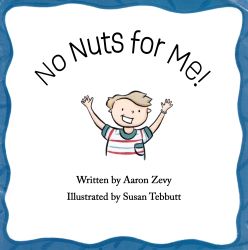
Noah explains his allergy straight to you, keeps asking you things and answering for you, and by the last page he has handed you the sentence and asked you to remember it.
Where you can see it:
- The first page — Before anything happens he says he did not notice you at first, asks your name, says it is a very nice name, and asks whether you want to spend the day with him. You have a part in this book before the story starts.
- The bracelet — He explains what a medic alert bracelet is and then says here, do you want to have a look. He is showing you the thing, not describing it.
- The EpiPen — He takes it out to show you, and then answers a reply you never gave — you know someone who has one too? Cool! He has decided what you said.
- Rachel's rule — The class votes not to trade food. He turns to her with a big smile and says the sentence: no nuts for me. It has stopped being a rule about him and become a thing between friends.
- The last page — He says he is sorry you have to go, that he will miss you, that you would be good friends — and then, remember, no nuts for me. The sentence is now yours to carry.
Where the class is in the book
| Session | Reading | Minutes |
|---|---|---|
| 1 | First reading, whole book, read aloud straight through | 30 |
| 2 | Second reading, only the places where the sentence appears | 30 |
| 3 | Third reading, the last page, then back across the Guest Book | 30 |
The Guest Book
One row per part of the day: where they are, what Noah asks you, and what he takes for granted that you said back.
Created in Session 1. Used by The Session 3 spoken message, where students say to a newcomer what they would need to know.
Session 3
A spoken message to somebody joining the class tomorrow, telling them one thing they would need to know to keep Noah safe, and one thing Noah would want them to know about him that is not about nuts at all.
Draws on sessions 1, 2.
The sessions
1He Is Talking to You
One page in, the class works out that Noah thinks they are standing in the room with him. They follow his day and chart every place he turns and asks them something.
Noah is not describing his day to a reader — he thinks you came over to spend it with him, and he keeps asking you things.
This session runs in all three. How a student takes the book in is not the same question as how hard their work is.
- Inherits: nothing — this is the opener
- Leaves: The Guest Book, created, with four rows filled through the what-he-asks-you column.
| Step | What to do |
|---|---|
| Who is he talking to | Read the first page only. Ask who Noah is speaking to. Wait for somebody to say us. Then say he thinks you are standing right there. |
| Read the day | Read the rest aloud. Students put a hand up whenever Noah asks the reader something. There are a lot, and the hands going up is the point. |
| Where and when | Build the Guest Book: parts of the day in order, and where each happens. Morning, carpool, school, lunch, playground, shopping, party — choose four. |
| What he asks you | Students fill the questions column on their four rows, copying what he actually asks. Push back on anything said to another character. |
| Anchor and out | Collect the anchor answer at the door. |
Only the ones he asks you. If somebody in the book could answer it, it does not go in this column.
Word for word on all three worksheets, so one closing discussion covers the room. If a Support answer and an Extension answer would not belong in the same conversation, the session needs rewriting.
Putting a hand up when Noah asks a question needs no English and keeps every student inside the reading. Give the questions printed so the column is a match rather than a copy. The day itself — breakfast, car, school, lunch, playground, shop, party — is familiar in any language and can be drawn in the first column instead of written.
- The Guest Book, three columns, six ruled rows
- Six printed questions on a strip for the support tier
- Anchor slips
- The Guest Book rules up in an exercise book across a page
- One read-aloud copy is enough for this session
What Does He Ask You? (Helper Version)
- Morning, in his bedroom — what does he ask you? ______
- Breakfast, in the kitchen — what does he ask you? ______
- School, in the classroom — what does he ask you? ______
- Shopping, at the supermarket — what does he ask you? ______
- Match from this strip: your name? / spend the day? / have a look at this? / want a piece? / come to school? / come shopping?
- Anchor question — everyone answers this one. What does Noah ask you at each part of the day? In the morning ______ . At school ______ .
- Check — four rows, each with a question he asks YOU.
The Guest Book
- Part of the day 1 — where: ______ What he asks you: ______
- Part of the day 2 — where: ______ What he asks you: ______
- Part of the day 3 — where: ______ What he asks you: ______
- Part of the day 4 — where: ______ What he asks you: ______
- Are your rows in the order the day happens? yes / no
- Is every question one he asks YOU, not another person in the book? yes / no
- Anchor question — everyone answers this one. What does Noah ask you at each part of the day? ______
- Check — four rows in day order, each with a place and a question aimed at you.
The Questions Nobody Answers
- Four rows, in day order, with place and question: ______
- Find a question Noah asks that you could not really answer from where you are sitting: ______
- What does he do instead of waiting for your answer? ______
- Find a place where he says something back as if you had spoken. Copy it: ______
- Anchor question — everyone answers this one. What does Noah ask you at each part of the day? ______
- Check — the copied line really does answer a question you never gave.
- allergic — your body reacts badly to a thing that is fine for most people (The bracelet page, where he explains what he cannot eat)
- medic alert bracelet — a band you wear so that anyone helping you knows what is wrong (Early on, the band he never takes off)
- carpool — when a few families share one car ride to school (The morning, when the horn goes)
- Questions he asks the reader, in day order: your name; whether you want to spend the day; whether you want to look at the bracelet; whether you want a piece of French toast; whether you want to come to school; whether you want a race; whether you want to come shopping.
- Things he says to characters, which do NOT belong in the column: Hey Mom, no nuts for me. Hi Mrs. Cooper. Hi Sandy. Happy birthday, Debbie. Use these to sort out any student filling the column with dialogue.
- The clearest place he answers for you is the EpiPen page: he shows it, and then says you know someone who has one too? Cool! You never said anything. He decided.
- The parts of the day, in order: waking and dressing, breakfast, carpool, school and show and tell, lunch, playground, shopping, birthday party. Any four in the right order is correct.
- For the extension, the strongest find is the EpiPen line. Second best is the race — I bet that you and I would make a great team — where he assumes you said yes to the race and then builds a friendship on it.
- Accept a student who says he does not want an answer, he wants company. That is the book in one line.
| Part of the standard | Practised in | Visible in |
|---|---|---|
| Identify plot structure — one day, running from waking up to a birthday party | Step 3, the parts of the day are laid out in order on the Guest Book | The where-and-when column, running morning to party |
| Describe the sequence of events — the day in the order it happens | Step 3, students place each part before filling anything else in | The Guest Book rows, checked against the book's order |
| Describe the setting — where each part of the day happens | Step 3 names the kitchen, the car, the classroom, the playground, the supermarket | The place named on every row |
| Describe characters' behaviour — what Noah does when he turns to you | Steps 2 and 4, students catch each question and copy what he asks | The what-he-asks-you column on four rows |
- Catalogue access facts (text_on_screen, narration, illustrations_displayed) were not supplied for this title, so all three are assumed true and every mode is available.
- Built from the words only; no spreads were supplied. Every question Noah asks the reader is in the text, so nothing in this session depends on the pictures.
2Who Says It Now?
The sentence Noah uses about himself turns up five times, and one of those times somebody else says it. Students track it and find what it has become.
No nuts for me starts as a rule Noah keeps about himself, and by the end of the day other people are saying it to him.
This session runs in all three. How a student takes the book in is not the same question as how hard their work is.
- Inherits: The Guest Book with four rows from Session 1.
- Leaves: The sentence tracked in order with who says it each time, and the what-he-takes-for-granted column filled.
| Step | What to do |
|---|---|
| Find them all | Reread only the places the sentence turns up. Students mark each. There are five, and one of them is not Noah speaking. |
| Who and to whom | For each, write who says it and who they say it to. Stop on the Mom one — it is the surprise and the room should notice it together. |
| What changed | Ask what is different about the way he says it to Rachel compared with the very first one. Take answers; the smile is in the text. |
| Fill the assumed column | Back to the Guest Book. Fill what he takes for granted you said, on all four rows. |
| Anchor and out | Collect. |
The words are the same. Who is he saying it to? Look at that column, and then tell me whether the fourth one is really the same as the first.
Word for word on all three worksheets, so one closing discussion covers the room. If a Support answer and an Extension answer would not belong in the same conversation, the session needs rewriting.
Recording who speaks and who listens is two names per row, so the whole of Step 2 is reachable with almost no English. Give the name list. For Step 3, offer the comparison as a choice before it is a sentence: was it a rule, or was it a joke between friends? The Mom line is short enough to be read aloud by a student who wants to.
- Tracking sheet, five rows, columns for speaker and listener
- The Guest Book from Session 1
- Name list for the support tier
- The five places can be marked with folded paper strips
- The tracking sheet rules up in an exercise book as two columns
Who Says It? (Helper Version)
- Time 1 — who says it? ______ Who to? ______
- Time 2 — who says it? ______ Who to? ______
- Time 3 — who says it? ______ Who to? ______
- Time 4 — who says it? ______ Who to? ______
- Choose names from this list: Noah / Mom / Rachel / the reader / himself.
- One of these is NOT said by Noah. Which one? ______
- Anchor question — everyone answers this one. Who says no nuts for me each time, and who are they saying it to? Time 1 ______ . The one that is not Noah ______ .
- Check — every row has two names.
Who Says It Now?
- All five uses, in order — who says it, and who to: ______
- Which one is not said by Noah? ______
- What is different about the one he says to Rachel, compared with the very first one? ______
- The book says how he says it to Rachel. Copy that bit: ______
- Guest Book — what does he take for granted you said, on each of your four rows? ______
- Anchor question — everyone answers this one. Who says no nuts for me each time, and who are they saying it to? ______
- Check — five rows with speaker and listener, and the assumed column finished.
From a Rule to a Joke
- All five uses, with speaker and listener: ______
- What does the sentence mean the first time it is used? ______
- What does it mean the last time? ______
- Which use is the one where it turns from a rule into something friends say? ______
- What makes you put the turn there rather than a use earlier? ______
- Anchor question — everyone answers this one. Who says no nuts for me each time, and who are they saying it to? ______
- Check — the turn is placed and defended from the text.
- trade — to swap something of yours for something of somebody else's (The classroom page, where Rachel suggests nobody swap food)
- ingredients — all the things that go into making a food (The birthday party page, about the cake)
- The five uses. One: Noah to himself, explaining what he always likes to say — a rule. Two: Noah to his mum at breakfast — a reminder, cheerful. Three: Noah to Rachel after the class votes, with a big smile — thanks, and a joke between friends. Four: Mom to Noah at the supermarket, no nuts for you — she has picked it up from him. Five: Noah to the reader on the last page, remember, no nuts for me — an instruction handed over.
- The one that is not Noah is the supermarket, where Mom says it back. That is the row to stop on: the sentence has left him and started travelling.
- What changed by Rachel: at the start it is a rule he keeps for his own safety, and by Rachel it is something a friend has made possible and he is thanking her for. The book gives you the smile so you can see it.
- For the extension, the turn is the third use, with Rachel. Before it, the sentence protects him. After it, other people are using it too. A student who puts the turn at the supermarket has also read carefully — Mom saying it is the proof rather than the moment — and should be told the difference.
- The assumed column, on the Guest Book: he assumes you said yes to spending the day, yes to seeing the bracelet, yes to school, and that you know somebody with an EpiPen. Accept any of these; the EpiPen one is the strongest because he says your answer out loud.
| Part of the standard | Practised in | Visible in |
|---|---|---|
| Identify Noah's attitude to his own allergy, and how it shifts | Step 3, comparing the first use of the sentence with the one he says to Rachel | The what-changed answer on the tracking sheet |
| Identify a different character's perspective — his mother's, when she says it back | Step 2, the row where the speaker is not Noah | The who-says-it column, where one row names Mom |
| Identify a third perspective — Rachel's, who proposes the rule for the class | Step 3 asks why he smiles when he says it to her | The written answer beneath the Rachel row |
| Keep perspective separate from who is speaking the words | Step 2 records the speaker and the listener as two different columns, so a change of speaker is not mistaken for a change of attitude | The two columns kept apart on all five rows |
- Catalogue access facts were not supplied for this title, so all three are assumed true and every mode is available.
- The session depends on finding five occurrences of one sentence. Marking them in advance for the support tier is what keeps the searching from eating the thinking time.
3Tell Somebody Else
Noah's last word is remember. Students work out what a newcomer would need to know, and what Noah would want them to know that has nothing to do with nuts, then say both aloud.
Noah asks you to remember one thing about his safety, and the book has spent all day showing you that he is not only that one thing.
This session runs in all three. How a student takes the book in is not the same question as how hard their work is.
- Inherits: The complete Guest Book from Session 2.
- Leaves: nothing — this is the closer
| Step | What to do |
|---|---|
| The last thing he says | Read the last page. He says remember. Ask who he is asking to remember, and let the room land on themselves. |
| Two kinds of thing | Two columns on the board: things about the allergy, and things about Noah. Fill three of each from the Guest Book together. |
| Build the message | Each student picks one from each column and writes two sentences. Check every one before it is spoken — this is where all-nuts messages get caught. |
| Say it out | Students say their message to the class as though a new person were sitting in the empty chair. Name the word that must be heard clearly before starting. |
| Collect | Take in every Guest Book and every message. |
Look at the Guest Book. He races you, he shows off his lunch, he does show and tell. Which of those would he want a new person to know?
Word for word on all three worksheets, so one closing discussion covers the room. If a Support answer and an Extension answer would not belong in the same conversation, the session needs rewriting.
The frame carries the task: if you sit with Noah you need to know ______ , and he would want you to know that he ______ . Two blanks, both fillable from a board already written. Let the message be rehearsed with a partner, and let the student choose their own must-land word — for many it will be EpiPen, which is short and worth owning. Speaking to an empty chair is easier than speaking to faces and that is partly why it is set up this way.
- Message sheet, two ruled lines and a word box
- The completed Guest Book
- An empty chair at the far side of the room
- Printed frame and three options per column for the support tier
- Any chair or a marked spot on the wall works as the newcomer
- The message can be written on the back of the Guest Book
My Message (Helper Version)
- Choose one safety thing: he cannot eat nuts / he carries an EpiPen / always check before sharing food.
- Choose one other thing: he is a fast runner / he hit a home run / he does show and tell / he likes raisins.
- If you sit with Noah you need to know ______ .
- He would want you to know that he ______ .
- The word I want everyone to hear clearly: ______
- Anchor question — everyone answers this one. What would a new person need to know, and what would Noah want them to know as well? They need to know ______ , and also that he ______ .
- Check — two sentences, and the second one is not about food.
Tell Somebody Else
- Something about staying safe, from the book: ______
- Something about Noah that has nothing to do with food: ______
- My first sentence: ______
- My second sentence: ______
- The word that must be heard clearly: ______
- Where in the Guest Book did each part come from? ______
- Anchor question — everyone answers this one. What would a new person need to know, and what would Noah want them to know as well? ______
- Check — two whole sentences, and the second one is not another safety rule.
And What Not to Do
- My two sentences: ______
- A third sentence — what you would want a new person NOT to do: ______
- Noah never asks anybody for that himself. Why do you think not? ______
- Find a place in the book where somebody else does the asking for him: ______
- The word that must be heard clearly: ______
- Anchor question — everyone answers this one. What would a new person need to know, and what would Noah want them to know as well? ______
- Check — the third sentence is a request, not a rule, and the why rests on the book.
- Safety things available from the book: he is allergic to nuts and could get very sick; he wears a medic alert bracelet; he carries an EpiPen in his knapsack; he never takes food from anybody because he cannot know what is in it; his mum reads every label; his mum phones ahead before parties.
- Not-about-food things: he is a very fast runner and everyone wants him on their team; he hit a home run; he did show and tell about his allergy and it was fun; he loves raisins; he laughs and sings in the carpool; Sandy helps him and he talks to her.
- The commonest failure is two safety sentences. It is worth naming why it matters: the book spends most of its pages on a normal day and only a few on the allergy, and a message that is all nuts describes a condition rather than a boy.
- For the extension, the honest answer to why Noah never asks anybody not to do something is that he does not ask at all — Rachel does. She proposes the no-trading rule and the class votes. He only ever explains himself and lets other people decide what to do about it. A student who finds that has read the book properly.
- The must-land word will usually be EpiPen or allergic. Both are worth practising. Accept any word the student names and can say clearly.
- Score the delivery from whether a student at the back can repeat the safety part back. That is more useful than a volume judgement and it takes five seconds.
| Part of the standard | Practised in | Visible in |
|---|---|---|
| Present information orally | Step 4, every student delivers a two-part message to the class as though a new person were sitting there | The delivery itself, and the listener's note of the two parts |
| Using complete sentences | Step 3, both sentences are written and checked before anything is spoken | The written message, collected at the end |
| Appropriate volume | Step 4, the message is aimed at an empty chair at the far side of the room | Whether students at the back can repeat the safety part back |
| Clear pronunciation | Step 4, the student names the word that must land before starting — usually EpiPen or allergic | The marked word on the message sheet, and whether the room caught it |
- Catalogue access facts were not supplied for this title, so all three are assumed true and every mode is available.
- This session works from the Guest Book and the last page only, so it runs identically whichever mode a student used for the reading.
Entry diagnostic — 10 minutes
Oh hi, I didn't notice you at first. I'm still a little sleepy. My name is Noah. Nice to meet you. What's your name? That's a very nice name. So, do you want to spend the day with me? Sounds like a good idea. Hold on while I get dressed. Hey, no peeking.
Can they read it
- Who is speaking in this part?
- What does he want to do with you?
- Write two of the questions he asks you.
What they bring
- When somebody new comes to your class, what do you want to know about them first?
- Is there a food you cannot eat? Or do you know somebody who cannot?
One skill probe
If I say to you, do you want to come outside, and then I walk off without waiting, what have I decided about your reply?
Culminating rubric
A spoken message to somebody joining the class tomorrow, telling them one thing they would need to know to keep Noah safe, and one thing Noah would want them to know about him that is not about nuts at all.
| What is judged | 4 | 3 | 2 | 1 |
|---|---|---|---|---|
| The safety part | Names something specific from the book and says what a person should do about it. | Names something specific from the book. | Says he is allergic without saying to what or what follows from it. | No safety part. |
| The part that is not about food | Names something from the book that shows what he is like with other children, not only what he can do. | Names something from the book that has nothing to do with food. | Offers a second safety fact instead. | No second part. |
| Both parts traceable to the Guest Book | Both parts named with the row each came from. | Both parts are from the book. | One part is from the book and one is invented. | Neither part is from the book. |
| Complete sentences | Both sentences are whole and the second follows the first without a restart. | Both sentences are whole. | One is whole and one trails off. | The message is delivered in fragments. |
| Volume | A student at the back can repeat the safety part back afterwards. | Reaches most of the room. | Reaches the front rows only. | A repeat has to be asked for. |
| Clear pronunciation | Every word lands, and the marked word — usually EpiPen — is unmistakable. | Every word lands. | Most words land; the marked word is swallowed. | The room cannot make out the safety part. |
| What a new person should not do beyond grade | Offers it as a request rather than a rule, and says why Noah never makes that request himself. | Offers a third sentence about what not to do. | Offers a third sentence that repeats the safety part. | No third sentence. |
Student reflection — 5 minutes
- Which part of your message was harder to choose, and why?
- Did you change your mind about the second sentence while you were writing it? What to?
- Name one thing you would say differently if a new person really did arrive tomorrow.
- Somebody chose a second sentence you had not thought of. What was it?
What this plan does not do
- There is no writing outcome beyond two sentences. Students chart and speak; the unit never asks for connected prose.
- Sandy, the older girl with the fish allergy, is the only other child in the book who shares Noah's situation, and the plan does not use her. She is left as reading.
- The unit does not teach what to do in an emergency, and a class that has a child with a serious allergy will need that taught separately and properly.
- The plan treats the direct address as a device to notice. A class that finds it uncomfortable — being spoken to as though you are in the room — may need that named out loud, and the plan does not do it for you.
Considered and left out
Everything below was weighed against the book and refused. It is here so you can see where the line was drawn.
| Skill | Why not | Reason |
|---|---|---|
| Theme (ELA.2.R.1.2) | MERGED | What the book is asking of a reader comes out in Session 3 through the two-column sort. A separate theme session would ask it a second time. |
| Retell the day in order (ELA.2.R.3.2) | MERGED | The Guest Book already holds the day in order and holds it for a reason. |
| Compare two texts (ELA.2.R.3.3) | EVIDENCE | Needs a second text this unit does not have. |
| Context clues (ELA.2.V.1.3) | EVIDENCE | The words that matter — medic alert bracelet, EpiPen, allergic reaction — are all explained outright by Noah as he goes. There is nothing left for a reader to work out, so a context-clue session would be practising a strategy on words that do not need it. |
| Point of view and who is narrating | MERGED | The direct address is the heart of the book and Session 1 is built on it. It is deliberately not tagged to the perspective benchmark, whose clarification separates perspective from the person of the narrator. |
| Fluency practice | WEEKLY | Runs with any book at this grade. |
| A health and safety lesson on allergies | SWAP | The book carries real and useful information and a school may well want that lesson. It is not a reading lesson, and building the unit on it would mean teaching the topic rather than the book. |