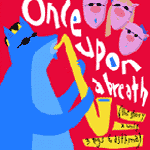
Everybody knows how the wolf's line ends, and this book will not let him finish it until the one night he has looked after himself all day.
Where you can see it:
- At the red light — He calls the line through the car window at the three pigs, gets the reply, starts to huff and puff — and the light turns green and they drive off. The line is cut by traffic.
- At the bathroom door — Same call, same reply, same start — and the announcement comes over that BB Wolf is on stage. The line is cut by his own show.
- At the pigs' house — Same call, same reply — and this time the pigs finish the sentence for him: you have asthma, you can't blow the house down. The line is cut by the truth.
- Straight after — He takes a deep breath, huffs, puffs, and the book says you know what I did. The line completes for the first and only time.
- The asthma diary — That same day he used his preventer puffer in the morning, went to get his vacuum fixed because of dust mites, and used his reliever puffer at the club when his chest went tight. The one day the line works is the day he did all three.
Where the class is in the book
| Session | Reading | Minutes |
|---|---|---|
| 1 | First reading, whole book, read aloud straight through | 30 |
| 2 | Second reading, the car chase and the basketball court only | 30 |
| 3 | Third reading, hunting back through the whole book for the puffers and the vacuum | 30 |
The Interrupted Line Chart
One row per reading: which time it was, where he was, and what stopped the line before he could finish it.
Created in Session 1. Used by The Session 3 answer to why the line works the last time.
Session 3
A spoken answer to one question — why does the line finish the last time and not the other three? — using two rows from the chart.
Draws on sessions 1, 2.
The sessions
1The Line That Never Finishes
The class says the wolf's famous line before the book is opened, then hears it start three times and get cut off every time. They chart where he was and what stopped him.
The most famous line in fairy tales starts three times in this book and something cuts it off before the end every time.
This session runs in all three. How a student takes the book in is not the same question as how hard their work is.
- Inherits: nothing — this is the opener
- Leaves: The Interrupted Line Chart, created, with all three interruptions charted through the what-stopped-him column.
| Step | What to do |
|---|---|
| Say the line first | Before opening the book, say I'll huff and I'll puff and — and let them finish it. Ask how many of them knew it. All of them will. |
| Read it once, all the way | Read aloud without stopping. Students raise a hand every time the line starts. Do not pause when hands go up, and do not comment. |
| Three places | Build the chart together: which time, and where he was. The car at the red light, the bathroom door at the club, the pigs' house. |
| What stopped him | Students fill the third column themselves, one thing per row, from the book. Push on any cell that says the pigs where something else did the stopping. |
| Anchor and out | Collect the anchor answer at the door. |
The pigs are always there. What is different about each time? Something else stops him twice, and the pigs only stop him once.
Word for word on all three worksheets, so one closing discussion covers the room. If a Support answer and an Extension answer would not belong in the same conversation, the session needs rewriting.
The hand-raise in Step 2 needs no English and tells you straight away who is hearing the pattern. Give the chart with the place column already filled, and let the third column be a match-to-a-strip before it is a sentence. The famous line will already be known in many languages, and a student who can say it in another language has the same head start as everyone else.
- The Interrupted Line Chart, four columns, three rows ruled
- Matching strip of three answers for the support tier
- Anchor slips
- The chart rules up in an exercise book across a page
- A single read-aloud copy is enough for this session
What Stopped Him? (Helper Version)
- Time 1 — in the car at the red light. What stopped him? ______
- Time 2 — at the bathroom door in the club. What stopped him? ______
- Time 3 — at the pigs' house. What stopped him? ______
- Match one to each row: the light turned green / the announcement said he was on stage / the pigs said he has asthma.
- Did the same thing stop him every time? yes / no
- Anchor question — everyone answers this one. What stopped the line each time? Time 1 ______ . Time 2 ______ . Time 3 ______ .
- Check — three different answers, one on each row.
The Interrupted Line Chart
- Time 1 — where was he? ______ What stopped him? ______
- Time 2 — where was he? ______ What stopped him? ______
- Time 3 — where was he? ______ What stopped him? ______
- What was he in the middle of doing each time? ______
- Are your three answers all different? yes / no
- Anchor question — everyone answers this one. What stopped the line each time? ______
- Check — three rows in book order, each with a place and a different reason.
The One That Is Different
- All three rows, in order, with place and reason: ______
- Which one is not like the other two? ______
- What makes it different? ______
- Two of the interruptions come from outside him. One does not. Which, and why does that matter? ______
- Anchor question — everyone answers this one. What stopped the line each time? ______
- Check — the odd one out is named and the reason is from the book.
- trigger — something that starts a problem going — for him, dust or pollen or cats (Early on, where BB Wolf explains what sets off his asthma)
- jalopy — an old beaten-up car (The car chase page, describing the pigs' car)
- exhaust — the pipe at the back of a car where the dirty smoke comes out (The car chase page, where the fumes come from)
- Time 1, in the car at the red light: the light turned green and the pigs drove off. The interruption is traffic.
- Time 2, at the bathroom door in the club: the announcement came that BB Wolf was on stage, so he had to go and perform. The interruption is his own show.
- Time 3, at the pigs' house: the pigs finish the sentence for him — you have asthma, you can't blow the house down. The interruption is the truth about him.
- The odd one out is the third. The first two are accidents of timing that could have happened to anybody. The third is about him, and it is the only one the pigs cause on purpose. A student who spots that has found the shape of the book.
- Watch for the cell that says the pigs on row one or two. The pigs are present every time, so naming them is not wrong so much as not yet an answer. Ask what actually made him stop talking.
| Part of the standard | Practised in | Visible in |
|---|---|---|
| Identify plot structure — the same moment repeating three times | Step 2, a hand goes up each time the line starts; Step 3 names all three | Three rows on the chart, one per interruption |
| Describe the sequence of events — the three in the order the book gives them | Step 3, the chart is built first time, second time, third time | The which-time column, which must run in book order |
| Describe the setting — where each one happens | Step 3, each row names the place: the car at the light, the club bathroom door, the pigs' house | The where column on all three rows |
| Describe characters' behaviour — what BB Wolf does each time | Step 4, the what-stopped-him column requires saying what he was in the middle of doing | The third column, rejected if it only names a place |
- Catalogue access facts (text_on_screen, narration, illustrations_displayed) were not supplied for this title, so all three are assumed true and every mode is available.
- This plan was built from the words only; no spreads were supplied. Nothing in this session turns on what an illustration shows — all three interruptions are stated in the text.
2He Was Trying to Explain
Two pages reread, and one discovery: the wolf is chasing the pigs to talk to them about fumes. The pigs have no idea. Students fill two speech bubbles for the same moment.
BB Wolf is running after the pigs to explain something, and the pigs think a wolf is coming to blow their house down.
This session runs in all three. How a student takes the book in is not the same question as how hard their work is.
- Inherits: The Interrupted Line Chart with three rows from Session 1.
- Leaves: Two speech bubbles per row — what BB Wolf thinks is happening, and what the pigs think is happening.
| Step | What to do |
|---|---|
| Why is he chasing them | Reread the car chase. Ask what BB Wolf says he is running after them for. Insist the answer comes from the page, not from what wolves usually want. |
| Two bubbles | Draw two speech bubbles on the board for the same moment. Fill the wolf's together, and copy the line from the book underneath it. |
| The pigs' bubble | Students fill the pigs' bubble themselves. Only what the pigs could know from where they are sitting. |
| Do it again on the court | Same two bubbles for the basketball court, both sides done by the student this time. |
| Anchor and out | Collect. |
The pigs did not hear the part about the fumes. They heard a wolf shouting the line through their window. Write only what they could know.
Word for word on all three worksheets, so one closing discussion covers the room. If a Support answer and an Extension answer would not belong in the same conversation, the session needs rewriting.
A bubble takes a few words, not a sentence, so the whole task is reachable with very little English. Give the wolf bubble filled and the pigs' bubble with two options to choose between on the first row. Let students say both bubbles aloud in a pair before writing. A drawn face inside the bubble alongside the words is worth accepting — it often shows the perspective more clearly than the words do.
- Bubble sheet, two rows, two blank bubbles per row
- The Interrupted Line Chart from Session 1
- Two offered wordings for the support tier
- Two bubbles drawn freehand in an exercise book work as well as the printed sheet
- One shared copy of the two reread pages per pair
Two Bubbles (Helper Version)
- The car chase. BB Wolf's bubble is filled in: I want to tell them their car fumes are bad for people with asthma.
- The pigs' bubble — choose one: (a) a wolf wants to blow our house down, (b) a wolf wants to talk to us about our car.
- Which one did the pigs actually shout back at him? ______
- The basketball court. BB Wolf's bubble is filled in: those pigs are here too, and the pollen is making me wheeze.
- The pigs' bubble on the court — write your own: ______
- Anchor question — everyone answers this one. What does BB Wolf think he is doing, and what do the pigs think he is doing? He thinks ______ . They think ______ .
- Check — the two bubbles on each row say different things.
He Was Trying to Explain
- Copy the line from the book that says why BB Wolf chased them: ______
- The car chase — BB Wolf's bubble: ______
- The car chase — the pigs' bubble, using only what the pigs could know: ______
- The basketball court — BB Wolf's bubble: ______
- The basketball court — the pigs' bubble: ______
- Anchor question — everyone answers this one. What does BB Wolf think he is doing, and what do the pigs think he is doing? ______
- Check — four bubbles filled, and on each row the two disagree.
What Nobody Says
- All four bubbles, filled: ______
- What would BB Wolf have to say for the pigs to understand him? ______
- What would the pigs have to say for him to understand them? ______
- Why does neither of them ever say it? ______
- At the pigs' house at the end, does the misunderstanding finally end? What makes you say so? ______
- Anchor question — everyone answers this one. What does BB Wolf think he is doing, and what do the pigs think he is doing? ______
- Check — the answer to why neither says it comes from the book, not from a guess.
- pollution — dirty stuff in the air that makes it harder to breathe (The car chase page, what BB Wolf wants to explain)
- ragweed pollen — tiny dust from a plant that floats in the air and sets off allergies (The basketball court page)
- BB Wolf's stated reason, from the page: he chased after them to explain how pollution is bad for everyone, and especially for people with asthma. That sentence is the whole session — a student who finds it has done the work.
- The pigs' side, car chase: a wolf is banging on our window shouting the line from the story. Of course they answer with not by the hair of our chinny chin chin. From where they sit, this is the fairy tale happening to them.
- BB Wolf, basketball court: his allergies are bothering him, there is ragweed pollen everywhere, and the pigs are there again. He wants to deal with them, and then someone passes him the ball.
- The pigs, basketball court: accept anything consistent with being chased by a wolf. They never get told otherwise.
- For the extension: neither says it because every time BB Wolf opens his mouth he reaches for the famous line instead of the explanation, and the line is the one thing guaranteed to make the pigs run. He is using the words that stop the conversation he says he wants.
- Send back any pigs' bubble that mentions asthma or fumes. The pigs cannot know that. If they knew, there would be no book.
| Part of the standard | Practised in | Visible in |
|---|---|---|
| Identify one character's perspective — what BB Wolf thinks is happening | Step 1 finds his stated reason in the text; Step 2 puts it in his bubble | The wolf bubble on both rows of the bubble sheet |
| Identify a different character's perspective — what the pigs think is happening | Step 3, students fill the pigs' bubble for the car chase; Step 4 repeats it on the court | The pig bubble on both rows |
| Hold both at once — the same moment seen two ways | Step 4, both bubbles for the basketball court are done by the student in one go | The second row of the sheet, where the two bubbles must disagree |
| Perspective as attitude, grounded in what the text says | Step 1 insists the reason comes from the book rather than from what a wolf usually wants | The line copied from the book beneath the wolf bubble |
- Catalogue access facts were not supplied for this title, so all three are assumed true and every mode is available.
- Step 1 asks students to copy the wolf's stated reason from the page, so the words need to be reachable in whichever mode the student is using. On a platform showing the text in all three, that holds.
3The Time It Worked
The line finally finishes. Students hunt back through the whole book for the three things BB Wolf did about his asthma that day, and answer why this time was different.
The one time the wolf finishes his line is the end of the one day he took his medicine, dealt with the dust and used his puffer when his chest went tight.
This session runs in all three. How a student takes the book in is not the same question as how hard their work is.
- Inherits: The chart and the speech bubbles from Session 2.
- Leaves: nothing — this is the closer
| Step | What to do |
|---|---|
| Read the last one | Read from the pigs saying he cannot blow the house down through to the diary entry. Ask what is different this time. Wait longer than is comfortable. |
| Hunt backwards | Go back through the book for everything BB Wolf did about his asthma that day. Add each to the fourth column. There are three, and they are scattered. |
| Put it together | Ask why those three things matter to the ending. Take answers. Do not correct a wrong one — ask which row of the chart it comes from, and let the chart do the correcting. |
| Say why | Each student answers the question aloud, naming two rows from the chart. Two say theirs to the whole class. |
| Collect | Take in every chart and every bubble sheet. |
Go back to the morning. What did he do before he even left the house? Now the afternoon. Now the club. Three things, and they are all in the book.
Word for word on all three worksheets, so one closing discussion covers the room. If a Support answer and an Extension answer would not belong in the same conversation, the session needs rewriting.
The hunt is a finding task before it is a writing task, so a student can do the whole of Step 2 by marking three places in the book. Give the answer frame: the line stopped because ______ , but the last time ______ . Let the spoken answer be rehearsed with one partner first, and accept two named rows pointed at on the chart as evidence even where the sentence around them is thin.
- The Interrupted Line Chart with the fourth column ruled
- A six-item list for the support tier, three of them the asthma actions
- Printed answer frame for the support tier
- The fourth column can be added to the existing chart in a different colour
- Students can share copies for the hunt; it is a re-skim, not a close read
Why Did It Work? (Helper Version)
- Six things BB Wolf did that day. Circle the three that were about his asthma: practised his sax / used his preventer puffer / went to get his vacuum fixed / played basketball / used his reliever puffer at the club / did his show.
- Write your three in the fourth column of the chart.
- Morning: what did he do before he left the house? ______
- Night: what did he do when his chest felt tight? ______
- Finish this: The line stopped because ______ , but the last time ______ .
- Anchor question — everyone answers this one. Why does the line finish the last time and not the other three? Because ______ .
- Check — three things circled and three written on the chart.
The Time It Worked
- Three things BB Wolf did about his asthma that day: 1 ______ 2 ______ 3 ______
- Where in the day did each one happen? ______
- Why do those three matter to the ending? ______
- Which two will you use in your answer? ______
- Anchor question — everyone answers this one. Why does the line finish the last time and not the other three? ______
- Check — three things found, and an answer that is about the day he had rather than about how he felt.
What If He Had Skipped It?
- The three asthma actions, with where each happens: ______
- What would have happened at the pigs' house if he had skipped the morning puffer? ______
- Which part of the book tells you that? ______
- The diary entry is the last thing in the book. Why does the book end there instead of at the house? ______
- Anchor question — everyone answers this one. Why does the line finish the last time and not the other three? ______
- Check — the what-if answer points at a part of the book, not at a guess.
- preventer puffer — the medicine he takes every day so the asthma does not start (The morning page, his daily medication)
- reliever puffer — the medicine he takes when the asthma has already started, to help right away (The club page, when his chest goes tight)
- dust mites — creatures far too small to see that live in carpets and beds and set off his asthma (The vacuum page, why he cleans the carpet)
- The three actions: he used his preventer puffer first thing in the morning; he took his vacuum to be fixed because of the dust mites in his carpet and bedding; and he used his reliever puffer at the club when his chest went tight and he started to cough.
- Why they matter: the book has been showing him managing his asthma all day in small ordinary ways, and the payoff is that when it finally counts, he can do the thing everyone said he could not. The pigs are wrong — not because he does not have asthma, but because having it is not the same as being stopped by it.
- Answers to accept on the why line: he looked after himself all day so he was ready; he took his medicine so his chest was clear; the pigs thought asthma meant he could not, and it does not. Any of these is the theme in a Grade 2 mouth.
- Answers to send back: he was angry, he really wanted to, he finally tried hard enough. All make the ending about feeling rather than about the day, and the fourth column is the argument against them.
- For the extension, the honest answer is that the book does not say — and that is worth accepting. A student who says the book does not tell us, and points out that it only ever shows the day where he did everything right, has read more carefully than one who invents a collapse.
- The diary entry matters: he writes in it every night, and that night he had an extra entry. The routine is the point, not the huff and the puff.
| Part of the standard | Practised in | Visible in |
|---|---|---|
| Identify a theme — what the book is saying, beyond what happens in it | Step 3, students say why the three asthma actions matter to the ending | The written answer on the why line, rejected if it retells the ending |
| Explain the theme — give the reason, drawn from the fourth column | Step 2 collects the three actions; Step 4 requires two of them to be named in the spoken answer | The fourth column of the chart and the two rows cited aloud |
- Catalogue access facts were not supplied for this title, so all three are assumed true and every mode is available.
- The hunt in Step 2 asks students to move back and forth across the whole book. A student taking it in by ear needs the re-skim done as a read-aloud with pauses, which is why the support tier turns the hunt into a circling task instead.
Entry diagnostic — 10 minutes
Oh, excuse me, I was just practicing my sax. Let me introduce myself. My name is BB Wolf. They call me BB because I'm big and I'm bad. This here is my very fine establishment, the Big Bad Wolf Blues Club. I perform here with my band, The Little Pigs 3, for all my fans.
Can they read it
- What is the character's name, and why do people call him BB?
- What was he doing at the start of the passage?
- Write down two things he says about who he is.
What they bring
- Tell me about a time you had to stop in the middle of doing something. What made you stop?
- Is there something you must do each day to stay well?
One skill probe
In lots of stories the same thing happens again and again. Tell me one like that, and say what repeats in it.
Culminating rubric
A spoken answer to one question — why does the line finish the last time and not the other three? — using two rows from the chart.
| What is judged | 4 | 3 | 2 | 1 |
|---|---|---|---|---|
| Answers the question that was asked | Says why the last one is different and also says what the other three had in common. | Says why the last one is different. | Describes what happens at the end without saying why it is different. | Retells the ending. |
| Uses two rows from the chart | Names two rows and says which column in each one is doing the work. | Names two rows from the chart. | Names one row, or gestures at the chart without naming a row. | The chart is not used. |
| The reason rests on the day, not on feelings | Names at least two of the three asthma actions and connects them to the ending. | Names at least one of the three asthma actions. | Says he was ready or prepared without naming what he did. | Says he was angry, or that he tried harder. |
| What would have happened without the morning puffer beyond grade | Says the book does not tell us, and points out that it only ever shows the day where he did everything right. | Gives an answer and points at a part of the book for it. | Gives an answer with nothing from the book behind it. | No answer attempted. |
Student reflection — 5 minutes
- Which of the three interruptions was hardest to explain? What made it hard?
- Did you change your mind about anything after the third reading? What?
- Name one thing you would say differently if you gave your answer again tomorrow.
- Someone else in the room gave an answer you had not thought of. What was it?
What this plan does not do
- There is no writing outcome. Students write on the chart and in bubbles and answer aloud; the unit never asks for connected prose.
- The plan does not teach the asthma information directly, though the book carries a lot of it. A teacher wanting that will need to add it.
- The joke depends on knowing how The Three Little Pigs goes. A class that does not know it will need the original told to them first, and Session 1 Step 1 assumes they do.
- The book is longer than its page count suggests and the third session asks students to hunt backwards through all of it. A slower class will need that split across two periods.
Considered and left out
Everything below was weighed against the book and refused. It is here so you can see where the line was drawn.
| Skill | Why not | Reason |
|---|---|---|
| Retell the story in order (ELA.2.R.3.2) | MERGED | The chart already orders the three interruptions and does it for a reason, rather than as a retelling exercise. |
| Compare two texts (ELA.2.R.3.3) | EVIDENCE | Needs two texts. A class that has read The Three Little Pigs could do it, but this plan cannot assume that. |
| Context clues (ELA.2.V.1.3) | MERGED | Trigger, preventer and reliever are the words that matter, and they are explained inside the story as it goes. A separate vocabulary session would re-teach what the book already teaches. |
| Fairy tale features and retellings | SWAP | Tempting and genuinely interesting, but it would need a second fairy tale in the room and would become a lesson about the genre rather than about this book. |
| Fluency practice | WEEKLY | Runs with any book at this grade. |
| A health lesson on asthma triggers | SWAP | The book carries real information about triggers and medication, and it would be easy to teach that instead. It is not a reading lesson, and the plan leaves it to the teacher to use as they see fit. |