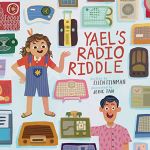
Every clue in this hunt is solved by Yael, and the book takes the trouble to tell you each time exactly what her family was doing instead.
Where you can see it:
- The first clue, the blue transistor — Her parents and brothers are confused and arguing about the best plan. Yael goes straight to the room with the big fan and finds it.
- The Remler dog — Her parents and brothers are still not a help. The book says she knew she would have to solve this one herself, and she does.
- The owl radio — Meanwhile her family had not done anything. The book says it is as if they were stuck in one place. Yael finds the green Zenith.
- The white radio — She walks right by her mom, brothers and dad on her way to the room with the white ones. The family is scenery now.
- The last page — Uncle Ronnie comes in, the family gathers around all with smiles, and the praise goes to Yael. They are there for the ending they had no part in.
Where the class is in the book
| Session | Reading | Minutes |
|---|---|---|
| 1 | First reading, whole book, read aloud straight through | 30 |
| 2 | Second reading, the four clue pages only, reading just the lines about the family | 30 |
| 3 | Third reading, the last page only, then the ledger | 30 |
The Clue Ledger
One row per clue: what the clue asked for, which radio it turned out to be, and what Yael's family was doing while she worked it out.
Created in Session 1. Used by The Session 3 clue the student writes and reads aloud.
Session 3
A clue of the student's own, written for an object in the classroom and read aloud for the class to solve, followed by one sentence naming which two ledger rows showed them how a clue works.
Draws on sessions 1, 2.
The sessions
1How a Clue Works
First reading, all the way through, then the class takes the riddles apart. Every clue is doing two jobs at once, and the ledger starts here.
Every clue in this book tells you two things — what the radio looks like, and roughly where to go and find it.
This session runs in all three. How a student takes the book in is not the same question as how hard their work is.
- Inherits: nothing — this is the opener
- Leaves: The Clue Ledger, created, with four rows filled through the which-radio column.
| Step | What to do |
|---|---|
| Read it once, all the way | Read aloud without stopping. Tell students to listen for how many radios Yael has to find. Do not stop to solve the clues along the way. |
| One clue on the board | Write out the first clue in full. Underline the part saying what to look for, circle the part saying where. Two jobs, one clue. |
| Three more | Students do the same for three more clues on the ledger: what to look for, and which radio it turned out to be. |
| In order | Check the rows run in hunt order. Each clue is found on the radio the one before it named — say that chain out loud together. |
| Anchor and out | Collect the anchor answer at the door. |
Read the first clue again slowly. It tells you what the radio is like and it tells you which room. Underline one and circle the other.
Word for word on all three worksheets, so one closing discussion covers the room. If a Support answer and an Extension answer would not belong in the same conversation, the session needs rewriting.
Marking two parts of a printed clue is a sorting task, not a writing task, so the whole of Steps 2 and 3 is reachable with very little English. Give the clues printed. The radio names — Remler, Zenith, Packard Bell — are proper nouns and should be treated as labels to copy, not words to decode. Let the which-radio column be a match from a list.
- The Clue Ledger, four columns, five ruled rows
- The four clues printed on a strip for the support tier
- Anchor slips
- The ledger rules up in an exercise book across a double page
- Two colours of pencil help but a circle-versus-underline rule does the same job
Two Parts to Every Clue (Helper Version)
- Clue 1 — a blue transistor playing a tune, in the room that is ready for guests. Underline what to look for. Circle where to look.
- Clue 2 — a dog that's small and shiny, with the name Remler. Underline what to look for. Circle where to look.
- Clue 3 — the exact opposite of the colour black. What colour is that? ______
- Clue 4 — a radio that looks like an owl. Which radio was it? Match from the list: Remler / Zenith / Packard Bell / Madison.
- Which room did Yael go to for Clue 1? ______
- Anchor question — everyone answers this one. What does each clue tell you to look for? Clue 1 ______ . Clue 2 ______ .
- Check — every clue has one underline and one circle.
The Clue Ledger
- Clue 1 — what to look for: ______ Where to look: ______ Which radio: ______
- Clue 2 — what to look for: ______ Where to look: ______ Which radio: ______
- Clue 3 — what to look for: ______ Where to look: ______ Which radio: ______
- Clue 4 — what to look for: ______ Where to look: ______ Which radio: ______
- Are your rows in the order the hunt happens? yes / no
- Anchor question — everyone answers this one. What does each clue tell you to look for? ______
- Check — four rows, both parts marked on each, in hunt order.
Which Words Did the Work?
- All four rows, both parts marked: ______
- Clue 2 says small and shiny AND says the name Remler. Which of those actually narrowed it down? ______
- Pick another clue. Which words did the work, and which were decoration? ______
- Is there a clue that would have been impossible without the where part? Which one? ______
- Anchor question — everyone answers this one. What does each clue tell you to look for? ______
- Check — for each clue you can say which word did the narrowing.
- transistor — a small portable radio (The first clue and throughout the hunt)
- collection — a lot of the same kind of thing, kept together on purpose (Uncle Ronnie's note at the start)
- Clue 1: a blue transistor playing a tune, in the room that is ready for guests. Yael goes to the room with the big fan and climbs a step ladder. The where part is what makes it findable.
- Clue 2: a dog that is small and shiny — but there is more than one, so the clue adds the name Remler. This is the clearest example of a clue that narrows twice.
- Clue 3: the exact opposite of the colour black, so white. She checks three white ones and finds the note on the bottom of the third.
- Clue 4: a radio that looks like an owl. The green Zenith. Yael's own line is worth pointing at — at least that's what Yael did think — because the book admits the answer is a judgement, not a fact.
- For the extension: on Clue 2 the name Remler does the narrowing and small and shiny is the decoration, because there is more than one shiny dog. On Clue 1 the where part does most of the work, since a blue transistor could be anywhere in a house full of radios.
- Accept four rows in any consistent order as long as the student can say why they are in that order. The chain matters more than the numbering.
| Part of the standard | Practised in | Visible in |
|---|---|---|
| Identify plot structure — the hunt repeating clue after clue | Step 1, students count how many radios Yael has to find; Step 4 checks the rows run in hunt order | Four ledger rows, in the order the book gives them |
| Describe the sequence of events — each clue found on the radio the one before it named | Step 4, the chain is checked row by row | The which-radio column, where each row's answer is where the next clue was found |
| Describe the setting — the rooms of the house the hunt moves through | Step 2 circles the where part of the first clue; Step 3 repeats it on three more | The circled where portion on each charted clue |
| Describe characters' behaviour — what Yael does when a clue arrives | Step 3, each row records that she goes straight somewhere rather than standing still | The ledger rows, which name the room she goes to |
- Catalogue access facts (text_on_screen, narration, illustrations_displayed) were not supplied for this title, so all three are assumed true and every mode is available.
- Built from the words only; no spreads were supplied. The clues describe radios, so a class with the pictures would have a richer session — but every clue is also answered in the text, which is why this session holds without them.
2What Was Everyone Else Doing?
The four sentences about Yael's family, read one after another with nothing in between. The class notices what the book keeps saying about them, and fills the last column.
The book stops at almost every clue to tell you what Yael's family is not doing, and by the end they are standing in the room taking the credit.
This session runs in all three. How a student takes the book in is not the same question as how hard their work is.
- Inherits: The Clue Ledger with four rows from Session 1.
- Leaves: The family column filled on every row, and one sentence about how Yael is different from them.
| Step | What to do |
|---|---|
| Only the family lines | Reread the four clue pages, but read aloud only the sentences that mention her parents and brothers. Four sentences, back to back, nothing in between. |
| What do you notice | Ask what those four sentences have in common. Take answers. Somebody will say they never do anything, and that is the whole session arriving on its own. |
| Fill the column | Students fill the family column on all four rows, using the book's own words where they can. |
| How is she different | One sentence about how Yael is different from her family. Not that she is cleverer — what she does that they do not. Send back any sentence that is only a compliment. |
| Anchor and out | Collect. |
Look at the last page again. They gather round smiling. They are not unkind. They just never work anything out. What is the difference?
Word for word on all three worksheets, so one closing discussion covers the room. If a Support answer and an Extension answer would not belong in the same conversation, the session needs rewriting.
Reading four sentences back to back makes the pattern audible without any reading load at all — a student who hears it can answer Step 2 by pointing. Give the family sentences printed and let the column be a copy rather than a paraphrase. For Step 4 provide the frame: Yael ______ , but her family ______ . Accept it spoken to you before it is written.
- The Clue Ledger from Session 1
- The four family sentences printed on a strip
- Sentence frame for the support tier
- The four sentences can be read aloud twice instead of printed
- The ledger continues on the same sheet; no new copy needed
What Was the Family Doing? (Helper Version)
- Match each sentence to its clue: confused and arguing about the best plan / still not a help / hadn't done anything / she walked right by them.
- Clue 1 — the family were ______ .
- Clue 2 — the family were ______ .
- Clue 3 — the family were ______ .
- Do the four sentences say the same kind of thing? yes / no
- Finish this: Yael ______ , but her family ______ .
- Anchor question — everyone answers this one. What was Yael's family doing while she solved each clue? They were ______ .
- Check — all four rows have something in the family column.
What Was Everyone Else Doing?
- Clue 1 — the family: ______
- Clue 2 — the family: ______
- Clue 3 — the family: ______
- Clue 4 — the family: ______
- What do all four have in common? ______
- One sentence about how Yael is different — what she DOES, not what she is: ______
- Anchor question — everyone answers this one. What was Yael's family doing while she solved each clue? ______
- Check — four rows filled from the book, and a sentence about doing rather than being.
Is the Book Being Unkind?
- All four family entries, in the book's own words: ______
- On the last page the family gather round smiling. What does the book say about them there? ______
- Is the book being unkind to them? ______
- What makes you think so? Point at a line: ______
- Would the story work if the family were helpful? What would be lost? ______
- Anchor question — everyone answers this one. What was Yael's family doing while she solved each clue? ______
- Check — the answer about unkindness rests on a line, not on a feeling.
- confused — not able to work out what is going on (The first clue page, describing the parents and brothers)
- meanwhile — at the same time as something else is happening (The owl clue page, before the sentence about the family)
- The four family moments, in order: confused and arguing about a plan while she goes; still no help, so she solves it herself; nothing done at all, stuck in one place; and she walks right past all three of them on her way to the white radios.
- What they have in common: every one is about the family not doing something. The book never shows them helping, and it goes out of its way to say so each time.
- How Yael is different — accept anything about what she does: she goes straight to a room, she climbs the ladder, she checks each one, she keeps going when the first two are empty. Send back she is smarter, she is the best, she is clever — those are compliments, not behaviour.
- For the extension: the book is not unkind. The family are never shown being mean, and the last page has them smiling and pleased for her. The book is doing something quieter — it keeps them present and useless so that every solved clue belongs entirely to Yael. A student who says the family are nice but never any help has it exactly.
- Watch for a student who notices the family are arguing about the best plan while Yael simply goes. That contrast — talking about how to look, versus looking — is the sharpest thing in the book and it is right there in the first clue.
| Part of the standard | Practised in | Visible in |
|---|---|---|
| Identify one character's perspective — how Yael treats a clue when it arrives | Step 4, the sentence about how she is different must say what she does, not that she is cleverer | The how-she-is-different line |
| Identify a different perspective — how the family treats the same clue | Steps 1 and 3, the four family sentences read together and then copied into the ledger | The family column on all four rows |
| Notice that the two perspectives are on the same event | Step 3 places the family's behaviour on the same row as Yael's, clue by clue | The ledger, where each row now holds both |
| Ground the perspective in the book's own words | Step 3 asks students to use the book's wording where they can | The family column, checked against the four sentences |
- Catalogue access facts were not supplied for this title, so all three are assumed true and every mode is available.
- The session depends on four specific sentences being findable. Reading them aloud back to back in Step 1 makes the pattern reachable by ear as well as in print, which is deliberate.
3Write One of Your Own
The ledger has shown what a clue is made of. Students build one for something in the room, read it out, and the class solves it.
A clue only works if it says what the thing is like and gives you somewhere to start looking.
This session runs in all three. How a student takes the book in is not the same question as how hard their work is.
- Inherits: The complete Clue Ledger from Session 2.
- Leaves: nothing — this is the closer
| Step | What to do |
|---|---|
| Read the ending | Read the last page. Ask who did the work, and let the room answer it themselves. |
| What makes a clue fair | Back to the ledger. A workable clue says what to look for and roughly where. Write those two parts on the board and leave them up. |
| Write one | Each student writes a clue for something in this classroom, with both parts in it. Check every one before it is read out — this is where the impossible ones get caught. |
| Read and solve | Students read their clues aloud and the class solves them. Each reader then names two ledger rows that showed them how a clue works. |
| Collect | Take in every ledger and every clue. |
Look at Yael's clues again. Every one of them could be solved. A clue nobody can solve is not a good clue, it is a locked door.
Word for word on all three worksheets, so one closing discussion covers the room. If a Support answer and an Extension answer would not belong in the same conversation, the session needs rewriting.
The frame carries the whole task: find something that is ______ , and look ______ . A student with little English can complete it with two words and still be doing exactly the work the standard names. Let the clue be rehearsed with one partner before it is read to the room, and let the reader point at the ledger rows instead of naming them aloud. Solving someone else's clue needs no production at all and is worth as much.
- Clue slips, one per student
- The completed Clue Ledger
- Printed frame and four chosen objects for the support tier
- Any scrap of paper serves as a clue slip
- If the room has few distinctive objects, allow the school bag or the coat pegs
My Own Clue (Helper Version)
- Choose your object from these four: the clock / the bookshelf / the window / the door.
- Find something that is ______ .
- Look ______ .
- Read it out loud. Did somebody solve it? yes / no
- Point to two rows on your ledger that showed you how a clue works.
- Anchor question — everyone answers this one. What makes a clue solvable rather than impossible? A clue works when it ______ .
- Check — both parts filled, and it was read out loud.
Write One of Your Own
- My object (do not write it where anyone can see): ______
- My clue, part one — what to look for: ______
- My clue, part two — where to look: ______
- My whole clue as one sentence: ______
- The word in my clue that people most need to hear clearly: ______
- Two ledger rows that showed me how a clue works: ______
- Anchor question — everyone answers this one. What makes a clue solvable rather than impossible? ______
- Check — both parts in the clue, and it can actually be solved.
A Clue in Two Steps
- Look at Clue 2 again. Why did it need the name as well as the description? ______
- My object: ______
- Part one — a description that fits more than one thing in this room: ______
- Part two — what narrows it to only one: ______
- My whole clue: ______
- Two ledger rows that showed me how a clue works: ______
- Anchor question — everyone answers this one. What makes a clue solvable rather than impossible? ______
- Check — the first part really does fit more than one thing, and the second really does narrow it.
- Who did the work: Yael, every time. The last page is worth pausing on because the family arrive for the ending, and Uncle Ronnie praises only her.
- The two parts of a workable clue, in the book's own practice: a description of the thing, and a place to start. Every clue Uncle Ronnie writes has both. The one time a clue is nearly all description — the small shiny dog — he adds the name Remler because he knows it is not enough on its own.
- Clues to send back at Step 3: anything with no where part; anything describing something the class cannot see; anything whose description fits twenty things. The check is simple — ask the writer whether they could solve it if they had not written it.
- For the anchor, accept: it tells you what it looks like and where to go; it gives you enough to start; you can narrow it down. Send back it is easy — solvable is not the same as easy, and Yael's clues are not easy.
- For the extension, Clue 2 needed the name because there was more than one shiny dog on the shelf. That is the two-step shape, and a student who builds one has understood the sharpest thing about how these clues are made.
- If a clue is read out and nobody solves it, that is data, not failure. Ask the room what the clue would have needed, and the whole class learns more from that than from a clue that worked first time.
| Part of the standard | Practised in | Visible in |
|---|---|---|
| Present information orally | Step 4, every student reads their clue to the class and the class attempts to solve it | Whether the class can solve the clue, which is the plainest evidence there is that it was delivered |
| Using complete sentences | Step 3, each clue is checked before it is read; a clue in fragments gets sent back | The written clue, collected at the end |
| Appropriate volume | Step 4, the clue has to reach the far side of the room or nobody can solve it | Whether students at the back attempt an answer |
| Clear pronunciation | Step 4, the describing word is the one that must land; students name it before reading | The marked describing word on the written clue, and whether the class heard it |
- Catalogue access facts were not supplied for this title, so all three are assumed true and every mode is available.
- This session produces spoken work and needs no return to the book beyond the last page and the ledger, so it runs identically whichever mode a student used for the reading.
Entry diagnostic — 10 minutes
It was the day before vacation and Yael was so excited. She was going to visit her uncle Ronnie. The whole family was delighted. Yael lived in Chicago, Illinois. In winter snow stuck to the ground. Uncle Ronnie lived in Boca, Florida, where it was warm all the year round.
Can they read it
- Where does the girl live, and where is she going?
- Who is she going to visit?
- What is the weather like in each of the two places?
What they bring
- Write about a place you go to visit that is not your home. What is it like there?
- When you cannot find something you are looking for, what do you do first?
One skill probe
I am thinking of something in this room that is round and up high. What is it, and which words helped you work it out?
Culminating rubric
A clue of the student's own, written for an object in the classroom and read aloud for the class to solve, followed by one sentence naming which two ledger rows showed them how a clue works.
| What is judged | 4 | 3 | 2 | 1 |
|---|---|---|---|---|
| The clue has both parts | Both parts are there, and the where part genuinely narrows the search rather than restating the description. | Both parts are there — what to look for, and where to look. | One part is there. | The clue names the object outright, or describes nothing findable. |
| The clue can be solved | Somebody solves it, and the writer can say which word did the narrowing. | Somebody in the room solves it. | Nobody solves it, but the writer can say what it needed. | Nobody solves it and the writer cannot say why. |
| Two ledger rows named | Two rows named, with what each one showed them about how a clue is built. | Two rows named or pointed to on the chart. | One row named. | The ledger is not used. |
| Complete sentences | The clue is one complete sentence and the ledger sentence is another, delivered without a restart. | Both are complete sentences. | One is complete and one is a fragment. | Neither is a complete sentence. |
| Volume | Reaches the far side of the room, so students at the back attempt an answer. | Reaches most of the room. | Only the front row can attempt it. | The clue has to be read again by the teacher. |
| Clear pronunciation | Every word lands, and the describing word is said deliberately so the room catches it. | Every word lands. | Most words land; the describing word is swallowed. | The room cannot make out what is being described. |
| A clue that narrows twice beyond grade | The first part genuinely fits more than one thing and the second narrows it to exactly one. | The clue has two steps, though the first may fit only one thing already. | Two steps attempted; the second does not narrow anything. | One step only. |
Student reflection — 5 minutes
- Was your clue solved on the first try? What would you change about it?
- Which of the book's riddles was hardest for you to work out, and why?
- Name one thing you would do differently if you read your clue again tomorrow.
- Somebody else wrote a clue you thought was clever. What made it work?
What this plan does not do
- The unit does not deal with why Uncle Ronnie set the hunt up, or why he was not there. A class will ask, and the book does not say.
- The family are treated as a pattern rather than as people. That is what the book does with them, and the plan follows it, but a teacher who wants students to think about the brothers as characters will not find help here.
- The written outcome is one clue. Students write and speak in every session but never produce connected prose.
- There are more clues in the book than the four the ledger uses. The others are left as reading.
Considered and left out
Everything below was weighed against the book and refused. It is here so you can see where the line was drawn.
| Skill | Why not | Reason |
|---|---|---|
| Retell the hunt in order (ELA.2.R.3.2) | MERGED | The ledger already holds the order, and it holds it for a reason rather than as a retelling task. |
| Compare two texts (ELA.2.R.3.3) | EVIDENCE | Needs a second text this unit does not have. |
| Context clues (ELA.2.V.1.3) | SWAP | The clues are riddles about objects, not about word meanings. A vocabulary session would use the word clue in a different sense from the book and would confuse the two. |
| Rhyme | EVIDENCE | The narration rhymes loosely and unevenly, and the clues do not. There is not a steady enough pattern to teach from. |
| Theme (ELA.2.R.1.2) | MERGED | What the book is saying about Yael and her family comes out in Session 2 through the family column. A separate theme session would restate it. |
| Fluency practice | WEEKLY | Runs with any book at this grade. |
| A unit on radios and how they work | SWAP | The book is full of radio names and styles and it would be easy to turn it into a technology lesson. That is not what the book is doing. |