Ready-to-teach lesson
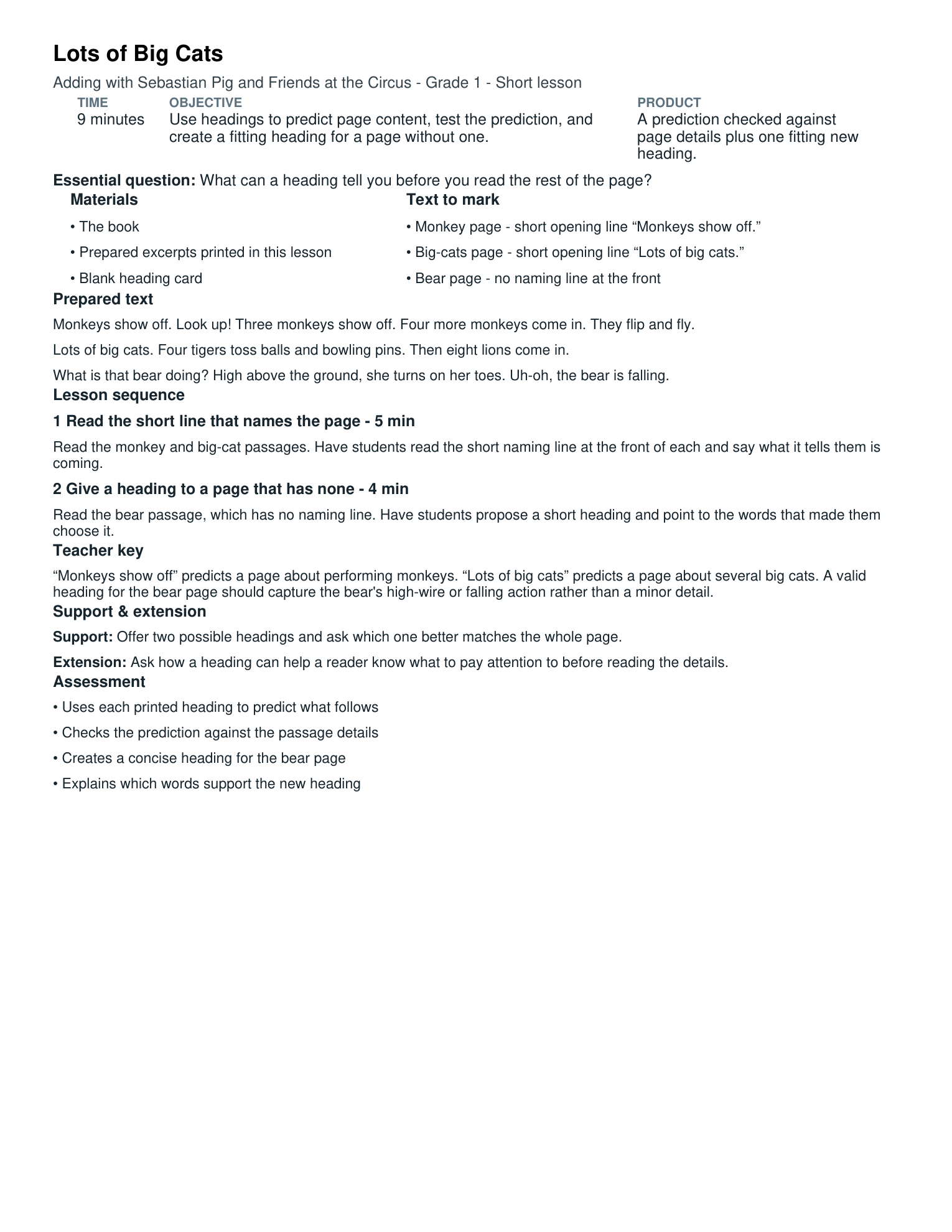
Lots of Big Cats Adding with Sebastian Pig and Friends at the Circus - Grade 1 - Short lesson
TIME
OBJECTIVE
PRODUCT
9 minutes Use headings to predict page content, test the prediction, and create a fitting heading for a page without one. A prediction checked against page details plus one fitting new heading. Essential question: What can a heading tell you before you read the rest of the page?
Materials
- The book
- Prepared excerpts printed in this lesson
- Blank heading card Text to mark
- Monkey page - short opening line “Monkeys show off.”
- Big-cats page - short opening line “Lots of big cats.”
- Bear page - no naming line at the front
Prepared text Monkeys show off. Look up! Three monkeys show off. Four more monkeys come in.
They flip and fly. Lots of big cats. Four tigers toss balls and bowling pins. Then eight lions come in.
What is that bear doing? High above the ground, she turns on her toes. Uh-oh, the bear is falling.
Lesson sequence
1 Read the short line that names the page - 5 min Read the monkey and big-cat passages. Have students read the short naming line at the front of each and say what it tells them is coming. 2 Give a heading to a page that has none - 4 min Read the bear passage, which has no naming line. Have students propose a short heading and point to the words that made them choose it.
Teacher key
“Monkeys show off” predicts a page about performing monkeys. “Lots of big cats” predicts a page about several big cats. A valid heading for the bear page should capture the bear's high-wire or falling action rather than a minor detail. Support & extension
- Support:
- Offer two possible headings and ask which one better matches the whole page. Extension: Ask how a heading can help a reader know what to pay attention to before reading the details.
Assessment
- Uses each printed heading to predict what follows
- Checks the prediction against the passage details
page 1
- Creates a concise heading for the bear page
- Explains which words support the new heading
page 2
page 3