Ready-to-teach lesson
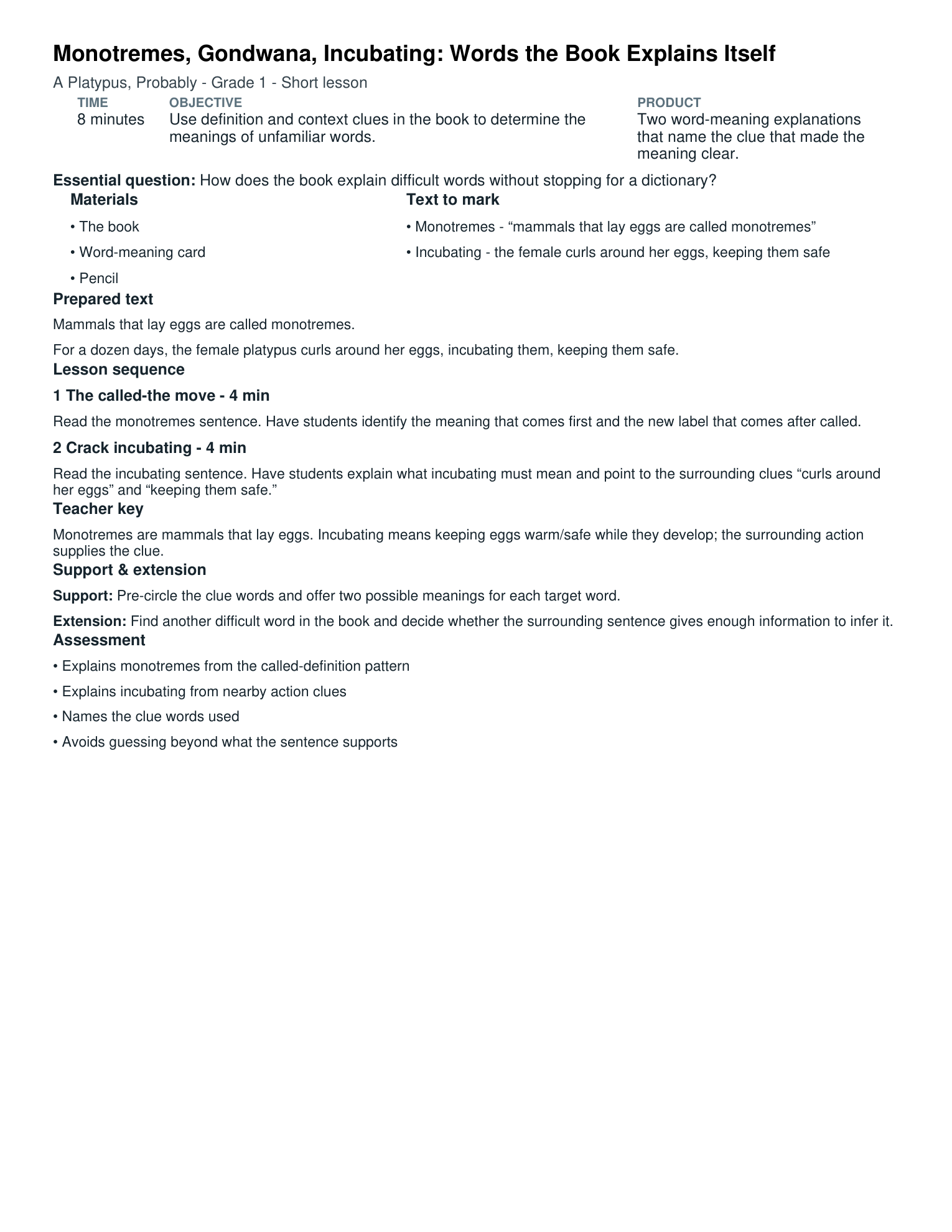
Monotremes, Gondwana, Incubating: Words the Book Explains Itself A Platypus, Probably - Grade 1 - Short lesson
TIME
OBJECTIVE
PRODUCT
8 minutes Use definition and context clues in the book to determine the meanings of unfamiliar words.
Two word-meaning explanations that name the clue that made the meaning clear. Essential question:
How does the book explain difficult words without stopping for a dictionary?
Materials
- The book
- Word-meaning card
- Pencil Text to mark
- Monotremes - “mammals that lay eggs are called monotremes”
- Incubating - the female curls around her eggs, keeping them safe Prepared text Mammals that
lay eggs are called monotremes. For a dozen days, the female platypus curls around her eggs, incubating them, keeping them safe.
Lesson sequence
1 The called-the move - 4 min Read the monotremes sentence. Have students identify the meaning that comes first and the new label that comes after called. 2 Crack incubating - 4 min Read the incubating sentence. Have students explain what incubating must mean and point to the surrounding clues “curls around her eggs” and “keeping them safe.”
Teacher key
Monotremes are mammals that lay eggs. Incubating means keeping eggs warm/safe while they develop; the surrounding action supplies the clue. Support & extension
- Support:
- Pre-circle the clue words and offer two possible meanings for each target word. Extension: Find another difficult word in the book and decide whether the surrounding sentence gives enough information to infer it.
Assessment
- Explains monotremes from the called-definition pattern
- Explains incubating from nearby action clues
- Names the clue words used
page 1
- Avoids guessing beyond what the sentence supports
page 2
page 3