Ready-to-teach lesson
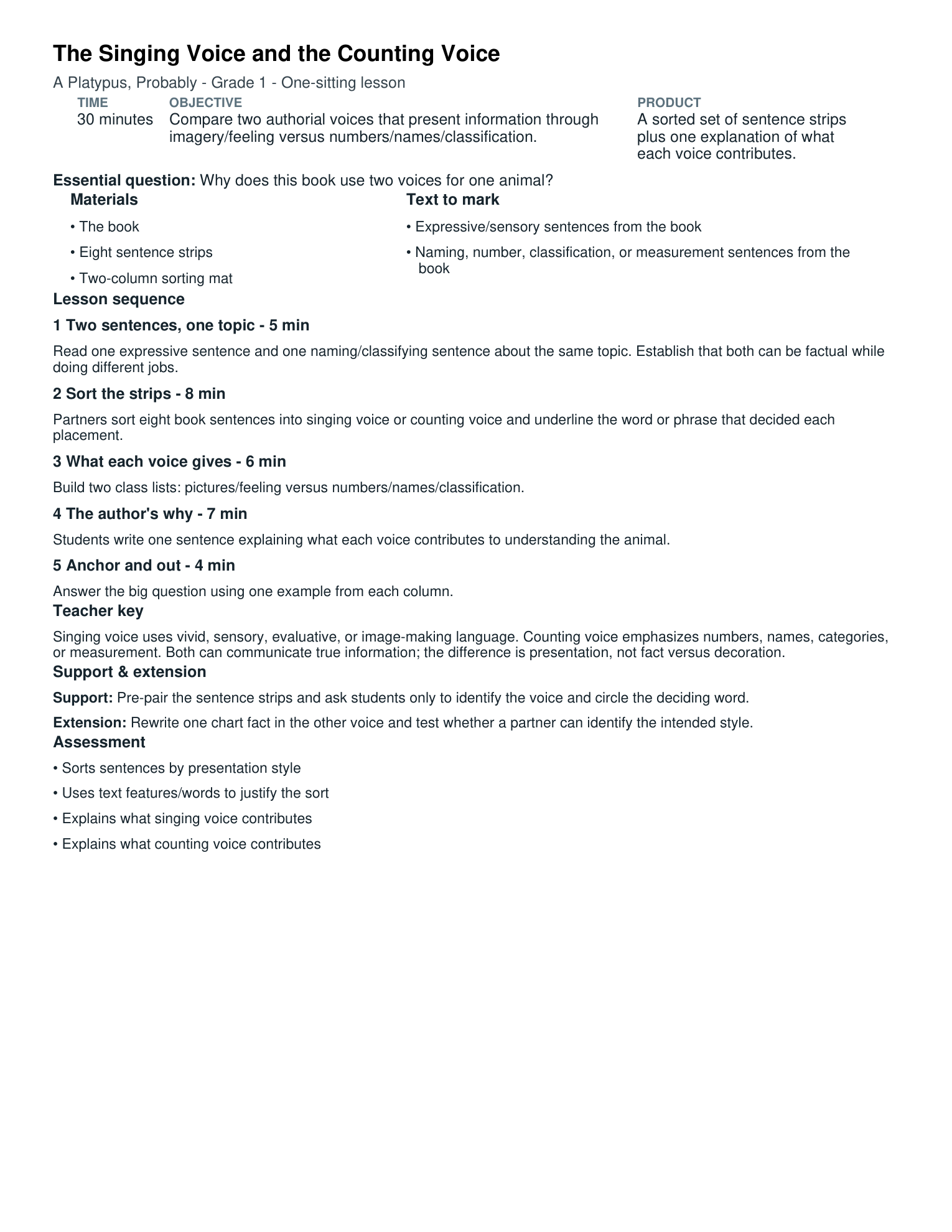
The Singing Voice and the Counting Voice A Platypus, Probably - Grade 1 - One-sitting lesson
TIME
OBJECTIVE
PRODUCT
30 minutes Compare two authorial voices that present information through imagery/feeling versus numbers/names/classification. A sorted set of sentence strips plus one explanation of what each voice contributes. Essential question: Why does this book use two voices for one animal?
Materials
- The book
- Eight sentence strips
- Two-column sorting mat Text to mark
- Expressive/sensory sentences from the book
- Naming, number, classification, or measurement sentences from the book
Lesson sequence
1 Two sentences, one topic - 5 min Read one expressive sentence and one naming/classifying sentence about the same topic. Establish that both can be factual while doing different jobs. 2 Sort the strips - 8 min Partners sort eight book sentences into singing voice or counting voice and underline the word or phrase that decided each placement. 3 What each voice gives - 6 min Build two class lists: pictures/feeling versus numbers/names/classification. 4 The author's why - 7 min Students write one sentence explaining what each voice contributes to understanding the animal. 5 Anchor and out - 4 min Answer the big question using one example from each column.
Teacher key
Singing voice uses vivid, sensory, evaluative, or image-making language. Counting voice emphasizes numbers, names, categories, or measurement. Both can communicate true information; the difference is presentation, not fact versus decoration. Support & extension
- Support:
- Pre-pair the sentence strips and ask students only to identify the voice and circle the deciding word. Extension: Rewrite one chart fact in the other voice and test whether a partner can identify the intended style.
Assessment
- Sorts sentences by presentation style
- Uses text features/words to justify the sort
- Explains what singing voice contributes
page 1
- Explains what counting voice contributes
page 2
page 3