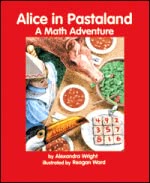
Alice In Pastaland
Grade 3
3 skill lessons · 3 math-through-reading
Math
Skill lessons
The mathematics the book carries, taught directly. Printable workbook pages and teacher keys are not available for this book yet.
- 1Ten Dozen Shells: Counting by Halves to Five Pounds
- 2Ten Spaghetti and Seven: Saying a Comparison Both Ways
- 3Five Cents and Twenty: Pricing the Walrus's Shells
Math + reading
Math through the reading
The same book, entered through a sentence it prints. Change one word in the reading and the numbers change with it.
- 4Dozen, Half and Enough: The Words That Weigh the Shells
- 5Did the Rabbit Buy Enough? Telling the Walrus What You Weighed
- 6Ten Spaghetti to Seven: Saying It Both Ways in the Flower Bed
Reading
Reading and language lessons
The same book read as a text. What a word means in its sentence, how a character is shown, how the writing is put together - no mathematics.
- 7Toucan, Two Can: The Joke That Lives in Your Ear
- 8The Walrus Speaks in Rhyme
- 9Can You? The Question the Book Asks You
- 10Aromas, Rustling, Poking: The Table You Can Smell
- 11Back Under the Oak Tree
Skill lessons
3 lessons on the mathematics the book carries. Printable workbook pages and teacher keys are not available for this book yet.
1. Ten Dozen Shells: Counting by Halves to Five Pounds
The fisherman gives the book's one clean unit-fraction fact, that a dozen shells weighs one half pound, and then states the ten-dozen total himself. Because the total is printed, students are not deriving it; they are building the half-pound unit on a balance and iterating it ten times to see why the printed five is the number it is. The half is a quantity of weight that can be repeated, not a piece of a cut-up shape. Two halves are pushed together and named one pound, and that pairing is the whole of the arithmetic; nobody multiplies ten by one half.
Full lesson — 20 minutes
1. Build the fisherman's half pound (5 min)
Each pair takes a balance and a bag of twelve pasta shells and calls that bag one dozen. Set the dozen on one pan and add half-ounce weights to the other until the pans level, then read what a dozen weighs. Say the reading aloud as the fisherman says it, one half pound, and write it beside the bag.
Word preview: dozen, half
A dozen weighs one half pound.
2. Iterate the half pound ten times (6 min)
Lay out ten of the twelve-shell bags in a row and touch each one, saying one half, one half again, all the way along. Every two bags you touch, slide them together and call that pair one pound. Count the pounds you have made and stop when the ten bags are gone.
Word preview: dozen, pound
We sold the white rabbit ten dozen small shells for the queen's party just an hour ago.
3. Check the book's five pounds (5 min)
Read the fisherman's answer and set it against the pounds on your strip. Point to the paired bags that make each pound and count them out loud for a partner. Agree or disagree with the fisherman and say which bags you are pointing at when you do.
Word preview: weigh, pound
How many pounds does that weigh?
So ten dozen weigh five pounds.
4. Say the unit that makes the answer (4 min)
Tell a partner what one dozen weighs and what ten dozen weigh, using both numbers in one sentence. Then change the fisherman's sentence so a dozen weighs one whole pound instead, and say what ten dozen would weigh then. Say which number moved and which stayed still.
Word preview: half, whole
A dozen weighs one half pound.
Short version — 9 minutes
1. Build the fisherman's half pound (4 min)
Each pair sets a bag of twelve pasta shells on a balance and adds weights until the pans level. Read what one dozen weighs and say it aloud the way the fisherman says it.
Word preview: dozen, half
A dozen weighs one half pound.
2. Iterate the half pound ten times (5 min)
Lay ten bags in a row and touch each one saying one half. Slide every two bags together and call the pair one pound. Count the pounds aloud and stop when the bags run out.
Word preview: dozen, pound
We sold the white rabbit ten dozen small shells for the queen's party just an hour ago.
Three levels
- Support
- Work with four bags rather than ten and keep the balance on the desk the whole time. Pair two bags, name the pound, pair the next two, name the second pound, and stop at two pounds. The counting of pairs is unchanged; only the length of the row is reduced.
- At Grade
- Build the half-pound bag on the balance, lay ten bags in a row, pair them into pounds and count five. Then set your five against the fisherman's printed five and point to the bags that justify it.
- Extension
- After the ten bags are paired, ask what eleven dozen would weigh and settle it on the row rather than on paper. The eleventh bag has no partner, so the answer carries a half that no pair absorbs, and students must say the five and a half aloud with the lone bag in hand.
English learners
Half in everyday English means roughly, as in half the fun or half asleep, and that sense will not carry a weight. Here half names one of two equal parts of one pound and nothing looser. Dozen is a counting word for twelve that many languages carry differently or not at all, so build it on the bag before using it. Rehearse the frame: one dozen weighs one half pound, so two dozen weigh one pound. Invite students to count the pairs aloud in their strongest language and to say only the two weight words in English.
Materials
- A balance scale for each pair
- Bags of twelve pasta shells, one per pair
- Half-ounce and ounce weights
- Ten bags of twelve pasta shells
- A long strip of paper for the row
- Word cards: dozen, half, pound
Standards & curriculum
Choose your curriculum above to see the standards for this lesson.
Standards are held back while this plan is edited. Every standard shown here was matched against the supplied wording of this lesson, quoting its steps, so a changed step is no longer the thing that was checked. Undo your changes to bring the standards back — your edits stay in this browser either way.
2. Ten Spaghetti and Seven: Saying a Comparison Both Ways
The arguing flowers give the book its only comparison where both sides carry a number in the same unit, the foxglove's ten spaghetti against the daffodil's seven. Students build both heights out of real spaghetti, match the rows piece to piece, and read the three unmatched pieces off the arrangement rather than off a subtraction. The same arrangement has to support two sentences that swap the flowers and swap the comparing word with them. The tulip's unquantified boast is kept in the lesson on purpose, as the case that cannot be built, so students meet the difference between a comparison with a number and one without.
Full lesson — 20 minutes
1. Put the two flowers side by side (5 min)
Two students take the foxglove's line and the daffodil's line and build each one out of dry spaghetti laid end to end, ten pieces for one and seven for the other. Stand the two rows next to each other on the desk with their bottoms level. Say which row is longer before anyone counts.
Word preview: taller, high
I'm the biggest and the best because I grow ten spaghetti tall.
I grow all my flowers. Seven spaghetti high.
2. Match the rows to find the extra (6 min)
Push the two rows together so each daffodil piece touches a foxglove piece. Point to the foxglove pieces that have no partner and count only those. Say the number of unmatched pieces aloud and keep the rows touching while you say it.
Word preview: match, extra
I'm the biggest and the best because I grow ten spaghetti tall.
3. Say the relation both ways (5 min)
With the rows still touching, tell a partner how the foxglove compares to the daffodil using the unmatched pieces in your sentence. Then swap which flower you name first and say it again, changing the comparing word so the sentence stays true. Both sentences must describe the one arrangement in front of you.
Word preview: taller, shorter
I grow all my flowers. Seven spaghetti high.
4. Test the tulip's claim against the rows (4 min)
Read the tulip's boast and try to build its row out of spaghetti. Tell a partner what you would need to know before you could lay a single piece down. Say why the foxglove and the daffodil can be matched and the tulip cannot.
Word preview: bigger, how many
My flowers grow bigger than yours.
Short version — 9 minutes
1. Put the two flowers side by side (4 min)
Build the foxglove's ten spaghetti and the daffodil's seven spaghetti as two rows with level bottoms. Say which row is longer before counting anything.
Word preview: taller, high
I'm the biggest and the best because I grow ten spaghetti tall.
I grow all my flowers. Seven spaghetti high.
2. Say the relation both ways (5 min)
Push the rows together, count the foxglove pieces with no partner, and say how the foxglove compares to the daffodil. Then name the daffodil first and say it again with the comparing word changed.
Word preview: taller, shorter
I grow all my flowers. Seven spaghetti high.
Three levels
- Support
- Build the rows on a strip already ruled into ten equal slots so the pieces line up without fiddling. Everything else holds: match the rows, count the unmatched pieces, and say both sentences.
- At Grade
- Build both rows, match them, count the three unmatched pieces, and produce both directions of the comparison from the single arrangement, changing the comparing word on the reversal.
- Extension
- Bring the pansy's twice as many into the same arrangement and try to build it. Students must say what the pansy never gives, a count of anyone's flowers, and explain why twice as many is a relation waiting for a number rather than a number itself.
English learners
Comparative syntax is the load here. English marks the comparison twice, on the adjective and with than, and taller than reverses to shorter than rather than to a negated taller. Many languages mark it once or with a separate particle, so the doubled marking is the transfer problem. Rehearse the frame: the foxglove is three spaghetti taller than the daffodil, so the daffodil is three spaghetti shorter than the foxglove. Invite students to lay the rows out and say the comparison in their strongest language first, then keep the same rows while they say the English pair.
Materials
- Dry spaghetti, at least twenty pieces per pair
- A desk strip to line the rows up on
- Word cards: taller, shorter, than
Standards & curriculum
Choose your curriculum above to see the standards for this lesson.
Standards are held back while this plan is edited. Every standard shown here was matched against the supplied wording of this lesson, quoting its steps, so a changed step is no longer the thing that was checked. Undo your changes to bring the standards back — your edits stay in this browser either way.
3. Five Cents and Twenty: Pricing the Walrus's Shells
The walrus prices small shells at five cents and large ones at twenty, and then says outright that he wishes he knew how to teach the little dears to write the price for each. That sentence is the lesson's warrant: the book asks for exactly this work and never does it. Students count on by five and by twenty with coins in hand, keeping the two sizes apart until the last step. The count-on is the method, not a memorised table; the coins stay on the desk and each number word is said as a coin lands. The book prints no shell count and no total, so every number on the recording sheet comes from the tray the class is holding.
Full lesson — 20 minutes
1. Price the two sizes (5 min)
Each pair takes a tray of small and large shells and the walrus's two prices. Sort the tray into a small pile and a large pile and put a price card on each pile. Count how many shells are in each pile and write the two counts under the two prices.
Word preview: cents, price
For just five cents the small ones and for twenty cents the large.
2. Add one pile at a time (6 min)
Lay out the small pile and count on by five for each shell, putting a nickel down as you say each number. Do the large pile the same way, counting on by twenty and laying a coin for each. Keep the two totals apart and say them as two separate amounts.
Word preview: count on, total
For just five cents the small ones and for twenty cents the large.
3. Write the price for each (5 min)
Take the walrus's own words about what he wishes he could teach and do that job for him. Write the price beside every shell on a recording sheet, small or large, so the sheet shows a price for each one. Read your sheet to a partner and have them check that no shell was left without a price.
Word preview: each, price
I wish I'd had a lesson so that I'd know how to teach the little dears to add themselves and write the price for each.
4. Bring the two totals together (4 min)
Put your two amounts side by side and combine them into one amount, using the coins to help. Tell a partner which pile contributed more and how you know from the coins in front of you. Say the combined amount aloud.
Word preview: altogether, more
Short version — 9 minutes
1. Price the two sizes (4 min)
Sort the tray into small and large shells and put the right price card on each pile. Count the shells in each pile and write the counts under the prices.
Word preview: cents, price
For just five cents the small ones and for twenty cents the large.
2. Write the price for each (5 min)
Do the job the walrus wishes he could teach. Write a price beside every shell on the sheet so none is left blank, then read the sheet to a partner to check.
Word preview: each, price
I wish I'd had a lesson so that I'd know how to teach the little dears to add themselves and write the price for each.
Three levels
- Support
- Work with the small shells only and a tray of five, counting on by five with a nickel laid down for each. The recording sheet and the read-back to a partner stay exactly as they are; only the second price is set aside.
- At Grade
- Sort both sizes, count on by five and by twenty with coins, write a price beside every shell, and combine the two amounts into one.
- Extension
- Give the pair a tray whose two piles come to the same amount by different routes, four small shells and one large. Students must say how two different collections carry one price, and show it with the coins rather than asserting it.
English learners
Cents follows the number in English and is dropped in speech more often than it is written, so five cents is heard as five. The count-on is the vulnerable place: the sequence five, ten, fifteen is a rehearsed chant in many languages and students may have it fluently in a language that is not English. Rehearse the frame: one small shell costs five cents, so two small shells cost ten cents. Invite students to run the counting chant in their strongest language while laying coins, then say only the final amount in English.
Materials
- A tray of small and large shells for each pair
- Price cards reading five cents and twenty cents
- Coins or coin cards
- A recording sheet with a row for each shell
- Word cards: cents, price, each
Standards & curriculum
Choose your curriculum above to see the standards for this lesson.
Standards are held back while this plan is edited. Every standard shown here was matched against the supplied wording of this lesson, quoting its steps, so a changed step is no longer the thing that was checked. Undo your changes to bring the standards back — your edits stay in this browser either way.
Math through the reading
The mathematics is reached through a sentence the book prints: change one word in the reading and the numbers change with it. These carry their own standards, matched against these lessons rather than inherited from the skill ones.
4. Dozen, Half and Enough: The Words That Weigh the Shells
Students weigh a dozen shells, then swap one word at a time in the fisherman's sentences and rebuild the weight each swap demands.
Full lesson — 20 minutes
1. Weigh what a dozen comes to (5 min)
Pairs put twelve shells on a balance and add weights until it levels, then read the weight and say the fisherman's sentence over their own balance.
2. Lay ten dozen in a row (5 min)
Pairs lay out ten bags, touch each saying one half, pair them into pounds and count the pounds against the fisherman's printed five.
3. Swap one word and weigh again (6 min)
Pairs replace half with whole in the fisherman's sentence, rebuild the row under the new word, and say both totals aloud with both arrangements in front of them.
4. Rule on the rabbit's enough (4 min)
Pairs say what enough means for the rabbit, using the pounds on their row, and decide aloud whether five pounds meets what he said he needed.
Short version — 9 minutes
1. Weigh what a dozen comes to (5 min)
Pairs put twelve shells on a balance and add weights until it levels, then read the weight and say the fisherman's sentence over their own balance.
2. Swap one word and weigh again (6 min)
Pairs replace half with whole in the fisherman's sentence, rebuild the row under the new word, and say both totals aloud with both arrangements in front of them.
Three levels
- Support
- Stay with four bags rather than ten and swap only the word half. Build both rows, say both weights, and leave the rabbit's verdict aside.
- At grade
- Weigh the dozen, iterate to five pounds, perform the half-for-whole swap and produce both totals, then rule on enough with the row in view.
- Extension
- Swap dozen for half dozen instead and rebuild. Students must notice that the word which moved was the count in the bag rather than the fraction, and say why the weight fell even though half did not change.
English learners
Half in ordinary English is often loose, as in half asleep, and that sense will not weigh anything. Dozen is a count word for twelve with no cognate in many languages, so build it on the bag before saying it. Rehearse the frame: if a dozen weighs one half pound, then two dozen weigh one pound. Students may run the pairing count in their strongest language and give only the two weights in English.
Materials
- A balance scale
- Bags of twelve pasta shells
- Half-ounce and ounce weights
- The fisherman's two sentences written large
- A word card for half and one for whole
Standards & curriculum
Choose your curriculum above to see the standards for this lesson.
Standards are held back while this plan is edited. Every standard shown here was matched against the supplied wording of this lesson, quoting its steps, so a changed step is no longer the thing that was checked. Undo your changes to bring the standards back — your edits stay in this browser either way.
5. Did the Rabbit Buy Enough? Telling the Walrus What You Weighed
Students weigh what the rabbit bought, take a position on whether it was enough, and say it to the walrus in a sentence carrying a number.
Full lesson — 20 minutes
1. Weigh what the rabbit was sold (6 min)
Pairs build the half-pound dozen on a balance, lay ten of them out, pair them into pounds and say what the rabbit carried away.
2. Lay out what the guests were promised (5 min)
Pairs mark forty guests on a strip and put a quarter-pound card beside one guest, saying what the rabbit promised each single guest.
3. Take a side out loud (4 min)
Each child says whether the rabbit bought enough and names the weight or the count their answer rests on, with both arrangements in view.
4. Tell the walrus and give him a number (5 min)
Each child addresses the walrus directly, in the voice the book gives him, and says the position in one sentence that contains a number.
Short version — 9 minutes
1. Weigh what the rabbit was sold (6 min)
Pairs build the half-pound dozen on a balance, lay ten of them out, pair them into pounds and say what the rabbit carried away.
2. Tell the walrus and give him a number (5 min)
Each child addresses the walrus directly, in the voice the book gives him, and says the position in one sentence that contains a number.
Three levels
- Support
- Work with the weighing only. Build the five pounds, say what the rabbit carried, and tell the walrus that one number in a full sentence.
- At grade
- Weigh the ten dozen, lay out the forty guests with a quarter-pound card, take a side aloud naming the quantity it rests on, and address the walrus in a sentence carrying a number.
- Extension
- Argue the position you did not take. Students must find the quantity that funds the other side and say aloud what the book would have had to print for that side to win outright.
English learners
Addressing a named listener changes the sentence in English, and the vocative is set off by intonation rather than by a word. Rehearse the frame: Walrus, the rabbit bought five pounds, and that is not enough. Quarter here names one of four equal parts of a pound and not a coin or a district. Students may reason about the weight in their strongest language and give the address to the walrus in English.
Materials
- A balance scale
- Ten bags of twelve pasta shells
- A guest strip of forty marks
- A quarter-pound card
- The rabbit's two sentences written large
- The walrus's teaching wish written large
Standards & curriculum
Choose your curriculum above to see the standards for this lesson.
Standards are held back while this plan is edited. Every standard shown here was matched against the supplied wording of this lesson, quoting its steps, so a changed step is no longer the thing that was checked. Undo your changes to bring the standards back — your edits stay in this browser either way.
6. Ten Spaghetti to Seven: Saying It Both Ways in the Flower Bed
Students build two flowers out of spaghetti, match the rows, and say the comparison in both directions from the one arrangement.
Full lesson — 20 minutes
1. Build the two flowers (6 min)
Pairs lay ten spaghetti for the foxglove and seven for the daffodil with bottoms level, and say which is taller before counting.
2. Match the rows (5 min)
Pairs push the rows together so each daffodil piece meets a foxglove piece, then count only the pieces left with no partner.
3. Say it both ways (5 min)
Pairs say how the foxglove compares to the daffodil using the unmatched count, then swap which flower is named first and change the comparing word so the sentence stays true.
4. Try to build the tulip (4 min)
Pairs attempt the tulip's boast, find they cannot lay a single piece, and say aloud what the tulip would have to state first.
Short version — 9 minutes
1. Build the two flowers (6 min)
Pairs lay ten spaghetti for the foxglove and seven for the daffodil with bottoms level, and say which is taller before counting.
2. Say it both ways (5 min)
Pairs say how the foxglove compares to the daffodil using the unmatched count, then swap which flower is named first and change the comparing word so the sentence stays true.
Three levels
- Support
- Build the rows on a strip ruled into ten equal slots so the pieces align without fiddling, then match and say both sentences.
- At grade
- Build both rows, match them, count the three unmatched pieces, and produce both directions of the relation from the single arrangement.
- Extension
- Bring the pansy's twice as many into the arrangement. Students must say that a doubling relation still needs one flower's count before it names anything, and that the pansy never gives one.
English learners
English marks a comparison twice, on the adjective and again with than, and the reversal changes the adjective rather than negating it. Languages that mark comparison once will transfer a single marking. Rehearse the frame: the foxglove is three spaghetti taller than the daffodil, so the daffodil is three spaghetti shorter than the foxglove. Students may say the comparison over the rows in their strongest language first and keep the same rows for the English pair.
Materials
- Dry spaghetti
- A desk strip to align the rows
- The foxglove's line and the daffodil's line written large
Standards & curriculum
Choose your curriculum above to see the standards for this lesson.
Standards are held back while this plan is edited. Every standard shown here was matched against the supplied wording of this lesson, quoting its steps, so a changed step is no longer the thing that was checked. Undo your changes to bring the standards back — your edits stay in this browser either way.
Reading and language lessons
5 lessons on the reading and language the book carries - what a word means in its sentence, how a character is shown, how a text is built. No mathematics: these are matched against the English language arts curricula, which are a different and smaller set than the mathematics ones.
7. Toucan, Two Can: The Joke That Lives in Your Ear
The toucan's question only works out loud. Toucan and two can are the same sound and different words, and the sentence hides one inside the other. Students say the sentence aloud until they hear both, split it into the two spellings, and then find a second creature in the book whose name is a sound-joke of the same kind. The work is hearing and separating look-alike sounds, not doing anything with the numbers.
Full lesson — 20 minutes
1. Say it until you hear both words (5 min)
Read this span aloud three times, faster each time. Two groups of letters in it sound exactly the same. Point at both. Then say the sentence once more, and say which one is the bird and which one is two of something.
Word preview: toucan
He asked. If a toucan adds two and two can, the answer be four.
2. Write both spellings side by side (5 min)
Put toucan on the left of your ledger and two can on the right. Beside each, write what it means. Then tell your partner why the joke would disappear completely if somebody read the sentence silently and never said it aloud.
He asked. If a toucan adds two and two can, the answer be four.
3. Find a second creature named by a sound (5 min)
Read this span aloud. A snake in this book has been given a name that is also a word for someone who does something with numbers. Say the name aloud twice. Tell your group which meaning the March Mayor intends and which meaning makes the joke.
Word preview: adder
Don't worry about him. That's just our little friend, the adder.
4. Rule on a name that is not a sound-joke (5 min)
Read the two spans reprinted here again. Then read this third one and decide with your partner: is intruder a sound-joke of the same kind, or just a word that means what it says? Say your ruling and your reason to the group.
Word preview: intruder
He asked. If a toucan adds two and two can, the answer be four.
Don't worry about him. That's just our little friend, the adder.
The flowers turned and stared at the intruder.
Short version — 9 minutes
1. Say it until you hear both words (5 min)
Read this span aloud three times, faster each time, and point at the two groups of letters that sound the same. Say which is the bird.
Word preview: toucan
He asked. If a toucan adds two and two can, the answer be four.
2. Find a second creature named by a sound (4 min)
Read this span aloud. Say the snake's name twice and tell your partner both meanings it carries.
Word preview: adder
Don't worry about him. That's just our little friend, the adder.
Three levels
- Support
- Support: work the toucan sentence only. Say it aloud with the teacher and point at the bird word and the two-of-something word. Stop before the ledger.
- At Grade
- At Grade: write both spellings with their meanings and find the adder as a second example.
- Extension
- Extension: a sound-joke only works in one language. Argue to your group whether this book could be translated without losing the toucan joke, and say what a translator would have to give up or invent.
English learners
Homophones are the hardest joke to carry across languages, because the two words only collapse into one sound in English and a learner may hear them as clearly different. Say toucan and two can slowly, then quickly, and let students tell you when they stop being able to hear the difference — that moment is the lesson. Frame: '___ sounds like ___ but means ___.' A sound-alike pair from the student's strongest language is worth hearing aloud.
Materials
- Printed passage strip: He asked
- Sound-alike ledger
- Printed passage strip: Don't worry about him
- Printed passage strip: The flowers turned and stared at the intruder
- Word cards: toucan, adder, intruder
Standards & curriculum
Choose your curriculum above to see the standards for this lesson.
Standards are held back while this plan is edited. Every standard shown here was matched against the supplied wording of this lesson, quoting its steps, so a changed step is no longer the thing that was checked. Undo your changes to bring the standards back — your edits stay in this browser either way.
8. The Walrus Speaks in Rhyme
The rest of the book is written in plain sentences. When the fisherman and the walrus talk, the sentences suddenly rhyme and fall into a beat. Students read both halves aloud, find the rhyming ends, decide where the beat wants them to pause, and then say what changes when a character stops speaking like everybody else. The lesson never touches the shell prices.
Full lesson — 20 minutes
1. Find the rhyming ends in the question (5 min)
Read this span aloud with a partner. Two words at the ends of its parts rhyme. Circle both and say them one after the other. Then read the span again, dropping your voice at each circled word so a listener can hear the pattern.
Word preview: seashells
Tell me dear friend, walrus, why have you been so sad? We have plenty of seashells and our business isn't bad.
2. Find the rhyming ends in the answer (5 min)
Read this span aloud. It rhymes too, and it uses three words instead of two: beach, reach, teach, each. Circle all four and say them in a row. Tell your partner whether the walrus's reply rhymes more tightly or more loosely than the question did.
Word preview: creatures
I cry for the sweet creatures who shells lie on the beach, while counting and collecting all of those within my reach. I wish I'd had a lesson so that I'd know how to teach the little dears to add themselves and write the price for each.
3. Hear the difference from ordinary prose (5 min)
Read this span aloud straight after the walrus's reply reprinted beside it. This one is ordinary sentences. Say to your group two things you did differently with your voice, and say which span was easier to read aloud and why.
Word preview: arguing
I cry for the sweet creatures who shells lie on the beach, while counting and collecting all of those within my reach. I wish I'd had a lesson so that I'd know how to teach the little dears to add themselves and write the price for each.
Alice came upon a garden of giant flowers. She wondered if the flowers were really large or if she somehow shrunk again. Hearing voices, Alice looked around and found a group of flowers arguing.
4. Perform the exchange (5 min)
In pairs, perform the two rhyming spans reprinted here, one of you as the fisherman and one as the walrus. Land hard on every rhyming word. Your listeners say back which words they heard rhyming, without looking at the page.
Tell me dear friend, walrus, why have you been so sad? We have plenty of seashells and our business isn't bad.
I cry for the sweet creatures who shells lie on the beach, while counting and collecting all of those within my reach. I wish I'd had a lesson so that I'd know how to teach the little dears to add themselves and write the price for each.
Short version — 9 minutes
1. Find the rhyming ends in the question (5 min)
Read this span aloud with a partner, circle the two rhyming words at the ends of its parts, and read it again dropping your voice on each.
Word preview: seashells
Tell me dear friend, walrus, why have you been so sad? We have plenty of seashells and our business isn't bad.
2. Find the rhyming ends in the answer (4 min)
Read this span aloud, circle beach, reach, teach and each, and say them in a row.
Word preview: creatures
I cry for the sweet creatures who shells lie on the beach, while counting and collecting all of those within my reach. I wish I'd had a lesson so that I'd know how to teach the little dears to add themselves and write the price for each.
Three levels
- Support
- Support: work the shorter span only. Say sad and bad aloud one after another and say whether they rhyme. Read the span once with the teacher.
- At Grade
- At Grade: find the rhymes in both spans and name one thing your voice did differently in the prose span.
- Extension
- Extension: the walrus's reply rhymes four words where the question rhymes two. Argue what that extra weight does to how the walrus comes across, and whether a character who rhymes harder sounds more serious or more comic.
English learners
English rhyme depends on vowel sounds a learner may still be sorting, so beach and reach may be clear while teach and each are not. Say all four aloud, exaggerated, and have students sort by ear before looking at spelling. Frame: '___ rhymes with ___.' Invite a rhyming pair from the student's strongest language; hearing that rhyme works the same way everywhere makes the English pattern easier to trust.
Materials
- Printed passage strip: Tell me dear friend, walrus
- Rhyme map
- Printed passage strip: I cry for the sweet creatures
- Printed passage strip: Alice came upon a garden of giant flowers
- Word cards: seashells, creatures, arguing
Standards & curriculum
Choose your curriculum above to see the standards for this lesson.
Standards are held back while this plan is edited. Every standard shown here was matched against the supplied wording of this lesson, quoting its steps, so a changed step is no longer the thing that was checked. Undo your changes to bring the standards back — your edits stay in this browser either way.
9. Can You? The Question the Book Asks You
In the middle of describing Alice, the narrator stops and asks the reader a two-word question. Students find it, notice that it is not addressed to any character, and work out what it invites them to do. They then compare it with a span where the narration stays firmly on Alice, and say how you can tell the difference. The evidence is pronouns and question marks.
Full lesson — 20 minutes
1. Find the sentence aimed at you (5 min)
Read this span aloud. The last sentence is two words long and has a question mark. Ask yourselves who it is speaking to — it is not Alice, and it is not her mother. Say your answer, then say what the narrator wants you to do when you hear it.
Word preview: stranger
Alice wondered if she should eat it. Her mother had always told her not to take food from strangers, and Alice couldn't think of anything stranger than falling down a rabbit hole. Can you?
2. Work out what the question is asking (5 min)
Read the span again. The two-word question leans on the sentence before it, which is about thinking of something stranger. Say the full question aloud in your own words, with all the missing pieces put back. Write your long version on your chart under the short one.
Alice wondered if she should eat it. Her mother had always told her not to take food from strangers, and Alice couldn't think of anything stranger than falling down a rabbit hole. Can you?
3. Compare a span that never turns to you (5 min)
Read this span aloud. It also has a question in it, but the question is not aimed at you. Say to your partner who is doing the wondering here, and point at the word that tells you the narrator is still talking about Alice rather than to you.
Word preview: peculiar
Something very peculiar began to happen. Was the room getting bigger? No. Alice was getting smaller.
4. Sort both spans and defend the sorting (5 min)
Put both spans reprinted here on your chart, one under Speaking to the reader and one under Telling about Alice. Say one sentence to your group defending each placement, pointing at a word on the page each time.
Alice wondered if she should eat it. Her mother had always told her not to take food from strangers, and Alice couldn't think of anything stranger than falling down a rabbit hole. Can you?
Something very peculiar began to happen. Was the room getting bigger? No. Alice was getting smaller.
Short version — 9 minutes
1. Find the sentence aimed at you (5 min)
Read this span aloud. Find the two-word question at the end and say who it is speaking to and what it asks you to do.
Word preview: stranger
Alice wondered if she should eat it. Her mother had always told her not to take food from strangers, and Alice couldn't think of anything stranger than falling down a rabbit hole. Can you?
2. Compare a span that never turns to you (4 min)
Read this span aloud. Say who is doing the wondering and point at the word that shows the narrator is talking about Alice, not to you.
Word preview: peculiar
Something very peculiar began to happen. Was the room getting bigger? No. Alice was getting smaller.
Three levels
- Support
- Support: find the two-word question and say aloud who it is talking to. Stop there; the teacher reads the second span and you say whether it talks to you or not.
- At Grade
- At Grade: expand the short question into a full one and sort both spans correctly with a reason.
- Extension
- Extension: the narrator asks this question and then never mentions it again. Argue whether the book wanted an answer from you or wanted you to stop and doubt Alice's choice, using what happens right after the span as your evidence.
English learners
A two-word elliptical question like this is hard for a learner because nearly everything in it is left out and has to be recovered from the sentence before. Say the full version aloud first, then the short one, so the short one arrives as a shortening rather than a fragment. Frame: 'Can you ___? means Can you ___ too?' A student who expands it correctly in their strongest language has done the reasoning.
Materials
- Printed passage strip: Alice wondered if she should eat it
- Narrator-and-reader chart
- Printed passage strip: Something very peculiar began to happen
- Word cards: stranger, peculiar
Standards & curriculum
Choose your curriculum above to see the standards for this lesson.
Standards are held back while this plan is edited. Every standard shown here was matched against the supplied wording of this lesson, quoting its steps, so a changed step is no longer the thing that was checked. Undo your changes to bring the standards back — your edits stay in this browser either way.
10. Aromas, Rustling, Poking: The Table You Can Smell
The hatter's table is described with three senses in two sentences: a smell, a sound, and something moving where it should not. Students sort the describing words by sense, name what each one contributes, and then compare with a span that leans on only one sense. The skill is noticing which senses a writer reaches for and what each one buys them.
Full lesson — 20 minutes
1. Sort the details by sense (5 min)
Read this span aloud. Put aromas, rustled and poked its head out on your senses chart under smell, hearing and sight. Tell your partner which of the three makes the table feel most alive, and say why.
Word preview: aromas, rustled
Wonderful aromas arose from the foods on the table. In the salad bowl, the leaves of lettuce rustled, and a smass snake poked its head out from behind a cucumber.
2. Test a span with fewer senses (5 min)
Read this span aloud. It describes falling, and it uses almost no senses at all. Say which sense it does reach and which it leaves out. Add it to your chart and say to your group what the writer gains by keeping this one bare.
Word preview: succeeded
Alice stuck her head in the hole and tried to see into the darkness. She only succeeded in losing her balance and falling down, down, down.
3. Find the detail that does not belong (5 min)
Read this span aloud once more. One detail in it is not the kind of thing you expect on a dinner table at all. Point at it. Say to your partner how the two ordinary details before it make that last one land harder than it would if it came first.
Word preview: cucumber
Wonderful aromas arose from the foods on the table. In the salad bowl, the leaves of lettuce rustled, and a smass snake poked its head out from behind a cucumber.
4. Describe a place of your own (5 min)
Look at the table span reprinted here one last time. Write two sentences describing your classroom in the same way: one smell, one sound, and one thing that should not be there. Read them to your group and let them name your three senses back to you.
Wonderful aromas arose from the foods on the table. In the salad bowl, the leaves of lettuce rustled, and a smass snake poked its head out from behind a cucumber.
Short version — 9 minutes
1. Sort the details by sense (5 min)
Read this span aloud and put aromas, rustled and poked its head out under smell, hearing and sight on your chart. Say which one makes the table feel most alive.
Word preview: aromas, rustled
Wonderful aromas arose from the foods on the table. In the salad bowl, the leaves of lettuce rustled, and a smass snake poked its head out from behind a cucumber.
2. Test a span with fewer senses (4 min)
Read this span aloud. Say which sense it reaches and which it leaves out, and what the writer gains by keeping it bare.
Word preview: succeeded
Alice stuck her head in the hole and tried to see into the darkness. She only succeeded in losing her balance and falling down, down, down.
Three levels
- Support
- Support: work the table span only and sort two details, aromas and rustled, into smell and hearing. Skip the comparison span.
- At Grade
- At Grade: sort all three details, compare the bare span, and name the detail that does not belong.
- Extension
- Extension: the falling span repeats one word three times instead of adding a sense. Argue what that repetition does that a smell or a sound could not have done there.
English learners
Sense words are concrete and transfer well, but aromas and rustled are both low-frequency English and will be new to the whole class. Teach aromas by having students smell something and rustled by rustling paper; the gesture carries the word. Frame: 'I can ___ the ___.' Let students name the smell or sound in their strongest language and add the English word beside it.
Materials
- Printed passage strip: Wonderful aromas arose
- Senses chart
- Printed passage strip: Alice stuck her head in the hole
- Word cards: aromas, rustled, succeeded, cucumber
Standards & curriculum
Choose your curriculum above to see the standards for this lesson.
Standards are held back while this plan is edited. Every standard shown here was matched against the supplied wording of this lesson, quoting its steps, so a changed step is no longer the thing that was checked. Undo your changes to bring the standards back — your edits stay in this browser either way.
11. Back Under the Oak Tree
The first sentence of this book and one of its last put Alice in exactly the same place. Students read the opening and the ending side by side, find the words the two spans share, and say what a story is telling you when it closes its own circle. They then decide, from the last exchange, whether anything has actually changed. The evidence is repeated wording, not events.
Full lesson — 20 minutes
1. Read the opening and mark the place (5 min)
Read this span aloud. Underline the words that tell you exactly where Alice is sitting and what she is doing. Say both aloud to your partner and keep the strip where you can see it.
Word preview: zeros
Alice was sitting under an oak tree, drawing eyes in the zeros of her math problems. When she saw a white rabbit running toward her, he tripped over her toes and landed flat on his face.
2. Read the ending and mark the place (5 min)
Read this span aloud. Underline the words that tell you where Alice lands. Now say to your group how many words this span shares with the opening, and read the shared ones aloud from both strips.
Alice was sitting under an oak tree, drawing eyes in the zeros of her math problems. When she saw a white rabbit running toward her, he tripped over her toes and landed flat on his face.
Alice flew out of the rabbit hole and landed with a bump on soft grass. She looked around to find that she was back where she started under the oak tree.
3. Look for what changed (5 min)
Read this span aloud. Alice comes back to the same tree but she is not saying the same kind of thing. Say to your partner what her last line shows she is carrying out of the dream, and put it in the changed column of your chart.
Word preview: feeling
Alice got up smiling. I had a feeling we'd have pasta.
4. Rule on whether the circle closed (5 min)
With all three spans reprinted here in front of you, say one sentence to your group: 'The story ends where it began, but ___ is different, and I know because ___.' Both blanks come from words on these strips.
Alice was sitting under an oak tree, drawing eyes in the zeros of her math problems. When she saw a white rabbit running toward her, he tripped over her toes and landed flat on his face.
Alice flew out of the rabbit hole and landed with a bump on soft grass. She looked around to find that she was back where she started under the oak tree.
Alice got up smiling. I had a feeling we'd have pasta.
Short version — 9 minutes
1. Read the opening and mark the place (5 min)
Read this span aloud and underline the words that say where Alice is sitting and what she is doing.
Word preview: zeros
Alice was sitting under an oak tree, drawing eyes in the zeros of her math problems. When she saw a white rabbit running toward her, he tripped over her toes and landed flat on his face.
2. Read the ending and mark the place (4 min)
Read this span aloud, underline where Alice lands, and read aloud the words it shares with the opening span printed beside it.
Alice was sitting under an oak tree, drawing eyes in the zeros of her math problems. When she saw a white rabbit running toward her, he tripped over her toes and landed flat on his face.
Alice flew out of the rabbit hole and landed with a bump on soft grass. She looked around to find that she was back where she started under the oak tree.
Three levels
- Support
- Support: find the words oak tree in both spans and say them aloud. That is the circle; you do not need the changed column.
- At Grade
- At Grade: name every word the two spans share and say one thing that has changed by the end.
- Extension
- Extension: the opening shows Alice avoiding her homework and the ending says it is done. Argue whether the book wants you to believe the adventure really happened or wants you to think she fell asleep, using only what these spans say and do not say.
English learners
Circular structure is a story shape found in tales all over the world, so the pattern will be familiar even where the English is not. Put the two strips side by side and let students point at matching words before anyone explains anything. Frame: 'At the start ___. At the end ___.' A student who names a circular story from their own tradition has shown they hold the concept.
Materials
- Printed passage strip: Alice was sitting under an oak tree
- Beginning-and-ending chart
- Printed passage strip: Alice flew out of the rabbit hole
- Printed passage strip: Alice got up smiling
- Word cards: zeros, feeling
Standards & curriculum
Choose your curriculum above to see the standards for this lesson.
Standards are held back while this plan is edited. Every standard shown here was matched against the supplied wording of this lesson, quoting its steps, so a changed step is no longer the thing that was checked. Undo your changes to bring the standards back — your edits stay in this browser either way.