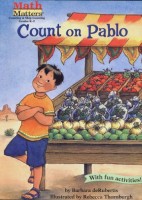
Count on Pablo

Count on Pablo book cover

Grade 2
5 skill lessons · 3 math-through-reading

Math

Skill lessons

The mathematics the book carries, taught directly. Printable workbook pages are currently available for 5 of 5 lessons; separate teacher keys are available for 3 of 5.

  • 1Count the Onions by Twos
  • 2Five in Each Bag
  • 3Is Tens Always Fastest
  • 4Two Bowls of Salsa
  • 5Show One Hundred Fast

Math + reading

Math through the reading

The same book, entered through a sentence it prints. Change one word in the reading and the numbers change with it.

  • 6The Little Word That Moves the Peppers
  • 7The Number the Book Never Says
  • 8Fast, Faster, Very Fast — Prove It

Reading

Reading and language lessons

The same book read as a text. What a word means in its sentence, how a character is shown, how the writing is put together - no mathematics.

  • 9Two languages in one sentence: how the author explains abuela
  • 10Pablo asks four times: reading a character's want from his own words
  • 11Hours, Soon, Then: retelling the market day in its own order
  • 12Scurried, quickly, chop chop chop: the words that set the pace
  • 13Nobody at all: finding the problem, the idea, and the turn
Download
PDF

Both exports carry any edits you have made. Edits are saved in this browser only — nobody else sees them, and they are not sent anywhere.

Skill lessons

5 lessons on the mathematics the book carries. Printable workbook pages are currently available for 5 of 5 lessons; separate teacher keys are available for 3 of 5.

1. Count the Onions by Twos Fluency · Skip counting by twos and fives

Pablo counts forty onions by twos and a hundred peppers by fives, and the book prints both counts in full. Students build the same counts with paired and grouped counters, using the book's own count lines as the script, and finish by counting to a called target without the script.

Full lesson — 20 minutes

  1. 1. Pairs on the table (4 min)

    Each pair of students snaps twelve counters into six pairs, the way Abuela ties two onions together. Count the pairs aloud by twos to twelve, touching a pair on each number word. The rule is one touch, one number.

    Word preview: pairs, twos

    First, we have to wash these onions, and tie them in pairs like this. Abuela made a knot with the tops of two onions.
  2. 2. The onion count (6 min)

    Grow the pile to twenty pairs. Students read Pablo's onion count from the printed passage while touching pairs, all the way to forty. Then hide the passage and count the same pairs again from memory. Anyone who loses the chain restarts at the last number both partners agree on.

    Two, four, six, eight, ten, twelve, fourteen, sixteen, eighteen, twenty, twenty-two, twenty-four, twenty-six, twenty-eight, thirty, thirty-two, thirty-four, thirty-six, thirty-eight, forty.
  3. 3. Faster: fives (6 min)

    Regroup the forty counters into cups of five, like peppers going into bags. Count by fives to forty, then keep the count going without objects, following the book's pepper count line to one hundred. Students whisper-count in pairs first, then the class counts once together, steady and unhurried.

    5, 10, 15, 20, 25, 30, 35, 40, 45, 50, 55, 60, 65, 70, 75, 80, 85, 90, 95, 100.
  4. 4. Count to my number (4 min)

    The teacher calls a target under one hundred that the twos or the fives can land on exactly, and names the count to use. Students count aloud to the target with no objects and no script. Finish with one target each way: by twos to a number within forty, by fives to a number within one hundred.

Short version — 9 minutes

  1. 1. Pairs on the table (4 min)

    Each pair of students snaps twelve counters into six pairs, the way Abuela ties two onions together. Count the pairs aloud by twos to twelve, touching a pair on each number word.

    Word preview: pairs, twos

    First, we have to wash these onions, and tie them in pairs like this. Abuela made a knot with the tops of two onions.
  2. 2. The onion count (5 min)

    Grow the pile to twenty pairs and read Pablo's onion count from the printed passage while touching pairs, to forty. Count once more with the passage hidden.

    Two, four, six, eight, ten, twelve, fourteen, sixteen, eighteen, twenty, twenty-two, twenty-four, twenty-six, twenty-eight, thirty, thirty-two, thirty-four, thirty-six, thirty-eight, forty.

Three levels

Support
Stay with the six pairs from the first step and count by twos only to twelve, touching each pair. Add pairs one at a time and extend the count by one number word per new pair, never past twenty.
At Grade
Complete both counts with objects, then count to called targets by twos within forty and by fives within one hundred without objects or the printed line.
Extension
Count by fives starting from a number other than five, such as fifteen, keeping the chain exact to one hundred, and explain what stays the same in the count no matter where it starts.

English learners

The count words themselves are the vocabulary of this lesson, and the objects carry the meaning: one touch, one number word, in any language first. Invite students to count the pairs in their strongest language before counting in English; the pairing under their hands is identical, so the English count attaches to something already understood.

Materials

  • 40 counters per pair of students
  • Printed source passage in this step
  • 8 small cups per pair of students
  • Word cards: pairs, twos

Workbook

Print these for the class. They carry your edits, and they print in black and white.

Count Cards: onions and peppers card set

Count on Pablo — Count the Onions by Twos

Card 1: Pairs on the table

First, we have to wash these onions, and tie them in pairs like this. Abuela made a knot with the tops of two onions.


Card 2: The onion count

Two, four, six, eight, ten, twelve, fourteen, sixteen, eighteen, twenty, twenty-two, twenty-four, twenty-six, twenty-eight, thirty, thirty-two, thirty-four, thirty-six, thirty-eight, forty.


Card 3: The pepper count

5, 10, 15, 20, 25, 30, 35, 40, 45, 50, 55, 60, 65, 70, 75, 80, 85, 90, 95, 100.

Word Cards card set

Count on Pablo — Count the Onions by Twos

pairs twos

Standards & curriculum

Choose your curriculum above to see the standards for this lesson.

2. Five in Each Bag Concept · Counting equal groups — groups and items

Abuela's instruction is precise: put five peppers in each plastic bag, then say how many peppers there are. Two different numbers live in that job, the number of bags and the number of peppers, and confusing them is the central error this lesson attacks. Students build bags, answer both questions about the same objects, and learn to hear which question a number answers.

Full lesson — 20 minutes

  1. 1. What did Abuela ask (4 min)

    Read the printed passage together. Ask what Pablo has to do first, and what he has to say at the end. Draw out that the job makes groups, and the answer counts items. Do not resolve the difference yet; name it as the question of the day.

    Word preview: each, groups, items

    I need you to wash these peppers. Put five in each plastic bag. Then tell me how many peppers we have.
  2. 2. Make the bags (6 min)

    Each pair of students gets twenty counters and four cups. Fill every cup with exactly five, the way the passage says, five in each. Then answer both questions out loud in turn: how many bags, how many peppers. Count the peppers by fives, touching a cup per number word.

  3. 3. Groups or items (6 min)

    The teacher fires alternating questions at the built bags. How many bags? How many peppers? How many in this one bag? If I pour two bags together, how many in the pile? Students answer with the number and the word, four bags, twenty peppers, never a bare number. Wrong-word answers get rebuilt, not corrected verbally.

  4. 4. One more bag (4 min)

    Add a fifth cup and fill it with five. Before counting, students predict both new answers, bags and peppers, and say which number grew by one and which grew by five. Verify by counting by fives to twenty-five. Close with the sentence: one more bag means five more peppers.

Short version — 9 minutes

  1. 1. What did Abuela ask (3 min)

    Read the printed passage together and name the two numbers hiding in the job: the number of bags and the number of peppers.

    Word preview: each, groups, items

    I need you to wash these peppers. Put five in each plastic bag. Then tell me how many peppers we have.
  2. 2. Make the bags (6 min)

    Fill four cups with exactly five counters each. Answer both questions out loud in turn, how many bags and how many peppers, counting the peppers by fives with a touch per cup.

Three levels

Support
Work with two bags of five instead of four. Answer the two questions with the objects still in hand, lifting the cups for the bag count and pouring them out for the pepper count, so the two numbers stay physically different.
At Grade
Build four bags of five, answer both questions with number and word, and predict both effects of one more bag before verifying.
Extension
Answer the pour-together questions without pouring: two bags is ten, three bags is fifteen, said from the count of bags alone. Then reverse it: I have thirty-five peppers in bags of five, how many bags.

English learners

The trap in this lesson is English, not mathematics: bags and peppers are both answers to how many. Pre-teach the two nouns with the real objects, and accept the two answers in any language as long as the noun comes with the number. The habit of answering with number plus word is exactly the support an English learner needs, and it is the same habit the whole class is being taught.

Materials

  • Printed source passage in this step
  • 20 counters per pair of students
  • 4 cups per pair of students
  • 5 extra counters per pair of students
  • 1 extra cup per pair of students
  • Word cards: each, groups, items

Workbook

Print these for the class. They carry your edits, and they print in black and white.

What did Abuela ask half page

Count on Pablo — Five in Each Bag

What did Abuela ask

I need you to wash these peppers. Put five in each plastic bag. Then tell me how many peppers we have.

Word Cards card set

Count on Pablo — Five in Each Bag

each groups items

Standards & curriculum

Choose your curriculum above to see the standards for this lesson.

3. Is Tens Always Fastest Reasoning · Choosing a skip count that fits the grouping

Pablo escalates through the book, calling twos fast, fives faster, and tens very fast. Students put the claim under test: they count the same quantity three ways, tally how many number words each way costs, and then meet a quantity where the fastest count does not land exactly. The lesson ends with a rule the class words itself: a skip count only works when the groups come out even.

Full lesson — 20 minutes

  1. 1. Pablo's three claims (4 min)

    Read the three printed claim lines. Ask the class what Pablo means by fast, and collect predictions: is counting by tens always the fastest way to count anything. Record the yes and no votes on the board for the end of the lesson.

    Word preview: claim, leftover

    That's a fast way to count, said Pablo.
    That's a faster way to count.
    That's a very fast way to count.
  2. 2. Race the counts (6 min)

    Each pair counts the same forty counters three times: grouped in twos, regrouped in fives, regrouped in tens. For each way they make one tally mark per number word spoken and write the tally total: twenty words, eight words, four words. The board collects the three totals under the headings twos, fives, tens.

  3. 3. When tens break (6 min)

    Add five counters so the pile is forty-five, and try the three counts again. Tens leaves five strays that the count cannot name; fives lands exactly; twos leaves one. Students record which counts landed and which left something over, and mark the leftover counters where everyone can see them.

  4. 4. Word the rule (4 min)

    Return to the votes from the opening. Each pair completes the sentence frame aloud: counting by tens is fastest when, and it does not work when. The class settles a shared wording, something like: a skip count works when the pile splits into equal groups with nothing left over. Write the class rule on the board under the tally table.

Short version — 9 minutes

  1. 1. Race the counts (6 min)

    Each pair counts the same forty counters by twos, then fives, then tens, tallying one mark per number word spoken, and writes the three totals: twenty, eight, four.

  2. 2. When tens break (3 min)

    Add five counters to make forty-five and count by tens once more. Name the five strays the count cannot reach, and say when a fast count is allowed to be called fast.

Three levels

Support
Race only two counts, twos against fives, on twenty counters, so the tally stays small: ten words against four. Meet the leftover with twenty-one counters and fives, one stray, before facing forty-five.
At Grade
Run all three counts on forty, tally the word costs, and word the rule with the class after the forty-five case.
Extension
Find every pile size between forty and fifty that all three counts land on exactly, and defend the answer, forty alone, using the leftovers of the others.

English learners

Fast, faster, and very fast are the comparison words this lesson turns into mathematics, and the tally makes their meaning visible: fewer marks is faster. Model the frame counting by blank took blank words with the tally sheet in hand. A student can argue the whole lesson through the tally totals while the English comparative forms are still settling.

Materials

  • Printed source passage in this step
  • 40 counters per pair of students
  • Tally sheet per pair of students
  • 5 extra counters per pair of students
  • Word cards: claim, leftover

Workbook

Print these for the class. They carry your edits, and they print in black and white.

Claim Cards and Word Cards card set

Count on Pablo — Is Tens Always Fastest

Card 1

That's a fast way to count, said Pablo.


Card 2

That's a faster way to count.


Card 3

That's a very fast way to count.


claim leftover
Tally Sheet: racing the counts full page

Count on Pablo — Is Tens Always Fastest

Race the counts

Make one tally mark for each number word you say.

Then write how many number words the count took.

Counting by twos

Tally marks:

____________________________________________

____________________________________________

How many number words: __________________

Counting by fives

Tally marks:

____________________________________________

____________________________________________

How many number words: __________________

Counting by tens

Tally marks:

____________________________________________

____________________________________________

How many number words: __________________

When tens break

Count the forty-five counters each way again.

Forty-five, counting by twos

Did the count land on the last counter? __________________

How many counters were left over? __________________

Forty-five, counting by fives

Did the count land on the last counter? __________________

How many counters were left over? __________________

Forty-five, counting by tens

Did the count land on the last counter? __________________

How many counters were left over? __________________

Sentence Frames: the count and the rule strip set

Count on Pablo — Is Tens Always Fastest

Counting by __________________ took __________________ words.


Counting by tens is fastest when ____________________________________________

____________________________________________


It does not work when ____________________________________________

____________________________________________

Teacher key (1 page) — not for the class
Teacher Key: Tally Sheet full page

Teacher Key — Count on Pablo — Is Tens Always Fastest

Forty counters, how many number words

  • By twos: twenty words
  • By fives: eight words
  • By tens: four words

Forty-five counters, what each count did

  • By twos: does not land, one counter left over
  • By fives: lands exactly, nothing left over
  • By tens: does not land, five counters left over

Read for

A close sheet has a tally whose marks can be counted to the number written beside them, so the tally and the total agree. A loose sheet has a total written with no tally to support it, or a tally that stops when the pair loses track.

On the forty-five rows, read for the leftover being named as a number of counters rather than as a mistake. The pair that writes five left over for tens has seen the thing the lesson is after.

The spoken frames

The frames are completed aloud, so there is nothing to collect from the strips. A strong completion of the rule names the even split rather than the size of the group: it works when the pile splits into equal groups with nothing left over. A loose completion says only that tens is fastest, which is the claim the lesson set out to test.

Standards & curriculum

Choose your curriculum above to see the standards for this lesson.

4. Two Bowls of Salsa Application · Adding equal groups within 20

The book states Pablo's recipe outright: ten tomatoes, five peppers, two onions, one lime for a bowl of salsa. Students build one bowl from the stated quantities, then double the order and find what two bowls need, adding each ingredient to itself and saying the four new totals. The recipe keeps every sum honest, because a wrong total makes a wrong bowl.

Full lesson — 20 minutes

  1. 1. Read the recipe (4 min)

    Read the printed recipe passage. Students repeat the four quantities back with their ingredient names and set out one ingredient card per kind. Check that everyone can say the recipe without looking: ten, five, two, one.

    Word preview: recipe

    You need 10 tomatoes, 5 peppers, 2 onions, 1 lime.
  2. 2. Build one bowl (5 min)

    Using counters in four colors, each pair builds one bowl. Ten red for tomatoes, five green for peppers, two white for onions, one yellow for the lime. Put each pile on its ingredient card. Partners cross-check each other's piles against the recipe before anything moves.

  3. 3. Build the second bowl (7 min)

    A second customer wants a bowl too. Students build a second identical set next to the first. Then find what two bowls need in all, one ingredient at a time. Ten and ten, five and five, two and two, one and one. For each ingredient they say the addition aloud and write the total on the ingredient card.

  4. 4. Say the order (4 min)

    Each pair says the two-bowl shopping order as a complete sentence: two bowls need twenty tomatoes, ten peppers, four onions, and two limes. The teacher collects the written ingredient cards as the record of the four sums.

Short version — 9 minutes

  1. 1. Read the recipe (3 min)

    Read the printed recipe passage and have students say the four quantities back with their ingredient names: ten, five, two, one.

    Word preview: recipe

    You need 10 tomatoes, 5 peppers, 2 onions, 1 lime.
  2. 2. Build the second bowl (6 min)

    With one bowl already drawn on the board by the teacher, students build the second bowl in counters and find what two bowls need, saying each addition aloud: ten and ten, five and five, two and two, one and one.

Three levels

Support
Double only the onions and the lime, two and two, one and one, with the counters touching as they combine. Say each total before writing anything. Add the peppers, five and five, only when both small doubles are solid.
At Grade
Build both bowls, produce all four sums with counters, and deliver the complete spoken order with every total in it.
Extension
Take a three-bowl order without building the third bowl: start from the two-bowl totals and add one more recipe on top, saying how each total moves, twenty to thirty, ten to fifteen, four to six, two to three.

English learners

The recipe is a list, and lists are friendly to new English: number plus noun, four times. Let students name the ingredients in their strongest language while keeping the numbers in the build, then attach the English nouns from the ingredient cards. The closing sentence has a fixed frame, two bowls need, which students can rehearse in pairs before saying it to the class.

Materials

  • Printed source passage in this step
  • 4 ingredient cards per pair of students
  • Counters in four colors per pair of students
  • Pencil per student
  • Word cards: recipe

Workbook

Print these for the class. They carry your edits, and they print in black and white.

Recipe Card and Word Card card set

Count on Pablo — Two Bowls of Salsa

Read the recipe

You need 10 tomatoes, 5 peppers, 2 onions, 1 lime.


recipe
Ingredient Cards card set

Count on Pablo — Two Bowls of Salsa

TomatoesTotal for two bowls PeppersTotal for two bowls OnionsTotal for two bowls LimeTotal for two bowls
Sentence Frame: the two-bowl order strip set

Count on Pablo — Two Bowls of Salsa

Two bowls need __________________ tomatoes, __________________ peppers,

__________________ onions, and __________________ limes.


Two bowls need __________________ tomatoes, __________________ peppers,

__________________ onions, and __________________ limes.

Teacher key (1 page) — not for the class
Teacher Key: Ingredient Cards half page

Teacher Key — Count on Pablo — Two Bowls of Salsa

Expected total on each ingredient card

  • Tomatoes: ten and ten, total 20
  • Peppers: five and five, total 10
  • Onions: two and two, total 4
  • Lime: one and one, total 2

Read for

A close card carries the two-bowl total, the doubled number, written as a single number. A loose card carries the one-bowl number copied from the recipe, or the addition written out with no total, or a total that is right for one ingredient and copied onto another card.

The four cards together should read 20, 10, 4, 2, which is the order the spoken two-bowl order takes. The same four numbers should come back in the sentence frame; a pair whose cards and spoken order disagree has not finished.

Standards & curriculum

Choose your curriculum above to see the standards for this lesson.

5. Show One Hundred Fast Representation · Representing a quantity as equal groups

One hundred peppers is too many to see all at once, which is exactly why Pablo bags them in fives. Students take the same quantity through three representations they make themselves: real groups of five, a drawing of those groups, and the written skip-count list to one hundred. The point is that all three show the same hundred, and that a good representation is the one that lets someone else check you fastest.

Full lesson — 20 minutes

  1. 1. The pepper count (4 min)

    Read the printed pepper count line together, tracking each number with a finger. Ask what each spoken number stands for, another bag of five going into the pile, and how many bags the line hides, twenty.

    5, 10, 15, 20, 25, 30, 35, 40, 45, 50, 55, 60, 65, 70, 75, 80, 85, 90, 95, 100.
  2. 2. Build it together (6 min)

    As a class, build one hundred for real. Each pair fills two cups with five counters and brings them to the front table. Count on by fives as each cup lands, until the count reaches one hundred. Count the cups afterward to find the twenty the count line was hiding.

  3. 3. Draw it small (6 min)

    Each student draws the hundred without drawing a hundred things. Use a small mark standing for one bag of five. Arrange them so a stranger could count the drawing by fives. Students trade drawings and check each other by counting the partner's marks aloud by fives to one hundred.

  4. 4. Write the count (4 min)

    Students write the fives list to one hundred from memory under their drawing, then check it against the printed passage line by line. The three versions now sit together on one page: the passage they read, the drawing they made, the list they wrote, all saying one hundred.

Short version — 9 minutes

  1. 1. The pepper count (3 min)

    Read the printed pepper count line together, tracking each number with a finger, and name what each spoken number stands for: another bag of five.

    5, 10, 15, 20, 25, 30, 35, 40, 45, 50, 55, 60, 65, 70, 75, 80, 85, 90, 95, 100.
  2. 2. Draw it small (6 min)

    Each student draws one hundred as twenty five-marks a stranger could count by fives, then trades and checks a partner's drawing by counting it aloud to one hundred.

Three levels

Support
Represent forty instead of one hundred: eight bags of five, built in cups first, then drawn as eight marks, then written as the fives list to forty. The three-representation structure stays; only the size shrinks.
At Grade
Carry one hundred through all three representations and check a partner's drawing by counting it aloud.
Extension
Redraw the same hundred in tens instead of fives, then write both count lists and explain which drawing is faster to check and why the answer does not change.

English learners

This lesson's product is visible thinking: a drawing that counts and a list that matches it. Neither needs English sentences to be right, so an English learner can be fully correct all lesson while the spoken fives-count rides along. Encourage counting a partner's drawing aloud in English, since the count words are a fixed chant the class rehearses together anyway.

Materials

  • Printed source passage in this step
  • 10 counters per pair of students
  • 2 cups per pair of students
  • Paper per student
  • Pencil per student

Workbook

Print these for the class. They carry your edits, and they print in black and white.

The Pepper Count half page

Count on Pablo — Show One Hundred Fast

The pepper count

5, 10, 15, 20, 25, 30, 35, 40, 45, 50, 55, 60, 65, 70, 75, 80, 85, 90, 95, 100.

Show One Hundred full page

Count on Pablo — Show One Hundred Fast

Draw it small

Use one small mark for one bag of five.

Arrange your marks so someone else can count them by fives.

Write the count

Write the fives list to one hundred from memory.

Then check it against the pepper count card.

____________________________________________

____________________________________________

____________________________________________

____________________________________________

Show One Hundred in Tens Extension full page

Count on Pablo — Show One Hundred Fast

Draw the same hundred in tens

Use one small mark for one group of ten.

Write both count lists

The fives list to one hundred:

____________________________________________

____________________________________________

____________________________________________

____________________________________________

The tens list to one hundred:

____________________________________________

____________________________________________

Teacher key (2 pages) — not for the class
Teacher Key: Show One Hundred full page

Teacher Key — Count on Pablo — Show One Hundred Fast

The drawing

Twenty marks, each mark standing for one bag of five. Any mark will do, and the arrangement is the student's own, so long as a second student can count it by fives without asking which marks belong together.

The written list

5, 10, 15, 20, 25, 30, 35, 40, 45, 50, 55, 60, 65, 70, 75, 80, 85, 90, 95, 100.

Read for

A close page has twenty marks and twenty numbers, and the last number is one hundred. A loose page has a drawing of a hundred separate things, or a drawing whose marks cannot be grouped by eye, or a list that is correct in the fives but stops short of one hundred or runs past it.

A count of the marks and a count of the numbers in the list should give the same answer, twenty. That match is the check worth making first.

Teacher Key: Show One Hundred in Tens Extension half page

Teacher Key — Count on Pablo — Show One Hundred Fast

The drawing

Ten marks, each mark standing for one group of ten. The quantity is unchanged; only the size of the group moved.

The two lists

  • Fives: 5, 10, 15, 20, 25, 30, 35, 40, 45, 50, 55, 60, 65, 70, 75, 80, 85, 90, 95, 100.
  • Tens: 10, 20, 30, 40, 50, 60, 70, 80, 90, 100.

Read for

A close page shows ten marks against the twenty of the first page and both lists ending at one hundred. A loose page keeps twenty marks and relabels them, which loses the point that the group size changed.

Standards & curriculum

Choose your curriculum above to see the standards for this lesson.

Math through the reading

The mathematics is reached through a sentence the book prints: change one word in the reading and the numbers change with it. These carry their own standards, matched against these lessons rather than inherited from the skill ones.

6. The Little Word That Moves the Peppers Integrated · Students discover that one small word in Abuela's instruction decides whether Pablo bags five peppers or twenty, then prove it with counters both ways.

Students discover that one small word in Abuela's instruction decides whether Pablo bags five peppers or twenty, then prove it with counters both ways.

Full lesson — 20 minutes

  1. 1. Hear the little word (4 min)

    Listen to three of Abuela's instructions read aloud, then vote with hands on which single word in the pepper sentence tells how many bags get five. Students say the candidate word and what they think it orders before any counters move.

  2. 2. Build the each (6 min)

    Build the sentence as written: four cups, five counters in each, then count the peppers by fives to twenty, touching a cup per number word. Say what each made them do: put five in every single bag.

  3. 3. The swap (6 min)

    Rebuild the sentence with the in place of each: one bag, five counters, the rest of the cups empty. Count again, landing on five. Pairs state both totals and point at the word that moved fifteen peppers: with each it was twenty, with the it is five.

  4. 4. Your own each sentence (4 min)

    Each student arranges their own small build, two or three cups with the same count in every cup, and says one sentence using each that is true of it, with both numbers in it: there are three in each cup, two cups make six.

Short version — 9 minutes

  1. 1. Build the each (6 min)

    Build the sentence as written: four cups, five counters in each, then count the peppers by fives to twenty, touching a cup per number word. Say what each made them do: put five in every single bag.

  2. 2. The swap (6 min)

    Rebuild the sentence with the in place of each: one bag, five counters, the rest of the cups empty. Count again, landing on five. Pairs state both totals and point at the word that moved fifteen peppers: with each it was twenty, with the it is five.

Three levels

Support
Give the sentence frame five in each bag means five here, five here, five here, spoken while pointing cup to cup, and keep the build at two cups. The swap is acted by the teacher and described by the student, so there is less for the student to say while the two totals stay the student's own count.
At grade
Build both readings, produce both totals, and close with an original spoken each-sentence carrying two correct numbers.
Extension
Take all three register words at once on one pile of twelve: say and show what tie them in pairs, put four in each cup, and count them by threes each order, producing the three different arrangements and explaining which words changed the mathematics and which only changed the objects.

English learners

The number work transfers whole: five, ten, fifteen, twenty is the same in any language of schooling, and the cups make the meaning of each visible before the word is secure. Teach each, the, and pairs as pointing words with the cups in hand, and let students say the closing sentence in their strongest language first, then in English with the frame in each. Never require a student to explain the grammar; the build is the explanation.

Materials

  • 20 counters per pair
  • 4 cups per pair
  • Printed sentence card with the original instruction
  • Two sentence strips: the original sentence and the swapped sentence, displayed side by side once the swap is made

Standards & curriculum

Choose your curriculum above to see the standards for this lesson.

IB PYP developmental alignment

Phases are not grades. The Primary Years Programme is a developmental continuum and your school places each student in a phase, so this names the strand the lesson works in and the phases it could sit across. Confirm against your own school's placement.

Number · Phases 1–3

Phase 1
Develop meaning for counting, quantity, number relationships, simple operations, and early fractions in meaningful contexts.
Phase 2
Develop place value and whole-number operations, mental strategies, fractions, and mathematical language for practical problem solving.
Phase 3
Extend number understanding to larger numbers, fractions, decimals, percentages, and efficient strategies for the four operations.
7. The Number the Book Never Says Integrated · The book tells how many peppers and how many fit a bag, but never how many bags; students find the missing number and must produce the lines that prove it.

The book tells how many peppers and how many fit a bag, but never how many bags; students find the missing number and must produce the lines that prove it.

Full lesson — 20 minutes

  1. 1. What the book never says (4 min)

    Listen to the packing scene and the sold-everything ending, then answer a hunt question: does the book ever say how many bags Pablo made. Students search their passage cards and report back that the number is not there, naming what is there instead: five in each bag, one hundred peppers.

  2. 2. Gather the evidence (5 min)

    Pairs choose, from four candidate sentences on cards, the two that pin the bag count down, and read them aloud to another pair. The evidence must be settled before any counting is allowed: the rule sentence and the total sentence, and why the other two candidates do not constrain bags.

  3. 3. Compute the missing number (7 min)

    Count by fives to one hundred, making one tally mark per spoken number, then count the tallies: twenty. Pairs verify by building four sample bags of five and confirming the count pattern, five, ten, fifteen, twenty for four bags, before trusting the tally to one hundred.

  4. 4. Number plus line (4 min)

    Deliver the two-part answer aloud: twenty bags, because it says five in each bag, and it says they sold one hundred peppers. A number without its lines is sent back for the lines; lines without the number are sent back for the number.

Short version — 9 minutes

  1. 1. Gather the evidence (5 min)

    Pairs choose, from four candidate sentences on cards, the two that pin the bag count down, and read them aloud to another pair. The evidence must be settled before any counting is allowed: the rule sentence and the total sentence, and why the other two candidates do not constrain bags.

  2. 2. Compute the missing number (7 min)

    Count by fives to one hundred, making one tally mark per spoken number, then count the tallies: twenty. Pairs verify by building four sample bags of five and confirming the count pattern, five, ten, fifteen, twenty for four bags, before trusting the tally to one hundred.

Three levels

Support
Shrink the arithmetic, not the reading: the stand sells thirty peppers at five per bag, so the tally runs five, ten, fifteen, twenty, twenty-five, thirty and the answer is six bags. The evidence sentences stay identical, the two-part answer stays identical, and the fives stay inside thirty.
At grade
Establish the evidence, tally the fives to one hundred, and deliver the two-part answer with both sentences read aloud.
Extension
Run the same inference on the tomatoes, ten in each box and two hundred sold, and then say what is strange about the market's arithmetic: limes, onion pairs, pepper bags, tomato boxes, and cilantro bunches all come out to twenty groups, and the recipe explains why.

English learners

The evidence sentences are short and concrete, and they can be located by their numbers, five and one hundred, before every word in them is understood. Let pairs read the evidence in whatever mix of languages gets the meaning across, but keep the two-part answer's shape fixed: number first is forbidden for everyone, so the English learner is practicing the same evidence-first delivery as the class, with the frame because it says.

Materials

  • Four candidate sentence cards per pair
  • 40 counters per pair
  • 8 small cups per pair
  • Tally sheet per pair
  • The packing sentence and the sold-everything sentence, revealed for the delivery check when the two-part answer is given

Standards & curriculum

Choose your curriculum above to see the standards for this lesson.

IB PYP developmental alignment

Phases are not grades. The Primary Years Programme is a developmental continuum and your school places each student in a phase, so this names the strand the lesson works in and the phases it could sit across. Confirm against your own school's placement.

Number · Phases 1–4

Phase 1
Develop meaning for counting, quantity, number relationships, simple operations, and early fractions in meaningful contexts.
Phase 2
Develop place value and whole-number operations, mental strategies, fractions, and mathematical language for practical problem solving.
Phase 3
Extend number understanding to larger numbers, fractions, decimals, percentages, and efficient strategies for the four operations.
Phase 4
Apply whole-number, fraction, decimal, percentage, ratio, and proportion concepts with increasingly efficient and flexible computation.

Data handling · Phases 1–4

Phase 1
Collect and organize simple information, sort objects by attributes, represent data in simple displays, and discuss chance in everyday events.
Phase 2
Collect, organize, represent, and interpret data in multiple graph forms; compare likelihood using appropriate probability language.
Phase 3
Collect, display, and interpret data using graphs and scale; summarize data and explore experimental probability.
Phase 4
Select effective data displays, analyze data using common statistical measures, and compare theoretical with experimental probability.
8. Fast, Faster, Very Fast — Prove It Integrated · The book claims twos are fast, fives faster, tens very fast; students test the ladder with tallies, argue both sides with their numbers, and find where tens break.

The book claims twos are fast, fives faster, tens very fast; students test the ladder with tallies, argue both sides with their numbers, and find where tens break.

Full lesson — 20 minutes

  1. 1. The book's ladder (4 min)

    Hear the three claim sentences and restate the claim as a question. Each student takes a starting position, yes tens always, or only when the groups fit, and holds up one or two fingers to commit to it before any counting.

  2. 2. Test with your hands (6 min)

    Count forty counters three times, regrouped each time: by twos, by fives, by tens. One partner counts aloud, the other makes a tally mark per spoken word. Record the three costs, twenty, eight, four, on the tally sheet.

  3. 3. Argue it (6 min)

    Face a partner who committed the other way. Each states their position with tally numbers inside it, by tens took four words and by twos took twenty, then the pair tries the forty-five pile: tens strand five, fives land exactly. Students may switch positions and must say the revision aloud with the new evidence.

  4. 4. Tell the class (4 min)

    Selected students give the class their final statement, position, quantity, reason, and the class checks each statement for a number: a statement without a quantity is applauded and sent back for its number.

Short version — 9 minutes

  1. 1. Test with your hands (6 min)

    Count forty counters three times, regrouped each time: by twos, by fives, by tens. One partner counts aloud, the other makes a tally mark per spoken word. Record the three costs, twenty, eight, four, on the tally sheet.

  2. 2. Argue it (6 min)

    Face a partner who committed the other way. Each states their position with tally numbers inside it, by tens took four words and by twos took twenty, then the pair tries the forty-five pile: tens strand five, fives land exactly. Students may switch positions and must say the revision aloud with the new evidence.

Three levels

Support
Give the argument its frame and keep the mathematics whole: I think blank is fastest because it took blank words and blank took blank words. The student fills four blanks from their own tally sheet and reads it to the partner; the counting and tallying are unreduced.
At grade
Run all three counts, argue with tally numbers, meet the forty-five case, and make a final statement carrying a quantity.
Extension
Argue the strongest case against your own final position, using the other side's best numbers, then say which single fact would settle the whole question for any pile: whether the pile splits into that group size with nothing left over.

English learners

The tally sheet is the argument in numbers, so a student can be fully armed for the debate before producing a full English sentence: pointing at twenty and at four while saying fewer words is already a quantified position. Rehearse the because it took frame in pairs first, and welcome positions argued in the strongest language and restated in English by the partner, which gives both students a legitimate reason to say the argument twice.

Materials

  • 45 counters per pair
  • Tally sheet per pair
  • Cups and pair-bands for regrouping
  • The three claim sentences on strips, kept visible through the lesson

Standards & curriculum

Choose your curriculum above to see the standards for this lesson.

IB PYP developmental alignment

Phases are not grades. The Primary Years Programme is a developmental continuum and your school places each student in a phase, so this names the strand the lesson works in and the phases it could sit across. Confirm against your own school's placement.

Number · Phases 1–4

Phase 1
Develop meaning for counting, quantity, number relationships, simple operations, and early fractions in meaningful contexts.
Phase 2
Develop place value and whole-number operations, mental strategies, fractions, and mathematical language for practical problem solving.
Phase 3
Extend number understanding to larger numbers, fractions, decimals, percentages, and efficient strategies for the four operations.
Phase 4
Apply whole-number, fraction, decimal, percentage, ratio, and proportion concepts with increasingly efficient and flexible computation.

Data handling · Phases 1–4

Phase 1
Collect and organize simple information, sort objects by attributes, represent data in simple displays, and discuss chance in everyday events.
Phase 2
Collect, organize, represent, and interpret data in multiple graph forms; compare likelihood using appropriate probability language.
Phase 3
Collect, display, and interpret data using graphs and scale; summarize data and explore experimental probability.
Phase 4
Select effective data displays, analyze data using common statistical measures, and compare theoretical with experimental probability.

Reading and language lessons

5 lessons on the reading and language the book carries - what a word means in its sentence, how a character is shown, how a text is built. No mathematics: these are matched against the English language arts curricula, which are a different and smaller set than the mathematics ones.

9. Two languages in one sentence: how the author explains abuela Concept · Using an in-sentence explanation to learn an unfamiliar word

The book's second sentence carries its own dictionary: the author writes abuela, then his grandmother, set off by commas, so an English reader never stops. Students find that gloss, then read three passages where Spanish words stand with no gloss at all and work out what the sentence alone tells them. They finish by writing a glossed sentence of their own. The language work is noticing that an author can teach a word inside the sentence that uses it, and deciding when a word needs that help.

Full lesson — 20 minutes

  1. 1. Find the words the author explains (5 min)

    Read the opening aloud with a partner and put a finger on the word abuela. Say the two words that come right after it, between the commas, and tell your partner what they do for a reader who does not speak Spanish. Then say the whole sentence again with only the word grandmother in it and decide out loud what the story loses.

    Word preview: abuela, grandmother

    It was market day. For the first time Pablo was going to help his abuela, his grandmother, with her market stand. He could hardly wait.
  2. 2. Meet the names the author does not explain (5 min)

    Read these two passages aloud. With a colored pencil, circle Señor Garcia, Senora Martinez and Senora Garcia. Tell your partner what job each of those Spanish words is doing in front of a name, and how you can tell from the sentence alone even though the author never stops to explain them.

    Word preview: Señor, Senora

    May I buy a bag of tortilla chips from Señor Garcia, he asked?
    Go buy a pretty bowl from Senora Martinez. I'll borrow two knives and a spoon from Senora Garcia.
  3. 3. Say why the author left the word in Spanish (5 min)

    Read the cilantro passage aloud. Cilantro is a Spanish word too, and the author leaves it in Spanish and tells you what it is with the word herbs in the next sentence. With your partner, finish this sentence out loud twice, once for abuela and once for cilantro: The author keeps the Spanish word because ___.

    Word preview: cilantro, herbs

    She tucked a little bunch of the herbs into each box of tomatoes. Isn't that pretty Pablo?
  4. 4. Write the gloss the author would write (5 min)

    Pick one of the three Spanish words on the word cards and write one sentence that uses it and explains it the way the author explained abuela, with the explanation set off by commas. Read your sentence to your partner and have them point to the part between the commas. Reread the opening passage below and check that your sentence works the same way.

    It was market day. For the first time Pablo was going to help his abuela, his grandmother, with her market stand. He could hardly wait.

Short version — 9 minutes

  1. 1. Find the words the author explains (5 min)

    Read the opening aloud. Put a finger on abuela, then on the two words between the commas that tell you what it means. Say what those two words do for a reader who does not speak Spanish.

    Word preview: abuela, grandmother

    It was market day. For the first time Pablo was going to help his abuela, his grandmother, with her market stand. He could hardly wait.
  2. 2. Say why the author left the word in Spanish (4 min)

    Read the cilantro passage aloud. Say out loud, once for abuela and once for cilantro: The author keeps the Spanish word because ___.

    Word preview: cilantro, herbs

    She tucked a little bunch of the herbs into each box of tomatoes. Isn't that pretty Pablo?

Three levels

Support
Work only with abuela in the opening passage. Read the sentence aloud, cover the words his grandmother with a finger, and read it again. Say which reading told you more. Skip the writing and say your explaining sentence to a partner instead.
At Grade
Handle all three Spanish words and write one glossed sentence with the explanation set off by commas.
Extension
Take the cilantro passage and rewrite the sentence so the explanation of cilantro sits between commas the way the explanation of abuela does. Then argue in one sentence which version you would print in the book, and why the author may have chosen the other.

English learners

Students whose home language is Spanish already own abuela, Señor, Senora and cilantro and can lead this lesson; invite them to read those words aloud first and to say whether the author's English gloss matches what the word means at home. What transfers is the comma gloss itself, which Spanish uses the same way. Where the two languages differ is the capital-letter treatment of Señor and Senora before a name, which English keeps capitalized here. Rehearsable frame: The word ___ means ___, and the author tells me right in the sentence.

Materials

  • Printed passage: the opening market-day sentences
  • Partner reading copies
  • Printed passage: Pablo buys chips from Señor Garcia
  • Printed passage: the bowl and the borrowed knives
  • Colored pencil
  • Printed passage: Abuela tucks the cilantro into the boxes
  • Sentence frame strip: The author keeps the Spanish word because ___
  • Writing paper
  • Word cards: abuela, grandmother, Señor, Senora, cilantro, herbs

Standards & curriculum

Choose your curriculum above to see the standards for this lesson.

10. Pablo asks four times: reading a character's want from his own words Reasoning · Inferring what a character wants from what he says again and again

Pablo asks to leave four times and the author never once writes that he is impatient. Students read the four askings, hear the same want dressed in different words, order them by how strongly each is asked, and then state the feeling and point at the printed evidence for it. The language work is inference: naming something the text shows but does not say, and being held to the exact words that show it.

Full lesson — 20 minutes

  1. 1. Hear the question come back (6 min)

    Read these three passages aloud in order, one partner as Pablo and one as Abuela. Each time Pablo speaks, he is asking the same thing in different words. Say the three ways he asks it, and tell your partner what Pablo wants without using any words from the passages.

    Word preview: called, asked, cried

    Is it time to go, Pablo called? Not yet, said abuela.
    Now can we go, Pablo asked? With only limes to sell, said Abuela.
    Now are we ready, Pablo asked? Then he saw that Abuela had five buckets of tomatoes. Oh no, cried Pablo, we'll never get to the market.
  2. 2. Mark where the asking gets stronger (5 min)

    Reread the third passage above and then this fourth one. Underline the word please with a colored pencil. With your partner, put the four askings in order from calmest to most desperate and say the one word or phrase in each that told you where to put it.

    Word preview: please

    Now are we ready, Pablo asked? Then he saw that Abuela had five buckets of tomatoes. Oh no, cried Pablo, we'll never get to the market.
    Very pretty, said Pablo, but can we please go to the market now? I've well as shook her head.
  3. 3. Say what the author never says (5 min)

    Read the passage below. The author never writes that Pablo is impatient. Say one sentence to your partner naming how Pablo feels, then say the exact words from the four askings that made you say it. Your partner checks that every word you name is really printed.

    Word preview: Finally

    In no time he was all cleaned up, and they were on their way. Finally said Pablo.
    Is it time to go, Pablo called? Not yet, said abuela.
  4. 4. Write the feeling with its evidence (4 min)

    On your writing paper, write one sentence that names what Pablo wants and one sentence that quotes the printed words that show it. The word cards hold the speaking words the author uses; take one for your first sentence. Use the passage below to copy your quotation exactly, commas and all, and read both sentences to your partner.

    Very pretty, said Pablo, but can we please go to the market now? I've well as shook her head.

Short version — 9 minutes

  1. 1. Hear the question come back (5 min)

    Read the three passages aloud in order, one partner as Pablo and one as Abuela. Say the three ways Pablo asks the same thing, then say what he wants without using any words from the passages.

    Word preview: called, asked, cried

    Is it time to go, Pablo called? Not yet, said abuela.
    Now can we go, Pablo asked? With only limes to sell, said Abuela.
    Now are we ready, Pablo asked? Then he saw that Abuela had five buckets of tomatoes. Oh no, cried Pablo, we'll never get to the market.
  2. 2. Say what the author never says (4 min)

    Read the passage below. Say one sentence naming how Pablo feels, then say the exact printed words that made you say it. Your partner checks each word is really there.

    Word preview: Finally, please

    In no time he was all cleaned up, and they were on their way. Finally said Pablo.
    Very pretty, said Pablo, but can we please go to the market now? I've well as shook her head.

Three levels

Support
Work with only the first two askings. Read them aloud as Pablo, then answer one question out loud: does Pablo want to stay or want to go? Point at the words that told you.
At Grade
Order all four askings and write the feeling sentence with an exact quotation under it.
Extension
Abuela answers every asking. Reread her four answers inside the printed passages and write one sentence naming what she wants, with the printed words that show it. Then say in one sentence why the author gives Pablo the questions and Abuela the answers.

English learners

The four askings are all questions, and English marks a question here with word order that Spanish does not need, so learners may hear the rise in voice before they see it on the page. Read the askings aloud before reading them silently. What transfers is the idea of asking again more politely; what does not is the English hedge please tucked inside the sentence rather than at its end. Rehearsable frame: Pablo feels ___ because the book says ___. Students may name the feeling in their strongest language first and then find the English word for it.

Materials

  • Printed passage: Is it time to go
  • Printed passage: Now can we go
  • Printed passage: Now are we ready
  • Printed passage: Very pretty, but can we please go
  • Colored pencil
  • Printed passage: In no time he was cleaned up
  • Writing paper
  • Word cards: called, asked, cried, please, Finally

Standards & curriculum

Choose your curriculum above to see the standards for this lesson.

11. Hours, Soon, Then: retelling the market day in its own order Application · Retelling events in order using the text's own time-order words

The market half of the book is held together by four time words the author prints: Hours, Soon, Then, and the Finally Pablo says earlier. Students collect those words, rebuild the day from shuffled strips of the printed passages, retell it aloud in four sentences each opening with a time word, and then test the order by trying to break it. The language work is oral retelling in sequence and hearing what an out-of-order retelling costs.

Full lesson — 20 minutes

  1. 1. Collect the time words (5 min)

    Read these three passages aloud and circle with a colored pencil every word that tells you when something happened: Hours, Soon, Then. Say to your partner which of the three covers the longest stretch of the day and which covers the shortest.

    Word preview: Hours, Soon, Then

    Hours went by. Still, they had not sold a thing. Pablo was getting hungry.
    Soon people were crowding around. They tasted the salsa. Delicious, they said. How do you make the salsa? Pablo told them.
    It was very busy. Then it was very quiet.
  2. 2. Put the market day in order (6 min)

    The four passages below are printed out of order on your strips. Read each one aloud, then lay the strips in the order the day happened and read them top to bottom as one story. Say the time word on each strip as you place it.

    Word preview: waited, crowding

    Abuela and Pablo waited for shoppers to come. Many people were at the market, but nobody stopped at a boilers stand. Nobody at all. Pablo began to worry.
    Hours went by. Still, they had not sold a thing. Pablo was getting hungry.
    Soon people were crowding around. They tasted the salsa. Delicious, they said. How do you make the salsa? Pablo told them.
    It was very busy. Then it was very quiet.
  3. 3. Retell it in four sentences (5 min)

    Turn the strips face down and keep the word cards face up in front of you. Retell the market day to your partner in four sentences, starting each one with a time word: First, Then, Soon, Finally. Your partner turns the strips back over and checks that your order matches the passages below.

    Abuela and Pablo waited for shoppers to come. Many people were at the market, but nobody stopped at a boilers stand. Nobody at all. Pablo began to worry.
    It was very busy. Then it was very quiet.
  4. 4. Test whether the order can move (4 min)

    Read the ending below. With your partner, try telling the day with the crowd arriving before the waiting, and say the one thing that stops making sense. Then say why the author had to put the empty hours first.

    Now on market day, shoppers hurry to a well-estand. There they buy everything they need to make Pablo's salsa. Delicious!
    Soon people were crowding around. They tasted the salsa. Delicious, they said. How do you make the salsa? Pablo told them.

Short version — 9 minutes

  1. 1. Put the market day in order (5 min)

    Read the four printed passages aloud, then lay your strips in the order the day happened and read them top to bottom as one story. Say the time word on each strip as you place it.

    Word preview: Hours, Soon, Then, waited, crowding

    Abuela and Pablo waited for shoppers to come. Many people were at the market, but nobody stopped at a boilers stand. Nobody at all. Pablo began to worry.
    Hours went by. Still, they had not sold a thing. Pablo was getting hungry.
    Soon people were crowding around. They tasted the salsa. Delicious, they said. How do you make the salsa? Pablo told them.
    It was very busy. Then it was very quiet.
  2. 2. Retell it in four sentences (4 min)

    Turn the strips face down and retell the market day in four sentences, each starting with a time word: First, Then, Soon, Finally. Your partner checks your order against the passages below.

    Abuela and Pablo waited for shoppers to come. Many people were at the market, but nobody stopped at a boilers stand. Nobody at all. Pablo began to worry.
    It was very busy. Then it was very quiet.

Three levels

Support
Order two strips instead of four: the waiting passage and the crowding passage. Read both aloud, place them, and retell the day in two sentences beginning First and Then.
At Grade
Order all four strips and retell in four sentences with four different time words.
Extension
Retell the whole market day in four sentences without using the words First, Then, Soon or Finally. Find four other ways to mark when, then say which retelling a listener followed more easily and why.

English learners

Time-order words are the highest-value transfer here: primero, luego, pronto and por fin do the same work, and a student who owns those can map them one to one onto First, Then, Soon and Finally. English puts the time word at the very front of the sentence, before the subject, which the printed passages show every time. Let students rehearse the retelling in their strongest language once, then again in English with the frame: ___, Pablo and Abuela ___.

Materials

  • Printed passage: Hours went by
  • Printed passage: Soon people were crowding around
  • Printed passage: It was very busy
  • Colored pencil
  • Printed passage: Abuela and Pablo waited for shoppers
  • Sequence strips: the four market passages, cut apart and shuffled
  • Retelling checklist: four sentences, four different time words
  • Printed passage: Now on market day, shoppers hurry
  • Word cards: Hours, Soon, Then, waited, crowding

Standards & curriculum

Choose your curriculum above to see the standards for this lesson.

12. Scurried, quickly, chop chop chop: the words that set the pace Concept · Explaining how a precise verb or describing word changes a sentence

This story runs on speed, and the author sets it with word choice rather than with statements. Pablo scurries rather than climbs; he washes very quickly; he chops chop, chop, chop until Abuela tells him he is chopping too fast. Students read those passages aloud, swap the author's words for plain ones and hear what drops out, sort the words by whether they speed or slow the action, and write the difference down. The language work is shades of meaning and the effect of a chosen word.

Full lesson — 20 minutes

  1. 1. Find the word that tells how fast (5 min)

    Read these two passages aloud. In the first, the author could have written climbed but wrote scurried. In the second, find the two words after washed that tell how fast. Say both sentences to your partner twice, once with the author's words and once with plain ones, and tell them which version puts a picture in your head.

    Word preview: scurried, quickly

    Pablo scurried up the lime tree. How many should I pick?
    He washed the peppers very quickly and got even wetter. But that was okay with Pablo.
  2. 2. Read the sound of hurrying (5 min)

    Read the chopping passage aloud three times: slowly, at a normal speed, and as fast as Pablo. The author writes chop three times in a row. Tell your partner what the repeated word does to your voice, and find the two words Abuela uses to tell Pablo to change it.

    Word preview: chop, Slow

    The minute Pablo returned, he began to chop, chop, chop. Bits of tomato and pepper and onion flew everywhere. Slow down Pablo said Abuela, you are chopping too fast.
  3. 3. Sort the hurry words (5 min)

    Take the word cards and sort them into two piles: words that make something go fast and words that slow it down. Reread the two passages below to check each card against the sentence it came from. Say one sentence to your partner explaining why the author needs both piles in the same story.

    Pablo scurried up the lime tree. How many should I pick?
    The minute Pablo returned, he began to chop, chop, chop. Bits of tomato and pepper and onion flew everywhere. Slow down Pablo said Abuela, you are chopping too fast.
  4. 4. Swap a word and hear the loss (5 min)

    Read the passage below and copy it out on your writing paper, replacing scurried with went. Read both versions aloud to your partner. Underneath, write one sentence saying what the author's word tells you that yours does not.

    Pablo scurried up the lime tree. How many should I pick?

Short version — 9 minutes

  1. 1. Read the sound of hurrying (5 min)

    Read the chopping passage aloud three times: slowly, normally, and as fast as Pablo. Say what the repeated word chop does to your voice, and find the two words Abuela uses to tell Pablo to change it.

    Word preview: chop, Slow

    The minute Pablo returned, he began to chop, chop, chop. Bits of tomato and pepper and onion flew everywhere. Slow down Pablo said Abuela, you are chopping too fast.
  2. 2. Swap a word and hear the loss (4 min)

    Read the passage below aloud, then read it again saying went where the author says scurried. Say one sentence about what the author's word tells you that yours does not.

    Word preview: scurried, quickly

    Pablo scurried up the lime tree. How many should I pick?
    He washed the peppers very quickly and got even wetter. But that was okay with Pablo.

Three levels

Support
Work with scurried alone. Read the lime-tree passage aloud, then act out going up a tree the way scurried sounds and again the way went sounds. Say which one matches the printed word.
At Grade
Handle all four words, sort them, and write the comparison sentence.
Extension
Abuela's line tells Pablo he is chopping too fast, but the author already showed his speed in the sentence before it. Write two sentences: one naming the word that showed it and one arguing whether the author needed Abuela's line at all.

English learners

Manner words are where a learner's English usually thins out first: many students have one all-purpose verb for going and one for washing. Give the word cards a picture or a gesture before the reading. What transfers is the very that stacks in front of quickly, since Spanish muy works the same way. English places the describing word after the verb in washed the peppers very quickly. Rehearsable frame: The author wrote ___ instead of ___, so I can tell ___. Students may act the difference before they say it.

Materials

  • Printed passage: Pablo scurried up the lime tree
  • Printed passage: He washed the peppers very quickly
  • Printed passage: The minute Pablo returned, he began to chop
  • Sorting mat: fast words and slow words
  • Writing paper
  • Word cards: scurried, quickly, chop, Slow

Standards & curriculum

Choose your curriculum above to see the standards for this lesson.

13. Nobody at all: finding the problem, the idea, and the turn Reasoning · Naming a story's problem, the turn, and the outcome from printed evidence

Halfway through, the story stops selling and starts worrying: nobody stops at the stand, hours pass, and then an idea arrives mid-thought. Students name the problem in their own words and back it with one printed sentence, read the moment the idea breaks a sentence off, show the solution working in the crowd passage, and retell the whole arc in three sentences. The language work is story structure and holding a summary to the evidence printed on the page.

Full lesson — 20 minutes

  1. 1. Name the problem in one sentence (5 min)

    Read these two passages aloud with a partner. Together, say one sentence that names the problem, using no words from the passages. Then point to the one printed sentence you would show someone who did not believe you.

    Word preview: nobody, worry

    Abuela and Pablo waited for shoppers to come. Many people were at the market, but nobody stopped at a boilers stand. Nobody at all. Pablo began to worry.
    Hours went by. Still, they had not sold a thing. Pablo was getting hungry.
  2. 2. Catch the moment the idea arrives (5 min)

    Read the passage below aloud. Find the exact word that tells you the idea came all at once, and find the three dots the author uses where Pablo's thought breaks off. Tell your partner what those dots let a reader do that a finished sentence would not.

    Word preview: suddenly

    Pablo bought a big bag of chips. As he walked back munching, he thought, I wish I had some... suddenly he had a great idea.
  3. 3. Show the solution working (5 min)

    Read these two passages aloud. Say one sentence to your partner naming what changed, and then read out the two short sentences from the second passage that show the change happening fastest.

    Word preview: crowding, Delicious

    Soon people were crowding around. They tasted the salsa. Delicious, they said. How do you make the salsa? Pablo told them.
    It was very busy. Then it was very quiet.
  4. 4. Tell the whole story in three sentences (5 min)

    Reread the two passages below and lay out the word cards where you can see them. Tell your partner the whole story in exactly three sentences: the problem, the idea, and what happened. Use one printed word from each passage in your telling and say which word you took.

    Hours went by. Still, they had not sold a thing. Pablo was getting hungry.
    Now on market day, shoppers hurry to a well-estand. There they buy everything they need to make Pablo's salsa. Delicious!

Short version — 9 minutes

  1. 1. Name the problem in one sentence (5 min)

    Read the two passages aloud. Say one sentence naming the problem using no words from the passages, then point to the printed sentence you would show someone who did not believe you.

    Word preview: nobody, worry

    Abuela and Pablo waited for shoppers to come. Many people were at the market, but nobody stopped at a boilers stand. Nobody at all. Pablo began to worry.
    Hours went by. Still, they had not sold a thing. Pablo was getting hungry.
  2. 2. Tell the whole story in three sentences (4 min)

    Read the two passages below aloud, then tell your partner the story in exactly three sentences: the problem, the idea, and what happened. Take one printed word from each passage and say which.

    Word preview: suddenly

    Pablo bought a big bag of chips. As he walked back munching, he thought, I wish I had some... suddenly he had a great idea.
    Now on market day, shoppers hurry to a well-estand. There they buy everything they need to make Pablo's salsa. Delicious!

Three levels

Support
Answer two questions out loud from the waiting passage and the hours passage: what were they trying to do, and what went wrong? Then say the problem in one sentence with your partner's help. Skip the three-sentence retelling.
At Grade
Name the problem, read the turn, and give the three-sentence retelling with a printed word from each passage.
Extension
The problem is Pablo's and Abuela's together, but the idea is only Pablo's. Reread the printed passages and write two sentences: one naming whose problem it is at the start, and one arguing whether the ending solves it for both of them.

English learners

Problem-and-solution retelling is oral work first: let students tell the three sentences in their strongest language, then in English. What transfers is the structure itself, which every storytelling tradition has. The English negative in nobody stopped is the exception, where one negative word does all the work and Spanish would carry two. Point at Nobody at all in the printed passage and read it aloud together. Rehearsable frame: The problem was ___. Then Pablo ___. After that, ___.

Materials

  • Printed passage: Abuela and Pablo waited for shoppers
  • Printed passage: Hours went by
  • Printed passage: Pablo bought a big bag of chips
  • Printed passage: Soon people were crowding around
  • Printed passage: It was very busy
  • Printed passage: Now on market day, shoppers hurry
  • Three-sentence retelling card: problem, idea, result
  • Word cards: nobody, worry, suddenly, crowding, Delicious

Standards & curriculum

Choose your curriculum above to see the standards for this lesson.

Return to this book in TumbleMath