Me Mat and Leo Mat full page
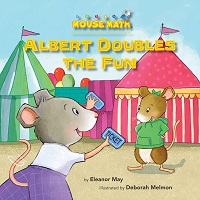
Albert Doubles the Fun — Say the Doubles Like Albert
Put counters on the two mats. Say the sentence out loud.
Grade 1
5 skill lessons · 2 math-through-reading
Math
Skill lessons
The mathematics the book carries, taught directly. Each lesson has printable workbook pages and a separate teacher key.
Math + reading
Math through the reading
The same book, entered through a sentence it prints. Change one word in the reading and the numbers change with it.
Reading
Reading and language lessons
The same book read as a text. What a word means in its sentence, how a character is shown, how the writing is put together - no mathematics.
5 lessons on the mathematics the book carries. Each lesson has printable workbook pages and a separate teacher key.
Albert narrates his day in doubles, one plus one through five plus five and finally ten plus ten, because everything he does for himself he does again for Leo. Students rebuild the fair in order with counters, saying each double sentence as they build it, then answer doubles out of order without the story's help. Fluency means the double arrives whole: four plus four is eight, said like one fact.
1. One for me, one for Leo (4 min)
Read the printed passage where Albert takes two maps. Every student builds it. One counter on the me mat, one on the Leo mat. Say the book's sentence with the build. Repeat with two and two by riding the pretend Ferris wheel twice for each friend.
Word preview: double
One plus one equals two.
2. The fair in order (8 min)
Walk the story's doubles in order. Build each one on the two mats and say its sentence before moving on. Two plus two for the rides. Three plus three for the pie slices. Four plus four for the tokens. Five plus five for the action figures. The printed passage carries the pie double as the model sentence. Each new double stays built until the next one replaces it.
Three plus three equals six.
4 plus 4 equals 8.
3. Doubles out of order (4 min)
The teacher calls doubles out of story order, three plus three, one plus one, five plus five. Students build fast on the mats and answer aloud. Anyone stuck rebuilds the double slowly, counts all, and answers again without the count.
4. The big one (4 min)
Finish where the book does: ten counters on each mat. The class says the biggest double of the day together. Ten plus ten equals twenty. Students point at the mats as proof, ten here, ten there, twenty in all.
Now we have 20 action figures.
1. One for me, one for Leo (3 min)
Build one and one on the two mats with the printed passage and say the book's sentence: one plus one equals two.
Word preview: double
One plus one equals two.
2. The fair in order (6 min)
Build the story's doubles in order on the mats, saying each sentence: two plus two, three plus three, four plus four, five plus five.
Three plus three equals six.
The doubles sentence is a fixed frame, blank plus blank equals blank, said the same way every time, which makes it a practise chant rather than open English. Let students say the frame in their everyday language on the first build and in English on the rebuild. The two mats carry the meaning of both and for both of us without needing either word explained.
Put counters on the two mats. Say the sentence out loud.
Cut on the lines. One strip for each step.
Cut out the cards. Show each one while the class says it.
A close response arrives whole: the student names the total without recounting the mats, and the mats are only proof afterwards.
A loose response counts every counter before answering. The lesson's own repair is the one to use: rebuild the double slowly, count all, then answer again without the count.
Choose your curriculum above to see the standards for this lesson.
Standards are held back while this plan is edited. Every standard shown here was matched against the supplied wording of this lesson, quoting its steps, so a changed step is no longer the thing that was checked. Undo your changes to bring the standards back — your edits stay in this browser either way.
Twenty action figures land for two friends, and the machine that made twenty has already been taught: ten and ten. This lesson runs the machine backward. Students deal totals out to the two mats one at a time, discover that a fair share of a double is the number that built it, and say both directions: double five is ten, half of ten is five.
1. Twenty for two friends (4 min)
Read the printed line where the total arrives. Ask the room what a fair way to split twenty between Albert and Leo would look like. Take answers without settling anything. The only agreed rule: fair means both mats end equal.
Word preview: half, fair
Now we have 20 action figures.
2. Deal them out (6 min)
Pairs deal twenty counters onto the two mats, one for you, one for me, until the pile is gone. Then count each mat: ten and ten. Check fairness by matching the mats. Repeat with a fresh total of eight dealt the same way, four and four.
3. Halves undo doubles (6 min)
Put the story's doubles on the board as machines: five and five made ten, three and three made six. For each, students predict the fair share before dealing, then deal to confirm. The pattern gets said out loud each time: the fair share of a double is the number that built it.
4. Say it both ways (4 min)
Around the room, each student takes one number pair. Say both directions without dealing: double four is eight, half of eight is four. Odd totals are refused at the door. Asked for half of seven, the student deals it and reports the leftover, instead of forcing an equal split.
1. Deal them out (5 min)
Deal twenty counters onto the two mats one at a time, count ten and ten, and check fairness by matching the mats.
2. Halves undo doubles (4 min)
Predict the fair share of ten and of six before dealing, deal to confirm, and say the pattern: the fair share of a double is the number that built it.
One for you, one for me is the whole procedure in six words, and it survives translation perfectly, so let it be said in any language while the hands deal. Half and fair are the words to anchor with the word cards and the matched mats. The closing both-ways sentence has a fixed frame, double blank is blank, half of blank is blank, worth one run-through before the round.
Deal the counters one at a time: one for you, one for me.
Match the mats to check that both are the same.
Cut on the line. Read the strip aloud.
Cut out the cards. Show each one while the class says it.
Twenty counters: ten on each mat. Eight counters: four on each mat. The mats match with nothing left over.
Five and five made ten, so the fair share of ten is five. Three and three made six, so the fair share of six is three. The pattern said aloud: the fair share of a double is the number that built it.
Each student takes one number pair, so the pair is theirs; the shape is fixed. Right pairs within this lesson: double one is two and half of two is one; double two is four and half of four is two; double three is six and half of six is three; double four is eight and half of eight is four; double five is ten and half of ten is five; double ten is twenty and half of twenty is ten.
Odd totals are refused. Asked for half of seven, the expected move is to deal it and report three each with one left over, not to force an equal split.
Half of fourteen is seven, explained as seven and seven make fourteen. Thirteen breaks fair: dealing it leaves six and six with one counter left over.
A close response predicts the share before dealing and then uses the mats as proof.
A loose response deals first and reads the answer off the mats every time, or splits an odd total by hiding the leftover counter.
Choose your curriculum above to see the standards for this lesson.
Standards are held back while this plan is edited. Every standard shown here was matched against the supplied wording of this lesson, quoting its steps, so a changed step is no longer the thing that was checked. Undo your changes to bring the standards back — your edits stay in this browser either way.
Albert's plan only works because Leo's share always equals his own: the book's phrase is double the fun, and the mathematics under it is two equal groups. Students sort built pairs of towers into doubles and not-doubles, then repair the not-doubles by making the groups equal. The concept on the table is equality, checked by matching, before any fact is memorized.
1. Albert's plan (4 min)
Read the printed passage where the plan is announced. Ask what Albert has to keep true all day for the plan to work. Land on this: whatever he gets, Leo gets the same. Show one true double on the mats, three and three. Then show one cheat, three and two. Let the class call out which is the plan and which is not.
Word preview: double, equal
I'll just have to have fun for both of us. Double the fun.
2. Double or not (6 min)
Each pair gets six ready-made tower pairs, some equal, some off by one or two. Students match the towers side by side, cube against cube, and sort the pairs into a doubles pile and a not-doubles pile. The check is physical: if any cube sticks out past its partner, it is not a double.
3. Fix the cheats (6 min)
Take each not-double and make it a double two ways. First, add cubes to the short tower. On the next one, take cubes off the tall tower. Students say what they did in the both-friends language of the book: now Albert and Leo have the same, four and four.
4. Tell a double (4 min)
Each student holds up one repaired double. Tell it in a full sentence: this is a double because both towers have five. Then say its total: five and five is ten. The teacher hears every student say one double sentence with a true equality inside it.
1. Double or not (5 min)
Sort four prepared tower pairs into doubles and not-doubles by matching cube against cube.
2. Fix the cheats (4 min)
Repair each not-double by adding to the short tower, and say the both-friends sentence: now both have the same.
Equal, same, and both carry this lesson, and the towers define them better than any definition: cubes that match with nothing sticking out. Accept the same in any language while the towers are in hand, and give the sentence frame this is a double because both have blank for the closing round so the one required English sentence has a rehearsed shape.
Cut on the line. Read the strip aloud.
Match the two towers side by side, cube against cube.
Put the pair in one place.
Cut out the cards. Show each one while the class says it.
Expected answer to what Albert must keep true: whatever he gets, Leo gets the same. Three and three is the plan. Three and two is not.
The tower pairs are the ones you built, so the pile each pair belongs in depends on your set. The rule is fixed: a pair goes on Doubles only when the towers match with nothing sticking out. Any cube past its partner sends the pair to Not doubles.
Two repairs, both right: add cubes to the short tower, or take cubes off the tall tower. Either way both towers end with the same number.
No single right answer; the numbers come from the student's repaired pair. A strong response names the equality and then the total, in the shape the lesson gives: this is a double because both towers have five, and five and five is ten.
A close response gives the because: both towers have the same number, and the total follows from it.
A loose response calls the pair a double with no reason attached, or names a total the two towers do not actually show.
Choose your curriculum above to see the standards for this lesson.
Standards are held back while this plan is edited. Every standard shown here was matched against the supplied wording of this lesson, quoting its steps, so a changed step is no longer the thing that was checked. Undo your changes to bring the standards back — your edits stay in this browser either way.
The book says its arithmetic out loud, four plus four equals eight, and this lesson makes students the ones who write it. Each double travels through three forms in their own hands: cube towers, a drawing of the towers, and the written plus sentence underneath. One quantity, three representations, and a partner check that all three match.
1. Build three and three (5 min)
Every student builds two equal towers of three. Check by matching, then say the book-style sentence together: three plus three equals six. The printed passage shows the book saying exactly this kind of sentence.
Word preview: plus, equals
Three plus three equals six.
2. Draw your towers (6 min)
Students draw their two towers as two columns of squares, one square per cube, side by side so the equality shows. The drawing must let a stranger count six without seeing the cubes. Partners count each other's drawings aloud to check.
3. Write the plus sentence (5 min)
Under the drawing, students write the sentence the book would say for it: 3 + 3 = 6. Then a second double of their choice, within five and five. Build it, draw it and write it the same way. The page holds two complete sets of tower, drawing and sentence.
4. Swap and check (4 min)
Partners trade pages and check each triple: count the drawing, read the sentence, rebuild the towers if the two disagree. A page passes when the drawing, the sentence, and the rebuilt towers all say the same double.
1. Build three and three (4 min)
Build two equal towers of three, check by matching, and say the book-style sentence: three plus three equals six.
Word preview: plus, equals
Three plus three equals six.
2. Draw your towers (5 min)
Draw the two towers as two equal columns of squares and write the plus sentence underneath: 3 + 3 = 6.
Plus and equals are the two English words this page needs, and both live on the word cards and in the chanted sentence. The drawing and the written 3 + 3 = 6 are language-free evidence that the mathematics is right, so a student new to English can produce a fully correct page while rehearsing the one spoken sentence with a partner.
Name: ______________________________
Build two towers of three. Draw them as two columns of squares.
Write the plus sentence.
Pick your own double, up to five and five. Build it, then draw it.
Write the plus sentence.
Name: ______________________________
Draw eight and eight, using the pattern of your smaller drawings.
Write the plus sentence.
Show your partner how the drawings grow.
Cut out the cards. Show each one while the class says it.
Fixed for everyone. Drawing: two columns of three squares, side by side. Sentence: 3 + 3 = 6. The book's own sentence for it reads: Three plus three equals six.
Student's choice, within five and five. Any of these is right when the drawing matches: 1 + 1 = 2, 2 + 2 = 4, 3 + 3 = 6, 4 + 4 = 8, 5 + 5 = 10. A second copy of 3 + 3 = 6 is also right.
Drawing: two columns of eight squares. Sentence: 8 + 8 = 16.
A close page holds three things that agree: both columns have the same number of squares, a stranger can count the total off the drawing, and the sentence names that same total.
A loose page has columns that differ by one, or a sentence remembered rather than read off the drawing. The lesson's own check applies: rebuild the towers when the drawing and the sentence disagree.
Choose your curriculum above to see the standards for this lesson.
Standards are held back while this plan is edited. Every standard shown here was matched against the supplied wording of this lesson, quoting its steps, so a changed step is no longer the thing that was checked. Undo your changes to bring the standards back — your edits stay in this browser either way.
The ring toss sets a hard target: four prize tokens for the whole set, and Albert needs two sets. Students win tokens one at a time and keep asking the shopkeeper's question, do I have enough yet, comparing their count to four and then to eight. The mathematics is the comparison, said precisely: I have three, I need one more.
1. Four for the whole set (4 min)
Read the printed passage that fixes the price. Set up the shop: a set card that costs four tokens. Show one worked round. With two tokens on the desk, ask: can I buy it? Model the answer: not yet, I have two, I need two more.
Word preview: enough, more
Robo-rat action figures. Only four prize tokens for the whole set.
2. Win and check (7 min)
Partners take turns drawing a token chip from the bag and adding it to their pile. After every draw, the winner answers the shop question out loud with both numbers. I have three, I need one more. Or: I have four, I can buy the set. Buying clears the pile and banks the set card; play continues toward a second set.
3. Albert needs two sets (5 min)
Read the printed line where Albert states his goal after the first four: four more tokens. Ask how many tokens two whole sets take in all. Let pairs prove eight with their chips: four banked and four to come. Students say the fact the game just taught: four and four more is eight.
I still need to win four more tokens.
4. Shopkeeper says (4 min)
The teacher plays shopkeeper with the whole class. A pile of tokens goes up on the board. Students answer together with both numbers: I have six, I need two more. Three piles, three answers, the last one landing exactly on eight so the class gets to say, we can buy both sets.
1. Four for the whole set (3 min)
Read the printed price line, set up the set card, and model the shop answer with two tokens: not yet, I have two, I need two more.
Word preview: enough, more
Robo-rat action figures. Only four prize tokens for the whole set.
2. Win and check (6 min)
Draw tokens one at a time and answer the shop question with both numbers after every draw until one set is bought.
The whole game runs on one two-part frame, I have blank, I need blank more, which is worth chanting once as a class before play. The token pile always shows the truth of the first number and the empty circles show the second, so a student can point while saying the frame, and the words enough and more attach to something countable on the desk.
Cut on the lines. Read each strip aloud at its step.
Cut out the set card and the ten token chips.
Put your tokens beside the card.
Cut out the set card and the ten token chips.
Put one token on each circle. When every circle is full, you can buy the set.
The worked round, with two tokens on the desk: not yet, I have two, I need two more.
The pile is drawn at random, so there is no fixed sequence. Each answer is checked against the count on the desk and the price of four.
Two whole sets take eight tokens: four banked and four to come. The fact the game teaches: four and four more is eight.
You choose the three piles, so the numbers are yours; the last one lands exactly on eight. A strong answer names both numbers every time, and on the last pile the class says it can buy both sets.
A close response carries both numbers: how many I have, and how many more I need.
A loose response gives only yes or no, or names one number and stops.
Choose your curriculum above to see the standards for this lesson.
Standards are held back while this plan is edited. Every standard shown here was matched against the supplied wording of this lesson, quoting its steps, so a changed step is no longer the thing that was checked. Undo your changes to bring the standards back — your edits stay in this browser either way.
The mathematics is reached through a sentence the book prints: change one word in the reading and the numbers change with it. These carry their own standards, matched against these lessons rather than inherited from the skill ones.
Students act Albert's fair-day sentences with counters, swap twice for once, and hear how the little words double, twice, more, and each decide the arithmetic.
1. Listen for the strong words (4 min)
Listen to four of Albert's sentences read aloud and raise both hands at the word that tells how many. Students say the caught word back and show its meaning with fingers before any counters move: twice is two fingers, double is both hands matching.
2. Act the word (6 min)
Act the ride sentence as written: two ride chips for Albert's rides, then twice for Leo puts two more, and students count all, saying the book's own sum, two plus two equals four. Repeat the acting for double-dunk, one and one.
3. The swap, acted (6 min)
Act the swapped sentence, once for Leo, one chip instead of two, and count all: three. Pairs hold up both builds side by side and say which word moved a whole ride, and why Leo is short-changed in the once world: Albert got two, Leo got one.
4. Say your own (4 min)
Each student builds a tiny double of their choice within five and says one sentence about it using twice or double, with the numbers in it: I jumped twice, two and two is four. The class echoes each true sentence.
1. Act the word (6 min)
Act the ride sentence as written: two ride chips for Albert's rides, then twice for Leo puts two more, and students count all, saying the book's own sum, two plus two equals four. Repeat the acting for double-dunk, one and one.
2. The swap, acted (6 min)
Act the swapped sentence, once for Leo, one chip instead of two, and count all: three. Pairs hold up both builds side by side and say which word moved a whole ride, and why Leo is short-changed in the once world: Albert got two, Leo got one.
Twice, double, more, and each are exactly the English that makes word problems hard, and this lesson teaches them with objects moving, which is the best possible introduction. Pair each word with a fixed gesture, two fingers for twice, matched hands for double, and let students say the acted sentence in their strongest language first. The counters make the meaning checkable without any English at all, and the closing sentence has a rehearsed frame.
Choose your curriculum above to see the standards for this lesson.
Standards are held back while this plan is edited. Every standard shown here was matched against the supplied wording of this lesson, quoting its steps, so a changed step is no longer the thing that was checked. Undo your changes to bring the standards back — your edits stay in this browser either way.
Phases are not grades. The Primary Years Programme is a developmental continuum and your school places each student in a phase, so this names the strand the lesson works in and the phases it could sit across. Confirm against your own school's placement.
Number · Phases 1–2
Pattern and function · Phases 1–2
Students get Albert's day as shuffled event cards and must restore the order, proving each placement with the growing doubles and the token arithmetic.
1. Hear the day, hold the cards (4 min)
Listen to the story straight through, then receive five shuffled event cards, maps, rides, pies, tokens, figures, each showing its picture and its double sentence. Pairs make a first ordering from memory and read their line aloud quietly to themselves.
2. Order by the numbers (7 min)
At each card in their line, students build its double in counters and place the total tile: two, four, six, eight, ten. A line whose tiles do not climb gets rearranged until they do. The check is the staircase, not the teacher.
3. Say why it can't move (5 min)
Each pair proves one placement aloud with quantities: the figures card cannot come before the tokens card because a set costs four tokens and two sets cost eight. Then the honest question: which two cards could swap without breaking anything, and pairs find the maps and the dunk, both one and one, and say why those are different.
4. Finish the day (4 min)
Add the final card, Leo arrives with his own ten. Pairs pool counters to build ten and ten, place the twenty tile at the end of the line, and read the whole day: two, four, six, eight, ten, twenty.
1. Order by the numbers (7 min)
At each card in their line, students build its double in counters and place the total tile: two, four, six, eight, ten. A line whose tiles do not climb gets rearranged until they do. The check is the staircase, not the teacher.
2. Say why it can't move (5 min)
Each pair proves one placement aloud with quantities: the figures card cannot come before the tokens card because a set costs four tokens and two sets cost eight. Then the honest question: which two cards could swap without breaking anything, and pairs find the maps and the dunk, both one and one, and say why those are different.
The cards carry pictures and the totals carry the order, so a student can restore and prove the whole day before saying a full English sentence: pointing at the four tile and the eight tile while moving a card is already a justification. The one required spoken why has a frame, this card comes after because, and the doubles vocabulary was rehearsed in gesture form in this book's register lesson, which pairs naturally with this one.
Choose your curriculum above to see the standards for this lesson.
Standards are held back while this plan is edited. Every standard shown here was matched against the supplied wording of this lesson, quoting its steps, so a changed step is no longer the thing that was checked. Undo your changes to bring the standards back — your edits stay in this browser either way.
Phases are not grades. The Primary Years Programme is a developmental continuum and your school places each student in a phase, so this names the strand the lesson works in and the phases it could sit across. Confirm against your own school's placement.
Number · Phases 1–3
5 lessons on the reading and language the book carries - what a word means in its sentence, how a character is shown, how a text is built. No mathematics: these are matched against the English language arts curricula, which are a different and smaller set than the mathematics ones.
This story says two things twice, and both times the second saying is the point. Albert invents double the fun near the beginning and shouts it at the very end. The ring toss mouse calls Scamper right up and win a prize, and pages later Leo calls the same words at his own booth. Students find the repeated words in printed passages, read them aloud in two different voices, and say what changed between the first time and the second.
1. Find the words that come back (5 min)
Read both printed passages aloud with your teacher. Point to the words double the fun in the first passage and point to them again in the second. Then say who is talking each time, and say whether the words sound the same or different the second time.
Word preview: double
But Leo and Lucy weren't home. Leo will miss all the fun. Albert said. Then he brightened. I'll just have to have fun for both of us. Double the fun.
Scamper right up and win a prize! Leo called out, or two prizes. Albert said, One for you, one for a friend, double the fun!
2. Read the same words two ways (5 min)
Read the printed passages aloud again in partners. In the first one Albert is alone and cheering himself up, so use a small voice. In the second one he is shouting to a crowd, so use a big voice. Say which voice fits which passage and why.
Word preview: shouted
But Leo and Lucy weren't home. Leo will miss all the fun. Albert said. Then he brightened. I'll just have to have fun for both of us. Double the fun.
Scamper right up and win a prize! Leo called out, or two prizes. Albert said, One for you, one for a friend, double the fun!
3. Track a second repeated line (6 min)
Read both printed passages. Underline the words Scamper right up and win a prize in each one. Say the name of the character who calls it the first time and the name of the character who calls it the second time. Write those two names on the chart under the words.
Word preview: prize
But at the ring toss, he stopped short. Scamper right up and win a prize! The mouse behind the counter said.
Scamper right up and win a prize! Leo called out, or two prizes. Albert said, One for you, one for a friend, double the fun!
4. Tell what changed the second time (4 min)
Turn to a partner and finish this out loud: The first time, ___ said it. The second time, ___ said it. Use the two names from your chart. Then say one word that tells how the second time is different.
1. Find the words that come back (4 min)
Read both printed passages aloud with your teacher. Point to the words double the fun in each one and say who is talking.
Word preview: double
But Leo and Lucy weren't home. Leo will miss all the fun. Albert said. Then he brightened. I'll just have to have fun for both of us. Double the fun.
Scamper right up and win a prize! Leo called out, or two prizes. Albert said, One for you, one for a friend, double the fun!
2. Track a second repeated line (5 min)
Read both printed passages. Underline Scamper right up and win a prize in each. Say who calls it first and who calls it second.
Word preview: prize
But at the ring toss, he stopped short. Scamper right up and win a prize! The mouse behind the counter said.
Scamper right up and win a prize! Leo called out, or two prizes. Albert said, One for you, one for a friend, double the fun!
Repeating a line for effect happens in stories in every language, and students often know a song or a story from home that repeats a line at the end. Invite them to say that line in their strongest language and to say who repeats it. English marks the second saying here with an exclamation mark, which not every writing system uses the same way, so read it aloud rather than only pointing. Rehearsable frame: Albert says ___ at the start and ___ at the end.
Choose your curriculum above to see the standards for this lesson.
Standards are held back while this plan is edited. Every standard shown here was matched against the supplied wording of this lesson, quoting its steps, so a changed step is no longer the thing that was checked. Undo your changes to bring the standards back — your edits stay in this browser either way.
The book almost never names a feeling. It gives an action word instead and lets the reader do the naming: Albert brightened, Wanda wobbled away, Albert squeaked, the counter mouse said it glumly. Students read four short printed passages, put a finger on the one word that carries the feeling in each, and say the feeling in their own words. The lesson is reading a feeling off a verb, not off a label.
1. Find the feeling word in each passage (6 min)
Read the four printed passages aloud with your teacher. In each one, put your finger on the single word that tells you how somebody feels: brightened, wobbled, squeaked, glumly. Say each word after you find it.
Word preview: brightened
But Leo and Lucy weren't home. Leo will miss all the fun. Albert said. Then he brightened.
After their fourth ride, Wanda wobbled away from the Ferris wheel. Let's go see the cheese sculptures. She said, I'd like to look at something that stands still.
For once, Albert passed by the micecreen pops. But at the ring toss, he stopped short. Scamper right up and win a prize! The mouse behind the counter said. Look, Wanda! Albert squeaked.
The mouse behind the counter rested his chin on his paw. Scamper right up. He said glumly. Albert did.
2. Say the feeling in your own words (5 min)
Take the feeling word cards. For each printed passage, say aloud one everyday word for that feeling: happy, tired, excited, sad. Put the card on the passage it matches. If two cards seem to fit one passage, say which one fits better and why.
Word preview: glumly
But Leo and Lucy weren't home. Leo will miss all the fun. Albert said. Then he brightened.
After their fourth ride, Wanda wobbled away from the Ferris wheel. Let's go see the cheese sculptures. She said, I'd like to look at something that stands still.
For once, Albert passed by the micecreen pops. But at the ring toss, he stopped short. Scamper right up and win a prize! The mouse behind the counter said. Look, Wanda! Albert squeaked.
The mouse behind the counter rested his chin on his paw. Scamper right up. He said glumly. Albert did.
3. Show the feeling with your body (5 min)
Read the printed passage about Wanda and the printed passage about the counter mouse. Act out wobbled with your feet and glumly with your face. Your partner reads the passage aloud while you act. Then trade.
Word preview: wobbled
After their fourth ride, Wanda wobbled away from the Ferris wheel. Let's go see the cheese sculptures. She said, I'd like to look at something that stands still.
The mouse behind the counter rested his chin on his paw. Scamper right up. He said glumly. Albert did.
4. Write one feeling sentence (4 min)
Pick one printed passage from this lesson. Write the sentence frame on your paper and finish it: ___ feels ___ because the book says ___. Copy the feeling word from the passage into the last blank.
Word preview: squeaked
For once, Albert passed by the micecreen pops. But at the ring toss, he stopped short. Scamper right up and win a prize! The mouse behind the counter said. Look, Wanda! Albert squeaked.
1. Find the feeling word in each passage (5 min)
Read the four printed passages aloud with your teacher. Put your finger on the word in each that shows a feeling, and say it.
Word preview: brightened, glumly
But Leo and Lucy weren't home. Leo will miss all the fun. Albert said. Then he brightened.
After their fourth ride, Wanda wobbled away from the Ferris wheel. Let's go see the cheese sculptures. She said, I'd like to look at something that stands still.
For once, Albert passed by the micecreen pops. But at the ring toss, he stopped short. Scamper right up and win a prize! The mouse behind the counter said. Look, Wanda! Albert squeaked.
The mouse behind the counter rested his chin on his paw. Scamper right up. He said glumly. Albert did.
2. Say the feeling in your own words (4 min)
For each printed passage, say one everyday feeling word and put the matching card on it.
Word preview: wobbled, squeaked
But Leo and Lucy weren't home. Leo will miss all the fun. Albert said. Then he brightened.
The mouse behind the counter rested his chin on his paw. Scamper right up. He said glumly. Albert did.
These feeling verbs do not translate one for one: brightened is a face changing, not a light, and glumly names a mood carried inside a word that ends in ly. Act each one out before asking for English, and invite students to give the word for that feeling in their strongest language first. Point at the printed word while they say it. Rehearsable frame: The book says ___, so I think ___ feels ___.
Choose your curriculum above to see the standards for this lesson.
Standards are held back while this plan is edited. Every standard shown here was matched against the supplied wording of this lesson, quoting its steps, so a changed step is no longer the thing that was checked. Undo your changes to bring the standards back — your edits stay in this browser either way.
Albert's day at the fair moves through named places in a fixed order: the gate, the dunking booth, the Ferris wheel, the big tent, the ring toss. Students read short printed passages that each name one stop, put the passages in the order the book gives, and retell the day aloud using first, next, then and last. The work is holding a sequence and speaking it in order.
1. Read the five stops (5 min)
Read the five printed passages aloud with your teacher. In each one, say the name of the place Albert is: the gate, the dunking booth, the Ferris wheel, the big tent, the ring toss. Say the place name out loud after each passage.
Word preview: fair
At the fair, the mouse of the gate handed Wanda a map. Albert took one too. One map for us and one to bring to Leo.
Look! Albert pointed. It was their gym teacher, Mr. Mouseley, in a dunking booth.
Wanda and Albert rode the Ferris wheel. Twice. Let's go again. Albert said.
They went into the big tent. While Wanda checked out the cheese sculptures, Albert eyed the cakes and pies.
For once, Albert passed by the micecreen pops. But at the ring toss, he stopped short.
2. Put the strips in order (5 min)
Your group gets the five passage strips shuffled. Read them again and lay them left to right in the order the book puts them. Check by finding the strip that names the gate and putting it first. Say the five place names in order when you finish.
Word preview: order
At the fair, the mouse of the gate handed Wanda a map. Albert took one too. One map for us and one to bring to Leo.
Look! Albert pointed. It was their gym teacher, Mr. Mouseley, in a dunking booth.
Wanda and Albert rode the Ferris wheel. Twice. Let's go again. Albert said.
They went into the big tent. While Wanda checked out the cheese sculptures, Albert eyed the cakes and pies.
For once, Albert passed by the micecreen pops. But at the ring toss, he stopped short.
3. Retell with order words (6 min)
Stand with a partner and retell Albert's day from your strips. Use first, next, then, and last, one order word per strip. Point at the strip you are on while you speak. Your partner listens for all four order words.
Word preview: first, last
His sister Wanda was going to take him to the fair. Can Leo come? He asked. Leo was his best friend. Wanda smiled. Why not? Maybe Lucy can come too.
4. Fix a mixed-up retelling (4 min)
Your teacher retells the day with two stops swapped, putting the big tent before the Ferris wheel. Read the two printed passages again and say which one the book puts first. Say the correct order out loud, using the order word cards.
Wanda and Albert rode the Ferris wheel. Twice. Let's go again. Albert said.
They went into the big tent. While Wanda checked out the cheese sculptures, Albert eyed the cakes and pies.
1. Read the five stops (4 min)
Read the five printed passages aloud with your teacher and say the place name in each one.
Word preview: fair, order
At the fair, the mouse of the gate handed Wanda a map. Albert took one too. One map for us and one to bring to Leo.
Look! Albert pointed. It was their gym teacher, Mr. Mouseley, in a dunking booth.
Wanda and Albert rode the Ferris wheel. Twice. Let's go again. Albert said.
They went into the big tent. While Wanda checked out the cheese sculptures, Albert eyed the cakes and pies.
For once, Albert passed by the micecreen pops. But at the ring toss, he stopped short.
2. Retell with order words (5 min)
Retell Albert's day to a partner from your strips, using first, next, then and last.
Word preview: first, last
His sister Wanda was going to take him to the fair. Can Leo come? He asked. Leo was his best friend. Wanda smiled. Why not? Maybe Lucy can come too.
Order words are among the earliest transfers: nearly every language has a word for first and a word for last, and students can supply theirs before using English. Have them say the five place names in their strongest language while touching the strips, then swap in the English name. The strips let them retell by pointing when the words are not ready yet. Rehearsable frame: First Albert went to the ___. Next he went to the ___.
Choose your curriculum above to see the standards for this lesson.
Standards are held back while this plan is edited. Every standard shown here was matched against the supplied wording of this lesson, quoting its steps, so a changed step is no longer the thing that was checked. Undo your changes to bring the standards back — your edits stay in this browser either way.
Albert keeps doing things that look odd until you find his reason, and the book usually prints the reason in the very next sentence. Students read printed pairs where an action comes first and the reason follows, ask why out loud, and answer with words lifted from the printed passage. The skill is answering a why question with text words instead of a guess.
1. Ask why about one action (5 min)
Read the two printed passages aloud with your teacher. After the first one, ask out loud: why does Albert say he has to have fun for both of them? After the second, ask: why does Albert buy another ticket? Do not answer yet.
Word preview: why
But Leo and Lucy weren't home. Leo will miss all the fun. Albert said. Then he brightened. I'll just have to have fun for both of us. Double the fun.
Albert bought another ticket. Sorry, Mr. Mouse Lee. He called out. Since Leo isn't here, I have to double-dunk.
2. Find the sentence that answers (6 min)
Look at the same two printed passages again. Underline the sentence in each that answers your why question. In the second passage the answer starts with the word Since. Read your underlined sentence aloud to a partner.
Word preview: because
But Leo and Lucy weren't home. Leo will miss all the fun. Albert said. Then he brightened. I'll just have to have fun for both of us. Double the fun.
Albert bought another ticket. Sorry, Mr. Mouse Lee. He called out. Since Leo isn't here, I have to double-dunk.
3. Match an action to its reason (5 min)
Read the two printed passages about the tokens. The first tells what Albert wants to do. The second tells why. Draw a line from the action to its reason on your paper, then say the whole thing as one sentence starting with the word because.
Word preview: reason
We can't go yet! Albert said, I still need to win four more tokens.
Four more? Wanda asked. Albert nodded. So I can get Leo a set of action figures too.
4. Say a reason with no book in front of you (4 min)
Close your paper. Your partner names one thing Albert does. You say why, in one sentence starting with because. If you cannot remember, open the paper and read the reason sentence instead of guessing.
1. Find the sentence that answers (5 min)
Read the two printed passages aloud. Underline the sentence in each that says why Albert does what he does, and read it to a partner.
Word preview: why, because
But Leo and Lucy weren't home. Leo will miss all the fun. Albert said. Then he brightened. I'll just have to have fun for both of us. Double the fun.
Albert bought another ticket. Sorry, Mr. Mouse Lee. He called out. Since Leo isn't here, I have to double-dunk.
2. Match an action to its reason (4 min)
Read the two printed passages about the tokens. Say which one is the action and which is the reason, then say them together as one sentence with because.
Word preview: reason
We can't go yet! Albert said, I still need to win four more tokens.
Four more? Wanda asked. Albert nodded. So I can get Leo a set of action figures too.
Since and because do the same job here, and many languages use one word where English offers two, so students may hear Since as a time word. Say both sentences aloud with the same because meaning and let students give their own language's reason word before switching. Answering why with words copied from the page is the safest route into English for this skill. Rehearsable frame: Albert does ___ because ___.
Choose your curriculum above to see the standards for this lesson.
Standards are held back while this plan is edited. Every standard shown here was matched against the supplied wording of this lesson, quoting its steps, so a changed step is no longer the thing that was checked. Undo your changes to bring the standards back — your edits stay in this browser either way.
One word, double, shows up four times in this book and never sits still. It is stuck onto fun, onto dunk with a hyphen to make one new word, and onto belly ache in Wanda's joke. Students read the four printed sentences, say what word double is holding hands with each time, and hear what it does to the meaning. The work is watching a familiar word take a new partner, not counting anything.
1. Read the four double sentences (5 min)
Read the four printed sentences aloud with your teacher. Put your finger on the word double each time you say it. Hold up a finger for each sentence, so you end with four.
Word preview: double
I'll just have to have fun for both of us. Double the fun.
Since Leo isn't here, I have to double-dunk.
Wanda shook her head. I just hope you don't get a double belly ache.
Albert said, One for you, one for a friend, double the fun!
2. Name the partner word (5 min)
Look at the same four printed sentences. Say the word that comes right after double in each one: fun, dunk, belly ache, fun. Write those partner words on the chart next to the word double.
Word preview: partner
I'll just have to have fun for both of us. Double the fun.
Since Leo isn't here, I have to double-dunk.
Wanda shook her head. I just hope you don't get a double belly ache.
Albert said, One for you, one for a friend, double the fun!
3. Look at the word with a line in it (6 min)
Read the printed sentence with double-dunk aloud. Two words are joined by a little line to make one word. Cover the line with your finger and read the two halves by themselves, then read them joined. Say which one sounds like something Albert does.
Word preview: dunk
Since Leo isn't here, I have to double-dunk.
4. Make your own double word (4 min)
Say a word of your own that double could hold hands with, something you like doing. Say the whole phrase out loud: double the ___. Your partner says whether it sounds funny or ordinary, the way double belly ache sounds funny.
Word preview: funny
Wanda shook her head. I just hope you don't get a double belly ache.
1. Read the four double sentences (4 min)
Read the four printed sentences aloud with your teacher, putting your finger on the word double each time.
Word preview: double, partner
I'll just have to have fun for both of us. Double the fun.
Since Leo isn't here, I have to double-dunk.
Wanda shook her head. I just hope you don't get a double belly ache.
Albert said, One for you, one for a friend, double the fun!
2. Look at the word with a line in it (5 min)
Read the printed sentence with double-dunk aloud. Cover the little line, read the two halves apart, then read them joined.
Word preview: dunk, funny
Since Leo isn't here, I have to double-dunk.
Double is a word many students already own in another language with a close cousin, so start by asking for their word and comparing sounds. The hyphen is the harder transfer: it joins two words into one in English writing, and some writing systems have no equivalent mark. Show it on the printed sentence with a finger before naming it. Rehearsable frame: Double goes with ___ here.
Choose your curriculum above to see the standards for this lesson.
Standards are held back while this plan is edited. Every standard shown here was matched against the supplied wording of this lesson, quoting its steps, so a changed step is no longer the thing that was checked. Undo your changes to bring the standards back — your edits stay in this browser either way.