The Word file and the PDF carry the whole guide. The student pages are the two checkpoints and the culminating task, one to a sheet.
About this unit
This is the third unit the 2026-09-02 audit could not build. It wanted a third Grade 2 book with a stated generating rule; the shelf now has nine books on the theme, and the four chosen here climb from the simplest rule to the hardest. Children count bundles by tens, then the same ten groups by twos and by fives, then threes with a unit attached — and then meet a rule that uses the two numbers before rather than a fixed step.
The two lessons that make it a unit about rules rather than about counting come at the end. In lesson 5 children write a prediction down and fold the strip before the next page is read, which turns a rule into a commitment. In lesson 6 they test three candidate rules against the same row of seven counts and circle the exact place each failing rule first disagrees — so a rule is beaten by one contradicting number rather than by anybody's opinion. The last lesson draws the same growth twice, as a branching picture and as a sum of two earlier days, and asks where one is inside the other.
The mathematical arc
Each lesson does one job the lesson before it made possible.
One bundle, one number word: counting by tens
The same ten groups, counted by twos and by fives
A step with a unit attached: three feet for every new yard
A rule that uses the two numbers before it
Write the prediction down and fold the strip
One place where it breaks is enough to beat a rule
The same growth as a picture and as a sum
Source books
Every lesson in this unit is already published under Math lessons. Nothing here asks you to teach anything you cannot open today.
Each day names one lesson that already exists under Math lessons, with its book, its number and its title. This guide says what that lesson is doing in the sequence and what to collect from it; the lesson itself carries the steps, the printables and the answers.
Thirty minutes a day.
Five minutes to connect to yesterday, the twenty-minute source lesson, five minutes to close on something you can see. A day that runs long should lose the close, never the core.
Teach a lesson on its own if you need to.
Every day carries a one-sentence opening for a teacher who is using that lesson outside the sequence.
Stop after a checkpoint.
The unit holds together if you stop after either checkpoint and come back to it. Stopping between a checkpoint and the next one leaves a lesson without the evidence it was built on.
Where this fits in your year
When to teach it
After the class can count by twos, fives and tens. It sits well before any multiplication work, because a fixed step repeated is what an equal group is.
What students need first
Children can count by twos and tens to a hundred and can add two numbers within twenty.
What this unit develops
Counting by tens, twos, fives and threes with one touch to one number word; a step with a unit attached; a rule that adds the two before; committing a prediction in writing; testing a rule against a row and naming where it breaks; the same growth as a picture and as a sum.
What it prepares them for
Equal groups and multiplication, and any later work where a conjecture has to be tested against cases rather than asserted.
Curriculum connections
None claimed. The lessons in this unit carry their own standards classifications on their own pages, checked lesson by lesson. A unit-level expectation is a different claim, and none has been verified for this unit, so none is printed here. Use the placement guide above to site the unit in your year, and the individual lesson pages for the codes.
Unit at a glance
#
Mathematical move
Source lesson
Collect
1
One bundle, one number word: counting by tens
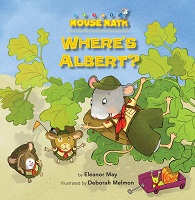
Where's Albert? lesson 1, Ninety, and Then Albert
Ten bundles counted to a hundred, and a written record of where the count stopped at ninety and how many scouts were still to come.
2
The same ten groups, counted by twos and by fives
Where's Albert? lesson 2, Two Cheesy Puffs, Five Tent Pegs
Three written numbers — where the twos stopped, where they finished, and where the fives stopped.
3
A step with a unit attached: three feet for every new yard Checkpoint after this lesson
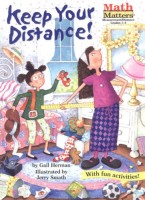
Keep Your Distance! lesson 3, Add Three Feet for Each New Yard
Six ribbons walked in both directions with the matching number card laid on each, and the sixth ribbon's number checked against the book's own sentence.
4
A rule that uses the two numbers before it
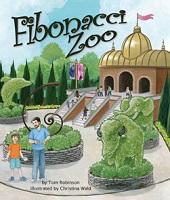
Fibonacci Zoo lesson 1, The Rule That Builds the Next Exhibit
Four rebuilt exhibits and four adding sentences written under the strip, ticked where they match Eli's printed ones.
5
Write the prediction down and fold the strip Checkpoint after this lesson
Fibonacci Zoo lesson 2, Predict the Gorillas Before You See Them
Two written and folded predictions, each with its addends, and the book's number written beside any that was wrong rather than replacing it.
6
One place where it breaks is enough to beat a rule
Rabbits, Rabbits Everywhere: A Fibonacci Tale lesson 2, Three Rules, One Row of Numbers
A strip carrying three tested rules, with the first disagreement circled for each of the two that fail and every agreement marked for the one that holds.
7
The same growth as a picture and as a sum
Rabbits, Rabbits Everywhere: A Fibonacci Tale lesson 3, A and B: Drawing the Rule Amanda Drew
A five-day drawing with every pair labelled and every day counted, checked against the book's own sentence for the fifth day.
Unit vocabulary
Words students say, not words they are taught to define.
step
How much the count goes up each time. Fixed in lessons 1 to 3 and not fixed after that.
in order
Lesson 4's phrase: the two numbers a rule uses are the two standing next to each other, not any two.
predict
Say the number before you see it. Lesson 5 requires it in writing.
breaks
Where a rule first produces a number the row contradicts. One place is enough.
pairs
Lesson 7's unit of counting, because the rabbits are counted in pairs and not singly.
Materials
From the source lessons
Each day's materials are listed on that day's page below and on the source lesson itself. Nothing is duplicated here.
New for this unit
Checkpoint 1 page, one per child
Checkpoint 2 page, one per child
Performance task set: forty counters, an eight-box strip, a rule-testing strip carrying a row of seven counts, a coloured pencil, and a set of three candidate-rule cards, one set per pair
Performance task page, one per child
Assessment plan
Daily evidence
Keep the folded prediction strips from lesson 5 with the wrong numbers still on them. A prediction written and then corrected beside itself is the record this unit wants; a rubbed-out prediction is the one thing that cannot be assessed.
Checkpoint 1, after lesson 3: Count it two ways
Ten plates with four counters on each. The child counts the whole set by fours and then by twos, and says which count took fewer number words.
Book-free. Plates and counters, no book.
Look for. One touch to one number word on both counts, and an answer to the fewer-words question that names both counts rather than guessing.
Checkpoint 2, after lesson 5: Write it before you see it
A row of five counts the child has not seen: 2, 3, 5, 8, 13. The child writes the next number and the two numbers they added, before being told anything.
Book-free. A number strip and a pencil, no book.
Look for. Both the number and the two addends written down. A number with no addends beside it cannot be told from a lucky guess, which is exactly what this unit is about.
Culminating task: Count it, predict it, break it
Each pair does three things. They count a set of ten equal groups two different ways and say which count took fewer number words. They take a row of numbers they have not seen, write the next number and the two numbers they added, and fold the strip before anything is read. Then they test three candidate rules against a row of seven counts, circle the first place each failing rule disagrees, and say which rule survived and where each of the others broke.
Collect. Both counts with the fewer-words answer, the folded prediction with its two addends, and the rule-testing strip with the breaking places circled.
What it assesses. A fixed step counted two ways, a rule committed in writing, and a rule beaten by one contradicting number — the three things the unit built, with no prediction rubbed out.
Daily lesson pages
Lesson 1One bundle, one number word: counting by tens
Skill lessonWhere's Albert? · lesson 1, Ninety, and Then Albert · Grade 2 · 20 minutes Skip counting by tens to 100
I can
I can count a row of tens and say where the count stops.
Big idea
A count by tens needs the ten to be a thing you can touch. Nine bundles reach ninety and the tenth is what reaches a hundred.
Success
The child counts the row from either end and lands on the same last number both times.
Connect | 5 min
First lesson. Ask the class to count a hundred sticks by ones and stop them. Ask what could be done to the sticks to make the count shorter.
Taught on its own
Agnes asks every scout for ten twigs and counts the returning scouts by tens. Nine scouts get her to ninety and she stops.
Source core | 20 min
Pairs bundle ten craft sticks with an elastic saying ten twigs, one scout as each is tied, build nine bundles, then touch each bundle and count aloud by tens with the book's printed line, stopping where Agnes stops.
Collect
Ten bundles counted to a hundred, and a written record of where the count stopped at ninety and how many scouts were still to come.
Close | 5 min
One partner lays out between four and ten bundles while the other looks away; the counting partner turns back, counts the row by tens and says the last number, and they swap until each has counted four rows.
From the source lesson: 100 craft sticks per pair of students; 20 elastic bands per pair; Printed source passage in this step; Recording paper and pencil per student; Word cards: bundle, ninety, hundred
Watch for: A bundle that comes apart mid-count. Keep the elastics on; a loose bundle makes the count wrong for a reason the child cannot see.
Lesson 2The same ten groups, counted by twos and by fives
Skill lessonWhere's Albert? · lesson 2, Two Cheesy Puffs, Five Tent Pegs · Grade 2 · 20 minutes Skip counting by twos and fives
I can
I can count the same set by twos and by fives and say which took fewer words.
Big idea
The size of the step decides how many number words a count costs. The set does not change; the counting does.
Success
The child counts the same ten plates both ways and says which count took fewer number words, using the written numbers as the reason.
Connect | 5 min
Yesterday the step was ten. Today the same ten groups get counted with a smaller step, and then a middle-sized one.
Taught on its own
The book runs the same count twice with different group sizes: two cheesy puffs per scout and five pegs per tent.
Source core | 20 min
Children set nine plates with two counters on each and count by twos touching one plate per number word, add the tenth plate to reach twenty, then clear the plates and count nine plates of five by fives with the printed line.
Collect
Three written numbers — where the twos stopped, where they finished, and where the fives stopped.
Close | 5 min
Children count the same ten plates once by twos and once by fives and say how many number words each count took, using the numbers on their paper to say which was quicker.
From the source lesson: 12 paper plates per pair of students; 50 counters per pair of students; Recording paper and pencil per student; Printed source passage in this step; Word cards: twos, fives, each
Watch for: Counting the counters rather than the plates. One plate, one number word, whatever is on it.
Lesson 3A step with a unit attached: three feet for every new yard
Skill lessonKeep Your Distance! · lesson 3, Add Three Feet for Each New Yard · Grade 2 · 20 minutes Skip counting by threes to eighteen along the yards-and-feet rows
I can
I can count by threes along the yards and say the feet.
Big idea
A step can carry a unit. Each new yard adds three feet, so the count by threes is not an exercise — it is a conversion the book uses on the next page.
Success
The child answers any yard from one to six from a called card before walking it, and only walks to check.
Connect | 5 min
Counting by twos and fives moved along plates. Today the step moves along the floor, and each step is worth three feet.
Taught on its own
The book hands over its own procedure in the back matter and then names the step: add three feet for each new yard. Its rows run one yard to six.
Source core | 20 min
Children lay six one-yard ribbons end to end with no gaps, walk the line saying three, six, nine, twelve, fifteen, eighteen with one touch per number word, and start again at the first ribbon if the voice gets ahead of the foot.
Collect
Six ribbons walked in both directions with the matching number card laid on each, and the sixth ribbon's number checked against the book's own sentence.
Close | 5 min
A partner draws a yard card face down and calls it; the child says the feet before moving, then walks the ribbons to check, and any card that had to be walked to answer goes back in the pile.
From the source lesson: Six one-yard ribbons per group; Six floor cards reading one yard through six yards; Six number cards reading three, six, nine, twelve, fifteen, eighteen; Two sentence strips reading six yards and 18 feet; A set of six yard cards to draw from, face down; Word cards: yard, feet, add
Watch for: Gaps between the ribbons. A gap makes the walk longer than the count, and the error looks like miscounting.
Checkpoint after this lesson: Count it two ways. The page is at the end of this guide.
Lesson 4A rule that uses the two numbers before it
Skill lessonFibonacci Zoo · lesson 1, The Rule That Builds the Next Exhibit · Grade 2 · 20 minutes Adding two numbers to make the next in a row
I can
I can make the next number by pushing together the two before it.
Big idea
Not every rule is a fixed step. This one adds the two numbers standing next to each other, so the step grows as the row grows.
Success
The child rebuilds a covered count by pushing the two piles immediately to its left, and says the two numbers used before saying the answer.
Connect | 5 min
Three lessons of fixed steps. Ask what the step is in this row — one, one, two, three, five, eight — and let the class find that there is not one.
Taught on its own
Eli writes down eight exhibits and then states, in his own words, the rule that made them: take any two numbers in order and add them, and you get the next one.
Source core | 20 min
Pairs build the first six exhibits as piles of counters in Eli's order, then one partner covers a pile and the other pushes the two piles immediately to its left together, counts the result and says what the covered pile must be before the card is lifted.
Collect
Four rebuilt exhibits and four adding sentences written under the strip, ticked where they match Eli's printed ones.
Close | 5 min
The strip goes face down and each child states the rule cold in their own words; a partner names two numbers standing next to each other and asks what comes after, and the speaker must answer and say which two they added.
From the source lesson: 40 two-colour counters per pair of students; One exhibit strip per pair, ruled into eight boxes; Eight exhibit cards carrying the book's counts, one animal per card; Printed source passage in this step; Word cards: exhibit, in order, pattern
Watch for: Two piles chosen because they are convenient. The rule says the two in order; ask which two and why those.
Lesson 5Write the prediction down and fold the strip
Skill lessonFibonacci Zoo · lesson 2, Predict the Gorillas Before You See Them · Grade 2 · 20 minutes Using a stated rule to predict and then check a count
I can
I can say the next number before I see it, and show the two numbers I used.
Big idea
A rule is worth having because it lets you commit before the answer arrives. A number written down with its two addends can be told apart from a lucky guess.
Success
The child writes both predictions before either page is read, with the two numbers used beside each, and does not rub out a wrong one.
Connect | 5 min
Yesterday the covered pile was already on the strip. Today the next exhibit has not been read yet, and the number has to be written before it is.
Taught on its own
Twice Eli says a number before he sees the animals, and twice the book confirms him: he predicts thirteen gorillas and the text answers exactly 13.
Source core | 20 min
Before anyone reads on, every pair writes a number in the seventh box with the two numbers they added underneath it, and folds the strip so nobody can change it; then the gorilla page is read and the strips come up.
Collect
Two written and folded predictions, each with its addends, and the book's number written beside any that was wrong rather than replacing it.
Close | 5 min
Children tell a partner why they were willing to write a number down before seeing the animals; an answer has to name the rule and at least two counts from the strip, and I guessed is sent back.
From the source lesson: 40 two-colour counters per pair of students; One exhibit strip per pair, ruled into eight boxes; Printed source passage in this step; Word cards: predict, next
Watch for: A wrong prediction rubbed out. Write the book's number beside it instead — the pair of numbers is the evidence.
Checkpoint after this lesson: Write it before you see it. The page is at the end of this guide.
Lesson 6One place where it breaks is enough to beat a rule
Skill lessonRabbits, Rabbits Everywhere: A Fibonacci Tale · lesson 2, Three Rules, One Row of Numbers · Grade 2 · 20 minutes Testing a rule against a row of numbers and finding where it breaks
I can
I can test a rule along a row and say where it first goes wrong.
Big idea
A rule is a claim about every place in the row. It is not beaten by an opinion but by one place where it produces a number the row contradicts.
Success
The child circles the first disagreement for each failing rule and names both numbers that disagreed there.
Connect | 5 min
The class now has a rule that works. Today two rules that also look reasonable get tested against the same numbers.
Taught on its own
Amanda names three candidate rules aloud and discards two of them, and the book prints the counts she tests them against.
Source core | 20 min
Children write the book's seven counts along a strip, then test the adding-one rule by writing what it produces underneath and circling the first place their answer and the book's count differ, saying both numbers aloud, and do the same for doubling.
Collect
A strip carrying three tested rules, with the first disagreement circled for each of the two that fail and every agreement marked for the one that holds.
Close | 5 min
Children tell a partner which rule works and how they know, naming the count where each of the other two first broke with both disagreeing numbers in the sentence, and say whether their partner named the same breaking place.
From the source lesson: Rule-testing strip with the seven counts; Pencils; Coloured pencil for circling; Word cards: sum, double
Watch for: A rule rejected without a circled place. Ask where it first goes wrong; without that the rejection is an opinion.
Lesson 7The same growth as a picture and as a sum
Skill lessonRabbits, Rabbits Everywhere: A Fibonacci Tale · lesson 3, A and B: Drawing the Rule Amanda Drew · Grade 2 · 20 minutes Building a picture from a stated growing rule and counting what it makes
I can
I can draw the rule and find the two earlier days inside my drawing.
Big idea
One growth can be written two ways. The branching picture and the sum of two earlier days describe the same thing, and finding one inside the other is what makes the rule make sense.
Success
The child extends the drawing one more day by the stated rule, counts the pairs, and can point at where the two earlier days show up in the new one.
Connect | 5 min
Rules have been rows of numbers. Today the same rule is a picture that grows, and the numbers have to be found inside it.
Taught on its own
Amanda draws her explanation in the dirt with letters, an A for adults and a B for babies, and the book prints both the drawing's first days and the rule that extends it.
Source core | 20 min
Children draw the four days Amanda describes, labelling every pair A or B exactly as she does and writing the count under each day, then apply her rule to draw day five — every A pair drawing a new B pair beneath it and every B pair becoming an A.
Collect
A five-day drawing with every pair labelled and every day counted, checked against the book's own sentence for the fifth day.
Close | 5 min
Children point at their day-five drawing and tell a partner where the day-three pairs and the day-four pairs both show up in it, and say one sentence naming the two earlier days and the number they make.
From the source lesson: Large drawing paper; Pencils; A and B label cards; Word cards: adults
Watch for: A pair that did not follow the rule. Walk back through day four pair by pair rather than recounting day five.
Culminating performance task
Count it, predict it, break it
Each pair does three things. They count a set of ten equal groups two different ways and say which count took fewer number words. They take a row of numbers they have not seen, write the next number and the two numbers they added, and fold the strip before anything is read. Then they test three candidate rules against a row of seven counts, circle the first place each failing rule disagrees, and say which rule survived and where each of the others broke.
Collect. Both counts with the fewer-words answer, the folded prediction with its two addends, and the rule-testing strip with the breaking places circled.
What it assesses. A fixed step counted two ways, a rule committed in writing, and a rule beaten by one contradicting number — the three things the unit built, with no prediction rubbed out.
Teacher key and rubric
Key
Checkpoint 1: forty either way; the fours take ten number words and the twos take twenty.
Checkpoint 2: 21, from 8 and 13. Accept any correct pair of addends the child actually used, but a bare 21 is only half the answer.
Task: write the three candidate rules yourself — add one, double, add the two before — and check where the first two break on your row before the lesson, so a child's correct circling is not marked wrong.
Rubric
Strand
Secure looks like
Developing
Not yet
Representation
A count touches one group per number word, and a growing rule is built as piles or as a drawing before it is written as a sum.
Does it with the arrangement in front of them.
Produces an answer without the arrangement or the reason.
Calculation
The two numbers a rule adds are the two standing next to each other, and each sum is checked against the row rather than against a feeling.
Does it with the arrangement in front of them.
Produces an answer without the arrangement or the reason.
Meaning
A prediction is written before the answer is available, with the numbers used beside it.
Does it with the arrangement in front of them.
Produces an answer without the arrangement or the reason.
Explanation
A rule is rejected by naming one place it breaks and both numbers that disagreed there.
Does it with the arrangement in front of them.
Produces an answer without the arrangement or the reason.
Print-ready student pages
These three pages print one to a sheet. Everything above them is the teacher guide.
Checkpoint 1 · Grade 2
Count it two ways
NameDate
Count these by fours, touching one plate at a time. Now count the same counters by twos. Which count took fewer words?
Checkpoint 2 · Grade 2
Write it before you see it
NameDate
Here is a row of numbers. Write the next one, and write the two numbers you added to get it. Do not tell me until it is written down.
Culminating task · Grade 2
Count it, predict it, break it
NameDate
Count these two ways and tell me which count took fewer words. Now look at this row: write the next number and the two you added, then fold it over. Last, here are three rules. Test each one along the row and circle the first place it goes wrong. Which rule survived? Where did each of the others break?
Teacher planning and handoff
A child who writes a prediction with no addends beside it has the answer and not the rule. Give them lesson 5's folded strip again before any conjecture work.
Lesson 6 is the unit's spine and the one to keep. Beating a rule with a single contradicting case is the habit the rest of the year's reasoning rests on.
Fibonacci Zoo's two closing lessons, on the phrase in the middle of Eli's rule and on jumbling the exhibits, were left out as a third and fourth from one book; the phrase's work is carried by lesson 4's in-order requirement.