The Word file and the PDF carry the whole guide. The student pages are the two checkpoints and the culminating task, one to a sheet.
About this unit
The unit begins with what a dot on a line graph is worth: a month from underneath and a number from the side, never one without the other. Children plot the two values the book states, trade grids with another pair, and read heights back off a line they did not draw. Then the question words get separated from the picture. Every graph in the book is asked the same two questions and only one word changes between them, so children answer both off one line, lay the word fewest over the word most, and watch the answer move while the graph stays still.
Tables come next, and both lessons are about structure rather than arithmetic. Two ledgers are laid side by side and every matching line is joined by hand — six of the eight match — which is what makes the conclusion available: because every cost line is identical, the whole of the extra forty dollars a buyer pays arrives at the last line and nowhere else. Then a table is rebuilt from the totals a book reports at three points, and the dependence between rows is proved rather than asserted: a row is covered with a blank card and a partner has to try to write the row after it.
The second half reads scales and carries what it finds through arithmetic. A scale of miles is built and a count of seconds between a flash and a bang is converted and marked on it twice, so the distance the storm moved is a measurement between two marks. Half a foot of snow is converted to inches before a range of melting is taken off it twice, and one row is checked on a ruler. Then the range straddles a rule: a forecast arriving in pieces, one of them hourly and given as one to two inches, has to be worked at its least and at its most against a six-inch snow-day rule, and the answer has to be given as two numbers. The unit closes on a rate given as a range — twenty-three to twenty-five minutes a pound on a five-pound roast — carried through a multiplication and then into hours, with each end of the range named for what it does to the meat.
The mathematical arc
Each lesson does one job the lesson before it made possible.
One dot holds two readings, and you need both
The word in the question decides which end of the line you want
Join every matching line, then look at the two that do not match
Rebuild the rows nobody printed, and show what each one needed
Build the scale, then put the converted number on it
Convert first, then take the range off twice
Carry both ends through, and compare both with the rule
Multiply a range by a weight, and name what each end costs
Source books
Every lesson in this unit is already published under Math lessons. Nothing here asks you to teach anything you cannot open today.
Each day names one lesson that already exists under Math lessons, with its book, its number and its title. This guide says what that lesson is doing in the sequence and what to collect from it; the lesson itself carries the steps, the printables and the answers.
Thirty minutes a day.
Five minutes to connect to yesterday, the twenty-minute source lesson, five minutes to close on something you can see. A day that runs long should lose the close, never the core.
Teach a lesson on its own if you need to.
Every day carries a one-sentence opening for a teacher who is using that lesson outside the sequence.
Stop after a checkpoint.
The unit holds together if you stop after either checkpoint and come back to it. Stopping between a checkpoint and the next one leaves a lesson without the evidence it was built on.
Where this fits in your year
When to teach it
Late in Grade 4, after multi-digit multiplication and division. It assumes children can multiply a two-digit number by five and divide by sixty with support.
What students need first
Children can read a ruler in inches, multiply and divide within tables, convert feet to inches, and read a two-column table.
What this unit develops
Taking both readings from a plotted point; letting the question word decide which extreme is wanted; comparing two tables line by line; rebuilding missing rows of a table and showing what depends on what; building a scale and marking converted values on it; converting before subtracting; carrying both ends of a range through addition, subtraction and multiplication; comparing a result against a stated rule.
What it prepares them for
Grade 5 work on rates and on graphs with two scaled axes, and any later reading of a forecast, a timetable or a label where the number given is a range.
Curriculum connections
None claimed. The lessons in this unit carry their own standards classifications on their own pages, checked lesson by lesson. A unit-level expectation is a different claim, and none has been verified for this unit, so none is printed here. Use the placement guide above to site the unit in your year, and the individual lesson pages for the codes.
Unit at a glance
#
Mathematical move
Source lesson
Collect
1
One dot holds two readings, and you need both
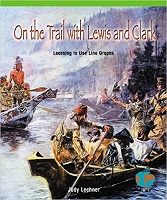
On the Trail with Lewis and Clark lesson 2, One Dot, Two Readings
A labelled grid with both of the book's values plotted and joined, and a partner's grid read back — a finger run down to the month and across to the miles for each dot.
2
The word in the question decides which end of the line you want
On the Trail with Lewis and Clark lesson 3, The Word That Points the Finger
Both questions answered off one line and checked against the printed answers, then the word fewest laid over the word most and the new answer pointed at.
3
Join every matching line, then look at the two that do not match
Follow Your Money lesson 2, Same Jeans, Double the Price: Where the Extra Forty Dollars Goes
Two differences written side by side, and the sentence on the strip completed with a number from the cards in each blank.
4
Rebuild the rows nobody printed, and show what each one needed Checkpoint after this lesson
The Great Number Rumble lesson 7, Rebuild the Table Sam Wrote
The table built to day eleven with running totals, checked at the reported figure, and the seven cards ordered with the rule-setting card identified.
5
Build the scale, then put the converted number on it
Weather Math lesson 4, One Mile Every Five Seconds
A scale of miles carrying two marks in two colours, with the distance between them measured and written beside the two counts.
6
Convert first, then take the range off twice
Weather Math lesson 5, What the Warm Spell Leaves
Eight depths converted and reduced twice each, with the rows that would melt away entirely ringed.
7
Carry both ends through, and compare both with the rule Checkpoint after this lesson
Weather Math lesson 1, Enough Snow for a Snow Day?
A two-column sheet carried to the end, with both totals placed on the snow strip beside the six-inch mark.
8
Multiply a range by a weight, and name what each end costs
Kitchen Math lesson 2, Two answers for one roast
Two cooking times in minutes and both of them divided by sixty into hours, with the whole number of hours both answers sit closest to said aloud.
Unit vocabulary
Words students say, not words they are taught to define.
plotted point
One dot holding two readings. Lesson 1 will not accept one of the two on its own.
most, fewest
The two words that send a finger to opposite ends of the same line. Lesson 2's whole lesson.
row, column
How a table is read. Lesson 3 joins rows across two tables and lesson 4 rebuilds the ones that are missing.
scale
A line marked in units, built in lesson 5 so that a converted number has somewhere to go.
range
Two numbers where one was expected. It stays two numbers through every operation in lessons 6, 7 and 8.
rule, threshold
A stated number an answer gets compared with — six inches for a snow day. It turns a question about weather into a comparison.
Materials
From the source lessons
Each day's materials are listed on that day's page below and on the source lesson itself. Nothing is duplicated here.
New for this unit
Checkpoint 1 page, one per child
Checkpoint 2 page, one per child
Performance task set: a printed line graph with a scale marked in tens, a two-column table with two rows missing, a blank scale strip, a ruler, a card giving a rate as a range and a stated rule, a two-column least-and-most recording sheet, and a pencil, one set per pair
Performance task page, one per child
Assessment plan
Daily evidence
Keep the two-column least-and-most sheets from lessons 6 to 8. A child who writes one number in a row where the source gave a range has made the error the whole second half of the unit is about, and it is visible at a glance across a pile of sheets without reading any of the arithmetic.
Checkpoint 1, after lesson 4: Read it, then say what you read
A line graph of five plotted months and a two-column table with one row missing. The child reads a named month's value, answers a most question and a fewest question, and fills the missing row.
Book-free. One printed graph and one printed table, no book.
Look for. Both readings given for the plotted point — the month and the value — and the missing row filled from the rule rather than guessed between its neighbours. A child who answers most and fewest with the same dot has read the picture and not the word.
Checkpoint 2, after lesson 7: Both ends, all the way through
A card stating that three inches have fallen and that one to two inches an hour will fall for three more hours, with a four-inch rule. The child works the least and the most and compares both with the rule.
Book-free. One forecast card and a two-column sheet, no book.
Look for. Two columns kept apart from the start, and an answer given as two numbers with the rule between them. A child who averages the hourly rate to one and a half has produced a single tidy number that the forecast does not support.
Culminating task: One display, one table, one range, and an answer with two numbers in it
Each pair does three jobs. They read a printed line graph: a named point's two readings, the highest and the lowest, and one value that falls between two marks on the scale, which they report as between two numbers rather than rounding it silently. They fill the two missing rows of a table from the rule the table follows, and say which row each one depended on. Then they take a card giving a rate as a range and a total to apply it to, carry both ends through the arithmetic into a two-column sheet, mark both ends on the blank scale strip, and compare both with the stated rule — finishing with one sentence that contains both numbers and says what each end would mean.
Collect. The graph readings including the between-two-marks value, both missing rows filled with the row each depended on named, the two-column sheet carried through, both ends marked on the scale, and the closing sentence with both numbers in it.
What it assesses. Every number in the task traced back to what was read off a display, and a range kept as a range from the card to the final sentence — which is the difference between an answer a forecast supports and a tidy one it does not.
Daily lesson pages
Lesson 1One dot holds two readings, and you need both
Skill lessonOn the Trail with Lewis and Clark · lesson 2, One Dot, Two Readings · Grade 4 · 20 minutes Reading a month and a value off a line graph
I can
I can read a plotted point as a month and a number.
Big idea
A dot on a line graph is a pair. The month comes from underneath and the value from the side, and a reader who takes only one of the two has not read the graph.
Success
The child rules and labels the grid, plots both stated values, joins them, and reads a dot on somebody else's grid back as a month and a number of miles.
Connect | 5 min
First lesson. Put one dot on a ruled grid and ask what it says. Take the answers and count how many of them named two things.
Taught on its own
The book explains that a line graph records facts as dots joined by lines, and then prints the answers a reader would get from four of its own graphs.
Source core | 20 min
Children read the two sentences saying how a line graph is made and put a finger on the dot and on the joining line, say aloud what one dot holds, then write the months along the bottom and the miles up the side counting by fifties, place a dot at three hundred eighty for May and at forty for June, and join them.
Collect
A labelled grid with both of the book's values plotted and joined, and a partner's grid read back — a finger run down to the month and across to the miles for each dot.
Close | 5 min
Children write one sentence for each dot in the book's own shape, the month then the miles, and read both to a partner who points at the matching dot — and if the partner points at the wrong dot, they find which half of the sentence sent them there.
From the source lesson: Printed source passage in this step; Blank grid paper, one sheet per pair; Ruler, one per pair; Coloured pencil, one per student; Sticky note, two per pair; Lined half-sheet, one per student; Word cards: dot, miles, month
Watch for: A dot reported as a number only. Ask which month, and wait for the finger to go down as well as across.
Lesson 2The word in the question decides which end of the line you want
Skill lessonOn the Trail with Lewis and Clark · lesson 3, The Word That Points the Finger · Grade 4 · 20 minutes Using most and fewest to locate a value on a line graph
I can
I can answer a most question and a fewest question off the same graph.
Big idea
The graph does not change when the question does. One word sends a finger to the highest dot and another sends it to the lowest, and noticing which word is doing that is the reading skill.
Success
The child answers both questions off their own line, checks both against the book's printed answers, swaps the two words on one question, and says what moved.
Connect | 5 min
Yesterday the dots were read. Today the same line is asked two questions that differ by one word, and the answers are different.
Taught on its own
Every graph in the book is asked the same two questions, and the only thing that changes between them is one word.
Source core | 20 min
Children take a card for each of the two words that make the questions different, lay them one above the other and say what each tells a finger to do, then find the dot the word most sends them to and write the month beside the card, and do the same for fewest — checking both against the book's own answers.
Collect
Both questions answered off one line and checked against the printed answers, then the word fewest laid over the word most and the new answer pointed at.
Close | 5 min
Children write one question of their own about their line using either word and hand it to another pair with the graph but not the answer; when the pair answers, they decide together whether the graph or the wording sent them wrong.
From the source lesson: Printed source passage in this step; Word card set, one per pair; Ruled and labelled grid, one per pair; Coloured pencil, one per student; Sticky note, two per pair; Lined half-sheet, one per student; Word cards: most, fewest
Watch for: The same dot given for both questions. Read the two words aloud and ask which one means the top.
Lesson 3Join every matching line, then look at the two that do not match
Skill lessonFollow Your Money · lesson 2, Same Jeans, Double the Price: Where the Extra Forty Dollars Goes · Grade 4 · 20 minutes Comparing two tables line by line and subtracting to find a difference
I can
I can compare two tables line by line and say where a difference ends up.
Big idea
Two tables are compared by matching rows, not by scanning totals. When every line but two is identical, the difference has only one place it can go, and that is a conclusion rather than a guess.
Success
The child joins each matching pair of lines, names and subtracts the two unmatched pairs, and states where the extra forty dollars ends up using numbers from the cards.
Connect | 5 min
Graphs have been read for two lessons. Put two ledgers side by side and ask which costs more to make — then ask how much of the price difference that explains.
Taught on its own
The book prints two ledgers back to back whose cost columns are identical line for line and whose prices differ by forty dollars.
Source core | 20 min
Children lay the two cards side by side cost line against cost line, read each pair aloud together working down the column, draw one joining line for every pair carrying the same amount and count the joining lines, then find the two lines with no joining line and subtract each pair.
Collect
Two differences written side by side, and the sentence on the strip completed with a number from the cards in each blank.
Close | 5 min
Children run the same test on the second pair of ledgers — joining the lines that match, naming the ones that do not, subtracting each unmatched pair — and say whether these two behave the way the first pair did, naming one cost line that changes here and did not change there.
From the source lesson: Regular jeans ledger card and designer jeans ledger card, one pair per two students; Pencil per student; Comparison strip with a price row and a leftover row, one per student; Sentence strip with two blanks, one per student; Cheap earrings and diamond earrings ledger cards, one pair per two students; Aligned two-ledger grid sheet, one per student; Blank ledger form with a printed price line and leftover line, one per student; Word cards: difference, cost line, left over
Watch for: A conclusion drawn from the totals alone. Ask how many lines matched, and count the joining lines.
Lesson 4Rebuild the rows nobody printed, and show what each one needed
Math through the readingThe Great Number Rumble · lesson 7, Rebuild the Table Sam Wrote · Grade 4 · 20 minutes Students reconstruct the missing rows of Sam's wage table between the three totals the book reports, and prove the order matters by trying to compute a row with the row above it hidden.
I can
I can rebuild missing rows of a table and say which row each one depended on.
Big idea
A table built on a rule has no independent rows. Each one is reachable only from the one above it, which is why the order of the rows is part of the information.
Success
The child orders the events, builds the table with running totals, checks a stated total at the checkpoint, and shows that a row cannot be written while the row above it is covered.
Connect | 5 min
Two tables were compared yesterday and every row was there. Today three totals are given and the rows between them are missing.
Taught on its own
The book reports totals at three points of a doubling wage and never prints the rows between them.
Source core | 20 min
Children spread the seven event cards, read each aloud and place them left to right in the order they happen, set the card that says how to get from one day's pay to the next slightly above the line, then build the day table from day one with the running total beside it and stop at day five to check against the stated figure.
Collect
The table built to day eleven with running totals, checked at the reported figure, and the seven cards ordered with the rule-setting card identified.
Close | 5 min
Children cover day seven with a blank card and hand the strip to a partner, who has to try to write day eight without uncovering it — then they uncover it, finish the table, and say aloud what the partner needed before day eight could be written.
From the source lesson: Seven event cards per pair, each printed with one sentence from the book; Day table strip per pair, ruled for eleven numbered rows with two columns; One blank cover card per pair; Pencil per student; The seven events enlarged in a scrambled row where the class can see them; One day table with day seven covered, held up during the dependence test
Watch for: A row filled by splitting the difference between its neighbours. Ask which card gave the rule and have the row recomputed from it.
Checkpoint after this lesson: Read it, then say what you read. The page is at the end of this guide.
Lesson 5Build the scale, then put the converted number on it
Skill lessonWeather Math · lesson 4, One Mile Every Five Seconds · Grade 4 · 20 minutes Turning a count of seconds into a distance at a stated rate and marking it on a scale
I can
I can turn a count of seconds into miles and mark it on a scale.
Big idea
A converted number means more once it is on a scale. Two marks on one scale turn two separate answers into a distance that can be measured and seen closing in.
Success
The child writes the rule as a division, converts both counts and marks them in two colours, measures the distance between the marks, and marks the distance at which the whistle goes.
Connect | 5 min
Tables and graphs have both been read. Ask how far away a storm is if the bang comes sixty-five seconds after the flash — and what would let anybody say.
Taught on its own
The book gives a rule for locating a storm — sound covers a mile every five seconds — works one case, thirty seconds being about six miles, and leaves two.
Source core | 20 min
Children read what flash to bang means and the speed of sound rule, write the division they would use to get from seconds to miles, then convert the sixty-five second count and mark it on their scale, and convert the later count and mark that in a different colour.
Collect
A scale of miles carrying two marks in two colours, with the distance between them measured and written beside the two counts.
Close | 5 min
Children read the rule about halting the game, mark the distance that matches it on the scale, and say how many more miles the storm has to travel before the whistle goes.
From the source lesson: A mile scale strip per pair, ruled and numbered to twenty; A five-row storm sheet per pair; A pencil; Word cards: Flash to Bang, every, per, scale
Watch for: Seconds marked on the scale instead of miles. Ask what the division produced and what the scale is marked in.
Lesson 6Convert first, then take the range off twice
Skill lessonWeather Math · lesson 5, What the Warm Spell Leaves · Grade 4 · 20 minutes Converting feet to inches and subtracting a range from a total
I can
I can change feet to inches before subtracting, and subtract both ends of a range.
Big idea
Two numbers in different units cannot be subtracted. The conversion comes first, and when the amount taken away is a range the subtraction gets done twice.
Success
The child converts each depth from feet to inches and subtracts both the smaller and the larger amount, and rings any row where the most that could melt would leave nothing at all.
Connect | 5 min
Yesterday one number went onto a scale. Today two numbers arrive in different units and one of them is a range. Read the sentence and ask what has to happen first.
Taught on its own
Half a foot of snow falls and a warm spell is expected to melt two to four inches of it.
Source core | 20 min
Children read what the storm produced and the reminder about feet and inches, write the snowfall in inches saying what they multiplied, then subtract the smaller amount of melting from the total and then the larger, writing both answers.
Collect
Eight depths converted and reduced twice each, with the rows that would melt away entirely ringed.
Close | 5 min
Children take one row and show it on the ruler — marking the snowfall, marking what melts, reading off what is left — and say whether the ruler agrees with the arithmetic.
From the source lesson: A twelve-inch ruler per child; An eight-row conversion sheet per pair, ruled for feet, inches, least left and most left; A pencil; Word cards: foot, inches, melt, left
Watch for: A subtraction done before the conversion. The answer looks plausible; ask what unit each number is in before the take-away.
Lesson 7Carry both ends through, and compare both with the rule
Skill lessonWeather Math · lesson 1, Enough Snow for a Snow Day? · Grade 4 · 20 minutes Carrying both ends of a stated range through an addition and comparing the result with a rule
I can
I can work the least and the most a forecast allows and answer with both numbers.
Big idea
When one piece of a sum is a range, the total is a range. If it straddles the rule, then two numbers are the honest answer and one number is a guess.
Success
The child writes the rule, adds the fixed pieces into both columns, carries the hourly range through for the right number of hours, and answers with both numbers in the sentence.
Connect | 5 min
The range was subtracted twice yesterday. Today it is added, and the answer lands on both sides of a rule.
Taught on its own
A forecast arrives in pieces — a fifth of an inch already down, two more inches by midnight, then one to two inches an hour until three in the morning — and the rule for a snow day is six inches.
Source core | 20 min
Children write the snow day rule at the top of the sheet and say how many hours the amount has to fall in, add what is on the ground to what is expected by midnight and write that total in both columns because so far the least and the most are the same, then read the hourly rate, work out how many hours it runs, and add the least it could give to the least column and the most to the most.
Collect
A two-column sheet carried to the end, with both totals placed on the snow strip beside the six-inch mark.
Close | 5 min
Children say what each end means for the two characters and answer the book's question with both numbers in the sentence.
From the source lesson: A two-column least-and-most sheet per pair; A pencil; A one-inch-per-square snow strip per pair; Word cards: rule, accumulate, per hour, least, most
Watch for: The hourly range averaged to one and a half. It produces one tidy number the forecast does not support; put the two columns back and start the hourly step again.
Checkpoint after this lesson: Both ends, all the way through. The page is at the end of this guide.
Lesson 8Multiply a range by a weight, and name what each end costs
Skill lessonKitchen Math · lesson 2, Two answers for one roast · Grade 4 · 20 minutes Multiplying a rate given as a range by a weight and converting the minutes to hours
I can
I can carry a rate given as a range through a multiplication and turn both ends into hours.
Big idea
A rate can be a range, and multiplying it by a weight gives two times rather than one. Reporting an about-figure in hours is fair only once both ends are known.
Success
The child multiplies both ends of the rate by the weight, divides both minute totals by sixty, reports the time as a range in minutes and as one about-figure in hours, and says what happens at each end of the range.
Connect | 5 min
A range has been subtracted and added. Read the label and ask what happens when the range has to be multiplied.
Taught on its own
The label gives a cooking rate as a range, twenty-three to twenty-five minutes per pound, and the roast weighs five pounds.
Source core | 20 min
Children read the label sentences aloud, write the weight in the weight box and the two rates on the two rate rows with the smaller on top, then multiply the top rate by five pounds and the bottom rate by five pounds, circling both and writing the word to between them so the card reads as a range.
Collect
Two cooking times in minutes and both of them divided by sixty into hours, with the whole number of hours both answers sit closest to said aloud.
Close | 5 min
Children point at each end of the range and say what happens to the meat there using the book's own two words, then say one sentence naming the number of minutes between the two ends and what a cook gains by knowing it.
From the source lesson: The label card, one per pair; Pencils; A number line marked in sixty-minute hours, one per pair; Word cards: per pound, range, convert
Watch for: One multiplication done and the other skipped. The card is supposed to read as a range; check that both rate rows have a product beside them.
Culminating performance task
One display, one table, one range, and an answer with two numbers in it
Each pair does three jobs. They read a printed line graph: a named point's two readings, the highest and the lowest, and one value that falls between two marks on the scale, which they report as between two numbers rather than rounding it silently. They fill the two missing rows of a table from the rule the table follows, and say which row each one depended on. Then they take a card giving a rate as a range and a total to apply it to, carry both ends through the arithmetic into a two-column sheet, mark both ends on the blank scale strip, and compare both with the stated rule — finishing with one sentence that contains both numbers and says what each end would mean.
Collect. The graph readings including the between-two-marks value, both missing rows filled with the row each depended on named, the two-column sheet carried through, both ends marked on the scale, and the closing sentence with both numbers in it.
What it assesses. Every number in the task traced back to what was read off a display, and a range kept as a range from the card to the final sentence — which is the difference between an answer a forecast supports and a tidy one it does not.
Teacher key and rubric
Key
Checkpoint 1: choose the graph yourself; the point to insist on is that a reading is a pair. The missing row is fillable from the rule, so a child who interpolates between the neighbours may land on the right number for the wrong reason — ask what let them do it.
Checkpoint 2: three plus three is six at the least and three plus six is nine at the most, so both ends clear a four-inch rule and the answer is yes at both ends. Use a five-inch rule instead if you want an answer that straddles.
Task: make the between-two-marks reading unavoidable — a point plotted at thirty-five on a scale marked in tens. Rounding it to forty is the commonest thing a class will do, and it is worth catching in front of everybody.
Rubric
Strand
Secure looks like
Developing
Not yet
Representation
A plotted point is read as a pair, a value between two marks is reported as between them, and a converted amount is marked on a scale where its size can be seen.
Does it with the arrangement in front of them.
Produces an answer without the arrangement or the reason.
Calculation
A conversion is done before the operation that needs it, and both ends of a range are carried correctly through addition, subtraction or multiplication.
Does it with the arrangement in front of them.
Produces an answer without the arrangement or the reason.
Meaning
A range is kept as two numbers because the source gave two, and a result is compared with the stated rule rather than reported on its own.
Does it with the arrangement in front of them.
Produces an answer without the arrangement or the reason.
Explanation
A conclusion from two tables names the lines that matched and the lines that did not, and an answer from a range says what each end would mean.
Does it with the arrangement in front of them.
Produces an answer without the arrangement or the reason.
Print-ready student pages
These three pages print one to a sheet. Everything above them is the teacher guide.
Checkpoint 1 · Grade 4
Read it, then say what you read
NameDate
What does this dot tell you? Both things. Which month was most, and which was fewest? Now fill in the missing row of the table and tell me what let you do it.
Checkpoint 2 · Grade 4
Both ends, all the way through
NameDate
What is the least it could come to, and the most? Put both against the rule and tell me the answer in a sentence with both numbers in it.
Culminating task · Grade 4
One display, one table, one range, and an answer with two numbers in it
NameDate
Read this graph: tell me both readings for the marked point, the highest and the lowest, and the one value that sits between two marks — say it as between, not as the nearer mark. Now fill the two missing rows of the table and tell me which row each one needed. Then take the rate card, work the least and the most in two columns, mark both on the strip, and give me one sentence with both numbers and the rule in it.
Teacher planning and handoff
The error the second half of this unit exists to prevent is the averaged range — one to two inches an hour quietly becoming one and a half. It produces a tidy answer the source does not support, and the two-column sheet is what stops it.
Watch for a single reading taken from a plotted point. It shows up as a month with no number or a number with no month, and it goes unnoticed in discussion.
Weather Math has a fourth lesson taking two-thirds of a wind speed and sorting the result against the seventy-four mile an hour definition of a hurricane. It is the cleanest threshold lesson in the material and makes a good extra day beside lesson 7.
Kitchen Math's scale-factor lesson — twelve servings cut to three, so every ingredient is divided by four — was left out because this unit already takes that book's range lesson. It belongs with division rather than with reading a display.
Known gaps in this unit
A two-way table. Every table here is read down a column or across two tables placed side by side; nothing asks a child to cross-reference a row against a column to find one cell, which is how a timetable or a distance chart is actually read.
Reading a scale whose marks are not units of one. Lesson 5 builds a scale in single miles and lesson 6 uses an inch ruler, so no candidate requires a value to be read between marks worth five or ten — which is why the performance task supplies one.