The Word file and the PDF carry the whole guide. The student pages are the two checkpoints and the culminating task, one to a sheet.
About this unit
This unit takes the naming of flat shapes away from recognition and gives it to counting. Children stamp objects in paint and look at the mark instead of the thing that made it, dot every corner and tick every side, then build shapes to a stated list — three sides and three corners — from sticks they have to make meet end to end. By the halfway point a shape is a set of attributes rather than a picture.
Two lessons carry the weight. In lesson 5 children count the sides and corners of a square and a rectangle, find the counts identical, and have to separate the two by laying sides against each other — so the name arrives from a comparison the child performed. In lesson 6 same shape and same size come apart: a big jar and a little jar pass the shape half of the test and fail the size half, and a child who says no has to name which half failed. The unit ends on containers, where a shape word and a position word get separated because English uses tall for both.
The mathematical arc
Each lesson does one job the lesson before it made possible.
Look at the mark, not at the thing that made it
Dot every corner, tick every side, and write both counts
Build the shape from the list, and count what you built
Sort by an attribute your finger can check
Four sides is not enough: lay the sides against each other
Same shape and same size are two tests, and one can fail alone
Two of these words are about the shape and two are about where it sits
Source books
Every lesson in this unit is already published under Math lessons. Nothing here asks you to teach anything you cannot open today.
Each day names one lesson that already exists under Math lessons, with its book, its number and its title. This guide says what that lesson is doing in the sequence and what to collect from it; the lesson itself carries the steps, the printables and the answers.
Thirty minutes a day.
Five minutes to connect to yesterday, the twenty-minute source lesson, five minutes to close on something you can see. A day that runs long should lose the close, never the core.
Teach a lesson on its own if you need to.
Every day carries a one-sentence opening for a teacher who is using that lesson outside the sequence.
Stop after a checkpoint.
The unit holds together if you stop after either checkpoint and come back to it. Stopping between a checkpoint and the next one leaves a lesson without the evidence it was built on.
Where this fits in your year
When to teach it
Any time after the class can count to ten reliably. It needs no arithmetic and works well as a first or second unit of the year.
What students need first
Children can count to ten with one touch to one number word and can hold a pencil to make a dot.
What this unit develops
Naming the flat shape a face prints; counting sides and corners and writing both counts; building a shape to a stated attribute list; sorting by an attribute that can be checked by touch; separating a square from a rectangle by comparing side lengths; same shape against same size; sorting containers by shape and by height.
What it prepares them for
Grade 2 and 3 work on quadrilaterals and on solids, and any later geometry where a definition has to be tested rather than recognised.
Curriculum connections
None claimed. The lessons in this unit carry their own standards classifications on their own pages, checked lesson by lesson. A unit-level expectation is a different claim, and none has been verified for this unit, so none is printed here. Use the placement guide above to site the unit in your year, and the individual lesson pages for the codes.
Unit at a glance
#
Mathematical move
Source lesson
Collect
1
Look at the mark, not at the thing that made it
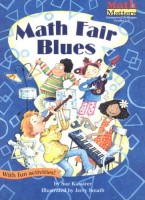
Math Fair Blues lesson 2, What Shape Did the Jar Leave Behind
Marks from three objects, each stamped twice, cut apart and sorted under the four name cards.
2
Dot every corner, tick every side, and write both counts Checkpoint after this lesson
Math Fair Blues lesson 4, Count the Sides, Count the Corners, Fill In the Row
Four row cards, each carrying two counts, with the circle's row filled in rather than blank.
3
Build the shape from the list, and count what you built
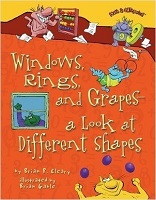
Windows, Rings, and Grapes lesson 1, Three Sticks, Four Sticks, No Corners
Four built shapes — triangle, square, rectangle, circle — each counted against its own list.
4
Sort by an attribute your finger can check
Windows, Rings, and Grapes lesson 3, The Pile With No Corners
Two piles sorted by corners, and a rule said in one sentence that a partner has applied to a tile the sorter never handled.
5
Four sides is not enough: lay the sides against each other Checkpoint after this lesson
Windows, Rings, and Grapes lesson 2, Four Sides Is Not Enough
Two built four-sided shapes, each named with its reason, and a partner's check made by laying the sides together themselves.
6
Same shape and same size are two tests, and one can fail alone
Math Fair Blues lesson 1, Will the Dollhouse Do Instead of the Block
Two judged pairs — the block and house, and the big jar and the little jar — with both halves of the reason said aloud for each.
7
Two of these words are about the shape and two are about where it sits
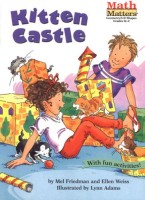
Kitten Castle lesson 2, Curvy, Square, High, Low
Six containers sorted by touch and checked by sight, and two builds — a tower and a low bed — compared by standing them on one table top.
Unit vocabulary
Words students say, not words they are taught to define.
side, corner
The two things counted from lesson 2 onwards, always in that order, sides first.
equal
Lesson 5's word, and the one that separates a square from a rectangle. Said about two sides laid against each other.
round
Used of the shape with nothing to count. Lesson 4 sorts by whether a finger has to stop and turn.
congruent
Lesson 6's word, straight from the book's own chart: same size and same shape, and both halves get checked.
curvy, high, low
Lesson 7. Two of these are about the outline of a thing and two are about where it sits, and the unit keeps them apart.
Materials
From the source lessons
Each day's materials are listed on that day's page below and on the source lesson itself. Nothing is duplicated here.
New for this unit
Checkpoint 1 page, one per child
Checkpoint 2 page, one per child
Performance task set: six unlabelled four-sided tiles including two squares, four craft sticks of one length and two shorter, a mixed tile set of triangles, circles and ovals, and a two-column row card, one set per pair
Performance task page, one per child
Assessment plan
Daily evidence
Keep the row cards from lesson 2 and the sorting rule a child said aloud in lesson 4. The row cards show whether both counts were made; the spoken rule shows whether the sort was by an attribute or by appearance, which is the distinction the whole unit turns on.
Checkpoint 1, after lesson 2: Sides and corners, both counts
A paper pentagon the child has not seen before, and a pencil. The child dots every corner, ticks every side, writes both counts in the right order, and then does the same for a paper circle.
Book-free. Paper shapes and a pencil, no book.
Look for. Zero written in both columns for the circle rather than the boxes left blank. Writing a number for nothing is the part of this that is worth reaching.
Checkpoint 2, after lesson 5: Square or rectangle?
Three four-sided tiles: an obvious square, an obvious rectangle, and a near-square whose sides differ by a few millimetres. The child sorts all three and says what they did to decide about the third.
Book-free. Tiles, no book.
Look for. The child lays sides against each other for the near-square rather than judging it by eye. A correct answer reached by looking is the one to probe, because the next near-square will fool it.
Culminating task: Count it, build it, name it
Each pair does three things. They take a shape they have not seen and fill a two-column row card for it, dotting every corner and ticking every side. They build a four-sided shape from four equal sticks and a second from two long and two short, and name each one with the reason said in the same breath. Then they sort six unlabelled four-sided tiles into a square pile and a rectangle pile by laying sides against each other, and say for two of the tiles what they did to decide.
Collect. The filled row card, the two built shapes with their names and reasons, and the sorted tiles with two decisions explained aloud.
What it assesses. Counting both attributes, building to an attribute list, and separating two shapes whose counts are identical by a comparison — the three things the unit built, with no shape named from a glance.
Daily lesson pages
Lesson 1Look at the mark, not at the thing that made it
Skill lessonMath Fair Blues · lesson 2, What Shape Did the Jar Leave Behind · Grade 1 · 20 minutes Naming the flat shape an object's face prints
I can
I can name the shape an object leaves behind.
Big idea
A flat shape is not the object. It is what the object's face prints, and naming it means looking at the mark.
Success
The child holds up an object, puts a finger on the mark it made, and says the object first and the shape second.
Connect | 5 min
First lesson. Hold up a jar and ask what shape it is. Take the answers — round, a cylinder, a circle — and say that today the jar will leave its answer on the paper.
Taught on its own
This book prints its shapes rather than drawing them: a washed jelly jar dipped in red paint leaves a perfect red circle, and a yellow block leaves the rectangle Seth wanted.
Source core | 20 min
Children press the mouth of a washed jar into shallow paint, stamp it once, and run one finger all the way round the mark without lifting it while saying the shape name; then they stamp a flat face of a block and a triangle box lid beside it and count the straight edges of each new mark by touch.
Collect
Marks from three objects, each stamped twice, cut apart and sorted under the four name cards.
Close | 5 min
Each child holds up one object with a finger on the mark it made and tells a partner the object first and the shape second, and the partner says whether the finger is on the right mark.
From the source lesson: An empty jar with a clean round mouth per pair; A shallow tray of washable paint per pair, one colour; White paper, several sheets per pair; A wooden block with one flat rectangular face per pair; A box or lid with one flat triangular face per pair; Four name cards per pair: circle, rectangle, triangle, square; Scissors per pair; Word cards: circle, rectangle, triangle
Watch for: A mark that will not go under any of the four cards. Lay it beside them and say what can be said about it rather than forcing it under one.
Lesson 2Dot every corner, tick every side, and write both counts
Skill lessonMath Fair Blues · lesson 4, Count the Sides, Count the Corners, Fill In the Row · Grade 1 · 20 minutes Counting the sides and corners of a printed shape
I can
I can count the sides and the corners of a shape and write both numbers.
Big idea
A shape carries two counts, and they are written in a fixed order: sides first, corners second. The shape with nothing to count still gets a number.
Success
The child writes both counts into each row card in the book's order and puts a number in both columns of the circle's row rather than leaving them blank.
Connect | 5 min
Yesterday the marks got names. Today they get numbers, and the numbers go in a row.
Taught on its own
The chart at the back gives each shape a row, and each row carries two counts in the same order, sides first and corners second, down to zero and zero for the circle.
Source core | 20 min
Children put a pencil dot on every corner of a print and a small tick on every side, count the ticks aloud and then the dots, and write both counts into that shape's row card — with a partner counting the dots back before anything else is written.
Collect
Four row cards, each carrying two counts, with the circle's row filled in rather than blank.
Close | 5 min
Children lay their row cards in a column, hear the book's four rows read out, and put the square's row beside the rectangle's to say whether the numbers alone would let anybody tell which print was which.
From the source lesson: Each pair's own prints from the printing lesson, or a set of paper circles, squares, rectangles and triangles; A pencil per child; A blank two-column row card per shape, headed sides and corners; A paper shape with five sides per pair, and a blank row card for it; Word cards: sides, corners, zero
Watch for: An empty pair of boxes for the circle. Ask how many corners they found, and write that number.
Checkpoint after this lesson: Sides and corners, both counts. The page is at the end of this guide.
Lesson 3Build the shape from the list, and count what you built
Skill lessonWindows, Rings, and Grapes · lesson 1, Three Sticks, Four Sticks, No Corners · Grade 1 · 20 minutes Building two-dimensional shapes from a stated number of sides and corners
I can
I can build a shape that has the right number of sides and corners.
Big idea
The book's closing pages state each shape as a checklist. If the list is what makes the shape, a shape built to the list has to pass a count.
Success
The child builds a shape and counts both its sides and its corners against the list the book states for it.
Connect | 5 min
Counting the parts of a shape somebody else printed is one thing. Today the class makes the shape and the parts have to come out right.
Taught on its own
The closing pages drop the rhyme and state each shape as a short list of things it must have: three sides and three corners, four equal sides, or perfectly round with no corners at all.
Source core | 20 min
Children say a shape's checklist back before anything is built, then lay three craft sticks so every stick touches two others end to end with no gap, count the sticks and the meeting places, and say whether both numbers match the list.
Collect
Four built shapes — triangle, square, rectangle, circle — each counted against its own list.
Close | 5 min
Children bend a pipe cleaner until its two ends meet with no bend sharper than any other, run a finger round hunting for a corner to stop at, and say what their count of corners came to.
From the source lesson: Attribute cards, one per shape, blank on the front and ruled into two lines on the back; Craft sticks, twelve per child, all the same length; Craft sticks in a second, shorter length, four per child; Pipe cleaners, two per child; Word cards: corner, equal, round, side
Watch for: Sticks laid with gaps at the corners. A gap means the corner was never made; push them together before counting.
Lesson 4Sort by an attribute your finger can check
Skill lessonWindows, Rings, and Grapes · lesson 3, The Pile With No Corners · Grade 1 · 20 minutes Sorting shapes into two groups by whether they have corners
I can
I can sort shapes by whether they have corners, and say my rule.
Big idea
A tile's group is settled by something checkable, not by what it looks like at a glance. A rule said precisely enough can be applied by somebody who never handled the tile.
Success
A partner places an unsorted tile correctly from the child's spoken rule alone.
Connect | 5 min
Shapes have been built and counted. Today they get sorted, and the rule has to be sayable.
Taught on its own
The book states the same fact twice at its close, once for the circle and once for the oval: it has no corners.
Source core | 20 min
Children run one finger slowly round a tile's outside edge without lifting it, put a counter down for every sharp turn, then sort the whole mixed set into the tiles where the finger had to stop and those where it never did — not by colour and not by size.
Collect
Two piles sorted by corners, and a rule said in one sentence that a partner has applied to a tile the sorter never handled.
Close | 5 min
Children sort the long thin oval and the very small triangle by their own rule, say which pile each goes in using the word corner, and say whether the size of a tile changed which pile it belonged in.
From the source lesson: Shape tiles, a mixed set of triangles, squares, rectangles, circles and ovals; Counters, ten per child; Two sorting mats, unlabelled; Word cards: corner, round, sort
Watch for: A sort by colour or size that happens to come out right. Ask for the rule, then hand the partner a tile that the colour rule would misplace.
Lesson 5Four sides is not enough: lay the sides against each other
Skill lessonWindows, Rings, and Grapes · lesson 2, Four Sides Is Not Enough · Grade 1 · 20 minutes Telling a square from a rectangle by comparing the lengths of its sides
I can
I can tell a square from a rectangle by comparing its sides.
Big idea
Counting leaves the two four-sided shapes indistinguishable. The name comes from a comparison — whether all four sides end together — and that is something the child does, not something the picture says.
Success
The child names each built shape with the reason in the same breath, and sorts an unlabelled set by laying sides against each other.
Connect | 5 min
Yesterday's sort had one clean yes-or-no. Today counting gives the same answer for two different shapes, and something else has to decide.
Taught on its own
The book states both four-sided shapes in almost the same words, four sides and four corners each, and then supplies the one thing that separates them.
Source core | 20 min
Children count the sides and corners of a square tile and a rectangle tile, say whether counting alone told them which was which, then build a four-stick shape and a two-long-two-short shape and lay one side on another to see whether all four end together.
Collect
Two built four-sided shapes, each named with its reason, and a partner's check made by laying the sides together themselves.
Close | 5 min
Children sort a set of unlabelled four-sided tiles into a square pile and a rectangle pile by laying sides against each other, and say aloud for at least two of them what they did to decide.
From the source lesson: A square tile and a rectangle tile, one pair per child; Craft sticks, twelve per child, all the same length; Craft sticks in a second, shorter length, four per child; A mixed set of unlabelled four-sided tiles, eight per pair; Two sorting mats, unlabelled; Word cards: equal, length, same, side
Watch for: A near-square judged by eye. Hand it back and ask them to lay two sides on each other.
Checkpoint after this lesson: Square or rectangle?. The page is at the end of this guide.
Lesson 6Same shape and same size are two tests, and one can fail alone
Skill lessonMath Fair Blues · lesson 1, Will the Dollhouse Do Instead of the Block · Grade 1 · 20 minutes Testing two shapes for same size and same shape
I can
I can say whether two marks are the same size and the same shape, and which half fails.
Big idea
Congruent is two claims in one word. A big jar and a little jar pass one of them and fail the other, so a no has to say which.
Success
The child judges the jar pair not congruent and names the half it failed on before saying anything else about it.
Connect | 5 min
Names have come from counts and from comparisons. Today two shapes get compared with each other, and there are two things to check.
Taught on its own
Seth wants the block Dana is using and finds a plastic dollhouse whose bottom is the same size and shape as the block, and the chart at the back says congruent means same size and same shape.
Source core | 20 min
Children stamp the block's face and the house's bottom, cut one mark out and lay it on the other, sliding and turning it until it sits as well as it can, and say whether the edges finish together all the way round.
Collect
Two judged pairs — the block and house, and the big jar and the little jar — with both halves of the reason said aloud for each.
Close | 5 min
Children take both pairs of marks to another pair, say for each whether the marks are congruent with a finger on each mark, and name the failing half first where a pair fails.
From the source lesson: A wooden block with one flat rectangular face per pair; A small plastic house or box with a flat bottom the same size as the block's face, per pair; A shallow tray of washable paint per pair, one colour; White paper, several sheets per pair; Scissors per pair; A big jar and a little jar, both with round mouths, per pair; Word cards: congruent, size, shape
Watch for: A yes given because both marks are circles. Ask about size as a separate question.
Lesson 7Two of these words are about the shape and two are about where it sits
Skill lessonKitten Castle · lesson 2, Curvy, Square, High, Low · Grade 1 · 20 minutes Describing and sorting containers by shape and height
I can
I can sort containers by shape and say which words are about height instead.
Big idea
English uses tall for a thing and for a place, and the two get mixed. A finger round a rim settles the shape words; standing two builds on one table settles the height words.
Success
The child says which two of the four words are about the outline of a thing and which two are about how high it sits, and sorts six containers by touch before looking.
Connect | 5 min
Flat shapes have been printed, counted, built and compared. Today the shapes are containers, and two of the words in play are not about shape at all.
Taught on its own
Tom asks the four words out loud and the book never answers him, which makes them a set worth handling rather than a list to recite.
Source core | 20 min
With eyes closed, children take a container from the feely bag, run a finger all the way round its rim without lifting, and say curvy if the finger never stops and square if it turns a corner, then open their eyes to check and put it on the right side of the mat.
Collect
Six containers sorted by touch and checked by sight, and two builds — a tower and a low bed — compared by standing them on one table top.
Close | 5 min
Children take the four kitten cards and the rooms the class has built and say for each kitten which room suits it, naming the kitten, naming the word and giving a reason; a partner may disagree and name a different word, and both say why.
From the source lesson: Word cards for curvy, square, high, low, one set per pair; The book read aloud; A feely bag with six containers per pair, three round and three with corners; A two-side sorting mat labelled curvy and square; Six stacking boxes per pair; A cardboard cat, one per pair; Four kitten cards naming Fudge, Ambush, Lovely and Trouble; Word cards: curvy, square, high, low, taller
Watch for: Tall used about a container and about its position in the same sentence. Ask which of the two they mean, and put the two word cards on opposite sides of the table.
Culminating performance task
Count it, build it, name it
Each pair does three things. They take a shape they have not seen and fill a two-column row card for it, dotting every corner and ticking every side. They build a four-sided shape from four equal sticks and a second from two long and two short, and name each one with the reason said in the same breath. Then they sort six unlabelled four-sided tiles into a square pile and a rectangle pile by laying sides against each other, and say for two of the tiles what they did to decide.
Collect. The filled row card, the two built shapes with their names and reasons, and the sorted tiles with two decisions explained aloud.
What it assesses. Counting both attributes, building to an attribute list, and separating two shapes whose counts are identical by a comparison — the three things the unit built, with no shape named from a glance.
Teacher key and rubric
Key
Checkpoint 1: five and five for the pentagon, nought and nought for the circle.
Checkpoint 2: square, rectangle, and whichever the near-square actually is — measure it yourself before the lesson. The answer matters less than whether the sides were laid together.
Task: put two squares in the set of six so that a child who sorts by counting sides alone cannot land on a plausible answer by accident.
Rubric
Strand
Secure looks like
Developing
Not yet
Representation
A shape built to a list has its sticks touching end to end with no gaps, and a printed mark is named from the mark rather than from the object that made it.
Does it with the arrangement in front of them.
Produces an answer without the arrangement or the reason.
Calculation
Both counts are made and written in the book's order, sides first and corners second, and the circle gets a number rather than a blank.
Does it with the arrangement in front of them.
Produces an answer without the arrangement or the reason.
Meaning
A name is given with its reason attached, and same shape is kept apart from same size.
Does it with the arrangement in front of them.
Produces an answer without the arrangement or the reason.
Explanation
A sorting rule is said in one sentence precisely enough that a partner can apply it to a tile the sorter never handled.
Does it with the arrangement in front of them.
Produces an answer without the arrangement or the reason.
Print-ready student pages
These three pages print one to a sheet. Everything above them is the teacher guide.
Checkpoint 1 · Grade 1
Sides and corners, both counts
NameDate
Put a dot on every corner and a tick on every side. Write how many sides and how many corners. Now do this one.
Checkpoint 2 · Grade 1
Square or rectangle?
NameDate
Put each of these in the square pile or the rectangle pile. Tell me what you did to decide about this one.
Culminating task · Grade 1
Count it, build it, name it
NameDate
Dot every corner and tick every side, and write both counts. Now build a four-sided shape with four sticks the same, and another with two long and two short. Name each one and say why in the same breath. Last, sort these six tiles into squares and rectangles, and tell me what you did to decide about two of them.
Teacher planning and handoff
A child who sorts squares from rectangles by eye in the performance task will be fooled by the first near-square they meet in Grade 2. Note them and give them the sticks again rather than the tiles.
Lesson 6 is the only place on this shelf where same shape and same size are pulled apart. If the class is going on to any work on scale or on equal parts, keep it.
Windows, Rings, and Grapes has two further lessons, on which changes to a shape change its name and on naming a shape at speed, which were left out because they would have been a fourth and fifth lesson from one book; the moves they teach are carried by lessons 4 and 5.