The Word file and the PDF carry the whole guide. The student pages are the two checkpoints and the culminating task, one to a sheet.
About this unit
This unit separates worth from size in the first two lessons and then spends five making worth do work. Children lay a penny pile under each coin and count it, so that the nickel sitting on five pennies and the dime sitting on ten is something they built rather than something they were told. From there they trade a handful for one coin, run a total forward as payments arrive, and finish with a goal and a gap.
The turns that matter are all about what stays the same. A trade changes how many coins are in your hand and not how much money you have, which children find genuinely strange and check by cent value rather than by counting coins. A running total starts where the last one stopped, so the six lines of a savings jar lock together and one line's answer is the next line's beginning. And a price can have had the discount taken off it already, which is the last lesson's whole difficulty: the same three words sit in a question about a price nobody has yet reduced and in a statement about one somebody has.
The mathematical arc
Each lesson does one job the lesson before it made possible.
Four coins, four values, and the value is not the size
Build the worth in pennies and let the piles decide the order
A trade changes how many coins you hold, not how much money
Add the new coin to the total you have already reached
One line's answer is the next line's beginning
The empty squares say how much is still needed
Ten dollars off — and telling a price that has already had it off
Source books
Every lesson in this unit is already published under Math lessons. Nothing here asks you to teach anything you cannot open today.
Each day names one lesson that already exists under Math lessons, with its book, its number and its title. This guide says what that lesson is doing in the sequence and what to collect from it; the lesson itself carries the steps, the printables and the answers.
Thirty minutes a day.
Five minutes to connect to yesterday, the twenty-minute source lesson, five minutes to close on something you can see. A day that runs long should lose the close, never the core.
Teach a lesson on its own if you need to.
Every day carries a one-sentence opening for a teacher who is using that lesson outside the sequence.
Stop after a checkpoint.
The unit holds together if you stop after either checkpoint and come back to it. Stopping between a checkpoint and the next one leaves a lesson without the evidence it was built on.
Where this fits in your year
When to teach it
After the class can count by fives and tens to one hundred. It needs that count and nothing more, and it sits well beside any classroom routine involving a shop or a collection.
What students need first
Children can count by fives and tens, and can count a set of ten objects reliably.
What this unit develops
The cent value of each coin; worth built as a penny pile; trading a group for one coin of equal value; adding a new coin to a running total; running a total forward through several checkpoints; finding the gap to a stated goal; taking a fixed amount off a price and telling a reduced price from an unreduced one.
What it prepares them for
The Grade 2 money units, which make amounts and change from mixed handfuls, and any later work where a total is carried forward rather than recomputed.
Curriculum connections
None claimed. The lessons in this unit carry their own standards classifications on their own pages, checked lesson by lesson. A unit-level expectation is a different claim, and none has been verified for this unit, so none is printed here. Use the placement guide above to site the unit in your year, and the individual lesson pages for the codes.
Unit at a glance
#
Mathematical move
Source lesson
Collect
1
Four coins, four values, and the value is not the size
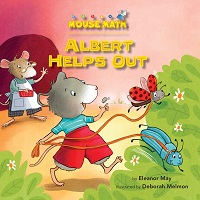
Albert Helps Out lesson 1, Four Coins, Four Cent Values
A four-line cent strip with the actual coin sitting on each line, read top to bottom as four sentences.
2
Build the worth in pennies and let the piles decide the order Checkpoint after this lesson
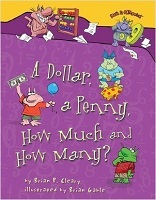
A Dollar, a Penny, How Much and How Many lesson 2, What Each Coin Is Worth
Four counted penny piles with a worth card beside each coin, checked by a partner against the pile.
3
A trade changes how many coins you hold, not how much money
Albert Helps Out lesson 2, Trade Five Pennies for One Nickel
Three completed trades with the cent value said at every swap, and a count of how many coins were held before and after.
4
Add the new coin to the total you have already reached
Albert Helps Out lesson 3, Count Up to Fifty Cents, One Payment at a Time
A wall chart carrying four running totals, each in the child's own number with the book's printed line written after it.
5
One line's answer is the next line's beginning Checkpoint after this lesson
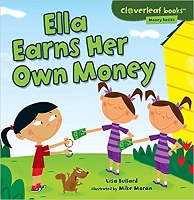
Ella Earns Her Own Money lesson 1, The Jar Line Chain
The six cards in order, and the chain built once on a mat that is never cleared, counted aloud after every line and matched to that line's stated answer.
6
The empty squares say how much is still needed
Ella Earns Her Own Money lesson 2, How Much More to Twenty
A recording strip carrying the gap at each of the book's stops, with the book's own nine used as the check on the method.
7
Ten dollars off — and telling a price that has already had it off
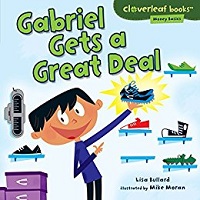
Gabriel Gets a Great Deal lesson 2, Ten Dollars Off
The written answer to the book's question, and the shop's two prices sorted by whether the ten has come off, with the wrong move tried aloud and refused.
Unit vocabulary
Words students say, not words they are taught to define.
worth
The number of cents a coin stands for, built as a penny pile in lesson 2 and used in every lesson after.
trade
Swapping a handful for one coin of the same worth. Lesson 3 checks fairness by cents and not by how many coins are left.
running total
Lesson 4 and 5. The number you have reached, which the next payment is added to rather than restarting.
gap
Lesson 6's idea: the empty squares of a twenty-frame, which say how much is still needed.
off
Lesson 7. Ten dollars off a price is a subtraction, and a price can already have had it done to it.
Materials
From the source lessons
Each day's materials are listed on that day's page below and on the source lesson itself. Nothing is duplicated here.
New for this unit
Checkpoint 1 page, one per child
Checkpoint 2 page, one per child
Performance task set: a coin tray with ten pennies, four nickels, three dimes and two quarters, thirty loose pennies, a twenty-frame, twenty paper dollar cards, and two price cards, one set per pair
Performance task page, one per child
Assessment plan
Daily evidence
Keep the cent strip from lesson 1 and the chart from lesson 4 where the child's spoken total was written before the book's printed one. The order of those two columns is the record: a child whose number went down first was doing the arithmetic rather than reading it.
Checkpoint 1, after lesson 2: Which is worth more?
A nickel and a dime, and a pile of loose pennies. The child builds the penny pile for each, says which coin is bigger across and which is worth more, and says the sentence that puts both facts together.
Book-free. Coins and pennies, no book.
Look for. The answer comes from the piles. A child who answers correctly from memory should still be asked to build both piles, because the next coin pair they meet will not be one they remember.
Checkpoint 2, after lesson 5: Where does the next line start?
Four cards, each a line of arithmetic about one jar, shuffled. The child puts them in order using only the rule that a line follows the line whose answer it begins with, and says the number the chain ends on.
Book-free. Four arithmetic cards, no book.
Look for. The ordering is done by matching an answer to a beginning, not by size of number. Ask which card goes first and why: the right reason is that its starting number is nobody's answer.
Culminating task: Worth it, trade it, count it, close the gap
Each pair does four things. They build the penny pile for a nickel and a dime and say which is worth more and which is bigger. They trade five pennies for a nickel and say whether they have more money than before. They run a total forward through four payments the teacher reads, saying each new total before it is written. Finally they build a total on a twenty-frame and count the empty squares to say how many dollars are still needed.
Collect. The two penny piles with the spoken comparison, the trade with its same-money answer, the four-payment chart with the child's numbers, and the gap counted off the frame.
What it assesses. Worth built rather than recalled, a fair trade checked by cents, a total carried forward, and a gap read off a frame — the four moves the unit built, with no coin judged by its size.
Daily lesson pages
Lesson 1Four coins, four values, and the value is not the size
Skill lessonAlbert Helps Out · lesson 1, Four Coins, Four Cent Values · Grade 1 · 20 minutes Naming the cent value of a penny, nickel, dime and quarter
I can
I can say how many cents each coin is worth.
Big idea
A coin's name carries its value. The nickel is bigger than the dime and worth less, so looking at a coin cannot tell you what it is worth.
Success
The child names a coin from a number of cents without looking at the strip, and can say the sentence where the smaller coin is worth more.
Connect | 5 min
First lesson. Hold up a nickel and a dime and ask which is worth more. Take the answers and let the disagreement stand.
Taught on its own
The book stops the story to print its four coin values one after another, each as a plain equation with the coin on the left and a number of cents on the right.
Source core | 20 min
Children line the four coins up in the order the book names them, read the four printed sentences aloud touching each coin as they say its value, then write each coin's name and cents on a strip, copying the value from the book's sentence rather than from memory.
Collect
A four-line cent strip with the actual coin sitting on each line, read top to bottom as four sentences.
Close | 5 min
One partner says a number of cents and the other picks up the coin that equals it and names it without looking at the strip; a disagreement is settled by putting the coin on the book's own sentence.
From the source lesson: A tray of real or plastic coins per pair: 10 pennies, 4 nickels, 3 dimes, 3 quarters; Printed source passage in this step; A cent-value strip per pair, blank, with room for four coin names; Word cards: cent, equals, penny, nickel, dime, quarter
Watch for: The nickel and dime pair answered from size. Send them back to the printed sentence rather than telling them.
Lesson 2Build the worth in pennies and let the piles decide the order
Skill lessonA Dollar, a Penny, How Much and How Many · lesson 2, What Each Coin Is Worth · Grade 1 · 20 minutes Coin worth: matching each coin to the number of pennies it is worth
I can
I can build each coin's worth in pennies and put the coins in order by worth.
Big idea
Worth is a count. A pile of pennies under a coin is what makes the number checkable, and the piles put the coins in an order that the coins themselves do not.
Success
The child orders the four coins from least worth to most using the penny piles, and recounts rather than looking at the coins when a partner disagrees.
Connect | 5 min
Yesterday the values came off the page. Today they get built out of pennies so the numbers can be checked.
Taught on its own
The book prints a worth line for all four coins and promises the reader will know each one before it ends.
Source core | 20 min
Children lay one penny under the penny, five under the nickel counted one by one, ten under the dime, and twenty-five under the quarter laid five to a row, counting each pile aloud and saying its cents before moving on.
Collect
Four counted penny piles with a worth card beside each coin, checked by a partner against the pile.
Close | 5 min
Children put the four coins in order from least worth to most using the piles and not the coins, and where two children disagree both recount the piles rather than looking at the coins again.
From the source lesson: Plastic coin sets per pair: one penny, one nickel, one dime, one quarter, and thirty loose pennies; Coin mat: a paper strip with four squares in a row; Worth cards: blank slips for writing a number of cents; Word cards: worth, cent, penny, nickel, dime, quarter
Watch for: A quarter pile counted one by one and lost. Lay it five to a row and count by fives.
Checkpoint after this lesson: Which is worth more?. The page is at the end of this guide.
Lesson 3A trade changes how many coins you hold, not how much money
Skill lessonAlbert Helps Out · lesson 2, Trade Five Pennies for One Nickel · Grade 1 · 20 minutes Trading a group of coins for one coin of equal value
I can
I can trade a handful of coins for one coin worth the same.
Big idea
Fairness in a trade is decided by cents on both sides. The number of coins in your hand gets smaller and the money does not change.
Success
The child says out loud, after each swap, whether they have more money than before, less, or exactly the same — and says the same.
Connect | 5 min
The piles showed that five pennies and a nickel are the same worth. Today that becomes something you can do rather than something you can see.
Taught on its own
Three times the book answers Albert's question with a trade rather than an amount: five pennies become a nickel, two nickels a dime, and two dimes with a nickel a quarter.
Source core | 20 min
Children put five pennies on the mat, count them aloud, swap all five for one nickel and say what the nickel is worth, then run the two-for-one and three-for-one trades in the book's own order, holding each result before the next trade begins.
Collect
Three completed trades with the cent value said at every swap, and a count of how many coins were held before and after.
Close | 5 min
The teacher offers one dime for four pennies. Children use the strip and the coins to decide whether to take it, say the two cent numbers that made up their minds, and say what would have to be added to make it fair.
From the source lesson: A tray of real or plastic coins per pair: 10 pennies, 4 nickels, 3 dimes, 3 quarters; A ten-frame mat per pair; Printed source passage in this step; A cent-value strip per pair, blank, with room for four coin names; Word cards: trade, fair, worth
Watch for: A trade accepted because it leaves fewer coins. Ask for the two cent numbers before any hand moves.
Lesson 4Add the new coin to the total you have already reached
Skill lessonAlbert Helps Out · lesson 3, Count Up to Fifty Cents, One Payment at a Time · Grade 1 · 20 minutes Adding a new coin to a running total in cents up to fifty
I can
I can add each payment to my total and say the new total.
Big idea
A running total is the number you are standing on. The next payment is added to it, and saying your own answer before reading the page is what makes it arithmetic rather than copying.
Success
The child says the new total aloud before the printed line is read, every time, and the chart carries their number first.
Connect | 5 min
Trades kept the money the same. Today the money grows, one payment at a time.
Taught on its own
Albert is paid four times and the book prints the running total in cents after each payment, each addition written out as a sentence.
Source core | 20 min
Children start with the nickel Albert holds, add the second nickel, trade the pair for a dime and add a second dime — saying what the two dimes are worth together and writing it on the chart before the book's sentence is read.
Collect
A wall chart carrying four running totals, each in the child's own number with the book's printed line written after it.
Close | 5 min
Children read the line where Albert is given the second quarter, put it on the mat, say the total in cents before writing it, and say the one number both they and the book ended on.
From the source lesson: A tray of real or plastic coins per pair: 10 pennies, 4 nickels, 3 dimes, 3 quarters; A ten-frame mat per pair; A wall chart the teacher writes the running total on; Printed source passage in this step; Word cards: total, plus, cents, fifty
Watch for: The page read first. Cover the sentence until the child's number is written down.
Lesson 5One line's answer is the next line's beginning
Skill lessonElla Earns Her Own Money · lesson 1, The Jar Line Chain · Grade 1 · 20 minutes Running a total forward through six printed checkpoints, adding one, two or four dollars at a time and never passing twenty
I can
I can put the jar lines in order and build the whole chain.
Big idea
Six lines about one jar lock together because each one starts on the number the last one ended on. That rule alone puts them in order, without adding anything up.
Success
The child orders the six cards by that rule alone and can say why the first card goes first — its starting number is nobody's answer.
Connect | 5 min
Yesterday's totals were in cents and arrived in order. Today they arrive shuffled, in dollars, and the order has to be worked out.
Taught on its own
Every chapter closes with a line of arithmetic about the same jar, and the six lock together: the numbers they start with run one, two, five, eight, eleven, sixteen, and the last ends on twenty.
Source core | 20 min
Groups put the six shuffled cards in order using one rule — a line goes after the line whose answer it starts with — reading each card aloud as it is placed and saying the number it ends on, without adding anything up.
Collect
The six cards in order, and the chain built once on a mat that is never cleared, counted aloud after every line and matched to that line's stated answer.
Close | 5 min
Children turn the cards face down and say the whole chain of totals from memory, then write the seven totals along a strip, cover one, and say which is hidden with the totals either side of it as the proof.
From the source lesson: Six jar-line cards per group, one printed line to a card; A long paper strip per group to lay the cards on; Twenty paper dollar cards per group; An arrow strip and a marker per group; Word cards: plus, equals, minus
Watch for: A mat cleared between lines. The pile is the running total; if it is cleared the chain is gone.
Checkpoint after this lesson: Where does the next line start?. The page is at the end of this guide.
Lesson 6The empty squares say how much is still needed
Skill lessonElla Earns Her Own Money · lesson 2, How Much More to Twenty · Grade 1 · 20 minutes Finding how many more dollars a total needs to reach twenty, by counting on or by counting the empty squares of a twenty-frame
I can
I can find how many dollars are still needed to reach the goal.
Big idea
A gap is a count of what is not there. Build the total on a frame of twenty and the empty squares answer the question without any subtraction.
Success
The child counts the empty squares to reach the gap and checks the method against the one gap the book works out before trusting it on the others.
Connect | 5 min
The chain ended on twenty because twenty was the price all along. Today the class measures how far away it was at each stop.
Taught on its own
The book fixes a goal on its first page — the ball costs twenty dollars — measures the distance to it twice in Ella's voice, and leaves it unmeasured at four more stops whose totals it prints.
Source core | 20 min
Children lay eleven dollar cards on the twenty-frame, one to a square, count the squares that stay empty and say whether their count and the book's nine agree, then clear the frame and do the same at eight and at sixteen.
Collect
A recording strip carrying the gap at each of the book's stops, with the book's own nine used as the check on the method.
Close | 5 min
With sixteen dollars on the frame, children read what grandma paid and lay that many cards into the empty squares one at a time, saying whether the frame came out exactly full, over or short.
From the source lesson: A twenty-frame per pair, one square to a dollar; Twenty paper dollar cards per pair; Three sentence cards per pair carrying the ball's price, the line that leaves the jar at eleven, and what Ella still needs; A recording strip per pair with a box for each stop; Word cards: more, still, enough
Watch for: The gap read off the full squares instead of the empty ones. Ask them to count what is missing.
Lesson 7Ten dollars off — and telling a price that has already had it off
Skill lessonGabriel Gets a Great Deal · lesson 2, Ten Dollars Off · Grade 1 · 20 minutes Taking a coupon's ten dollars off a price, and telling a price that already has it off from one that does not
I can
I can take ten dollars off a price and say whether a price has already had it taken off.
Big idea
A discount is a rule printed once and used twice. The hard part is not the subtraction but deciding whether it has already been done to the price in front of you.
Success
The child sorts the shop's two prices by whether the ten has come off yet, and can point at the words that decide it.
Connect | 5 min
Totals have gone up all unit. Today one comes down, and the amount is fixed by a coupon rather than by a payment.
Taught on its own
The coupon is a rule the book prints in a single line and then uses twice without ever printing either result.
Source core | 20 min
Children read the coupon and the price aloud, point at the word telling them the thirty-eight is what the shoes cost before any coupon, build thirty-eight from three tens and eight ones, slide one ten out under the coupon, and count and write what is left.
Collect
The written answer to the book's question, and the shop's two prices sorted by whether the ten has come off, with the wrong move tried aloud and refused.
Close | 5 min
Children put the build and the answer side by side, say how many one-dollar cards they started with and how many are there now, then take a ten off thirty-eight with their eyes shut and say which part of the amount they had to think about and which they did not.
From the source lesson: A coupon card per pair reading ten dollars off; Four play ten-dollar cards and ten play one-dollar cards per pair; An answer strip per pair; Two price cards per pair, one reading thirty-eight dollars and one reading twenty dollars; Word cards: off, usually, coupon
Watch for: The ten taken off the already-reduced price. Ask them to read the sentence under that price aloud before any card moves.
Culminating performance task
Worth it, trade it, count it, close the gap
Each pair does four things. They build the penny pile for a nickel and a dime and say which is worth more and which is bigger. They trade five pennies for a nickel and say whether they have more money than before. They run a total forward through four payments the teacher reads, saying each new total before it is written. Finally they build a total on a twenty-frame and count the empty squares to say how many dollars are still needed.
Collect. The two penny piles with the spoken comparison, the trade with its same-money answer, the four-payment chart with the child's numbers, and the gap counted off the frame.
What it assesses. Worth built rather than recalled, a fair trade checked by cents, a total carried forward, and a gap read off a frame — the four moves the unit built, with no coin judged by its size.
Teacher key and rubric
Key
Checkpoint 1: the nickel is bigger and the dime is worth more, five cents against ten.
Checkpoint 2: whichever order your four cards make. Write them yourself so exactly one card's starting number is nobody's answer, or the ordering has two solutions and the rule stops being a rule.
Task: choose four payments that reach a total under fifty cents and check the running totals yourself, because a child's correct method on a wrong set of payments produces a wrong total that looks like their mistake.
Rubric
Strand
Secure looks like
Developing
Not yet
Representation
A coin's worth is shown as a counted penny pile, and a total is built on the mat or the frame rather than held in the head.
Does it with the arrangement in front of them.
Produces an answer without the arrangement or the reason.
Calculation
A new payment is added to the total already reached, and a running total is never restarted from the beginning.
Does it with the arrangement in front of them.
Produces an answer without the arrangement or the reason.
Meaning
A trade is judged by cents on both sides, and the child can say that the money did not change even though the number of coins did.
Does it with the arrangement in front of them.
Produces an answer without the arrangement or the reason.
Explanation
The child can say why the smaller coin is worth more, and can tell a price that has had an amount taken off from one that has not.
Does it with the arrangement in front of them.
Produces an answer without the arrangement or the reason.
Print-ready student pages
These three pages print one to a sheet. Everything above them is the teacher guide.
Checkpoint 1 · Grade 1
Which is worth more?
NameDate
Build the penny pile for each of these. Which coin is bigger? Which is worth more? Now say both of those in one sentence.
Checkpoint 2 · Grade 1
Where does the next line start?
NameDate
Put these four in order. A line goes after the line whose answer it starts with. Which one goes first, and how do you know? What does the chain end on?
Culminating task · Grade 1
Worth it, trade it, count it, close the gap
NameDate
Build the penny pile for the nickel and for the dime. Which is worth more? Now trade five pennies for a nickel — do you have more money than before? I am going to read you four payments; say the new total each time before you write it. Last, build your total on the frame and tell me how many dollars are still needed.
Teacher planning and handoff
A child who orders coins by size in the performance task needs lesson 2's piles again before any Grade 2 money work, where mixed handfuls make size a permanent trap.
Lesson 5 is the one that teaches a total to carry forward. If the class is going on to any multi-step arithmetic, that is the habit to check before starting.
Albert Helps Out has three further lessons, on swapped trade words and on the coin the book never names, which were left out as a fourth and fifth from one book; the trading idea is fully carried by lesson 3.