Suspects, observations, red herrings, testimony, and revision turn clues into defensible solutions.
6 core booksGrades 2-430 min across 1 timed titlesCatalogue-metadata reviewed
You are the teacher.
You know your students and what they need today.
Use what works. Change what doesn’t. Make it yours.
Teaching purpose
Students compare several kinds of mystery evidence, from eliminating suspects to testing testimony and revising an early theory. The sequence gives inference a visible job: a solution must explain the clues better than competing possibilities.
Recommended grade band: Grades 2-4
The Big Question
How does a reader turn clues into a solution?
Source and confidence boundary
This set was built from TumbleBookLibrary catalogue metadata, not full-text review. All 6 core titles are publication-eligible: 6 HIGH and 0 MEDIUM confidence; no LOW-confidence title is included.
Set up an evidence board with observation, possible meaning, competing explanation, and conclusion. Remind students that a guess becomes an inference only when evidence connects it to the problem.
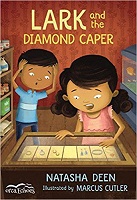
Why it belongs: Two young detectives use observation, teamwork, and reasoning to investigate missing diamond earrings.
Unique contribution: It closes with a multi-clue case suited to combining the set's evidence habits.
AskWhich chain of evidence makes one explanation stronger than every alternative?
Optional extensions
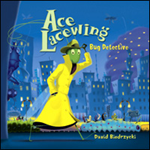
Ace Lacewing - Bug DetectiveBook ID 4128David Biedrzycki · Metadata confidence HIGHWhy optional: The insect detective offers genre variety and a strong clue trail, but the anthropomorphic setting adds another interpretive layer.
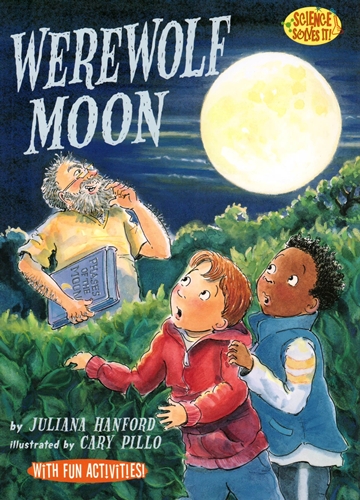
Werewolf MoonBook ID 4955Juliana Hanford · Metadata confidence HIGHWhy optional: Science corrects a werewolf theory through moon evidence; it is a valuable evidence-versus-assumption extension but also supports the protected Space set.
Across-the-set teaching moves
Record each clue before discussing what it might mean.
Generate at least two explanations for an ambiguous clue.
Mark evidence that rules a possibility out as well as evidence that supports one.
Notice red herrings and explain why they seemed convincing.
Require the final solution to account for the whole clue pattern, not only the last clue.
Book-to-book connections
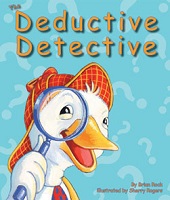
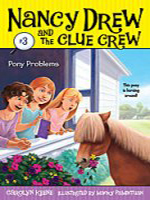
Deductive Detective + Nancy Drew and the Clue Crew #3: Pony Problems: Compare ruling suspects out with explaining a repeated pattern.
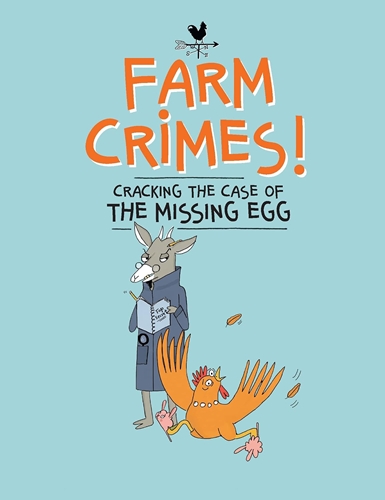
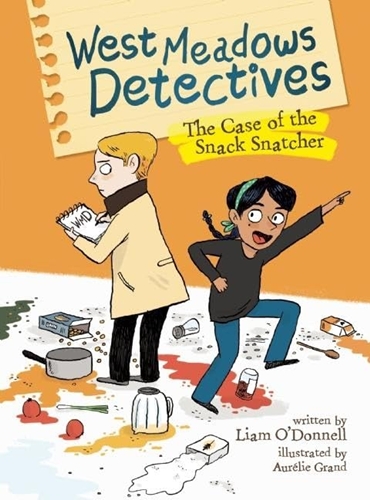
Farm Crimes! Cracking the Case of the Missing Egg + West Meadow Detectives #1 The Case of the Snack Snatcher: Compare physical clues with what characters say or assume.
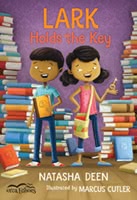
Lark Holds the Key + Lark and the Diamond Caper: Compare when teamwork and revision improve a theory.
Culminating discussion
Build the strongest explanation for one mystery, then use two other books to justify the evidence rules your explanation follows.
Teacher look-fors
Separates observation from possible meaning.
Considers a competing explanation.
Revises a theory when evidence changes.
Explains why a final solution accounts for more than one clue.
Existing-set duplication check
Closest existing Text Set: Graphic novels
What overlaps: Several mysteries use comics or strong visual evidence.
Why this set is genuinely different: The protected set compares word-image meaning; this set explicitly teaches evidence, competing explanations, and inference revision across formats.