A recurring character meets addition, money, time, place value, measurement, and problem solving in situations that give the math a reason to matter.
6 core booksGrades 1-2Catalogue reviewed
You are the teacher.
Use what works. Change what doesn’t. Make it yours.
Teaching purpose
Students follow Albert across different everyday situations and compare how the mathematical job changes while the recurring character stays familiar. The series is especially useful for showing that mathematics is not one subject with one kind of answer: sometimes Albert must count, combine, compare, schedule, trade, or represent a quantity differently.
Recommended grade band: Grades 1-2
The Big Question
How does the kind of problem tell Albert what mathematics to use?
Source and confidence boundary
Titles, book IDs, authors, and listed reading levels were checked against the updated TumbleBookLibrary Book_List.xlsx. Mathematical concept labels in this set were also checked against the existing TumbleTA math catalogue. Grade-band recommendations are instructional recommendations for the set, not catalogue claims about every individual title.
Standards status
This curated reading sequence is not itself a region-specific standards claim. Review the documentary status on any linked lesson plan.
Tell students to name the situation before naming the math. Keep a chart with three columns: What is happening? What does Albert need to find out? What mathematics helps?
Why it belongs: A beach-building situation turns container capacity and comparison into a problem with a physical purpose.
Unique contribution: It closes by moving from discrete objects to comparing how much different containers hold.
AskHow can Albert compare how much two containers hold?
Optional extensions
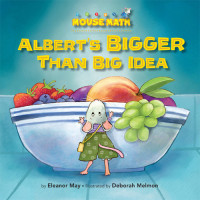
Albert's BIGGER Than Big IdeaBook ID 8469Eleanor May · Catalogue reviewedWhy optional: Useful for place-value and magnitude comparisons when students are ready to think about larger numbers.
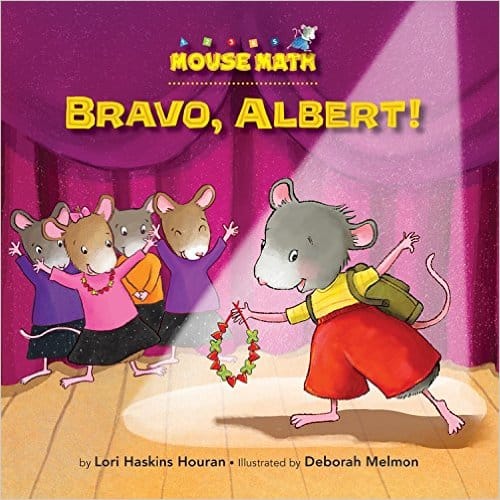
Bravo, Albert!Book ID 8478Lori Haskins Houran · Catalogue reviewedWhy optional: A series extension by another author; useful for discussing how a recurring character can continue while the writing voice changes.
Selection note: The core is limited to six titles so every book has a distinct job. The point of an author/series set is not to catalogue everything held; it is to make recurring craft, structure, or instructional design visible.
Across-the-set teaching moves
Name the real-world problem before naming an operation or concept.
Ask what quantity or relationship Albert needs to know.
Compare two books in which the same character needs completely different mathematics.
Use objects, sketches, calendars, coins, or number sentences to recreate the representation.
End each lesson by stating the answer in the language of Albert's problem, not just as a number.
Book-to-book connections
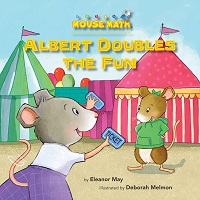
Albert Adds Up! + Albert Doubles the Fun: Compare general addition with the special structure of two equal groups.
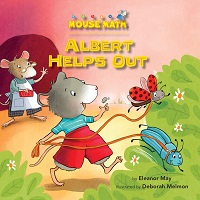
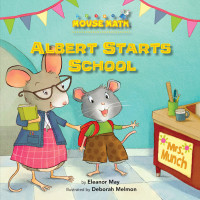
Albert Helps Out + Albert Starts School: Compare organizing value with organizing time.
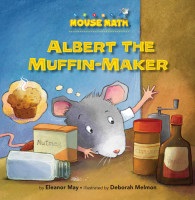
Albert the Muffin-Maker + A Beach for Albert: Compare grouping a countable quantity with comparing capacity by filling containers.
Culminating discussion
Choose three Albert books from different math domains. Explain how the situation tells Albert what information matters and what kind of mathematics will help.
Teacher look-fors
Names the situation before choosing the mathematics.
Identifies the quantity or relationship being studied.
Explains why a representation fits the problem.
Recognizes that a recurring character can encounter very different mathematical structures.
Existing-set duplication check
Closest existing Text Set: Stuart J. Murphy: Math in Everyday Problems
What overlaps: Both sets use recurring real-world situations to make mathematical need visible.
Why this set is genuinely different: The Murphy set compares one author's design across unrelated characters; this set follows one recurring character across several math domains, making continuity of character the bridge between concepts.