Patterns, clocks, counting, measurement, and data become visible through images and situations students can inspect.
6 core booksGrades 1-3Catalogue reviewed
You are the teacher.
Use what works. Change what doesn’t. Make it yours.
Teaching purpose
Students compare how Trudy Harris repeatedly turns abstract mathematical ideas into something visible: a pattern to extend, a clock sequence to follow, quantities to count, objects to measure, or marks to tally. The sequence moves across domains while keeping visual representation at the center.
Recommended grade band: Grades 1-3
The Big Question
How can a picture, pattern, or representation make mathematics easier to see?
Source and confidence boundary
Titles, book IDs, authors, and listed reading levels were checked against the updated TumbleBookLibrary Book_List.xlsx. Mathematical concept labels in this set were also checked against the existing TumbleTA math catalogue. Grade-band recommendations are instructional recommendations for the set, not catalogue claims about every individual title.
Standards status
This curated reading sequence is not itself a region-specific standards claim. Review the documentary status on any linked lesson plan.
Tell students to look for the representation before solving. Ask: What can I see here that the mathematics is using - a pattern, line, clock, coin, count, group, or tally?
Why it belongs: Tally marks turn repeated observations into organized data.
Unique contribution: It closes with representation as a memory tool: the marks preserve information so it can be compared later.
AskWhat can a tally show at a glance that would be hard to remember without recording?
Optional extensions
100 Days of SchoolBook ID 8449Trudy Harris · Catalogue reviewedWhy optional: A strong counting-and-grouping extension for cumulative quantities and place-value thinking.
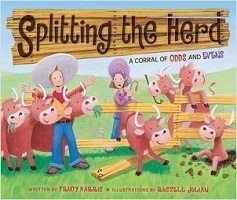
Splitting the HerdBook ID 8607Trudy Harris · Catalogue reviewedWhy optional: A more demanding extension for dividing a collection into groups and explaining how the groups were formed.
Selection note: The core is limited to six titles so every book has a distinct job. The point of an author/series set is not to catalogue everything held; it is to make recurring craft, structure, or instructional design visible.
Across-the-set teaching moves
Ask students to point to the representation before discussing the answer.
Name the unit being counted, repeated, measured, or tallied.
Translate one representation into another - picture to number sentence, clock to words, tally to count.
Compare two books that use different pictures to express similar mathematical structure.
Ask what information the representation makes easier to notice.
Book-to-book connections
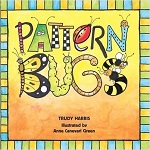
20 Hungry Piggies + Pattern Bugs: Compare counting each object with noticing a repeated unit.
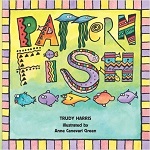
Pattern Fish + The Clock Struck One: Compare visual repetition with a representation that organizes time.
The Royal Treasure Measure + Tally Cat Keeps Track: Compare measurement data with recorded frequency data.
Culminating discussion
Choose three Trudy Harris books and explain what each representation makes visible that would be harder to see without it.
Teacher look-fors
Names the representation precisely.
Explains what information the representation preserves or reveals.
Transfers between two forms of representation.
Distinguishes the picture's decorative features from its mathematical structure.
Existing-set duplication check
Closest existing Text Set: Stuart J. Murphy: Math in Everyday Problems
What overlaps: Both author sets cross several elementary math domains.
Why this set is genuinely different: Murphy emphasizes the everyday problem that creates mathematical need; Harris is especially useful for studying how visual and symbolic representations make mathematical structure visible.